
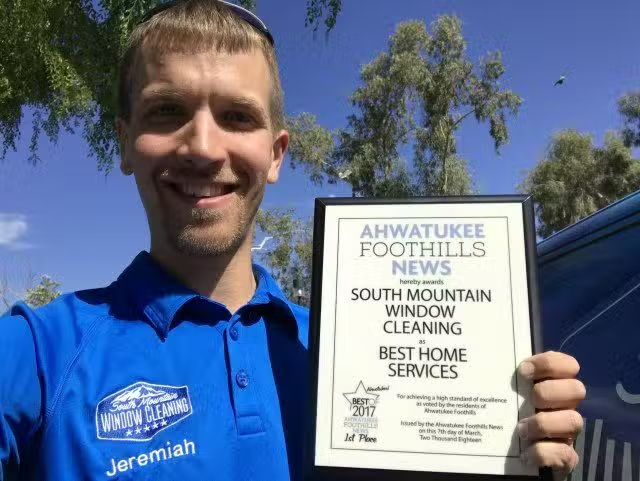
By the time a Phoenix property starts to look dirty, tenants have usually noticed it before the manager does. Dust settles on storefront glass, gum darkens walkways, dumpster pads start holding odor, and drive-thru lanes collect grease that won't rinse off with a hose. In Arizona, that buildup isn't cosmetic for long. It turns into a maintenance issue, a slip-risk issue, and a customer-perception issue.
That's where a commercial power washer trailer enters the conversation. Not as a gadget, and not as a hobbyist upgrade, but as the kind of mobile system serious exterior cleaning crews use when they need to clean efficiently across large sites without relying on whatever utilities happen to be available on-site.
For property managers, the bigger question usually isn't “What PSI should I buy?” It's whether ownership makes business sense at all. A trailer can solve real problems, but it also brings capital cost, storage, training, compliance, and liability. Hiring a professional crew can remove those burdens, but only if the vendor is equipped and managed at a commercial level.
The Professional's Tool for Arizona Curb Appeal
A retail center in Scottsdale doesn't get judged one surface at a time. Visitors see the whole property at once. They notice stained concrete near the entrance, dirty lower walls, runoff marks at service areas, and cloudy first-floor glass. Clean windows help, but if the surrounding hardscape looks neglected, the property still reads as neglected.
That's why exterior cleaning has become more equipment-driven and more specialized. The trailer-mounted side of the industry keeps growing because mobile commercial work demands capacity, consistency, and speed. The global trailer-mounted pressure washer market was valued at USD 1.47 billion in 2024 and is projected to reach USD 2.62 billion by 2033, growing at a CAGR of 5.9%. North America accounted for USD 540 million in 2024, reflecting strong use in industrial and commercial cleaning, according to Dataintelo's trailer-mounted pressure washer market report.
Why Arizona properties feel this faster
Phoenix, Tempe, Chandler, Gilbert, Paradise Valley, and Scottsdale all share the same practical issue. Fine dust doesn't stay in the parking lot. It moves onto glass, stucco, sidewalks, loading zones, and entry canopies. Once water hits those surfaces, the dust turns into visible staining.
A manager has two jobs at once:
- Protect appearance: Clean exteriors support leasing, tenant satisfaction, and customer confidence.
- Protect operations: Dirty concrete, greasy service areas, and neglected waste enclosures create avoidable problems that maintenance teams end up chasing repeatedly.
Practical rule: If a property needs recurring hard-surface cleaning across multiple zones, the real decision isn't whether the work matters. It's who should own the system behind it.
The trailer is the operating backbone
A commercial power washer trailer is the core asset behind many professional exterior cleaning services because it brings water supply, pressure, flow, hose management, and often heat to the job site in one road-ready package. That changes how work gets scheduled and completed. Crews spend less time improvising around site limitations and more time cleaning.
For a property manager, understanding that tool helps with vendor evaluation and budget planning. It also keeps you from comparing a commercial crew to a maintenance employee using a consumer washer that was never built for drive-thrus, dumpster pads, storefront walkways, or large building exteriors.
What Makes a Power Washer Trailer Commercial Grade
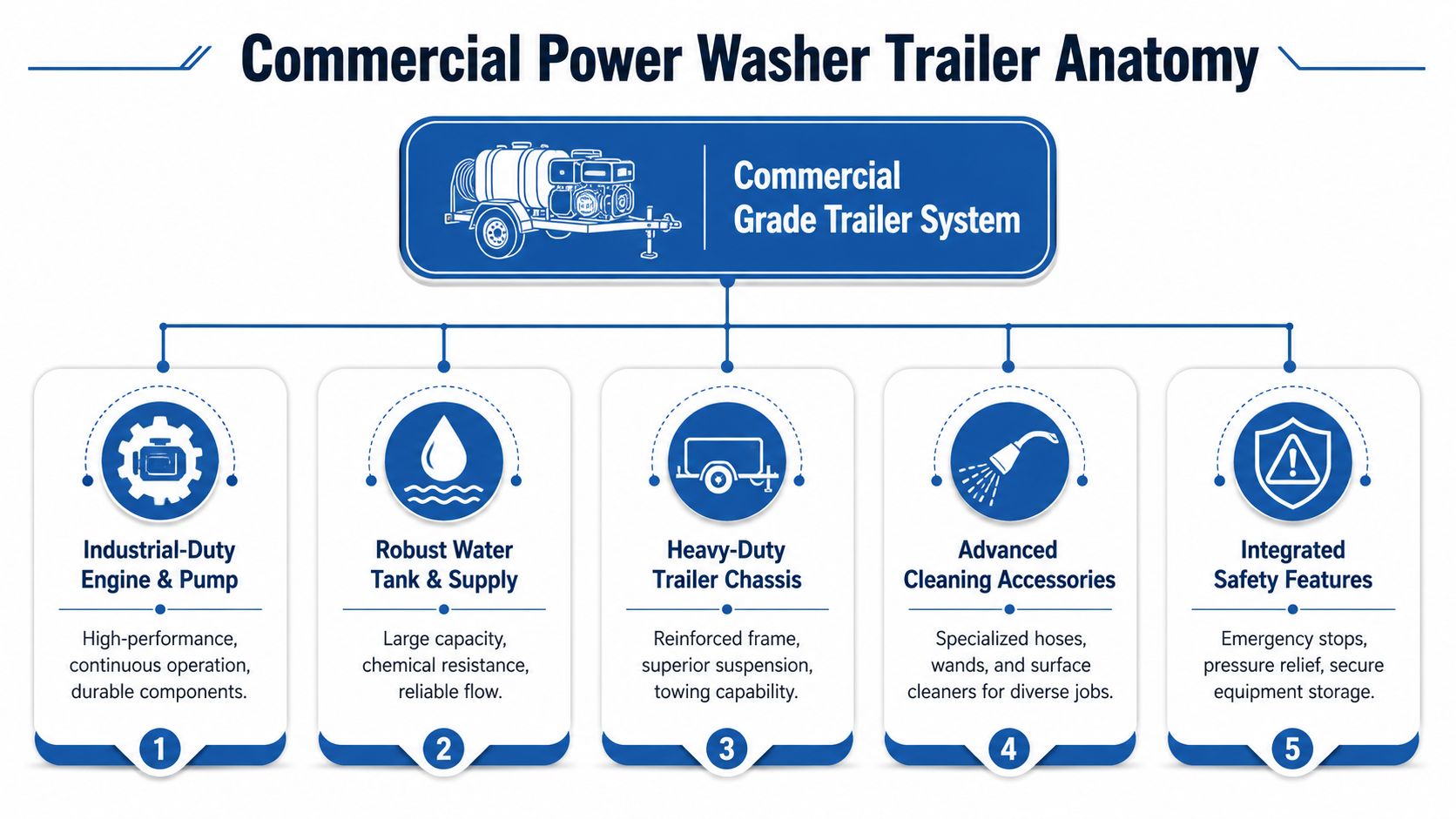
A true commercial trailer is best thought of as a mobile cleaning command center. It's not a box-store machine strapped to a utility trailer. It's a complete field setup built for repeated use, faster deployment, and the kind of cleaning loads commercial sites create.
A visual breakdown helps.
The core parts that matter on real jobs
The first thing to look at is the engine and pump. Commercial work needs a system that can run through long service windows without overheating, surging, or losing output. If the machine can't stay consistent, the crew slows down, rinse quality drops, and the job starts taking longer than the schedule allows.
Then there's the water tank. On commercial properties, mobility is a big deal. A trailer that carries its own water gives a crew options when hose bib access is inconvenient, restricted, or too far from the work area. The same goes for chemical delivery and hose reels. If hoses are always tangled, leaking, or dragged through customer traffic, that's not a small annoyance. It's lost time and added risk.
The hot water burner is another dividing line between light-duty washing and serious commercial cleaning. Cold water can remove loose dust. Heat helps break down grease, food residue, and buildup that tends to collect in restaurant lanes, trash areas, and service corridors.
PSI matters, but GPM often matters more
People fixate on PSI because it sounds like power. In the field, flow rate often tells you more about productivity. High pressure helps cut through bonded soil, but higher flow moves debris away faster, rinses larger areas better, and shortens dwell time between passes.
Commercial power washing trailers used in high-volume operations typically generate 3,500 to 4,000 PSI at 4 to 5 gallons per minute, which is why they're effective for drive-thrus, dumpster pads, and dusty building exteriors in Arizona, as described by South Mountain Window Cleaning.
A machine that sprays hard but rinses slowly can still waste labor.
What separates commercial gear from a homeowner setup
A commercial-grade trailer usually includes:
- Road-ready trailer hardware: Brakes, lights, and a chassis that can handle the load instead of flexing under tank weight.
- Heavy hose capacity: Enough hose and reel quality to work around islands, sidewalks, and building fronts without constant repositioning.
- Better task coverage: Wands, nozzles, and surface tools that let the operator switch from open concrete to tighter detail areas.
- Safer field use: Pressure relief, organized storage, and a layout that reduces trip hazards.
If you're comparing cleaning systems for specialized work, a resource on choosing a detailing pressure washer is useful because it shows how tool selection changes with surface sensitivity, access, and finish requirements. Commercial property cleaning works the same way. The right machine isn't the one with the loudest spec sheet. It's the one matched to the job mix.
For a closer look at the kinds of tools and accessories crews rely on in the field, review these commercial power washing supplies.
Common Commercial Applications in the Phoenix Area
What a trailer can do becomes clearer when you look at the jobs that show up on Arizona commercial properties. Most managers aren't trying to clean abstract surfaces. They're dealing with recurring problem zones that affect traffic, safety, and appearance.
Restaurant lanes and waste areas
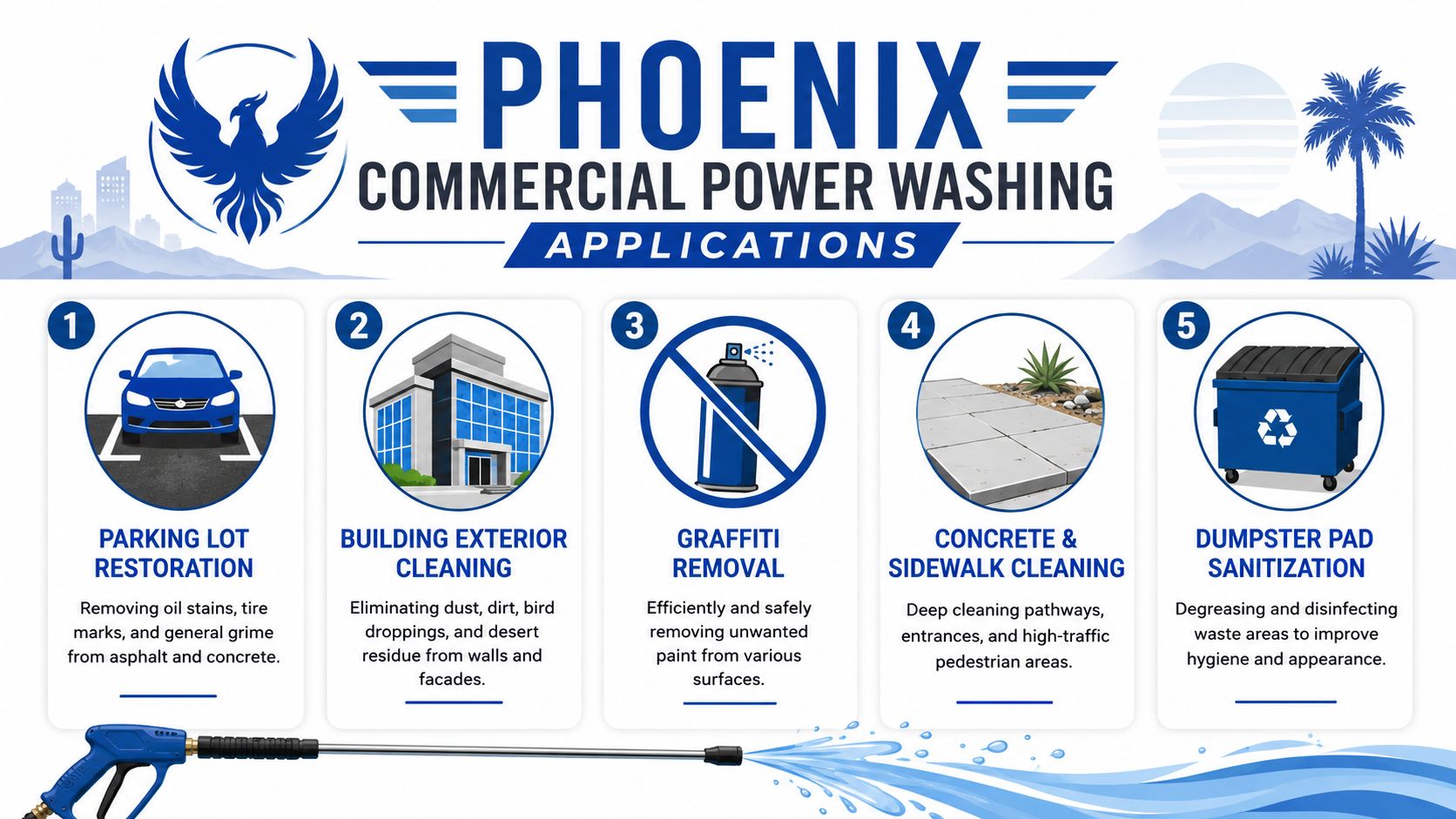
Drive-thrus and dumpster pads are some of the least forgiving surfaces on any commercial site. Grease, beverage residue, food waste, and tracked-in grime build layers that regular janitorial work can't address. When crews have hot water, steady flow, and enough hose to reach around the building without relocating constantly, these areas get cleaned properly instead of just wetted down.
The business impact is obvious. Cleaner waste areas support sanitation, reduce odor complaints, and help a property look managed rather than reactive.
Storefront approaches and pedestrian concrete
Retail and office properties live or die on first impressions. Lower walls, entry walks, curbs, and concrete aprons collect a surprising amount of discoloration in Phoenix-area conditions. Once those surfaces dull out, the glass above them can still be spotless and the property will look tired.
For managers building preventive maintenance routines, a checklist for property managers is a useful companion because exterior washing works best when it's treated as part of a broader site-care program rather than an emergency response.
Clean concrete changes how people read the whole property. It signals oversight.
Building exteriors, service corridors, and prep work
Dust, bird droppings, splashback near irrigation zones, and residue at ground level all make lower elevations look older than they are. Trailer systems help crews move across long facades, breezeways, loading areas, and service paths without depending on a separate water setup at each stop.
These cleanings also matter before other trades arrive. Painters, coating contractors, and maintenance teams work better when the surface has been cleaned correctly first. The same goes for graffiti removal and flat-surface restoration, where the trailer's mobility saves time over dragging a smaller machine across a wide site.
For broader examples of site-specific exterior cleaning, see this overview of pressure washing for commercial buildings.
High-rise support and solar environments
In Phoenix and surrounding cities, high-rise and mixed-use properties often need more than glass care. Ground-level hardscape, amenity decks, loading areas, and adjacent service surfaces still need regular washing to keep the full property presentation consistent.
Solar installations create a similar issue. Dust accumulation affects appearance and maintenance expectations around the system. The cleaning method has to match the surface, the mounting layout, and water-control requirements. It's one more example of why property managers benefit when the crew understands more than just “turn the machine on and spray.”
The Big Decision Owning vs Contracting a Service
A Phoenix property manager usually reaches this decision after a familiar problem. The site needs regular washing. Complaints are coming in about stained entries, dirty dumpster pads, or gum and spill buildup near tenant-facing walkways. Then the question comes up: should we buy a trailer and handle this ourselves, or hire a company that already runs this equipment every day?
That decision is less about horsepower and tank size than about utilization, labor, and liability. If exterior cleaning is not a true in-house operation, trailer ownership often turns into another asset to store, maintain, insure, and supervise.
What ownership actually requires
Buying the trailer is the easy part. Keeping it productive is harder.
A commercial rig needs secure parking, routine maintenance, fuel management, hose and fitting replacement, pump service, and someone accountable for inspections before it ever leaves the yard. It also needs a vehicle that can tow it safely and staff who know how to clean a live commercial property without damaging surfaces or creating a slip hazard. On paper, ownership can look efficient. In practice, many properties do not generate enough steady work to keep the trailer busy enough to justify the cost.
That idle time matters. A machine that runs every week across a large portfolio can earn its keep. A machine that comes out once in a while usually becomes expensive backup equipment.
The labor question is usually the deciding factor
Operating a trailer is skilled field work, not a side task for maintenance staff between work orders. The operator has to judge pressure, heat, runoff, dwell time, traffic control, and which surfaces should not be cleaned aggressively at all. Mistakes get expensive fast. Coatings can be stripped. Water can be pushed into door thresholds and electrical areas. Pedestrian access can be disrupted at the wrong time of day.
For Arizona managers, summer staffing adds another trade-off. The work is physically demanding, often done in heat, and usually needs to happen during low-traffic hours. That is difficult to build into an internal maintenance team unless cleaning is a planned part of the operation, not an occasional add-on.
What contracting changes
Contracting a service shifts the job from asset ownership to result management. You are paying for completed cleaning, trained technicians, proper equipment, scheduling, and field experience. That is usually the cleaner business decision for office parks, retail centers, HOAs, medical properties, and mixed-use sites that need reliable appearance standards without building an in-house wash crew.
It also makes budgeting clearer. A service contract turns a sporadic equipment and labor problem into a planned operating expense. Managers comparing service intervals and site conditions can use this guide to commercial pressure washing cost to frame what pricing usually reflects on an active property.
Owning a trailer vs contracting a professional service
| Factor | Owning Equipment | Contracting a Service (e.g., South Mountain) |
|---|---|---|
| Upfront spend | Significant capital purchase | No equipment purchase |
| Storage | Requires secure space for trailer and gear | Vendor handles storage |
| Maintenance | Owner manages engine, pump, burner, trailer, hoses | Vendor handles upkeep |
| Staffing | Requires trained operators and towing capability | Vendor provides technicians |
| Scheduling | In-house team controls timing, if staff and equipment are available | Service visits are scheduled around property needs |
| Liability | Owner carries operational risk during use | Risk is shifted to the service provider, subject to contract and insurance |
| Compliance | Owner must manage equipment, site safety, and runoff practices | Professional vendor should manage field procedures |
| Utilization risk | Idle equipment still costs money | You pay for completed service |
Ownership makes sense when a company has enough recurring work, trained staff, secure storage, and a clear reason to keep cleaning in-house. Contracting makes more sense when the property needs dependable results and management wants to control cost, reduce risk, and avoid running a trailer-based cleaning operation as a side business.
Safety Permitting and Environmental Compliance
A commercial power washer trailer can clean quickly, but it can also create problems quickly if the operator treats it like a simple rinse tool. High-pressure water cuts skin, throws debris, damages soft materials, and turns open pedestrian areas into active work zones. Add hot water and detergents, and the risk goes up.
What safe operation looks like on a live property
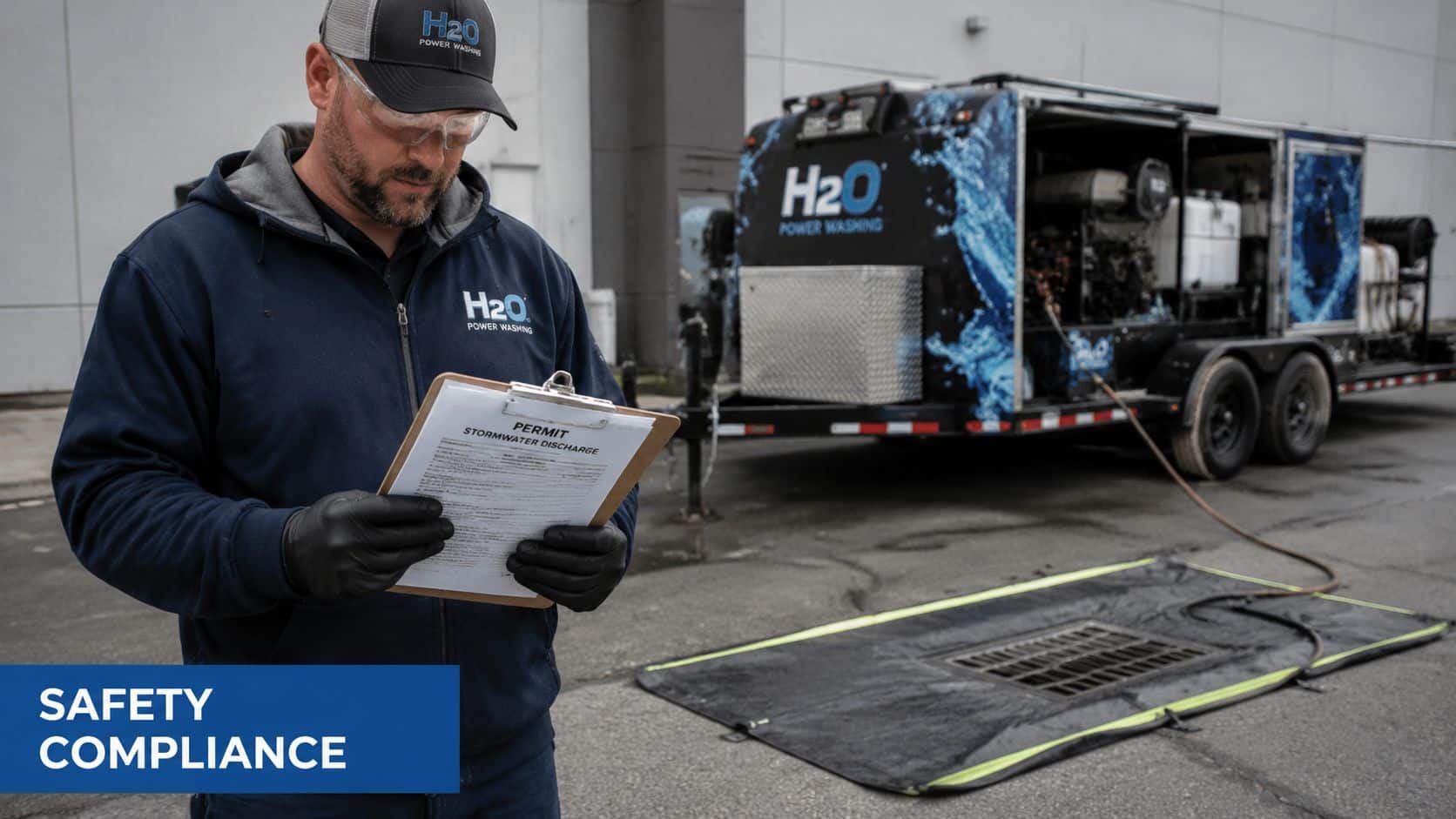
On a commercial site, safety starts before the trigger gets pulled. Crews need controlled hose runs, visible work boundaries, proper footwear, eye protection, and a plan for customer traffic. Entry points, ADA routes, and loading zones need active management while cleaning is underway.
The other side of safety is surface judgment. Not every material tolerates the same pressure, nozzle selection, standoff distance, or heat. Painted surfaces, sealers, soft stone, older concrete, and caulking lines can all be damaged by an operator who only knows the machine and not the substrate.
Runoff and local expectations
Environmental compliance matters just as much. In the Phoenix area, property managers should assume that runoff control is part of professional exterior cleaning, especially where grease, detergents, or heavy soil are involved. Water moving into storm drains can create regulatory issues that outlast the cleaning itself.
A credible vendor plans for containment, collection when needed, and detergent choices that fit the site. That's especially important at restaurant pads, parking areas, service corridors, and any location where wash water can carry contaminants off the immediate work area.
Water control is part of the job, not an optional add-on.
Why this pushes many managers toward professional service
Ownership can look appealing until safety and compliance become daily operating responsibilities. Then the question changes from “Can we clean this ourselves?” to “Do we want to supervise a field operation with public exposure, equipment hazards, and runoff accountability?”
That's why many managers prefer a vendor that already has procedures for staging, signage, technician training, and site protection. It simplifies oversight and reduces the chance that a routine cleaning turns into a claim, complaint, or damaged surface.
Choosing a Power Washing Vendor A Checklist for Managers
A bad vendor choice usually looks fine on bid day. The problems show up later, when a crew misses a grease line at the restaurant pad, leaves runoff questions for your team to answer, or ties up your loading area longer than promised.
That is why vendor screening matters more than price alone. For Arizona property managers, the primary question is simple. Are you hiring a contractor that can protect the property, the schedule, and your staff time, or are you hiring someone with a machine and a low number on a proposal?
The questions worth asking
Start with proof, not promises.
- Insurance: Ask for current certificates and check that the coverage fits active commercial work.
- Commercial experience: Ask what types of properties they clean every week. Retail centers, medical offices, industrial sites, HOA common areas, and restaurant pads all create different access and cleaning challenges.
- Equipment match: Ask what system they bring for flatwork, building fronts, gum removal, or greasy service areas. A serious vendor can explain why their setup fits your site instead of giving a generic “high pressure” answer.
- Crew procedures: Ask who supervises the job, how they handle restricted access areas, and what happens if tenants or customers are on site during service.
- Scope control: Ask what is included, what is excluded, and what surfaces need a lower-pressure or specialty approach.
A professional answer is usually specific. Vague answers usually mean more oversight for your team.
Signs the vendor understands property operations
The best contractors do not treat power washing as an isolated task. They understand traffic flow, tenant hours, surface sensitivity, and how one service affects another. That shows up in better scheduling, fewer callbacks, and less disruption to the property.
If your site includes solar assets, this guide on hiring a solar panel cleaning company is a useful comparison because it highlights the same issue property managers face with pressure washing. Specialized surfaces need the right method, not just available equipment.
A qualified vendor talks about scope, access, protection, and cleanup before discussing production speed.
A short manager's checklist
| Checkpoint | What you want to hear |
|---|---|
| Insurance | Current documentation and coverage suited to commercial work |
| Site understanding | Clear notes on surfaces, access, water use, and exclusions |
| Equipment | Commercial-grade systems matched to the job type |
| Operations plan | Arrival window, crew lead, staging, and area control |
| Surface protection | A clear method for delicate finishes and problem areas |
| Communication | Fast updates, written proposals, and dependable scheduling |
For managers comparing vendors against broader upkeep goals, this overview of commercial property maintenance services for Arizona properties helps put pressure washing in the right context. It is one part of site presentation, not a standalone purchase decision.
Your Partner in Phoenix Property Maintenance
A commercial power washer trailer is an impressive tool when it's matched to the right operator and the right business model. It brings mobility, cleaning power, and efficiency to jobs that would overwhelm smaller equipment. But the machine itself isn't the whole decision.
For most commercial property managers, ownership creates more responsibility than advantage. You're not just buying cleaning capacity. You're taking on storage, upkeep, operator training, scheduling, safety exposure, and compliance oversight. Contracting a qualified service is usually the cleaner business decision because it keeps your team focused on the property, not on running a trailer-based cleaning operation.
In the Phoenix area, that matters even more. Dust, heat, traffic, and constant public visibility put exterior surfaces under pressure year-round. Properties in Phoenix, Scottsdale, Paradise Valley, Chandler, Tempe, and Gilbert need consistent care, not occasional rescue work.
If you need a reliable exterior cleaning partner, South Mountain Window Cleaning, LLC provides residential, commercial, and high rise window washing services across Phoenix, Scottsdale, Paradise Valley, Chandler, Tempe, and Gilbert, Arizona. The team also handles power washing for walkways, drive-thrus, dumpster pads, and building exteriors, making it easier to keep the whole property looking sharp. Reach out for a fast, free, no-obligation quote and get a service plan that fits your site, schedule, and standards.