
Your windows probably looked fine a month ago. Then Charlotte did what Charlotte does. Pollen settled into the corners, a summer shower dried into spots, and the glass that once pulled in daylight now looks dull by midafternoon.
That’s usually the point when homeowners start wiping a pane or two with paper towels, and property managers start fielding comments about curb appeal. The problem isn’t just dirt. In Charlotte, window glass takes a steady hit from pollen, humidity, rain residue, and mineral spotting, so the right cleaning approach matters as much as the timing.
Professional charlotte window cleaning isn’t one single service. A ground-floor storefront, a historic home with divided panes, and a multi-story office building all need different tools, different workflow, and very different safety planning. The biggest mistakes I see are hiring by the lowest price alone, using the wrong method for the building, and treating every property as if it should be cleaned on the same schedule.
Beyond the Pollen A Clear View for Your Charlotte Property
You clean the front windows on Saturday, get one clear day, and by Monday the glass already looks hazy again. In Charlotte, that usually means pollen stuck to damp surfaces, rain drying over residue, or sprinkler overspray leaving mineral spots on the lower panes. The glass is dirty, but the bigger issue is what was left behind before the last rinse.
Charlotte window cleaning works best as routine property care, not an occasional touch-up. Clean windows improve natural light, curb appeal, and first impressions, but they also make it easier to spot clogged tracks, screen buildup, failing seals, and oxidation around frames before those problems get worse. Homeowners notice the difference in brighter rooms. Property managers notice it in fewer tenant complaints and a cleaner-looking building from the parking lot.
Local conditions change the job. Spring pollen clings fast, summer humidity helps grime bond to the glass, and hard water spotting is common anywhere irrigation hits the same windows week after week. A quick spray-and-wipe may remove loose dirt, but it often leaves residue that shows up again as soon as the sun hits the pane.
Good service also means knowing what is included before the crew arrives. A useful breakdown of what professional window cleaning services typically include helps set expectations on glass, screens, tracks, and detail work.
For a house, the goal is usually cleaner views and less upkeep between visits. For a commercial property, the standard is higher. The crew needs to show up on schedule, work around customer traffic, protect landscaping and entryways, and use the right access method for the building. On taller properties, safety planning, insurance, and documented procedures matter just as much as the final finish.
One more point gets missed all the time. If windows look worse right after a rain, the rain usually exposed existing pollen, dust, soap residue, or mineral deposits already on the glass. Proper cleaning removes that film so the next storm does less cosmetic damage.
Decoding Window Cleaning Services in Charlotte
A homeowner in Myers Park, a retail manager in South End, and a property manager for an Uptown tower can all ask for “window cleaning” and need three very different scopes of work. The glass may be the common denominator, but access, scheduling, safety requirements, and the kind of buildup on the windows change the service.

Residential service for homes condos and townhouses
Residential jobs usually look simple from the driveway. Once the crew starts, the details show up fast. Screens hold pollen, tracks collect damp debris, and second-story windows often need more than a basic extension pole if you want a clean edge and consistent finish.
Older Charlotte homes add another layer. Divided panes take longer. Aging wood frames need a lighter touch. Tight planting beds and sloped ground can limit ladder placement, which affects both method and labor time. Newer homes often have larger panes and better access, but irrigation overspray can leave hard water spotting that needs restoration work rather than a standard wash.
A solid residential visit usually covers more than the glass itself. Homeowners should confirm whether the scope includes interior and exterior panes, screen cleaning, track and sill detailing, and any add-on work such as post-construction cleanup. For a plain-language reference, this breakdown of what professional window cleaning services include helps clarify what should be on the work order before the crew arrives.
Commercial service for storefronts and low-rise buildings
Commercial service is maintenance-driven. Storefront glass gets fingerprints, splash marks, tape residue, and traffic film near eye level. Restaurants pick up grease haze around entrances. Medical and office properties usually need a cleaner, more uniform appearance on a set schedule, even if the glass is not heavily soiled.
The best plan is not always the most intensive one. Weekly or biweekly storefront service often produces a better result than waiting until the glass looks bad and then trying to recover it in one visit. Property managers also need a crew that can work around opening hours, customer flow, locked access points, and sidewalk safety without slowing down the business.
Charlotte conditions matter here too. Pollen season can make lower glass and entry doors look dirty again within days, and sprinkler systems around storefront landscaping often leave mineral spotting on the same panels over and over. A good commercial provider accounts for that and recommends a maintenance cycle that fits the property instead of selling the same schedule to every site.
High-rise service for Charlotte’s taller properties
High-rise window cleaning is a separate category with separate risk. Once a building requires rope descent, suspended platforms, roof anchors, or controlled drop zones, the conversation shifts from appearance alone to engineering, documentation, and liability control.
Property managers should ask direct questions before approving a bid:
- What access method is planned for this building
- Is the crew trained for suspended or rope-based work
- What insurance documentation can the contractor provide
- How are sidewalks, entries, and loading areas being protected below
- How will weather delays and tenant coordination be handled
This work rewards planning. Uptown buildings can face wind exposure between towers, restricted access windows, and strict operating rules from building ownership. The cheapest bid can become the most expensive one if the contractor lacks the right coverage, cannot meet the building’s safety requirements, or has to stop mid-project because access was not properly coordinated.
Clean glass matters. On taller properties, safe execution and complete paperwork matter just as much.
Understanding Charlotte Window Cleaning Prices
A quote in Charlotte can swing more than homeowners expect. Two houses with the same square footage can price very differently if one has large picture windows and the other has divided panes, steep roof lines, or landscaping that forces ladder repositioning on every side.
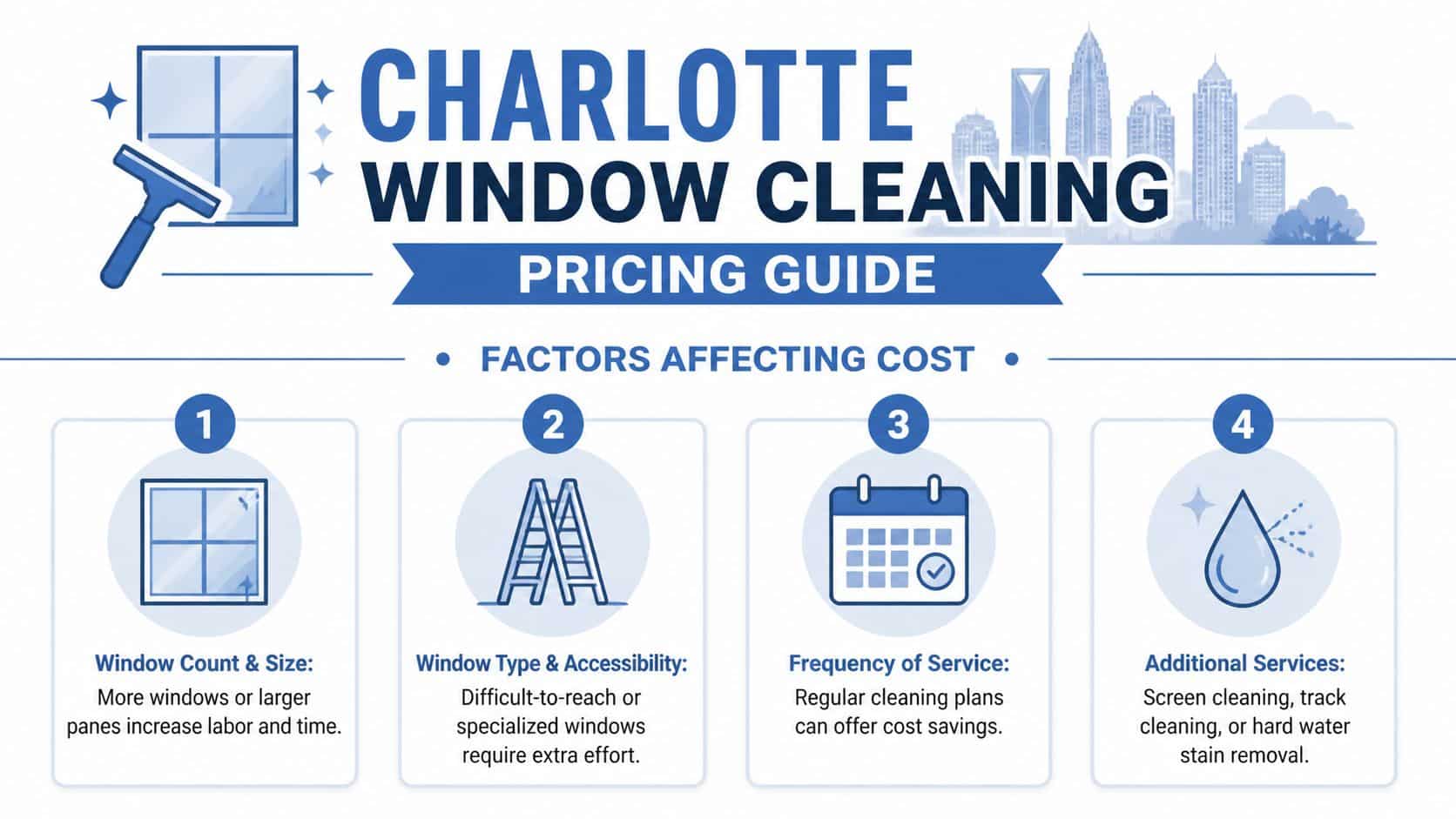
The fastest way to get an accurate number is to look past window count alone. I price by labor, access, and condition first, then by quantity. That matters in Charlotte because spring pollen sticks to glass and frames, and irrigation systems around homes, retail pads, and office entries often leave hard water spotting that takes extra scrubbing or restoration work.
What changes the quote
Straightforward homes with wide access and standard panes are quicker. Older homes in neighborhoods like Myers Park often have cut-ups, storm windows, or delicate screens that slow the job down. Condos can look simple on paper but take longer if parking, elevator access, or HOA entry rules add time.
These are the factors that usually move pricing:
- Pane style and total glass area: A single large pane is faster than several divided panes with muntins and detailed edges.
- Access difficulty: Second- and third-story windows, steep grades, dense shrubs, and tight side yards all add labor.
- Interior and exterior scope: Exterior-only work is less involved than full service, especially if interior access requires furniture protection or tenant coordination.
- Glass condition: Pollen film, oxidation on frames, paint specks, and mineral deposits from sprinklers or hose overspray can turn a routine cleaning into a more labor-heavy visit.
- Add-on services: Screens, tracks, mirrors, skylights, and post-construction cleanup are often priced separately.
Low bids usually assume easy access, standard glass, and light soil. If the property has stubborn spotting or awkward access, the final invoice can change unless the quote was detailed from the start.
Price ranges that are actually useful
For many Charlotte homes, a basic residential job falls somewhere in the low hundreds, with smaller exterior-only visits coming in lower and larger full-service homes climbing from there. Commercial storefront work is often priced per pane or by recurring route, while larger low-rise properties are usually quoted by scope, access, and service frequency.
High-rise work sits in its own pricing category. The cost reflects planning time, access method, crew qualifications, and site controls as much as the glass itself. Property managers comparing tower bids should treat price as only one line item. Scope clarity, insurance documentation, and access planning carry real cost.
A practical benchmark helps. Smaller homes with standard windows and clear access usually price far below large homes with French panes, transoms, and heavy ladder work. If you want a broader baseline before requesting estimates, this average window cleaning cost guide gives a helpful frame of reference.
Sample Window Cleaning Costs in Charlotte 2026 Estimates
| Service Type | Typical Price Range | Notes |
|---|---|---|
| Residential average job | $150 to $300 | Typical Charlotte residential range for full service jobs |
| Residential 10 to 15 windows | $110 to $160 | Smaller homes or limited-scope visits |
| Residential 35+ windows | $275 to $400+ | Larger homes with more labor and time |
| Interior-only residential | $100 to $180 | Exterior glass not included |
| Storefront commercial | $2 to $4 per window | Often tied to recurring service routes |
| Low-rise commercial exterior-only | $7.60 to $9.30 per pane | Excludes interior cleaning and extra surfaces |
| High-rise properties | $5 to $11+ per window | Premium pricing due to specialized access and safety needs |
Use sample ranges carefully. They help with budgeting, but they do not replace a site-specific quote.
The best comparison is line by line. Check whether the bid includes screens, tracks, ladder work, hard water treatment, and interior glass. Charlotte properties near construction corridors or under heavy tree cover often need more than a quick wash, and that difference should be spelled out before work starts. For another outside perspective on what separates a basic wash from a more detailed service, this expert window cleaning guide is a useful reference.
Pro Methods and Equipment for a Streak-Free Finish
A lot of disappointing window cleaning results come from using the wrong method, not from a lack of effort. In Charlotte, that matters because the local mix of pollen, rain residue, and moderate water hardness can leave glass looking worse after a rushed cleaning than it did before.

Traditional squeegee work still matters
Professional squeegee cleaning is still the standard for detailed hand work. It’s precise, especially on interior glass, storefront glass, and residential windows with edges, corners, and frames that need close attention. The difference between amateur and professional work usually shows up in the last few inches of the pane, where drips, edge lines, and lint tend to remain.
The process is straightforward when done properly. Soap solution loosens grime, a scrubber lifts buildup, and a well-controlled squeegee pass removes the water cleanly. Dry detailing cloths finish the edges and catch anything left in the corners.
That classic method works well for many properties. It just isn’t the best answer for every exterior.
Why pure-water systems work so well in Charlotte
Charlotte’s moderately hard water is one reason homeowners struggle with spot-free results. Professional pure-water systems use deionization to reduce Total Dissolved Solids to under 10 ppm, which is a big reason they perform so well on exterior glass in this market. That level of purification helps prevent mineral spotting from local water and can boost light transmission by 10 to 15 percent for commercial spaces, according to this Charlotte pure-water explanation.
Think of deionized water like a clean magnet. Ordinary tap water leaves minerals behind when it dries. Pure water has those dissolved solids stripped out, so it grabs dirt and dries without the same spotting residue.
This is especially useful on:
- Upper-story residential exteriors
- Large commercial glass runs
- Properties with repeated hard water spotting
- Buildings where ladder reduction improves safety and efficiency
For readers who want a broader outside perspective on tools and process, this expert window cleaning guide gives a solid overview of what separates professional methods from casual cleaning.
Soap microfiber and water-fed poles
Not every job calls for the same chemistry or tool choice. Some crews use biodegradable soap with microfiber applicators for detailed hand cleaning. That approach can be especially effective on interior glass and on exteriors where precise agitation matters more than reach.
A typical professional sequence looks like this:
- Loosen the soil first: Dust, pollen film, and oily residue need to be broken up before the finish pass.
- Choose the right removal method: Squeegee work for close-detail panes, pure-water poles for broader exterior runs.
- Dry or rinse correctly: Spot-free results depend on what’s left behind, not just what’s taken off.
Later in the process, it helps to see the technique in motion:
The tools matter, but the judgment matters more. A seasoned technician knows when hand detailing beats a pole, when mineral residue needs extra attention, and when eco-friendly products are the better choice around landscaping and entryways. If you’re curious about the standard toolkit, this guide to what professional window cleaners use covers the basics well.
Safety Licensing and Insurance Your Shield Against Liability
A crew is on the glass at a South End mid-rise, pedestrians are moving below, and one dropped tool can turn a routine service call into a property claim. That is why safety paperwork is not office fluff. It is part of the job, especially on commercial buildings and any property with difficult access.

What property owners should verify first
Start with current proof of coverage. Ask for the certificate of insurance, confirm general liability is active, and verify workers' compensation if technicians will be on ladders, roofs, or lift equipment. For managers of offices, condos, and mixed-use buildings, I also recommend asking who supervises the job on site and who approves the access plan before work starts.
Charlotte property owners often focus on price first. On upper-floor or high-traffic properties, the bigger question is exposure. If a vendor cannot explain how they protect the glass, the façade, and the public area below, the bid is incomplete.
Use a short screening list:
- Insurance certificate: Check that the policy is current and appropriate for the property type.
- Workers' compensation: Confirm the crew is covered while working on site.
- Safety training: Ask whether technicians are trained for ladder work, lift work, roof access, or suspended access, depending on the building.
- Job-specific access plan: Get clear details on ladders, aerial lifts, roof anchors, swing stages, or other approved systems.
- Damage procedures: Ask what happens if screens, seals, landscaping, or walkway areas are affected during service.
Why high-rise work needs a different standard
High-rise window cleaning is access work first and cleaning work second. The glass may be straightforward. Reaching it safely is the main operation.
On taller Charlotte buildings, crews may need roof anchors, suspended platforms, controlled descent systems, lift coordination, barricades at ground level, and written procedures that match OSHA rules. A contractor who prices that job like a large house usually has not accounted for the actual risk, labor setup, or equipment requirements. That is also where insurance limits and worker classification matter more.
Charlotte adds a local wrinkle here. Pollen film and hard water spotting can make glass look simple from the ground while hiding extra detail work up close. On a high-rise, that can tempt an underqualified crew to rush the cleaning phase to make up time lost on setup. Good companies do the opposite. They plan more carefully, protect more thoroughly, and clean at a pace that fits the access method.
The liability problem owners notice too late
The cheap bid usually looks fine before the job starts. Problems show up after an injury, a scratched panel, water intrusion around a weak seal, or a falling tool near an entryway.
At that point, the questions get specific fast. Was the crew insured? Were they employees or uninsured subs? Did the company have the right coverage for the work they agreed to perform? If you want a plain-language breakdown, this bonded versus insured guide for property owners explains the difference clearly.
For a one-story home, weak documentation is still a risk. For commercial and multi-story properties, it is a management problem waiting to happen. A professional window cleaning proposal should show safe access, active coverage, and a crew that knows how to work the building without creating a second problem while solving the first.
Local Considerations When to Schedule Your Window Cleaning
A Charlotte homeowner can have the glass cleaned on Monday, get a yellow dusting by Wednesday, then call on Friday wondering what went wrong. Usually, nothing went wrong with the cleaning. The timing was off for local conditions.
Charlotte windows take a beating from tree pollen, summer storms, humidity, and irrigation overspray. Schedule too early in spring and fresh pollen coats the glass again before you get much value from the service. Wait through a long hot stretch and residue can dry harder onto the surface, especially on west-facing windows and panels that catch sprinkler mist.
The Charlotte pattern that affects clean glass
The biggest scheduling mistake I see is booking during the peak pollen push instead of just after it. On many properties, the better play is to let the heaviest yellow film pass, then clean once the glass can stay clear for a reasonable stretch.
Hard water changes that decision too. In Charlotte, spotting often comes from irrigation, runoff, and mineral residue left behind after rain dries on already dirty glass. That is why two homes on the same street can need different schedules. A shaded brick home under trees usually deals with pollen, sap, and organic buildup. An open property with sprinklers hitting the front elevation often has more spotting and mineral detail work.
A practical schedule for different property types
The right frequency depends less on a generic calendar and more on what surrounds the building and how clean the glass needs to look day to day.
- Twice a year works for many homes, condos, and small offices with moderate exposure.
- Three to four times a year fits properties under heavy tree canopy, near busy roads, or close to active construction.
- Monthly or biweekly service is common for storefront glass that shapes first impressions every day.
- Custom scheduling makes more sense for multi-story and high-rise properties, where access planning, tenant visibility, and weather windows affect timing as much as soil level.
For property managers, I recommend tracking problem elevations instead of treating the whole building the same. The lobby glass may need frequent attention, while upper floors on a protected side can go longer without losing appearance.
Best seasons for the cleanest result
Late spring is often the first strong exterior cleaning window because it comes after the worst pollen buildup. Fall is another smart time to schedule service. The weather is usually steadier, summer grime is ready to come off, and the glass stays presentable heading into holiday traffic, events, and year-end walkthroughs.
Summer still has its place, especially for commercial properties that cannot wait for ideal conditions. The trade-off is faster resoiling from storms, heat, and mineral spotting. Winter can work for many exterior jobs too, but shorter days and temperature swings sometimes limit interior work or extend drying time around frames and edges.
A simple Charlotte schedule works like this. Homes often benefit from one cleaning after pollen season and one in fall. Retail locations usually need recurring service. Larger properties should set the schedule around exposure, irrigation, and appearance standards, then adjust after seeing which areas soil up first.
Your Pre-Service Checklist DIY vs Pro and What to Expect
DIY window cleaning has its place. Ground-floor glass, a small condo, or a quick touch-up before guests can be manageable if you have the right tools and enough patience. The trouble starts when homeowners expect household spray and paper towels to handle exterior buildup, second-story access, or mineral spotting.
DIY versus professional results
Here’s the honest comparison.
- DIY works when: The glass is easy to reach, lightly soiled, and you don’t mind spending the time.
- DIY struggles when: You’re dealing with ladders, screens, stubborn residue, or lots of panes.
- Professional service makes sense when: Safety, speed, consistency, and finish quality matter more than saving a few dollars upfront.
A pro visit also solves the parts often neglected. Tracks, edges, screen dust, and upper-story exteriors usually determine whether the windows look clean for a day or for a while.
What a professional appointment usually looks like
A well-run service call should feel organized, not vague. Expect a process like this:
- Quote and scope review: The company confirms what’s being cleaned, what’s included, and any access issues.
- Scheduling confirmation: You get a clear appointment window and instructions if interior access is needed.
- Arrival walk-through: The crew reviews the property, notes any existing issues, and confirms the work order.
- Cleaning and detailing: Glass gets cleaned using the method that fits the job, with screens or tracks handled if included.
- Final review: The team checks the result and makes sure any touch-ups are handled before wrapping up.
The best service visits don’t surprise you. You know what’s included, who’s arriving, and how the crew plans to handle your property before work starts.
If you’re comparing companies, that clarity is a good sign. Disorganized quoting usually leads to disorganized execution.
Charlotte Window Cleaning FAQs
How often should windows be cleaned in Charlotte
For many properties, twice a year is a solid baseline. Homes near trees, heavy pollen, or recurring dust often benefit from more frequent service. Storefronts and high-visibility commercial sites usually need a more regular schedule.
Is pure-water cleaning better than hand cleaning
Neither method is automatically better. Hand cleaning with a squeegee is excellent for close-detail work and interiors. Pure-water systems are especially useful on exterior glass where mineral spotting is a concern and where safer ground-based access improves the workflow.
Why do my windows look spotted after it rains
Rain usually exposes residue that was already on the glass. In Charlotte, pollen, dust, and mineral content in water all contribute to spotting and haze.
Are high-rise window cleaners required to use special equipment
Yes. Taller buildings require specialized access and safety systems. Property managers should ask for specifics on equipment, insurance, and compliance before approving the work.
Should screens and tracks be cleaned too
Usually, yes. Clean glass next to dirty screens and packed tracks never looks fully finished. If pollen is one of your biggest frustrations, screen cleaning matters more than most homeowners expect.
If you need a team that understands residential, commercial, and high-rise exterior cleaning with a strong focus on safety and results, South Mountain Window Cleaning, LLC is worth contacting. They serve homes and businesses across the Phoenix area, use professional pure-water and squeegee methods, and make it easy to request a fast quote for routine service or a more complex property.