

A lot of Phoenix homeowners start in the same place. They’ve got a flat wall, a room that feels dim in the afternoon, and a view they’d like to enjoy a lot more. Property managers run into a similar problem from the other side. They want a facade that looks sharper, attracts more light, and still makes sense to maintain through dust storms, hard water, and brutal summer sun.
That’s where the bay or bow window decision gets real.
On paper, both options push outward from the wall and add character. In practice, they behave differently once Arizona weather, cleaning access, seal wear, and cooling loads get involved. A window that looks great on install day can become a long-term headache if the shape, frame, or placement doesn’t match the building and the maintenance plan.
From a window cleaning and exterior maintenance standpoint, this choice isn’t just about style. It’s about how the glass performs, how the frames hold up, how often the tracks fill with debris, and how difficult the exterior becomes to service on a second story or high-rise elevation. Good design matters. So does living with it year after year.
Expanding Your View An Introduction to Projection Windows
A projection window changes the feel of a room fast. Instead of stopping at the exterior wall, the glass moves outward and creates a small extension of the interior. That extra shape can turn a plain living room into a brighter sitting area, a breakfast corner, or a focal point from the street.
In Arizona, that sounds appealing for good reason. Homes in Phoenix, Scottsdale, Chandler, and Gilbert get strong daylight for most of the year. If your current windows feel flat or undersized, a projection window can pull in more sky, open up a view, and make the room feel less boxed in.
Why this choice matters in Arizona
The usual conversation focuses on looks. Angular versus curved. Traditional versus elegant. That’s fine as far as it goes, but it skips the Valley realities that affect long-term value.
Those realities include:
- Dust load: Protruding glass catches more airborne dust and pollen than a flat window wall.
- Hard water exposure: Exterior panes are more likely to show spotting if they sit where irrigation mist, runoff, or rain blowback reaches them.
- Heat management: More glass can mean more light, but it can also mean more work for your HVAC system if the package isn’t efficient.
- Access: Cleaning a first-floor projection window is one thing. Cleaning a high, curved exterior above landscaping, signage, or a drop-off is another.
Practical rule: The right projection window should look good from inside, look right from the curb, and still be reasonable to clean and maintain in August.
A bay or bow window can absolutely improve a property. The better question is which one fits the room, the budget, and the maintenance reality. That’s where the difference starts to matter.
Understanding the Architectural DNA Bay vs Bow Windows
A lot of confusion comes from the fact that both styles project outward. But the structure is not the same, and that structural difference affects everything that follows, from appearance to installation to cleaning.
What defines a bay window
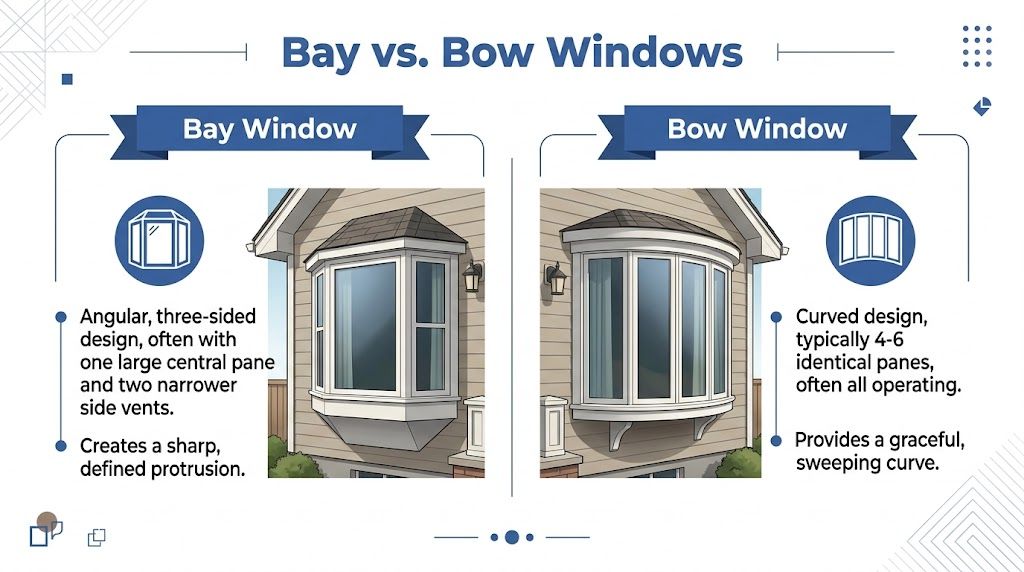
A bay window is the more angular option. It typically uses a three-panel layout with a large center section and two side windows set at an angle. Historically, bay windows emerged during the English Renaissance and became widespread residential features after the 1894 Building Act in Britain was amended to allow windows to protrude from the external wall, as outlined in this bay versus bow window history overview.
That history still shows up in the look. A bay window creates a defined outward bump with clear lines. From inside, it often forms a usable nook. From outside, it gives the home more shape without taking on a fully curved profile.
If you're comparing venting options around a center picture unit, it helps to understand how casement-style windows pair with these assemblies, because operable side panels often affect airflow, screen cleaning, and hardware access.
What defines a bow window
A bow window is the curved variant. It uses four or more window facets, and the extra sections create a smoother, more rounded sweep than a bay. Bow windows appeared later, in the eighteenth century, and needed more advanced engineering to produce that signature curved effect.
They’re usually associated with wider visual span and a softer architectural line. In larger rooms, that can look impressive. In the wrong room, it can feel oversized or overly decorative.
The structural difference that drives everything else
The shape isn’t just cosmetic.
- Bay windows: Fewer sections, sharper angles, more geometric projection.
- Bow windows: More sections, gentler curve, broader span across the wall.
That one distinction affects several practical issues:
Framing complexity
More sections mean more joints, more seals, and more installation variables.Visual effect
Bay windows frame a view. Bow windows spread the view.Maintenance
More panes and more transitions usually mean more edges, more glass to detail, and more places for dust to collect.
Bay windows tend to feel more architectural. Bow windows tend to feel more decorative. Neither is better by default. The room and the maintenance plan decide that.
A Detailed Comparison for Arizona Homeowners
A west-facing living room in Phoenix can turn a window decision into a utility bill, a cleaning problem, or a smart long-term upgrade. Bay and bow windows both add projection and curb appeal, but they do not age the same way once you factor in hard sun, dust, monsoon wind, and regular maintenance access.
For Arizona owners, the better choice usually comes down to four things. Solar heat gain, cleaning difficulty, seal life, and whether the added projection improves the room enough to justify the upkeep.
| Feature | Bay Window | Bow Window |
|---|---|---|
| Shape | Angular, geometric projection | Curved projection made from multiple sections |
| Typical configuration | Three panels | Four or more sections |
| Interior feel | Defined nook or seat area | Broader, softer sweep |
| Wall space needed | Less wall space | More wall span |
| View style | Framed and directional | Wider and more panoramic |
| Maintenance profile | Fewer panes and joints to service | More panes, edges, and detailing |
| Best fit | Smaller rooms, focused feature areas | Larger rooms, wider facades |
| Cost tendency | Lower than bow units | Higher due to added complexity |
How each option lives day to day
Bay windows usually fit Arizona homes better when the goal is practical improvement. They create usable interior space, they break up a plain wall, and they do it without adding as many glass lines, frame joints, and cleaning edges as a bow.
Bow windows make a stronger visual statement from the street. They also ask more from the house and from the maintenance plan. More sections mean more seals to watch, more corners where dust settles, and more exterior glass that bakes in afternoon sun.
That trade-off matters more here than it does in milder climates.
Light, heat, and orientation
A bow window can pull in a wider view and more daylight, which sounds good until that window faces west or southwest in the Valley. More glass spread across more angles can mean more solar exposure during the hottest part of the day. Good glass packages help, but they do not erase bad orientation.
Bay windows are easier to control. The shape is simpler, and homeowners can often manage glare and heat gain with a tighter layout, better overhang planning, and fewer exposed sections. The National Fenestration Rating Council explains how U-factor and Solar Heat Gain Coefficient affect real energy performance, and those labels are worth checking before choosing style over efficiency: NFRC window energy performance ratings.
For many Arizona homes, the best-looking window on paper is not the one that performs best at 4 p.m. in July.
Maintenance is where the difference gets real
From a cleaning and exterior service standpoint, bay windows are usually easier to live with. Fewer panes mean fewer edges to detail. Fewer transitions mean fewer places for mineral residue, oxidized screen dust, and monsoon grime to collect. On second-story homes, that often reduces labor time and access difficulty.
Bow windows take longer. That does not make them a bad choice. It means owners should expect higher service time over the life of the unit, especially if the window sits above landscaping, on a narrow side yard, or over a roofline that limits ladder placement.
If the project includes operable side units, compare those costs too. This breakdown of casement window replacement cost in Arizona gives a useful reference point because many bay and bow assemblies include casement components at the flanks.
Long-term wear and repair exposure
Arizona is hard on seals, finishes, and moving parts. UV exposure dries materials out faster. Dust works into tracks and hardware. Irrigation overspray leaves mineral spotting that can bake onto lower panes if it is ignored.
Bay windows have fewer connection points, so there are fewer places for small problems to start. Bow windows have more joints and more glass divisions, which increases the number of areas that need periodic inspection. That does not guarantee failure. It does increase the odds that one section will need attention sooner than the rest.
Property managers usually see this quickly. The more complex the window assembly, the more often it shows up on maintenance lists.
Which one fits the property better
A bay window usually makes more sense in these situations:
- Smaller rooms where the projection needs to create usable interior space
- Homes with stronger sun exposure where limiting glass area helps control heat
- Rentals or managed properties where simpler cleaning and repair matter
- Owners who want added character without committing to a higher-maintenance feature
A bow window usually earns its keep in different conditions:
- Large front rooms with enough wall span to support the wider curve
- Homes with a view that benefits from a broader sweep of glass
- Higher-end properties where architectural impact is part of the resale strategy
- Projects with the budget and service plan to support more upkeep over time
Design still matters. So does contractor selection, communication, and follow-through. Many firms that produce the best-looking jobs also invest in effective marketing strategies for remodeling contractors, but polished branding should never replace questions about glass specs, access planning, and long-term serviceability.
In Arizona, the better window is usually the one that still looks good, stays efficient, and does not become a maintenance headache five summers from now.
Installation Complexity Cost and Contractor Vetting
A projection window install can get expensive fast in Arizona. A homeowner starts with a design upgrade in mind, then the bid comes back with framing changes, exterior patchwork, new drywall returns, paint, and access equipment for a second-story opening. That gap between showroom pricing and real installed cost is where plenty of projects go sideways.
Bay and bow windows both push out past the wall, but they do not ask the same thing from the installer. A bay window usually uses three units and simpler angles. A bow window often uses four or more connected sections, a wider footprint, and more finish work across the face of the home. More joints, more glass, and more trim detail usually mean more labor and more chances for small installation mistakes that show up later as air leaks, rattles, or service calls.
Installed price also depends on whether this is a true new configuration or a same-size replacement. The National Association of Home Builders notes that bay windows often need roof or soffit tie-ins and seat or knee-brace support, which is why these projects should be priced as structural window work rather than basic replacement work. You can review their bay window design and construction guidance here: NAHB's overview of bay window requirements.

In Phoenix, I tell owners to watch the labor scope as closely as the glass package. Desert heat exposes weak installation work quickly. Poor flashing, thin sealant lines, or sloppy trim transitions do not stay hidden for long once that wall bakes through a summer.
What to ask before you hire
Skip the polished pitch and get specific.
- Projection window experience: Ask for completed bay and bow jobs, including photos from the exterior and interior finish stage.
- Structural responsibility: Confirm who handles support brackets, reframing, header changes if needed, and stucco or siding repair.
- Flashing and waterproofing: Ask what goes above the unit, how side transitions are sealed, and how the sill is protected.
- Glass specification: Verify U-factor, solar heat gain coefficient, and whether the center unit or side units vent.
- Service access: Ask how future glass replacement, cleaning access, and screen removal will work on upper floors.
- Warranty terms: Get product and labor coverage in writing, with clear language on what voids each one.
For budget planning, it also helps to compare the surrounding costs tied to operable side units, trim, and replacement scope. This breakdown of casement window replacement cost factors is useful because casement flankers are common in bay window assemblies.
Contractor vetting matters just as much as the product choice. A company can look polished online and still be weak on project management or post-installation cleanup. This guide on effective marketing strategies for remodeling contractors is helpful for seeing how stronger firms present process, communication, and proof of work before a contract is signed.
Where good installs hold up better
The better contractors treat a bay or bow window like part of the wall system, not a decorative add-on. They plan load support, flashing sequence, finish integration, and future service access before the unit is ordered.
That approach costs more up front. It usually saves money later.
On Arizona properties, the long-term winners are the installs that stay tight, keep water out during monsoon season, and do not turn routine cleaning or glass repair into a ladder-heavy headache.
Maintaining Your View in the Arizona Climate
Arizona is hard on glass. Dust settles fast, hard water spots bake onto the surface, and UV exposure puts every seal and finish under stress. Projection windows deal with all of that more directly because they sit out from the wall and collect more debris on more exposed surfaces.
That’s why maintenance matters more with a bay or bow window than with a standard flat window set.
Why these windows get dirtier faster
The design creates edges, ledges, and angled glass that catch what the desert throws at them. Fine dust settles in corners. Screens trap debris. Tracks collect grit. On bow windows, the extra sections multiply the detailing work.
A 2025 study by the International Window Cleaning Association found that protruding windows like bays and bows require 30 to 50% more time to clean for streak-free results, as referenced in Pella’s bay versus bow window discussion. In Arizona, that added complexity matters because leftover mineral spotting and debris don’t stay minor for long.
DIY cleaning versus professional maintenance
Most DIY problems come from two places. Poor access and the wrong tools.
Homeowners often try to reach angled exterior panes from inside, skip the frame details, or use store-bought cleaner in direct sun. That usually leaves streaks, pushes grit across the glass, and ignores the tracks and screens where a lot of the mess sits.
Professional service works better because the process is different:
- Pure-water systems: These help remove minerals and rinse clean without residue.
- Professional squeegees: Better control on large panes and less chance of dragging debris.
- Screen and track care: Necessary if you want the whole unit clean, not just the visible glass.
- Safe access methods: Important on second-story windows, over landscaping, or on commercial buildings.
Clean glass is only part of the job. If the tracks are packed with grit and the frames hold mineral residue, the window still looks neglected.
A practical cleaning rhythm for the Valley
The right schedule depends on location and exposure. Homes near open desert, active roads, or construction usually need more frequent service than sheltered neighborhoods. Commercial buildings with strong street visibility also benefit from a tighter routine.
A simple rule is to clean before buildup gets baked in. If you wait until the glass looks obviously dirty, Arizona has usually already turned light dust into a harder cleanup.
Helpful signs it’s time include:
- Visible haze on angled panes
- Debris packed in lower corners of tracks
- Water spotting that doesn’t wipe off easily
- Screens that look gray or dusty from the street
For homeowners trying to set a realistic schedule, this guide on how often to clean windows is a useful starting point.
What protects long-term value
Regular care isn't cosmetic only. It helps preserve coatings, keeps tracks functioning, and makes it easier to spot frame or seal issues before they become more expensive. On projection windows, neglect shows earlier because there’s more exposed surface to collect damage.
If the goal is curb appeal plus performance, consistent maintenance beats occasional deep cleaning every time.
Making the Final Decision Which Window Is Right for You
The right answer depends on what you need the window to do after the excitement of the remodel wears off.
Choose a bay window if practicality comes first
A bay window is usually the better choice when you want strong curb appeal without creating a complicated maintenance profile. It fits well in smaller rooms, creates a defined nook, and generally makes better sense for homeowners who care about energy performance and easier cleaning.
It also tends to work better for properties where the window will be exposed to heavy dust, direct west sun, or second-story access challenges. The shape is simpler to maintain and easier to plan around.
Choose a bow window if the room can carry it
A bow window makes more sense when the room is large, the wall is wide, and the goal is a broader visual statement. In the right setting, it can soften the architecture and open up the room in a way a bay window can’t.
That said, it asks more from the owner. More glass, more detailing, and more installation complexity mean you should only choose it if you’re comfortable with the added care.
If you're undecided, don't start with style. Start with exposure, room size, and how the exterior will be cleaned five years from now.
Quick recommendations by scenario
- Gilbert or Tempe homeowner updating a family room: Bay is often the safer and smarter fit.
- Paradise Valley custom home with a broad front elevation: Bow can be worth it if the architecture supports it.
- Phoenix commercial property manager focused on serviceability: Bay usually wins on simplicity.
- High-rise condo board reviewing appearance and access issues: The decision should lean toward whichever option the installer and maintenance team can safely support long-term.
The best bay or bow window is the one that still feels like a good decision after a monsoon season, a summer utility bill, and a few cleaning cycles.
Answering Your Top Questions About Bay and Bow Windows
Do new Arizona wind rules affect bay and bow windows
Yes, especially on commercial buildings and high-rise properties where structural review is tighter and exterior projections get more scrutiny. For current code requirements, the starting point is the Arizona Registrar of Contractors code resources, then the local jurisdiction that adopted and enforces the applicable building code.
In practice, the issue is less about whether a bay or bow window is allowed and more about how it is engineered, supported, flashed, and tied into the wall assembly. On retrofit jobs, that can change the budget fast if the existing opening, framing, or exterior wall system needs reinforcement.
What frame material holds up best in Arizona heat
Fiberglass usually holds up better in extreme sun and heat swing, especially on west-facing exposures. It expands and contracts less than lower-grade vinyl, which helps with long-term seal performance and operation.
That does not make vinyl a bad choice. A well-made vinyl unit installed correctly can perform well in many Arizona homes. The trade-off is product quality. Cheap vinyl tends to show its weaknesses faster here, especially when it gets hit with full afternoon sun, dust, and repeated thermal movement.
Wood looks good, but it asks for more upkeep. In Phoenix-area conditions, that matters.
Are these windows harder to clean on upper floors
Yes. Projection windows are harder to service than flat windows because the exterior glass sits out past the wall and access gets awkward fast. That matters on two-story homes, hillside lots, and commercial buildings where the glass sits above walkways, lower roofs, or decorative plantings.
From a maintenance standpoint, bow windows usually take more labor because there are more panes, more edges, and more spots where dust builds up. Bay windows are simpler to reach and usually less expensive to keep clean over time. If you want to compare providers, this breakdown of what a professional window cleaning company should handle is a good place to start.
Is a bow window always the better-looking option
A bow window can look better on the right house, but only if the wall has enough width and the elevation can carry the curve. On an average stucco home in the Valley, a bow can look oversized and add more glass than the room or exterior really wants.
A bay window often looks cleaner and more intentional. It also fits the simpler lines you see on many Arizona homes and tends to age better visually when the trim, seals, and glass are easier to keep in good condition.
Which one is usually the better long-term value
For many Arizona homeowners and property managers, bay windows are the safer long-term value. They usually cost less to install, cost less to maintain, and create fewer cleaning and access problems later.
Bow windows still make sense in the right setting. They can add a wider view and a softer exterior line. The trade-off is straightforward. More glass and more joints usually mean more heat gain potential, more sealing detail, and more maintenance over the life of the unit.
If the goal is lasting curb appeal without adding avoidable upkeep, bay windows usually win.