

A lot of homeowners start looking up casement window replacement cost after the same moment. The crank gets stiff. The sash no longer seals tightly. Dust keeps showing up on the sill even when the window is closed. In Phoenix, Scottsdale, and the rest of the Valley, that frustration usually shows up right when you need the window to do its job most.
A typical example is the bedroom or kitchen casement that used to catch a nice morning breeze, but now sticks halfway open or leaves a faint whistle when the AC is running. The glass may still look decent from across the room, yet the hardware feels worn, the frame looks tired, and the whole window starts acting older than the rest of the house.
Replacement is not just about fixing a broken crank. It is about getting back smooth operation, a tighter seal, clearer glass, and less day-to-day annoyance. It is also about making a smart choice for Arizona conditions, where sun, dust, hard water, and heat expose every weak spot in a window system.
Is It Time to Replace Your Casement Windows
The first sign is usually operational. A casement window should open cleanly, close evenly, and lock without a fight. When the handle strips, the sash drags, or the lock stops lining up, the problem is rarely limited to one small part. Wear in the hardware often comes with frame movement, failed seals, or water and dust intrusion.
In Arizona, older casement windows also tell on themselves in subtler ways. The room feels warmer near the opening. The glass loses clarity. Tracks, hinges, and weatherstripping collect grit faster because the seal is no longer doing its part. Homeowners who want a refresher on how these windows are supposed to function can compare that with the basics of casement style windows.
Common signs that usually mean replacement is worth pricing out
- Hard operation: If you have to lean into the crank or lift the sash slightly to close it, the unit is already past normal adjustment.
- Fogged glass: Moisture between panes points to seal failure. Cleaning the surface will not fix it.
- Drafts and dust: A casement window is supposed to close tightly. If it leaks, the sealing system is no longer performing the way this style should.
- Visible frame wear: Sun-baked finishes, warped vinyl, and brittle gaskets usually get worse, not better.
A repair makes sense when the issue is limited to hardware. Replacement makes more sense when operation, sealing, glass condition, and frame wear are all slipping at once.
That is where cost questions become more practical. The primary decision is not only what a new window costs today. It is what you get back in reliability, comfort, and lower maintenance over the years in a Phoenix climate.
The Anatomy of Casement Window Replacement Costs
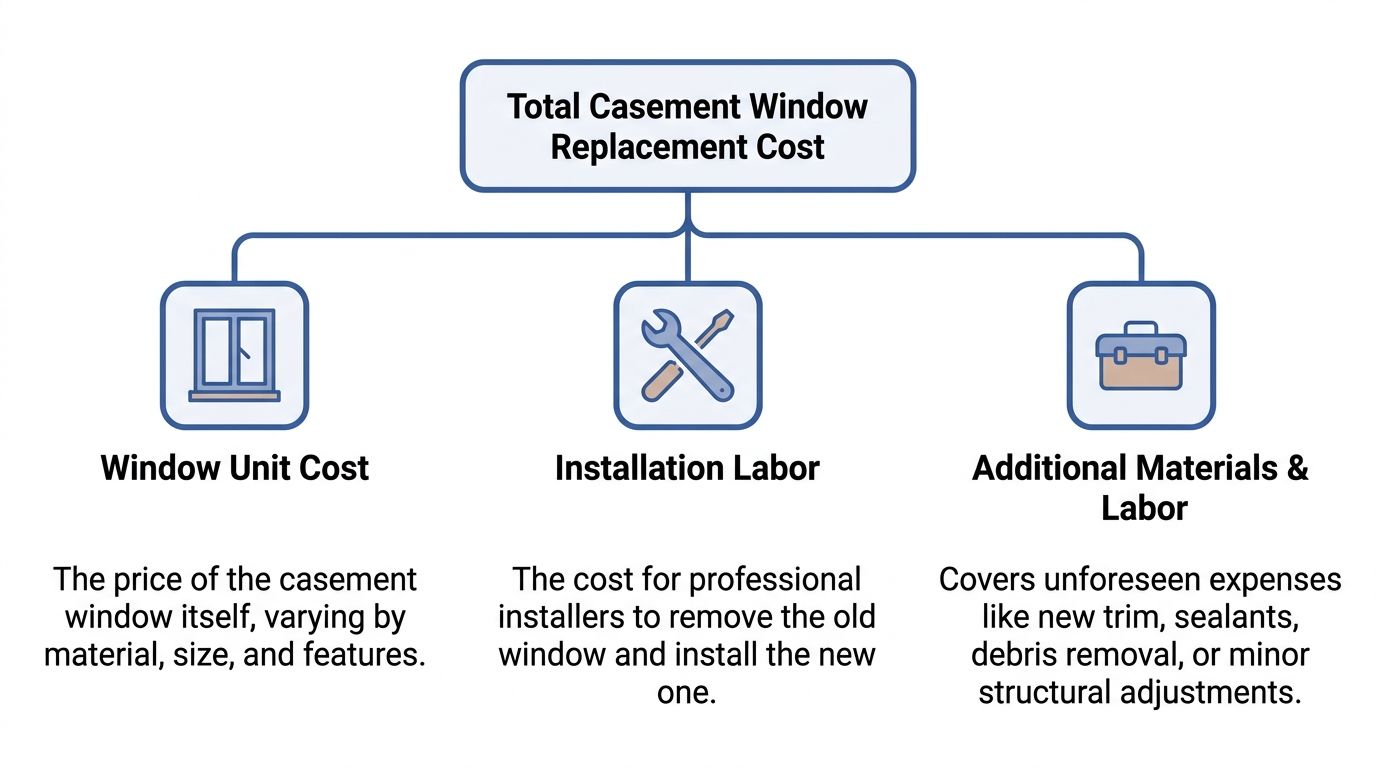
Most homeowners focus on the sticker price of the window itself. That is only one part of the total. The installed price usually comes from three buckets: the unit, the glass and feature package, and the labor required to remove the old window and install the new one correctly.
According to Budget Windows' 2025 window replacement cost guide, the average cost to replace a single casement window in the United States ranges from $430 to $1,060, with a midpoint of about $750 per window. The same source notes that labor typically accounts for 40-60% of the total, and high-cost areas like the Southwest can carry a 10-20% premium because installers often need heat-resistant materials and skilled labor.
The window unit itself
The frame is the foundation of the price. Homeowners often save money too aggressively here.
Vinyl usually enters the conversation first because the upfront number is easier to accept. Wood has a different look and feel, but it comes with more upkeep. Fiberglass and composite options tend to appeal to homeowners who care about dimensional stability, cleaner lines, and better long-term durability in extreme heat.
The frame material affects more than appearance. It influences how well the sash stays aligned, how the weatherstripping performs over time, and how often the window starts needing adjustment. In Phoenix, those practical details matter more than showroom finishes.
The glass package
The glass option can move the final number quickly. Many homeowners underestimate this part because the window can look nearly identical from the room even when the performance is very different.
For Arizona homes, the glass package is rarely the place to cut corners. Double-pane glass with a Low-E coating is a practical baseline because the sun exposure is relentless and rooms near west-facing walls can punish cheaper assemblies. A well-selected glass package can help the window do what casements are supposed to do best, seal tightly when closed and support comfort instead of fighting your HVAC system.
Some upgrades are worth it. Others only make sense on very exposed elevations or specialty rooms. The right choice depends on orientation, room use, and how long you plan to stay in the home.
Labor and installation
Installation is where quotes can vary sharply even when the product line looks similar on paper. Labor is not just a line item for putting a new window in the opening. It includes measuring, protecting the interior, removing the old unit, setting the new frame square, fastening it correctly, insulating the perimeter, sealing the exterior, trimming the interior if needed, and checking operation.
A lower labor quote is not always a better quote. If an installer rushes shimming or sealant work, the window can look finished but still perform poorly.
There is also a major difference between two replacement approaches:
- Insert replacement: The installer fits a new window into the existing frame when that frame is still sound.
- Full-frame replacement: The entire old assembly comes out, which allows the installer to address hidden damage, poor flashing, or frame movement.
Insert jobs can cost less. Full-frame work usually gives the installer more control over the final result. In older homes, especially where sun exposure and previous patchwork repairs are involved, full-frame replacement often solves problems that an insert window would hide.
Extra materials and job conditions
Most quotes also include smaller items that still affect your budget:
- Sealants and insulation: Critical in a dusty, high-heat environment.
- Trim work: Interior and exterior finish details can add labor.
- Disposal: Old windows, broken glass, and site cleanup are part of a complete job cost.
- Access issues: Second-story openings, tight landscaping, or masonry walls can slow the crew down.
A casement window is only as good as its installation. A premium unit installed out of square will disappoint faster than a modest unit installed carefully.
When homeowners compare bids, this is the part to study line by line. A clear quote should show where the money is going, not bury everything inside one round number.
Key Factors That Drive Your Final Price
Two casement window projects can look similar from the curb and land in very different price ranges. The reason is usually not a mystery. It comes down to size, type, material, and job difficulty.
The biggest mistake I see in window budgeting is assuming every opening behaves the same. It does not. A simple replacement in an accessible stucco wall is one thing. A bedroom egress opening on an upper level with aging trim and tricky access is another job entirely.
Size and specialty type matter fast
According to Angi's casement window cost guide, window size can drive 30-40% of the cost variance. The same source says a 24×36-inch unit averages $308, while a 36×60-inch unit averages $482 or more. It also notes that egress casement windows can run up to $2,300 because they must meet bedroom safety requirements.
That tracks with real-world estimating. As the sash gets larger, the hardware, frame strength, glass weight, and installation demands all change. Bigger casements are not just scaled-up small windows. They ask more from every component.
Bedroom egress windows deserve special attention. If a bedroom replacement needs to meet code for emergency escape and rescue opening, that requirement can force a more specialized product and more careful installation. Homeowners sometimes price a standard casement in their heads, then get surprised when the bedroom quote comes back much higher.
Material choice in Phoenix conditions
Arizona conditions alter the discussion at this point. The cheapest frame at install is not always the cheapest frame to own.
Vinyl is common because it keeps the upfront quote lower. In milder climates, that may be enough to justify the choice. In Phoenix, long sun exposure and dust put more pressure on lower-cost materials. Frames that move, discolor, or lose crisp alignment can create extra cleaning headaches, rougher operation, and more frustration later.
Fiberglass and stronger composite-style products usually appeal to homeowners who plan to stay put and want fewer maintenance surprises. Wood can still make sense when aesthetics matter most, but it asks for attention and care. Aluminum has its place in some designs, but many homeowners in hot climates think carefully about heat transfer before choosing it.
Here is a practical comparison for Arizona homes.
Casement Window Material Comparison for Arizona Climate
| Material | Upfront Cost (Per Window) | Durability in High Heat | Maintenance Needs | Est. Lifespan |
|---|---|---|---|---|
| Vinyl | Lower upfront, often the budget pick | Fair to good, but can be more vulnerable to warping or discoloration in intense sun | Moderate, especially when dust and UV exposure start affecting seals and finish | Varies by product and exposure |
| Fiberglass | Higher upfront | Strong choice for high heat and sun exposure | Lower routine upkeep than many budget materials | Often longer-term |
| Wood | Higher upfront | Can perform well when protected, but finish condition matters | Highest maintenance of the group | Varies with maintenance quality |
| Aluminum | Varies | Structurally durable, but less forgiving on heat transfer | Moderate | Varies by build quality and exposure |
The point of the table is not to crown one winner for every house. It is to show that the right material depends on whether you are optimizing for upfront price, appearance, or long-run ownership.
Installation complexity changes the labor line
Labor swings the quote more than many homeowners expect. A first-floor replacement with easy access is straightforward. A second-story opening, a brick exterior, deep trim work, or a high-end finish standard can all increase labor effort.
Crews also run into hidden conditions once the old window comes out. The opening may be out of square. There may be minor deterioration around the perimeter. The old unit may have been installed with shortcuts that now need correction. None of that shows up in a showroom sample.
Conditions that often raise the quote
- Upper-floor access: Harder setup, more time, more safety equipment.
- Masonry or specialty exterior finishes: Removal and sealing require more care.
- Custom sizes or shapes: Fewer off-the-shelf options and more ordering complexity.
- Interior finish sensitivity: If the surrounding drywall, plaster, or trim must stay nearly untouched, labor gets more precise.
The least expensive quote often assumes the smoothest possible job. The most accurate quote usually reflects the awkward details your house already has.
Design choices that affect daily use
Not every cost driver is structural. Some are practical lifestyle choices.
A casement placed above a kitchen sink may be perfect because the crank is easier to reach than a sliding sash. A casement facing a walkway may be less ideal because of exterior clearance. Matching sightlines with adjacent fixed windows can improve appearance, but it can also push you toward a more specialized product line.
These choices are worth discussing before ordering, not after. Replacing windows is expensive enough without paying twice for the wrong layout.
Beyond the Sticker Price Hidden Costs and Potential Savings
Many homeowners build a budget around the window quote and stop there. That leaves out the costs that shape the total, and it also misses the savings that come from choosing the right materials and timing.
A quote may not fully reflect permit requirements, trim repair, paint touch-up, or disposal. Structural changes can trigger more paperwork. Some homes also reveal hidden issues only after removal, especially around older openings that have taken years of heat and dust exposure.
The long-term ownership cost most guides skip
The bigger blind spot is maintenance over time. Phoenix is rough on windows. UV exposure and airborne dust punish lower-grade materials in ways that standard price charts rarely capture.
According to Today's Homeowner's casement window cost guide, Phoenix's intense UV exposure and dust accelerate material degradation, and vinyl casement windows often start around $525 to $740. That lower upfront cost can be attractive, but the same source notes that warping or discoloration over time can raise maintenance needs and shorten effective service life compared with more durable premium materials.
That matters because a cheaper window may ask more from you later:
- More frequent cleaning: Dust sticks harder to rougher, aging surfaces.
- More seal and finish issues: Once the frame starts showing wear, maintenance becomes more repetitive.
- Earlier replacement pressure: A lower entry price can look different when the unit ages poorly in direct sun.
Homeowners comparing material options often also compare upkeep costs around the house. A good reference point is the local reality of residential window cleaning cost, since easier-to-maintain windows usually stay clearer and service better.
Savings that are real and savings that are not
Some savings are worth pursuing. Others are false economy.
The best savings usually come from smart product selection, realistic scope planning, and avoiding a mismatch between window type and exposure. Spending a bit more on a stronger frame can lower the odds of operational problems later. Keeping the opening size standard can also help. So can replacing multiple problem units in one organized project instead of patching one at a time whenever hardware fails.
A common false saving is choosing the lowest quote without asking what was removed from the scope. Less prep, less trim work, and less cleanup can all show up as a lower number now and a worse result later.
A quick visual can help when you start budgeting the full project.
Hidden items to ask about before signing
- Permit responsibility: Ask who pulls permits if the job requires them.
- Disposal and site protection: Confirm debris removal, glass handling, and interior protection.
- Finish work: Clarify who handles trim, caulk lines, and paint touch-up.
- Warranty service: Ask who comes back if a sash binds or a lock needs adjustment after installation.
The best budget is not the cheapest one. It is the one that accounts for ownership after the installers leave.
Smart Strategies to Manage Your Replacement Budget
You usually get the best value when you approach windows like a planned upgrade, not an emergency purchase. A rushed decision tends to favor whatever quote arrives first, whatever material looks cheapest, or whatever product is immediately available. That is how homeowners end up replacing a weak window with another weak window.
One practical lever is project scope. According to Homewyse cost data for replacement casement windows, replacing 6-10 windows can cut labor fees by 20-30% because crews gain efficiency in setup, scaffold use, and travel. If several casement windows are aging at the same time, bundling them often makes more financial sense than spacing them out over years.
How to compare quotes without getting fooled
A strong quote should be itemized enough that you can compare apples to apples.
Ask each contractor for:
- The exact window line and material
- The glass package
- Whether the job is insert or full-frame
- Trim and finish details
- Cleanup and disposal
- Lead time and warranty process
If one quote comes in well below the others, do not assume you found a bargain. Read the scope. A lower number may reflect a less durable product, less finish work, or less labor built into the install.
Budget moves that usually work
- Replace by condition, not only by room: Group windows that share the same exposure and age. West-facing units often deserve attention sooner.
- Keep custom work limited when possible: Standard sizes and straightforward configurations are easier on the budget.
- Prioritize performance where the sun is worst: Spend money where it solves a real problem, not where it just sounds premium.
- Think about curb appeal too: Window choices affect the exterior look of the home, especially from the street. Good planning supports the broader goal of improving curb appeal.
The best budget strategy is simple. Buy the strongest window you can reasonably afford for the harshest exposure on your house, then make sure the installer gives it a fair chance to perform.
Timing and decision discipline
If a window has completely failed, you may have to move quickly. But if the issue is gradual wear, use that time. Get multiple bids. Ask direct questions. Hold each contractor to the same scope.
That discipline matters more than trying to guess the perfect month to buy. Homeowners save more by choosing the right combination of product and installer than by chasing a small scheduling advantage.
From Installation to Long-Term Care Your Next Steps
Once you have chosen the window and signed the contract, the next job is protecting that investment. New casement windows can look fantastic on day one and still lose ground quickly if dust, hard water, and track buildup are allowed to sit.
Arizona conditions are rough on moving parts. Casement windows rely on clean hardware, clean seals, and clear drainage paths. If grit builds up in the sill or around the sash, operation gets rougher and wear speeds up. If hard water spots bake onto the glass, the window can look older than it is.
A practical post-install checklist
- Inspect operation early: Open, close, and lock each window several times while the installation is still fresh.
- Watch the perimeter: Look for clean sealant lines and consistent interior finish work.
- Keep tracks and sills clean: Casements perform better when dust and debris are not grinding into the hardware.
- Add window care to routine home maintenance: A simple reminder inside an annual home maintenance checklist helps prevent neglect.
Why regular care matters
Casement windows have more visible hardware interaction than some other styles. You feel it every time you use them. That makes maintenance noticeable in a good way or a bad way.
Clean glass is only part of the story. The frame, tracks, screens, and sill area all affect how the window looks and functions. Professional cleaning also helps protect specialty glass surfaces and keeps buildup from turning into permanent staining.
A new window should still look and operate like a premium upgrade after the first dust season, the first monsoon, and the first year of hard sun. Regular care is what makes that happen.
If you choose well and maintain the windows properly, the replacement cost goes toward something durable, comfortable, and easier to live with every day.
Frequently Asked Questions About Casement Window Costs
Are casement windows more expensive than other window styles
Often, yes, but not always by a dramatic margin. The hardware, hinged design, and tighter sealing system can place them above simpler options in some projects. The more useful comparison is not just initial price. It is whether the style fits the room, the airflow needs, and the exposure on that side of the house.
Is it worth replacing one casement window at a time
Sometimes. If one unit has isolated glass failure or hardware damage while the others are still in good shape, a single replacement can be reasonable. But if several windows are the same age and facing the same sun exposure, piecemeal replacement can be less efficient and less economical than grouping them.
What should I look for in a quote
Look for product detail, not just a total. You want the frame material, glass package, installation method, finish scope, cleanup terms, and warranty process spelled out clearly. A vague quote makes comparison difficult and leaves room for unpleasant surprises later.
Should I choose the cheapest vinyl option
Only if you are comfortable with the trade-off. Lower upfront cost can be the right call in some projects, especially where the exposure is milder or the ownership timeline is shorter. In Phoenix, though, the harsher climate means the cheapest material can create more maintenance and earlier replacement pressure over time.
Can old casement windows be repaired instead of replaced
Yes, in some cases. If the problem is limited to hardware, screens, or minor alignment, repair can buy time. If the window has fogged glass, worn seals, frame degradation, and poor operation all at once, replacement is usually the cleaner long-term decision.
What warranty questions matter most
Ask what is covered on the product, what is covered on labor, and who handles service calls. A good warranty is only useful if you know who will respond when a sash drags, a lock needs adjustment, or a sealed glass unit develops a problem later.
If your home or property needs expert care after window replacement, South Mountain Window Cleaning, LLC helps protect that investment with professional residential, commercial, and high-rise window cleaning across Phoenix, Scottsdale, Paradise Valley, Chandler, Tempe, and Gilbert. Clean glass, clear tracks, and proper maintenance keep casement windows looking better and working the way they should in Arizona conditions.