
Pool maintenance usually runs $1,800 to $3,000 per year for full professional service, but it can be as low as $900 for a DIY owner and climb past $4,200 for premium service packages. In Phoenix, real-world costs often land 20% to 50% above national averages because heat, dust, evaporation, and hard water all push the budget up.
If you own a pool in the Valley, you already know the pattern. The water looks perfect on Sunday, then a wind event rolls through, the skimmer fills up, the tile line starts showing scale, and the pump seems to run forever just to keep up. National pool guides give you a starting point, but they often miss the part Phoenix homeowners care about, which is what this costs here.
The average cost of pool maintenance isn't just a chemical bill. It's the full yearly cost of keeping water clean, equipment healthy, surfaces protected, and the whole backyard usable through a long swim season. In Phoenix, those details matter more because the climate is harder on pools than many homeowners expect.
Your Phoenix Pool's True Annual Cost
A lot of homeowners search this question right after buying a house. They love the pool, but they want a realistic budget before the first full summer hits.
The broad U.S. baseline is straightforward. The average annual cost of pool maintenance typically ranges from $900 to $3,000, while weekly chemical-only service usually costs $100 to $150 monthly ($1,200 to $1,800 annually) and full-service cleaning plus chemicals averages $150 to $250 monthly ($1,800 to $3,000 yearly), according to PoolDial's pool maintenance cost breakdown.
That national range is useful, but it doesn't tell the whole story for Phoenix. A backyard pool in the Valley deals with stronger sun, longer run times, and more airborne dust than many markets. Those three things alone can shift a homeowner from the low end of the range to the middle or upper end pretty quickly.
A realistic local budget starts with service level
If you do your own testing, brushing, basket cleaning, and chemical balancing, you may stay closer to the lower end. If you want somebody else handling chemistry, debris, and routine checks all year, most owners should budget around the full-service range instead of the DIY number.
For a second opinion focused on long-term ownership costs, the Vistancia pool cost analysis is a useful companion read because it helps frame maintenance as an ongoing home expense, not a one-time seasonal chore.
Practical rule: In Phoenix, the cheapest annual number you see online is usually a starting point, not a finished budget.
It's the same reason homeowners compare service pricing across exterior upkeep. If you're already reviewing household upkeep costs, this guide to Phoenix cleaning services cost gives a helpful broader look at what recurring exterior maintenance tends to involve in the Valley.
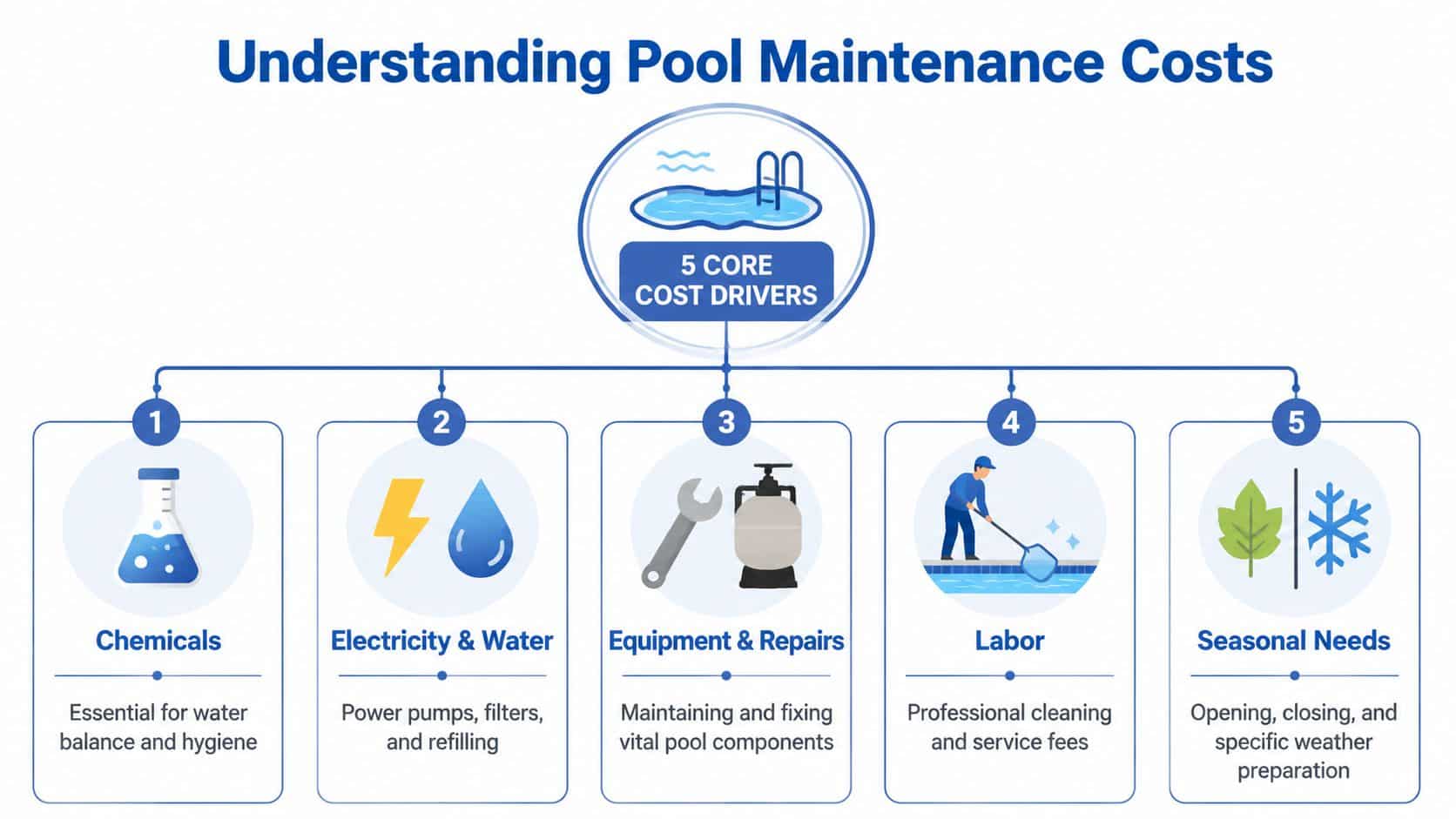
What Exactly Are You Paying For? The 5 Core Cost Drivers
A Phoenix pool bill usually comes from the same five buckets. The difference is that our heat, dust, and hard water push a few of those buckets higher than national averages suggest.
Chemicals
Chemicals are a year-round operating cost in the Valley, not a summer-only expense. Strong UV burns off chlorine faster, dust adds contaminant load, and hard fill water often means more acid, stabilizer management, and occasional scale-control products.
For baseline national chemical spending, HomeAdvisor's pool maintenance cost guide places chemical use within the normal annual ownership budget. In Phoenix, many owners end up on the higher side of that range because the water needs more correction over a longer swim season.
Electricity and water
This category gets expensive fast in Arizona.
The pump runs longer in extreme heat, especially if the pool gets full sun and heavy debris. Water also disappears faster here through evaporation, so refill water is part of regular maintenance, not an occasional add-on. If the pool has a variable-speed pump, the electric bill is usually easier to control. If it has an older single-speed unit, summer operating costs climb quickly.
Equipment and repairs
Pumps, filters, valves, cleaner hoses, cartridges, and automation parts all wear out. Hard water makes this worse because scale builds up inside equipment and cuts efficiency before something fully fails.
I see this one all the time in Phoenix. A filter that should have been cleaned on schedule starts restricting flow. Then the pump works harder, circulation drops, and chemistry gets less stable. The repair bill rarely starts with one dramatic failure. It usually starts with deferred upkeep.
Labor
Labor is the time spent skimming, brushing, vacuuming, emptying baskets, cleaning filters, testing water, and adjusting chemistry before problems get expensive.
DIY owners can save real money here, but only if they stay consistent. Miss a couple of weeks during monsoon season or a dusty stretch, and the cleanup usually costs more in chemicals, water, and time than the service visit would have.
Seasonal and surface-related needs
Phoenix does not have a traditional closing season, but it does have ongoing cleanup costs tied to the area around the pool. Dust, deck runoff, and windblown debris all end up in the water, which means more filter loading, more brushing, and more chemistry correction.
A dirty deck makes pool care harder than many owners expect. Regular Arizona pool deck cleaning helps cut down on the grit and residue that get tracked or blown back into the pool. If your deck is travertine, sealing also affects maintenance. Paving Supplies' advice on travertine is useful because porous stone around the pool can hold grime and mineral residue that make the whole area tougher to keep clean.
In Phoenix, pool maintenance is not just a water-care job. It is also a heat, dust, and hard-water management job.
How Pool Type and Size Impact Your Annual Budget
Two pools can sit on the same street and have very different maintenance costs. Material and size are usually why.

Pool type changes the long-term math
Over a long ownership window, surface material matters more than many buyers expect. According to River Pools and Spas on inground pool maintenance costs, concrete pools average $1,650 per year and require $10,000+ resurfacing every 10 to 15 years. Vinyl pools average $700 per year but need a $3,000 to $5,000 liner replacement every 7 to 10 years. Fiberglass pools average $375 per year in maintenance.
That doesn't automatically make fiberglass the right choice for every property. Concrete is common in Arizona because it handles custom shapes well and fits a lot of backyard designs. But from a pure maintenance standpoint, concrete usually asks for more from the owner over time.
Size drives routine consumption
Pool size affects almost everything. A larger pool needs more chemical correction, longer circulation, more brushing time, and more filter load.
PoolDial's market data notes that small pools up to 10,000 gallons cost $800 to $1,200 yearly, while medium pools from 10,000 to 20,000 gallons cost $1,200 to $1,800 yearly, with routine cleanings at $80 to $150 per visit as discussed earlier in the article. The practical takeaway is simple. More water means more maintenance pressure on every system.
| Pool factor | Budget effect | What owners usually notice |
|---|---|---|
| Concrete surface | Higher long-term upkeep | More brushing, more surface wear concerns |
| Vinyl liner | Lower routine cost, bigger replacement event | Good monthly control, eventual liner bill |
| Fiberglass shell | Lowest routine maintenance | Easier cleaning and lower chemical demand |
| Smaller pool | Lower recurring spend | Faster balancing and shorter cleaning time |
| Larger pool | Higher recurring spend | More chemicals, more energy, more debris load |
If you're also looking at the area around the pool, this guide to swimming pool deck cleaning in Arizona is worth reading because deck dust, runoff, and hard-water residue often raise cleaning demands inside the pool itself.
DIY vs Professional Service A Complete Cost-Benefit Analysis
A lot of Phoenix pool owners start with DIY for a simple reason. On paper, it looks cheaper. Sometimes it is.
The actual comparison involves labor, consistency, and risk. In the Valley, one missed week in July can turn a manageable pool into a cleanup job, especially after dust, heavy sun, and fast chlorine loss stack up.
The raw cost comparison
HomeAdvisor's pool cleaning service pricing guide puts professional pool cleaning at roughly $80 to $150 per month for routine service, with higher costs for larger pools, problem pools, or plans that include more than basic cleaning. DIY usually costs less in direct cash because you're buying test kits, chemicals, and replacement parts as needed instead of paying for labor every month.
That monthly gap is real. So is the trade-off.
| Expense Item | DIY Monthly Cost | Pro Service (Full) Monthly Cost |
|---|---|---|
| Chemicals and water balancing | Lower cash outlay, but owner buys and doses everything | Often included, or billed with service |
| Skimming, brushing, vacuuming | Owner's time each week | Included |
| Equipment checks | Owner has to catch pressure, flow, and noise changes | Technician usually checks these during service |
| Repair risk from missed issues | Higher if testing or cleaning slips | Lower when small problems are caught earlier |
| Total monthly range | Usually lower, but less predictable in problem months | Usually higher, but easier to budget |
Where DIY works
DIY makes sense for owners who are home regularly, don't mind learning water chemistry, and will stay on schedule through the hottest stretch of the year. A smaller, newer pool with reliable equipment is a better DIY candidate than an older pool with scale, aging seals, or weak circulation.
There is also a control advantage. You know when the pool was tested, what was added, and whether the brushing got done.
But Phoenix pools punish inconsistency. Skip testing during a heat wave, let baskets clog after a storm, or wait too long to correct scaling, and the savings can disappear fast.
Where professional service earns its keep
Good pool service is maintenance plus inspection. The technician is not just scooping leaves. They are watching filter pressure, water level, circulation strength, early calcium buildup, and signs that a pump, cleaner, or valve is starting to drift out of spec.
That matters here because Valley conditions shorten your margin for error. Dust loads the filter. Hard water leaves scale. Long hot months keep the system running under stress.
For busy households, short-term rentals, snowbird owners, and anyone who travels, professional service often wins because it prevents expensive neglect. It follows the same logic as routine exterior upkeep. Preventive care usually costs less than waiting until visible damage forces a bigger fix, whether that means pool equipment service or a regular schedule for house exterior cleaning and maintenance.
The practical choice for Phoenix homeowners
DIY is a reasonable option for a hands-on owner who treats pool care like a set weekly task and follows through all summer. Professional service is usually the better value for larger pools, older equipment, rental properties, and families who know the routine will get skipped when life gets busy.
The cheapest option on paper is not always the lower-cost option over a full Phoenix pool season.
The Arizona Factor Why Phoenix Pool Maintenance Costs More
Phoenix doesn't just have hot weather. It has a pool climate that magnifies every weak spot in your maintenance routine.
Nationally, pool maintenance averages $80 to $260 monthly, but Phoenix and Scottsdale can see 20% to 50% higher costs because of evaporation up to 1/4 inch daily, heavy dust, and hard water scaling, according to Swimply's pool maintenance cost article. That same source notes that hard water can add $200 to $500 per year in acid washes alone.
Heat and sun change the chemistry
Long Phoenix summers mean the pool keeps working even when you're not using it much. Water is still evaporating. Debris still lands in it. The filter still has to move water and trap fine dust.
Chemical demand feels less forgiving here because strong sun and heat don't give you much room to ignore balance. Water that looks fine can move out of balance fast after a hot stretch, especially if the pool already has dust load or scale starting.
Dust storms and yard debris raise the cleaning load
Anyone who's lived through a haboob knows what happens next. The pool turns into a collection point for everything airborne. Baskets fill faster, filter pressure becomes more important, and manual cleanup takes longer.
This is one reason local maintenance budgets don't line up neatly with national averages. A Phoenix pool isn't just battling normal swimmer use. It's handling the desert.
Here's a visual explainer that does a good job showing the kind of maintenance issues pool owners run into over time:
Hard water is the sneaky cost multiplier
Hard water is where many Valley owners underestimate their true annual cost. Scale builds gradually, but once it's visible on tile, spillways, or equipment surfaces, removal gets harder and more expensive.
This isn't just cosmetic. Hard-water residue can affect how clean the whole pool environment looks, even when the water chemistry is otherwise under control.
- Tile line buildup: Makes the pool look dirty sooner.
- Equipment stress: Mineral accumulation can make systems less efficient.
- Acid wash needs: Sometimes necessary to reset a neglected surface.
- Deck runoff residue: Surrounding surfaces can feed dirt and minerals back into the water.
In Phoenix, the pool itself and the surfaces around it behave like one system. If the deck, coping, and drainage stay dirty, the pool usually does too.
Sample Pool Maintenance Budgets for Phoenix Homeowners
Abstract numbers help, but homeowners typically want a budget that feels familiar. Here are a few common Valley scenarios.
The hands-on owner in Gilbert
This homeowner has a smaller play pool, stays on top of brushing and testing, and doesn't mind cleaning baskets after windy days. They're trying to keep costs controlled, so they handle the labor side themselves and spend mainly on supplies, electricity, and periodic upkeep.
Their budget usually feels manageable month to month, but only if they stay consistent. The moment they put off scale removal, let debris sit, or ignore circulation issues, the savings narrow.
The DIY route works best when the owner treats pool care like yard care. It has to happen on schedule, not only when the water starts looking off.
The busy family in Scottsdale
This family uses the pool often and wants it ready without thinking about it. They hire full service because nobody in the household wants to test water after work or deal with post-storm cleanup.
This is the homeowner profile that often fits the $1,800 to $3,000 annual full-service range discussed earlier, and in tougher Valley conditions it can move above that general band depending on service frequency, equipment condition, and surface issues. Their higher monthly spend buys predictability, cleaner water, and fewer surprise repair situations.
The premium setup in Paradise Valley
This owner has a larger pool, higher finish level, and a stronger expectation that everything always looks sharp. The water needs to be clean, the tile line needs to stay presentable, and equipment checks matter because the replacement costs on upscale installations are painful.
Premium packages offer an alternative approach for homeowners. If the service includes deeper routine attention and more thorough monitoring, annual cost can move beyond standard full service and toward the upper end of the ranges already discussed in this article.
A simple way to think about your own budget
Use this framework instead of chasing one national number:
| Homeowner type | Likely budget direction | Main reason |
|---|---|---|
| DIY and consistent | Lower end | Labor stays in-house |
| Full-service family | Middle range | Convenience and routine care |
| Larger or high-finish pool | Upper range | More water, more surfaces, more risk |
| Neglected older system | Unpredictable | Repairs distort the annual budget |
If you want a realistic Phoenix estimate, match your home to the closest behavior pattern first. Pool ownership cost is driven as much by how the pool is managed as by the pool itself.
How to Hire a Reliable Pool Service in the Valley
If you're hiring out pool care, don't shop by price alone. The cheapest monthly quote can get expensive if the tech misses chemistry problems, ignores scale, or never flags failing equipment.
What to ask before you hire
Use a short checklist and listen for clear answers.
- Insurance and business protection: Ask whether the company is properly insured before anyone steps onto your property. This matters for any contractor. If you want a plain-English primer, this breakdown of bonded vs insured explains why owners shouldn't treat those terms as interchangeable.
- Scope of service: Ask exactly what's included. Skimming only isn't full maintenance.
- Reporting habits: Good companies tell you what they did, what they added, and what needs watching.
- Equipment awareness: Ask how they handle early signs of pump, filter, or heater issues.
- Phoenix-specific experience: Valley pools need techs who understand dust events, hard water, and summer chemistry drift.
Warning signs to avoid
A vague quote is a problem. So is a company that can't clearly explain its visit routine.
Watch for these red flags:
- No written service outline: You need to know what you're paying for.
- No mention of equipment checks: Cleaning without inspection is incomplete maintenance.
- No discussion of scale or hard water: In Phoenix, that's a sign they may not be detail-oriented.
- Prices that sound unrealistically low: Something is usually being skipped.
The best pool service companies operate the same way good exterior service companies do. They show up consistently, document their work, carry proper protection, and prevent small issues from becoming expensive ones.
If you're taking a broader look at exterior upkeep around your property, South Mountain Window Cleaning, LLC serves homeowners and commercial properties across Phoenix, Scottsdale, Paradise Valley, Chandler, Tempe, and Gilbert with professional window cleaning, house washing, power washing, solar panel cleaning, and other exterior cleaning services built for Arizona conditions.