
The call usually comes after someone looks up. The lobby glass is dusty, the upper transoms show water spots, the light fixtures in the atrium haven't been touched in too long, and nobody on staff can reach the work safely from the ground. In Phoenix, that problem shows up fast. Dust, heat, traffic, and constant sun exposure make high interior and exterior glass look neglected sooner than most managers expect.
That's where atrium lift rentals enter the conversation. They're built for spaces that are too tall for ladders, too tight for standard boom lifts, and too visible to leave unfinished. But renting one isn't just an equipment decision. It's a building-access decision, a floor-protection decision, an operator decision, and in many cases a liability decision.
There's a reason this rental category keeps getting attention. The broader aerial work platform rental market was valued at US$23,729.48 million in 2024 and is projected to expand at a 5.50% CAGR through 2032, while the specialized atrium lift rental market alone was estimated at USD 1.2 billion in 2024, according to aerial work platform rental market data. Property teams use these machines because buying one outright rarely makes sense for occasional high-access work.
When Your Windows Are Out of Reach
A typical Phoenix property manager doesn't need an atrium lift every week. You need one when the glass over an entry court is too high, when lobby windows rise above safe hand access, or when a maintenance task sits over finished flooring and tenant traffic. That's exactly why atrium lift rentals are appealing. You get temporary access without owning a specialized machine.
The problem is that many projects look simpler from the ground than they are in operation. A glass wall might be reachable in theory, but the path to it may involve narrow doors, polished stone, decorative planters, ceiling soffits, or a slab that needs review before any machine rolls across it. The lift solves one problem while creating several others if the plan is weak.
What managers usually underestimate
Most building teams first focus on height. Height matters, but it's rarely the first thing that derails the job. The bigger issues are usually:
- Access route fit: Can the machine get from the delivery point to the work area without removing doors, moving furniture, or blocking tenant circulation?
- Floor and finish protection: Can the building tolerate the machine and the setup process without cracked tile, dented metal thresholds, or damaged stone?
- Operational footprint: Does the machine have room to stabilize and articulate once it reaches the work zone?
- Work quality: Will the crew using it know how to clean or maintain the surface efficiently once they're in the air?
Practical rule: If the only thing confirmed so far is the ceiling height, the job is not ready for an atrium lift.
For buildings with high exterior glass or harder access conditions, many managers are better served by reviewing a provider that already handles high-rise window cleaning services instead of starting with the rental catalog. The machine is only one part of the result.
What works in the field
Atrium lift rentals work well when the site path is simple, the slab is suitable, the schedule allows setup time, and the operator is experienced with tight indoor access. They work poorly when the building is occupied, the route is narrow but irregular, and the staff assigned to use the machine are learning on the fly.
That difference is where most of the cost lives.
Choosing the Right Atrium Lift
The wrong atrium lift can still reach the glass and still be a bad rental. Selection comes down to the working envelope, access path, power source, and what the worker needs to carry up.
Rental fleets show just how wide the range is. Atrium lift models can offer platform heights from 35 to over 72 feet, horizontal reaches up to 30 feet or more, and platform capacity typically around 500 pounds, according to atrium lift rental specifications. That sounds straightforward until you match those numbers to a real building.
Start with the work, not the machine
Ask four questions before you look at brand or model:
Where is the glass or fixture in relation to the floor below?
Straight-up access is one thing. Reaching over fountains, railings, planters, or storefront projections is another.How much side reach do you need?
A lift that gets high enough may still fail if it can't reach out far enough to clear the obstacle below.What must go in the basket?
One worker with a squeegee setup is different from a worker carrying tools, replacement lamps, sealant, or restoration equipment.Is this an indoor job, outdoor job, or both?
Indoor atriums usually call for quieter, cleaner power options and more finish-sensitive handling.
What the specs mean in plain English
A few rental terms cause confusion:
| Term | What it means on the job |
|---|---|
| Platform height | How high the basket floor goes |
| Working height | The practical reach of the worker above the basket floor |
| Horizontal outreach | How far the basket can reach sideways from the base |
| Platform capacity | The allowable combined weight of worker, tools, and materials |
If a manager only asks for “a lift that goes high enough,” the rental company may send a machine that technically reaches the elevation but can't position correctly once it's indoors.
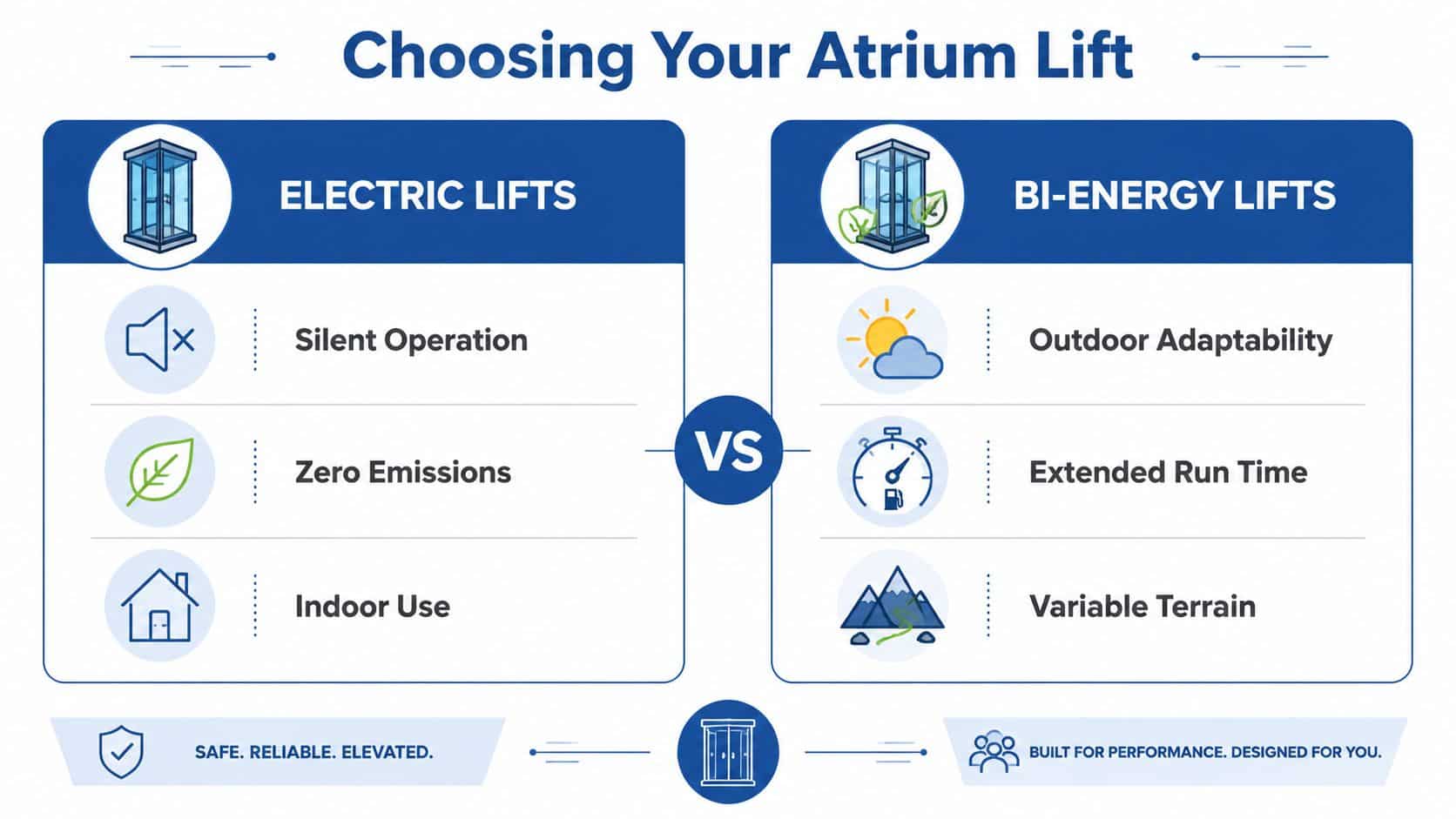
Electric versus bi-energy
For occupied commercial properties, electric units are usually the cleaner fit. They're better suited to interior use where noise, exhaust, and tenant disruption matter. Bi-energy setups make more sense when the machine needs flexibility between indoor and outdoor conditions or when a longer workday and mixed terrain are part of the plan.
That same logic applies to hydraulic behavior and control smoothness. If you manage facilities where precision matters, it helps to understand how hydraulic flow is controlled in lifting systems. A technical overview like selecting hydraulic flow divider valves gives useful background on why predictable movement and balanced flow matter when equipment is operating in tight, finished spaces.
A smooth machine is easier to place, but it still won't fix a bad access plan.
Compact crawler or wheeled unit
Compact crawlers usually make the most sense when access is tight and flooring protection needs extra thought. Wheeled units can be practical where the route is simpler and the surface is built for it. Neither is “better” in the abstract. The right choice depends on your building, not the brochure.
For managers who want to understand what operators and cleaners look for in height access equipment, South Mountain Window Cleaning has a useful overview of high-rise window cleaning equipment. It helps to see how the lift fits into the larger access strategy rather than treating it as a standalone fix.
Can Your Property Handle an Atrium Lift
A surprising number of atrium lift rentals fail before the boom ever goes up. The machine arrives, and someone realizes the route pinches at a doorway, the lobby floor needs protection, or the work zone can't support the setup footprint without disrupting the building.
That's why the site walk matters more than the rental reservation.
The dimensions that matter first
Some narrow crawler models are only 31 to 39 inches wide, which is why they're often chosen for commercial interiors, according to compact atrium lift specifications. That narrow profile helps them pass through standard commercial doorways, but it doesn't guarantee the job will go smoothly.
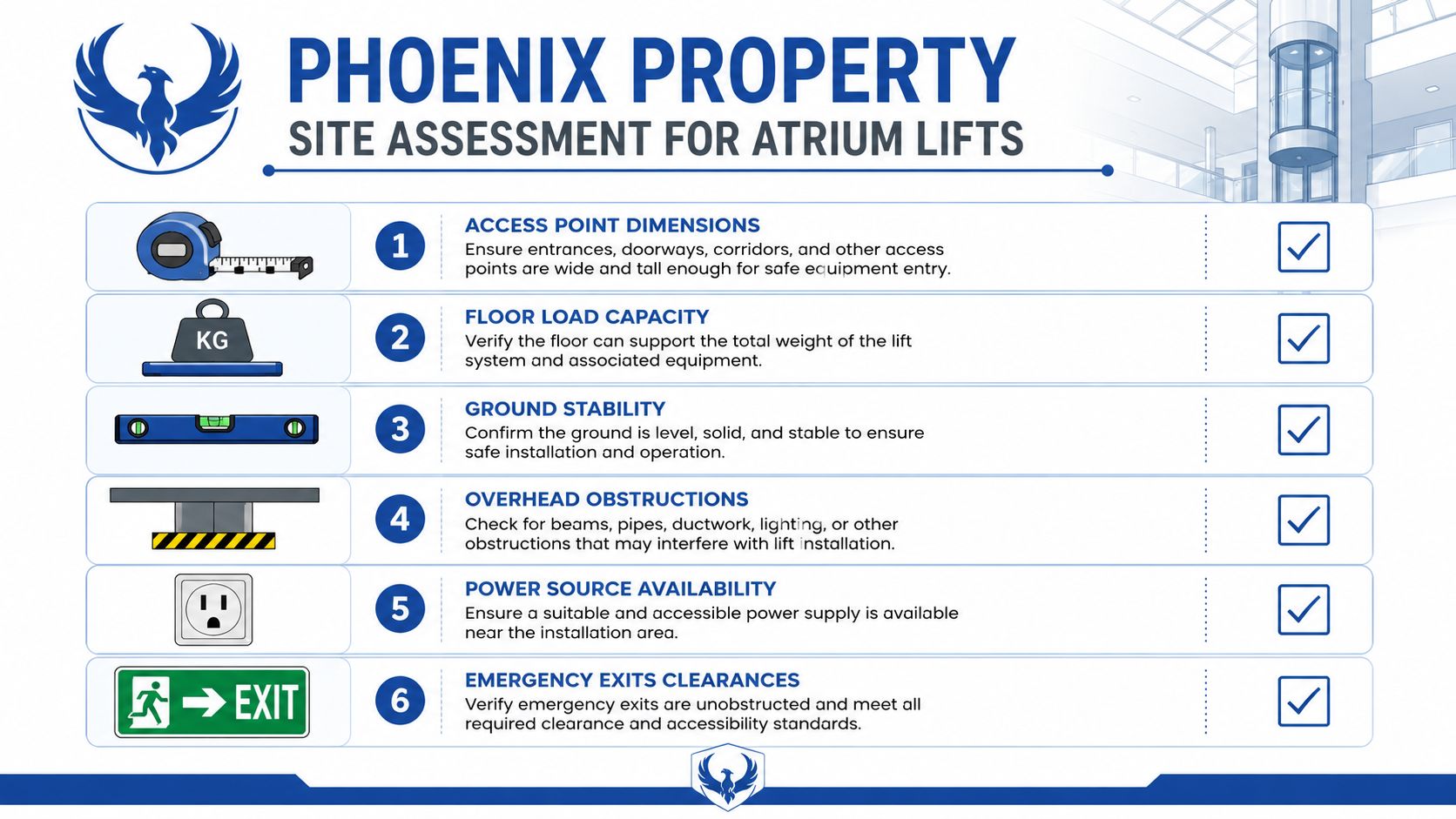
A proper site review needs to include the entire route, not just the smallest doorway. That means loading area, curb transitions, vestibules, corridors, turns, elevator lobbies if relevant, and the final work position.
A practical site review
Walk the route with a tape measure and a notepad. Don't rely on memory or old plans.
- Measure the pinch points: Check doors, glass entries, hallway turns, service corridors, and the final setup zone.
- Review the floor path: Marble, tile, decorative concrete, and raised interior areas all deserve extra scrutiny.
- Look overhead: Exit signs, hanging lights, soffits, security devices, sprinklers, and ceiling baffles can all interfere with boom articulation.
- Plan protection in advance: Floor coverings, corner guards, and route control should be decided before delivery day, not after the machine arrives.
- Check operational room: The lift may fit through the path and still lack enough room to stabilize and work.
Why compact doesn't mean harmless
Managers sometimes hear “narrow crawler” and assume it's automatically safe for any interior route. It isn't. Compact footprint improves access, but the machine still has weight, turning requirements, setup needs, and boom movement that can affect finishes and occupied spaces.
Here's a cleaner way to understand the matter at hand:
| Site question | Why it matters |
|---|---|
| Can it fit to the work area? | Delivery success doesn't matter if the last turn fails |
| Can the floor tolerate it? | Surface damage can cost more than the rental |
| Can it operate without blocking the building? | Tenant disruption changes the real project cost |
| Can it exit easily after the work? | End-of-day removal is often overlooked |
If your building team has to “make it work” after delivery, the planning happened too late.
Managers responsible for recurring exterior and common-area upkeep can benefit from a broader facilities planning framework like this commercial building maintenance checklist. Atrium lift work should fit into your maintenance system, not interrupt it.
The Essential Guide to Safety and Liability
Once you rent the machine, a lot of responsibility shifts onto your side of the project. That's the point many property managers underestimate. Equipment access is visible. Liability is not, until there's a damaged floor, an injured worker, or a tenant claim.
Indoor atrium work adds a specific risk profile because mistakes happen around finished surfaces, occupied areas, and constrained paths. Published guidance on atrium lift use notes that misjudging floor loading, path dimensions, and slope can lead to project delays or property damage, and that proper site planning and safety verification are essential, as described in atrium lift safety planning guidance.
The real risk isn't just the machine
Most problems don't begin with dramatic equipment failure. They begin with ordinary shortcuts:
- assigning the lift to a staff member who isn't properly prepared for that machine and site
- skipping route verification because “it should fit”
- assuming the rental company's delivery replaces operational responsibility
- overlooking how public access changes the work zone
- treating glass cleaning like a simple janitorial task instead of high-access work
That's why the legal concept of duty matters even outside construction-heavy environments. A plain-language explanation of duty of care explained by Mattiacci Law is useful here because it gets to the core issue. Once you know a hazard is foreseeable, ignoring it becomes much harder to defend.
Questions managers should ask before the rental starts
Use these as a minimum screen:
- Who is operating the lift? Make sure responsibility is assigned to a specific person, not a vague “maintenance team.”
- Who is controlling the work area below? Indoor lifts create pedestrian and tenant exposure as much as operator exposure.
- Who is responsible for surface protection? If this isn't assigned clearly, it usually gets missed.
- What insurance applies if the machine damages the building? Don't assume your standard coverage answers every equipment-related loss.
- What happens if the machine can't be used after delivery? Clarify responsibility for delays, return timing, and alternate access.
The expensive part of a lift mistake usually isn't the rental bill. It's the claim, the delay, or the damage to a visible part of the property.
Documentation matters more than people think
Before work starts, managers should review internal approvals, vendor insurance if a third party is involved, work-zone controls, and the exact scope of the task being performed aloft. If your organization is fuzzy on the difference between a company being bonded and being insured, this breakdown of bonded vs insured is worth reading before you sign off on work at height inside an occupied building.
A clean-looking plan isn't enough. It needs documented responsibility behind it.
How to Rent an Atrium Lift in Phoenix
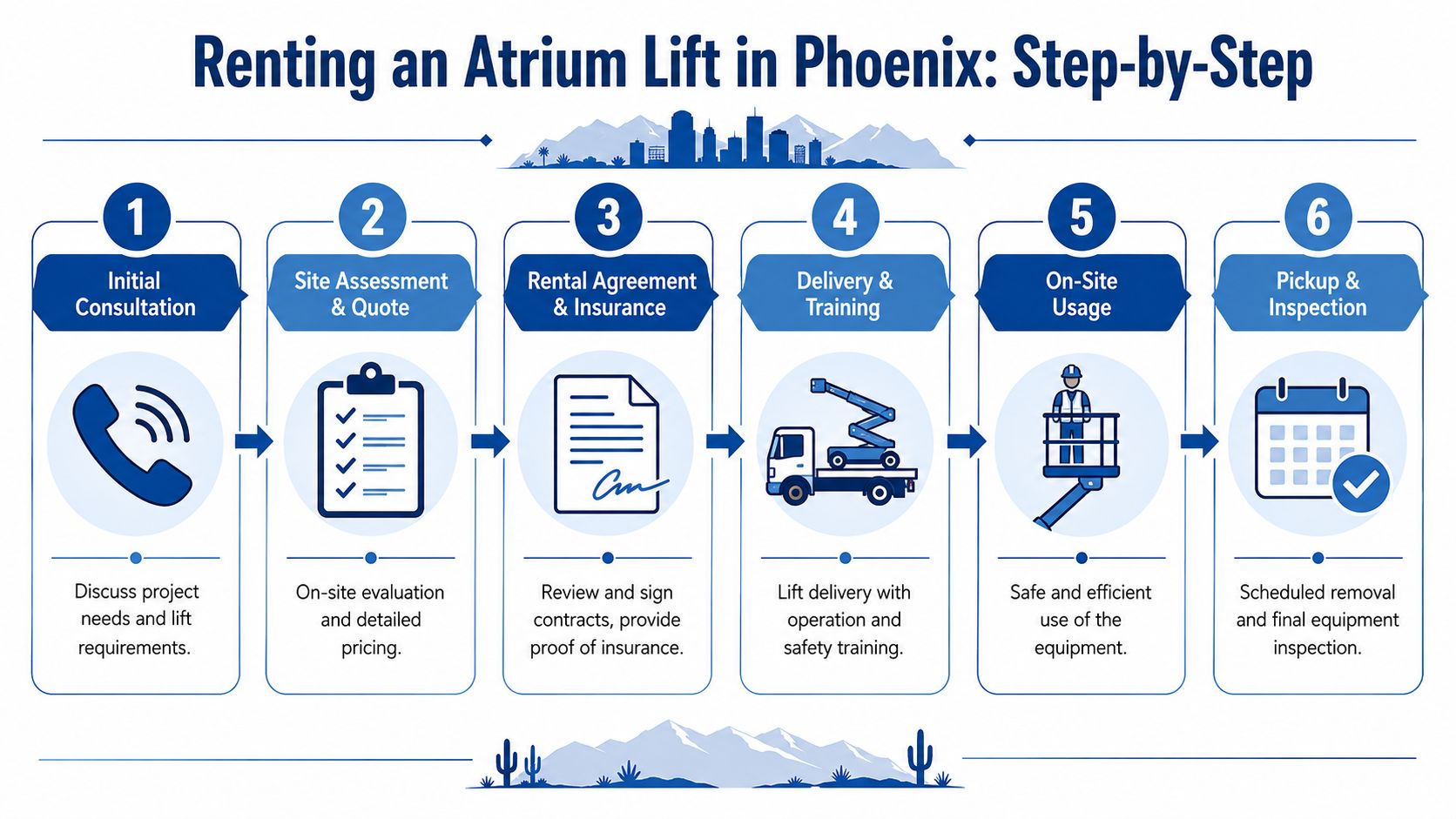
The rental process gets easier when you treat it like a coordinated project instead of a quick equipment order. Good atrium lift rentals start with accurate project information, then move through site confirmation, paperwork, delivery review, active use, and pickup planning.
If any of those pieces are rushed, the machine may still arrive on time and still become a headache.
A workable rental sequence
The cleanest process usually looks like this:
Define the task clearly
State what needs to be reached, whether the work is inside or outside, and what the basket must carry.Confirm the route and setup area
In this step, many bad rentals can still be avoided.Request the right machine category
Give the rental company useful constraints instead of vague height requests.Review the agreement slowly
Know what the rental includes, what triggers added charges, and who handles damage questions.Schedule around building operations
Delivery at the wrong time can create avoidable tenant conflict, loading congestion, and idle equipment time.Plan the return before the work begins
Pickup delays can become extra cost and extra disruption.
What to verify at delivery
Don't let your team “figure it out later.” Walk the machine before use and confirm that what arrived matches the job you planned.
- Model suitability: Is it the same machine type or equivalent configuration you expected?
- Access compatibility: Does the machine as delivered still fit the route you measured?
- Visible condition: Check for obvious damage, wear, leaks, or missing guards.
- Safety components: Verify that gates, controls, emergency functions, and decals appear intact and usable.
- Power and charging plan: Indoor electric units need a practical charging and staging plan.
- Work-zone timing: Make sure your team knows when the area must be cleared for setup and use.
Administrative details that affect the real cost
A rental agreement often looks manageable until the project stretches. Delayed access, tenant conflicts, rescheduled maintenance, or an unexpected route issue can all leave the machine sitting while the clock runs. That's why atrium lift rentals should be scheduled around actual building readiness, not hoped-for readiness.
For Phoenix managers, the smoothest jobs usually happen when glass cleaning, pressure washing, and high-reach access work are coordinated under one maintenance calendar instead of handled as isolated events. That same operating logic shows up in any well-run exterior service schedule. The machine should arrive when the site is ready, the crew is ready, and the exit plan is already set.
Atrium Lift Rental vs Hiring a Professional Crew
A Phoenix property manager rents an atrium lift to save money on a glass cleaning job. By the time the machine is delivered, building access has shifted, tenants are asking about blocked walkways, and the in-house team is waiting on direction. The lift is only one part of the job. The harder part is controlling downtime, liability, and finish quality from start to finish.
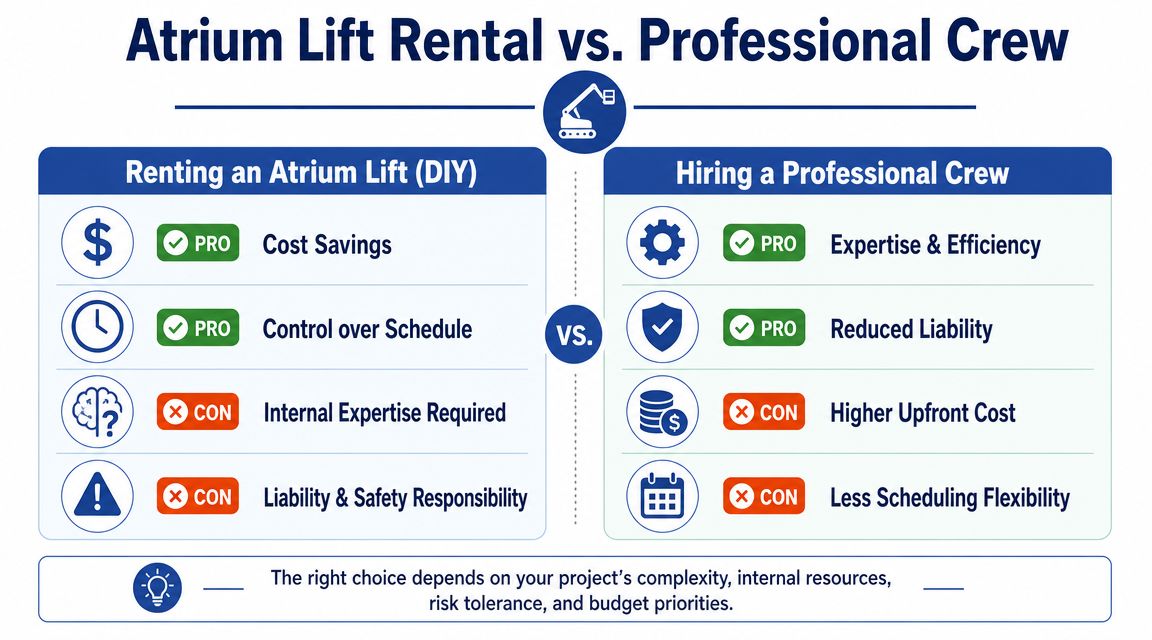
A self-managed rental can work under limited conditions. The route must already be confirmed, the operator must be qualified for that machine, and the task must be simple enough that access is the main challenge, not the cleaning or maintenance itself. Once those conditions slip, the savings on the rental line item can disappear into labor hours, delays, and avoidable risk.
Published rental guidance makes the same point. An atrium lift is not always the best solution for the work. The right access method depends on reach, site conditions, and overall cost compared with options like scaffolding, rope access, or a specialized crew, as noted in a complete guide to aerial lift rentals.
What DIY includes
The rental quote only shows part of the decision. A fair comparison looks at who is carrying the planning, the execution risk, and the responsibility if the job falls behind.
| DIY atrium lift rental | Professional crew |
|---|---|
| You choose the machine and accept the consequences if it is wrong for the space | They choose the access method based on the task and site conditions |
| Your team handles staging, schedule coordination, and site protection | Setup and work planning are part of the contracted scope |
| Internal staff time goes to oversight, vendor coordination, and problem-solving | Your team mainly provides access, timing, and building communication |
| Results depend on your operator and your cleaning process | Results depend on the crew's trade skill and production experience |
On paper, a rental can look cheaper. In operation, the better value often comes from the option that finishes the work cleanly, on schedule, and without creating a new problem for management to solve.
Where DIY usually loses efficiency
I've seen rental jobs drift off course in the same few ways. The machine arrives, but the work zone is not fully ready. The operator can run equipment, but not at the pace or finish standard the property expects. Or the property team spends so much time coordinating access, floor protection, tenant communication, and follow-up that the rental stops looking like a simple maintenance task.
That is the part many managers miss. You are not only renting reach. You are taking on more of the job management.
If the glass still needs touch-up, if interiors need cleanup, or if the machine sits for an extra day because access windows changed, those costs still belong to the project even if they never appear under one purchase order.
If your goal is finished glass with low disruption, access is only half the job. The other half is getting the result without tying up staff time or creating liability exposure.
When hiring the work makes more sense
Hiring a professional crew is usually the better call when the building is occupied, the interior finishes are expensive, or the schedule leaves little room for trial and error. It also makes sense when the assignment requires more than lifting a worker into place. High atrium glass, detailed frames, spotting, runoff control, and final presentation all depend on trade skill, not just equipment access.
That trade-off matters in Phoenix commercial properties. Managers are often balancing tenant experience, heat, scheduling restrictions, and appearance standards at the same time. In that setting, the lowest visible price is not always the lowest total project cost.
South Mountain Window Cleaning, LLC handles residential, commercial, and high-rise window washing. When the need is completed glass cleaning rather than running an access project in-house, a dedicated crew can reduce oversight, contain risk, and keep the responsibility with the contractor performing the work.
If you're weighing atrium lift rentals against hiring the work out, talk with South Mountain Window Cleaning, LLC before you commit to the machine. A direct site review can help you decide whether the job calls for a lift, another access method, or a fully managed window cleaning crew, so you can protect the property, reduce disruption, and get the glass cleaned right the first time.