
You walk out after an Arizona summer and see the same story written across the driveway: pale dust over the surface, dark oil beneath the parked car, tire marks near the garage, and leaves or mesquite debris caught along the edges. The instinct is understandable. Reach for the pressure washer, turn up the force, and blast everything clean.
That approach can make asphalt look worse while shortening the life of the surface. Effective asphalt driveway cleaning starts with chemistry, water control, and brushing. Pressure washing has a place, but it should be the second tool, not the automatic first choice.
Why Asphalt Driveway Cleaning Matters in Arizona
A Phoenix driveway deals with more than vehicle traffic. Low humidity dries dust into a hard film, intense sun bakes the pavement, haboob events deposit fine grit across every exposed surface, and monsoon storms push leaves, soil, and debris into cracks and low areas. After weeks of that exposure, the driveway may look merely dirty, but the buildup also hides early surface problems.
Oil spots deserve prompt attention because asphalt contains a petroleum-based binder. A fresh stain can soften the area, while grit worked into the spill adds abrasion under tires. Dust and organic debris also hold contamination against the surface, making stains harder to remove later. Cleaning gives you a better chance to spot loose edges, cracks, soft areas, and drainage trouble before those conditions become larger repair problems.
Arizona maintenance rule: Clean the driveway to inspect it, not only to improve its color.
Routine cleaning also supports the appearance of the entire property. A clean driveway frames the front entry, walkway, windows, and landscaping. Homeowners planning a broader exterior refresh can pair driveway care with resources for instant yard transformations for Phoenix, especially when dust and sparse landscaping make hardscape condition more visible.
Pressure washing can help on sound asphalt, but the wrong technique strips the surface layer that protects the aggregate underneath. A detergent-first method usually removes routine dust and light staining with less risk. If you're comparing exterior cleaning methods, the discussion of the benefits of power washing is useful, provided you distinguish durable surfaces from asphalt.
What Asphalt Is and Why It Dictates the Method
Asphalt is a bituminous composite, combining mineral aggregate with a petroleum-based binder. Its visible surface includes a thin, binder-rich layer that holds the small stones together and gives newer pavement its deep, even appearance.
That top layer functions much like sunscreen on skin. Removing it along with surface dirt exposes aggregate and speeds wear. A forceful jet may clear grime quickly, but it can also strip this protective material, especially under Arizona's intense sun and abrasive dust.
Two failure modes matter during cleaning. Aggregate loss occurs when small stones loosen and pull free. Binder exposure appears when darker, softer material beneath the surface becomes visible or tacky. Either problem can start with a nozzle held too close or stationary for too long.
That material structure explains why a bucket, detergent, and stiff brush often outperform brute force for routine maintenance. Chemistry breaks down oily and organic residue, while brushing lifts loosened soil. A controlled rinse then carries the debris away without concentrating damaging energy on one patch.
Older asphalt requires greater restraint. Sun exposure, vehicle turning, previous sealing, and existing cracks can make the surface less uniform than it appears. A driveway already shedding small stones or crumbling along its edges is a poor candidate for aggressive cleaning.
The practical rule is simple: remove contamination while preserving the pavement structure. Cleaning success depends on more than how quickly the surface turns dark. The aggregate should remain locked in place afterward.
The Core Cleaning Routine Step by Step
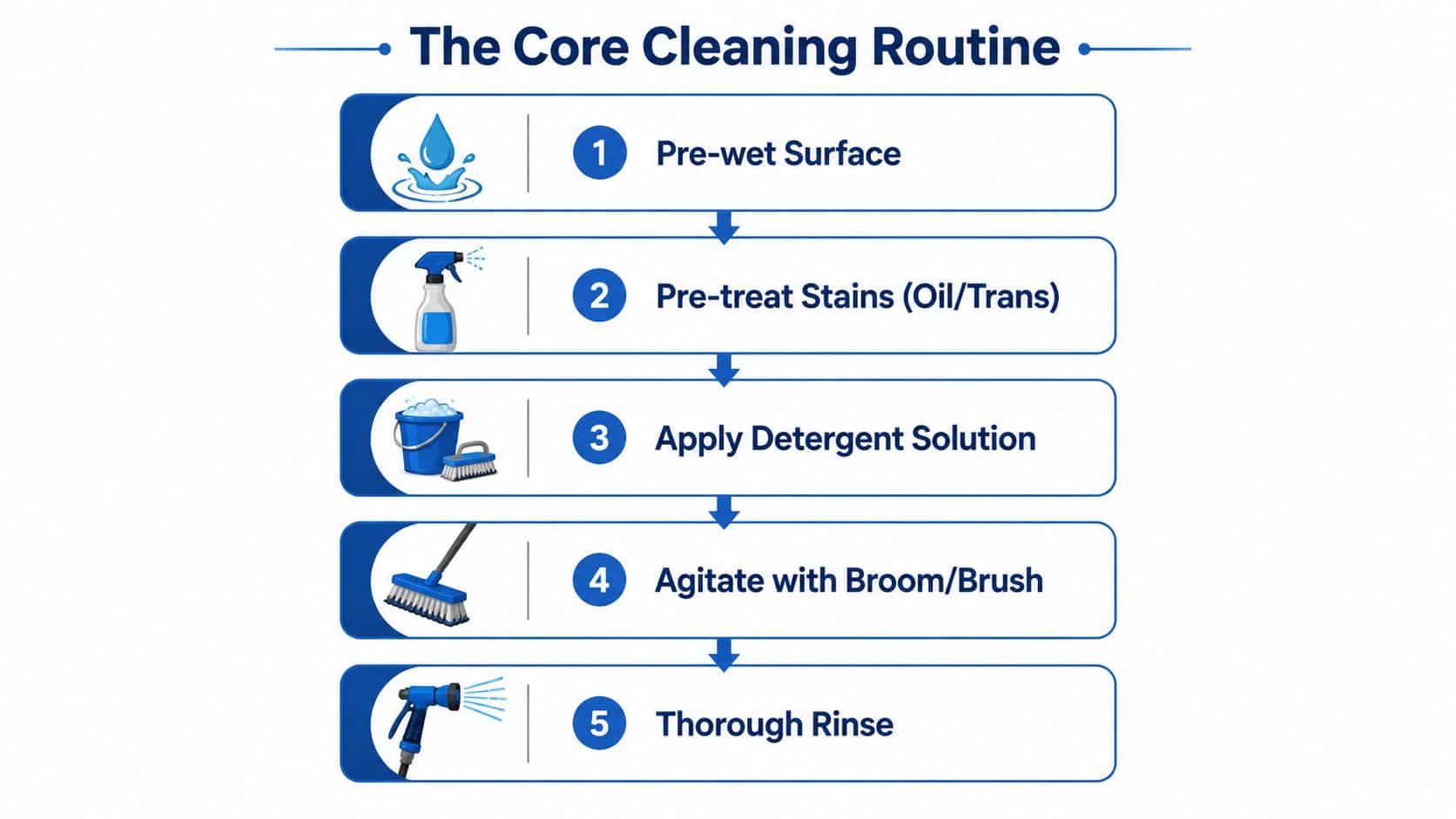
Arizona heat can dry cleaner before it has time to loosen grime, so start with surface preparation and work in small sections. Sweep away dust, leaves, gravel, and mesquite debris with a push broom or leaf blower. Keep loose material out of cracks and drainage openings. Dry removal prevents detergent from turning the debris into muddy slurry.
Pre-wet the asphalt with a garden hose. Damp pavement gives the cleaner time to work rather than allowing it to flash-dry. Avoid the hottest part of the day when possible, and keep each work area manageable.
Treat oil spots separately. Apply full-strength cleaner, allow about 10 minutes of dwell time, and prevent the product from drying completely. If the spot begins to dry, mist it lightly with water. The dwell period helps separate oily residue from the bituminous surface before brushing.
For the general wash, mix about 1.5 cups of cleaner per gallon of water, while following the product's asphalt-safety directions. Apply it with a pump sprayer, bucket, or low-pressure applicator. Agitate with a stiff nylon brush or push broom. This chemistry-and-brush approach provides controlled cleaning without concentrating a powerful jet on one patch.
Rinse with a regular garden hose and controlled flow. Direct water toward gravel, soil, or landscaping, not a storm drain. Water those absorbent areas in afterward so runoff does not pool or carry loosened cleaner across the property.
A Saturday routine that works
- Sweep first: Remove dry grit and organic debris.
- Pre-wet: Slow evaporation and keep cleaner active.
- Treat oil: Use full-strength cleaner for about 10 minutes.
- Wash and scrub: Apply diluted solution and use a stiff brush.
- Rinse responsibly: Send water toward absorbent ground and water it in.
If a garden hose and brush cannot handle the buildup, review this guide to pressure washing a driveway before selecting equipment. The goal is controlled cleaning that preserves the asphalt's bitumen-rich top layer, not maximum force.
Hand Scrubbing vs Pressure Washing When to Use Each
For ordinary Arizona dust, pollen, light oil haze, and surface dirt, hand scrubbing is the safer default. It takes more physical effort, but the operator can feel changes in the surface and adjust immediately. A brush also spreads cleaning action across a wider area, unlike a narrow jet that can cut stripes into the pavement.
Pressure washing earns its place when grime is compacted, tire marks are ground in, or an intact surface needs preparation before sealing. Even then, expert guidance recommends keeping pressure around or below 1,300 PSI, using a wide fan nozzle, and moving the wand continuously. See the trade-offs at a glance:
| Criterion | Hand Scrubbing | Pressure Washing |
|---|---|---|
| Surface preservation | Low mechanical risk when paired with asphalt-safe cleaner | Higher risk if the jet is too close, narrow, or stationary |
| Routine dust and pollen | Effective and usually sufficient | Often unnecessary |
| Ground-in grime | May require repeated passes | More effective on sound asphalt when carefully controlled |
| Time and equipment | Slower, inexpensive, and accessible | Faster on large areas, but requires equipment and technique |
| Existing cracks and weak edges | Easier to avoid | Can widen cracks or loosen edges |
| Pre-seal preparation | Suitable for light contamination | Useful when the asphalt remains structurally intact |
The decision changes when you see raveling, pitting, exposed stones, crumbling edges, or a soft patch. Those signs indicate that the surface may not tolerate high-energy rinsing. In that situation, cleaning should be gentle, and repairs or sealing decisions should come before equipment selection.
A pressure washer isn't automatically a professional solution. The difference between power washing and pressure washing matters less than matching the equipment, nozzle, distance, and technique to the material beneath it.
Removing Common Stains Without Damaging the Surface
Different stains need different chemistry. Scrubbing harder with one universal cleaner often wastes time and increases surface stress.
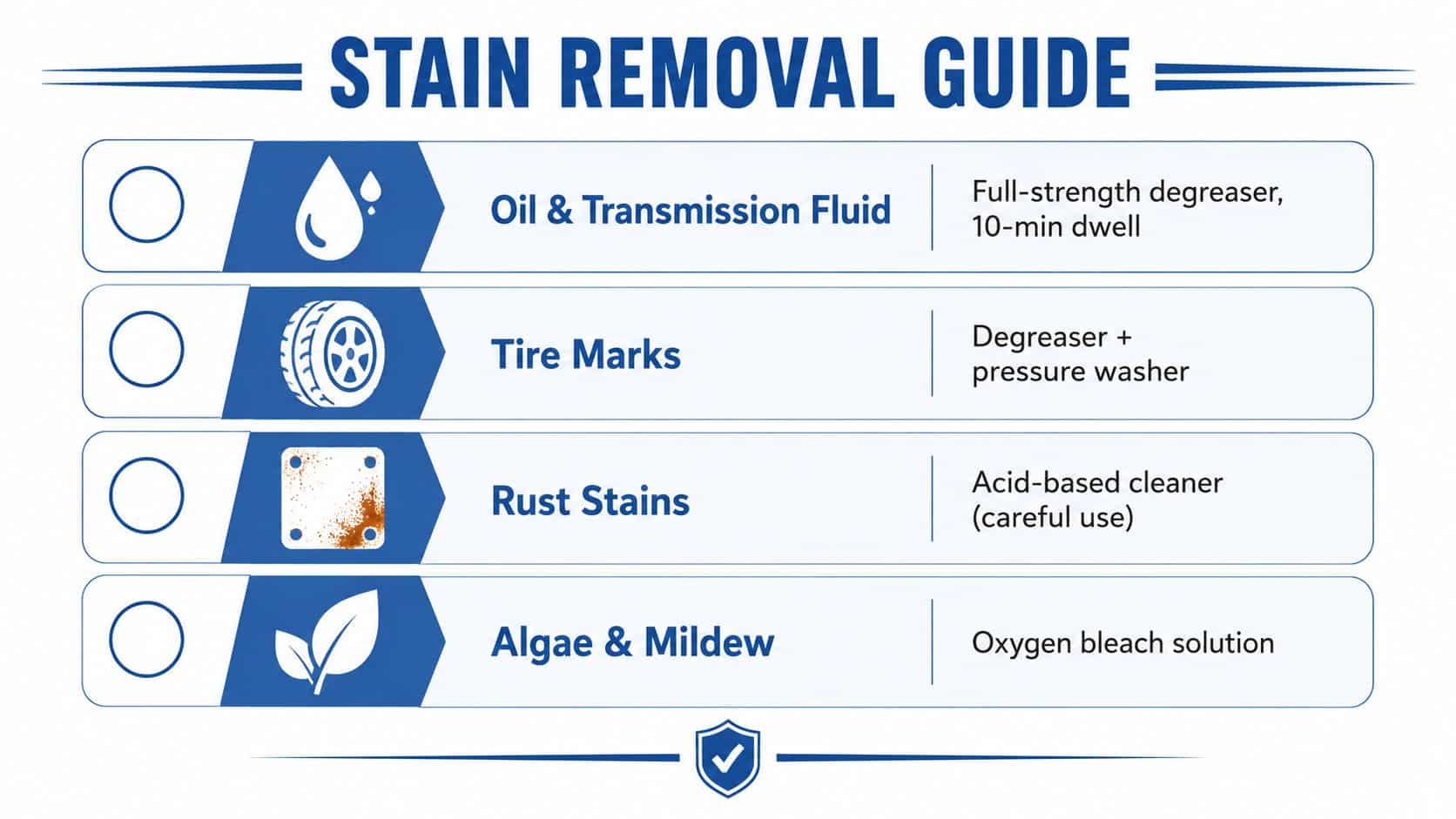
Oil and transmission fluid call for full-strength degreaser on the affected spot, followed by about 10 minutes of dwell time and firm brushing. Repeat rather than immediately increasing pressure. A successful treatment lightens the dark halo and removes the slick feel. If the asphalt remains soft, glossy, or discolored after cleaning, the contamination may have altered the binder rather than sitting on top.
Rust from sprinklers, metal furniture, or irrigation hardware needs an oxalic-acid-based remover suitable for asphalt. Apply carefully, follow the label, and neutralize afterward so residual acidity doesn't continue reacting with the binder. Improvement means the orange or brown discoloration fades without a pale etched ring. If the mark barely changes, stop experimenting and consider professional stain treatment. Guidance on removing rust stains from concrete can help explain why rust chemistry differs from oil cleaning, though asphalt still requires material-specific caution.
Tire-skid marks usually respond to hot water, detergent, and a stiff brush. Start gently and work across the mark rather than scrubbing one small point until the surface changes texture. Success looks like a gradual reduction in the black transfer mark while the surrounding asphalt stays uniform. If the mark is a worn or polished section of pavement, cleaner won't restore the lost texture.
Leaf and mesquite tannin stains respond better to oxygen bleach than chlorine bleach. Oxygen-based products can break down organic discoloration with less risk of lightening or weakening the asphalt. The stain should fade progressively after dwell time and brushing. If organic residue has remained through repeated wetting and intense sun, it may leave a permanent shadow.
For related vehicle-care problems, the principles behind removing tar from car paint reinforce an important rule: use targeted chemistry and patience rather than escalating force.
Pressure Washing Safety and the PSI Ceiling
More pressure doesn't automatically mean a cleaner driveway. A concentrated jet can remove the bitumen-rich surface layer, loosen aggregate, create streaking or striping, produce pitting, and worsen cracks. Once the surface stones pull free or an edge breaks away, cleaning can't reverse that damage.
Keep the pressure around or below 1,300 PSI, use a wide fan nozzle, and keep the wand moving continuously, as recommended by asphalt surfacing guidance at Premier Surfacing. Treat that figure as a ceiling for careful work, not as a target you must reach. A lower setting may be appropriate for an older or visibly weakened driveway.
A practical safety check
- Wear protection: Use closed-toe shoes and eye protection.
- Control distance: Keep the nozzle about 8 to 12 inches from the surface.
- Protect joints: Never aim directly at expansion joints, crack edges, or crumbling borders.
- Control the area: Don't spray toward anyone standing nearby, vehicles, doors, or unprotected windows.
- Watch the rinse: Stop if water begins jetting into existing cracks or pooling against the structure.
Stop immediately if chunks of aggregate lift, edges crumble, or the surface develops stripes. Those aren't signs that you need more passes. They're warnings that the cleaning method is exceeding what the asphalt can handle.
Arizona heat can also soften pavement and make surface damage easier to create. Work when the asphalt is cooler, keep sections small, and let the detergent do more of the work.
Arizona Climate Frequency and a 12-Month Maintenance Plan
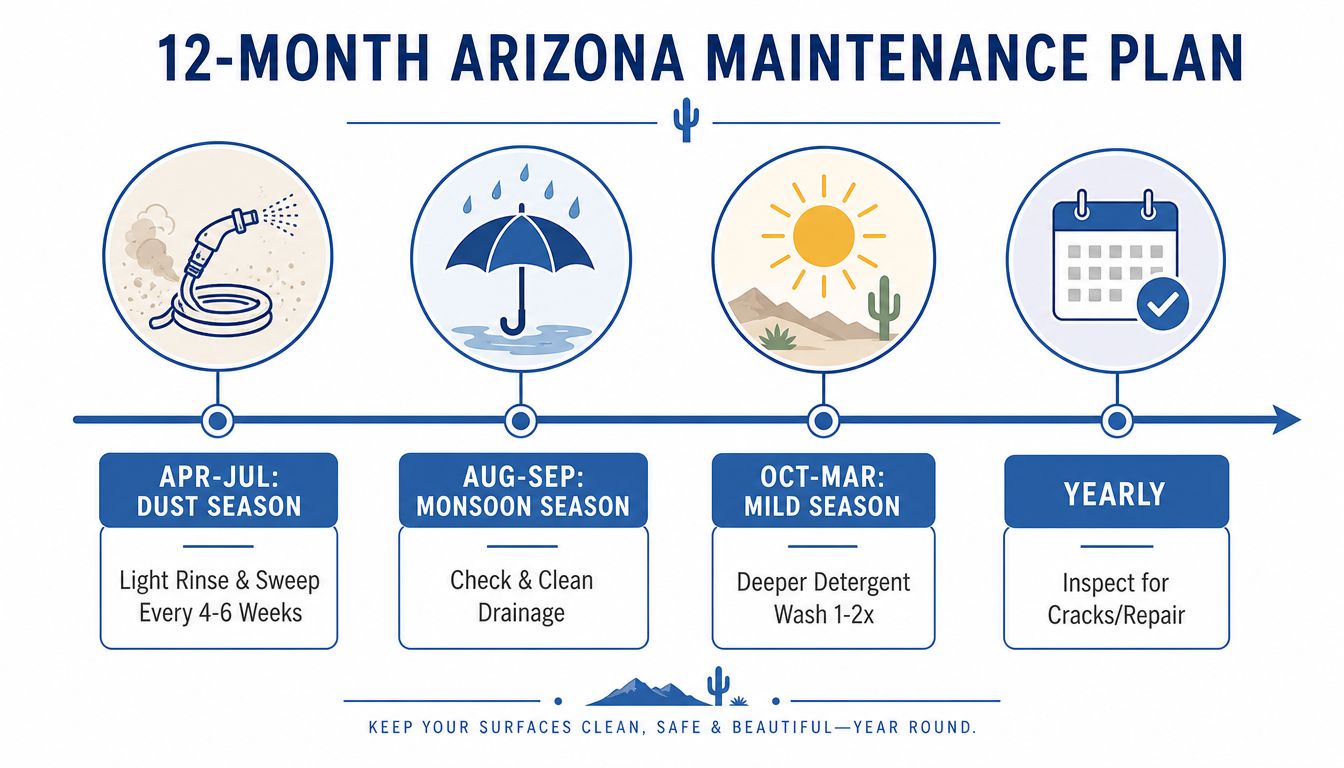
A Phoenix-area maintenance plan should respond to dust, sun, pollen, and monsoon debris rather than follow a rigid national schedule. During dust season, from April through July, a light rinse and sweep every 4 to 6 weeks helps prevent grit and organic matter from becoming a bonded film. Choose cooler parts of the day so the cleaner has time to work.
Monsoon runoff deserves its own inspection. Water can move soil and leaves onto the driveway, then leave damp debris along edges and low spots. Clear those areas after storms and confirm that runoff doesn't remain pooled against the asphalt.
The annual rhythm
- April through July: Sweep and lightly rinse every 4 to 6 weeks as dust accumulates.
- Spring: Perform a deeper detergent wash and inspect cracks, edges, and drainage.
- Late summer and monsoon season: Remove storm debris, check runoff paths, and clean trapped organic matter.
- Fall: Complete another deeper detergent wash before cooler conditions and seasonal debris settle in.
- Across the year: Inspect for cracks and soft areas, especially after heavy weather or visible surface changes.
- Every 2 to 3 years: Plan a full clean-and-seal cycle when the surface is sound and ready for protection.
Sealing requires patience after cleaning. Many recommendations use 24 hours, but 24 to 48 hours is the safer window in humid conditions or after a deep wash, as noted in asphalt-maintenance guidance from Asphalt Kingdom. The pavement must be dry enough for the sealer to bond. Rushing that stage can trap moisture and undermine the finish.
When to Call a Pro and How It Ties to Curb Appeal
DIY cleaning makes sense when the asphalt is intact, the stains are limited, drainage is clear, and you can work safely with a brush and hose. Call a professional when the driveway has a network of large cracks, crumbling edges, soft spots, or standing water. Cleaning won't solve a base problem, and pressure can expose it faster.
Professional help also makes sense when the driveway is part of a larger exterior project. A coordinated visit may include walkways, house washing, windows, solar panels, or other flat surfaces, so the property presents a consistent finish instead of a clean driveway beside dusty glass and stained walls.
South Mountain Window Cleaning, LLC serves residential, commercial, and high-rise properties in Phoenix, Scottsdale, Paradise Valley, Chandler, Tempe, and Gilbert. Its broader exterior-cleaning work includes flat-surface pressure washing, house washing, window cleaning, gutter cleaning, rust removal, and solar panel cleaning. For high-rise work, access must be planned and supervised by competent people under the Work at Height Regulations 2005, while U.S. suspended-access projects must follow applicable OSHA requirements.
Print this before starting
- Equipment: Push broom, asphalt-safe cleaner, measuring cup, stiff nylon brush, hose, gloves, eye protection, and closed-toe shoes.
- Surface cues: Stop for loose aggregate, pitting, soft pavement, crumbling edges, or water entering cracks.
- Drainage cues: Call for help if rinse water pools or cannot reach absorbent ground.
- Project cues: Choose a pro for major crack repair, clean-and-seal work, or a driveway bundled with roofs, walls, walkways, and windows.
A clean driveway improves first impressions, but preserving its structure matters more than creating a quick, dark appearance.
South Mountain Window Cleaning, LLC provides residential, commercial, and high-rise exterior cleaning across Phoenix, Scottsdale, Paradise Valley, Chandler, Tempe, and Gilbert, including careful driveway and flat-surface washing. Visit South Mountain Window Cleaning, LLC to request a quote and coordinate driveway cleaning with window, house, walkway, or solar-panel service.