
A gutter can look clear from the driveway all spring, then spill over its front edge when the first hard summer storm reaches a Phoenix home. Fine dust and windblown debris may have left the trough looking almost empty, while silt blocks the outlet, an elbow, or the drain beyond the downspout. The water has nowhere to go but over the edge.
That's why aluminum gutter cleaning is about keeping roof runoff moving, not making the metal shine. The right check looks beyond the visible channel: it follows water through the outlet and downspout to the place it's meant to drain. Knowing what overflow tells you, when desert weather calls for attention, and when a job is safer for a professional can help you protect a home or commercial property.
Why a Clean Gutter Still Overflows
After months of dust, the trough on a Scottsdale or Chandler home may look clear from the ground. Then rain hits the roof, gathers grit from the shingles, and rushes toward the gutter. If the downspout opening is packed with debris, or the buried drain beyond it is blocked, water can back up and pour over the front.
The spill can leave marks on the gutter face, siding, and ground below. It can also send water toward areas where you don't want it collecting. A stain or overflow isn't proof of one particular fault, but it's a reason to check the system's path from roof edge to discharge point.
Follow the water, not just the debris
Start by separating what looks clean from what drains correctly. The trough can be free of leaves and still fail because the outlet, an elbow, or a receiving drain is clogged with silt. On a property with buried drainage, water leaving the downspout may still have nowhere to go.
A useful check includes the roof valleys, gutter channel, downspout opening, visible elbows, and the place where water exits. Look for staining, standing water, sagging sections, or soil erosion near the discharge point. Those signs help identify where runoff may be escaping or slowing down.
Practical rule: A clean-looking trough isn't proof of a working drainage system. Follow the route water takes.
Decide what the condition calls for
Some work is straightforward from a stable ladder: removing dry leaves or loose plant debris from an accessible, single-story run. A blocked downspout that won't clear, a loose hanger, a leaking corner, or a roof that's difficult to reach changes the job. So does unsafe weather. Don't climb during a storm or when wind makes ladder access uncertain.
For homes and commercial properties alike, the aim is to clear debris, inspect the parts that hold and carry water, and verify that runoff reaches its intended destination. That's more useful than judging the job by how bright the gutter looks from the street.
How Long Aluminum Gutters Really Last
After a dusty Phoenix summer, an aluminum gutter may look fine from the ground. Then monsoon rain arrives, and water spills over because a downspout or receiving drain is blocked. Age matters, but a gutter's service life also depends on how it is installed, exposed, and maintained.
The National Association of Home Builders' 2007 Study of Life Expectancy of Home Components estimated an average service life of about 20 years for aluminum gutters and 30 years for aluminum downspouts (service-life estimates for aluminum gutters and downspouts). An InterNACHI chart gives a broader expected range of roughly 20 to 40 or more years, reflecting differences in installation, climate, exposure, and maintenance.
Treat those estimates as planning guides, not a deadline. A well-maintained gutter may last beyond an average estimate, while one with poor support or neglected blockages can develop problems sooner. Cleaning removes debris that adds weight and can hold water, but it cannot stop aging.

Look for mechanical wear
Aluminum does not fail like ordinary iron or steel. Look for loose hangers, cracked corners, failed sealant, dents, fading, and deformation. Wet debris adds weight to the channel. A blocked downspout can also keep water from draining, even when the trough itself appears clean.
Valley sun and changing temperatures put added strain on a system. Repeated expansion and contraction can affect joints, while ultraviolet exposure can wear finishes. A sound-looking surface cannot confirm that hangers are secure or that water is draining properly.
Use service life to guide decisions
As you assess an older system, distinguish routine cleaning from signs that may call for repair or replacement. Repeated sagging or leaks can signal a condition that cleaning alone will not fix. If you're comparing repair with replacement, this guide to seamless gutter costs can help frame the decision.
Use service-life estimates to plan inspections and maintenance, not to assume cleaning will preserve aluminum forever.
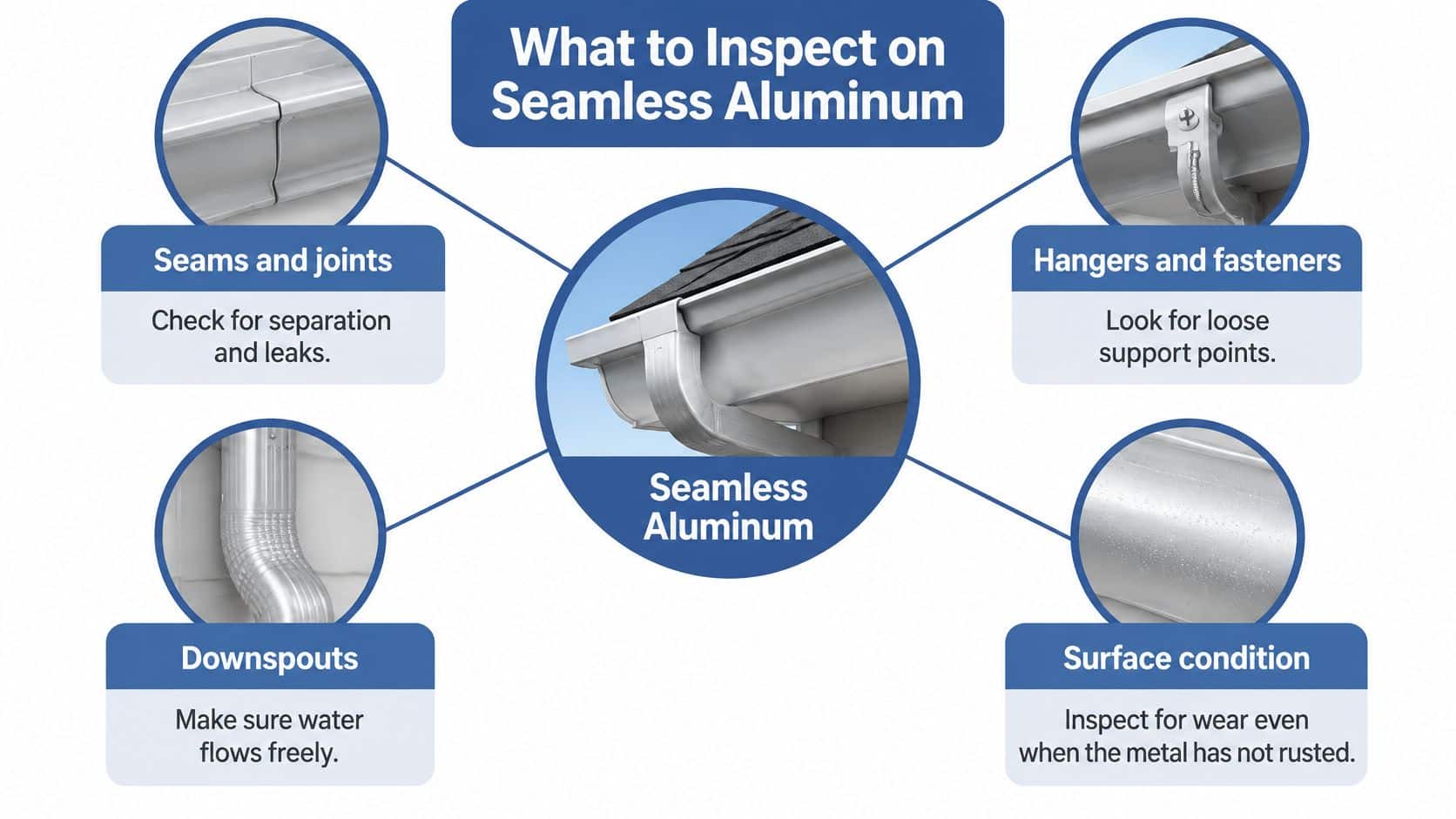
What to Inspect on Seamless Aluminum
Aluminum became a major gutter material after World War II because it was lightweight, durable, and more widely available than before. Its use grew in the 1960s, when portable forming machines let installers shape continuous gutters on site. That history matters because it helps explain where to look for trouble.
Older sectional systems commonly joined 10- or 20-foot pieces with caulk or solder. Temperature changes, heavy rain, and debris could stress those connections. Continuous systems reduce the number of joints, leaving corners and downspout connections as important places to inspect. Aluminum's rust resistance and malleability make a rusty-steel checklist the wrong model.
Work through the parts in order
Start with the channel and outlet. Check for debris that can obstruct flow, then look for dents that may hold water or affect the route to the downspout. A gutter can be free of rust and still drain poorly.
Check the supports. Look for loosened hangers and fasteners, especially where the gutter appears to pull away from the fascia. A sagging section can change the slope and interfere with drainage.
Inspect corners and end caps. Failed sealant or a separated joint can leak even when the rest of the metal looks sound. Heat-related movement can also put stress on these connections.
Notice movement and deformation. A section that seems uneven or pulled out of line deserves a closer look. Don't try to force it back into place while cleaning.
A homeowner or property manager can take a few useful photos from a safe position: uneven-looking hanger spacing, an open end cap, a separated corner, or an outlet that doesn't appear to pass water. Those pictures can help track a change over time or show a technician where to inspect.
A Dust and Monsoon Cleaning Calendar
A gutter can look clear from the ground and still overflow when a Phoenix storm hits. Dust can settle in the channel, then wash toward an outlet, downspout, or buried drain that is already blocked. A basic “clean twice a year” schedule can miss that dust-then-monsoon pattern. Phoenix's monsoon season runs from June 15 through September 30, with storms peaking from mid-July through mid-August. The city advises clearing roof drains, scuppers, drainage grates, catch basins, and drywells before storms (Phoenix monsoon preparation guidance).
Make checks fit the weather
Before the first monsoon: Clear the channel and check the outlet, downspout, and route runoff takes away from the building. Follow the water's path past the roof edge. A buried drain or catch basin can be blocked even when the gutter looks clean.
After a major dust storm: Wait until surfaces and access routes are safe. Then check for fresh dust, plant debris, and other storm material. Rain may wet the deposits without flushing them through the system.
After the season: Look for debris, loose supports, damaged corners, or signs of overflow. This check helps identify issues that arose during the storm period, rather than repeating a calendar appointment.
At applicable larger developments, Phoenix also expects maintenance planning and inspection for private stormwater controls. Debris and silt can contribute to erosion, flooding, structural damage, and water-quality problems. Gutter cleaning is one part of site drainage maintenance.
During a property walk-through, follow the water beyond the gutter: check downspout discharge, buried drains, roof valleys, splash blocks, scuppers, and any water sitting near the foundation. That route works like a chain. A blockage at the downspout or receiving drain can stop the whole system, even if the trough itself is clear. For additional scheduling guidance, review the best time for gutter cleaning.
For an HOA or commercial property, record inspection dates, photos, storm damage, and repairs. These records show what was found and corrected, and help teams judge drainage performance instead of scheduling cleanings without checking the result.
Choosing DIY or Professional Gutter Cleaning
A Phoenix gutter can look clear from the ladder and still overflow in the next storm. Dust settles in the trough, then monsoon rain pushes it toward a downspout or receiving drain that may be blocked. Choose DIY or professional help based on access, debris, and whether water can leave the system.
DIY may suit a single-story run with stable access and ordinary dry leaves or plant material. A high roof, difficult reach, stubborn downspout blockage, or sharp and contaminated debris calls for more caution. Phoenix emergency guidance warns that monsoon storms can bring heavy rain, high winds, flash flooding, and dust storms. Dust walls can arrive suddenly, with gusts commonly reaching 40–60 mph. Runoff may also carry pollutants that can harm skin, eyes, and ears (Phoenix emergency information). Keep off roofs and ladders during unstable weather. Wait for safe surfaces and access routes.
| Situation | Reasonable DIY job | Better as a professional visit |
|---|---|---|
| Access | A single-story run reachable with a secure ladder on stable ground | A two-story roof, difficult access, or commercial building |
| Debris | Dry leaves and loose plant material | Contaminated sediment, animal waste, or sharp storm debris |
| What you find | The channel clears and water flows normally | Loose hangers, leaks, damaged corners, or a downspout that won't clear |
| Weather | Calm, dry conditions and safe access | Unstable monsoon weather or unsafe surfaces |
Before setting a ladder, review safe gutter-cleaning practices. Never rest it against a thin gutter or reach sideways to avoid moving it. If a hanger feels loose, or a blockage won't clear without force, stop.
South Mountain Window Cleaning is a licensed, bonded, and insured Valley company serving Phoenix, Scottsdale, Paradise Valley, Chandler, Tempe, Gilbert, and nearby communities. Its exterior services include gutter cleaning, window washing, and house washing. The company describes its technicians as safety-trained and offers a 100% satisfaction guarantee, free quotes online or by phone, and computerized scheduling for businesses.
The choice involves more than ladder time. DIY carries fall risks and can damage a gutter if you scrape too hard. Hiring help also gives a professional a chance to identify a loose joint or hanger that could otherwise go unrepaired. If the trough looks clean but water still backs up, the downspout or receiving drain may be the underlying problem. Choose the option that matches the access and condition, and don't risk a fall to force a blockage clear.
Tools and Cleaners That Protect Aluminum
After a Phoenix dust storm, a gutter can look clean from the ground while grit remains in the channel. Use gentle tools and cleaners to protect the aluminum finish, then remember that a clear-looking trough does not prove the outlet or receiving drain is open.
Aluminum has a thin oxide film that helps protect its surface. Strong acids, caustic alkaline degreasers, and long chemical dwell times can damage that layer. Technical guidance describes a comparatively stable range of pH 4 to 9 (technical guidance on aluminum corrosion and cleaners). For baked-on desert dust, more chemical strength is not necessarily a better fix.

Use a gentle sequence
Begin with a gutter scoop or small trowel to remove leaves and shingle grit. Brush out remaining debris before adding water. Choose a cleaner labeled for aluminum, and test it in a hidden spot if the gutter is painted or factory-finished.
Keep the cleaner on the surface only as long as its label directs, then rinse thoroughly. A second pass with a brush is a safer choice than stepping up to a harsher product. For more on protecting metal surfaces from corrosion, read this guide to rust prevention for metal.
A bucket, low-pressure hose, stable ladder, gloves, and eye protection cover basic cleaning needs. Avoid aggressive scraping, which can mark the finish. Do not bend hangers or rest a ladder against the gutter, since either can damage the gutter or nearby roof materials.
Chloride can work through weak spots in aluminum's protective layer and contribute to localized pitting. Technical surface-finishing guidance says concentrations around 100–150 ppm, especially with other contaminants present, can contribute to pitting, and higher concentrations make it more likely. It also advises against using chlorinated city water for the final rinse when aluminum corrosion is a concern (technical guidance on aluminum surface finishing and corrosion). Use a compatible solution, prevent dirty cleaner from drying on the metal, and rinse completely with low pressure.
The video shows a gutter-cleaning example. Use it as a visual reference, not a replacement for safe ladder setup or the cleaner's directions.
After cleaning, separate removable dirt from surface damage. Coating failure, chalking, pits, pinholes, and seam deterioration will not be fixed by more scrubbing. They may need repair or replacement. A clear channel can still overflow if the downspout or the drain receiving its flow is blocked.
Prove the Downspout Works Then Book Help
After a dusty stretch in Phoenix, a gutter can look clear and still spill over when monsoon rain arrives. The trough is only the first part of the route. Water must pass through the outlet and downspout, then flow away at the discharge point. A municipal gutter-and-downspout specification includes a flowing-water test and requires the finished system to be clear of debris (gutter and downspout flow-testing specification).
Check the full route
Run water into the gutter and follow it from end to end. It should reach the outlet, move through the downspout, and leave at the splash block, drain, or intended discharge point. Watch corners and connections for water that slows, backs up, or spills over. A visual check alone may not reveal a blockage inside the pipe.
If water stalls, avoid forcing high pressure against thin gutter joints. Stop if the outlet, seam, or downspout appears damaged, and arrange a closer inspection. The goal is steady drainage through the whole system, not just water running into the downspout.
Property managers can record what condition you found, what risk it created, and what was safely corrected. For example, noting a loose seam or a downspout that failed the water test gives the next person a useful record. “Gutters cleaned” does not explain whether the water had a clear path.
Homeowners and managers in Phoenix, Scottsdale, Paradise Valley, Gilbert, Chandler, Tempe, and elsewhere in the Valley can request a free quote from South Mountain Window Cleaning online or by phone. Ask for gutter clearing and a downspout water test before the next monsoon period.
South Mountain Window Cleaning, LLC provides residential, commercial, and high-rise window washing in Phoenix, Scottsdale, Paradise Valley, Chandler, Tempe, and Gilbert, as well as exterior cleaning that includes gutter cleaning. Ask for gutter clearing and downspout-flow verification when requesting a free quote.