
The global pressure washer market was valued at $3.28 billion in 2024, according to Jobber's industry statistics. That's equipment, not a measure of cleaning-service wages. Owning a machine and qualifying for pressure washing jobs are different things: employers need people who can clean a surface, control the wastewater and recognize when the work is unsafe.
If you're considering applying, start by choosing the responsibility you're ready to carry. Running a wand is only part of the day. Setup, customer communication, drain protection and equipment inspection all affect whether a crew finishes the job properly.
Pressure Washing Job Roles at a Glance
| Role | Typical duties | Core skills | Common setting |
|---|---|---|---|
| Residential technician | Driveways, siding, decks, patios and house washing | Ladder safety, chemical mixing and customer communication | Homeowner accounts and route work |
| Commercial crew member | Parking lots, dumpster pads, storefronts and drive-thrus | Traffic awareness, wastewater containment and crew coordination | Scheduled contracts with property managers |
| Flat-surface specialist | Concrete, pavers, decks and sealing preparation | Surface assessment and nozzle and pressure selection | Contractors and landscape firms |
| Estimator or route lead | Site walks, quotes, scheduling and supervising crews | Measuring areas, bid pricing and job documentation | Growing companies and multi-crew operators |
| Owner-operator | All field duties plus marketing, insurance and billing | Business management and knowledge of licensing and insurance | Independent or small local business |
Residential work is often route-based, with different homes and relatively short assignments. You need to explain what can be cleaned without promising to remove permanent discoloration. Commercial work usually involves scheduled site visits, access restrictions and documented wastewater procedures. A restaurant entrance, for example, requires coordination with staff so customers don't walk through hoses or wet work areas.
Technicians can move between roles as their judgment improves. A reliable crew member might begin measuring jobs, then supervise a route; ownership adds responsibility for claims, collections and disposal costs. The U.S. pressure-washing-services industry generated an estimated $1.2 billion across approximately 32,193 businesses in 2024, according to IBISWorld, a fragmented setting where small operators may hire employees or subcontractors as their workload grows.
Choose the responsibility before the title
Don't treat high-level exterior cleaning as an automatic promotion. Explore the separate access and training demands of high-rise window washing jobs before pursuing that path.
Use this fit test:
- Work pattern: Do you prefer repeat routes or one-off projects?
- Site conditions: Are you comfortable with properly supervised ladder work and assignments near traffic lanes?
- Financial responsibility: Would you rather earn an hourly wage or carry the margin, overhead and risk of your own work?
For a beginner, supervised residential or commercial crew work is a stronger starting point than buying equipment and immediately selling unfamiliar services.
What Pressure Washing Jobs Pay
BLS wage categories do not isolate pressure washers. The closest listed comparison is building cleaning workers, all other: its mean wage was $22.32 per hour, with 17,210 jobs nationally, according to the Bureau of Labor Statistics wage material. Treat it as a broad benchmark, not a pressure-washing pay scale or an Arizona rate.
| Measure | Hourly | Annual | Context |
|---|---|---|---|
| Mean wage, building cleaning workers, all other | $22.32 | $46,420 | BLS 2025 profile, 17,210 jobs nationally |
| Median wage, building cleaning workers, all other | $21.17 | $44,030 | Half of workers earn more; half earn less |
| 90th percentile, building cleaning workers, all other | $30.78 | $64,020 | Upper-end benchmark, not an experience guarantee |
| Mean wage, broad building-cleaning and maintenance group | $19.01 | $39,540 | May 2024, about 4.5 million workers |
| U.S. all-occupation average mean wage | $32.65 | $67,920 | National comparison benchmark |
The broad building-cleaning and maintenance group had a lower annual mean wage than the all-occupation average. Use these figures to frame an offer, not predict your pay: location, employer, schedule and assigned duties all matter.
Compare the responsibility behind the rate
Commercial-site experience, equipment competence and supervisory duties can strengthen an application. Employers also value workers who can keep pedestrians clear and recognize when wash water needs containment. Cleaning speed alone does not cover those responsibilities.
Arizona heat and seasonal scheduling affect the hours attached to a rate. Ask about heat precautions, training and schedule consistency before comparing offers. A higher hourly figure may be less attractive if setup time is unpaid or work is irregular.
Pay comparison rule: Compare paid time and assigned responsibilities, not just the hourly number.
Owner-operators earn from margin rather than wages. Travel, chemicals, insurance, maintenance and disposal costs come out of revenue before personal income. Licensing and insurance may allow independent bidding, but they do not guarantee profitable work.
Before accepting an offer, clarify who provides equipment, whether mileage and setup time are paid, and who handles wastewater recovery.
Skills, Safety Training and Equipment Employers Expect
A minor-looking wound from a high-pressure leak can require immediate medical evaluation, not ordinary first aid. The manufacturer's pressure-washer safety manual warns that fluid can penetrate tissue through exposure to damaged hoses, loose fittings or pinhole leaks, and specifies ANSI Z87.1-approved eye protection.
| Hazard | Control | Why it matters |
|---|---|---|
| Damaged or leaking hose | Remove it from service before the job; never touch a pressurized leak | Injection injuries can look minor but need immediate medical care |
| Nozzle aimed at people or animals | Point it away and restrict wand operation to trained personnel | High-pressure fluid can penetrate tissue |
| Eye exposure | Wear the specified approved eye protection | Spray and debris can strike the eyes |
| Pedestrians, vehicles and glass | Establish exclusion zones before starting | Spray can cause secondary damage and flying debris |
| Electrical equipment and fragile coatings | Mark and avoid these areas during planning | Spray can damage equipment and finishes |
Build skill in layers
Technical skill means matching pressure, nozzle and chemistry to the material. Applicants should recognize axial and triplex pumps, identify hose pressure ratings, distinguish nozzle orifice size from spray angle, and explain what a detergent injector does. A narrower spray isn't a universal fix for a stubborn stain.
Physical skill means managing hose drag, carrying equipment without twisting awkwardly and maintaining footing on wet surfaces. Don't improvise ladder work while fighting wand recoil. The access method needs to suit the assignment.
Judgment means stopping when a pedestrian enters the work zone, a fitting starts leaking or a coating behaves differently during testing. Employers should value that decision more than uninterrupted production.
Inspect hoses and connections before every job. Remove hoses with cracks, bubbles, melted sections, pinholes or leakage, rather than wrapping them and continuing. New hires should practice under a supervisor before controlling the wand independently.
Use a commercial power washing supplies guide to familiarize yourself with equipment names, but don't confuse product knowledge with operating competence.
Bring a simple training record to interviews. List completed instruction in hose inspection, chemical handling, ladder safety and equipment operation, and distinguish supervised practice from tasks you're qualified to perform independently.
A Typical Job From Walk-Through to Final Rinse
A good workflow keeps the crew from discovering preventable problems after washing starts. This process graphic provides a quick overview, while the field sequence below adds the checks that matter during handoff.
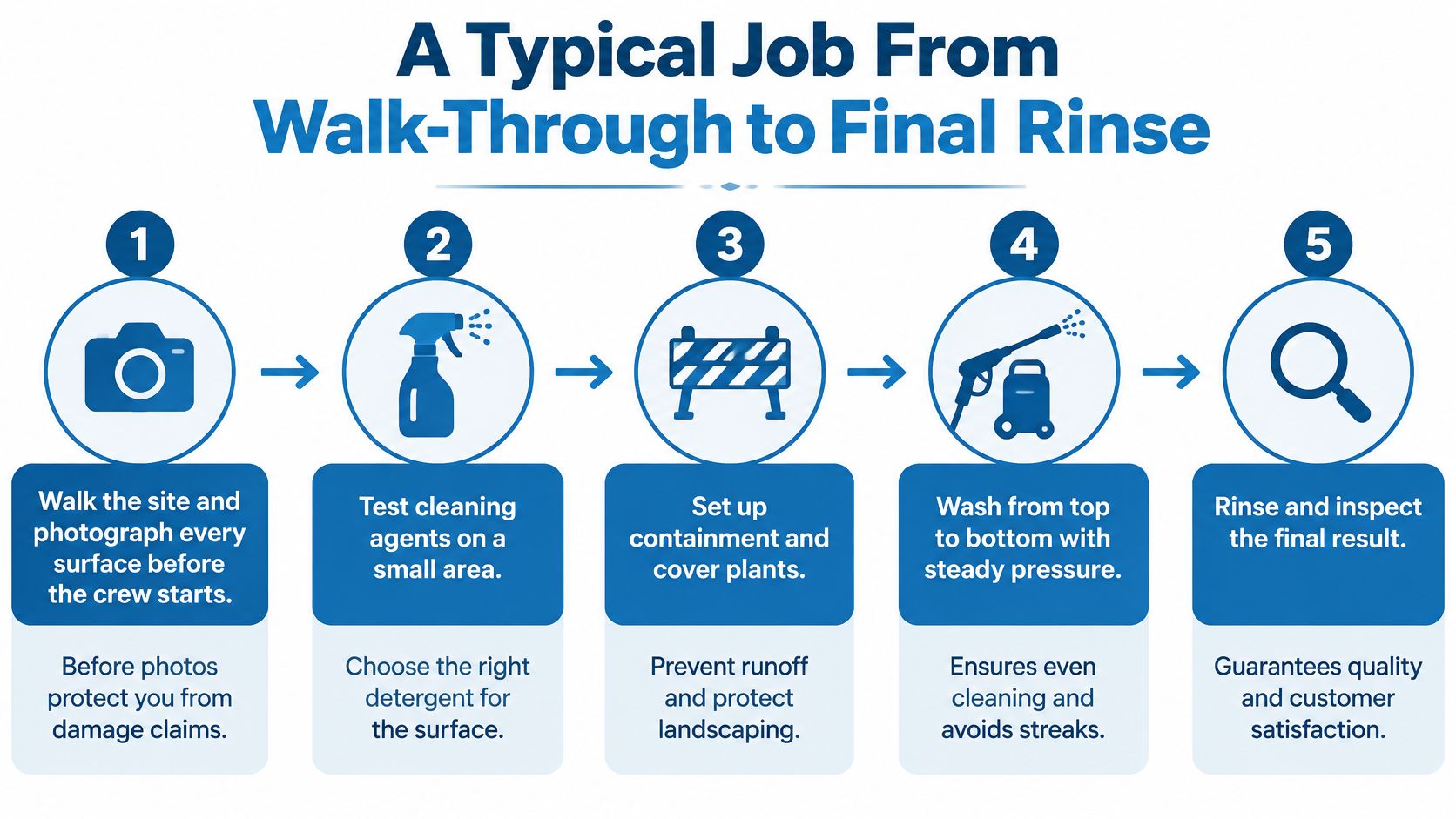
- Photograph the untouched site. Capture existing cracks, peeling finishes and stained joints before unloading. The common mistake is documenting only the dirty area and missing nearby pre-existing damage.
- Identify concrete, brick, painted siding, sealed wood and glass. Each requires a deliberate method; treating every hard-looking surface like concrete risks damage.
- Mark sensitive areas and exclusion zones. Include doors, outlets, vehicles and pedestrian approaches. A barrier that blocks one entrance but leaves another open isn't a complete setup.
- Prepare drainage protection and dry-clean the surface. Map flow paths, protect inlets and position recovery equipment before introducing water; don't wait until runoff is moving.
- Test the cleaning method out of sight. Start conservatively with the selected detergent, tip and pressure. High pressure on painted wood can strip the finish before you recognize the mistake.
- Work from the top downward with controlled, overlapping passes. On flatwork, keep movement consistent rather than stopping over one spot and leaving a visible mark.
- Rinse and evaluate. Look for residue, streaks, missed patches and etching. Stronger pressure won't repair a damaged surface.
- Photograph the finished work from the original angles. Close-up images alone can hide uneven cleaning across the whole area.
- Complete the job record. Note surfaces, chemicals, water use and disposal route. Don't leave the next crew guessing what product was applied.
Check the result before packing up
Even color, no avoidable halo marks, and a matching before-and-after photo set make the handoff easier. Discuss remaining stains rather than repeatedly attacking them with more pressure.
Watch the demonstration with attention to wand movement and working position, not just the visible cleaning effect.
Wastewater Duties Most Job Listings Skip
Pressure washing isn't only cleaning. It's also wastewater control, because the wash water can carry the contamination you just removed somewhere it doesn't belong.
The Maricopa County pressure-washing fact sheet recommends dry cleanup, sealing nearby storm-drain inlets and containing wastewater with temporary berms, vacuums and pumps. Pressure-washing wastewater must not enter storm drains.
Drain protection belongs in the setup, not in the cleanup after a problem.
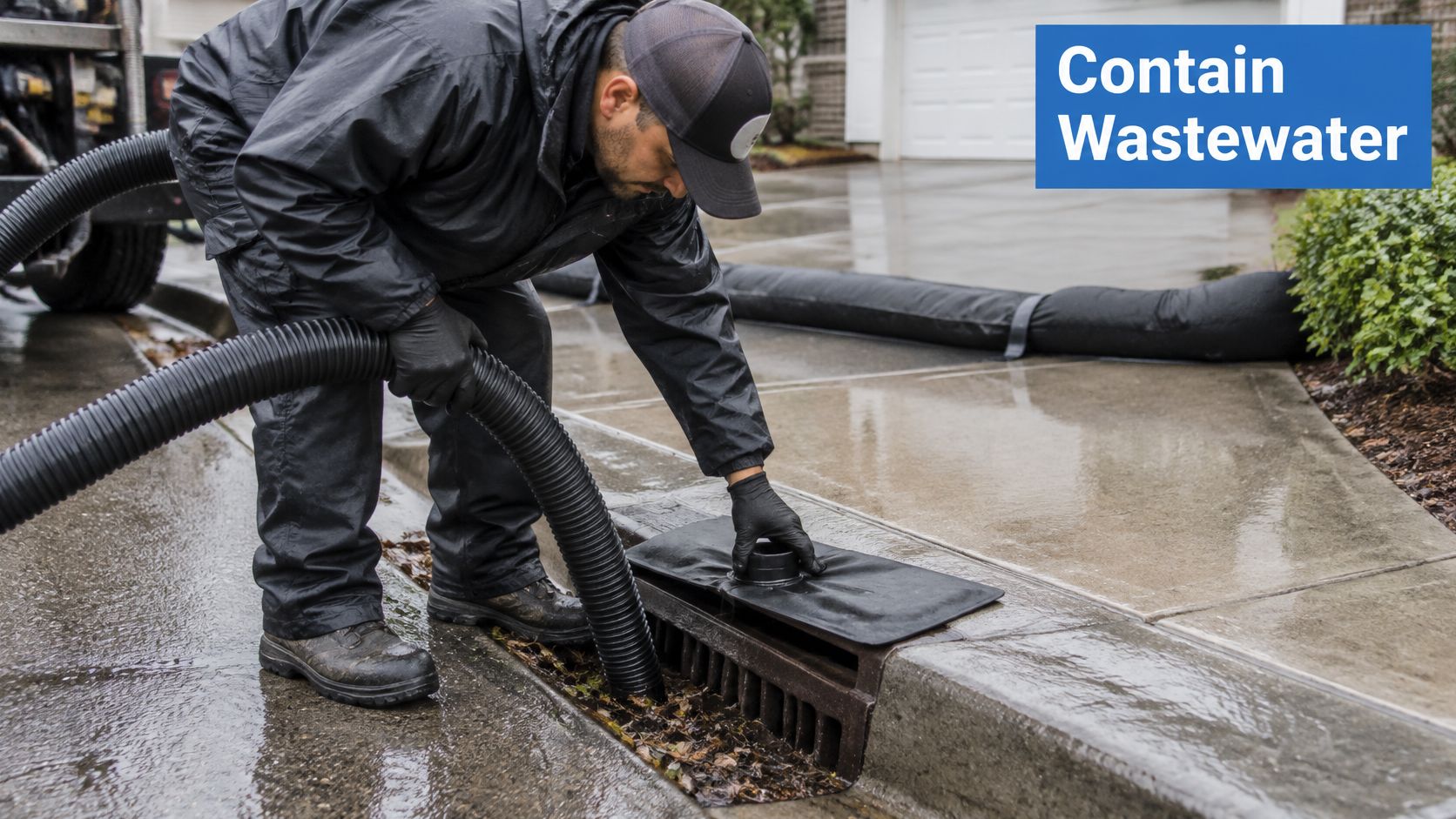
Decide where the water goes before starting
Sweeping or vacuuming removes loose sediment; absorbents help collect oil before washing. Without that preparation, the crew turns debris, hydrocarbons and detergent residue into a moving waste stream. Capturing that stream prevents it from reaching the stormwater system.
Walk the slope of the property and identify every inlet, including those beyond the immediate work area. Use the minimum practical water and detergent, but don't assume lower water consumption removes the need for containment.
The disposal decision should be explicit:
- Authorized sanitary sewer: Confirm permission and any pretreatment conditions with the relevant sewer authority.
- Approved planted infiltration: Verify that the location and wastewater are suitable and approved; a planted bed isn't automatic permission.
- Recycling system: Confirm that the recovery and treatment setup suits the contaminants.
- Collected waste: Arrange appropriate disposal when an approved on-site route isn't available.
Restaurant drive-thrus, dumpster pads and parking areas need particular attention because grease and suspended solids complicate recovery. Unknown residues are a reason to escalate to the supervisor, not experiment with disposal.
A clean walkway doesn't make a job successful if the crew sends contaminated water into a storm drain.
When reviewing power washing service scope, look beyond the surface list. The proposal should identify who obtains approvals, who pays disposal charges and who retains photos and disposal records.
Before accepting commercial pressure washing jobs, ask:
- Equipment: Is recovery equipment available for this site?
- Authority: Who approves the disposal route?
- Evidence: What photos and logs must I submit?
- Stop-work decision: Who do I contact if containment fails?
How to Land Your First Pressure Washing Job
Apply as someone who can follow a controlled process, not someone who merely enjoys cleaning videos. If you're comparing outdoor maintenance work with other occupations, HiredBySkill's guide to starter roles in the skilled trades can help you assess alternative entry paths.
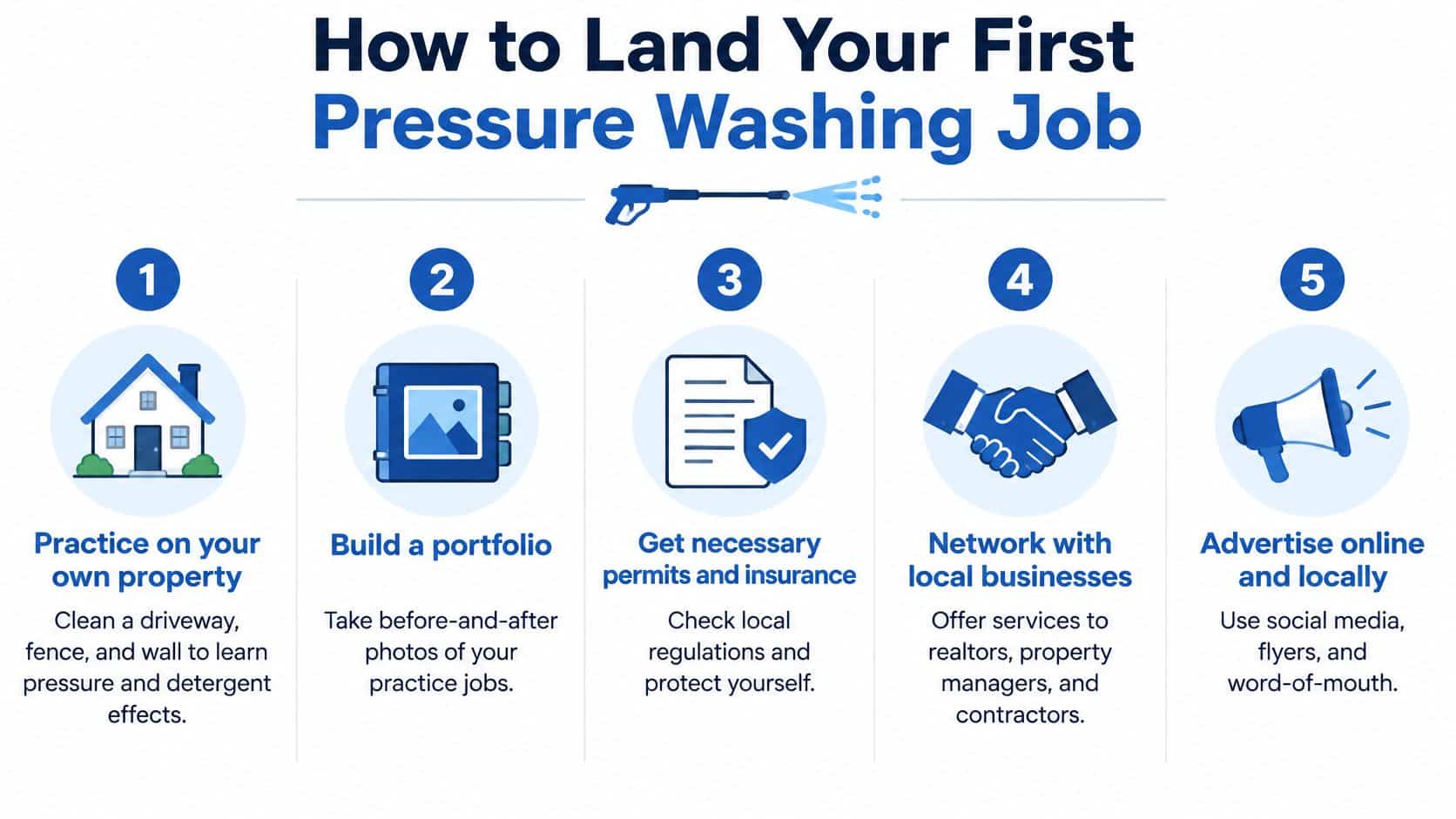
Use this checklist as an overview of the preparation involved.
Turn preparation into evidence
- Practice on suitable surfaces you own. Start with a driveway, then assess whether your fence and wall are appropriate for the equipment and method. You're done when you can explain why each surface needed a different approach, without causing damage.
- Build a portfolio using matching camera angles. Label each image set with the surface and time spent. The test is whether someone else can understand the assignment without your narration.
- Check local requirements before quoting. Confirm stormwater rules, disposal permissions, business licensing and insurance obligations with the relevant authorities and insurer. Keep the answers in a usable job-preparation file.
- Identify repeat buyers: property managers, restaurants, HOAs, retail plazas and apartment complexes. Prepare a short introduction for one property type rather than sending the same vague pitch everywhere.
- Approach established exterior-cleaning contractors. Ask about employment, helper work or properly arranged subcontracting within your competence. Before accepting, establish who supervises, supplies equipment and controls site safety.
- If pursuing independent work, create a basic business presence with an eligible Google Business Profile, an accurate service list and a phone line you can answer promptly. Don't advertise higher-level or specialist work you can't safely deliver.
- Write a complete quote. Include surfaces, exclusions, access, wastewater handling, traffic control and cleanup. Your test is whether another operator could identify what you've promised.
- Start with a manageable route or property type. Expand only when your records show consistent completion, clear communication and acceptable results.
Starting recommendation: Don't buy a larger machine to solve a problem caused by weak setup, poor technique or incomplete pricing.
Underpricing often begins with ignoring travel, recovery and teardown. Skipping the walk-through creates another problem: you commit to conditions you haven't inspected.
For an illustrative first-month target, aim for three to five small, suitable jobs, complete documentation and a referral list. That's a practice goal, not a forecast of demand or earnings. If you're applying as an employee, prioritize supervised competence over collecting independent jobs.
Choose Your Starting Path in Pressure Washing
Choose commercial crew work when you can describe a containment setup, explain how you respond to a hose leak and show a clear before-and-after photo set. You don't need to know everything, but you need to recognize when you've reached the limit of your training.
If those skills aren't established, start with supervised residential route work on simpler sites. Residential work isn't exempt from runoff or injury hazards; it offers an opportunity to build competence without immediately taking on a busy commercial property.
Match the path to your current skills
Hourly employment lets you develop technique within an employer's operating system. Independent work makes you responsible for pricing errors, equipment downtime and the full scope you've promised. Review the practical commitments of a pressure washing business before choosing ownership mainly for its apparent earning potential.
At South Mountain Window Cleaning, LLC, we serve Phoenix, Scottsdale, Paradise Valley, Chandler, Tempe and Gilbert, Arizona. Our services include residential, commercial and high rise window cleaning, power washing, solar panel cleaning, house washing and Christmas light installation. Our cleaning team members undergo extensive window cleaning safety training.
To understand real scopes, request written quotes for an actual residential project and an actual commercial project you're authorized to arrange. Compare access provisions, cleanup and wastewater handling, not just price.
Choose one role and practice one relevant skill this week. Request those two project quotes before accepting an offer so you can compare the responsibilities being assigned with the work being sold.
We offer exterior cleaning for homes and commercial properties, including power washing of drive-thrus, dumpster pads, walkways and building exteriors. Visit South Mountain Window Cleaning, LLC for a fast, free quote and describe your surfaces, access conditions and cleaning needs so we can discuss the right service scope.