

The first week of October is when the arithmetic gets uncomfortable. Twelve storefronts, a two-story façade, four exterior outlets that nobody has ever traced to a breaker panel, and a switch-on date locked to the first Saturday of December.
Buying a cart full of light strings is the easy part. Commissioning a display that turns on when the marketing calendar says it will, holds through a windy December, satisfies an insurance review and comes off the parapet without leaving holes is a different kind of job.
Commercial Christmas light installation runs like a scheduled project: survey first, then layout, permits, installation, testing, weekly inspection, and a removal date written into the work order. Skip a step and the failure lands in December, when no crew has spare capacity. The parts that separate a display which runs cleanly from one that trips a breaker on the busiest sales weekend of the year rarely show up in a photograph.
What a Commercial Holiday Lighting Project Includes
Take the anchor space at a twelve-tenant retail center. The entrance has to be framed in light by the first weekend of December, the parking-lot trees need something, and every clip, cord and bulb has to be gone by mid-January without leaving holes in the EIFS or ladder scars on the parapet. That's not a weekend with a ladder. It's a temporary electrical system that gets designed, wired, tested, inspected and struck on a fixed schedule, the way a touring show builds and strikes a rig for a two-month run.
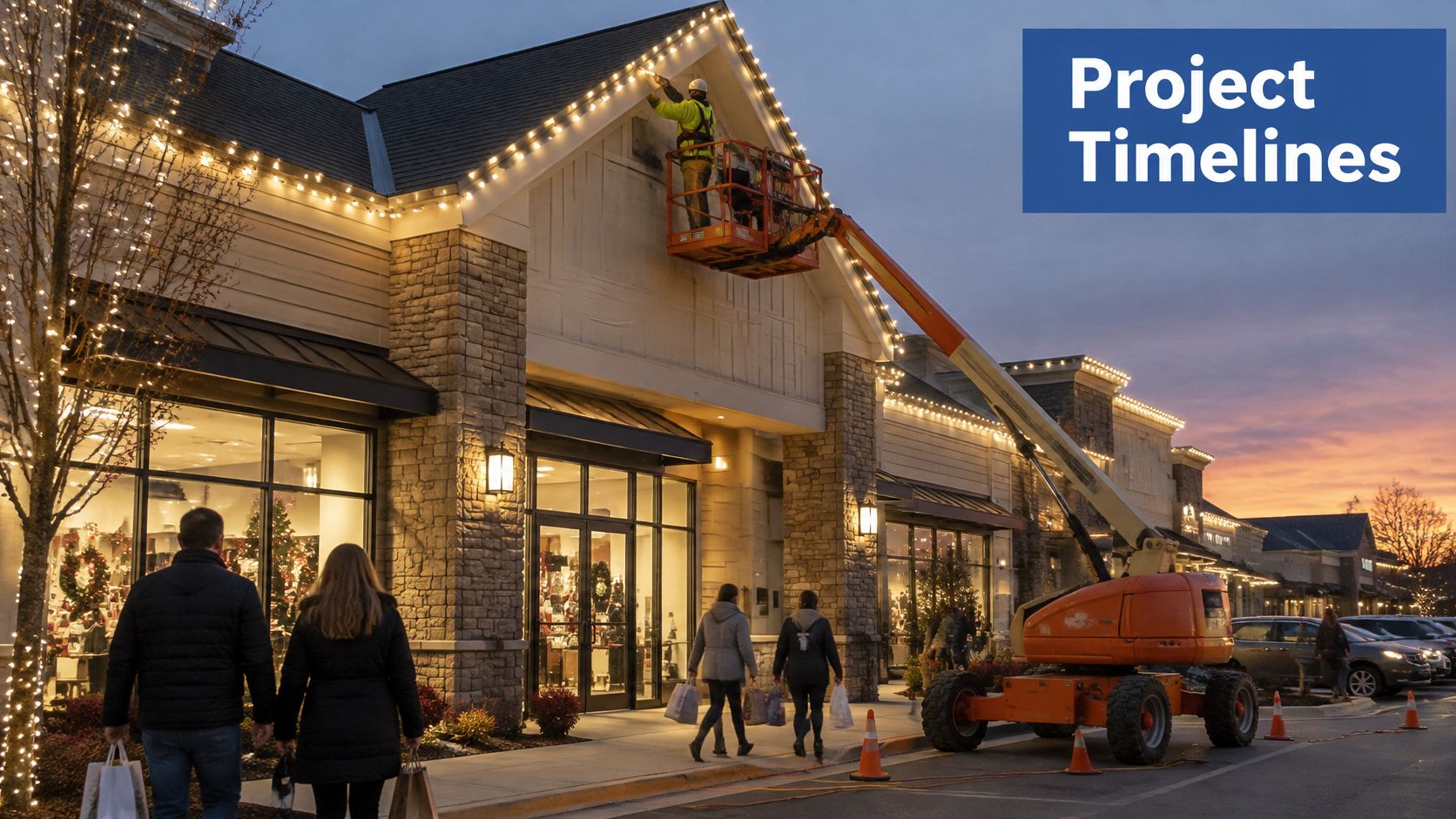
Here's the crew at work on a center exterior, on a lift rather than a ladder, because working height and fall protection are part of the scope.
The contracted-service model is older than many assume. General Electric began selling preassembled Christmas-light kits in 1903, replacing custom hand-wiring with standardized strings one crew could install consistently, a shift the Library of Congress traces back to Edward H. Johnson's 80-bulb tree in 1882. Standardized product plus organized installation is still the whole business model.
On a real property, the scope breaks into five stages:
- Site survey of roof lines, parapets, storefront frames, trees, walkways and every exterior outlet, with each outlet traced to its breaker and its tenants.
- Layout design cut to the building's actual dimensions, so runs match the façade instead of being pieced together on a lift at dusk.
- Installation with every circuit tested before the first switch-on, not after.
- In-season maintenance, including walk-throughs and post-storm inspections while the display is live.
- Removal, testing and storage, so next December starts from a known inventory rather than a pile of mystery cords.
The Christmas-lighting segment accounted for 35.1% of the global Christmas lights and decorations market in 2025, according to Market Data Forecast, which is another way of saying the category is mature enough that process, not novelty, decides who gets hired back.
Most DIY plans leave out four things: load checks, fire-clearance rules, permit and insurance records, and a written removal date. This guide takes them in the order a property manager works through them.
Planning Timeline From Survey to Removal
Most December problems are October decisions. A survey that slips into early November pushes the order for matching LED sets into the week before Thanksgiving, and a permit question raised in December has no good answer. Work backward from the switch-on date with this schedule and the season stops being a scramble.
| Phase | Timing | Lead | Output |
|---|---|---|---|
| Site survey and electrical check | 8-10 weeks before install | Provider with building engineer | Circuit map and load estimate |
| Design and approval | 6-8 weeks before install | Property manager and provider | Signed layout and install dates |
| Permits and site clearance | 4-6 weeks before install | Property manager | Written owner and city approvals |
| Installation and testing | 1-2 weeks before switch-on | Provider crew | Tested circuits and GFCI checks |
| In-season inspection | Weekly and after storms | Provider or facilities team | Damage log |
| Removal and storage | 2-4 weeks after season | Provider | Stored inventory and repair list |
Why the survey date anchors everything
The survey is the only phase that requires two parties in the same place: your building engineer, who knows which panel feeds the parking-lot receptacles and which circuits already carry tenant load, and the provider who has to design to those limits. Eight to ten weeks out is enough runway to discover that the only convenient outlet is on the wrong side of the building and to solve it with a permanent receptacle instead of a hundred feet of cord across a walkway.
Design and approval follows within two weeks of the survey. That's where the property manager signs a layout showing which rooflines, columns, trees and entrances get lit, and which deliberately don't. Get that signature at six to eight weeks out and the crew can order matched sets, including replacements, before supply tightens.
Schedule rule: a display is booked by its survey date, not its switch-on date.
Permits, site clearance and landlord approvals usually sit with the property manager, and four to six weeks out is late enough that you know the design and early enough to fix a problem. Installation and testing land one to two weeks before switch-on, which leaves a buffer for weather. Once the display is live, inspection goes weekly and after any storm worth naming, logged as it happens so an insurance file has something to point at.
Say a plaza with six storefronts books its survey in early October. The crew has time to order matching LED sets in the same color temperature for all six bays before Thanksgiving, instead of substituting whichever boxes are left on a shelf in the third week of November.
Write those six dates into the work order and have every party initial the same document. Verbal timelines are how a center ends up half-lit on the first weekend of the month.
Choosing Listed LED Products and Their Running Costs
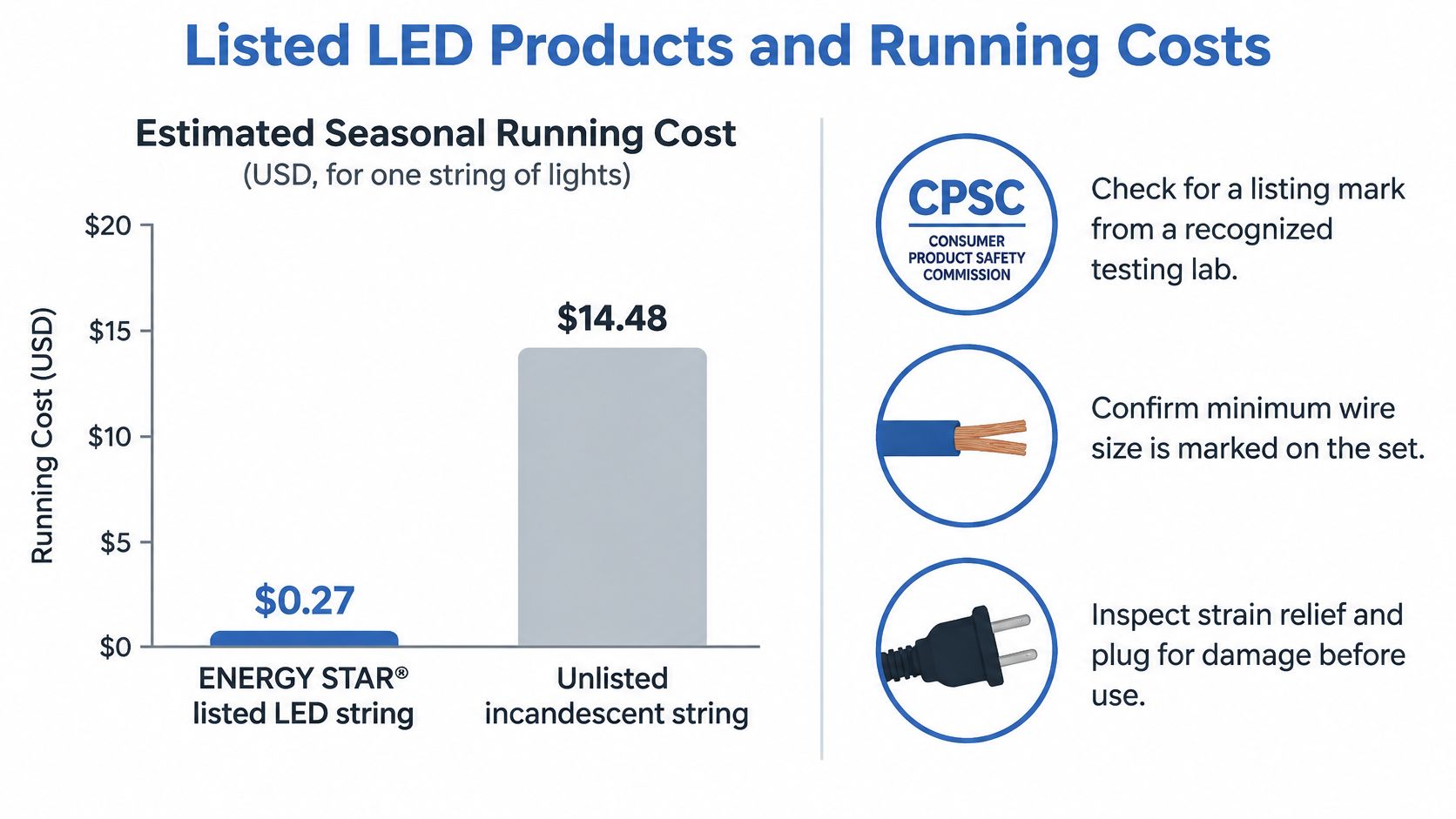
Buy LED, and buy listed. That's the purchase decision, and everything else is detail. Commercial-grade LED sets are built for the longer operating hours and repeated handling a business display goes through, and they cut the electricity line on the seasonal budget at the same time.
Reading the table by format
National Grid publishes a direct operating-cost comparison for the common formats, and the gap holds across all three.
| Bulb format | Incandescent watts and season cost | LED watts and season cost |
|---|---|---|
| C-9 bulbs | 700 W, $22.68 | 100 W, $3.24 |
| C-7 bulbs | 500 W, $16.20 | 50 W, $1.62 |
| Mini lights | 40 W, $1.30 | 7 W, $0.22 |
Read the C-9 row first, because C-9 is what outlines a roofline or a storefront frame. A 700-watt incandescent C-9 display costs about $22.68 for the season; the 100-watt LED version costs $3.24. Per circuit that's small money. Across a center with a dozen separate runs, it's a line item worth arguing about at budget time, and the LED row also cuts the connected load on circuits you may not have spare capacity for.
The same source puts LED bulb life at up to 50,000 hours against roughly 3,000 hours for incandescent, which matters more than the energy savings for repeat installations. A display that comes down, goes into storage and goes back up for four or five seasons is a durability purchase, not a decoration purchase.
The U.S. Department of Energy reports that LED holiday light strands use about 70% less energy than conventional incandescent strands, and describes LEDs as sturdier, longer-lasting and less likely to burn out or break, which reduces mid-season replacement runs.
What to reject at the loading dock
The Consumer Product Safety Commission names three readily observable characteristics on any seasonal light set: minimum wire size, adequate strain relief, and overcurrent protection such as fuses. Products missing them present a substantial shock or fire hazard, per the CPSC guidance on seasonal and decorative lighting.
Before anything goes up, confirm each set carries a listing mark from a recognized testing laboratory and is marked for outdoor use. Inspect sockets, plugs, connectors and cable jackets, and reject damaged components rather than repairing them with tape or improvised splices. Fasten with clips, not nails or staples, because a pierced jacket creates a fault path you can't see once the run is up.
A cheaper upfront set usually costs more across four seasons of replacements, storage failures and rewiring labor.
Commercial users represented about 29.7% of the LED Christmas-light market in 2025 and were projected to be the fastest-growing end-user segment at a 7.5% compound annual growth rate through 2034, per DataIntelo market reporting. That projection is one more reason to standardize on one product family now: matched spares stay available.
Line items decide more than the total, and a breakdown of Christmas light installation cost makes the comparison between quotes honest.
Electrical Load Checks Before the Crew Arrives
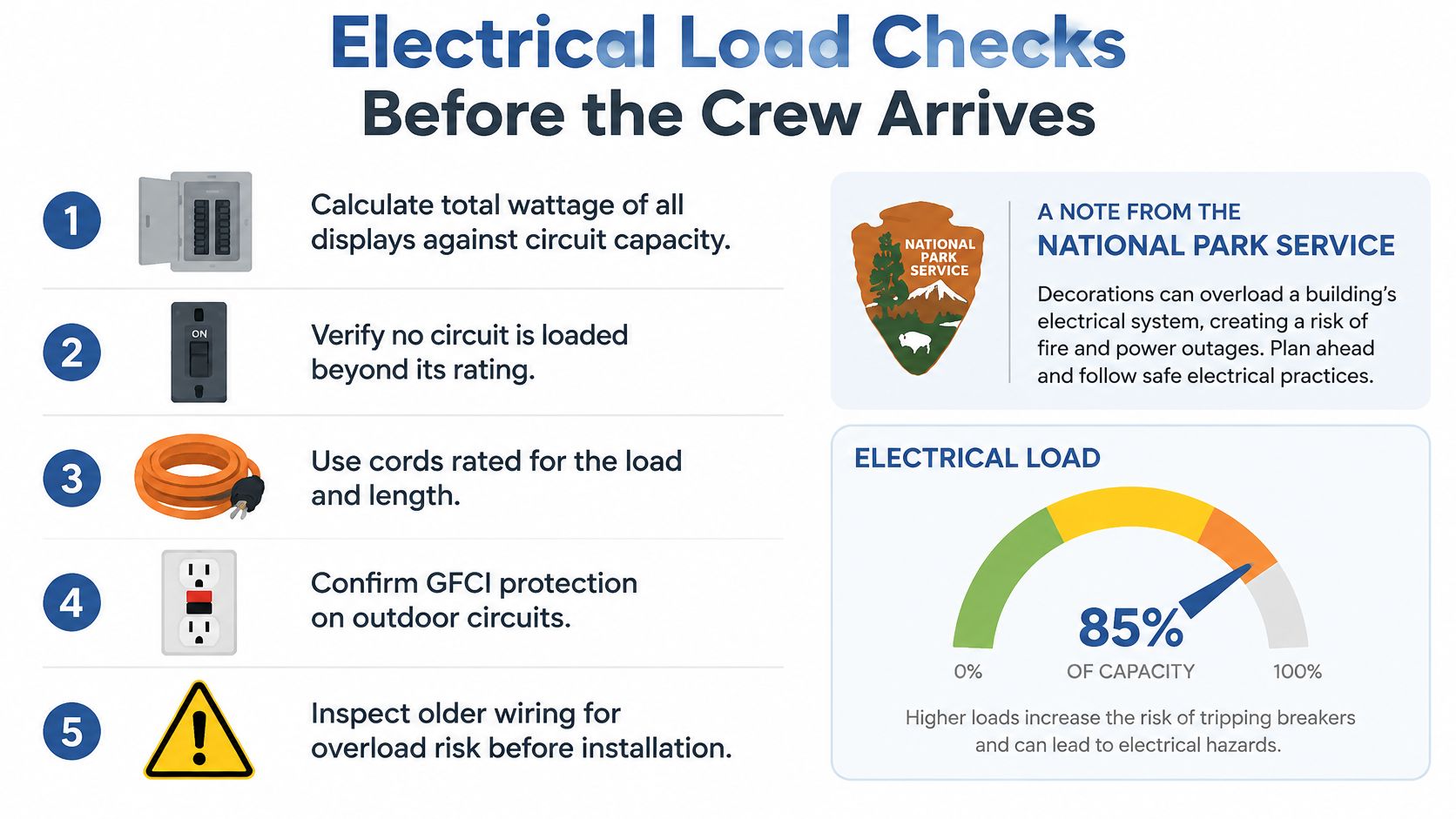
Think of each circuit as a pipe with a fixed flow. Every additional string draws from the same pipe, and the pipe doesn't widen because the display looks better with more lights on it. The National Park Service warns that holiday decorations can overload a building's electrical system, especially in older buildings, and recommends limiting linked mini-light strands and using permanent outlets installed by a professional electrician, as its guidance on decorating safely sets out.
The arithmetic behind a safe circuit
Run these checks before the crew arrives, not while the lift is in the air:
- Map every outlet to its breaker. Record which tenants, zones and equipment share each one, including any circuit feeding signage, irrigation controls or exterior lighting.
- Add connected wattage per circuit from the product labels on each set and accessory, then compare it against the breaker rating.
- Keep continuous load at or below 80 percent of the breaker rating. That margin is a planning habit; it leaves room for the compressor that kicks on in a service bay or the heater on a patio.
- Limit linked strands to the manufacturer's stated maximum and add permanent outlets, installed by a licensed electrician, where the display keeps landing year after year.
- Clear the life-safety paths. Decorations stay off sprinkler heads, fire extinguishers, alarm pull stations, exit signage and egress routes.
- Respect the power lines. People and equipment stay at least 10 feet from power lines during setup.
That last item comes with context. A Copper Valley Electric safety publication citing National Fire Protection Association data reports roughly 860 home fires a year caused by holiday decorations, plus 210 attributed to Christmas trees, and warns against overloaded outlets because excessive demand can overheat equipment and start a fire. Those are residential figures, but the mechanism is identical on a commercial façade, where runs are longer and the building is full of people.
A smaller display on well-planned circuits beats a larger one that trips a breaker in the second week of December. If the survey shows a panel at capacity, redesign around it rather than adding cords.
Safety and Permit Rules for Outdoor Displays
The assumption worth challenging is that a decoration needs no paperwork. Once wire is attached to a building and energized, an inspector, an insurer and a fire marshal see a temporary electrical installation, and the rules follow from that.
The ninety-day clock
The OSHA electrical safety guidance for temporary wiring allows temporary electrical power and lighting for Christmas decorations for no more than 90 days, requires temporary wiring rated at 600 volts or less to follow applicable electrical-safety provisions, and requires that wiring be removed when the project or purpose ends. A typical season runs inside that window comfortably. It's an outer limit, not a target, and it also explains why seasonal cable left up into February is a compliance problem rather than an aesthetic one.
Practically, that means three things in the work order: a defined installation date, a defined removal date, and a documented list of circuits used. Seasonal wiring that becomes a semi-permanent building modification is exactly what the rule exists to prevent.
Moisture, cords and ground fault protection
Exterior receptacles and branch circuits feeding a display should be protected by ground-fault circuit-interrupter devices, tested before use and again at the manufacturer's recommended intervals, because moisture, damaged insulation and conductive building surfaces all raise shock risk at exactly the moment the property is busiest.
Cord discipline is the other half. Extension cords should be listed for outdoor use and inspected for cracked jackets, exposed conductors, loose connections or crush damage. Route them out from under doors, off walkways and away from vehicle traffic, because a cord across a fire lane is a trip hazard and an abrasion waiting to happen.
What gets missed: the display is installed in dry weather and inspected in dry weather, then runs through its first rain without anyone rechecking the connections.
What the city requires and what it doesn't
Phoenix carves out a specific exception in its advertising and decoration rules. The municipal code states that no provisional sign, advertising or decoration may be attached to electric wiring or energized by electricity, except for decorations for the Christmas holiday season and certain directional or informational pedestrian signage, per the Phoenix city code. Holiday displays are treated differently from ordinary energized advertising under that provision.
That exception isn't a blanket clearance. Other city rules, electrical requirements, lease terms, HOA covenants, building conditions and site-specific permissions still apply, and the property owner still has to sign off before a lift goes up. Before any work starts, put the method on paper using a safe work method statement, which forces the crew to name the hazards, the controls, the responsible person and the shutdown procedure for the specific site rather than a generic one.
The attachment side deserves the same attention. Our guide to hanging Christmas lights on a roof covers clips, ridge lines and the fasteners that won't void a roofing warranty.
The fire record is why this paperwork exists. The National Fire Protection Association reports that electrical distribution or lighting equipment was involved in 41 percent of reported home Christmas-tree fires, with lamps or bulbs directly starting 20 percent of them, as documented in Smithsonian Magazine's history of the holiday light. Scale that pattern onto a commercial façade with public foot traffic below and the inspection log stops looking bureaucratic.
Removing, Storing and Testing Displays Between Seasons
Removal is a scheduled phase with its own crew, its own daylight window and its own paperwork, and it's where next season is won or lost. Arizona is hard on stored light strings: sun degrades insulation, heat makes plastic brittle, and dust settles into sockets and connectors until a strand that passed in December refuses to light in October.
A storage routine that pays for itself
Work through these in order, in daylight, with the shutdown plan in hand:
- Unplug and disconnect each circuit following the work order's shutdown sequence, then take the display down before weather forces the schedule.
- Test every strand and record failures by location, so you know whether one bad bay is a hardware problem or an installation problem.
- Repair or replace damaged sections and retire anything that would need a taped splice to survive.
- Coil cords loosely over-arm rather than tight around the elbow, and store strands in dry, cool, labeled containers by length and format.
- Update the building record with circuit assignments, replaced sections and removal status, so the file stays useful to the next manager.
- Schedule a pre-installation test of stored inventory well before the next season's install window.
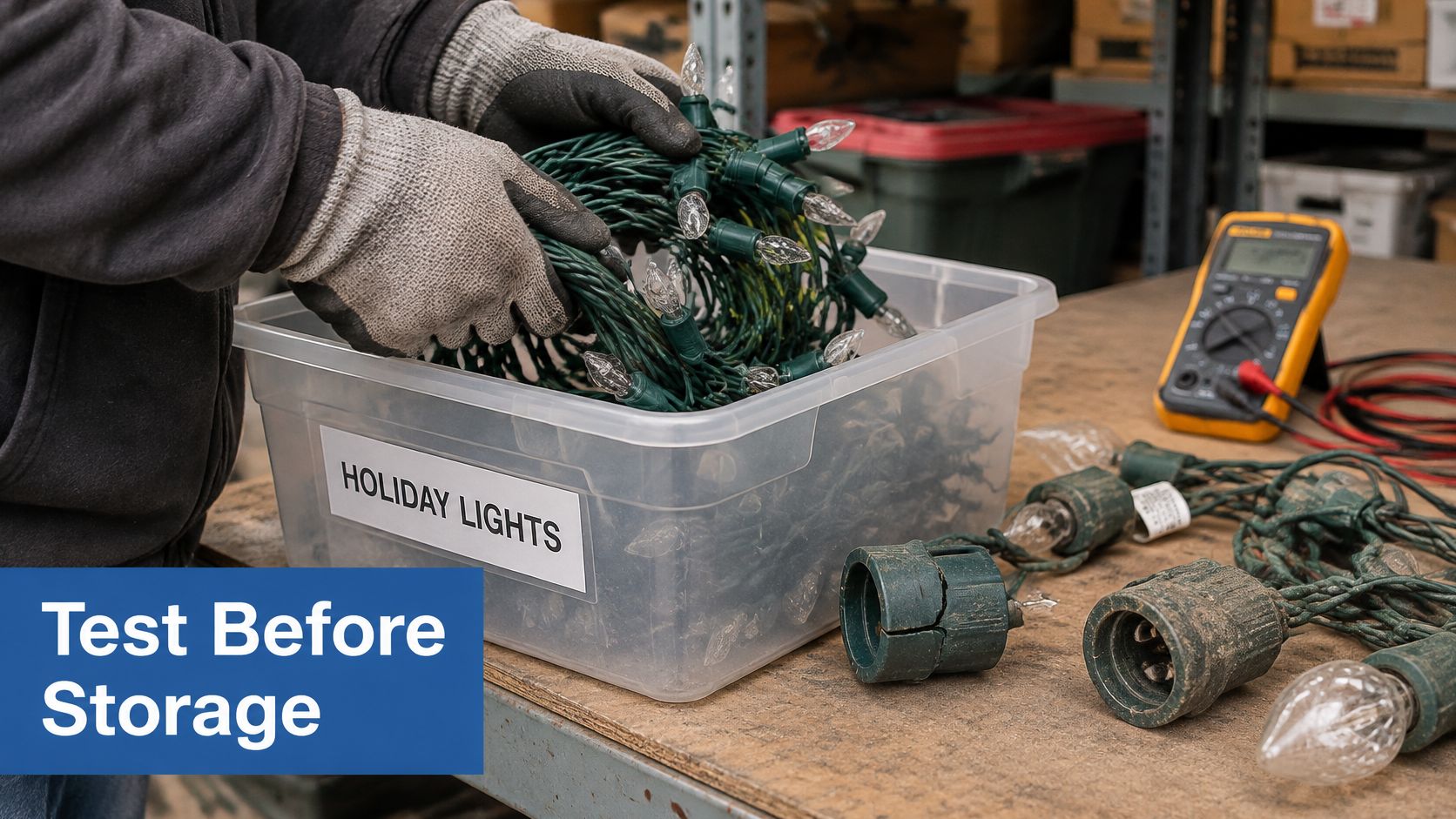
A bulb tester for Christmas tree lights belongs in the storage bin, not in a drawer at the office. Testing a strand at the shelf takes seconds; discovering the failure on a lift in December takes an hour and a second visit.
Then there's the October warm-up. A string that worked in January can fail on its first power-up after ten months in a hot container, because the failure is often in the socket or the connector rather than the bulb. Retest stored inventory rather than trusting the label on the box, and build that test into the schedule instead of treating it as an emergency.
Confirm Your Installation Plan This Week
Pick the target switch-on date and count what the survey needs to see: storefront bays, roof lines, trees, and the location of every exterior outlet. Name the person who signs off on permits, because that signature is the step most likely to stall.
Keep the request short when you call a provider: property address, number of storefronts or roof lines, outlet locations, and the requested switch-on date. That's enough to scope a survey and slot it into the calendar.
When you compare quotes, ask for separate line items for the survey, design, installation and testing, in-season inspections, removal and storage. Ask how crews are scheduled around the December rush, whether you get a circuit map for the building file, and for proof of insurance. We're licensed, bonded and insured and send that documentation with the quote, and customers across Phoenix and Scottsdale can call South Mountain Window Cleaning at (480) 519-9327 or schedule an estimate online.
Then do one thing: send the planning timeline to your chosen provider and ask for a site survey on a fixed date. Everything else follows from that appointment.
South Mountain Window Cleaning, LLC installs commercial Christmas lights across Phoenix, Scottsdale, Paradise Valley, Chandler, Tempe, Gilbert and the wider Valley, with custom-cut professional-grade LED lighting, installation, maintenance, removal and storage bundled into one all-inclusive seasonal service. The same licensed, bonded and insured crews that handle high-rise glass, power washing and solar panel cleaning work around your tenants, customers and delivery schedules instead of through them. Visit South Mountain Window Cleaning, LLC to book a site survey and lock your switch-on date before the December calendar fills.