

Most U.S. homes land near $150 to $300 for interior and exterior service, or about $10 per window, and a Phoenix bid moves with access and scope rather than a fixed local rate.
You are staring at two proposals for the same house and they do not agree. One looks cheap because it quotes a per-window rate. The other is higher and lists screens, tracks, and how the crew reaches the second floor. The fair price is the one that matches the glass you own, not the smaller headline.
Typical Window Washing Prices at a Glance
Say a homeowner in Chandler gets $210 from one crew and $410 from another for what sounds like the same house. That $200 gap is usually missing work, not a mystery markup. Cleaners Rated reports residential window cleaning in the United States at about $120 to $450 per home, with many national surveys clustering around $150 to $300 for interior and exterior together. Other published estimates put a typical project at $150 to $302, with an average near $221, or roughly $10 per window.
Those totals break into units you can check. Per-window pricing is often about $6 to $13. Individual panes may run about $4 to $15. Hourly labor for one cleaner is about $40 to $75. These figures are national estimates, not Phoenix, Scottsdale, or Chandler bids. Use them as comparison ranges. A straightforward one-story job tends toward the low end. Larger homes, multi-story access, and restoration work move toward the high end.
A quick check before you trust a bid
Take a 24-window home at $6 to $13 per window. That math lands near $144 to $312, which sits inside the whole-home range and is a fair first screen. Count windows and panes, multiply by the per-window range, then adjust for height and access. Compare that result with the whole-home range before you call any bid high or low. A credible quote also splits interior from exterior and names optional work such as screens, tracks, hard-water stains, or high-access cleaning. It should say whether labor, equipment, travel, safety gear, and cleanup are included.
The same habit of reading the written scope, not the headline, shows up in other markets. Eco Clean Solutions lets customers book exterior window cleaning Dublin against a stated exterior job, which is the comparison you want before you accept a Valley number.
| Pricing basis | National benchmark | How to use it in a Valley quote |
|---|---|---|
| Per window, interior and exterior | $6 to $13 (about $10 in some estimates) | Multiply window count by the range, then adjust for height |
| Per pane | about $4 to $15 | Useful for homes with many small panes |
| Whole home, interior and exterior | about $150 to $300, average near $221 | Compare totals only when the scope matches |
| Hourly labor for one cleaner | about $40 to $75 | Ask how many hours the bid assumes |
| Phoenix or Valley per-window rate | Not published as a local benchmark | Confirm with a local written quote |
Phoenix, Scottsdale, and Chandler per-window rates are not published here. Confirm them on a written quote from a local company before you treat any national figure as your bill.
What Raises or Lowers Your Window Washing Cost
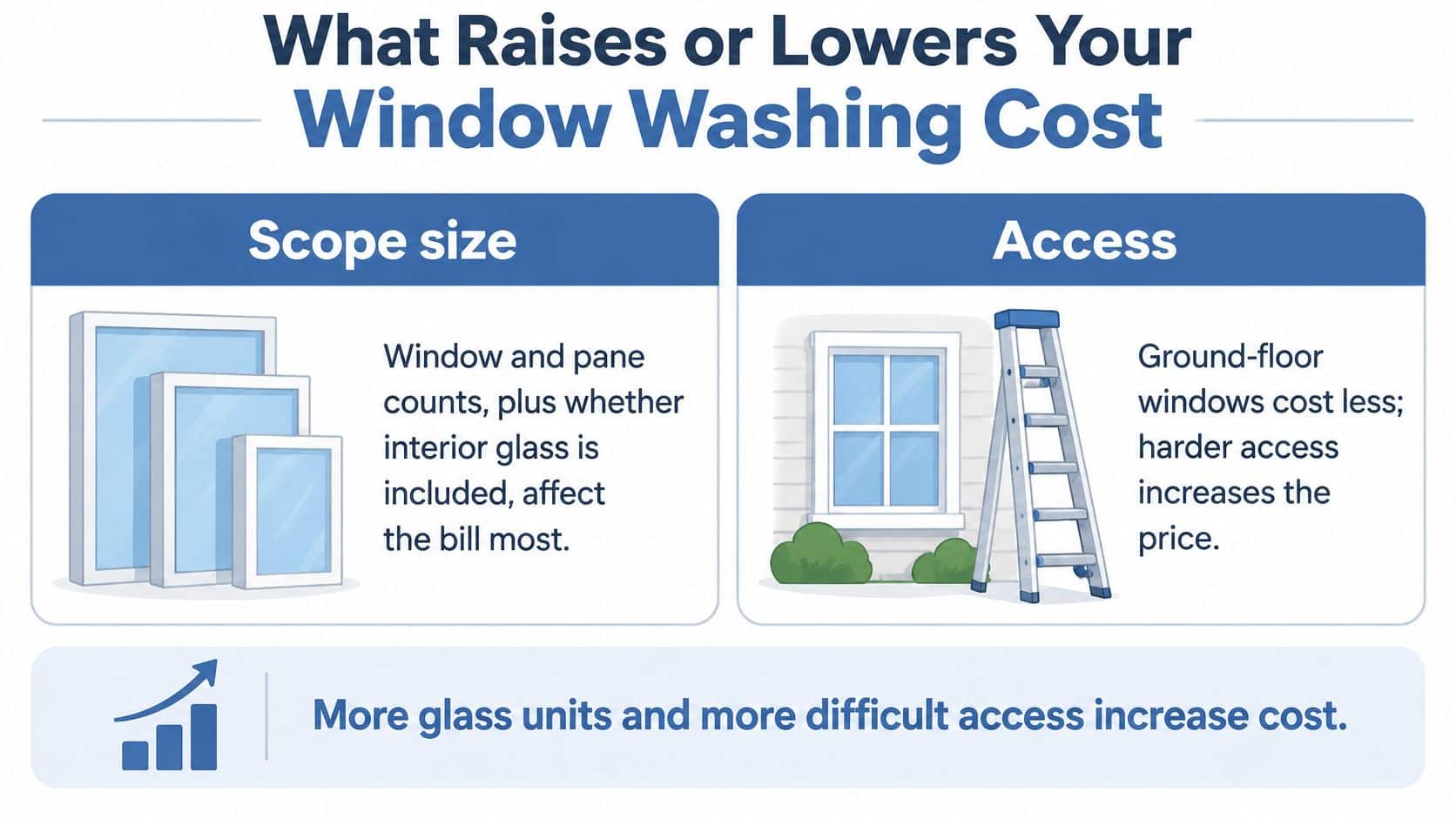
Scope size moves the bill more than the advertised rate. Window count, pane count, and whether interior glass is included change production time on every opening. A ground-floor slider and a French door with many small lites are not the same job, even if both get called "a window."
Access, extras, and how often you book
Height and access are the next lever. A ground-floor pane reached from a short ladder costs less than a second-story opening that needs a water-fed pole or a lift. Setup, tie-offs, and moving the equipment eat time before anyone squeegees glass.
Screens, tracks, and sills add handling that basic washing skips. A bid that drops them looks cheaper and leaves the dirt you notice every time you open the window. Hard-water mineral stains and construction film are restoration, not a maintenance wash. Razor work, specialty solution, and extra passes belong on their own line. Travel, minimum charges, and cleanup often hide inside a headline rate, and they hit small jobs hardest because the trip cost is spread over fewer openings.
Frequency works the other way. A recurring route on a set interval usually lowers the price per visit compared with a one-time rescue of a neglected house. In Phoenix, the first visit after a long dust buildup is heavier than the visits that follow. What lowers the bill is regular maintenance, a written scope, and grouping every opening into one mobilization instead of calling the crew back for the side you forgot.
Practical rule: If two bids differ and you cannot point to glass count, access, or an add-on, you are not comparing the same job.
| Factor | Effect on price | Why it matters |
|---|---|---|
| Window and pane count | Raises | More glass means more production time |
| Height and access | Raises sharply | Ladders, poles or lifts add setup time and safety work |
| Interior glass included | Raises | Adds a second cleaning pass and more handling |
| Screens, tracks and sills | Raises | Extra labor that basic washing does not include |
| Hard-water or mineral stains | Raises | Needs restoration work, not routine cleaning |
| Recurring schedule | Lowers per visit | Predictable routes and lighter soil on each visit |
| Travel and minimum charges | Raises for small jobs | Fixed trip costs spread over fewer windows |
| Grouping windows into one visit | Lowers | Fewer mobilizations for the same scope |
How to Compare Quotes on the Same Scope
A per-window price does not answer the budgeting question. Checkbook.org consumer research found that the highest-priced window-washing companies can charge more than twice the lowest-priced company for identical hypothetical homes, while pane count and job complexity change the quote. Put two or three bids on one scope before you compare totals. Our window cleaning company page is a useful checklist of what a full residential or commercial visit can include, so you can see which lines a bid left blank.
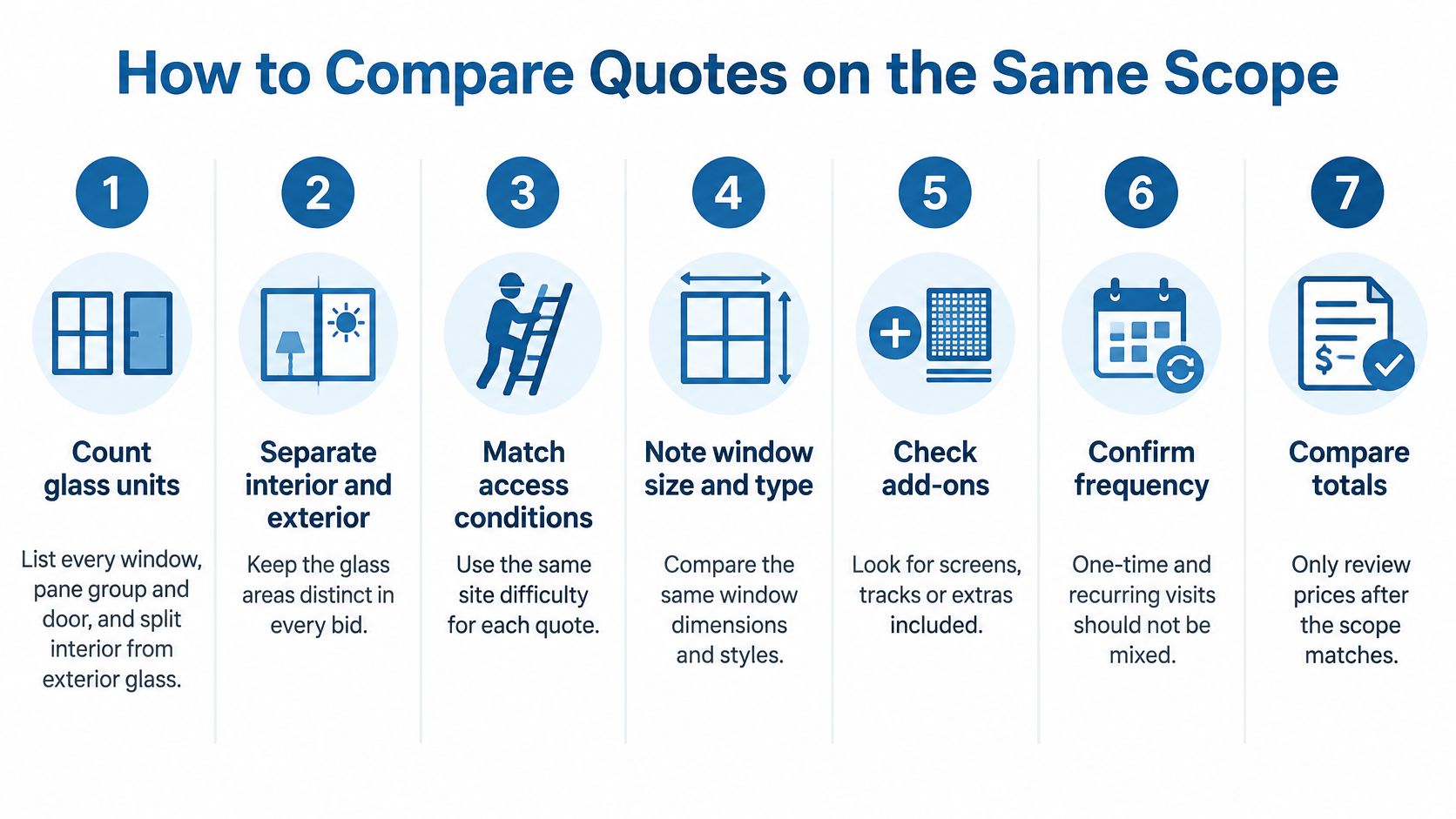
- Count glass units. List every window, pane group, and door, and split interior glass from exterior glass, because a combined count hides a missing pass.
- Mark access. Note ground level, ladder, pole, or lift, and any work above the second floor, since the same pane costs more once the crew leaves the ground.
- List add-ons on separate lines. Screens, tracks, sills, ceiling fans, and mineral-stain removal each get their own line so a "wash" cannot swallow them.
- Confirm frequency. Say whether you want one-time service or a recurring interval. A quarterly price and a one-off price are different products.
- Ask what the total includes. Travel, cleanup, insurance, return visits, and any minimum charge belong in the writing, not in a verbal aside.
- Convert every bid to the same scope. Divide the matched total by window count so the per-window rates sit side by side.
- Flag gaps. A bid that omits screens or high-access equipment is not cheaper. It is incomplete.
When the lower total costs more
Take a hypothetical pair. A $180 bid that skips screens and interior glass can cost more than a $230 bid that includes both, once you price the missing lines. Commercial managers feel this faster than homeowners, because they need a recurring cost they can budget, not a one-time residential average.
Keep maintenance pricing separate from restoration pricing. Mineral deposits and post-construction residue need specialized labor and should not be sold as ordinary washing. A low bid that folds that work into a wash rate is either underpriced or planning to skip it.
The cheapest advertised price is often the least useful number on the page. Scope transparency and a steady interval matter more than the headline rate.
A complete quote names scope, method, schedule, included items, and the total. If a line is missing, ask for it in writing before you rank the bids.
How Dust Storms and Heat Change Your Cleaning Schedule
Elapsed months are only half of how much to wash windows in the Valley. In July 2025, dust monitors across Maricopa County exceeded the healthy PM10 standard, eight monitors reached the unhealthy category, and one reached very unhealthy, while a separate report described Phoenix temperatures approaching 113°F with hazardous dust, according to AZ Central.
Triggers you can use this week
Do not wash in the middle of a blowing haboob. Inspect after a haboob or a strong monsoon wind, then clean once the air has settled and you can see film on the glass. Washing during a poor air-quality alert raises risk for the crew and for people inside with windows open. Schedule exterior work for cooler hours. Glass and ladders are harder on people when the afternoon is already past a safe working heat.
Soil does not land evenly.
- High-traffic storefronts pick up dust, grease, and road film faster than a sheltered residential elevation.
- Construction nearby can reload glass within days of a wash.
- A quiet courtyard can wait longer than a west-facing commercial façade on a busy road.
Set a routine interval by exposure for homes, storefronts, and high-rise glass, then add an event check after major dust. That pairing is more honest than a rule that every home needs a monthly wash. Re-soiling starts as soon as the next wind moves, so the question is whether the film is visible and whether occupants or customers can see through it, not whether a calendar square turned over. For a closer look at intervals by property type, see our guide on how often to clean windows.
Frequency should follow exposure and how the building operates, not only the date of the last visit.
How Recurring and High-Rise Jobs Are Priced
Commercial work stops being a simple per-window guess. Ground-level storefronts, restaurants, and dusty frontages load grime fast, so they usually need a shorter recurring interval than a house. A route spreads setup across visits. Ask for the price per visit at each frequency, monthly against quarterly, then compare the yearly totals. The cheaper visit can be the more expensive year if you are booking extra callouts between cycles.
Storefront glass is the job most managers picture first.

| Job type | What sets the price | What to request |
|---|---|---|
| Ground-level storefront | Visit frequency and soil load | Price per visit at each interval, plus the yearly total |
| High-rise or elevated glass | Elevation, access method, and mobilization | A price by elevation, not a pane-only rate |
Safety rules behind the high-rise number
For high glass, access sets the scope more than glass area. OSHA's two-point scaffold guidance requires two-point suspended scaffolds to be designed by a qualified person, erected or altered under competent-person supervision, and secured against hazardous swaying. Each scaffold rope must support at least six times the maximum intended load. OSHA also states that boatswain's chairs should be used only when windows cannot be cleaned safely and practically by other methods. For permanently installed powered platforms, OSHA also requires fall-arrest protection, stabilization, operator training, and a written emergency plan.
A routine frequency pays off only when the building has compliant anchors, stabilization, rescue procedures, and trained operators. Otherwise inspection, setup, and access planning dominate the invoice. A bid that leaves those items out is not a bargain. Our cleaning team members undergo extensive window cleaning safety training, and that preparation belongs in the price of high-rise window cleaning, not as an optional extra after the crew is already on the roof.
Ask whether the price covers equipment inspection, setup, and the number of return visits. Request the breakdown by elevation and access method. A short walk-through of how crews stage a drop makes those line items easier to read on the proposal.
Request a Firm Quote for Your Property
Write the scope before you call anyone. List window count by floor and by side of the building. Note the access each floor needs, any screens, tracks, or mineral stains, and whether you want one visit or a recurring schedule. That list turns a vague "how much to wash windows" request into a scope two bidders can match.
Then ask for a written quote that names scope, method, schedule, and included items. Check it against the seven comparison steps. Confirm that the price covers travel, cleanup, and return visits. If a line is verbal only, it is not part of the deal.
South Mountain Window Cleaning, LLC offers full service commercial and residential window cleaning valley-wide, including Phoenix, Scottsdale, Paradise Valley, Chandler, Tempe, and Gilbert, for homes, commercial glass, and high-rise work. We provide a fast and free quote for any cleaning needs, and residential window cleaning carries a 100% satisfaction guarantee. Ask how the job is insured before you book. Our page on window cleaning insurance is the place to see what coverage means for a crew on your property.
Use that written quote to test your own list, then set it next to at least one other written bid on the same scope.
Choose the most complete quote for a fair scope, not the lowest total.
South Mountain Window Cleaning, LLC handles residential, commercial, and high-rise window washing across the Valley, with pricing built from your glass count, access, and schedule rather than a generic per-window ad. If you want a number you can compare, request a fast, free written quote and put it beside any other bid on the same scope. Visit South Mountain Window Cleaning, LLC to send your window list and get that quote started.