
The strongest cleaner often makes a hard water stain worse. If that white haze is etching instead of mineral scale sitting on top of the surface, another round of acid won't clear it. It'll dull more of the finish. That's why choosing cleaners for hard water stains starts with the surface and a test, not with the strongest bottle you own.
Quick Picks for Each Surface and Stain Type
| Surface | Start with | Avoid | Stop and reassess if |
|---|---|---|---|
| Glass windows | White vinegar or citric acid, 5-15 minute dwell | Abrasive pads, undiluted acid | Spots return after two treated cycles |
| Shower glass | Diluted citric acid, then squeegee rinse | Scouring powder and steel wool | Haze remains after acid treatment |
| Chrome fixtures | Mild acid on soft microfiber | Steel wool, strong acid | Pitting or dull patches appear |
| Ceramic tile and grout | Vinegar or citric acid, brush on grout | Long acid dwell on unsealed grout | Grout discolors after cleaning |
| Marble, travertine, limestone | pH-neutral stone cleaner | Vinegar, citric acid, any acid | Any dull or etched spot appears |
| Quartz countertops | Mild non-abrasive cleaner | Bleach-based and harsh acid cleaners | Residue persists after two passes |
| Solar panels | Pure water rinse, then manufacturer-approved cleaner | Acid and abrasive tools | Film returns quickly after rinsing |
| Acrylic and fiberglass | Non-abrasive pH-neutral cleaner | Scouring pads and strong acid | Scratches or cloudiness after cleaning |
Read the table by matching the surface first, then the stain.
The same acid that's safe on plain glass can permanently dull marble, travertine, and limestone, so don't carry one method across a whole bathroom or storefront. Diluted vinegar on a window is a reasonable starting point. On stone, it's the damage itself.
How to Use These Picks
These dwell times assume fresh, light deposits. Heavier, bonded scale needs a chelating product or careful mechanical work, and colored rust-type staining needs different chemistry entirely. For kitchen and bath fixtures beyond glass, it's worth seeing how others tackle hard water marks on porcelain before you improvise on a finished sink.
Stopping rule: If a cloudy film remains after one controlled treatment, it's probably etching rather than scale. Run the surface test instead of repeating a stronger acid.
I would treat any haze that stays perfectly smooth under your fingertip as suspect. Removable scale usually feels slightly raised or chalky. Etched glass, scratched acrylic, and damaged coatings feel smooth because the surface itself has changed.
Why Hard Water Leaves Marks That Resist Ordinary Cleaning
A hard water stain is mineral, not dirt, which is why soap and a sponge often just move it around. The U.S. Environmental Protection Agency water quality criteria explains that freshwater hardness comes mainly from dissolved calcium and magnesium, with iron, strontium, and manganese contributing when present. Hardness is expressed as mg/L as CaCO3. As water evaporates off glass, those minerals stay behind as opaque spots, rings, or scale-like films that no amount of wiping will lift.
| Category | Hardness (mg/L as CaCO3) | Typical staining behavior |
|---|---|---|
| Soft | 0-75 | Few visible deposits; spots wipe off easily |
| Moderately hard | 75-150 | Visible spotting after dry-off |
| Hard | 150-300 | Films and rings form on exposed glass |
| Very hard | More than 300 | Scale bonds quickly and needs repeated treatment |
Reading Your Own Water Report
You can calculate hardness from lab results instead of guessing. The EPA hardness calculation guidance gives mg/L as CaCO3 = 2.497 × calcium (mg/L) + 4.118 × magnesium (mg/L). Water with 40 mg/L calcium and 20 mg/L magnesium therefore calculates to approximately 182 mg/L as CaCO3, which falls in the hard band of the table above. Other classification systems can label the same water differently, so don't argue over the label. Use the number to judge how fast deposits will build.
Every wetting and drying cycle leaves a little more mineral behind, and a faint film becomes a bonded ridge because each new layer dries onto the last. Left through enough cycles, a deposit stops sitting on top of the surface and starts marking it. That's the point where a cleaning problem becomes an etching problem, and no cleaner reverses it. Iron staining is the other exception to watch for. It's often brown or rust-colored and doesn't respond to the same acid you'd use on white calcium scale.
Staining follows water chemistry and how often water dries on the surface, not how dirty the glass looks. Check your local utility water report before choosing a method, and review how to prevent hard water stains on glass if spots keep returning between cleanings. If stone sits next to the glass, separate guidance on stone-safe methods for granite water spots will keep a glass method from spilling onto the wrong material.
How to Test a Surface Before Any Treatment
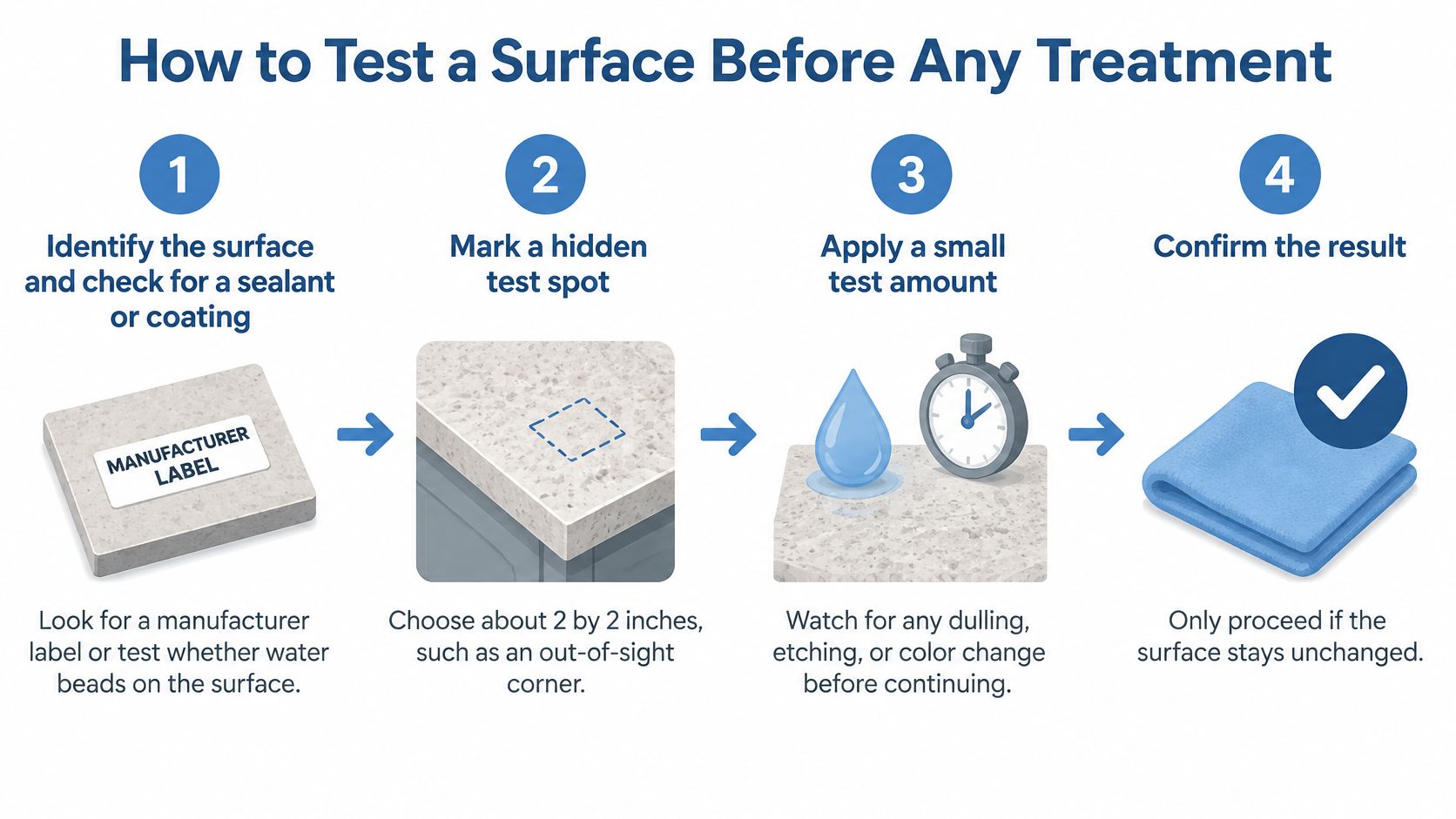
- Identify the surface first. Look for a manufacturer label and check for a sealant or coating. Water that beads tightly often signals a coating you shouldn't strip with acid or abrasion.
- Mark a hidden test spot. Choose about 2 by 2 inches, such as a lower corner, the inside of a frame, or an edge behind a fixture.
- Apply the mildest candidate. Use diluted vinegar on plain glass or a pH-neutral cleaner on stone, then wait five minutes without letting it dry.
- Rinse, dry, and inspect. Hold a light at a low angle across the surface. Raking light reveals haze, fine scratches, and dulling that overhead light hides.
- Compare the spot to the area around it. If residue lifts and the surface stays smooth and clear, proceed. If a dull patch appears, stop.
- Separate scale from etching. Raised, chalky deposit is removable scale. Smooth, glassy haze is likely etching or coating damage that cleaning won't reverse.
What a Passing Test Looks Like
A passing test leaves a clean, smooth spot with no new haze, color change, or loss of shine. That's your permission to treat the full area with the same product, dwell time, and pressure. Change any one of those three, and you should test again.
A failed test is useful information, not a reason to scrub harder. Our guide to window cleaning water spots covers how fresh spots differ from older marks, and that distinction decides your next move here too.
If glassy haze on glass lifts only with glass-polishing compound, treat it as light etching and consider the mechanical option carefully. On stone, chrome, or acrylic, stop and get the surface assessed.
Run your fingernail lightly across the edge of the mark. If it catches, you're likely dealing with deposit on top. If it glides across a dull patch, chemistry alone won't restore the finish.
Acidic Cleaners Compared by Strength and Risk
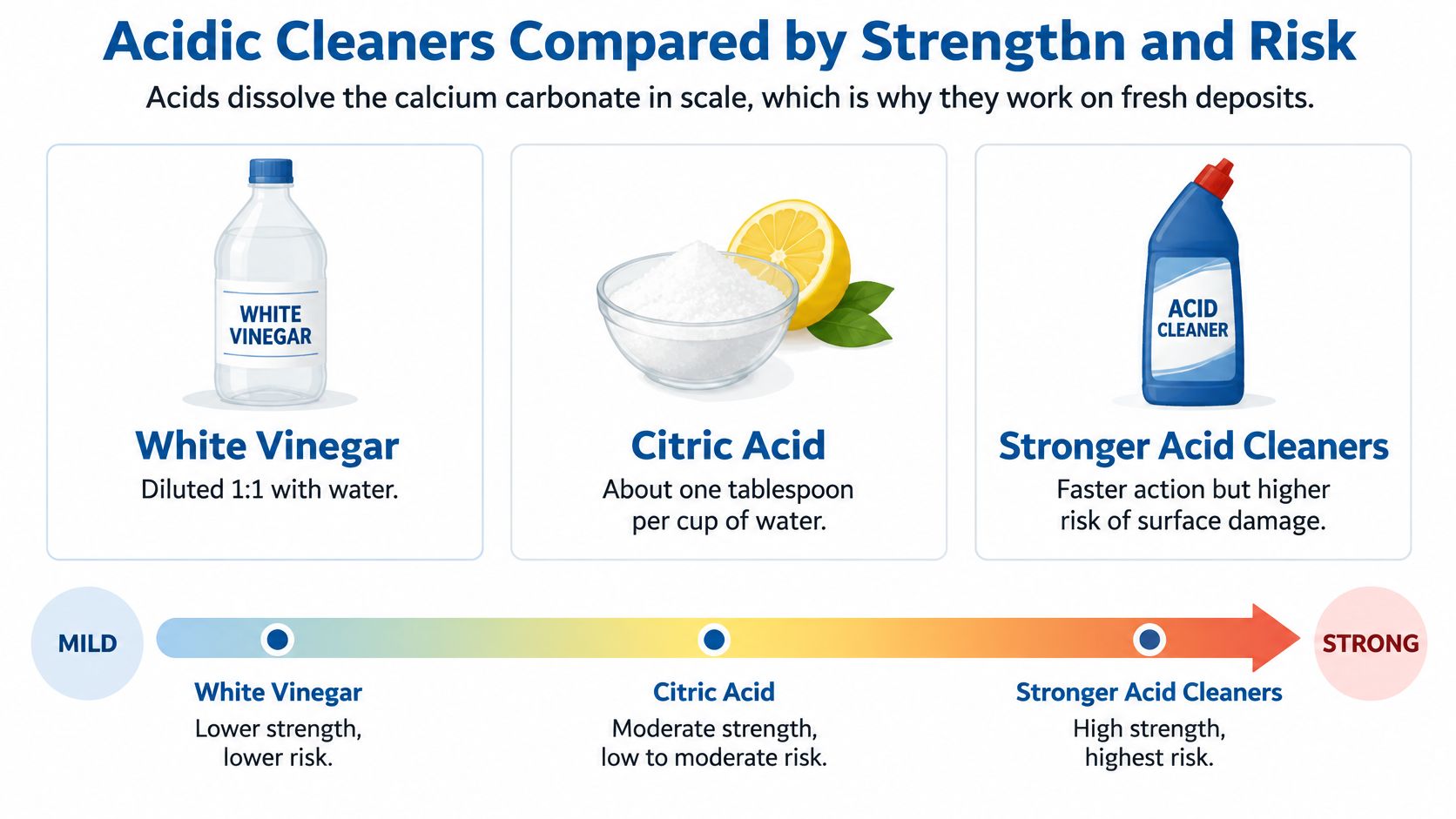
Acids work because they dissolve the calcium carbonate in scale. Start weak, because every step up in strength adds risk to seals, coatings, and nearby finishes.
| Cleaner | Strength | Dwell on light deposits | Main limit |
|---|---|---|---|
| White vinegar, diluted 1:1 | Mild | 5-15 minutes | Weak on heavy scale; strong odor |
| Citric acid, about 1 tablespoon per cup of warm water | Mild to moderate | 5-15 minutes | Can etch some stone; rinse thoroughly |
| Commercial acid cleaner (phosphoric or sulfamic) | Strong | As the label directs | Can damage seals and chrome; needs ventilation and gloves |
For light deposits, The House Mag guide to removing hard water stains from glass states that a mild acidic cleaner such as diluted acetic acid or citric acid should remain wet for approximately 5-15 minutes before agitation, thorough rinsing, and squeegee or microfiber drying. Letting the solution dry can redeposit dissolved minerals and create additional spotting.
The Sequence That Protects the Surface
Remove loose dirt first, so you're not grinding grit into the glass. Apply cleaner only to the affected area, keep it wet, agitate lightly with a non-scratch pad, rinse completely, then squeegee or dry with microfiber. Don't flood frames, grout, or stone thresholds with runoff.
Say you're cleaning a shower door with a light, even film. Citric acid kept wet for about ten minutes will usually clear it in one controlled pass. Now say you're facing an exterior storefront with thick rings from irrigation spray. One pass of vinegar won't finish that job, and repeating it five times won't change the result. That deposit needs a different method, not more patience with the wrong one.
- White vinegar, diluted 1:1: Cheapest first test for fresh spots on plain glass and ceramic.
- Citric acid solution: Easier to control than vinegar, rinses clean, and has less odor.
- Phosphoric or sulfamic acid products: Faster on heavier scale, but I would keep them off chrome, stone, and coated glass entirely.
Hot Phoenix glass dries acid fast, so work in small sections and mist to keep the surface wet. Never apply acid to glass baking in direct midday sun.
Chelating Agents and Mechanical Removal for Stubborn Scale
Chelating agents work differently from acids. They bind calcium and magnesium ions so the deposit releases from the surface without relying on strong acid to dissolve it. That makes an EDTA-based or citrate-based descaler a gentler step up when mild acid softens scale but doesn't clear it.
Follow the label dwell time and keep the surface wet. Chelators are slower than strong acids, but they're easier to control around mixed materials. They have one clear limit. They don't reliably remove iron or manganese stains, which need an iron-specific remover after you've confirmed the stain type by its rust or brown color.
Tools, In Order of Aggression
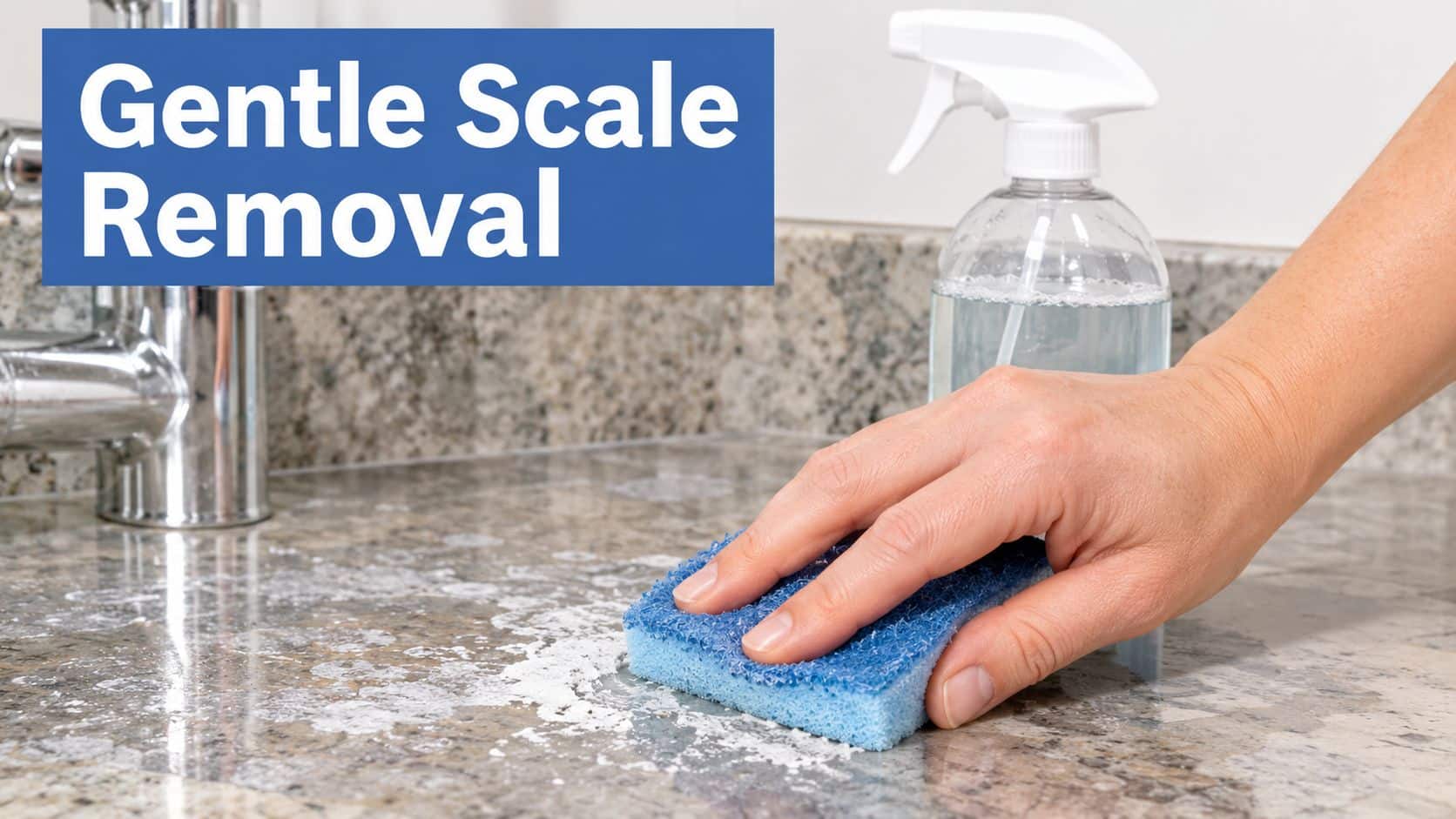
A white non-scratch pad suits glass and ceramic tile for light agitation. It adds friction without the cutting action of scouring pads. Use it wet, with light pressure, and check your test spot before covering a full pane.
A plastic razor scraper handles bonded ridges on glass only. Hold it flat at a shallow angle, keep the surface wet, and push in one direction. Lift it on the return stroke so trapped grit doesn't drag. Never use it on acrylic, fiberglass, stone, or coated and tinted glass.
Steel wool doesn't belong on chrome, acrylic, or coated glass. It leaves fine scratches that catch light and hold new deposits faster than the original surface did. Glass-polishing compound is the last mechanical option, and only for glass. It can soften light etched haze by leveling the surface slightly, but it won't rebuild a damaged coating.
Take hard-water rings on a shower door as the worked example. Apply a chelating solution for about ten minutes, rinse, then use the plastic scraper on any remaining ridge. If the ridge is gone but haze stays, you've reached etching.
Division of labor: Chemistry handles thin film. Mechanical removal handles bonded residue on glass. Neither one restores etched stone.
DIY Recipes Versus Professional Treatment
| Factor | DIY | Professional |
|---|---|---|
| Best-fit deposit | Light, fresh spots on accessible glass | Heavy bonded scale and mixed surfaces |
| Equipment | Bucket, squeegee, microfiber, ladder for low glass | Pure-water systems, pro squeegees, safe access equipment |
| Surface testing | Depends on the owner's checks | Tested before any product is applied |
| Damage risk | Higher with strong acid or wrong product | Lower with tested methods and controlled chemistry |
| Rinse method | Often tap water, which can redeposit minerals | Pure-water rinse to prevent new spotting |
DIY is reasonable for light, fresh spots on ground-level glass, a single shower door, or a few windows you can reach without leaning off a ladder. If you're mixing a homemade solution, read our notes on a baking soda and vinegar cleaner first, because combining the two neutralizes much of the acid you were counting on.
When the Job Stops Being a DIY Job
Call a professional for heavy bonded scale on exterior glass, multistory windows, or properties where glass, stone, and chrome sit side by side. Two failed DIY passes are also a clear signal. The problem is misidentified, bonded, or etched, and a third pass usually adds risk without adding results.
Say a homeowner has twenty windows, most with light spotting and two upper-floor panes with heavy rings. I'd split the job. Handle the lower glass yourself with a tested citric acid treatment, and let a professional handle the upper panes with safe access and a pure-water rinse that won't leave new minerals behind.
Professionals test each surface before applying product, then finish with pure water so the rinse itself doesn't redeposit scale. That rinse step is where many DIY jobs undo themselves, since hard tap water dries into the same spots you just removed.
For multistory work, OSHA occupational safety rules at 29 CFR 1910.28(j)(4) address attachment requirements for window-washing equipment, so ask any vendor to confirm equipment is properly secured before booking. Our cleaning team members undergo extensive window cleaning safety training, and that should be a standard question with any company you hire.
Compare quotes on method and surface testing, not price alone. A cheap quote that names one acid for every surface is a warning sign.
Phoenix Heat and Timing Your Cleaning
Glass in direct Phoenix sun can get hot enough to dry rinse water mid-stroke. Every droplet that evaporates leaves its minerals behind in a tighter, more visible ring. Flash-drying is a timing problem, and timing is the one variable you fully control.
National Weather Service Phoenix records identify 2024 as Phoenix's warmest year on record, with an average temperature of 97.0°F. Heat at that level speeds evaporation on the glass itself, so a pane you just wet can spot before you reach it with the squeegee.
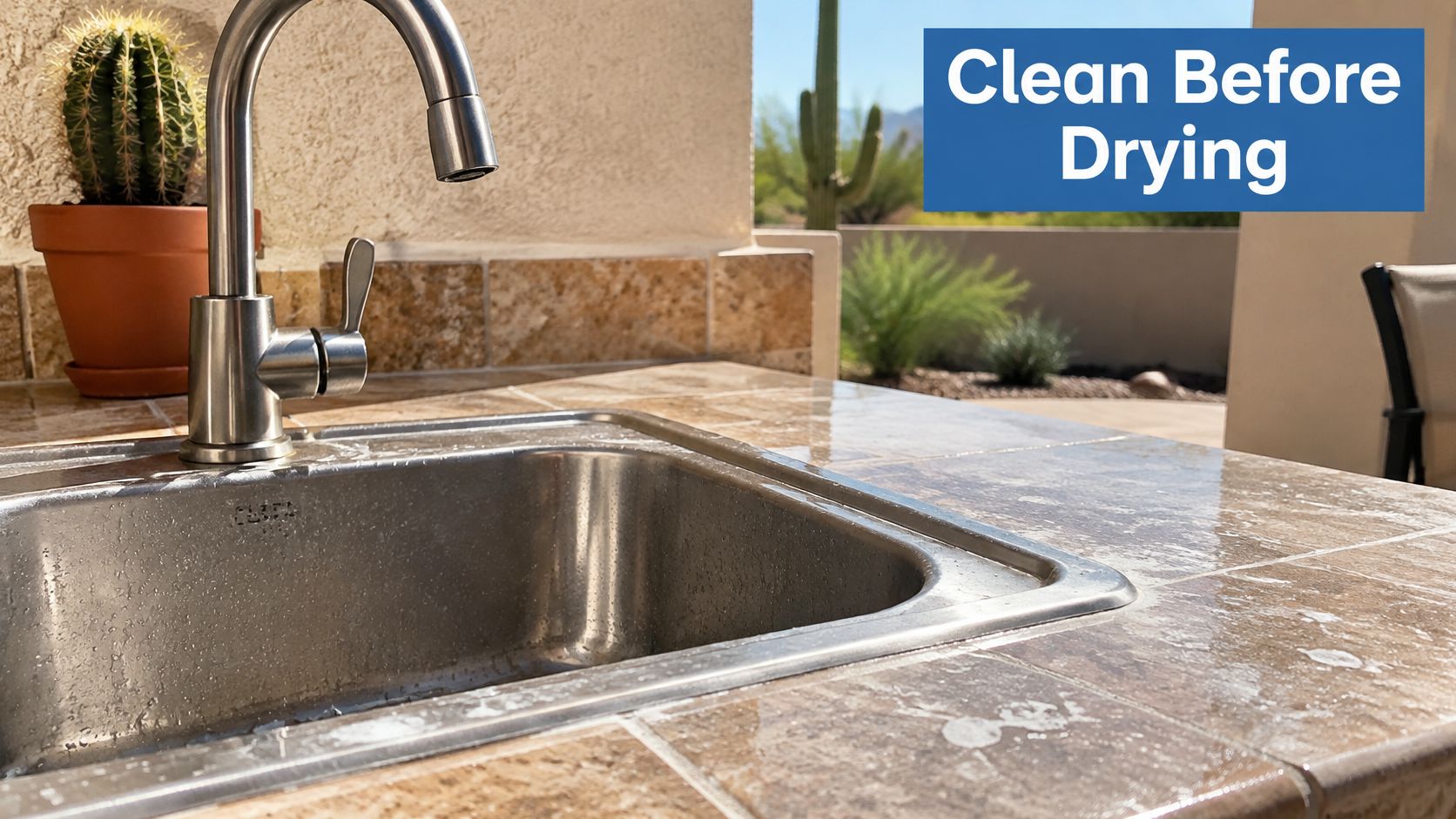
A fresh flash-dry ring is loose mineral residue, and it usually lifts with the next proper cleaning. Repeated bake cycles are different. Each round of wetting and drying presses the same minerals harder against the glass, which is how removable spotting turns into bonded scale. If a ring survives a correct cool-conditions treatment, test for etching before you run another pass. Adding dwell time on a hot pane only bakes the next layer on faster.
Timing Rules for Valley Properties
Clean in early morning or shaded late afternoon, and work in sections small enough that no glass dries between treatment and rinse. Our breakdown of what temperature is best for cleaning windows explains why cooler glass gives you a longer working window. Cooler scheduling also protects the person on the ladder, since Valley summer afternoons push glass and ambient temperatures past the point where sustained outdoor work stays safe.
Three recurring sources rebuild deposits across Phoenix, Scottsdale, Paradise Valley, Chandler, Tempe, and Gilbert:
- Dust storms: Grit and film settle on glass and need rinsing before any scrubbing.
- Monsoon rain: Raindrops carry dust down the pane, then dry as spotted trails.
- Irrigation overspray: Sprinklers deliver mineral-rich water to the same panes daily, building the heaviest rings.
Plan a plain or pure-water rinse after dust storms and rain, and schedule full treatment when spotting returns on a regular cycle. A water softener or point-of-use filter reduces the calcium and magnesium reaching exterior glass, and cleaning when glass shows soil, rather than on a fixed calendar, limits water use. Fixing one misaimed sprinkler head often does more than any cleaner for hard water stains.
Confirm the Right Method Before You Clean
Use one decision rule per situation, and don't let a stubborn spot talk you into skipping steps.
Light, fresh spots on accessible glass suit a tested citric acid or diluted vinegar treatment, kept wet, rinsed fully, and dried with a squeegee. That's the cheapest fix, and I would always start there.
Heavy bonded scale on glass suits a chelating step followed by a wet plastic scraper at a shallow angle. If the ridge lifts but smooth haze remains, you're looking at etching, and further chemical passes won't help.
Stone, chrome, acrylic, and solar panels need the surface test before anything touches them. Any dulling, pitting, or coating damage means stopping chemical treatment and getting a professional assessment. Replacement or refinishing is sometimes the honest answer, and hearing that early is cheaper than hearing it after three acid treatments.
Choosing Who Does the Work
Decide with the same criteria you'd use for any surface risk. Accessible glass and fresh deposits favor careful DIY. Height, mixed materials, bonded scale, and two failed attempts favor a professional crew with pure-water rinsing and tested chemistry.
South Mountain Window Cleaning, LLC serves Phoenix, Scottsdale, Paradise Valley, Chandler, Tempe, and Gilbert, Arizona with residential, commercial, and high-rise window washing. The team can remove water marks left on windows by powerful storms, assess each surface before choosing a method, and provides a fast and free quote for any cleaning needs.
The best method is the one that clears the deposit without changing the surface. If you can't confirm that's what your cleaner will do, you haven't picked a cleaner yet. You've picked a risk.
If your test spot says stop, or the glass sits two stories up with bonded rings, let South Mountain Window Cleaning, LLC assess the surface and match the treatment to the material before anything gets applied. We handle residential, commercial, and high-rise window washing across Phoenix, Scottsdale, Paradise Valley, Chandler, Tempe, and Gilbert, and we'll give you a fast, free quote so you know the method and the cost before we start.