

You're looking through dusty apartment glass, but the outside pane is beyond the balcony rail. Or you manage a building where residents want cleaner windows, and the quotes don't seem to cover the same work. One includes screens and tracks; another lists exterior glass without explaining how the crew will reach it.
Settle the scope and access method before comparing prices. Apartment window cleaning can mean an interior visit to a single unit or a coordinated façade project. The right choice starts with who controls the windows and how the crew can safely reach them.
Apartment Window Cleaning Options at a Glance
| Option | Who usually books it | What it covers | Access needed |
|---|---|---|---|
| Resident interior cleaning | Tenant | Inside glass, sills and tracks in one unit | Inside the unit only |
| Full unit cleaning, inside and out | Tenant with landlord approval | Inside and outside glass, screens and tracks | Exterior reach by ladder or pole |
| Building exterior glass | Property manager or HOA | Exterior glass across common areas and multiple units | Specialist equipment and a documented site plan |
| High-rise exterior glass | Property manager or condo board | Full façade glass | Suspended platform or rope access with a fall-protection plan |
Who controls the glass
Start with your lease or association documents. A resident may be responsible for keeping interior glass clean without having authority to hire someone to work on the building's exterior.
The distinction matters even when a window opens into your unit. Exterior frames, façade attachments and access systems may fall under the owner's or association's control. Don't assume permission to clean inside also authorizes ladders against the building or access to its roof.
Can the crew reach it without going outside
Walk through the apartment and identify sliding doors, balcony or patio doors, bathroom and kitchen panes, screens and tracks. Note which surfaces are accessible from the room and which require exterior equipment.
A balcony doesn't automatically make outside glass reachable. If cleaning requires leaning over a rail, standing on furniture or reaching around a fixed panel, that surface needs a different access method.
Booking rule: Describe where the glass is, not just how many windows you have.
Interior-only work is the simplest choice when exterior permission or access remains unresolved. Building-wide exterior cleaning makes more sense when several residents share the same problem and the manager can coordinate access across the property.
Tenants should get written permission before exterior work. Managers should choose the service category that accommodates the highest floor requiring access, while allowing the contractor to use different equipment on lower, more accessible sections.
What a Standard Apartment Cleaning Includes
A standard visit should be defined by a written checklist, not the phrase full cleaning. Glass, screens and tracks require different work, and a low glass-only quote won't necessarily include the surrounding components.
Compare the quote against this checklist
- Interior glass: Clean the room-facing glass on every listed window and sliding door.
- Frames and sills: Wipe accessible frame surfaces and the ledges where dust collects.
- Screens: Remove serviceable screens with permission, wash and rinse them, then reinstall them securely.
- Tracks: Vacuum loose debris before wiping accessible channels.
- Mirrors: Include only the mirrors specifically named in the scope.
- Exterior glass: Identify ground-accessible panes, balcony and patio doors, and upper-floor glass the crew can reach safely.
The graphic below also includes general housekeeping tasks. Floors, kitchen touchpoints and bathroom surfaces aren't automatically part of a window-cleaning appointment.
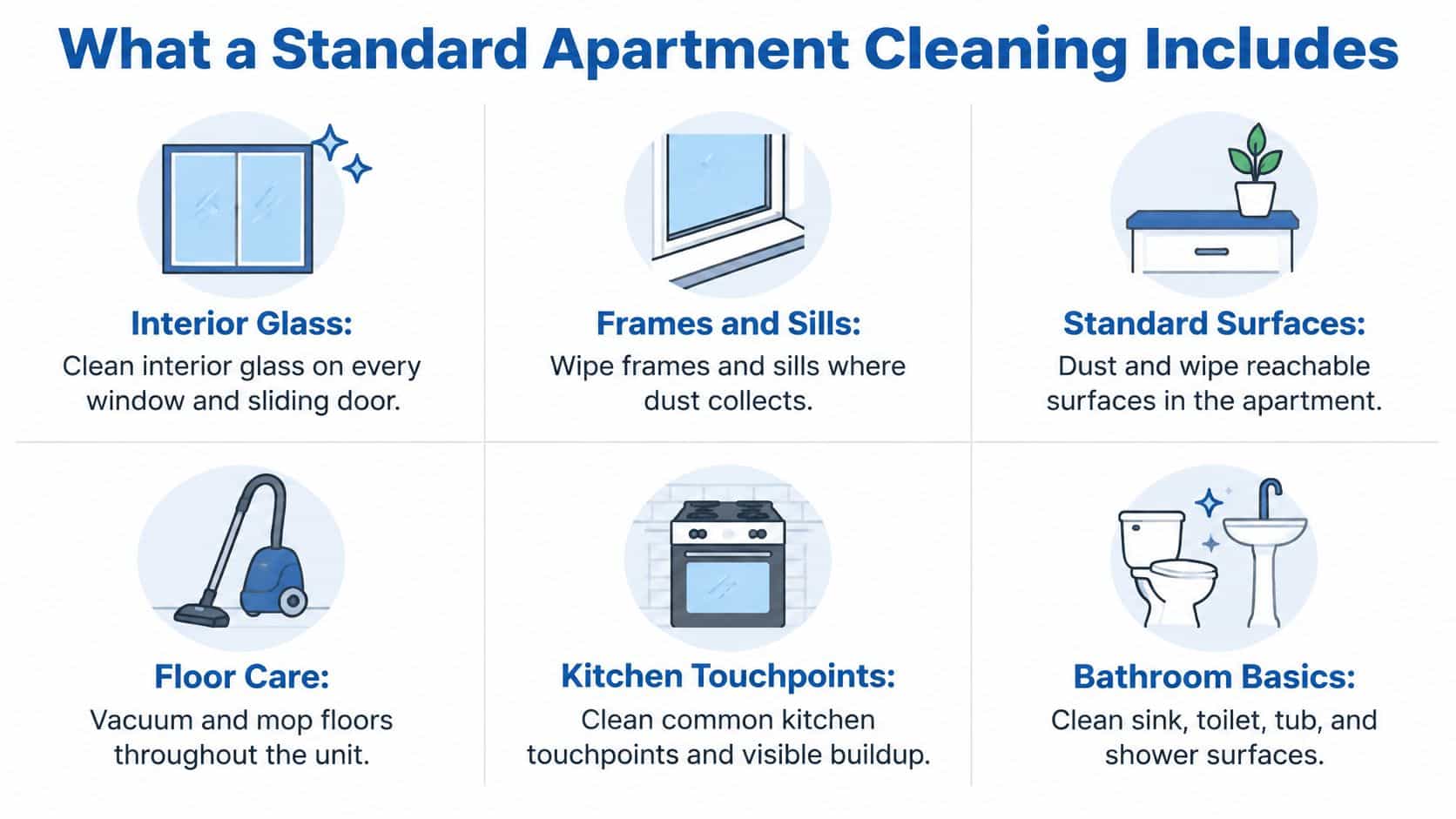
For routine glass, a washer sleeve, suitable cleaning solution and professional squeegee remove ordinary surface soil. Tracks need dry debris removed first; flooding a dusty track turns grit into slurry and can push water toward interior finishes.
Separate cleaning from repairs and restoration
Screen repair means fixing mesh or frames, not washing them. Window tinting changes the glass treatment and needs a separate scope.
Ceiling fans aren't window components, even if the same contractor offers that service. Caulking is building-envelope work, not a substitute for cleaning.
Glass requiring equipment absent from the quote should remain excluded until access is assessed. Mineral deposits, paint and construction residue also need explicit review rather than an assumption that ordinary washing will remove them.
Consider a hypothetical two-bedroom apartment with eight windows and two sliding doors. An interior-only visit touches the room-facing panes and whichever sills and tracks are listed; an inside-and-out visit adds the exterior faces, agreed screen work and the equipment needed to reach them. The resident pays for that additional labor and access, not merely a different description on the invoice.
Clean glass preserves the view and daylight residents expect. Andersen's window-performance guide distinguishes visible light transmission from solar heat gain; cleaning should preserve optical clarity, not be presented as changing the window's certified performance.
Use this booking sentence:
Please list every included window, sliding door, screen and track, identify the interior and exterior surfaces covered, and mark each exclusion separately.
What Sets the Price of Apartment Window Cleaning
| Price factor | How it changes the quote | What to ask the provider |
|---|---|---|
| Number of windows | More panes add labor time per visit | Window count per unit and per building |
| Interior only or inside and out | Exterior work adds access time and equipment | Whether screens and tracks are included |
| Floor level and access method | Ladders, poles or platforms change crew setup | Which equipment the crew will use |
| Glass condition | Hard-water spots, paint or construction residue need extra time | Whether mineral removal is quoted separately |
| Service frequency | Recurring visits can lower the per-visit rate | Rates for weekly, monthly or quarterly service |
| Units in the building | Multi-unit properties can be bundled into one visit | Site-wide minimums and bundled rates |
| Insurance and safety records | Exterior and commercial work needs proof of coverage and training | Certificates of insurance before work starts |
Compare the same work
Consider two hypothetical two-bedroom units, each with eight windows. The ground-floor resident wants interior glass only, with clear access through the apartment. The third-floor resident wants both sides cleaned, and exterior reach requires a suitable ladder or pole system after assessment.
The window count matches, but the work doesn't. The second quote must account for equipment setup, exterior positioning and any restrictions around balconies, landscaping or pedestrian routes.
Residential quotes may use a per-window or per-unit basis. Building contracts may use per-visit or monthly pricing, so confirm whether a monthly figure represents one visit or a recurring billing arrangement. Use the cost-per-window guide to understand the pricing structure, then compare matching scopes rather than isolated unit prices.
Look for condition and coordination charges
Heavy mineral spotting requires a different approach from loose dust. Before authorizing restoration, identify the glazing and coatings, test the proposed treatment and agree on the expected result. Aggressive scraping isn't a universal answer to stubborn marks.
Construction dust can conceal abrasive debris. Pet hair caught in screens takes extra handling, while crowded balconies can prevent the crew from reaching the agreed work area.
Check cancellation and rescheduling terms before accepting the quote. A locked unit, unavailable escort or blocked equipment route can leave a scheduled crew unable to work; any associated fee should be disclosed, not discovered afterward.
Recurring weekly, monthly or quarterly appointments can support a lower per-visit price because the contractor can organize routes and maintain cleaner starting conditions. A discount isn't automatic, and an initial restoration visit shouldn't be compared directly with routine maintenance.
A cheaper quote isn't equivalent if it leaves out the screens, difficult panes or equipment needed to finish the job.
For commercial and multi-unit work, insurance documentation and safety training belong in the value comparison. Our team members undergo extensive window-cleaning safety training; those credentials matter more than a vague promise to handle difficult access.
Before accepting a quote, confirm:
- Included windows: Which panes, doors, screens and tracks are covered?
- Access equipment: What will the crew use, and is setup included?
- Mineral removal: Is treatment priced separately from routine washing?
How Often Apartment Windows Need Cleaning
Choose a maintenance interval based on exposure, then adjust it after seeing how quickly the glass gets dirty again. The following are practical starting recommendations, not mandatory schedules or measured guarantees.
| Exposure | Starting interval | Note |
|---|---|---|
| Residential unit, inside and outside glass | Every 3 to 4 months | Adjust after the second visit |
| Ground-floor and patio glass in dusty areas | Every 2 months | Closest to dust and foot traffic |
| Buildings near construction sites or unpaved lots | Monthly | Heavy dust build-up |
| Commercial lobbies and storefronts | Quarterly | Maintenance interval |
Let local dust set the pace
The City of Phoenix dust program defines PM10 as particulate matter with a diameter of 10 micrometers or less. Dust can settle on exterior glass, screen mesh, frames and tracks, so a quick glance from across the room isn't a complete condition check.
For properties in Phoenix, Scottsdale, Paradise Valley, Chandler, Tempe and Gilbert, examine the exposed side of the building separately from sheltered courtyards. Nearby earthwork, irrigation overspray and open lots can justify different schedules within the same property.
Storms can leave water marks and redistributed dust that need a separate cleaning pass. Don't automatically order mineral restoration after rain, though; first distinguish removable surface residue from deposits that require treatment.
Adjust after the first maintenance cycle
Book the initial visit after a dusty period, then inspect representative panes before the next appointment. Photograph the same glass from the same position so you can compare clarity without relying on memory.
If the glass remains acceptably clear, extend the interval. If residents struggle with dusty views well before the scheduled return, shorten it or target the most exposed elevations. The window-cleaning frequency guide provides further scheduling considerations.
Screens and tracks may need a different cycle from the glass, especially where residents frequently open sliding doors. Managers should send written notices and coordinate interior access around move-outs, when furniture and personal belongings are less likely to obstruct the windows.
Safe Access to Exterior Glass for Apartments
The cheapest available method isn't necessarily a method the building can support. Exterior apartment cleaning is an access and fall-protection operation, and floor level alone doesn't establish what equipment is appropriate.
Under OSHA's scaffold standard, each scaffold and component must support its own weight plus at least four times the maximum intended load; employees on single-point or two-point adjustable suspension scaffolds require both a personal fall-arrest system and a guardrail system. Scaffold support surfaces also have specific load requirements, so a parapet or roof edge cannot be assumed suitable.
Match equipment to the building
| Floor or building type | Access method | What it needs | Plan requirement |
|---|---|---|---|
| Ground floor and reachable glass | Pole-fed system from the ground | Clear, stable footing | Standard site check |
| Short reach, second floor and below | Stable ladder with a spotter | Level ground and a spotter present | Standard site check |
| Above second floor, low-rise | Platform, lift or rope access | Verified anchors where applicable and suitable equipment capacity | Documented site assessment |
| High-rise façade | Suspended platform or boatswain's chair | Rated equipment, suitable rope rigging and system-specific fall protection | Site-specific plan with rescue procedure |
These are planning categories, not universal height cutoffs. Pole reach, façade geometry, overhead hazards and ground conditions can change the choice.
A water-fed pole lets the cleaner brush and rinse suitable glazing from the ground. It works best when the operator can maintain control and reach the full pane without obstructions.
A ladder suits limited reaches where its footing and positioning are appropriate. A spotter doesn't make unstable ground, sideways overreaching or an unsuitable ladder safe.
Mechanical or suspended access brings the worker to upper façades. For boatswain's chairs, OSHA's single-point scaffold guidance specifies a 250-pound maximum intended load and addresses vertical ropes, protected rigging and rescue accessibility. Equipment-specific requirements must be assessed rather than treating a chair and a guarded platform as interchangeable.
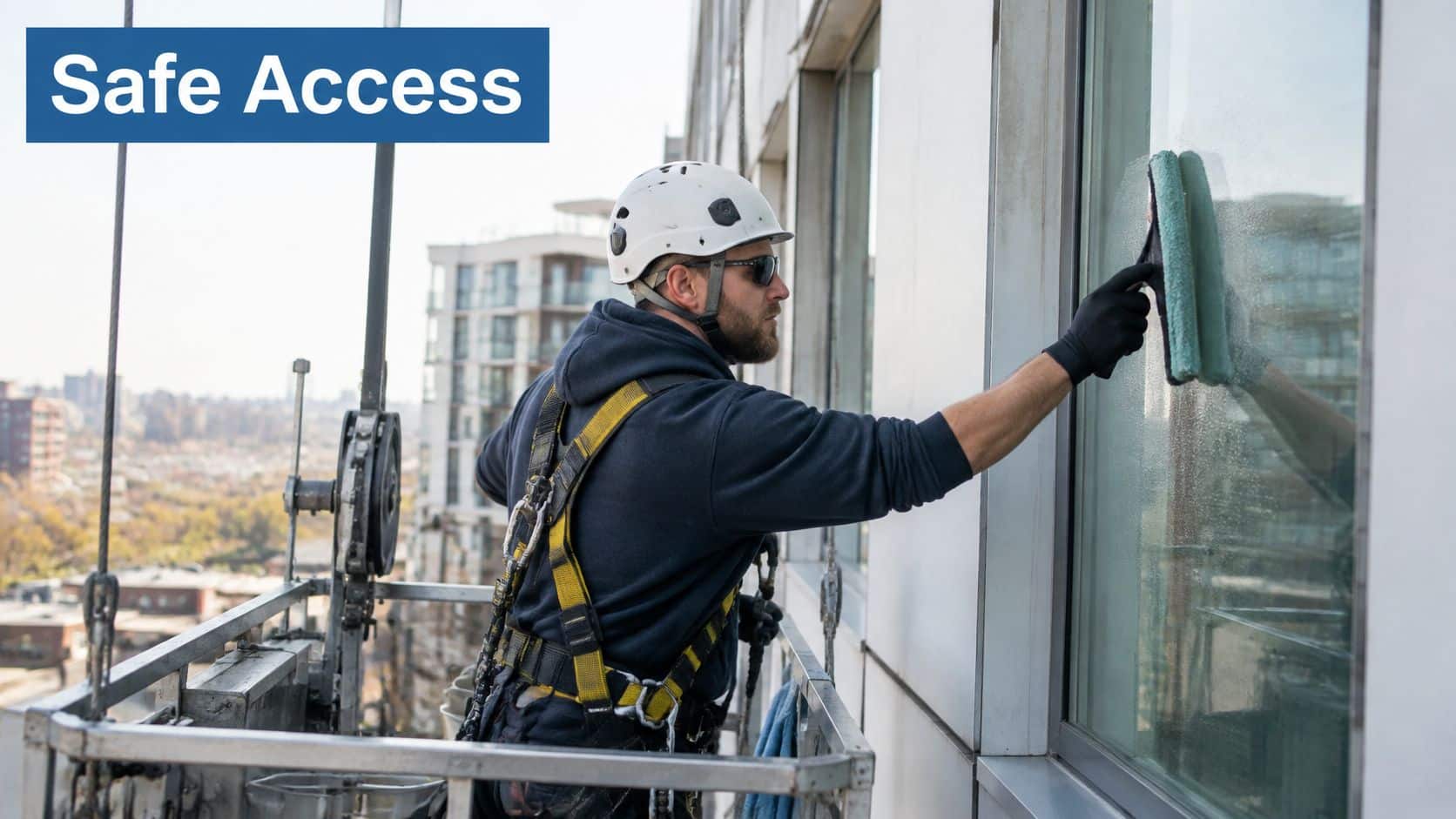
Verify the plan before work starts
A responsible pre-work review should address:
- Building condition: Inspect access routes, fragile cladding, setbacks, parapets and façade obstructions.
- Equipment support: Verify anchor documentation, tie-ins, equipment capacity and inspection records.
- Public protection: Establish drop zones and keep residents and pedestrians away from overhead work.
- Weather limits: Stop when wind or other conditions exceed safe operating limits.
- Emergency recovery: Identify who responds, how workers are reached and how emergency services access the site.
Ask directly: What happens if the lift stops or someone on the platform needs rescue? An answer limited to calling emergency services doesn't explain the recovery arrangements.
For properties with varied elevations, the mid-rise building cleaning information is a useful starting point for describing access needs. Unusual setbacks or missing anchor records may require a different method before anyone can finalize the scope.
The lowest quote offers no saving if its proposed access method can't be used safely on your building.
Preparing Your Unit and Residents for the Crew
Preparation succeeds when every window is either ready for the agreed cleaning method or recorded as inaccessible. That keeps access decisions with the crew and prevents residents from being asked to hold screens, force hardware, or move safety equipment on cleaning day.
A resident preparation routine
- Move obstructions: Leave clear working space around each included window, moving furniture and plants and raising blinds so the crew does not have to stretch over belongings.
- Secure pets and children: Keep them in a separate, supervised area away from tools, open doors and cleaning water.
- Identify guards and stuck sashes: Tell the crew before work begins, and do not remove guards yourself or force a reluctant window.
- Clear balconies and patios: Move items blocking the agreed exterior route without placing anything against a railing.
- Check unused windows: Close and lock windows outside the cleaning scope, and flag broken latches rather than relying on them.
- Confirm entry arrangements: Put the arrival window and authorized keyholder in writing so access does not depend on an unanswered call.
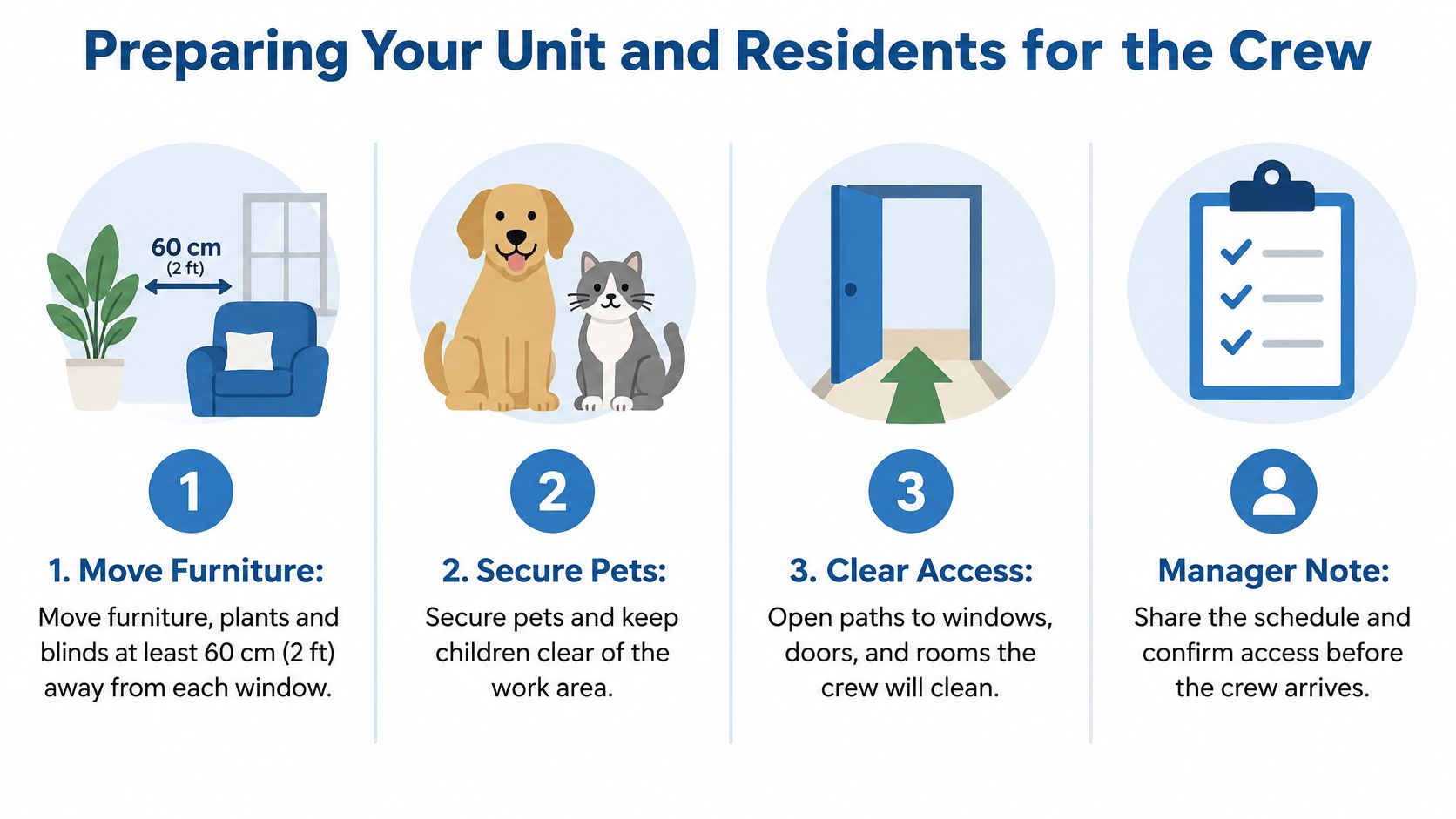
Protect guards, finishes and privacy
Local window-guard requirements vary, so leave installed guards in place and never remove or work around a safety guard during cleaning. If a guard blocks a pane, the safer outcome is a documented exclusion.
Use this decision path when access is blocked:
- Guard present: Leave it installed and document any glass that cannot be safely reached.
- Screen obstructing access: Remove it only with the resident's consent and when its condition permits safe handling.
- Furniture in the way: Move it only with the resident's agreement; otherwise record the limitation.
- Damaged hardware: Photograph and report it instead of forcing the sash, latch or slider.
Crews should protect floors and sills with drop cloths and photograph pre-existing cracks, loose seals or damaged finishes before starting. Managers should tell residents when exterior workers may pass bedroom or bathroom windows, especially where the crew may be visible before reaching the scheduled level.
A notice managers can adapt
Scheduled window cleaning: [Date], during [arrival window]. The crew needs [interior entry, balcony access or exterior access only]. Please clear the agreed work areas, secure pets and report guards or damaged hardware. Contact [manager name and contact details] with access restrictions or privacy concerns.
A finished visit should leave the agreed glass and any included tracks clean. The close-out note should identify skipped panes, the reason access was unavailable or unsafe, and whether repairs or further authorization are needed. If safer access means one pane remains uncleaned, record it plainly rather than stretching from furniture or leaning over a railing.
Book Apartment Window Cleaning With the Right Scope
Your next step isn't to request the lowest price for an apartment. It's to send a description that allows the contractor to price the work you need.
Assemble a useful booking request
- Count by type and floor: Separate ordinary windows, fixed panes and sliding doors.
- Mark restrictions: Identify guards, enclosed balconies, patio doors and inaccessible exterior faces.
- Choose the coverage: State interior-only or inside-and-out, with screens and tracks listed explicitly.
- Choose a starting frequency: Match the appointment to exposure and occupancy rather than requesting an undefined regular service.
- Attach access notes: Include photographs, entry arrangements and known equipment restrictions.
Request a written quote that names the access equipment and lists exclusions. Keep the accepted scope with the booking confirmation so the resident, manager and crew are working from the same description.
For multi-unit and high-rise properties, request certificates of insurance and a site assessment before the first visit. The window-cleaning insurance guide can help you organize the documentation questions without treating insurance as a substitute for safe access planning.
Keep the handoff clear
South Mountain Window Cleaning, LLC provides full-service residential, commercial and high-rise window washing valley-wide, serving Phoenix, Scottsdale, Paradise Valley, Chandler, Tempe and Gilbert, Arizona. We provide a fast, free quote for cleaning needs and a 100% satisfaction guarantee on residential window cleaning services.
Managers coordinating multiple residents should name a contact for access changes and urgent questions. If a property office can't reliably handle incoming calls during field work, a call answering service from SkipCalls is one option for receiving messages; the manager should still retain responsibility for entry permissions and safety decisions.
This week, photograph each window, note its floor and access problems, and send those details with your quote request. That small amount of preparation makes it easier to distinguish a complete proposal from one that leaves difficult work unresolved.
South Mountain Window Cleaning, LLC offers residential, commercial and high-rise window cleaning for apartment units and buildings across the Valley. Visit South Mountain Window Cleaning, LLC to request a fast, free quote, and include your window count, floor levels and access photos so the proposed scope matches your property.