
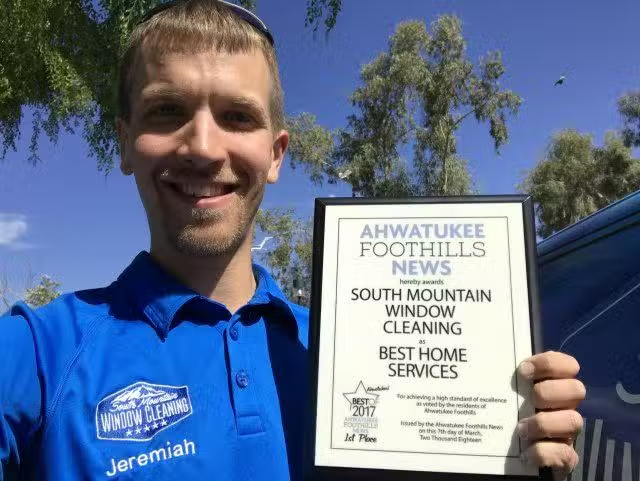
Your driveway has dark tire tracks, the entry walk looks stained, and dust has settled into the building's textured walls. You're ready to book exterior pressure washing services, but the quotes don't explain whether the crew will protect the stucco or keep dirty water out of the parking lot drain.
Those details matter more than the machine's maximum pressure. Surface protection and wastewater handling are real cost drivers, because they determine the equipment, preparation, labor, and disposal work a property needs. A useful quote explains both, not just the square footage.
Which Surfaces Need Which Pressure
Choose pressure for the surface, not for the machine. Sound concrete can tolerate cleaning methods that would strip paint, erode mortar, or force water behind siding. Even on durable materials, existing deterioration changes the method.
Treat the following settings as planning guidance, not permission to start at the top of a range. Coatings, repairs, age, and manufacturer requirements can all call for gentler cleaning.
Pressure, nozzle and main risk by exterior surface
| Surface | Typical pressure | Nozzle | Main risk |
|---|---|---|---|
| Concrete driveway or walkway | Lowest effective concrete-cleaning setting established by a test patch | 25 degree | Etched or pitted surface when held too close |
| Dumpster pad or loading area | Test-established concrete setting with a compatible degreaser | 25 degree | Oil and sediment carried into drains |
| Vinyl siding | Low-pressure wash approved for the siding system | 40 degree | Lifted seams and water pushed behind panels |
| Painted wood or fiber cement | Soft wash only | Wide low-pressure tip | Peeled paint and raised wood grain |
| Brick or stone masonry | Under 1,000 psi after test patch, with stricter limits for historic masonry | 40 degree | Mortar erosion and spalling |
| Stucco | Soft wash only | Wide low-pressure tip | Cracks and surface loss |
The nozzle matters because a narrow spray concentrates force into a smaller area. Narrow tips don't belong on siding or painted trim, and moving the wand closer isn't a safe substitute for selecting the correct cleaner.
A powerful homeowner machine isn't automatically a better siding-cleaning tool. Its output still needs to be controlled, and a wide spray can cause damage when aimed upward into laps, vents, or weather seals.
Read the material before choosing the setting
Stucco deserves particular care around patched areas, cracks, decorative bands, and window openings. Our explanation of whether you can pressure wash stucco helps distinguish washable surface dirt from conditions that need repair first.
For decks, identify whether you're dealing with wood, composite boards, or coated concrete. The fact that a surface is horizontal doesn't make it suitable for aggressive pressure.
Practical rule: If cleaning exposes fresh aggregate, loosens coating edges, or changes the surface texture, stop. That's material removal, not better cleaning.
Before booking, run this simple check:
- Identify each surface, including coatings and repairs.
- Find its row and note the proposed cleaning method.
- Mark test-patch locations, especially on masonry, stucco, painted finishes, and questionable concrete.
Services Covered in a Full Exterior Job
A single-family homeowner might need siding, soffits, an entry walk, a driveway, and the garage apron cleaned together. A townhome owner may have a smaller footprint but tighter access, shared landscaping, and neighboring doors that need protection.
Commercial scopes get more complicated. At a restaurant, the drive-thru lane collects vehicle residue while the dumpster pad needs grease-focused cleaning. A retail center adds storefront approaches and pedestrian routing; a multifamily property combines building exteriors, walkways, parking areas, and resident access.
South Mountain Window Cleaning, LLC offers full-service power washing for drive-thrus, dumpster pads, walkways, building exteriors, and more. Our flat-surface cleaning covers driveways, walkways, decks, parking lots, and other flat surfaces, with the cleaning method selected for the material.
Build the scope around how the property operates
Say you manage a restaurant in a shared plaza. The pad can't be cleaned while waste containers block access, the drive-thru can't stay wet during service, and pedestrians still need a route to neighboring businesses. Those restrictions belong in the scope, not in a conversation after the crew arrives.
Add-ons also need clear names. Our garbage bin cleaning service means dumpster pad cleaning for commercial buildings. Specify separately whether the work includes an enclosure, surrounding walls, or other surfaces rather than assuming they're included.
Rust removal on concrete and house washing paired with flat-surface cleaning can be grouped into the same visit. Bundling avoids a separate mobilization, but specialized stain treatment should remain identifiable in the quote.
Walk the property with a simple sketch and record:
- Surface and size: Mark approximate dimensions and material.
- Condition: Identify oil, rust, algae, loose coatings, and existing damage.
- Access: Note gates, parked vehicles, ladders, lifts, and restricted areas.
- Operating constraints: Identify business hours, deliveries, and resident routes.
A complete scope sheet should name every included surface, its condition, proposed method, access requirements, exclusions, and expected finish. That's how you compare quotes fairly instead of comparing different jobs disguised as the same service.
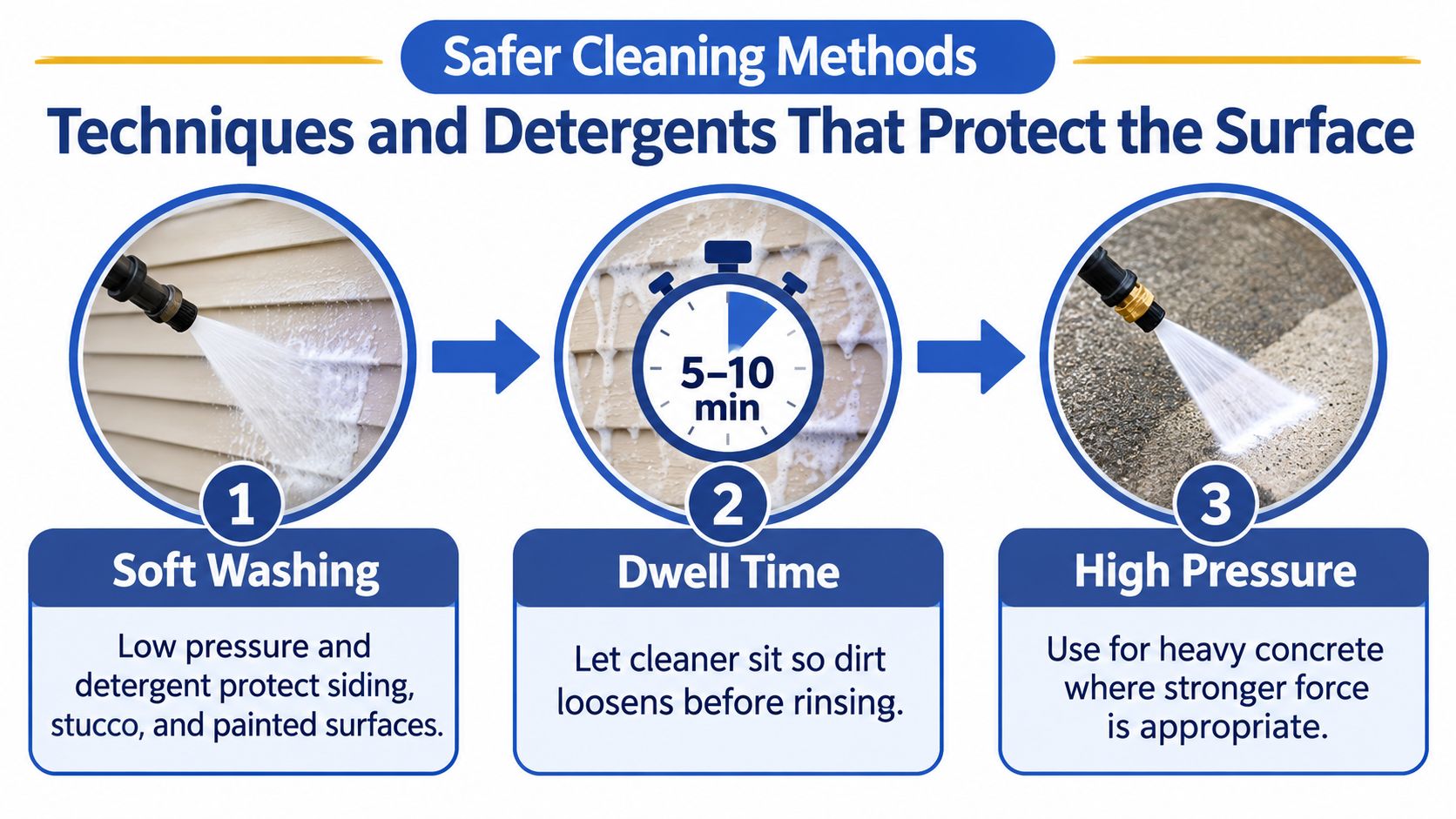
Techniques and Detergents That Protect the Surface
Soft washing uses low pressure, detergent, and dwell time to loosen contamination before rinsing. It's often the better approach for siding, stucco, and painted finishes, while sound, heavy concrete can justify stronger mechanical cleaning.
Choose chemistry for the stain and substrate. A phosphate-free, pH-balanced cleaner can suit general soil, but grease may need a compatible alkaline degreaser, and rust requires a dedicated treatment. Less-toxic products are preferable where effective, but no cleaner becomes harmless just because its label sounds environmentally friendly.
This visual summarizes where each method belongs.
Test before committing to the whole wall
A façade failure analysis in The Construction Specifier describes a misinterpreted specification below 2,750 kPa (400 psi) that resulted in stone spalling, mortar-joint erosion, coating loss, and visible spray patterns. Its historic-building guidance sets firm limits of 500 psi on masonry and 300 psi on cast iron, with no pressure washing on wood or other fragile materials.
The test patch is the practical control against that kind of damage. It checks the combination of pressure, chemistry, nozzle, distance, and surface condition.
- Choose a hidden test area. Include representative staining without starting on an already failing edge.
- Begin at the lowest effective pressure with a wide tip. Establish what the surface tolerates before trying to accelerate production.
- Apply the correct detergent and allow dwell time. Keep it from drying, and work in manageable areas so the cleaner can loosen soil before rinsing.
- Start with the wand about 12 to 18 inches away. Treat that as a trial position, not a universal safe distance, and keep the spray moving evenly.
- Increase pressure only if the test supports it. Try appropriate chemistry or gentle agitation before adding force.
- Rinse from the top down. Control overlapping passes so dirty water doesn't leave streaks or tide marks.
- Inspect seams, joints, and door frames. Stop if water enters openings or the finish changes.
Keep bleach-based cleaners away from unprotected plants and sensitive metal trim. Pre-wet nearby vegetation, control overspray, and rinse exposed surfaces promptly; never mix bleach with acids or ammonia. Our guide to choosing a house-washing solution explains why cleaner selection matters as much as equipment.
For commercial façades, the written method statement should record each substrate, test result, maximum pressure, nozzle, stand-off distance, and protection needs. A successful test leaves a uniformly clean surface after drying, without roughened texture, loose mortar, coating loss, or spray-shaped marks.
Where Wastewater Can Legally Go
A spotless walkway isn't the finish line if its dirty water has entered a storm drain. Pressure-washing runoff can carry oil, sediment, detergents, metals, and biological growth from the surface into a drainage system.
The EPA's pressure-washing guidance identifies this wastewater as a potential pollutant source and recommends planning the work area, minimizing water use, using less-toxic products, and collecting runoff for appropriate disposal. A drain's location doesn't tell you whether it connects to a sanitary sewer or a storm system.
Drain protection needs to be installed before washing starts.
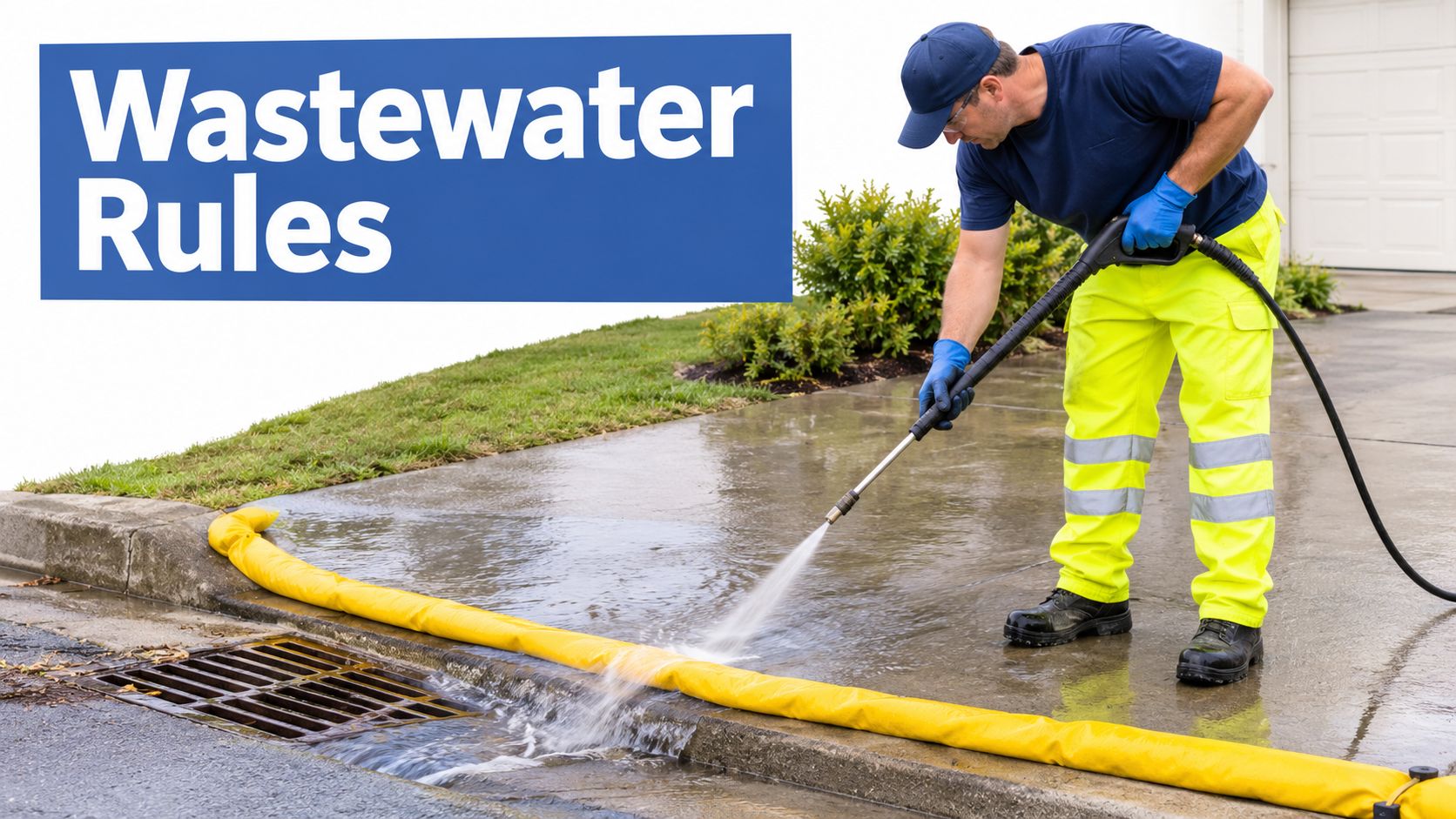
Contain first, then choose an authorized outlet
Booms and berms redirect shallow flow. Portable containment captures water around a defined work area, while storm-drain covers protect inlets. Wet vacuums and pumps transfer collected water into holding tanks; an oil-water separator may be part of treatment, but it doesn't itself authorize discharge.
Dry preparation helps too. Sweep sediment, collect loose debris, and absorb free oil before introducing water. Otherwise, the crew creates more contaminated liquid to handle.
Allowed wastewater routes and required controls
| Water route | When it is allowed | Required control |
|---|---|---|
| Sanitary sewer | Preferred where authorized | Collect with wet vacuum or pump and discharge to an approved sanitary line |
| Landscaping or lawn | Only where permitted, with owner permission and no storm-drain path or soil-contamination risk | Block nearby drains, limit water volume, and verify wastewater suitability |
| Storm drain | Not allowed as an ordinary washwater disposal route | Install storm-drain covers and capture runoff before work starts |
| Hazardous-material wastewater | Through an appropriately licensed hazardous-waste hauler | Hold in compatible tanks and arrange off-site disposal |
Owner permission alone doesn't make landscaping discharge acceptable. Likewise, an accessible sewer cleanout isn't permission to dispose of grease-heavy water. Obtain authorization from the responsible sewer authority and meet its acceptance conditions before using that route.
Consider a restaurant dumpster pad in a Phoenix-area plaza. The crew first removes solids, isolates the pad with berms, and blocks the parking lot inlet. Greasy washwater is captured with a wet vacuum and transferred to a holding tank or an authorized sanitary connection, rather than being pushed across the lot.
The following video provides an additional visual reference for the work.
Before work begins, request a drainage sketch, a containment equipment list, and the planned disposal destination. Afterward, retain a disposal record identifying where the captured water went and any applicable authorization or hauling receipt.
A clean surface and a documented disposal route are separate deliverables. A professional scope needs both.
Scheduling and Maintenance Plans
Set intervals by surface use, soil load, moisture, and exposure, not by applying the same calendar rule across an entire property. The schedule below is a practical starting plan to adjust after inspecting the site, not a requirement or a guarantee that every surface needs washing that often.
Typical cleaning intervals by property and surface
| Property and surface | Typical interval | Main reason |
|---|---|---|
| Single-family house wash | Once a year | Dust, pollen, and mildew where moisture persists |
| Driveway and walkway | Every 12 to 18 months | Oil, dirt, and algae |
| Restaurant dumpster pad | Monthly | Grease and odor buildup |
| Drive-thru lane | Monthly to quarterly | Oil stains and tire marks |
| Retail storefront walkway | Quarterly | Foot traffic and staining |
| Multifamily building exterior | Twice a year | Dust, localized mildew, and graffiti assessment |
Don't wash an entire façade just because a dumpster pad needs attention. Separate service intervals let the crew address heavy-use areas without repeatedly wetting surfaces that remain clean.
Make the plan measurable
For a hypothetical 30-unit building, a workable starting arrangement might combine monthly dumpster-pad cleaning, twice-yearly exterior assessment and washing where needed, and annual driveway cleaning. Adjust the plan after reviewing actual staining and resident access needs.
Bundle compatible tasks into the same visit, then identify which services remain separate. Our commercial window cleaning uses computerized scheduling so the crew arrives at the scheduled time, and customers can schedule an estimate or service online.
For Phoenix-area properties, review conditions before summer dust accumulation becomes heavy and after monsoon storms leave visible residue. Don't automatically add a full wash after every storm; inspect first and distinguish removable deposits from coating damage or mineral staining.
Use our guide to how often to power wash your home when setting residential priorities. For recurring commercial work, AurenWell's pressure washing contract guide is a useful resource for organizing scope, responsibilities, and service terms before committing to a schedule.
Watch for these signs that the plan needs adjustment:
- Returning black streaks: Identify the cause rather than repeatedly treating the appearance.
- Grease odor at the pad: Review cleaning frequency, spills, and waste handling.
- Rapid algae return: Check irrigation overspray, shade, and persistent moisture.
Shortening the interval won't fix a leaking irrigation line. Correct the source of recurring contamination before paying for more frequent cleaning.
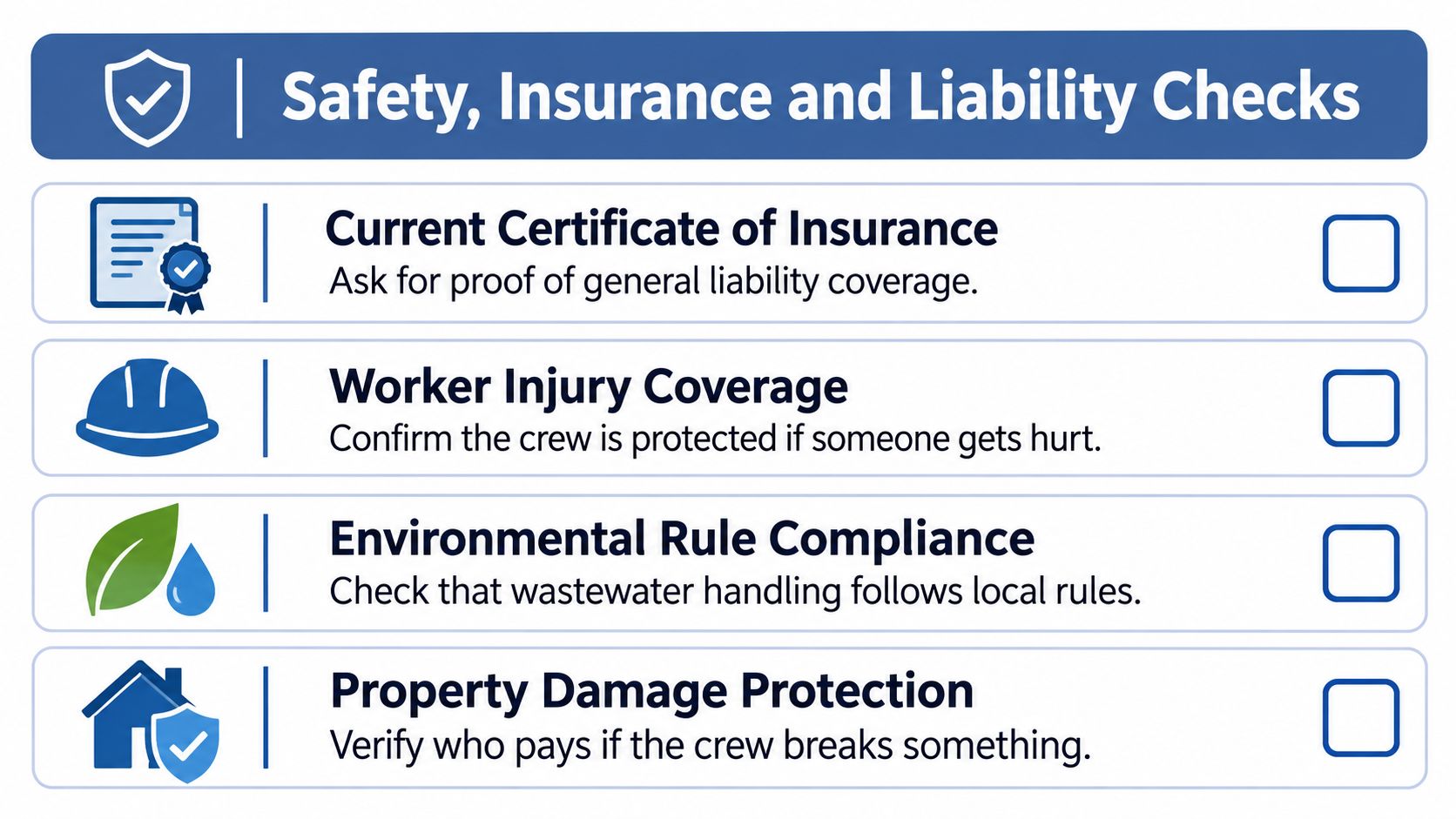
Safety, Insurance and Liability Checks
A worker slips near a wash area, a finish is damaged, or wastewater reaches a prohibited outlet. Each can create costs beyond the cleaning itself. Check the contractor's safety procedures, insurance, and runoff controls before work begins.
Under the Clean Water Act framework described in EPA wastewater guidance, pressure-washing water may be process wastewater requiring separate NPDES coverage rather than automatically qualifying under an industrial stormwater permit. Local rules also matter: prohibited washwater discharge can lead to fines or other enforcement.
Use a written checklist, not verbal assurances.
Elevated work needs its own plan
For powered building-maintenance platforms, including window-cleaning platforms, OSHA's standard requires personal fall-arrest protection, operator training, and emergency procedures for equipment or power failure. Ground-level washing procedures do not cover the risks of high-rise access.
OSHA's scaffold guidance requires fall protection for employees working more than 10 feet above a lower level. The required combination of guardrails and personal fall-arrest protection depends on scaffold type. The guidance also calls for suspension-scaffold sway control when a competent person determines it is necessary, and rope inspection before each shift.
South Mountain Window Cleaning team members undergo extensive window-cleaning safety training. For work at heights, the access method still requires a site-specific review, including firm support for ladders or lifts and a controlled area below.
Before signing, confirm:
- Current insurance certificate showing general liability, the written coverage limit, and the owner as certificate holder.
- Workers' compensation evidence covering the personnel assigned to the job.
- Training records relevant to each operator's duties.
- Surface method statements identifying the cleaning approach for each material.
- Wastewater documentation stating where collected washwater will go.
- Test-patch acceptance for masonry, stucco, and painted surfaces.
- Fall-protection and emergency plans for work at heights.
Certificate-holder status alone does not make the owner an additional insured. Have the provider's operations lead confirm crew readiness, and have the property manager approve access, scope, and documentation before work begins.
Compare Costs and Request a Written Quote
There isn't one meaningful price for every exterior job. Square footage matters, but it doesn't account for fragile finishes, heavy grease, high-level access, or captured-water disposal.
Cost drivers and what to request in a quote
| Cost factor | How it changes the price | What to request |
|---|---|---|
| Surface area | Cleaning time generally increases with square footage | Measured square feet for each surface |
| Surface type | Delicate surfaces require slower, lower-pressure work | Method listed for each surface |
| Soil level | Grease, rust, and algae add treatment and cleaning passes | Condition notes from the site visit |
| Access and height | Ladders or lifts add setup and labor | Access plan listed in the quote |
| Water and disposal | Containment and hauling add handling costs | Written wastewater plan |
| Visit frequency | Predictable recurring work may reduce per-visit setup costs | Contract interval and terms |
A recurring agreement can lower the per-visit price when predictable access and routine soil levels make production more efficient. It isn't an automatic discount, particularly where containment, equipment, or disposal requirements remain unchanged.
Compare equivalent work
Consider a restaurant with a dumpster pad, drive-thru lane, and customer walkways. That visit can cost more than a single residential driveway because grease treatment, pedestrian controls, and wastewater recovery add work beyond spraying concrete.
The restaurant quote should show those areas as separate line items, each with its cleaning method and wastewater provisions. It should also distinguish routine soil removal from specialty stain treatment, so an old oil shadow doesn't become an unexpected dispute over completion.
We provide a fast, free quote for cleaning needs. Use our guidance on power-washing quotes to organize the information needed for a useful comparison, including surface dimensions, condition photos, access restrictions, and preferred service windows.
Before accepting any exterior pressure washing services proposal, get clear answers to these questions:
- What pressure and method will you use? The answer should identify the surface, not just the equipment.
- Where does the water go? The proposal should name an authorized destination and the collection method.
- What insurance covers this job? Confirm the work and personnel fall within the documented coverage.
A per-visit range only becomes useful once area, soil level, and access are known. Customers in Phoenix and Scottsdale can call (480) 519-9327 to arrange a quote built around the actual property rather than an unexplained flat rate.
South Mountain Window Cleaning, LLC provides residential, commercial, and high-rise window washing in Phoenix, Scottsdale, Paradise Valley, Chandler, Tempe, and Gilbert, Arizona, along with power washing and house washing. Visit South Mountain Window Cleaning, LLC to schedule a free estimate, and include your stained surfaces, access constraints, and drainage concerns so the proposed exterior cleaning scope addresses more than appearance.