
The afternoon sun hits your windows, and suddenly every dusty edge, sprinkler spot, and hazy handprint shows. You're ready to book a cleaning, but another windy day is forecast, the screens look worse than the glass, and you're not sure whether the quote includes the tracks.
Window washing in Gilbert works best when the scope matches the property and the timing matches local conditions. Desert dust, water conservation, and high-access requirements matter just as much as the final squeegee pass. A useful service plan accounts for all of them before the crew arrives.
Window Washing Services in Gilbert by Property Type
| Property Type | Typical Properties | Services Included | Visit Pattern |
|---|---|---|---|
| Residential homes and condos | Single-family homes, townhomes, condos | Inside and outside glass, screens, tracks, mirrors, ceiling fans | One visit, repeated on a seasonal or dust-driven schedule |
| Commercial buildings | Offices, retail storefronts, restaurants, medical suites | Exterior glass, storefront frames, entrance doors, accessible screens and tracks | Recurring maintenance visits or a one-time clean |
| High-rise and multi-story buildings | Condominium towers, office towers, multi-story retail | Upper-floor exterior glass reached by lift or rope access | Planned with the building manager under an approved access plan |
| Mixed-use properties | Ground-floor shops under apartments or offices | Separate residential and commercial scopes | Scoped on site so each part has its own visit plan |
Residential work usually means coordinating interior access and cleaning the components around the glass. Commercial work prioritizes customer-facing surfaces and predictable visits. High-rise buildings need a building-specific access plan, while mixed-use properties need clearly separated responsibilities.
The table describes typical scopes, not an automatic package. A site visit confirms what's included because buildings with the same use can have different glass coatings, setbacks, landscaping, security requirements, and access limitations. A condo's exterior windows might also fall under association responsibility rather than the individual owner's.
Confirm the surfaces, not just the property label
For a home, distinguish removable insect screens from fixed solar screens and identify sliding-door tracks that need debris removal. Mirrors and ceiling fans should appear explicitly in the scope rather than being assumed part of glass cleaning.
For a storefront, identify entrance doors, sidelights, transoms, and frames. Cleaning the main display window while leaving fingerprints on the entrance door won't give the business a consistent finish. Interior partitions and restaurant glass exposed to grease need their own scope.
Gilbert had 93,230 housing units in 2020, and 1,858 units were permitted in 2024, up 15.9%, with multifamily housing representing 79.1% of permitted units, according to TownView's Gilbert housing and permit figures. Shared entrances, leasing offices, balconies, and storefront frames create recurring maintenance needs alongside single-family homes.
Before calling, gather:
- Window count: Include patio doors and note grouped panes or divided lights.
- Floors: Identify upper windows above roofs, courtyards, or planting beds.
- Interior access: Specify whether you need both sides or exterior glass only.
- Screens and tracks: Flag packed debris, damaged mesh, or difficult removal.
These details establish the job's boundaries. Gilbert's weather, conservation status, and building-access requirements then determine how that work should be scheduled and performed.
How Gilbert Dust and Wind Set Your Cleaning Schedule
A haboob moves through the Valley, airborne dust settles, and the next breeze can carry residue from dirty screens and tracks back onto freshly cleaned glass. The City of Phoenix identifies dust and smoke as primary particulate-pollution concerns, giving local property owners a practical reason to inspect more than the visible panes.
Maricopa County's air-quality monitoring service provides dust alerts and explains that dust storms can produce very high PM10 concentrations while short-term NowCast AQI readings change rapidly. Wait until outdoor conditions are safe before inspecting or scheduling cleanup.
The following timings are starting recommendations, not municipal requirements or guarantees that every property needs the same interval.
| Trigger | Example in Gilbert | Inspect or Clean First | Timing |
|---|---|---|---|
| Dust storm alert | Haboob crosses the Valley | Screens and tracks, then glass | Within a few days after the wind passes |
| Nearby construction or unpaved lots | New build or vacant lot beside the property | Sills, tracks and glass facing the site | Check monthly while the work continues |
| Dry stretch with no rain | Several weeks without measurable rainfall | Exterior glass and frames | Consider every three to four months for homes; set commercial timing by contract |
| Tenant or customer complaint | Lobby glass looks hazy | Entrance and storefront glass | Aim to address within two weeks of the complaint |
| Move-in or post-construction | New tenant or finished renovation | Interior and exterior glass, screens, tracks | Before occupancy |
Inspect where dust collects first
After a storm, examine screen mesh, lower tracks, exterior sills, and sheltered corners. Vacuum loose debris from dry tracks before introducing moisture. Otherwise, you turn dust into slurry and leave material behind that can transfer onto the glass.
Construction exposure calls for a different inspection. Compare the elevation facing the work with the sheltered side of the building, and tell the cleaner about possible cement residue, paint, or sealant. Those deposits need identification before removal, not aggressive scraping.
Scheduling rule: The best cleaning frequency isn't the shortest interval. It's the interval that responds to what the property actually collects.
Cleaning immediately before forecast blowing dust can waste a visit. Waiting indefinitely makes the eventual cleanup harder and leaves occupants looking through accumulated haze. Use our guide to how often to clean windows to organize a baseline, then adjust it for exposure.
Window cleaning is surface maintenance, not an air-quality remedy. It doesn't resolve dust-control violations, replace filtration, or make unsafe outdoor conditions safe.
Safe Access for High-Rise and Commercial Window Washing
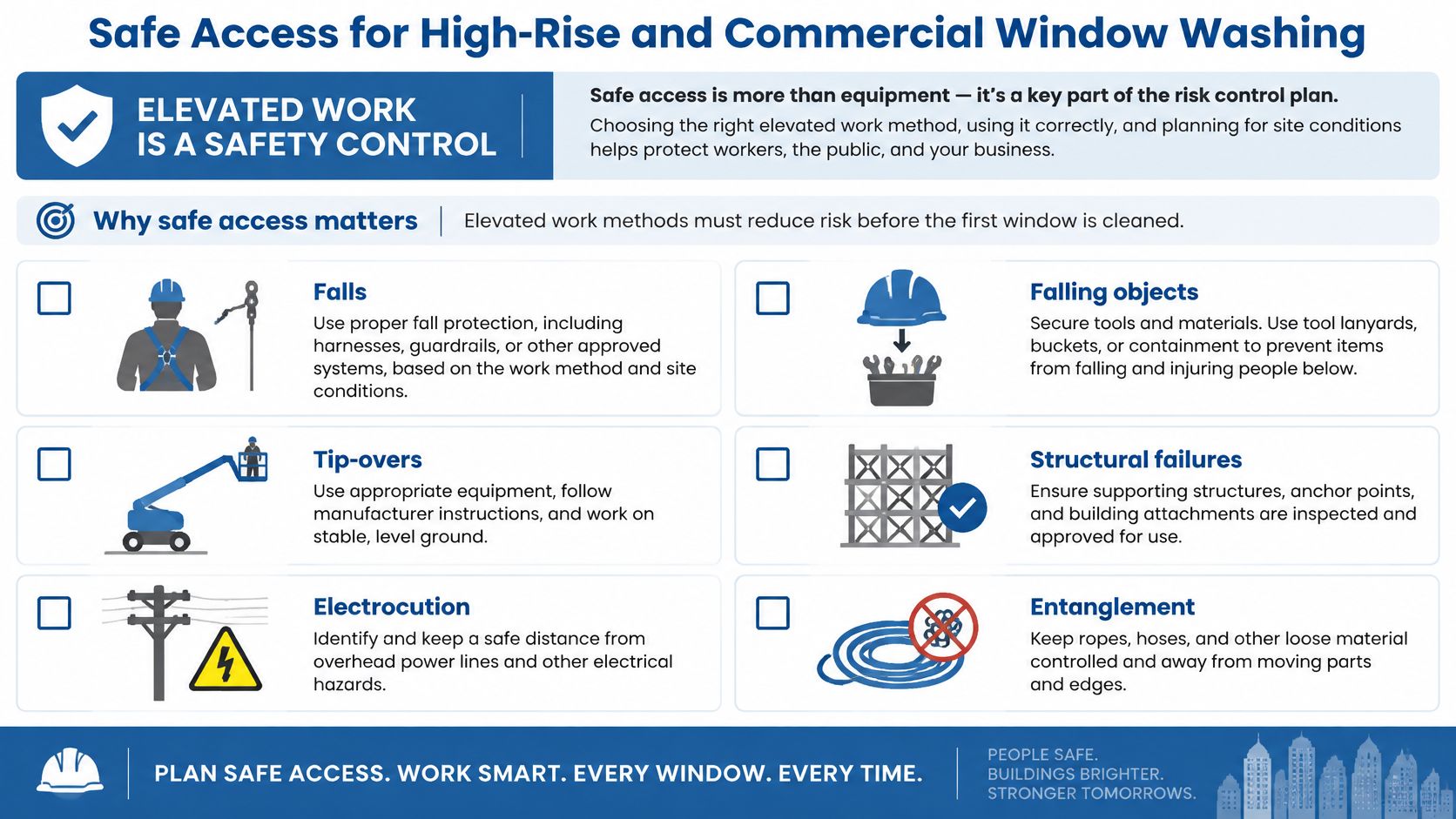
High access is a safety control, not just an equipment choice. A lift that reaches the window still needs a suitable approach route, stable ground, overhead clearance, and a protected work zone.
Use this checklist to recognize the hazards that must be controlled before cleaning begins.
Match the equipment to the building
The OSHA aerial-lift fact sheet identifies falls, falling objects, tip-overs, structural failures, electrocution, and entanglement, and requires trained, authorized operators. Workers must remain on the platform floor, keep gates closed, avoid climbing or leaning over guardrails, and never add ladders, planks, or improvised devices for extra reach.
The specified harness or restraining-belt lanyard attaches to the lift's boom or bucket, not an adjacent structure. Ask which lift will be used and how the crew will reach recessed glass without improvising.
OSHA's powered-platform standard includes window cleaning within building maintenance, requires a minimum platform live-load design of 250 pounds per occupant, and prohibits operation above 25 miles per hour, except when moving between operating and storage positions. Ask who monitors wind and who has authority to stop work.
Under OSHA's scaffold requirements, suspension scaffolds must be secured against swaying when a competent person determines it necessary, and window-cleaner anchors cannot serve that stabilization purpose. The building manager should make approved anchor and suspension information available before mobilization.
Clear the route and emergency arrangements
- Access routes: Confirm gate openings, loading restrictions, equipment dimensions, and arrival authorization.
- Ground and overhead hazards: Identify unstable surfaces, underground structures, overhead obstructions, and power-line clearances.
- Public protection: Establish pedestrian and vehicle exclusion zones beneath the work.
- Emergency response: Confirm a written rescue plan and the crew's understanding of the building's anchor setup.
For gated sites, Nimbio's resource on commercial gate access control can help managers organize contractor entry. Entry authorization doesn't replace a safety inspection.
Our crews complete extensive window-cleaning safety training. Our high-rise window-cleaning safety guide provides further context for coordinating work at heights.
This video offers an additional visual reference for the safety discussion.
Before approving work, confirm that personal fall-arrest equipment is configured for the applicable requirements, including the 6-foot maximum free fall specified within OSHA's powered-platform fall-protection provisions.
Water-Smart Window Cleaning Under Gilbert's Conservation Rules
Gilbert's official water-shortage page states that the town has activated Stage 1 of its Water Supply Reduction Management Plan, calls for voluntary reductions in outdoor water use, and identifies January 1, 2027 as the scheduled start of Colorado River supply reductions. Property owners should check the current status before arranging exterior washing.
Water-based cleaning doesn't automatically mean wasteful cleaning. Controlled application and a deliberate rinse can use less water than repeatedly spraying windows with a garden hose. Purified water can also reduce mineral residue, limiting the need to rinse again.
| Task | Water-Smart Approach | Why It Matters |
|---|---|---|
| Glass | Purified-water rinse with a squeegee where appropriate | Less residue and fewer repeat rinses |
| Screens | Brush off loose dust first, then a light rinse | Keeps dust from washing onto clean glass |
| Tracks and sills | Vacuum and brush before any water | Avoids flooding frames and wasted runoff |
| Sidewalks and driveways | Pressure wash only where needed and where permitted | Paved surfaces are judged separately from glass |
| Dumpster pads | Scrape and spot clean, then follow local rules | Runoff can carry grime into storm drains |
| Storefront entrances | Schedule in cooler hours and reuse rinse water where practical | Limits evaporation and unnecessary water use |
Separate glass cleaning from pavement washing
A window-cleaning scope shouldn't become an unrestricted pressure-washing job. Sidewalks, driveways, and dumpster pads present different runoff concerns, particularly where wash water could carry grease, chemicals, or sediment.
Likewise, water reuse needs a workable collection method and suitable water quality. Dirty recovered water shouldn't be reapplied to glass just to claim conservation. Our explanation of window cleaning with pure water describes the cleaning approach, but purification alone doesn't establish how much water a visit consumes.
Measure the visit, not the slogan: Request an estimated water volume and a clear explanation of where rinse water goes.
There's no established per-visit comparison here that justifies promising a percentage saving over hose washing. Ask for estimated gallons per visit, including separate estimates for any pavement work.
Before approving the scope, clarify:
- Purification: Will purified water be used, and on which surfaces?
- Recovery: Can rinse water be captured or reused safely and practically?
- Timing: Can exposed elevations be cleaned during cooler hours?
If dampness appears inside a wall or around a frame, investigate rather than treating it as a cleaning issue. Axis Meter Solutions' guide to wall leak detection for property managers offers useful diagnostic context.
Check Gilbert's current municipal guidance before the visit. A generic Arizona cleaning schedule doesn't establish local permission or runoff compliance.
What Shapes Your Window Washing Quote
A useful quote follows what must be cleaned and how it can be reached, not a flat assumption about the building. Two similar-looking homes can require different labor because one has removable screens and accessible glass while the other has fixed screens, roof setbacks, and mineral deposits.
This page doesn't list prices because each property needs its own scope. Our window-cleaning pricing guide explains the considerations behind an estimate.
What changes the work
- Window count: Count glass doors and divided panes, and confirm whether the estimate counts openings or individual panes.
- Floors and access: Ground-level work, ladders, lifts, and rope access require different preparation and equipment.
- Inside versus outside: Interior cleaning adds room access, furniture protection, and coordination with occupants.
- Additional surfaces: Screens, tracks, mirrors, and ceiling fans should be named rather than assumed.
- Visit frequency: Recurring maintenance may reduce per-visit labor, but the written quote should establish any actual price difference.
- Condition: Heavy mineral spotting, adhesive, and construction residue require more assessment than loose dust.
Hard-water spotting deserves particular attention. Routine washing removes surface dirt; mineral-removal work may need a compatible treatment and a test patch. A cleaner should distinguish removable deposits from damaged glass before promising restoration.
Arrange an accurate estimate
- Share the property address and clear photos of the glass and surrounding access.
- Confirm the window count, floors, and access obstacles.
- Receive a written quote identifying included work and exclusions.
- Choose one-time service or an agreed maintenance arrangement.
- Agree on a visit time and any occupant-access requirements.
When comparing proposals, don't compare only the bottom line:
- Equal scope: Confirm that screens, tracks, and interior glass are treated consistently.
- Credentials: Our company is licensed, bonded, and insured, and our team completes window-cleaning safety training.
- Scheduling: Confirm arrival coordination, weather contingencies, and who authorizes changes.
A lower total isn't necessarily a better value if the proposal leaves out the surfaces you expect to be cleaned. Resolve those differences before approving the visit.
Book Gilbert Window Washing With South Mountain Window Cleaning
Choose the service that matches your property, then evaluate the proposal on scope, timing, and safe access. For a homeowner, that might mean including neglected screens and interior glass. For a commercial manager, it might mean separating public entrances from upper-floor work so each gets the right service arrangement.
South Mountain Window Cleaning, LLC provides residential, commercial, and high-rise window washing in Phoenix, Scottsdale, Paradise Valley, Chandler, Tempe, and Gilbert, Arizona. Our services include screen, track, mirror, and ceiling fan care, plus power washing for walkways and building exteriors. Commercial clients can choose recurring maintenance or a one-time clean.
Check commitments before authorizing work
We're licensed, bonded, and insured, and our team members undergo extensive window-cleaning safety training. For commercial accounts, computerized scheduling supports arrival coordination. Building managers should still provide site-specific restrictions and emergency contacts rather than assuming the crew can obtain them on arrival.
Our residential window-cleaning services carry a 100% satisfaction guarantee. Confirm the applicable terms when arranging service so expectations are clear before work begins.
The business has over 400 customer reviews. Read the published reviews on our website and business listing pages, paying attention to comments about communication, scope, and scheduling rather than relying only on an overall rating.
A worthwhile proposal makes it clear what will be cleaned, what access is needed, and what could change the visit.
For properties with shared ownership, identify who can approve exterior work and who controls interior access. A tenant's permission to enter a suite may not authorize equipment placement in a common area or work on association-maintained glass.
Use the booking sequence above to prepare the estimate information without committing to work you haven't defined. Keep photos current, identify unusual conditions, and make sure the person approving the quote understands its exclusions.
The right decision isn't to clean sooner or purchase the largest package. It's to authorize the work your property needs, with an achievable schedule and a clear plan for the conditions around it.
South Mountain Window Cleaning, LLC offers residential, commercial, and high-rise window washing for Gilbert properties, with related exterior-cleaning services available for a coordinated scope. Visit South Mountain Window Cleaning, LLC to request a free quote online or arrange one by phone, and include your window count, number of floors, and current photos so the estimate reflects the actual work.