
A Phoenix homeowner can spend a Saturday washing dusty windows, only to see white spots appear when the glass dries in the sun. A facilities manager may face the same frustration across a storefront or office façade, especially after a windstorm pushes fine desert dust against already mineral-marked glass. Tap water, soap residue, ladders, and harsh sunlight can turn a simple cleaning task into repeated work with uneven results.
Window cleaning with pure water approaches the problem differently. A purification system removes dissolved minerals from ordinary water, then a water-fed pole delivers that water to exterior glass from the ground. The method suits routine residential maintenance, commercial properties, difficult-to-reach windows, high-rise access planning, and solar-panel cleaning, while still having clear limits on construction debris and hardened stains.
For Phoenix, Scottsdale, Paradise Valley, Chandler, Tempe, and Gilbert properties, the right question isn't whether pure water sounds modern. It's whether the system reaches the required height, produces water clean enough for local conditions, and matches the type of soil on the glass.
Introduction To Pure Water Window Cleaning
Consider a Phoenix property manager preparing a retail center for opening. Overnight dust has settled on the storefronts, the afternoon sun is already exposing streaks, and a ladder would interrupt customer access. A homeowner in Paradise Valley might face the same issue on second-story windows, skylights, or solar panels that are difficult to reach safely from the ground.
Traditional tools still have an important role, particularly for interior glass and detailed restoration. Yet exterior maintenance can become inefficient when technicians must carry ladders, wipe away detergent film, and correct mineral spots after the glass dries. Phoenix's dry air and dusty conditions make those flaws easy to notice.
Pure-water cleaning uses ultra-filtered water without dissolved minerals. A soft brush on a telescopic water-fed pole agitates dirt on the glass and frames, then the technician rinses the surface with purified water. Because the water contains little or no dissolved material, it can air-dry without depositing the mineral residue found in ordinary tap water.
That doesn't make the process universal. Pure water is highly effective for routine exterior dirt, dust, and maintenance cleaning, but paint, plaster, adhesive, and other bonded debris can require traditional detailing. The strongest results come from choosing the method according to the building, the glass condition, access requirements, and the local water supply.
Understanding Pure Water Window Cleaning Process
Phoenix tap water can leave a mineral load behind, so a pure-water system treats the water before it reaches the glass. The process is a treatment chain, not one filter. Each stage prepares the next.
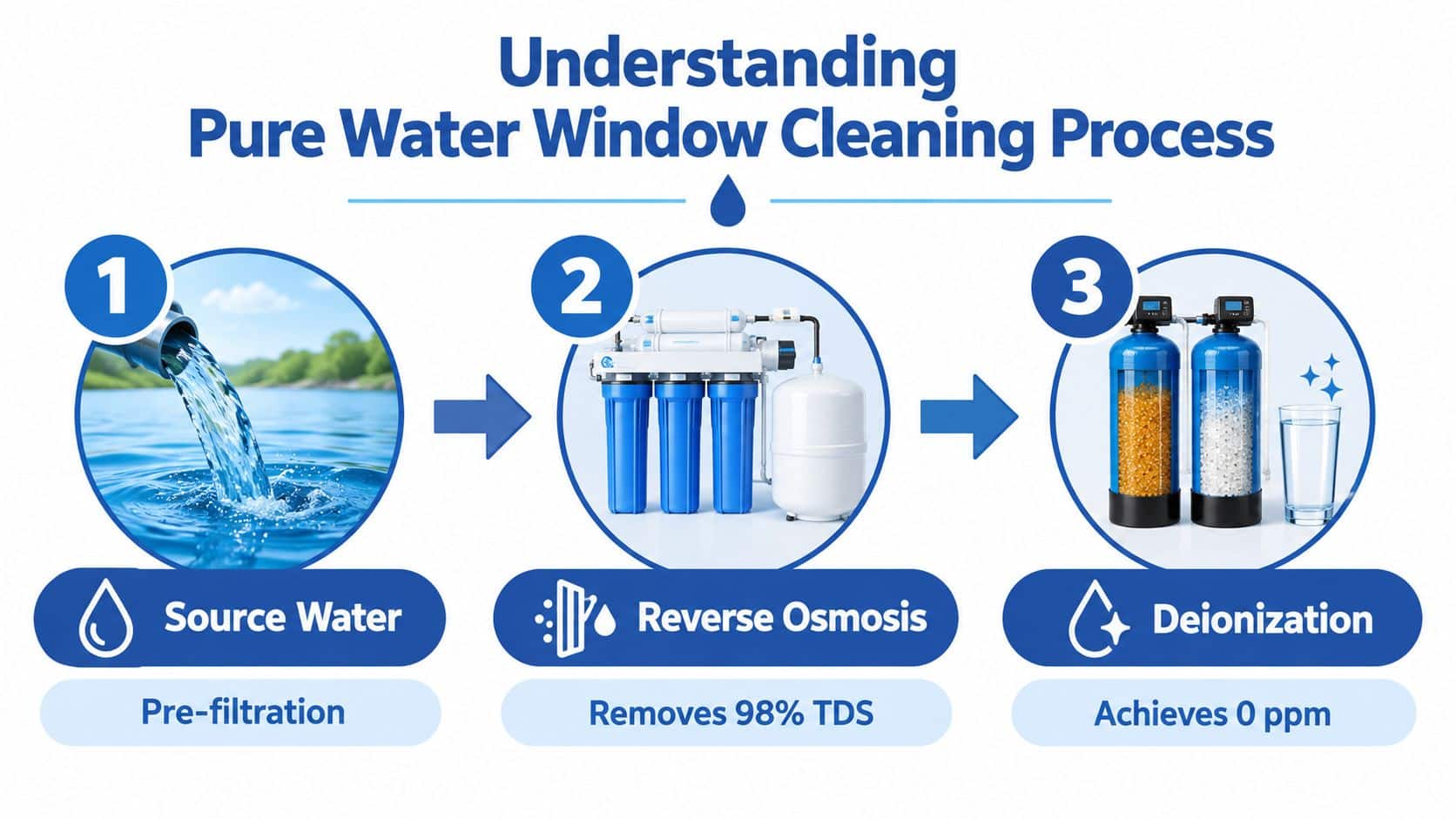
Source water enters pre-filtration. Sediment and larger particles are reduced first. This protects downstream equipment and gives the membrane a more consistent supply.
Reverse osmosis removes most dissolved material. A referenced system describes reverse osmosis as removing about 98% of salts and other impurities before final polishing, as detailed in this pure-water system guidance.
Deionization completes the polishing step. DI resin captures remaining charged particles. The target at the pole is 0 ppm dissolved solids. Professional guidance treats 0 ppm as the professional standard, considers 0 to 5 ppm ideal, and warns that readings above 10 ppm may leave visible spotting as minerals dry on glass. A technician checks the water reading before choosing this method for a Phoenix property.
The process resembles brewing coffee. Mineral-heavy water can alter coffee's flavor, while dissolved minerals can remain on glass after evaporation. Pure water has fewer solids available to form a film, allowing the technician to rinse exterior panes instead of relying on detergent and a squeegee for every window.
A hose carries the purified water through or alongside a telescopic pole. At the top, a soft brush agitates dust on the pane, seals, and frames. A thorough rinse leaves the surface to dry naturally. This professional window-cleaning equipment guide explains the tools used for this type of work.
Water-fed poles also change access planning. Industry guidance says extendable poles can reach up to five stories from the ground, reducing ladder use for many higher windows. That helps around retail entrances, offices, and solar panels, although bonded construction debris still requires careful traditional detailing.
Key Benefits Of Pure Water Window Cleaning
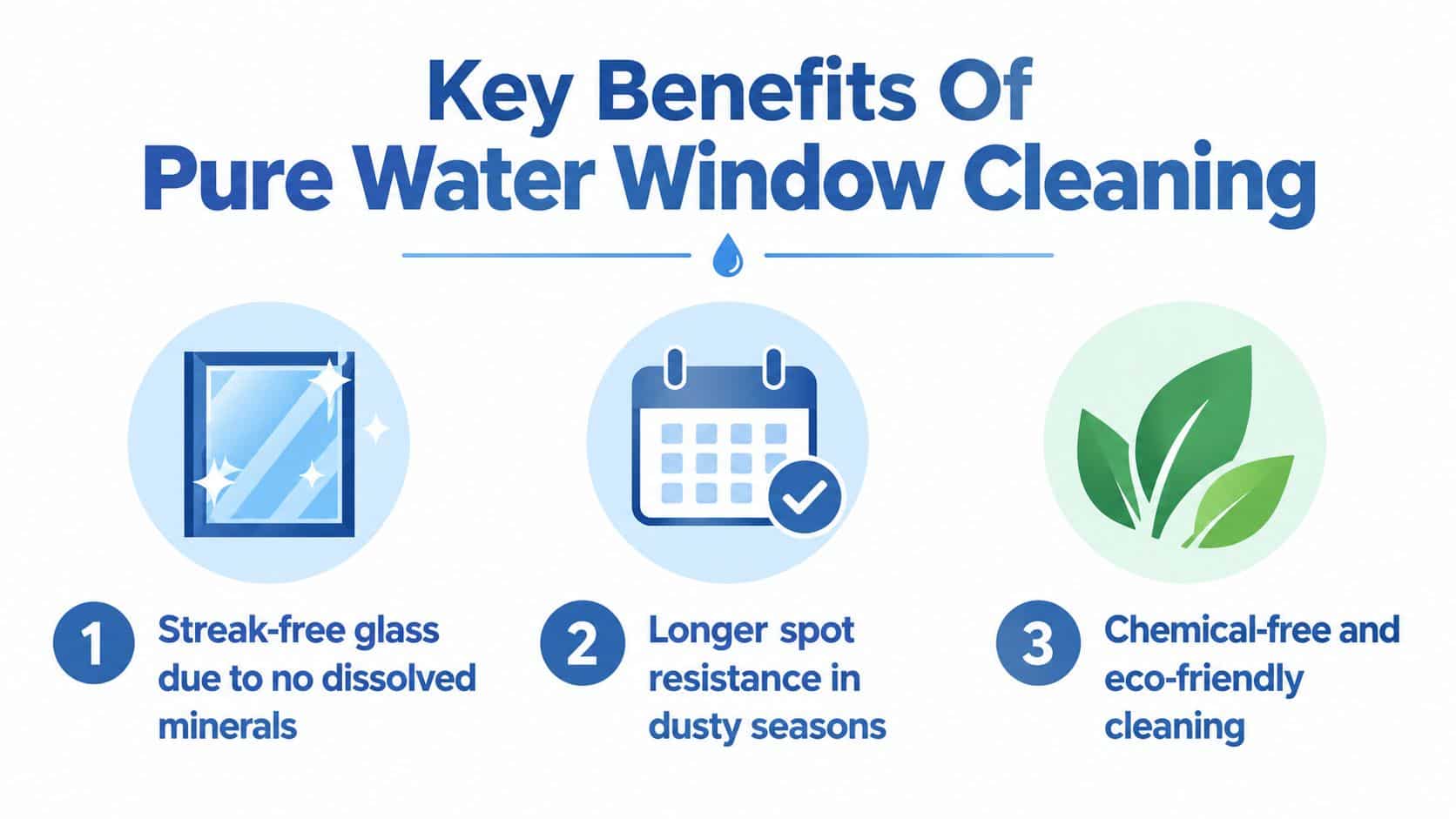
The central advantage is simple. When dissolved minerals aren't left behind, the drying process has less material available to create spots and streaks. That matters in Phoenix, where strong sunlight can reveal a faint residue shortly after a window appears clean.
Pure-water cleaning also reaches the frames and edges during the brushing stage. Those areas collect dust, insect debris, and residue that a quick glass-only wipe can miss. A controlled rinse carries loosened material away instead of redistributing it across the pane.
Cleaner maintenance with fewer chemical variables
Exterior maintenance often doesn't need detergent when the water itself has been purified. That can reduce chemical use and prevent soap residue from becoming another surface for dust to collect on. It also helps crews work around planted areas, entrances, and occupied commercial spaces without introducing a detergent solution into every rinse.
The result isn't that glass becomes permanently clean. Dust will return, especially during windy periods. Pure water gives the technician a cleaner starting point and avoids adding mineral or soap residue during the visit.
A practical benefit for solar panels
Arizona's dusty climate creates a recurring need for exterior glass and solar-panel cleaning because accumulated dust can reduce solar energy production, as explained in this regional pure-water cleaning overview. For a solar homeowner, mineral-free rinsing is useful because a panel can be left with a visible film if ordinary water dries in place.
A facility manager can apply the same reasoning to glass-heavy properties. Storefront visibility, tenant presentation, and solar-panel maintenance all benefit when the cleaning plan accounts for dust, mineral residue, access, and drying conditions rather than treating every surface as an identical pane of glass.
Practical rule: Pure water improves the rinse and drying stage, but agitation and surface inspection still determine whether the technician has removed the actual soil.
Limits And Best Use Cases
Pure water is a maintenance method, not a universal restoration chemical. It handles loose dust, ordinary exterior grime, and recurring surface contamination well because the brush can agitate the soil and the rinse can carry it away. It becomes less suitable when a substance has bonded to the glass or hardened through construction activity.
Independent FAQ guidance warns that pure-water systems may not remove plaster splatters, paint spatters, sticker residue, or ivy sucker marks, which can require hand scraping or solvent work, as explained in this pure-water cleaning FAQ.
Routine maintenance
For a residential home in Chandler or Gilbert, pure water can be a strong choice for exterior windows with dust, light bird residue, and everyday atmospheric soil. It also fits commercial storefronts that need repeat service without placing ladders near entrances or customer walkways.
High-access glass presents a similar use case, provided the crew has an appropriate access plan. A water-fed pole can handle many windows from the ground, but building geometry, wind, setbacks, and pole control still matter.
Restoration and post-construction work
Construction glass needs a different inspection. A new build or remodel may have dried paint, cementitious splashes, silicone, labels, or adhesive. A brush-and-rinse process alone may spread or soften some debris without removing it, and aggressive scraping can damage coated or delicate glass if the technician uses the wrong blade or angle.
For those conditions, the cleaning plan may combine safe hand scraping, a compatible solvent, spot treatment, and a final pure-water rinse. Homeowners dealing with mineral buildup can also review this guide to removing hard-water stains from windows.
The best service specification separates maintenance cleaning from restoration cleaning. Ask whether the quote includes bonded residue, hard-water stain treatment, screen and track care, or only routine exterior washing. That distinction prevents unrealistic expectations and helps the technician bring the correct tools.
Cost Factors And Return On Investment
The economics of a pure-water system depend heavily on water chemistry. A setup may include a telescopic pole, brush, hose, pump, reverse-osmosis equipment, DI resin, testing tools, transport, labor, and ongoing maintenance. A homeowner considering DIY must account for all of those categories, not just the pole.
Source water changes the balance. If water measures around 20 TDS, a DI vessel may be sufficient, while harder water generally calls for reverse osmosis followed by deionization. That difference affects how quickly resin becomes exhausted and therefore changes the operating cost, as explained in this traditional and pure-water cost guide.
How to evaluate the investment
Don't calculate payback from equipment price alone. Compare the total DIY cost with the price of professional visits, then add the value of your time, equipment storage, maintenance, water testing, and the risk of rework when the final rinse isn't pure enough.
For a commercial property, the useful calculation is broader:
- Service quality: Does the system reduce spotting and tenant complaints?
- Labor efficiency: Can crews clean more exterior glass without repeated ladder repositioning?
- Access planning: Does ground-based work reduce disruption around entrances and walkways?
- Maintenance frequency: Will the property stay presentable between scheduled visits?
- Water chemistry: Will Phoenix-area hardness require more filtration and resin management?
A solar-panel owner should also avoid promising a precise production gain without a site measurement. Dust accumulation can reduce solar energy production in Arizona, so cleaning can have a rational maintenance value, but the return depends on panel condition, soiling, weather, system output, and service price.
The most defensible ROI is therefore site-specific. Request a written quote that separates routine glass cleaning, solar-panel cleaning, hard-water restoration, and any access or specialty work. For a residential baseline, use this guide to understand window cleaning cost per window, then compare the quote with the time and equipment required to reproduce the result yourself.
DIY Versus Professional Window Cleaning
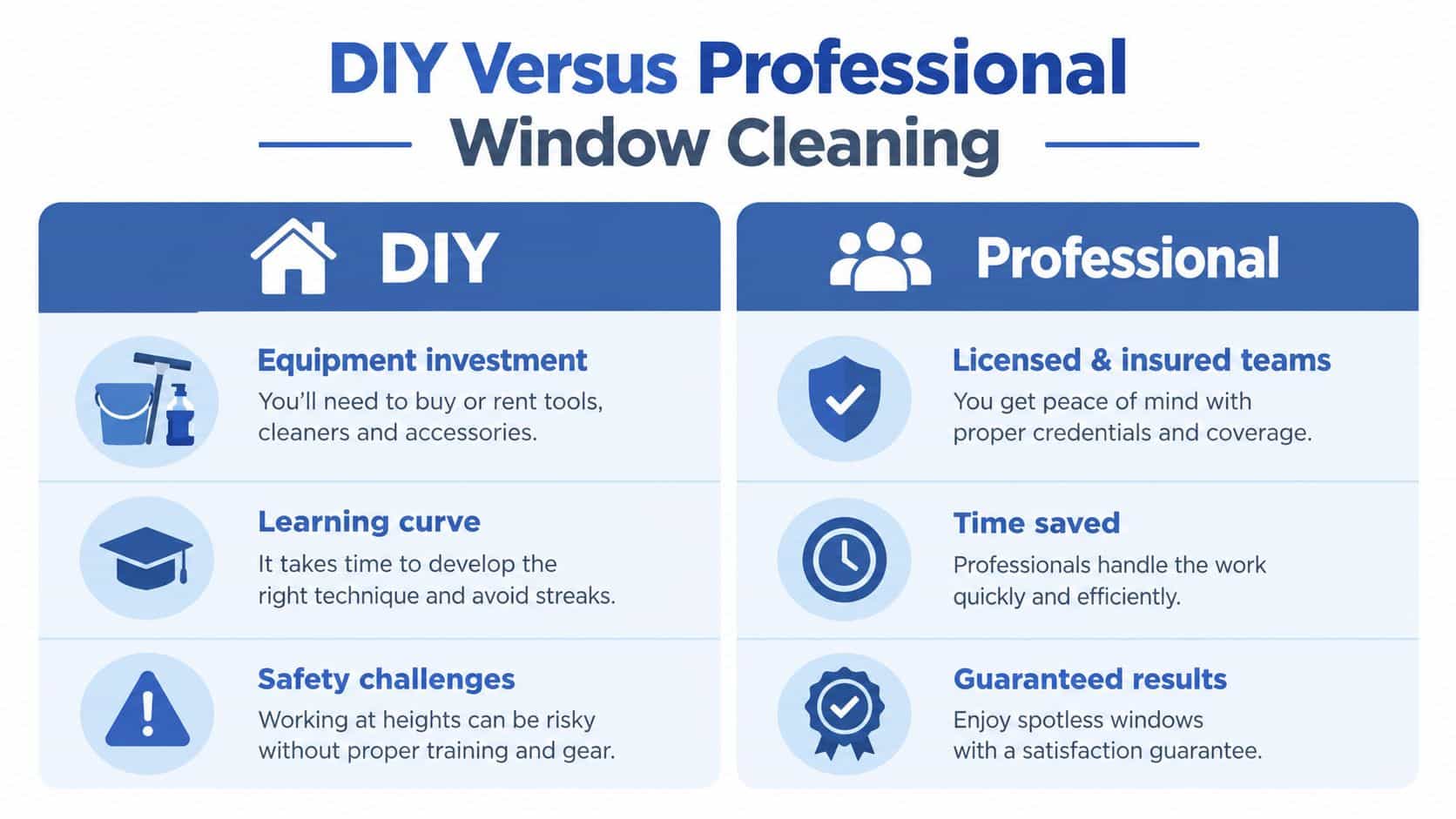
DIY pure-water cleaning can make sense for a property owner who enjoys equipment maintenance, understands water testing, and has mostly accessible exterior glass. The learning curve isn't limited to brushing a pane. You must manage filtration, monitor TDS, protect the membrane and DI resin, control the pole, identify fragile surfaces, and rinse thoroughly.
Professional service changes the risk profile. A trained crew arrives with the purification equipment, poles, brushes, hoses, and traditional detailing tools needed for mixed-condition work. The crew can also decide when pure water is appropriate and when a scraper, solvent, or squeegee finish is safer for the surface.
| Decision factor | DIY approach | Professional approach |
|---|---|---|
| Equipment | You purchase and maintain the system | The crew supplies and maintains job equipment |
| Water quality | You test and manage TDS | Technicians manage purification before cleaning |
| Access | Suitable only for work you can safely control | Crews plan poles, ladders, and specialty access |
| Residue | You identify and treat stubborn spots | Technicians can combine pure water with detailing |
| Liability | You carry the personal and property risk | Licensed and insured service can reduce customer exposure |
Water-fed poles can reach up to five stories, according to Unger's commercial cleaning guidance. Taller buildings require a more formal access strategy. OSHA guidance states that rope-descent systems shouldn't be used above 300 feet above grade, or more than 30 stories, because increasing rope length creates greater wind exposure, as summarized by this high-rise pure-water cleaning reference.
For facility managers, vendor selection also involves local search visibility and relevance. A resource on relevance distance and prominence explained can help clarify why a nearby, established service provider may be easier for property teams to evaluate than a distant generalist.
DIY is rarely a good trade for tall, fragile, or high-consequence work. A professional crew is usually the more practical choice when access, insurance, scheduling, or consistent results matter as much as the cleaning itself.
Why Choose South Mountain Window Cleaning
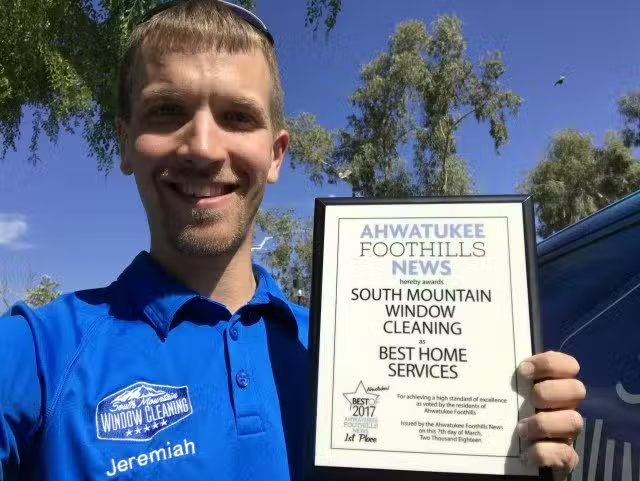
South Mountain Window Cleaning serves Phoenix, Scottsdale, Paradise Valley, Chandler, Tempe, Gilbert, and communities across the Valley with residential, commercial, high-rise, and solar-panel cleaning. That range matters because a single provider may need to handle a home's exterior glass one day and a scheduled storefront, office, condominium, or high-rise property the next.
The company operates with licensed, bonded, and insured crews, including a $2 million liability policy for business protection. Its service model combines pure-water systems for exterior maintenance with professional squeegees and detailing methods where the glass condition calls for closer hand work.
A service plan built around Arizona properties
Phoenix properties need more than a one-time rinse. Dust, intense sun, hard-water residue, screens, tracks, building exteriors, and solar panels can all affect the finished appearance. South Mountain Window Cleaning also provides screen and track care, mirror and ceiling-fan cleaning, power washing for drive-thrus, walkways, and exteriors, house washing, gutter cleaning, rust removal, flat-surface cleaning, dumpster-pad sanitation, and seasonal Christmas-light installation.
Commercial clients can benefit from computerized scheduling for repeat service, while homeowners can request online or phone estimates. The company states that its work is backed by a 100% satisfaction guarantee and supported by 400+ five-star reviews. Those details don't replace a property-specific inspection, but they give buyers concrete service standards to discuss before approving recurring work.
For high exterior glass, the company's water-fed pole cleaning approach describes how purified water and ground-based equipment can support safer, more efficient maintenance. High-rise work still requires building-specific access planning, especially where poles can't reach or wind conditions affect rope-descent operations.
A strong quote should state the surfaces included, the cleaning method, the treatment of hard-water stains or construction residue, the planned frequency, and any access limitations. South Mountain Window Cleaning, LLC is one local option for property owners who want those questions addressed alongside routine window, solar-panel, and exterior-cleaning needs.
Frequently Asked Questions
What ppm level qualifies as pure water?
Professional window cleaners generally aim for 0 ppm at the pole, with readings above that checked before water reaches the glass. A TDS meter confirms whether the system is producing water clean enough to reduce spotting, especially important with Phoenix's hard-water residue.
How often should Phoenix windows and solar panels be cleaned?
Dust, nearby construction, landscaping, traffic, wind, and panel output all affect the schedule. Solar panels may need attention when dust visibly covers the surface or performance declines. Sheltered properties can often wait longer than exposed sites.
Can pure water remove paint or sticker residue?
Pure water is a final cleaning and rinsing method, not a reliable treatment for paint spatters, plaster, stickers, adhesive, or ivy marks. Those soils may need safe scraping, solvent treatment, or restoration before the rinse.
How long does a service visit take?
Window count, height, access, soil level, interior work, solar-panel area, and restoration needs determine the time. A property-specific quote is more useful than a generic promise.
South Mountain Window Cleaning, LLC provides pure-water window and solar-panel cleaning, commercial maintenance, high-rise service, and exterior cleaning across the Phoenix area. Visit South Mountain Window Cleaning, LLC to request a quote based on your glass, access, and Arizona dust exposure.