
If a contractor says the water is pure, what number would prove it at the glass, not just at the tank? Most quotes for pure water window cleaning services never answer that question. They use pure water as a label, when it's really a process-control specification you can measure, test, and hold a provider to. Once you know the number to ask for, and where it should be taken, you can judge a quote the way a technician judges a rinse.
What Pure Water Window Cleaning Actually Means
Pure water doesn't mean bottled water, boiled water, or water that looks clear. It means water that's been filtered and deionized so most dissolved minerals are removed before it touches your glass.
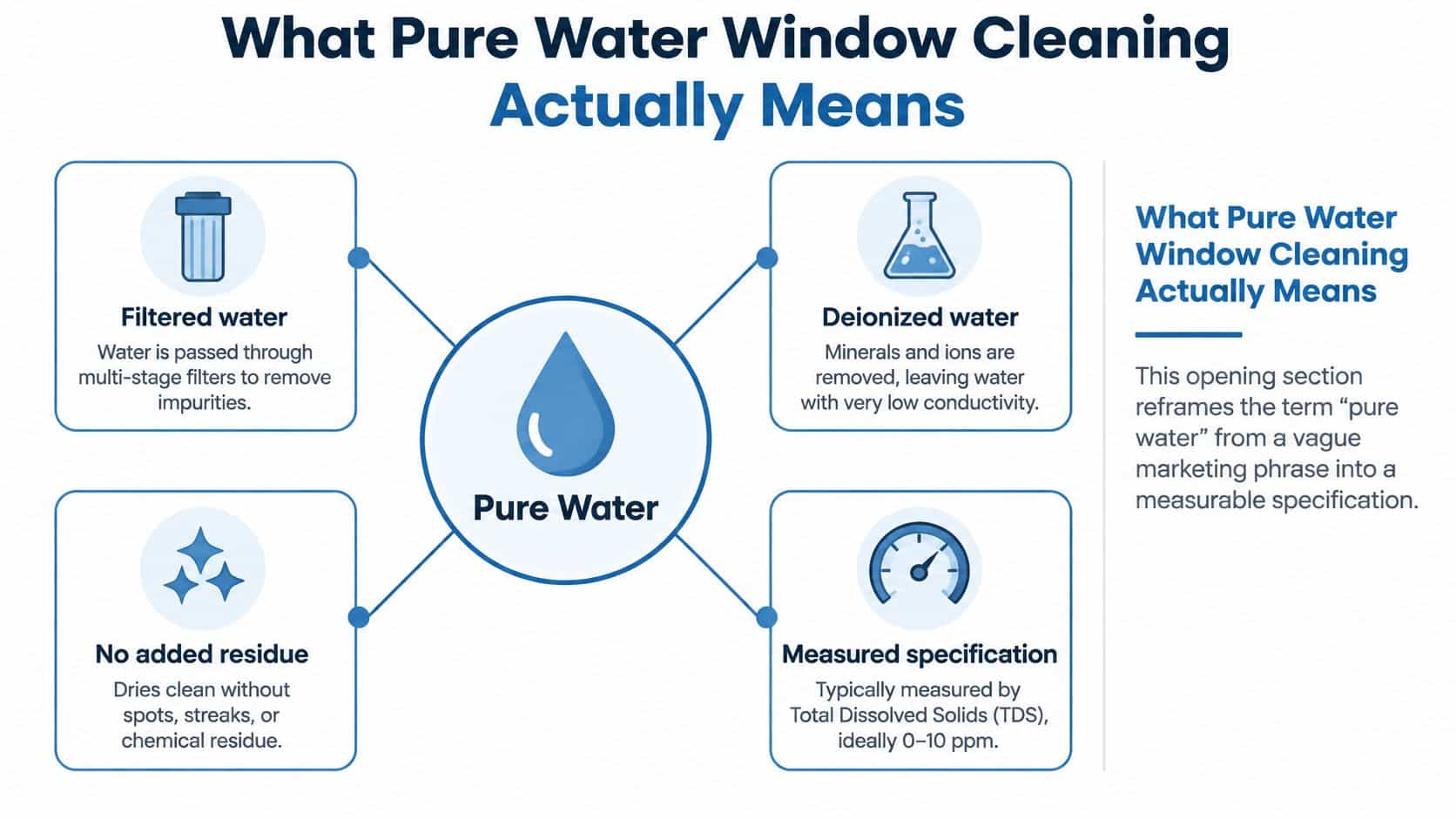
Technicians measure that removal as total dissolved solids, or TDS, in parts per million. Pure-water window cleaning became commercially significant in the United Kingdom during the late 1990s and expanded rapidly in the early 2000s as water-fed poles made ground-based cleaning practical, using water commonly targeting approximately 0–10 parts per million TDS.
The visual below maps that definition into its working parts.
Why Low TDS Changes How Glass Dries
Tap water carries calcium, magnesium, and other salts you can't see while it's liquid. When that water evaporates on a hot pane in Phoenix, the water leaves and the minerals stay. That's the white spotting you see after a hose rinse or a sprinkler hits a storefront window.
Take most of those solids out and the math changes. A technician can scrub with a brush, rinse with a steady flow, and let the pane air-dry because there's very little mineral load left to deposit. You're not relying on a squeegee pass to pull dirty water off before it dries.
Practical rule: If a provider can't state a target TDS range, they're selling a phrase, not a controlled process.
Why Poles Mattered as Much as Filters
Purified water alone didn't change the trade. The shift came when purification was paired with lightweight telescopic poles that feed water to a brush head. Work that once needed ladders, lifts, or rope access for routine exterior panes could often be done by a technician standing on the ground.
That pairing is why pure water window cleaning services spread so fast for homes, storefronts, and mid-rise buildings. It also sets your first screening question. Ask what TDS the crew targets, and listen for a specific range rather than a promise that the water is clean.
A number without a measurement point is still incomplete, though. Where that reading is taken, and how often, decides whether the result on your glass matches the claim on the truck.
How the Purification and Cleaning Process Works
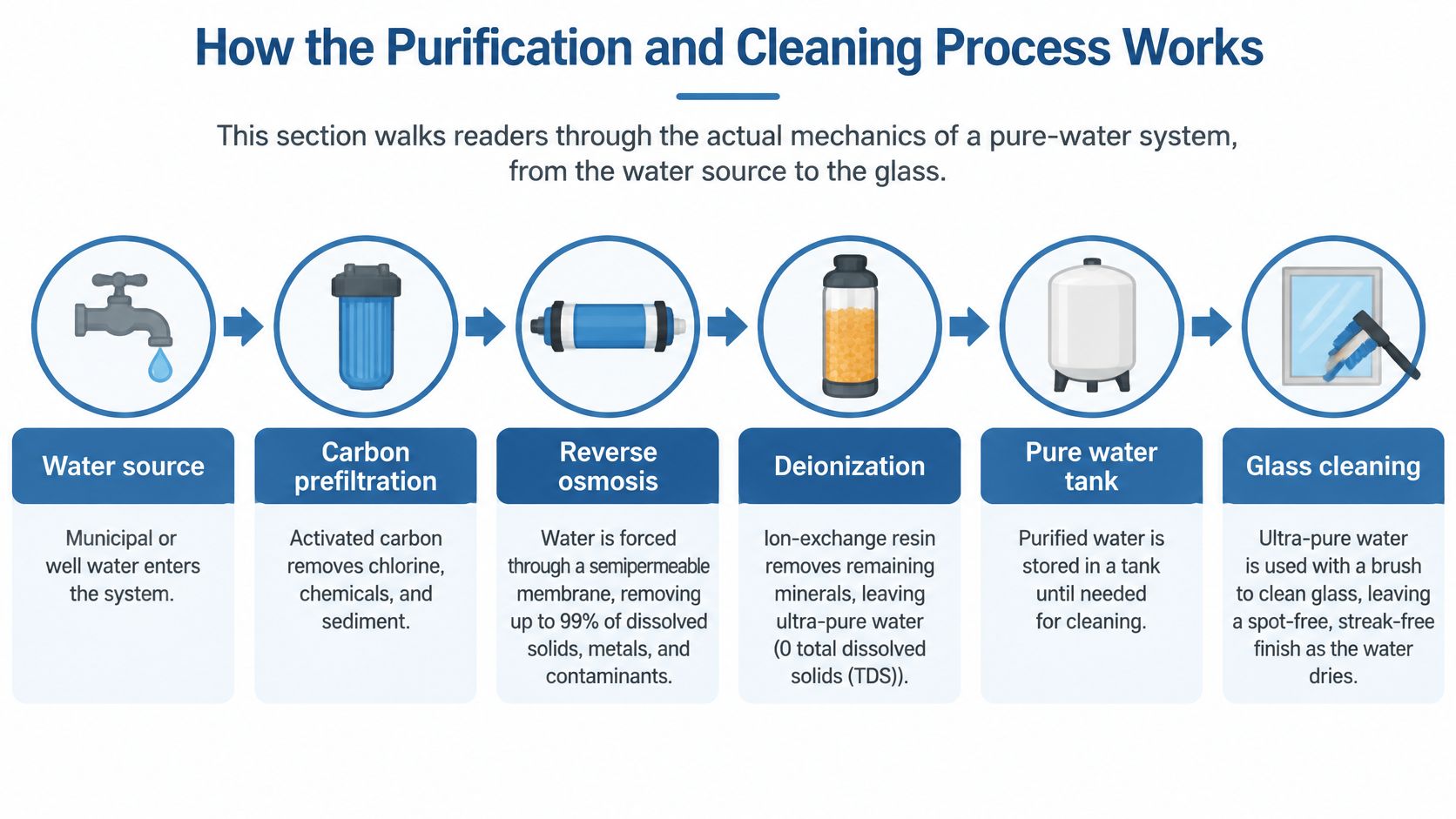
Think of the system as two jobs in sequence. First the equipment strips minerals from ordinary supply water. Then a pole delivers that water to the glass while a brush does the physical loosening.
The diagram that follows shows that path from source to pane.
The Three Filtration Stages
A typical setup combines carbon prefiltration, reverse osmosis, and deionization, where reverse osmosis removes most dissolved contaminants and deionization exchanges remaining ions including calcium, magnesium, sodium, and silica. Carbon handles the early pass before water reaches the membrane. The membrane does the heavy reduction, and the resin polishes what's left.
That last polish matters in a hard-water market like Phoenix. Silica and hardness ions are exactly what form visible deposits after evaporation. If resin is exhausted or a membrane starts passing solids, the outlet reading climbs and spots return, even though the water still looks perfectly clear in a hose.
That's why competent crews monitor TDS at the outlet and replace or regenerate media when readings rise. The goal isn't clear-looking water. It's near-zero-mineral rinse water verified with a meter.
This short video shows the pole and brush delivery in action, so you can see how flow and agitation work together.
What Happens at the Glass
At the pane, the process is deliberately simple:
- Brush agitation: Soft bristles loosen dust, pollen, and atmospheric film without relying on heavy pressure.
- Continuous rinse: Flowing pure water carries loosened soil down and off the surface.
- Air drying: The pane dries without a detergent film for dust to cling to and without squeegee lines.
Here's where readers often get confused. Pure water is excellent for routine exterior maintenance, but it doesn't reverse damage that's already bonded to or etched into glass. Existing calcium or silica etching usually needs a separate restoration process, with pretesting, rather than more rinsing with the same pole.
The Safety and Performance Benefits for Property Owners
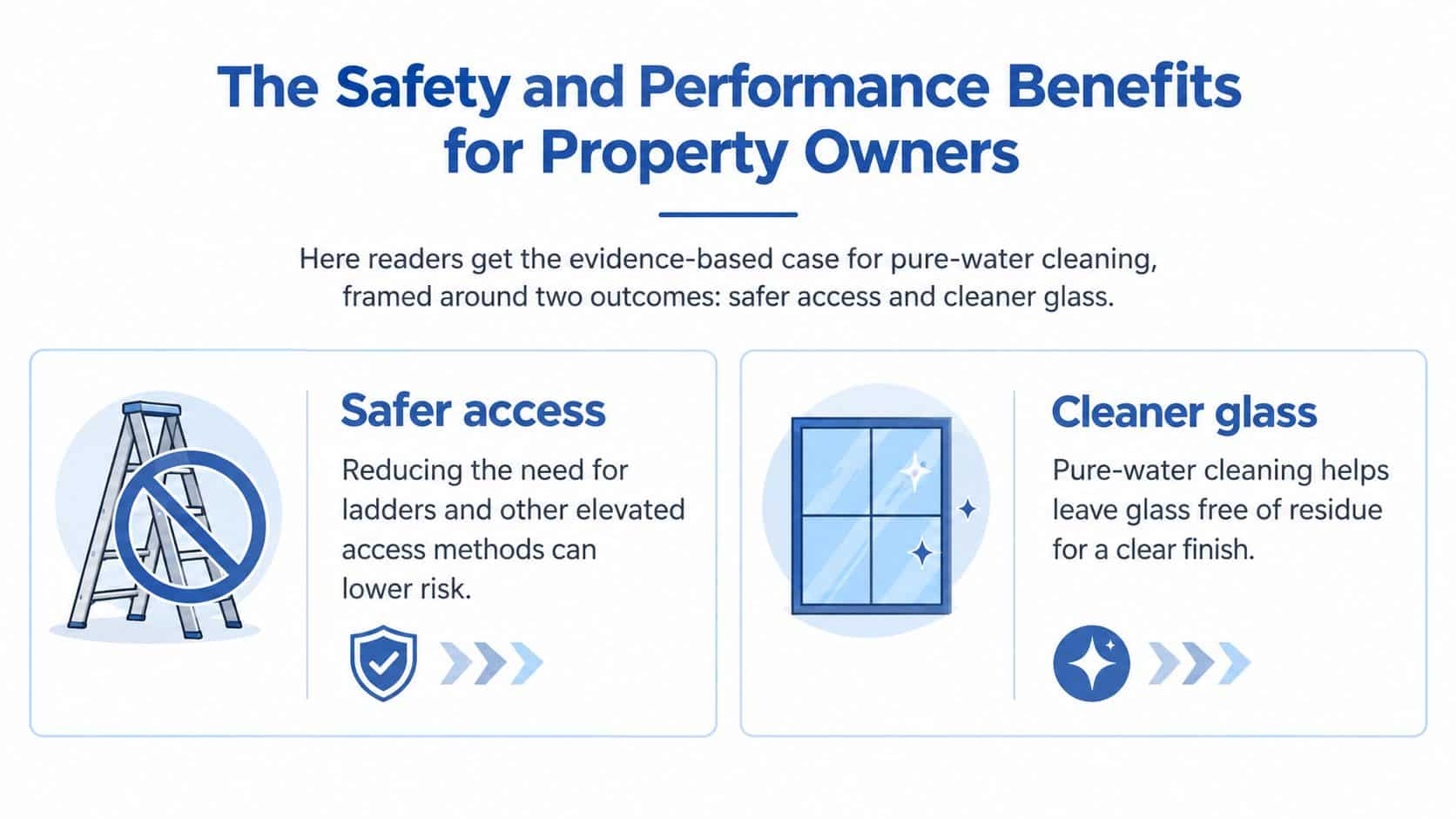
For a property manager, two measures make pure-water service easier to evaluate: how much work can be done from the ground, and whether the rinse leaves visible residue. Ask for the system's outlet TDS reading, how often the crew checks it, and the pole's rated reach. Those numbers describe a process, not just a marketing claim.
The Access Case in Plain Numbers
The UK Health and Safety Executive says water-fed poles can allow window cleaning from ground level at heights up to approximately 80 feet (24 metres). Actual reach depends on the building, pole setup, and safe working conditions, so ask the provider what height its crew can service at your property.
A UK parliamentary record cites an analysis of 88 window-cleaning accidents over 15 years. Of those, 62 were fatal, or about 70.5% of the recorded incidents. The same record notes that falls from height accounted for more than one-quarter of fatal workplace injuries in 2024–25. These figures show why reducing work at height matters, though they do not make every window suitable for pole access.
Ground-level work still needs hazard controls. Long poles can strain shoulders and backs, hoses can create trip hazards, and overhead power lines require careful site assessment.
Ground-based work reduces fall exposure. It does not remove the need for a safety plan.
The Residue Case on the Pane
A CleanLink article says RO/DI water-fed-pole systems can eliminate approximately 99% of streaking in suitable applications. The figure applies to conditions where the glass has routine soil and the rinse water is within specification. Ask the crew to measure TDS at the outlet, where water reaches the brush, and to explain how often readings are checked.
With sound glass and a controlled rinse, the water dries without soap film or mineral residue. Pure water does not remove everything: bonded scale, paint, and construction debris may need separate treatment, and etched glass cannot be restored by rinsing alone. The practical benefit is a measurable cleaning process with less high-access exposure where pole work suits the building.
Residential, Commercial, and High-Rise Applications Compared
The same water and brush behave differently depending on the building in front of them. A two-story home in Gilbert, a restaurant frontage in Tempe, and a downtown tower don't share access rules, soil load, or appearance pressure.
Pure Water Window Cleaning by Property Type
| Property Type | Typical Access Method | Primary Frequency Driver | Key Consideration |
|---|---|---|---|
| Single-family home | Water-fed pole from ground, squeegee for some interior work | Dust, pollen, monsoon spotting | Screens, tracks, and frame condition |
| Storefront or office | Pole for exterior, scheduled ground-level service | Traffic film, sprinkler overspray, fingerprints near entries | Appearance standard customers see daily |
| High-rise building | Powered platform or other engineered access where poles can't reach | Exposure, wind, building height | Engineered anchors, fall arrest, emergency plan |
Homes and Storefronts Run on Different Clocks
For houses, service usually centers on routine exterior panes plus screen and track care, timed around dust and pollen cycles. Nobody's judging the glass hourly, so the interval can follow how the home looks from inside.
Commercial glass is judged constantly. Retail, restaurant, and hospitality operators typically need a schedule built around contamination load, including traffic film and irrigation overspray, which is why many managers start by reviewing a structured commercial window cleaning service before setting frequency. A dusty arterial in Chandler will soil faster than a sheltered office courtyard in Scottsdale.
High-Rise Work Enters a Different Rulebook
Once a building needs permanently installed powered platforms, you're no longer talking about ordinary pole work. OSHA's standard requires structural supports, tie-in guides, and anchoring devices to be designed by or under the direction of a registered professional engineer experienced with the systems, with workers using a compliant personal fall-arrest system. Employers also must maintain a written emergency plan for power or equipment failures.
Phoenix weather pushes all three categories toward recurring service. National Weather Service data for the Phoenix station report a 30-day average high of 92.1°F, an average temperature of 82.9°F, and 1.04 inches of precipitation for the reported period. Long dry stretches let dust sit, then brief rain redistributes it and leaves deposits as it evaporates. Rain here doesn't rinse your building clean, it often finishes the spotting.
Pricing, Frequency, and How to Evaluate a Provider
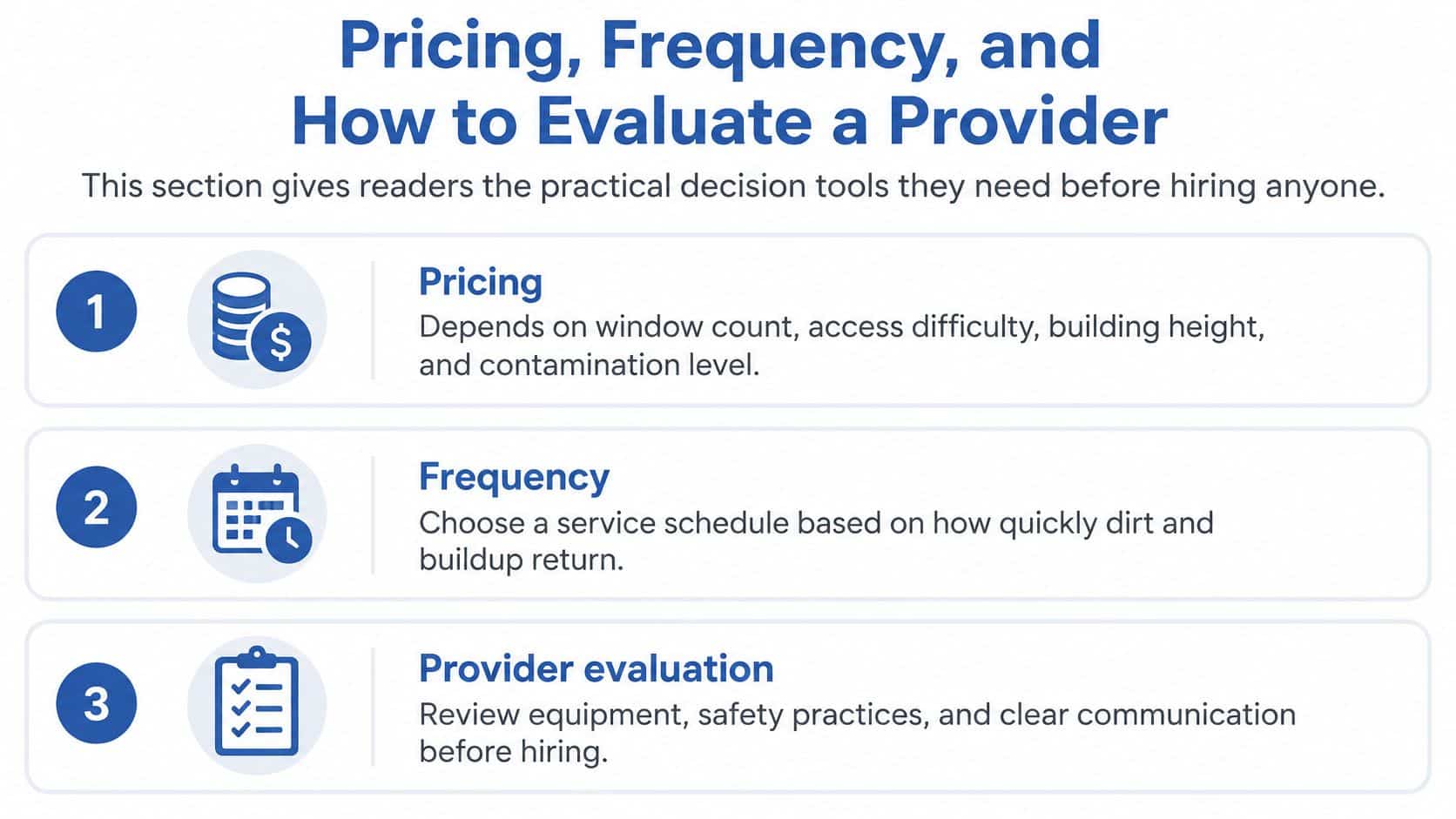
You can't accurately price glass from a single per-pane number without knowing the building. Window count, access difficulty, building height, and contamination level all move a quote, and a provider who prices before asking about them is guessing with your money.
The checklist graphic below groups the three decisions you have to make.
Set Frequency by Exposure Not Habit
A fixed calendar ignores why your glass gets dirty. Set the interval from nearby construction, traffic, landscaping, building height, and your appearance standard. A Paradise Valley home under mature trees, a Phoenix drive-thru, and an office near active grading work shouldn't share a schedule just because a contract template says quarterly.
If you're comparing bids, it helps to understand how crews build a window cleaning cost per window estimate before you negotiate frequency. Then you can trade interval against appearance with real numbers in front of you, instead of buying visits you don't need or too few to hold a standard.
Ask Where the TDS Reading Is Taken
This is the question that separates controlled work from marketing. Neutral technical guidance places the practical spot-free range around 0–10 ppm, while the National Glass Association's cited ceiling is 20 ppm for water allowed to evaporate on glass.
Now the part most quotes skip. A 0-ppm reading at the tank doesn't prove a spot-free rinse at the pole outlet, because exhausted resin, membrane breakthrough, or contaminated hoses, tanks, connectors, and brush heads can raise the final reading. By the time water travels through warm hose on Phoenix pavement, the tank number may not describe what's hitting the pane.
Ask for three things: The outlet TDS, how often it's tested, and what the crew does when it rises.
Bring this short list to any quote conversation:
- Outlet specification: What TDS do you guarantee at the brush, not the tank?
- Corrective procedure: At what reading do you swap resin or stop and service the system?
- Insurance and licensing: Can you show current coverage sized for my building type?
- Restoration boundary: How do you handle damaged coatings, etched glass, or heavy construction debris that pure water alone can't correct?
A straight answer on that last point builds trust. Pure water won't fix coating failure or remove cured debris, and a provider who says otherwise before pretesting hasn't earned the job.
Choosing a Pure Water Provider in the Phoenix Valley
Put the threads together and your decision gets simpler. You're weighing verified outlet TDS, documented safety practices, and appropriate insurance against price, in that order. The cheapest visit that leaves spots or sends an uninsured worker up a ladder isn't cheaper once you count callbacks and liability.
What Professional Operation Looks Like Locally
For properties across Phoenix, Scottsdale, Paradise Valley, Chandler, Tempe, and Gilbert, expect computerized scheduling so recurring commercial visits don't drift, safety-trained technicians who use pure-water systems and pro squeegees where each fits, and coverage you can verify in writing. Before you sign, read how window cleaning insurance should be structured for residential versus high-rise exposure.
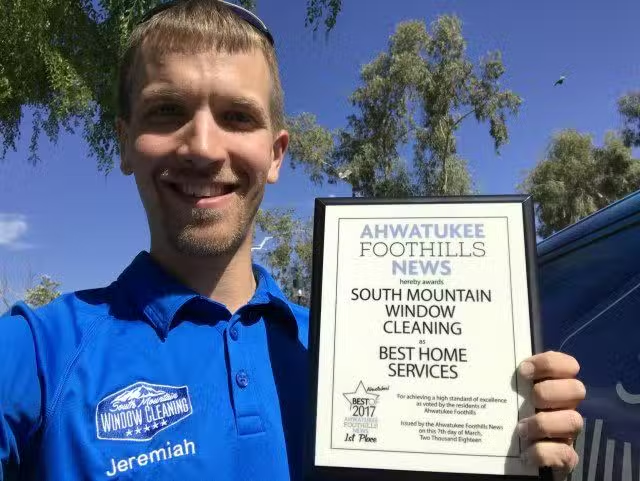
One local option structured that way is South Mountain Window Cleaning, which provides residential, commercial, and high-rise window washing across those Valley communities, carries a $2 million insurance policy, offers a 100% satisfaction guarantee, and reports 400+ five-star reviews along with trusted vendor status for Amazon and Google Home Services. Treat those as checkable credentials, the same way you'd check a TDS reading, rather than as reasons to skip your own questions.
Look Beyond the Pane When You Scope Work
Glass rarely fails on appearance alone. When you walk a property with a bidder, scope the full exterior picture in one visit:
- Detail work: Screen and track care, mirrors, and ceiling fans inside.
- Flat and vertical surfaces: Power washing, house washing, flat-surface cleaning, and dumpster pad sanitation.
- Problem deposits: Gutter cleaning and rust removal where irrigation has stained surfaces.
- Energy and seasonal items: Solar panel cleaning and Christmas light installation.
Bundling isn't about buying more. It's about catching the sprinkler overspray, clogged gutter drip line, or dirty frame that will put soil back on clean glass within weeks. A technician who points those out before quoting is showing you how they'll protect the result. Your next step is a site-specific, free quote, online or by phone, with your TDS and insurance questions ready.
Frequently Asked Questions About Pure Water Window Cleaning
Will Pure Water Remove Hard-Water Stains or Construction Debris
No, not reliably. Scale, paint, oxidation, and cemented mineral soiling are bonded deposits, so they usually need a separate restoration process with pretesting rather than more rinsing. Pure water prevents new mineral spots during routine cleaning, it doesn't dissolve old scale for you.
How Is This Different From Soap and a Squeegee
Traditional methods apply detergent, then pull it off with a squeegee, often from a ladder. Pure-water cleaning uses brush agitation and mineral-free rinse water from the ground where access allows, so there's no detergent film left behind. Both have a place, and interior glass still commonly suits squeegee work.
How Often Should a Phoenix Property Schedule Service
There's no single honest interval. Dust exposure, building height, nearby construction, traffic, and your appearance standard set the clock, which is why it's worth reviewing guidance on how often windows should be cleaned against your own site. Sunlit desert glass shows dust quickly, so let visible soil and customer-facing standards drive the date.
Does Cleaning Solar Panels Actually Pay
It can, depending on your production loss and electricity value. One 2025 study found clean panels produced 7.8%–15.6% more power than dirty panels under its conditions. Compare your monitoring app output before and after a cleaning, record the date and method, and service again when measured loss justifies the cost.
If you're ready to put a verified number on your next window cleaning instead of accepting a vague promise, South Mountain Window Cleaning, LLC offers residential, commercial, and high-rise pure-water service across the Phoenix Valley with safety-trained technicians and a satisfaction guarantee. Request a fast, free quote online or by phone, and bring your outlet TDS, testing frequency, and insurance questions to the conversation.