
The popular advice is to pick a sealant, run a neat bead, and call the job done. That mindset misses the point. Commercial window sealant is part of the building envelope, which means it has to manage water, air, movement, and the day-to-day stress that comes from glass, metal, masonry, and concrete all expanding at different rates.
A clean-looking joint can still be a failing joint. If the substrate is wrong, the old chemistry is incompatible, or the installation happened under bad conditions, the bead may look fine while moisture is already getting into the assembly. For property managers, the core task is not cosmetic caulking, it's envelope performance.
The Role of Sealant in the Building Envelope
A shiny bead of caulk is not proof of a sound window perimeter. Commercial window sealant works inside the building envelope, the system that separates conditioned interior space from exterior weather across windows, doors, walls, roofs, ceilings, and related assemblies. When the sealant is selected and installed correctly, it helps limit water intrusion, control air movement, and support energy efficiency.
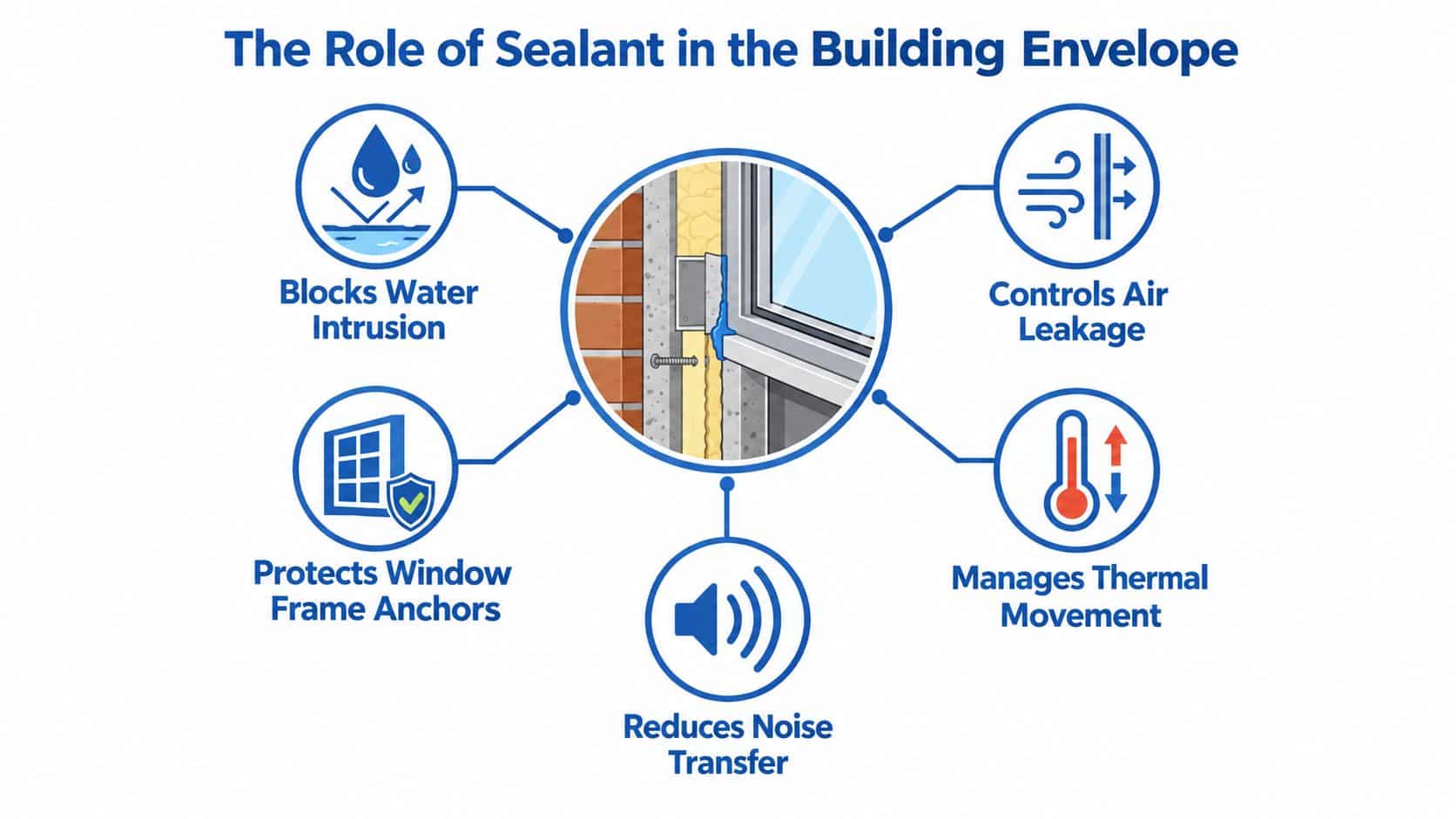
ASTM C920 gives the performance framework professionals should be thinking about first. It classifies cold-applied elastomeric joint sealants by movement capability, with Classes 12, 25, 35, 50, and 100, and the number reflects the rated percentage of joint movement. A Class 50 sealant is intended to accommodate movement equal to up to 50% of the original joint width, which is why it's commonly used in façade and glazing applications. ASTM C920 movement classification for commercial sealants
Match movement, not marketing
That rating matters because glass, aluminum frames, masonry, and concrete do not move the same way. They expand and contract under daily sun load and seasonal temperature change, and the joint has to absorb that movement without tearing away from the substrate or overstressing the bond line.
Practical rule: choose for movement, compatibility, and exposure first. Brand names come after that.
For property managers, that means a product label isn't enough. The joint design, substrate chemistry, and exposure conditions have to match the sealant's actual capability. If you're managing a recurring leak at a storefront or curtain wall, a neat exterior finish doesn't prove the assembly is performing. It only proves someone tooled the bead well.
commercial building maintenance checklist
Comparing Commercial Sealant Chemistries
A commercial joint does not forgive guesswork. UV exposure, temperature swings, vibration, and cleaning chemicals all push sealant chemistry in different ways, so shelf appeal is irrelevant. The actual question is which product can stay bonded and flexible under the conditions that exist in the field.
Silicone is still the first choice for many exterior glazing and high-performance façade details because it holds up well outdoors and keeps its flexibility as the joint moves. Polyurethane can be the better fit where abrasion resistance or a specific project condition matters, but it is not a universal substitute. Polysulfide and hybrid formulations have their own uses too, yet each one has to be matched to the assembly, not treated as a plug-and-play replacement.
What the common chemistries do differently
| Sealant Type | Best Use Case | UV Resistance | Movement Capability |
|---|---|---|---|
| Silicone | Exterior glazing, façades, structural sealant glazing | Strong in exterior exposure | High, suited to dynamic joints |
| Polyurethane | Select commercial joints, abrasion-sensitive areas | More limited than silicone | Good, but project-dependent |
| Polysulfide | Specialized glazing and joint applications | Moderate, depends on formulation | Moderate to good |
| Hybrid formulations | Mixed-use commercial joints where flexibility matters | Varies by product | Varies by product |
For structural glazing, the filter is tighter still. Only silicone sealants specifically formulated, tested, and marketed for structural sealant glazing are acceptable under ASTM guidance, and those products can serve as both an air-and-water barrier and part of the structural attachment system for glazing or curtain-wall components. ASTM guidance for structural sealant glazing
The most common selection mistake
Initial adhesion gets too much credit. A sealant that grabs well on day one can still fail early if it is not compatible with glass, insulating-glass edge seals, or frame materials, or if it cannot tolerate UV exposure and movement over time.
Practical takeaway: choose for movement, compatibility, and exposure first.
That is why silicone remains the safest high-exposure default in many commercial façade applications. Other chemistries can work, but only when the joint conditions clearly justify them. A good specification starts with the joint, then the product.
Understanding Sealant Lifespan and Failure
Durability isn't a product-rating question by itself. It's a field condition question. Commercial window sealant ages under UV, cleaning agents, humidity, outdoor exposure, temperature cycling, and installation quality, and those stressors don't behave politely just because the bead looks smooth.
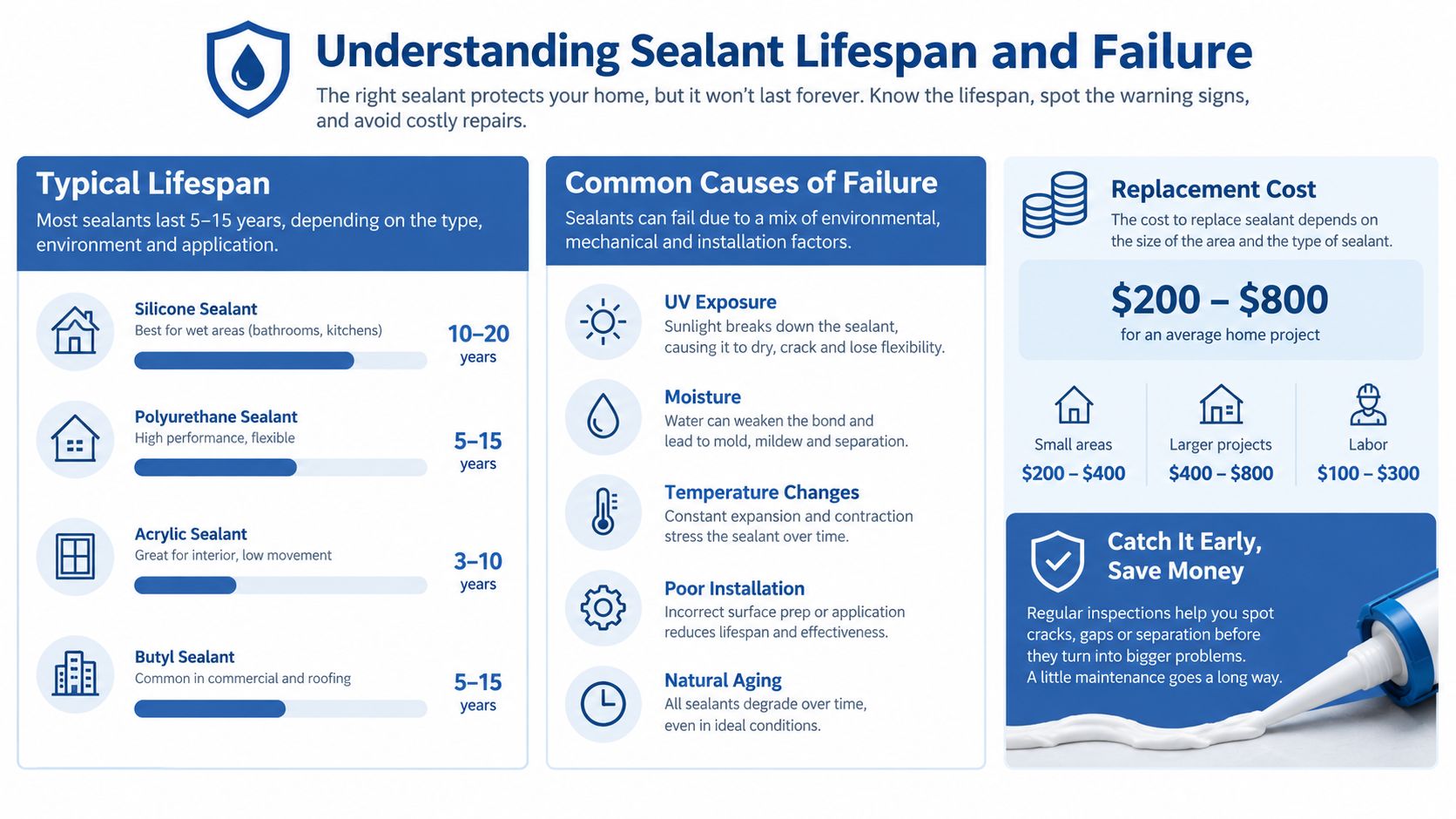
National Institute of Standards and Technology field findings indicate that approximately 50% of building sealants fail within 10 years and 95% within 20 years. Those numbers aren't a universal expiration date, but they do show how hard a joint works in everyday conditions. NIST field findings on building sealant failure
What failure looks like before the leak shows up
The early signs are usually subtle. Look for adhesion loss at the edges, embrittlement in the bead, chalking, split surfaces, or weathering that changes the sealant's flexibility.
A visually neat exterior can be misleading. Moisture can be trapped inside the joint, or the sealant may be incompatible with the existing interface, especially near insulating-glass units and frame transitions. That's why a repair based only on appearance often misses the actual problem.
A sealant that still looks intact can already be losing bond where you can't see it.
For owners and managers, the useful question is not “How old is the sealant?” It's “How is this joint performing under its exposure?” A joint on a sunny, high-movement elevation ages differently from one that's shaded and sheltered, even on the same building. That's what to plan around, not a calendar shortcut.
Pre-Work Inspection and Substrate Preparation
Before a single tube opens, the joint needs to be diagnosed. That's where most bad repairs are won or lost. If the old material is failing because the substrate is wrong, the movement is misread, or moisture is already in the assembly, adding more sealant can make the situation worse.
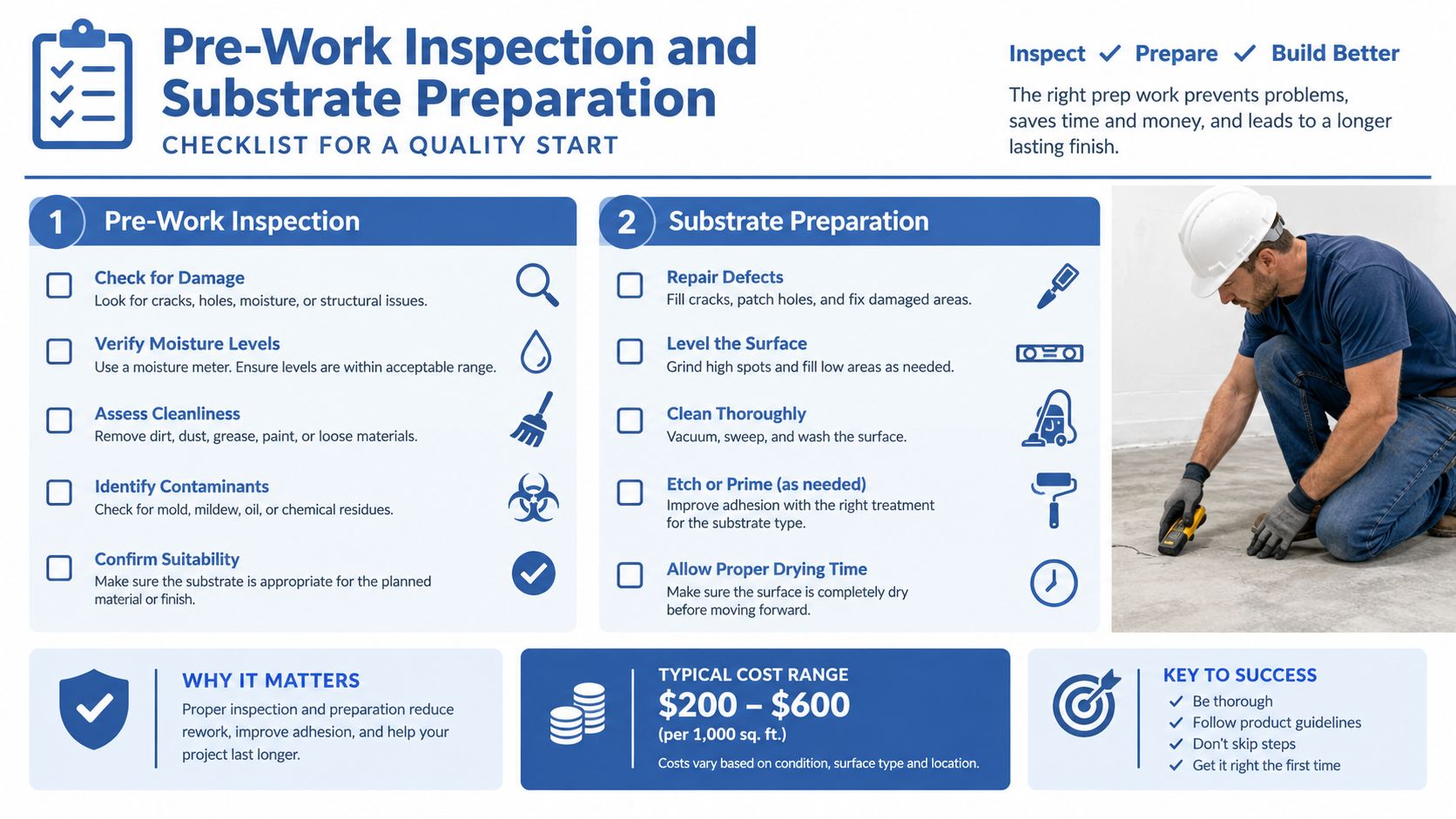
Current glazing specifications prohibit sealant installation when substrates are wet or when temperatures fall outside manufacturer limits, with 40°F often used as a minimum reference point. Glazing specification limits for wet substrates and temperature
What to inspect before repair
Start by identifying the old sealant chemistry and the substrate it's bonded to. Then test adhesion, verify joint depth and backer material, inspect weeps, and document any visible moisture or staining.
If the joint is a perimeter weatherseal issue, the solution is different from a failed insulating-glass unit or a blocked drainage path. Cosmetic recaulking won't fix a drainage problem, and it won't restore a failed unit that has already lost its edge seal. The wrong repair can trap water, hide the source of the leak, and shorten the life of the whole assembly.
For a practical workflow, many managers pair this inspection with a broader project-prep review like construction site preparation so access, staging, and weather conditions are handled before the first repair begins.
Remove, repair, or replace
A local repair works when the failure is isolated and the substrate is sound. Full removal and replacement makes more sense when the old chemistry is incompatible, the bond line is failing broadly, or the joint geometry was wrong from the start.
Don't bury a bad joint under fresh sealant. Fix the cause first.
That's the difference between a cosmetic touch-up and a durable repair. In commercial glazing, the second choice is the one that protects the building.
Integrating Sealant Care with Exterior Maintenance
Sealant maintenance works best when it's tied to the rest of the exterior care routine. Dust, residue, and oxidation can hide cracking, edge lift, and staining, especially in a dry climate like Phoenix, where a monthly climate chart shows an average high of 103.4°F, an average temperature of 93.6°F, and only 0.43 inches of precipitation for the reported period. Phoenix climate data from the National Weather Service
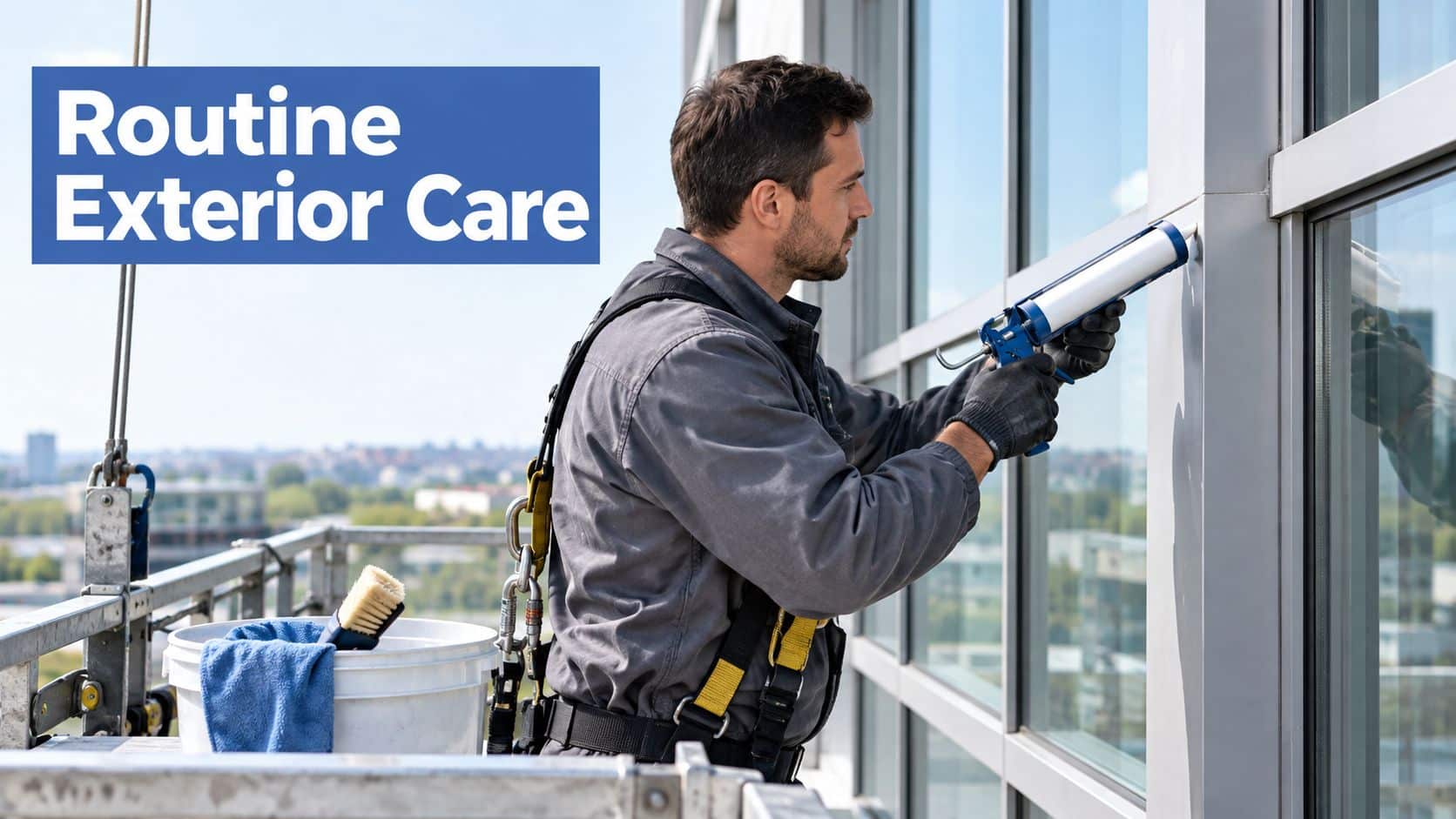
In a market like Phoenix, Scottsdale, Paradise Valley, Chandler, Tempe, and Gilbert, routine window washing does more than improve appearance. It clears the film that can conceal joint separation, failed edges, and staining patterns that point to water intrusion. Solar panels also benefit from careful cleaning because deposited material reduces light reaching the cells, and the National Renewable Energy Laboratory defines the soiling ratio as the output of a soiled device divided by the output of a clean device. NREL definition of soiling ratio and soiling rate
Safety and access matter as much as cleaning
For high-rise work, the access plan is part of the maintenance plan. OSHA's powered-platform standard requires workers on platforms to use fall-arrest systems and keep written emergency plans for power failures, equipment failures, and other emergencies. OSHA powered-platform safety requirements
That matters because a properly insured, safety-trained crew sees more than glass. They also see failed seal lines, blocked weeps, damaged gaskets, and staining that points to trouble behind the surface. A good exterior maintenance vendor should treat those findings as part of the service, not as an afterthought.
If you want a practical framework for scheduling those jobs together, build a preventive maintenance routine and align it with window washing, façade inspections, and solar cleaning. That's the easiest way to keep cosmetic work from becoming the only line of defense.
For property managers, that's where exterior cleaning and envelope care overlap. If the glass is clean, the joints are visible, and the crew knows what to look for, you catch problems while they're still manageable. commercial exterior cleaning services
Building a Condition-Based Maintenance Program
Calendar-based sealant replacement sounds simple, but it wastes money when joints are still healthy and creates risk when high-consequence elevations are ignored. A better approach is condition-based maintenance, where the building gets inspected, the joints get scored by risk, and the work gets prioritized by exposure, leakage history, and consequence of failure. Commercial roof inspections and upkeep follows the same logic, because envelope systems hold up better when maintenance is based on condition instead of habit.
How to structure the program
Inspect wet-applied perimeter joints at least annually, then put the most exposed elevations first in line. High-traffic storefronts, upper façades, and joints with repeated leakage deserve faster action than sheltered areas that still show good adhesion and flexibility.
Track where leaks recur, what weather was present, and what was repaired last time. That record helps separate a local defect from a systemic joint problem, and it keeps crews from repeating the same patch in the same place without solving the source.
Best practice: coordinate sealant work with façade access, window cleaning, and other exterior service windows.
That coordination reduces disruption. It also makes targeted replacement more practical than wholesale window replacement when frames and glass are still serviceable. In many buildings, that's the lower-impact path, and often the lower-carbon one too.
For broader planning, tie this logic into commercial property maintenance so the sealant program isn't isolated from the rest of the asset strategy. When the whole exterior is managed as one system, the building stops surprising you.
If your property in Phoenix, Scottsdale, Paradise Valley, Chandler, Tempe, or Gilbert needs a sharper eye on glass, sealant condition, and exterior maintenance, South Mountain Window Cleaning, LLC can help with professional window washing, high-rise service, and exterior cleaning that supports envelope visibility. Visit South Mountain Window Cleaning, LLC to schedule service and keep your building easier to inspect, maintain, and protect.