
You’re often standing at the same point when a project starts. The land looks quiet, but the risk is already active. Before concrete trucks, steel deliveries, storefront glass, or tenant improvements show up, the outcome is being set by what happens in the dirt, at the curb, and along the perimeter.
That’s why construction site preparation deserves owner-level attention, not just contractor attention. Poor execution during early groundwork leads to unexpected ground conditions that cause up to 30% of construction issues globally, and in major U.S. markets site preparation typically represents 5% to 10% of total project cost according to SafetyCulture’s site preparation overview. On a commercial property, that’s not a small line item. It’s the stage that controls what every later line item has to absorb.
In Arizona, the stakes feel sharper. A site may look dry and simple, but dust, hard sun, utility congestion, drainage mistakes, access conflicts, and neighboring property exposure can turn a straightforward job into a messy one fast. Owners usually feel the impact in three places first: schedule creep, change orders, and a handover that doesn’t feel finished.
The Blueprint for Success Before You Build
At 6:30 a.m. on a new commercial job in Arizona, the site can look harmless. Flat dirt. A curb cut. Maybe an old asphalt apron and a few utility markers. By 10:00 a.m., one bad assumption about drainage, access, or surface condition can start a chain of delays that follows the project all the way to final turnover.
That is why early site preparation has to be treated as full-cycle project control, not a preliminary box to check. Census Bureau reporting tracked more than $2 trillion in U.S. construction spending, and every dollar tied up in rework, access conflicts, erosion control failures, or poor closeout starts getting expensive long before vertical construction is finished. On Arizona commercial properties, the pressure points are predictable. Dust control, stormwater handling, hard summer conditions, neighboring tenant exposure, and final appearance all begin with decisions made before heavy equipment starts moving.
A raw site also hides problems that only show up later if the team does not document and control them early. Water paths look minor until monsoon runoff finds the low point. Existing pavement damage looks cosmetic until delivery traffic makes it worse. Dirty exterior surfaces and debris around the perimeter can even weaken pre-construction photos and condition records that owners may need to settle disputes at the end of the job.
Three early checks separate disciplined projects from expensive ones:
- Identify what can disrupt the build. That includes soil behavior, drainage routes, site access, utility conflicts, dust boundaries, and exposure to adjacent buildings or parking areas.
- Record what matters before the site gets busy. Capture pavement condition, curb lines, façade areas, runoff patterns, and any existing staining, cracking, or damage while the property is still undisturbed.
- Set cleanup expectations at the start, not the end. Owners should define who is responsible for haul-off, dust residue, window and façade cleanup, surface washing, and handover presentation before contracts are fully in motion.
Some teams also use preconstruction modeling to compare staging, paving, and access options before committing field crews. For owners reviewing route layouts or hardscape quantities, AI takeoffs for paving project plans can help tighten those decisions early.
I also advise owners to connect site prep to long-term property care. A project should not leave behind worn access routes, stained glass, clogged drains, or a handover that still looks under construction. If your operations team already works from a commercial building maintenance checklist, use the same discipline here. The smartest prep plans protect the property on day one and make final cleanup easier to verify at the end.
The trade-off is simple. Spending more time on front-end coordination can feel slow, especially when everyone wants visible progress. Spending less time there usually means schedule drift, field fixes, and a closeout phase full of avoidable punch items.
Strong site preparation plans spell out sequence, controls, documentation standards, and cleanup responsibilities from mobilization through handover. Weak plans focus on clearing dirt and starting equipment. Owners feel that difference twice. First during construction, then again when the site is supposed to look finished.
Navigating Permits Surveys and Pre-Excavation Assessments
The projects that move cleanly usually look methodical before they look busy. Permits are in hand. Survey control is clear. Utility conflicts are flagged early. Access routes are thought through before the first delivery driver asks where to go.
Start with the paperwork that keeps the field moving
A lot of owners want to get to the visible work. That’s understandable. But delayed approvals and missing documentation stop jobs more effectively than a broken machine.
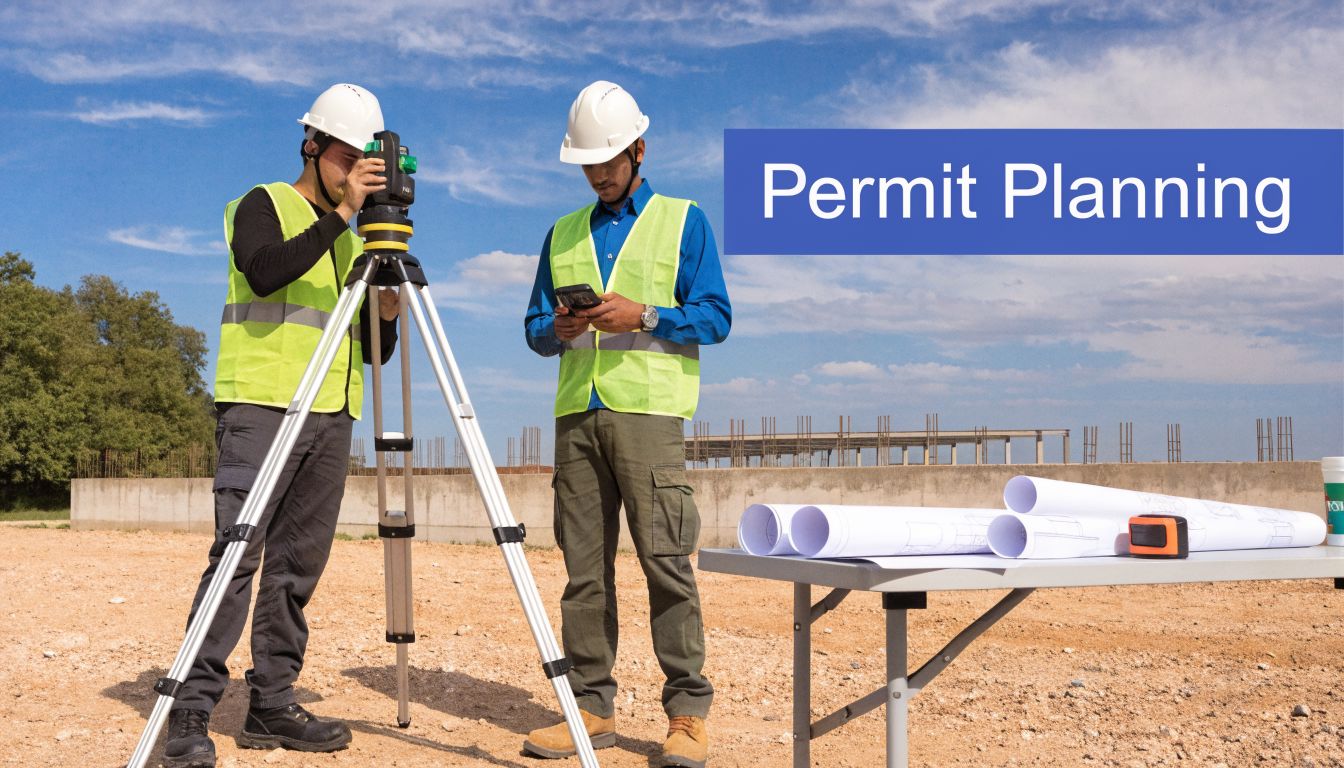
For Phoenix, Scottsdale, and other Valley jurisdictions, approval paths can vary by scope, parcel conditions, drainage implications, utility work, and surrounding use. If you’re organizing the early package, a practical overview of permits for commercial projects can help frame the kinds of requirements that tend to matter before excavation begins.
A strong permit file should align with what the field crews will do. If the approved plan assumes one access point and the superintendent creates another in the field, you’ve already created avoidable exposure. Owners should ask for direct confirmation that the operational plan matches the permitted plan, not just the drawings.
Surveys that matter and why they matter
Not every survey serves the same purpose. Owners should understand the function of each because survey gaps become construction problems later.
A practical pre-excavation survey package often includes:
- Boundary confirmation so staging, fencing, and material laydown don’t drift into the wrong area.
- Topographic work so the team understands existing elevations, runoff direction, and grading demands.
- Utility locating and mapping so excavation crews don’t discover conflicts with a bucket.
- Geotechnical investigation so the foundation design and compaction plan match actual site conditions.
Per site preparation best practices, permits and approvals should be secured before physical work begins because they confirm zoning, environmental, and excavation compliance and help avoid legal stoppages, according to Perlo’s site preparation guide. In the field, that translates to fewer surprise pauses and fewer decisions made under pressure.
The overlooked step that prevents ugly disputes
Most site preparation guidance talks about subsurface conditions. Far less attention goes to the surfaces everyone can already see.
Current literature often overlooks the need for professional exterior assessment and cleaning of existing site surfaces before groundwork begins, and for large commercial projects in Phoenix and Scottsdale that’s a significant blind spot affecting survey accuracy and worker safety, as noted by Ground Zero NWA’s discussion of site preparation gaps.
That matters more than many owners realize. If access pavement is covered in dirt, oil residue, algae, rust bleed, or loose debris, several problems follow:
- Survey marks and photographic documentation become less reliable.
- Equipment routes may be chosen without a clear understanding of surface condition.
- Slip hazards increase around existing structures and service areas.
- Owners lose a clean baseline when adjacent tenants later claim damage or staining.
Clean first, document second, excavate third. Reverse that order and you invite arguments nobody can resolve cleanly.
A better pre-excavation protocol
Before heavy equipment arrives, use a short owner-side checklist:
- Photograph and map existing conditions: Curbs, walks, storefronts, loading zones, perimeter walls, drain inlets, and neighboring interfaces.
- Clean critical surfaces: Remove loose soil, staining, and buildup where survey visibility and vehicle traction matter.
- Mark protection zones clearly: Existing glass, finished masonry, decorative pavement, and occupied entries need physical protection before site disturbance starts.
- Confirm access logic: Decide where trucks enter, where they turn, and where they stage before habits form on-site.
- Document responsibility lines: Make sure site contractor, utility crews, and later cleaning vendors understand who owns which conditions.
Arizona owners who skip this step often discover that “existing condition” becomes a moving target once excavation starts. A clean baseline reduces finger-pointing and gives the project team a common record of what was there before the site got rough.
Transforming Raw Land into a Buildable Canvas
A commercial site can look ready long before it is actually ready. I have seen cleared parcels with clean haul roads and fresh stakes still fail the first hard rain, the first proof roll, or the first utility trench because the ground work was treated as dirt moving instead of platform building.
The goal here is simple. Create a stable, drainable, testable site that supports every trade that follows, and that can still be cleaned and handed over in presentable condition at the end of the job. In Arizona, that standard matters more because heat, caliche, windblown dust, and sudden monsoon runoff expose weak prep fast.
Clearing has to remove future problems, not just visible ones
Clearing starts the transformation, but appearance is a poor quality measure.
Brush, stumps, buried rubble, abandoned footings, undocumented asphalt sections, and old utility remnants all need to be identified and removed based on what comes next. If a root mass stays under a pavement section, or broken concrete gets buried in a building pad, the project team usually pays for it later through unstable subgrade, trenching delays, or compaction failures.
Owners should press for disposal tickets, limits of removals, and confirmation that underground obstructions were addressed where foundations, utilities, and paving will go. A parcel that only looks open can still be a bad building site.
Grade the site for water, traffic, and the next trade
Grading sets the job up for success or rework. On Arizona projects, the grading plan has to do more than create the right finish elevation. It has to move runoff away from pads and entries, preserve access for equipment, and avoid low areas that turn into mud, rutting, or ponding after a storm.
The practical standard is straightforward. Build the slopes shown on the civil plans, confirm that water leaves the site or reaches approved collection points, and protect those grades as work continues. The Federal Highway Administration explains in its earthwork and grading guidance for construction operations that earthwork performance depends on proper moisture control, lift placement, and verification during construction, not just on the intended final contour.
Three grading failures create repeat costs on commercial sites:
- Low pockets at doors, docks, and storefront paths: Water stands where owners need safe access and clean finishes.
- Temporary drainage that ignores the actual storm path: A site works in dry weather, then sends runoff into neighboring parcels or active work areas.
- Grades that get cut back up by later crews: Good subgrade is lost because nobody protected the finished elevations.
I tell owners to watch where water would go if a storm hit that afternoon. That quick field check catches bad assumptions early.
Excavation works best when the sequence is disciplined
Excavation is where schedule pressure often starts to distort judgment. Crews want production. Owners want visible progress. The right sequence still matters more than speed because every overcut, every unstable trench wall, and every rushed backfill shows up again in cost and delay.
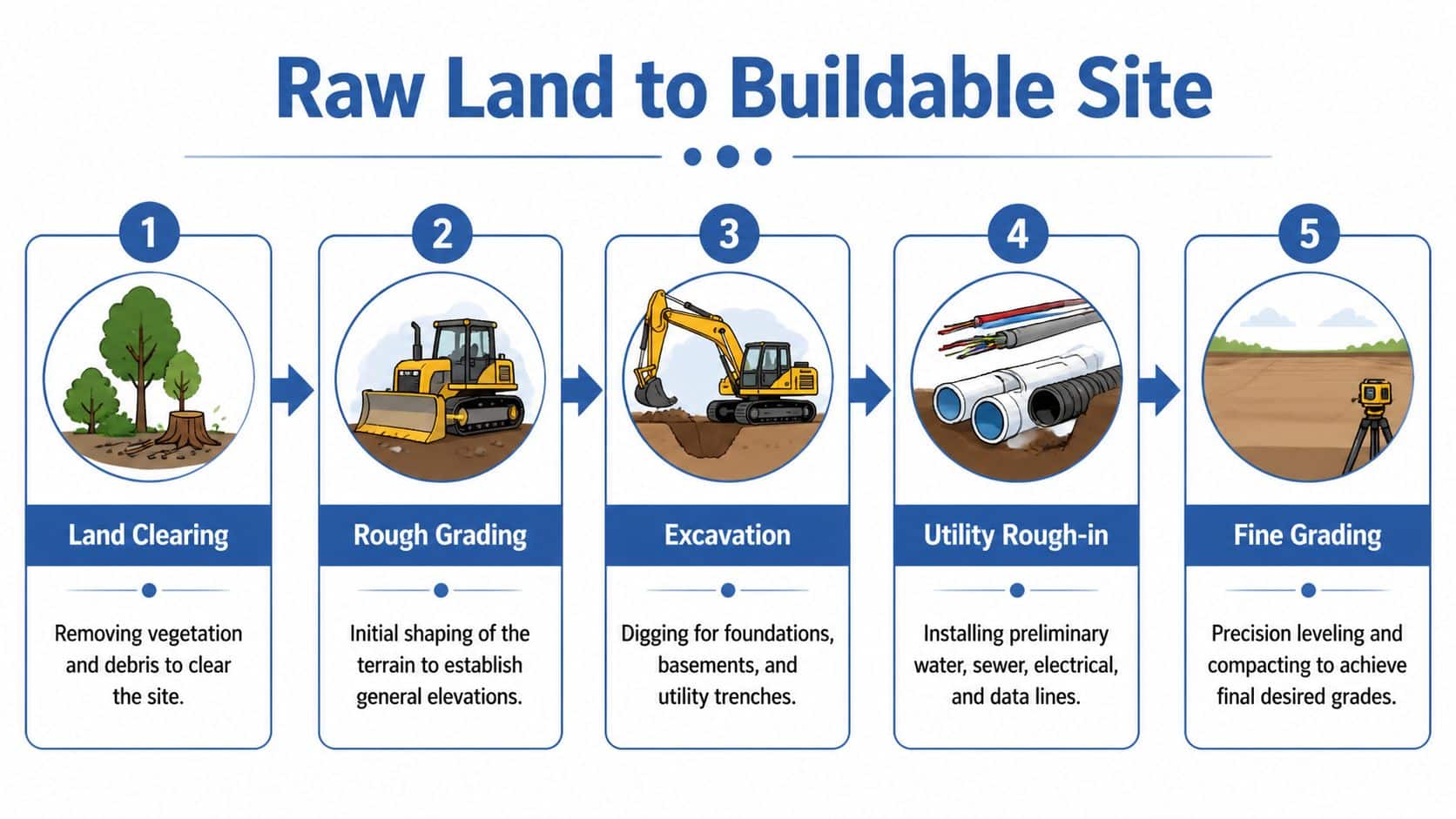
A sound progression usually follows this order:
| Phase | What the crew is trying to accomplish | Owner concern |
|---|---|---|
| Initial clearing | Remove obstructions and establish access | Protect adjacent improvements |
| Rough grading | Create general elevations and drainage logic | Avoid temporary drainage failures |
| Excavation | Cut for foundations, utilities, and structural elements | Prevent over-excavation and conflicts |
| Utility rough-in | Place underground systems before final surface work | Verify locations before covering |
| Fine grading and compaction | Prepare exact final subgrade for the next build step | Demand test-backed acceptance |
That sequence protects money. If excavation starts before rough grades and haul routes are controlled, equipment tracks up the pad and crews spend time rebuilding work they already completed. If utility trenches get cut after fine grading, the site loses density and flatness in the exact areas that need both.
Retaining and edge conditions need drainage built into the solution
Many commercial sites cannot rely on open grading alone. Property line transitions, drive aisles, ramps, and tight building envelopes often require retaining features. The retaining choice should be driven by soils, surcharge loads, drainage, access, and maintenance, not by whichever detail seems fastest to install.
Teams comparing systems sometimes review H beam and concrete sleeper walls to understand how different wall assemblies handle grade separation and constructability. The owner-side question is more important than the product comparison. Does the wall detail release water, tie into site drainage, and allow nearby soils to be compacted correctly?
A wall that holds grade but traps water behind it creates a different failure.
Compaction is the proof that the site is actually ready
A smooth subgrade can still be weak. Compaction is where the job either earns confidence or borrows trouble from later phases.
The right process depends on soil type, moisture content, lift thickness, and testing frequency. The University of Missouri Extension’s overview of soil compaction in construction gives a clear explanation of why soil condition and equipment selection affect density and long-term performance. On a live project, that translates into practical controls. Place fill in manageable lifts, adjust moisture before rolling, proof roll where needed, and keep unnecessary traffic off finished areas.
Owners do not need to run the density tests themselves, but they should expect test reports, failed area corrections, and clear acceptance points before foundations, paving base, or slab prep moves ahead.
Finish the earthwork in a way that protects final cleaning and handover
Good site prep considers the last phase of the project, not just the first pour. If crews leave sediment at walks, caked mud on hardscape, or heavy soil staining at perimeter concrete, the final turnover gets harder and more expensive. The wrong cleaning method can also damage new surfaces. On exterior finishes and site hardscape, the difference between pressure washing and soft washing for construction-related surface cleanup matters because owners are trying to remove soil and residue without etching, striping, or forcing water where it should not go.
That handover starts here, while the site is still dirt. Protect finished grades. Keep haul routes controlled. Stabilize exposed soils. Clean paved edges before sediment bakes in. A well-prepared site supports the build, shortens punch work, and makes the final post-construction cleanup look like the planned closeout step it should be, not a rescue operation.
Controlling Your Site Environment in Arizona
A site can be technically graded and still be poorly managed. Once work is active, the challenge changes. You’re no longer just shaping land. You’re controlling a temporary environment that affects safety, compliance, neighbors, and the final condition of the property.
Utility control comes first
Before anyone cuts, trenches, or drills, underground utilities need to be located and protected. That starts with 811 and continues with field verification, visible marking, and crew communication. The paper map isn’t enough by itself. Operators need current field marks, and supervisors need to protect those marks as the site changes.
A clean utility process includes temporary power and water planning too. If crews improvise service access, the job gets less safe and less efficient. Hoses drag across traffic paths. Temporary cords cross work zones. Delivery routes conflict with trench areas. Owners feel this later through delays, repairs, and damaged finished surfaces.
Dust control isn’t optional in the Valley
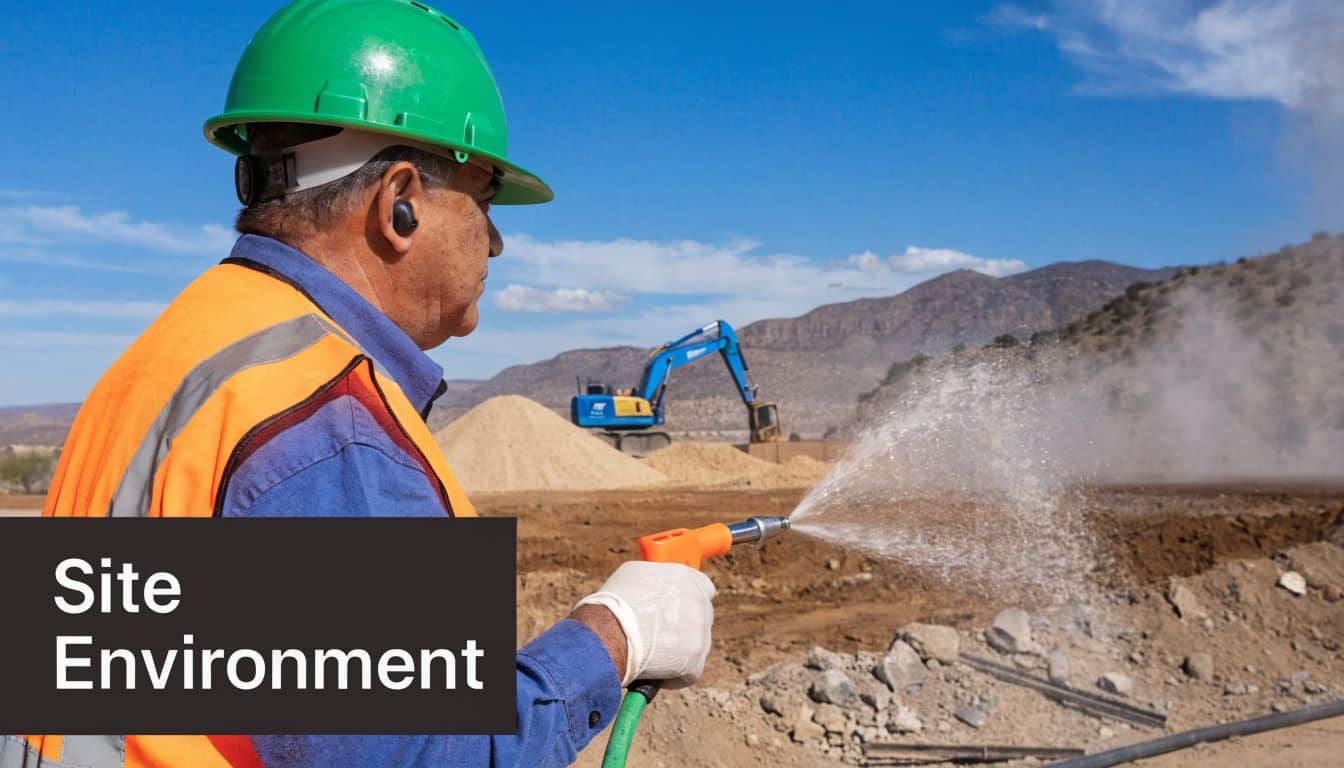
Arizona punishes sites that treat dust as a minor nuisance. Dust settles into equipment, coats storefront glass, drifts onto neighboring properties, and degrades working conditions fast. It also creates a bad first impression for tenants, customers, and city inspectors.
Construction site prep content rarely covers post-excavation and post-grading cleaning protocols, yet this gap matters especially in Arizona, where desert dust accumulation affects equipment efficiency, worker respiratory health, and neighboring properties if teams don’t manage dust suppression and sediment control properly, as noted by White Cap Builders’ site preparation gap analysis.
That gap leads to one of the most common owner mistakes. They budget for site prep, then treat ongoing environmental control as an extra. It isn’t extra. It’s part of maintaining control over the work.
What effective environmental control looks like
The best-managed sites make dust and sediment control routine, not reactive. That usually includes:
- Water application at the right intervals: Not occasional spraying for appearances. Actual suppression where traffic and cutting generate fine dust.
- Stabilized entrances and exits: Keep soil from riding out on tires and tracking into public streets.
- Sediment barrier maintenance: Controls only work if crews inspect and repair them after activity and weather.
- Defined debris zones: Scrap, packaging, and broken material need consistent collection points.
- Surface cleaning during active work: Pavement, hardscape edges, and access points should be cleaned before buildup turns into runoff or damage.
For existing finished surfaces, the right cleaning method matters. Hard buildup and heavy construction residue may call for a different approach than delicate finishes, painted surfaces, or certain façade materials. A practical comparison of pressure washing vs soft washing helps owners understand why one cleaning method can solve a problem while another can create one.
Safety and cleanliness reinforce each other
A dirty site isn’t just unattractive. It’s harder to manage. Loose debris hides trip hazards. Dust obscures markings. Mud and sediment reduce traction. Overflowing waste areas tempt crews to create new unofficial dump spots.
A controlled site usually has these traits:
| Site condition | Poorly managed result | Well-managed result |
|---|---|---|
| Perimeter fencing | Gaps, improvised openings, weak access control | Defined entry points and clearer accountability |
| Signage | Missing, faded, or ignored | Visible routing and hazard communication |
| Housekeeping | Debris spreads into work paths | Crews move faster with fewer obstructions |
| Dust suppression | Complaints and visibility issues | Better neighbor relations and cleaner operations |
The cleanest active sites usually run the smoothest because crews can see, move, stage, and inspect with less friction.
For Arizona commercial work, that matters beyond the fence line. Adjacent retailers, offices, residents, and pedestrians don’t separate “construction dust” from “property neglect.” If the site throws debris and residue onto surrounding improvements, the owner’s reputation takes the hit first.
Integrating Vendors and Passing Critical Checkpoints
Construction site preparation isn’t a solo trade. It’s a sequence of handoffs. Surveyors establish control, earthwork crews shape the site, utility contractors cut and backfill, inspectors verify compliance, and finish trades depend on all of them having done their jobs correctly. If the choreography breaks down, the schedule does too.

Coordination is a cost-control tool
Inadequate preparation and poor coordination cause 36% of project delays, and 45% of construction professionals report spending excess time on suboptimal activities because unresolved site issues keep interrupting the work, according to Construction Coverage’s analysis of U.S. construction spending and project conditions. The same source notes that proper planning can prevent 15% cost overruns on high-rise projects.
Those numbers line up with what owners see in the field. A missed utility conflict rarely stays isolated. It affects trenching, inspections, paving, concrete sequencing, and sometimes tenant turnover dates.
Where jobs usually lose time
Most coordination failures happen in familiar places:
- Delivery timing: Material shows up before the laydown area is ready.
- Trade overlap: One crew blocks another because access routes weren’t sequenced.
- Inspection misses: The site is physically ready, but the paperwork or testing isn’t.
- Late specialty scheduling: Final cleaning and glass work are treated as afterthoughts.
The easiest way to reduce that friction is to manage the site through checkpoints rather than assumptions.
Critical checkpoints worth protecting
Owners should ask the project team to identify no-fail checkpoints and the release conditions for each one.
| Checkpoint | What must be ready | Common failure |
|---|---|---|
| Rough grading approval | Elevations, drainage intent, accessible review path | Inspector sees ponding risk or mismatch to plans |
| Utility inspection | Exposed work, marked lines, correct documentation | Crews backfill before approval |
| Subgrade acceptance | Compaction records, stable access, protected surface | Traffic damages finished subgrade |
| Foundation release | Excavation complete, moisture and bearing concerns resolved | Last-minute correction work delays pour |
| Final exterior cleanup scheduling | Site access, debris haul-off, safe lift or ladder access | Cleaning vendor gets called too late |
A vendor calendar should include the handover team long before the building looks finished.
Vet the people who touch the site late
Late-phase vendors can protect your turnover date or wreck it. Exterior cleaners, glazing touch-up teams, pressure washing crews, and specialty access providers need to understand active-jobsite realities, insurance requirements, and sequencing. If you need a framework for screening outside firms, this guide to vendor vetting is useful for evaluating reliability before you add another name to the schedule.
This is also the right point to bring in post-construction exterior service partners. For example, South Mountain Window Cleaning, LLC handles construction cleaning of windows on homes and businesses, including high-rise buildings up to 12 stories, and can be scheduled as part of the turnover plan rather than as a last-minute scramble. That’s the right way to think about final cleaning in general. Not as a separate errand, but as a scheduled project requirement.
The Final Handover From Dusty Site to Pristine Property
Owners don’t judge completion by whether the excavation passed months ago. They judge it by what they can see when they receive the property. If dust still coats the glass, concrete splatter still marks surfaces, trash remains in corners, and the approach looks rough, the job doesn’t feel complete.
That’s why the final handover deserves the same discipline the site demanded before the first footing. Advanced site preparation ends with final quality checks such as proof-rolling and plate load tests requiring settlement under 0.5 inches under a 10-ton load before concrete pour, according to Buildings Guide’s site prep benchmarks. The same standard of verification should extend to turnover. Close the job with evidence, not assumptions.
What post-construction cleanup actually includes
A standard janitorial pass isn’t enough for a newly built or renovated commercial property. Post-construction cleanup on the exterior is a trade-sensitive process.
It typically includes:
- Debris removal: Fine debris, leftover packaging, adhesive remnants, and perimeter scrap.
- Exterior washing: Cleaning concrete, entries, walls, loading areas, and high-traffic hardscapes without damaging finishes.
- Glass cleanup: Removing construction dust, residue, and film so the building presents correctly.
- Detail cleaning at transitions: Door frames, sills, ledges, canopies, and corners where dirt collects.
- Final presentation review: Making sure the property looks occupancy-ready from curb to entry.
If you’re planning that phase, a dedicated guide to cleaning after construction helps define the scope more clearly than a generic janitorial checklist.
Why final cleanup affects more than appearance
The last cleanup does three jobs at once.
First, it reveals defects. Dirty windows and dusty surfaces hide scratches, sealant residue, runoff patterns, and finish inconsistencies. Second, it supports sign-off. Owners, tenants, and inspectors can evaluate a clean property more accurately. Third, it shapes the first real impression of the asset. A new building should look finished, not merely stopped.
That matters on office, retail, multifamily, and hospitality projects alike. Handover is the moment when all the early discipline either becomes visible or doesn’t.
The Ultimate Construction Handover Checklist
| Category | Check Point | Status (Not Started / In Progress / Complete) |
|---|---|---|
| Documentation | As-built records collected and organized | Not Started / In Progress / Complete |
| Documentation | Permit closeout items verified | Not Started / In Progress / Complete |
| Site Conditions | Temporary fencing, signage, and protection removed where appropriate | Not Started / In Progress / Complete |
| Site Conditions | Remaining debris, scrap, and unused materials hauled off | Not Started / In Progress / Complete |
| Drainage and Exterior | Drain inlets, swales, and surface flow paths cleared of sediment | Not Started / In Progress / Complete |
| Drainage and Exterior | Hardscape and access areas cleaned and free of tracked soils | Not Started / In Progress / Complete |
| Building Exterior | Façade inspected for residue, stains, and splashback | Not Started / In Progress / Complete |
| Building Exterior | Exterior windows cleaned and checked for remaining construction film | Not Started / In Progress / Complete |
| Building Exterior | Entry glass, frames, and hardware detailed for presentation | Not Started / In Progress / Complete |
| Safety | Access routes safe for owner, tenant, and service traffic | Not Started / In Progress / Complete |
| Systems and Quality | Required tests, inspections, and punch items confirmed complete | Not Started / In Progress / Complete |
| Owner Turnover | Final walk performed on a clean site with clear deficiency list if needed | Not Started / In Progress / Complete |
A practical turnover standard
A good handover feels calm. There’s no scramble to hide debris before the owner arrives. No dusty glass waiting for “the cleaning guys.” No unresolved mud at entries. No uncertainty about whether the property is ready for photos, tenants, or operations.
Owners remember the final condition longer than they remember the excavation sequence.
That’s why the complete lifecycle matters. Construction site preparation begins with permits, surveys, and soil work, but it doesn’t end when the slab is ready. It runs through environmental control, vendor coordination, and the final washdown that changes a worksite into a property. Treat the final clean-up as mandatory, and the whole project closes stronger.
If you need an exterior cleaning partner for post-construction window cleaning, power washing, or final presentation work on a commercial or high-rise property in the Valley, South Mountain Window Cleaning, LLC provides services for businesses across Phoenix, Scottsdale, Paradise Valley, Chandler, Tempe, and Gilbert. Their work fits best when it’s scheduled early in the handover plan, so the property is clean, safe, and ready when your turnover date arrives.