
Most advice about a gutter cleaning brush starts with leaves. In Arizona, that's often the wrong starting point. Phoenix-area gutters may look clear while holding fine desert dust, roof grit, pollen, and sediment that turns into stubborn sludge when a monsoon downpour finally arrives.
A long-handled brush can be useful, but it isn't a maintenance-free solution or proof that the drainage system works. It's a controlled-contact tool for light debris and finishing work. The right question is whether it restores flow without creating a false sense of safety, and whether the operator can see enough to know what the brush has missed.
Understanding Gutter Cleaning Brushes and Guards
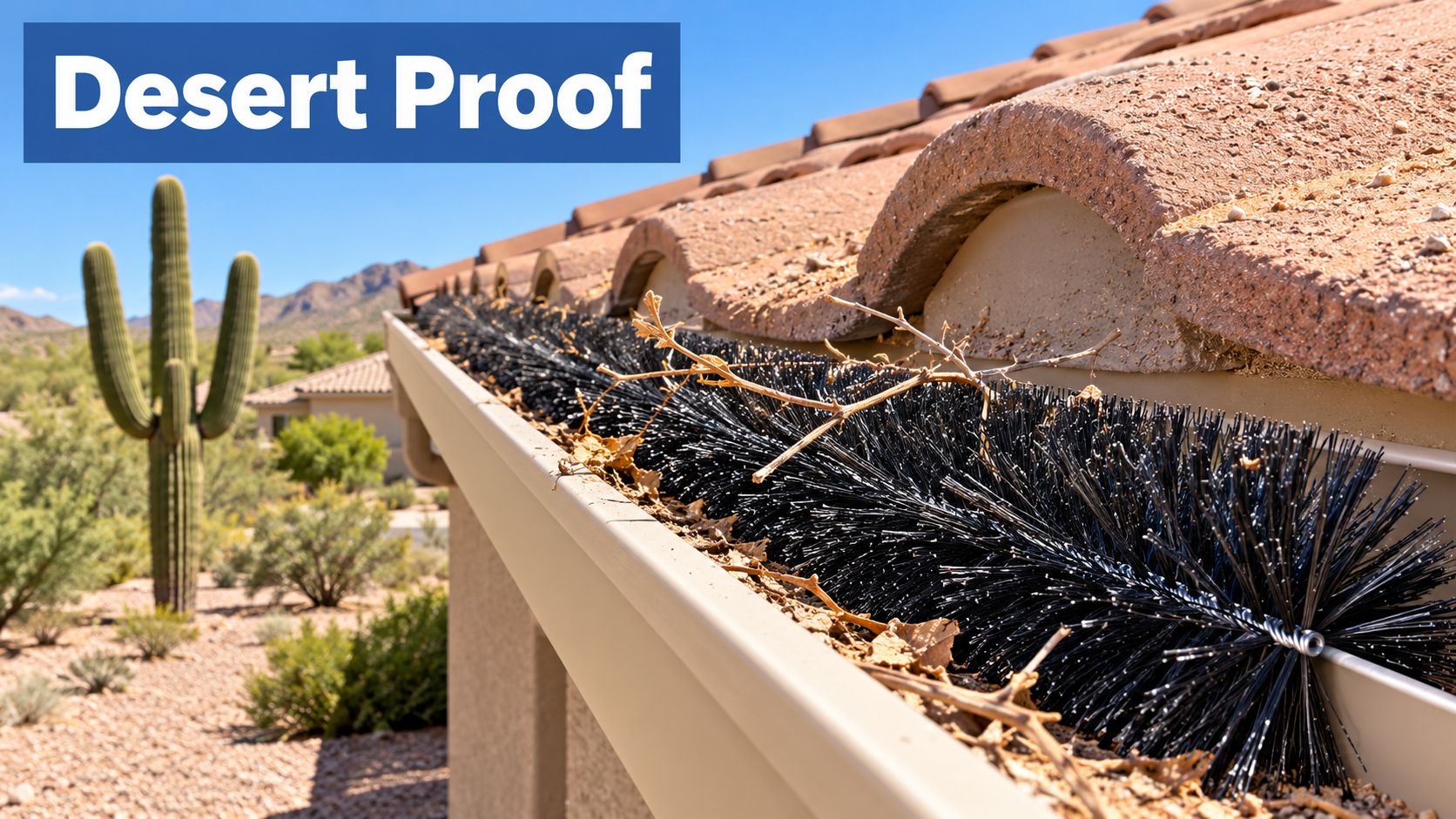
A gutter brush is a cylindrical insert with bristles facing upward inside the gutter channel. Large leaves and twigs rest on top while rainwater moves between the bristles. A brush guard and a rigid gutter cover serve related purposes, but they aren't interchangeable. A brush occupies the channel, while a guard covers it from above.
The design has developed through a long record of patented gutter-cleaning tools rather than from one modern invention. Documented milestones include patents from 1996, 1997, 2001, and 2009, followed by U.S. patent application US20170022715A1, filed on July 25, 2016, for a gutter-cleaning apparatus incorporating a brush. The application was later listed as abandoned, so it demonstrates engineering development, not proof that a particular product remains available or widely used. The patent specification identifies nylon, polypropylene, polyester, polystyrene, PEEK, and PTFE as suitable bristle materials.
How bristle stiffness affects results
The bristles have to be stiff enough to lift leaves, small branches, and loose particles, but not so aggressive that they abrade painted aluminum, galvanized coatings, or membrane-lined surfaces. Stiffness, durability, chemical resistance, and surface protection all matter.
A brush with excessive flex may fold over and leave grit in corners. One that's too rigid can scrape coatings, catch on hangers, or transfer force into a weak gutter edge. A narrow, flexible head is generally more useful around miters and hidden hangers, while an angled head can improve contact when the brush is mounted to an extension pole.
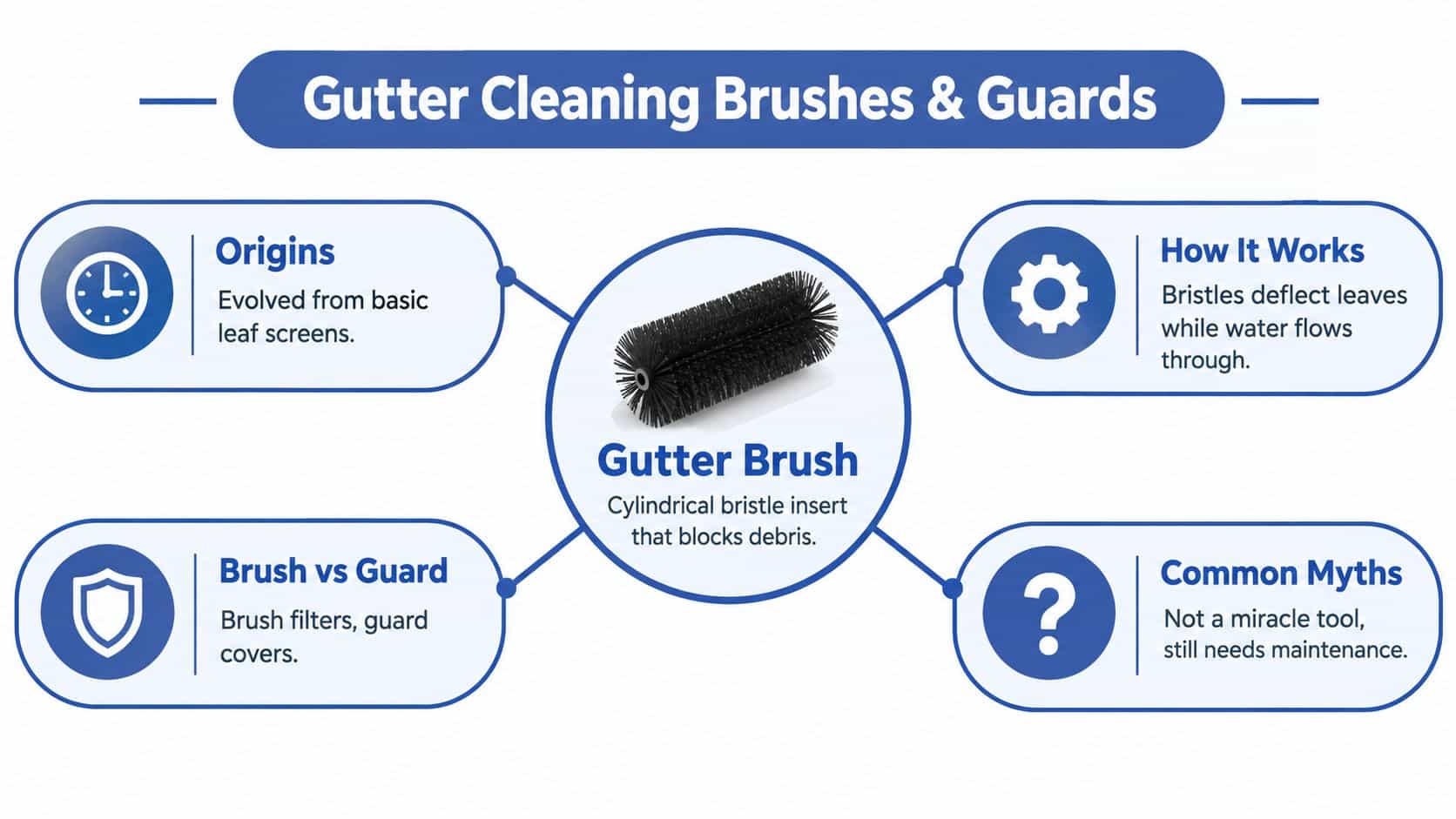
Treat the brush as a preventive or finishing instrument, not an excavation tool. Saturated leaves, compacted sediment, and root-like vegetation need hand removal or scraping before brushing. A useful maintenance overview is available in this guide to gutter cleaning and maintenance, but the practical principle is simple: brush loose residue, then verify that water can leave the system.
Comparing DIY Brushes to Professional Gutter Services
A DIY brush is attractive because it gives a homeowner immediate access to a simple tool. It can sweep loose leaves from a reachable section, clear light surface debris, and serve as an interim measure between more thorough inspections. It also lets a property owner respond after a dusty storm without waiting for an appointment.
That convenience has limits. From the ground, visibility is poor. From a ladder, the operator must manage the tool, footing, debris, and the gutter edge at the same time. A brush may also leave behind compacted sediment, hide damaged seams, miss a failing fascia board, or push debris toward a downspout opening without clearing the obstruction.
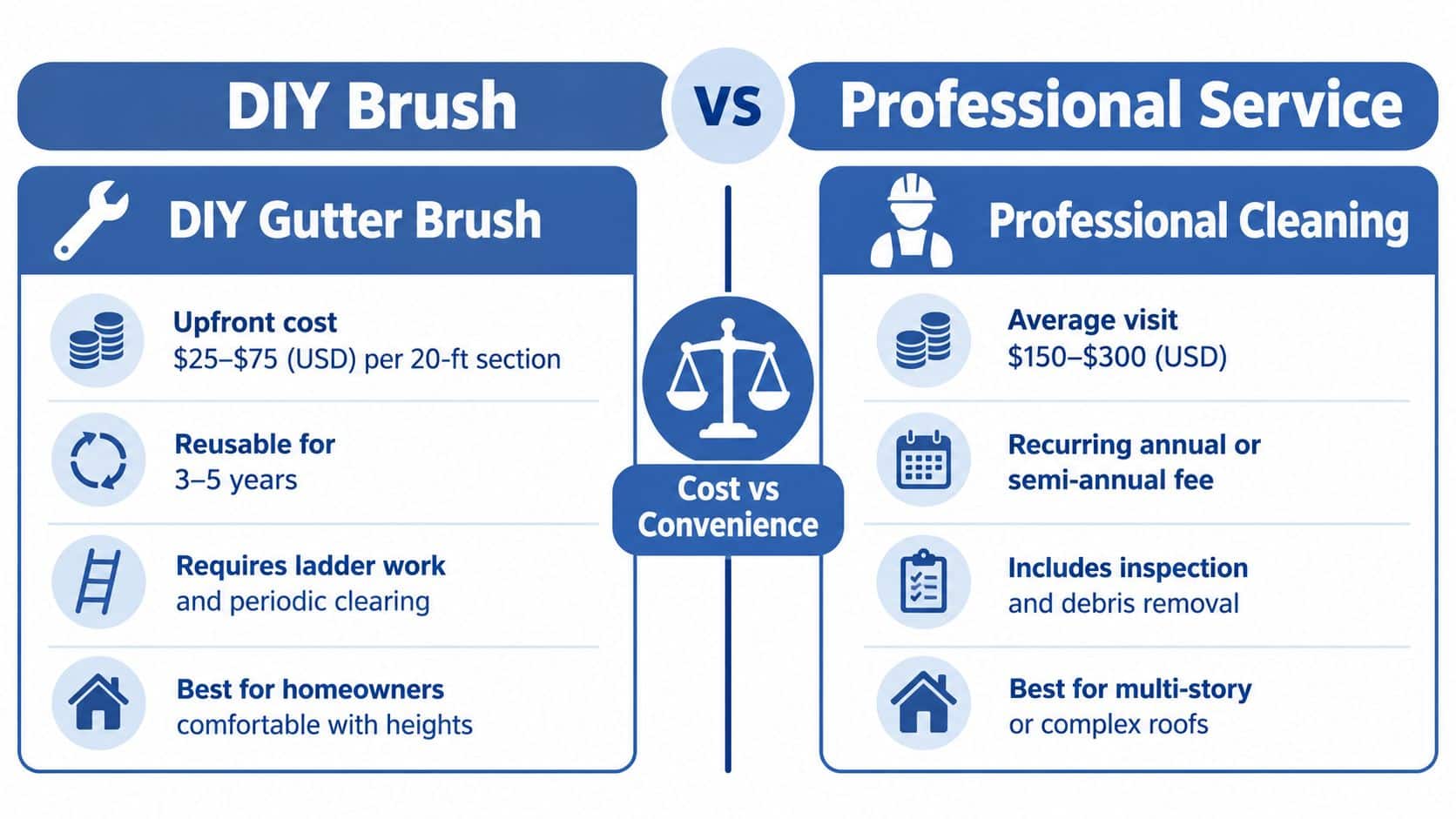
What the two approaches actually provide
| DIY brush | Professional service |
|---|---|
| Quick surface sweeping | Debris removal with system inspection |
| Limited visibility | Direct assessment of channels, outlets, seams, and brackets |
| Useful for light, loose material | Better suited to compacted buildup and complex rooflines |
| Requires the owner to judge safety | Uses a planned access method and appropriate equipment |
| Can miss downspout restrictions | Includes flow verification and follow-up recommendations |
The brush makes sense when the gutter channel is visible, the material is loose, and the work can be completed without unstable ladder positioning. It makes less sense when the property has multiple stories, steep roof sections, fragile surfaces, screens, guards, or drainage complaints that haven't been diagnosed.
Property owners comparing regional service standards can also review this practical resource on gutter cleaning services in Ventura County. The location differs, but the decision principle applies in Arizona too: cleaning the visible channel isn't the same as proving that the entire drainage path works.
A professional visit earns its value through verification, not just removal. The technician can determine whether water reaches the outlet, whether the downspout backs up, and whether a gutter problem is actually a roof, fascia, bracket, or drainage-design problem. For local planning, review gutter cleaning pricing near you as part of the broader cost-versus-risk decision, not as a comparison with a single retail tool.
Practical rule: Use a brush for light maintenance when you can see the work. Hire help when you need someone to prove the drainage system is functioning.
Proper Installation and Maintenance Techniques
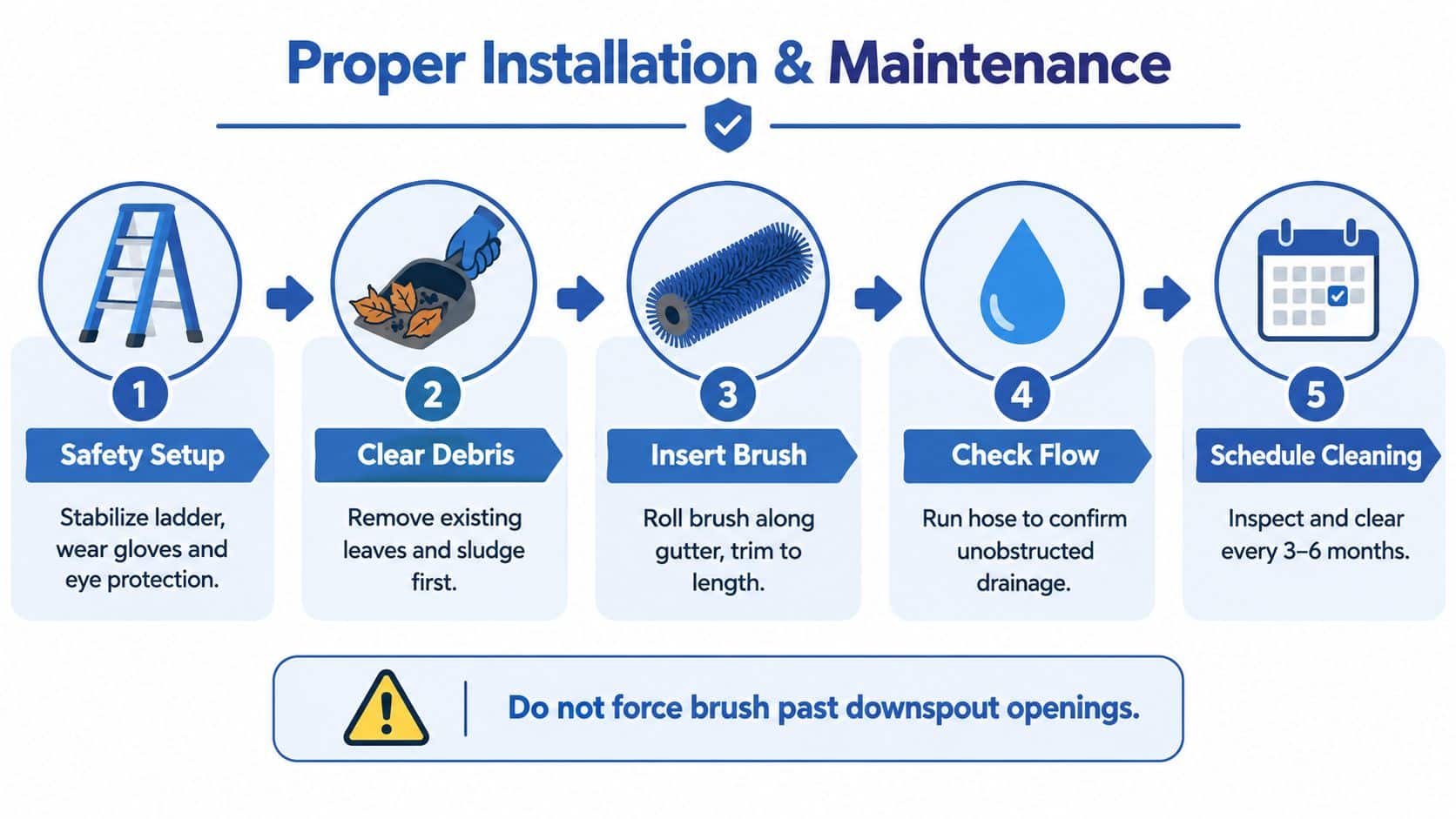
A brush works best when the operator follows the correct sequence. Installing it over existing sludge hides the problem and can make later cleaning more difficult. The workflow should move from safety, to removal, to controlled brushing, and finally to a water test.
A reliable operating sequence
Set up safely. Stabilize the ladder if ladder access is necessary, wear gloves and eye protection, and keep the pole within a controlled working envelope. OSHA training materials instruct users to face the ladder while climbing and descending. Standard ladder guidance also uses a 4:1 setup ratio, with the base approximately one foot out for every four feet of working height, and a rail extension of at least 3 feet above a landing when stepping onto a roof or raised surface. See safe ladder use for gutters for practical setup context.
Remove saturated material first. Scoop out wet leaves, sludge, nests, and hardened deposits by hand or with a suitable scraper. Don't force the brush through a mass that resists movement. Brush bristles are designed to move loose debris, not to substitute for excavation.
Work the remaining particles. Roll or sweep the brush along the gutter floor, corners, hanger zones, and outlet throat. A narrow head helps around concealed hangers. An angled or articulating head improves contact from an extension pole, but excessive pole flex reduces control and leaves sediment behind.
Protect the outlet. Don't force a brush past the downspout opening. That can wedge debris into the throat or damage the connection. Treat resistance near the outlet as a signal to stop and inspect directly.
Flush and observe. Run a hose through the channel while watching the downspout outlet. Water should move freely and continue exiting after the hose stops. If it backs up with a clean-looking gutter, the restriction is probably inside the downspout or at an elbow, where repeated brushing won't solve the hydraulic problem.
Maintenance is more than sweeping
Inspect the brush itself for flattened bristles, trapped sediment, biological growth, and sections that have shifted out of place. A brush that holds fine material can become part of the blockage rather than preventing one. Remove and rinse it when the design allows, then inspect the gutter floor before reinstalling it.
For properties with persistent drainage trouble, a specialized gutter drain repair guide can help explain why the problem may involve the outlet, downspout, or surrounding roof drainage rather than the brush. Exterior cleaning also benefits from a separate outside gutter cleaning service when staining, dust, and runoff marks affect the visible gutter face.
Evaluating Gutter Brushes for Arizona Desert Conditions
A gutter brush designed around autumn leaves faces a different job in the Sonoran Desert. Phoenix-area properties collect fine dust, roof granules, pollen, and windblown sediment. Those particles can pass through or settle among bristles, then combine with sudden runoff during monsoon storms.
The Maricopa County 2025 monsoon report recorded 2.71 inches of average rainfall, equal to 92% of the network mean. Central Phoenix areas received 100% to 136% of normal rainfall, showing why a long dry period can be followed by concentrated runoff that tests a neglected gutter system. These figures come from the Maricopa County monsoon verification report.
Why dry brushing often disappoints
Dry brushing can move loose dust, but it may also redistribute fine grit along the channel. Once sediment becomes damp and compacted, a cylindrical brush often skims over the top. The operator may see a cleaner surface while a dense layer remains below.
That's why Arizona maintenance should be triggered by conditions, not only by a calendar:
- After major storms: Inspect for washed-in roof grit, displaced brush sections, and overflow marks.
- Before the rainy season: Remove deposits while they're still dry and easier to loosen.
- During a hose test: Watch the outlet, downspout elbows, and discharge area instead of judging the channel alone.
- When guards are present: Check whether fine dirt has accumulated beneath or around the guard, since protection reduces debris entry but doesn't eliminate maintenance.
Arizona's dust problem also affects glass, frames, sills, and other exterior surfaces. The City of Phoenix defines PM10 as particulate matter with a diameter of 10 micrometers or less and identifies dust as an air-quality concern in its dust and air-quality information. The same fine particulate environment that makes windows visibly dirty can leave gutter sediment that a brush can't fully remove.
A brush is most useful here as a light-duty surface tool between inspections. Rinsing, outlet testing, and direct inspection matter more than the appearance of the bristles. For a visual look at brush use in an arid setting, the following video provides additional context.
Safety Limits and When to Stop DIY Cleaning
A long pole can reduce ladder repositioning, but it doesn't remove every hazard. It can reduce visibility, increase side loading, and encourage an operator to reach farther than the stance allows. Ground-level work is safer only when the tool remains controllable and the operator can recognize what the brush is doing.
Stop the job when any of these conditions appear:
- The brush meets firm resistance. Compacted sludge, roots, or a damaged gutter may be underneath. Pushing harder can bend the gutter or drive material into the outlet.
- The hose test causes backup. A clean-looking channel with poor discharge points to the downspout or elbow, not a need for more surface sweeping.
- You can't see the channel. Blind brushing can miss separated seams, loose hangers, standing water, or fascia damage.
- The pole becomes difficult to control. Excessive flex and lateral force can shift a ladder or damage the gutter edge.
- Power lines, fragile roofing, or steep surfaces are nearby. Keep the work out of situations where a pole, ladder, or falling debris could create a serious exposure.
- The building is too tall or complex for reliable ground control. Multi-story façades and commercial access routes require a site-specific plan.
OSHA's suspended-scaffold guidance requires fall protection for employees on a scaffold more than 10 feet above a lower level. Workers on a two-point adjustable suspension scaffold must use both a guardrail system and a personal fall-arrest system, and the scaffold must be stabilized against dangerous swaying when a competent person determines that stabilization is necessary. OSHA also prohibits using window-cleaner anchors to prevent scaffold sway. These requirements are described in OSHA's two-point suspended scaffold guidance.
For permanently installed powered platforms, employers need engineered structural supports, tie-in guides, anchoring devices, and affected building components. OSHA's powered-platform fact sheet also identifies a maximum vertical interval of three floors or 50 feet, whichever is less, for intermittent stabilization and requires written emergency planning and operator training.
A homeowner-facing safe gutter cleaning guide from Water Works Power Washing offers useful general safety context. For local planning, the same boundary applies: a brush is a risk-reduction tool, not permission to work beyond your equipment, visibility, or training.
Property owners can also review this safe gutter cleaning guidance before deciding whether the task belongs at ground level, on a ladder, or with a trained crew.
Choosing the Right Approach for Your Property
A single-story home with visible gutters, loose surface debris, and good pole control may benefit from occasional brushing and rinsing. A home surrounded by dust, roof grit, or heavy vegetation needs closer inspection because the dominant blockage may sit beneath the visible surface.
For a retail storefront or low commercial building, schedule routine checks around storm exposure and watch for overflow stains. For a multi-story property, complex roofline, or high-rise building, use a professional access plan rather than treating a long brush as a complete solution. High-rise window washing and exterior work require fall-protection controls, trained personnel, and building-specific equipment.
The most reliable framework is simple:
- Use a brush for loose debris and light preventive maintenance.
- Flush the system to confirm actual drainage.
- Stop when resistance, backup, poor visibility, or access hazards appear.
- Schedule professional service when the gutter condition, building height, or roof design exceeds safe ground-level control.
A brush can protect curb appeal and reduce routine surface buildup, but it can't verify every seam, hanger, outlet, or downspout. Arizona owners get better results when they combine condition-based checks with periodic professional inspection.
South Mountain Window Cleaning, LLC provides residential, commercial, and high-rise exterior cleaning across Phoenix, Scottsdale, Paradise Valley, Chandler, Tempe, and Gilbert, including gutter cleaning, window washing, and power washing. For a safe assessment of dust buildup, runoff marks, and gutter flow, visit South Mountain Window Cleaning, LLC to request a fast, free quote.