
Mitered or sectional gutters typically cost $6 to $12 per installed linear foot for standard aluminum, with most 150-foot residential projects totaling $900 to $1,800 before complex access or premium upgrades. The final quote can move well above that range when the roof is difficult to reach, the drainage design is demanding, or the property needs repairs and accessories.
You may be looking at three estimates for the same Phoenix home and wondering why they don't agree. One contractor prices by the roofline, another includes removal and downspouts, and a third gives a low per-foot number that leaves fascia repairs and difficult access out of the proposal.
That confusion is avoidable. The useful question isn't only “how much do continuous gutters cost?” It's what does the installed price include, and how does the property affect the work?
Baseline Pricing for Continuous Gutters in Phoenix
A single-story Phoenix home with a simple roofline may receive a straightforward estimate. A nearby property with the same floor area can cost considerably more if it has several roof sections, extra corners, long downspout runs, or a second story. Contractors price the roofline and the work required to collect and redirect water, not the square footage listed for the property.
For a typical U.S. residential project, installed standard aluminum gutters commonly run about $6 to $12 per linear foot. A 150-linear-foot system may total around $900 to $1,800 before unusual access, fascia repair, or drainage upgrades, according to HomeAdvisor's gutter cost guide. Use that range as a starting point for Phoenix conversations, not as a guaranteed local quote.
A broader national range runs from about $3 to $25 per linear foot, with average project pricing near $1,150 and a commonly reported total range of approximately $650 to $1,700, according to Angi's gutter cost information. The spread reflects differences in material, roof geometry, access, removal, and structural work.
Calculate the roofline, not the living area
Estimate the total gutter length along roof edges that need to collect water. A 2,000-square-foot home may require about 200 linear feet of guttering, producing a broad estimate of $600 to $5,000 before unusual structural work or premium accessories. That example is also reported in Angi's pricing information cited above.
House size remains only a rough proxy. A compact home with several wings may need more gutter than a larger rectangular house. In Phoenix, inspect roof valleys and the points where monsoon runoff reaches the eaves. Those concentrated flows may require additional downspouts, larger outlets, or a drainage route that carries water away from the foundation.
Two-story access adds labor because installers need more setup, lifting, and fall protection. A quote that looks low on a per-foot basis may exclude those access demands or leave drainage work outside the stated price.
Practical rule: Compare bids using installed price per linear foot, then verify exactly what the contractor counted in that footage.
The estimate should state the measured length, material, gauge, gutter size, number of downspouts, removal charges, access costs, and warranty terms. For a clearer explanation of drainage components, review this guide to downspout installation by Superior Home Improvement.
Installation is only the initial cost in the desert. Dust, leaves, roof grit, and monsoon debris still require upkeep, so review gutter cleaning costs in Phoenix before setting the project budget.
Material Costs and Desert Durability
Material choice affects the purchase price, appearance, weight, durability, and repair profile of a continuous gutter system. Aluminum is usually the practical starting point for Phoenix homes. Galvanized steel suits owners who want greater rigidity, while copper fits properties where architectural character justifies a much higher material cost.
Material prices generally rise in that order: aluminum is the value-focused option, galvanized steel costs more for its stiffness, and copper carries a premium for appearance and patina. Treat those differences as planning guidance rather than a complete installation quote. Labor, roof layout, access, outlets, and drainage changes can alter the final price substantially.
| Material | Relative Material Cost | Best For |
|---|---|---|
| Aluminum | Lowest of the three | Residential rooflines, color coordination, and value-focused projects |
| Galvanized steel | Higher than aluminum | Owners seeking a more rigid metal system |
| Copper | Highest | High-end architecture and projects where patina and appearance matter |
Aluminum is usually the sensible desert choice
Aluminum keeps weight manageable and comes in a broad range of colors. That helps the gutter blend with stucco, fascia, trim, or a tile roof instead of appearing as an afterthought. It also avoids the rust concern associated with damaged galvanized coatings.
The trade-off is impact resistance. Ladders, branches, tools, and construction materials can dent aluminum. In an exposed Phoenix installation, material thickness and support deserve as much attention as the color sample. A thin or poorly supported run may show movement and distortion sooner, particularly after heat exposure or contact with debris.
Steel trades lightness for rigidity
Galvanized steel is harder and more rigid than aluminum, which can suit long, exposed runs or locations where impact is a concern. Its weakness is corrosion when the protective coating is scratched, cut, or compromised. Fasteners, miters, outlets, and contact points between dissimilar metals deserve close inspection.
Specify the material gauge or thickness in writing. “Aluminum gutter” does not fully describe the product. Thickness affects how the run handles heat, movement, fastening, and the weight of accumulated dust, leaves, and monsoon debris.
Copper is a design decision, not a default upgrade
Copper provides a distinctive finish that changes as it develops a patina. It can complement historic homes, custom masonry, and high-end architectural details. The premium is harder to justify when the only goal is moving rainwater away from the structure.
Phoenix conditions make installation quality important for every material. Intense sun, temperature swings, dust, and short periods of heavy monsoon rain can expose poor slope, weak fastening, or undersized drainage quickly. Choose compatible accessories and fasteners, and review rust prevention for metal surfaces before combining metal components.
A premium material cannot compensate for the wrong slope, undersized downspouts, or a discharge point that sends water toward the structure.
Labor Variables and Access Challenges
Two Phoenix homes can have the same gutter length and very different labor bills. A single-story ranch with open ground access lets a crew move equipment, form long runs, and work from stable positions. A two-story house with steep roof sections, block walls, dense landscaping, or a narrow side yard requires slower setup and more fall-protection planning.

Labor alone is commonly estimated at $4 to $10 per linear foot, according to Angi's installation cost guide. That work involves more than fastening a trough. The crew forms long sections on-site from coil stock, measures and cuts each run, joins corners, fits outlets and end caps, sets the drainage pitch, and secures the system to the fascia.
Why two-story work costs more
Thumbtack's gutter installation cost guide estimates that two-story work can reduce crew productivity by 35% to 50% because workers need fall-protection equipment and slower ladder transitions. The same guide places two-story labor at roughly $7 to $10 per linear foot.
That higher rate reflects real job conditions. Workers may need to move forming equipment around gates, trees, and landscaping, establish stable positions against block walls, protect stucco and windows, and carry materials farther than expected. Multiple roof planes and tight corners add measuring, fitting, sealing, and alignment time. Phoenix's summer heat can also make exposed roof work slower and more demanding, while monsoon preparation requires attention to drainage paths and discharge points.
Review the property as a crew would before comparing bids:
- Height: Count roof edges that require second-story access.
- Roof shape: Note valleys, dormers, multiple wings, and tight corners.
- Ground access: Identify walls, pools, trees, gates, patios, and landscaping that restrict equipment placement.
- Attachment condition: Look for soft, cracked, or deteriorated fascia where hangers need firm support.
- Drainage route: Check whether downspouts can reach safe discharge areas without awkward bends or directing stormwater toward the foundation.
A quote based only on visible gutter footage may miss these conditions. Ask whether the proposal includes ladders, scaffolding, a lift, fall protection, equipment transport, and protection for nearby surfaces. Reviewing ladder safety equipment for exterior work can clarify why access planning affects professional pricing.
The contractor should explain the installation method before work begins. This video illustrates the equipment and process involved in gutter installation:
A bid with safe access planning may exceed a handyman's number. Compare the proposals only after confirming that both include the same preparation, equipment, access controls, and workmanship.
Add-Ons and Hidden Line Items
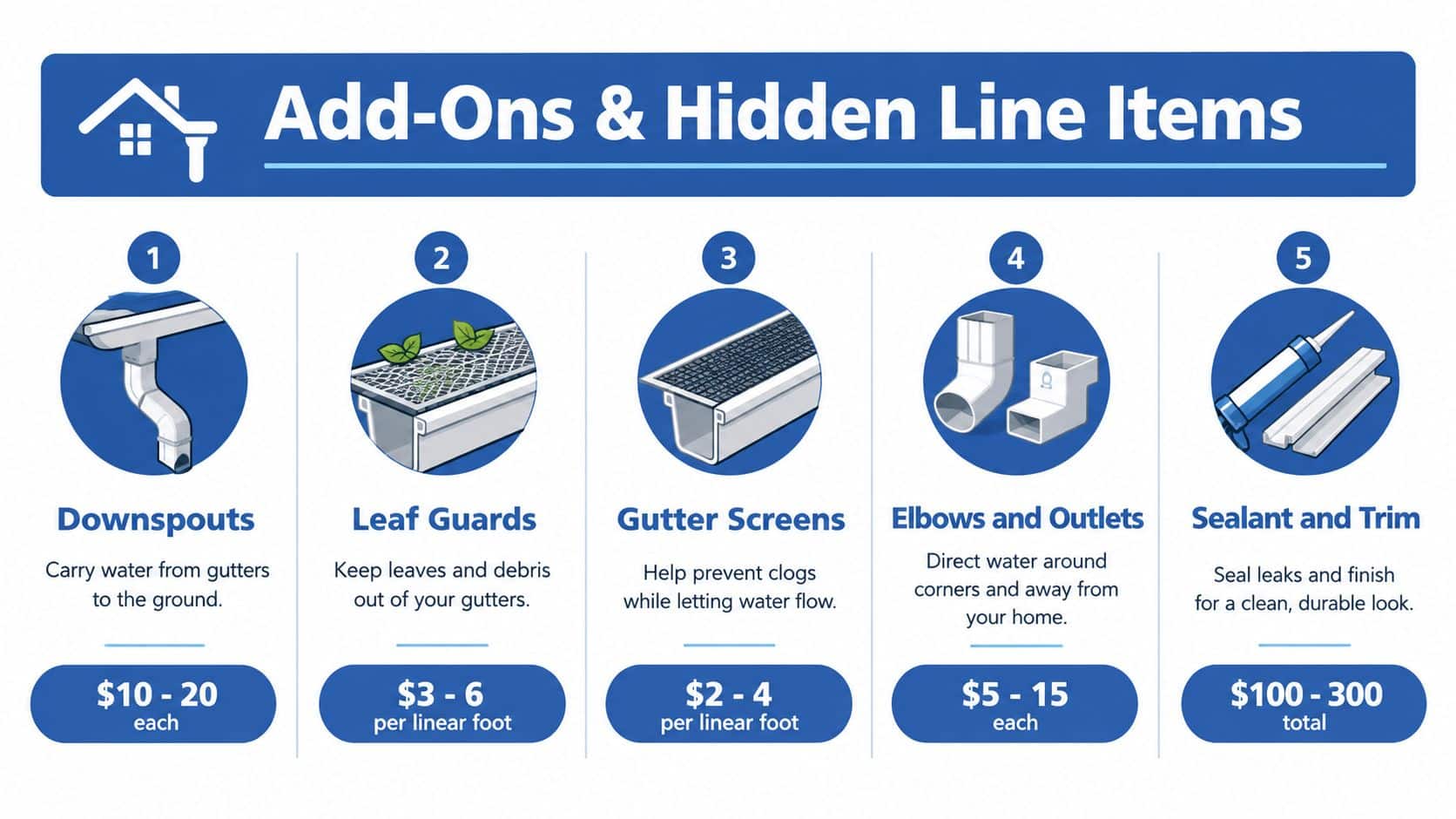
A gutter quote can look reasonable until the supporting parts appear as extras. The trough is only one component of a working drainage system. Downspouts, outlets, elbows, extensions, flashing, hangers, removal, disposal, fascia repairs, and debris-control products can all change the final price.
Read the estimate line by line
Start with the measured linear footage, not just the lump sum. The proposal should show how much gutter is included and identify each roof edge being served. Confirm the number, size, and routing of downspouts, along with outlets, elbows, and extensions. In Phoenix, those details determine whether monsoon runoff reaches a safe discharge point or creates a new problem beside a wall, walkway, or planted area.
Check the hanger type, fastening method, and condition of the fascia. If the wood is damaged, ask whether repair or replacement is included before installation begins. A contractor may price the gutter run while treating fascia work as a separate allowance.
Ask what happens to the existing system. Tear-off, loading, disposal, and final cleanup may be separate line items. That arrangement is acceptable when the allowance is clear. It becomes expensive when the homeowner first sees the charge on the final invoice.
The roof edge also needs a clear scope. Confirm whether flashing, trim, sealant, and repairs are included, and whether taxes, permits, warranty coverage, and cleanup appear in the written price. If any item is optional, request the total with and without it so competing bids can be compared on the same basis.
Treat guards as a separate purchase
Leaf guards can reduce debris entering the trough, but they do not eliminate cleaning. One estimate places guards at about $7 to $10 per linear foot, or about $1,500 on average, according to Pipeline's gutter installation guide.
Product choice depends on the roof and debris. Fine screens can collect desert dust and roof grit, while larger openings may admit smaller particles. Guards also need to pass water during monsoon storms without becoming blocked by windblown material.
If the bid does not list hangers, downspouts, disposal, guards, fascia repairs, and flashing separately, assume those items are not included.
Phoenix Climate and Ongoing Maintenance
A continuous run reduces the number of longitudinal joints, but it doesn't stop dust from entering the gutter. It doesn't prevent roof grit from washing into the trough, and it can't keep a downspout clear after a wind event.
NOAA describes Arizona as primarily desert and identifies windblown dust as a significant source of air-quality problems, as explained in its technical material on Arizona dust conditions. That same dust can settle on windows, screens, tracks, roof surfaces, and gutters around Phoenix, Paradise Valley, Gilbert, Chandler, and Tempe.
Monsoon runoff changes the drainage question
Dry soil and sudden high-volume rain create a different drainage challenge from a steady wet climate. Water needs to leave the roof quickly, travel through properly placed outlets, and discharge where it won't wash out landscaping or collect against the foundation.
A gutter contractor should evaluate whether every roof edge needs a gutter. Some roof sections may shed water safely away from the structure, while others may send concentrated flow toward a walkway, wall, basement-equivalent lower area, or planted bed. The correct answer depends on the roof configuration and discharge path, not a blanket rule for every home.
Maintenance still matters
Dust, leaves, roof grit, and storm debris can accumulate even when the system has no mid-run seams. Guards may reduce larger debris, but they can also collect fine material on their surface and still require inspection. Downspouts need attention because a blocked outlet can turn a well-installed gutter into an overflowing channel during the rain event when the property needs it most.
Set the maintenance schedule around exposure rather than a universal calendar. Construction activity, traffic, landscaping, nearby open desert, wind, and major dust events can all increase the amount of material reaching the roof and gutters.
A practical service visit should inspect the trough, outlets, elbows, downspout openings, discharge points, and adjacent fascia. For a broader maintenance checklist, review the importance of gutter maintenance before deciding whether guards alone will solve the problem.
Evaluating Quotes and Safety Standards
A low per-foot price deserves questions when the property requires high work. The contractor may have excluded access equipment, fall protection, removal, fascia repair, or the time needed to move safely around a complex roofline. Those omissions can create change orders, delays, or avoidable risk.
Ask each bidder to provide a written scope with:
- Measured footage: The exact length of each gutter run.
- Drainage design: Downspout count, size, outlet locations, elbows, and discharge plans.
- Access method: Ladders, scaffolding, lifts, roof access, or another approach.
- Surface condition: Any fascia, soffit, roof-edge, stucco, or trim repairs that aren't included.
- Coverage: Material warranty, labor warranty, insurance, and the process for resolving defects.
Safety is part of the price
OSHA's general-industry fall-protection rule, 29 CFR 1910.28, generally requires protection when workers face a fall of 4 feet or more, as described in this overview of high-rise window-washing safety standards. The appropriate control may include guardrails, safety nets, or a personal fall-arrest system, depending on the setup.
That standard concerns more than high-rise glass. It demonstrates why a professional exterior contractor should evaluate the work area before choosing a ladder. A written site-specific process, pre-use equipment inspection, trained workers, and clear access planning are meaningful indicators that the company treats work at height as a controlled operation.
For taller commercial buildings, OSHA's rope-descent framework generally limits rope-descent systems to elevations at or below 300 feet above grade, unless the employer demonstrates that another method isn't feasible or would create a greater hazard. Descents exceeding 130 feet require stabilization at the work location, according to this explanation of OSHA window-cleaning requirements.
Those requirements may not apply directly to a typical gutter replacement, but they provide a useful standard for judging high-access contractors. A property manager should ask how the crew will reach each elevation, how equipment will be stabilized, and what happens if the planned method can't be used safely.
Booking Your On-Site Estimate in the Valley
An accurate quote starts with an inspection, not a guess based on online photos or square footage. Schedule an on-site assessment and ask the contractor to walk the roofline with you, identify each collection area, and explain where the water will go.
Prepare a short list of questions before the appointment:
- How many linear feet did you measure? Ask to see the run-by-run calculation.
- Which material and gauge are you recommending? Request the reason, not just the product name.
- Will the system handle concentrated monsoon runoff? Have the contractor identify valleys, outlets, and downspout locations.
- What condition is the fascia in? Confirm whether repairs are included or excluded.
- What access equipment will the crew use? The answer should match the property's height, roof pitch, walls, landscaping, and working space.
- What remains after installation? Clarify removal, disposal, cleanup, water testing, and maintenance recommendations.
- What does the warranty cover? Separate material coverage from installation workmanship.
Take photos of existing leaks, overflowing corners, stained fascia, washed-out landscaping, and downspouts that discharge too close to the structure. Those details help the estimator connect the proposed work to actual drainage problems instead of treating every roof edge as identical.
For homes and commercial properties in Phoenix, Scottsdale, Paradise Valley, Chandler, Tempe, and Gilbert, the best estimate is specific enough to compare without another phone call. It should show the gutter length, material, downspout plan, access requirements, repairs, accessories, and final installed price.
South Mountain Window Cleaning, LLC offers residential, commercial, and high-rise exterior cleaning across the Valley, including window washing, gutter cleaning, power washing, screen and track care, solar panel cleaning, and related exterior services. Visit South Mountain Window Cleaning, LLC to request a quote and discuss the gutter maintenance and exterior-care needs of your property.