
A property manager often sees the problem before seeing the risk. The glass looks dusty, tenants are asking when the next cleaning is scheduled, and a vendor's proposal is waiting in your inbox. Then the safety packet arrives, filled with anchor diagrams, insurance documents, training records, and equipment inspection forms. The right question isn't just whether the crew can make the windows shine. It's whether the building, access system, workers, and documentation are ready for the job.
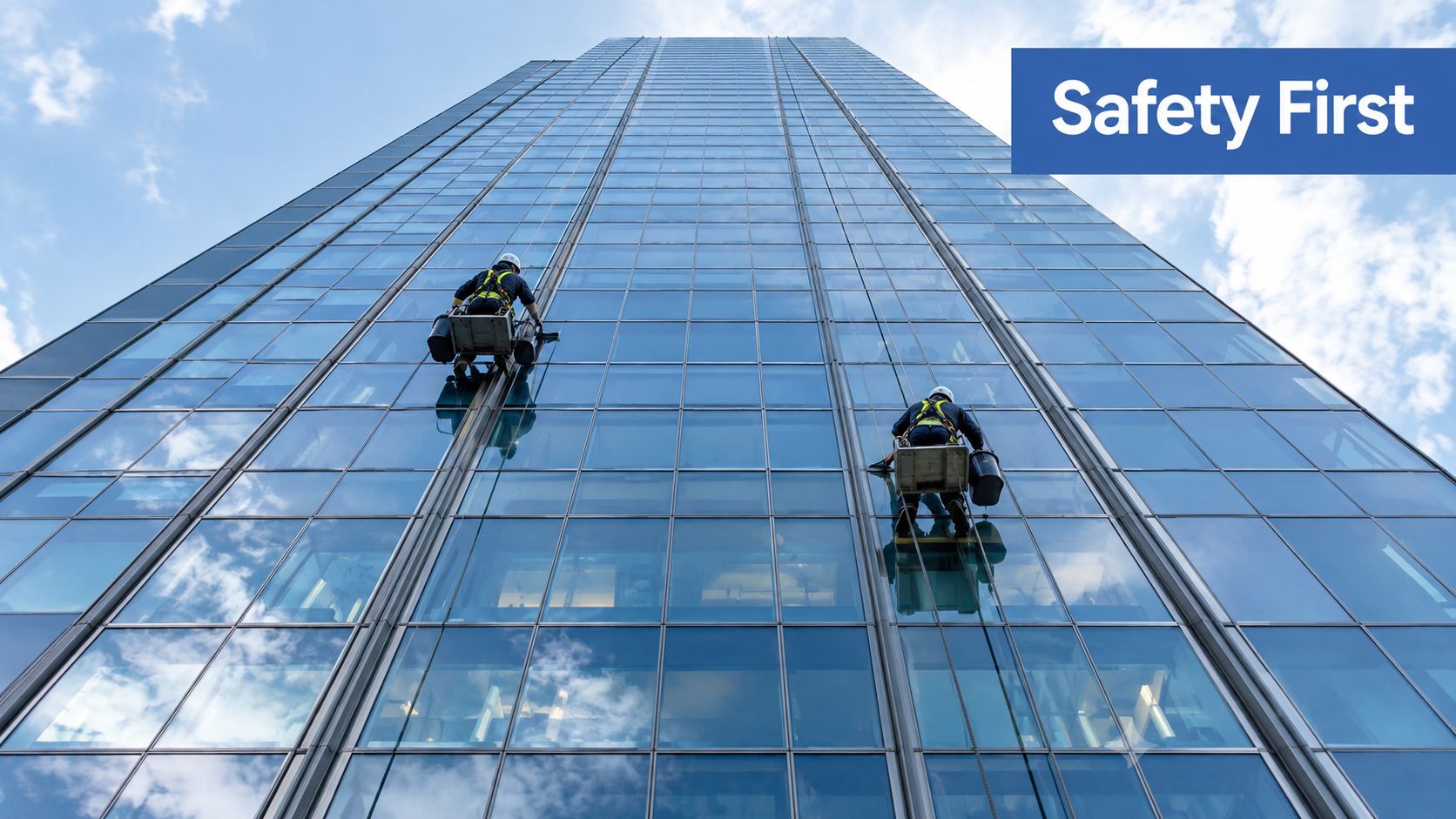
High rise window cleaning safety depends on engineered controls, not worker courage. For properties in Phoenix, Scottsdale, Paradise Valley, Chandler, Tempe, and Gilbert, that means accounting for exterior exposure, wind, intense sun, dust, pedestrian traffic, and the condition of the roof anchorage before anyone leaves the parapet. A professional cleaning plan should protect the crew, occupants, visitors, and building owner at the same time.
The Reality of High Rise Window Cleaning Safety
A vendor packet can reveal more than a sales presentation. If it contains a current site-specific plan, documented anchor information, worker credentials, equipment inspection records, and a rescue procedure, the contractor is showing that safety begins before the first descent. If it only includes a generic paragraph about harnesses, the building manager still has unanswered questions about the load path, access method, weather decisions, and emergency response.
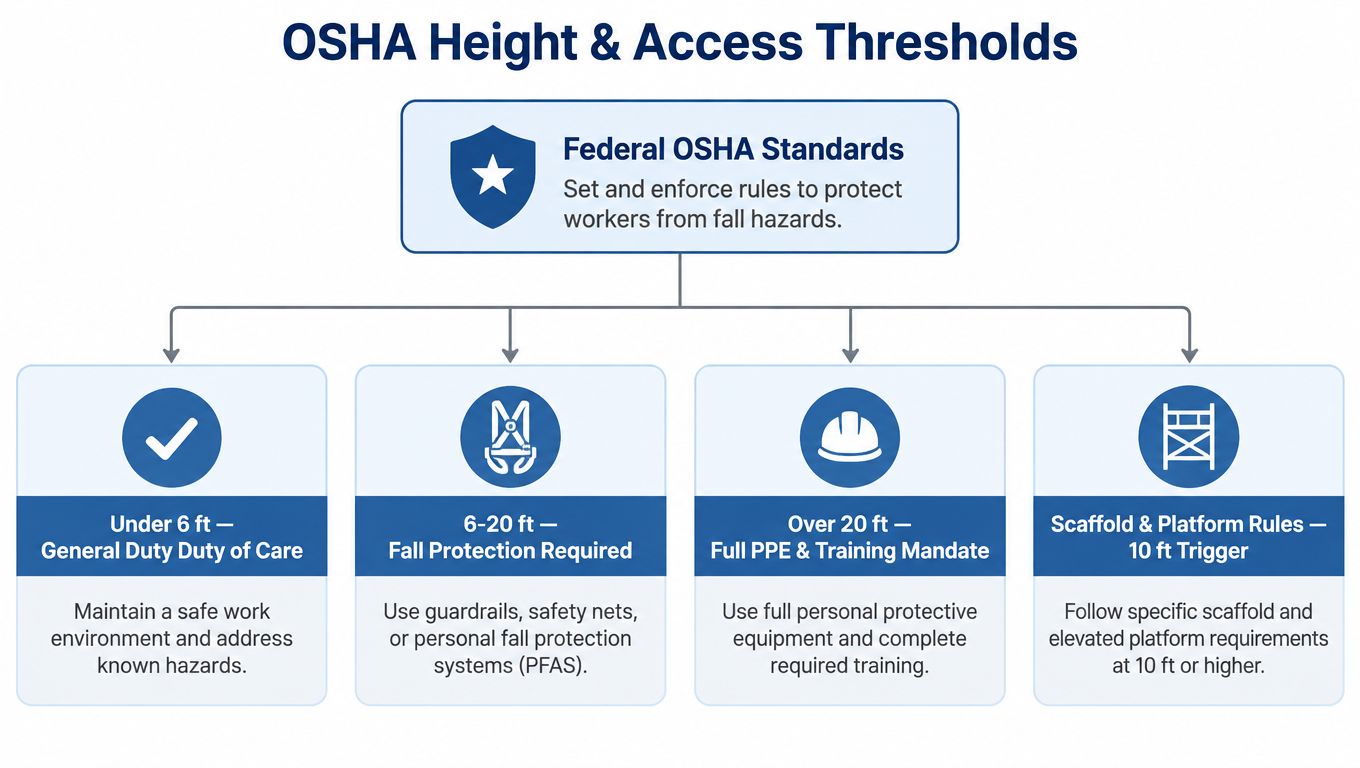
The old image of a window washer improvising outside a tower has no place in a modern commercial maintenance program. Exterior work from suspended scaffolds or window positions requires continuous fall protection. Cornell's window-washing program explains that personal fall arrest systems must protect workers on exterior cleaning tasks, with approved harnesses and independent lifelines for people working from suspended scaffolds. OSHA guidance requires a personal fall arrest system to be rigged so a worker can't free-fall more than 6 feet, or 1.8 meters.
What managers should see before work starts
The safety model has several connected parts:
- Building assessment: The crew identifies roof anchors, parapets, davits, glass conditions, ledges, sharp edges, and areas that could affect rigging or movement.
- Access selection: The contractor chooses rope access, a bosun's chair, a suspended platform, or another method based on the façade and the building's engineered systems.
- Independent protection: Suspension and fall arrest remain separate so one failure doesn't remove every layer of protection.
- Ground control: Workers below manage exclusion zones, communication, equipment movement, and public exposure.
- Document control: The site file shows who inspected the equipment, who approved the rigging, and what happens if weather or equipment conditions change.
A manager doesn't need to become a rope-access technician to evaluate a vendor. You do need enough information to determine whether the contractor understands the building's actual hazards and can demonstrate compliance rather than merely promise it.
For Arizona properties, cleaning quality and safety planning are closely connected. Dust, hard-water residue, heat, and glare can encourage rushed work or unplanned return visits if the crew arrives without the right tools and access strategy. South Mountain Window Cleaning provides residential, commercial, and high rise window washing services across Phoenix and nearby Valley communities, with high-rise information available through its high rise window cleaning service.
Practical rule: Treat the safety packet as a working control document, not as paperwork collected for appearance.
Navigating OSHA Regulations and Height Limits
A crew may arrive with the right equipment and still have the wrong access plan for the building. Height, façade geometry, wind exposure, anchorage, stabilization, rescue access, and nearby structures must be reviewed together. Rope descent can suit one elevation and create unacceptable movement or rescue problems on another.
OSHA limits rope descent systems for high-rise window cleaning to 300 feet above grade unless the employer demonstrates that no other safe, feasible access method exists, or that another method would create a greater hazard. OSHA also identifies wind effects on longer ropes as a significant concern above that threshold. A longer line can swing into the façade or adjacent structures and make controlled positioning harder.
The same height limit appears in industry guidance for transportable, ground-rigged suspended platforms. The International Window Cleaners Association suspended scaffold guidance states that these platforms should not be used above 300 feet unless they remain continuously stabilized. A building below that height is not automatically suitable. The contractor still has to match the platform, stabilization method, anchors, and operating procedure to the site.
What the manager should verify
Ask the vendor to explain the proposed access method, whether it uses rope descent, a suspended platform, a powered platform, a davit system, or another engineered arrangement. If the work exceeds an applicable threshold, the file should explain why the method remains legally and operationally appropriate.
The stabilization plan deserves equal attention. Wind at corners, façade setbacks, projections, and transitions can defeat a generic promise to monitor conditions. Require a site assessment, rigging plan, equipment records, worker qualifications, and rescue procedure. Those documents should also identify who approved the setup and when it must be reassessed.
The stop-work triggers should be written before the crew begins. Wind, lightning, poor visibility, damaged equipment, unexpected façade conditions, and communication failure can change an acceptable setup into an unsafe one. A schedule cannot override those controls.
For a broader contractor review, essential safety rules for sites offers general context on site controls, worker protection, and operational coordination. Use it as background, not as a substitute for a high-rise-specific assessment covering access equipment, fall exposure, façade contact, chemicals, and public protection.
South Mountain Window Cleaning describes its high-rise building cleaning service for commercial properties. Regardless of the provider, the decision record should show why the method fits the building, which conditions limit its use, and which documents support approval. Logging near misses and reviewing them before the next service helps managers correct recurring access or coordination failures instead of treating each visit as an isolated job.
Fall Protection Systems and Anchor Certification
A certified harness cannot compensate for a questionable roof connection. Safe access depends on a continuous load path through the building connection, rigging hardware, suspension line, backup line, worker attachment, and rescue method. A failure at any point can change a controlled descent into a fall exposure.
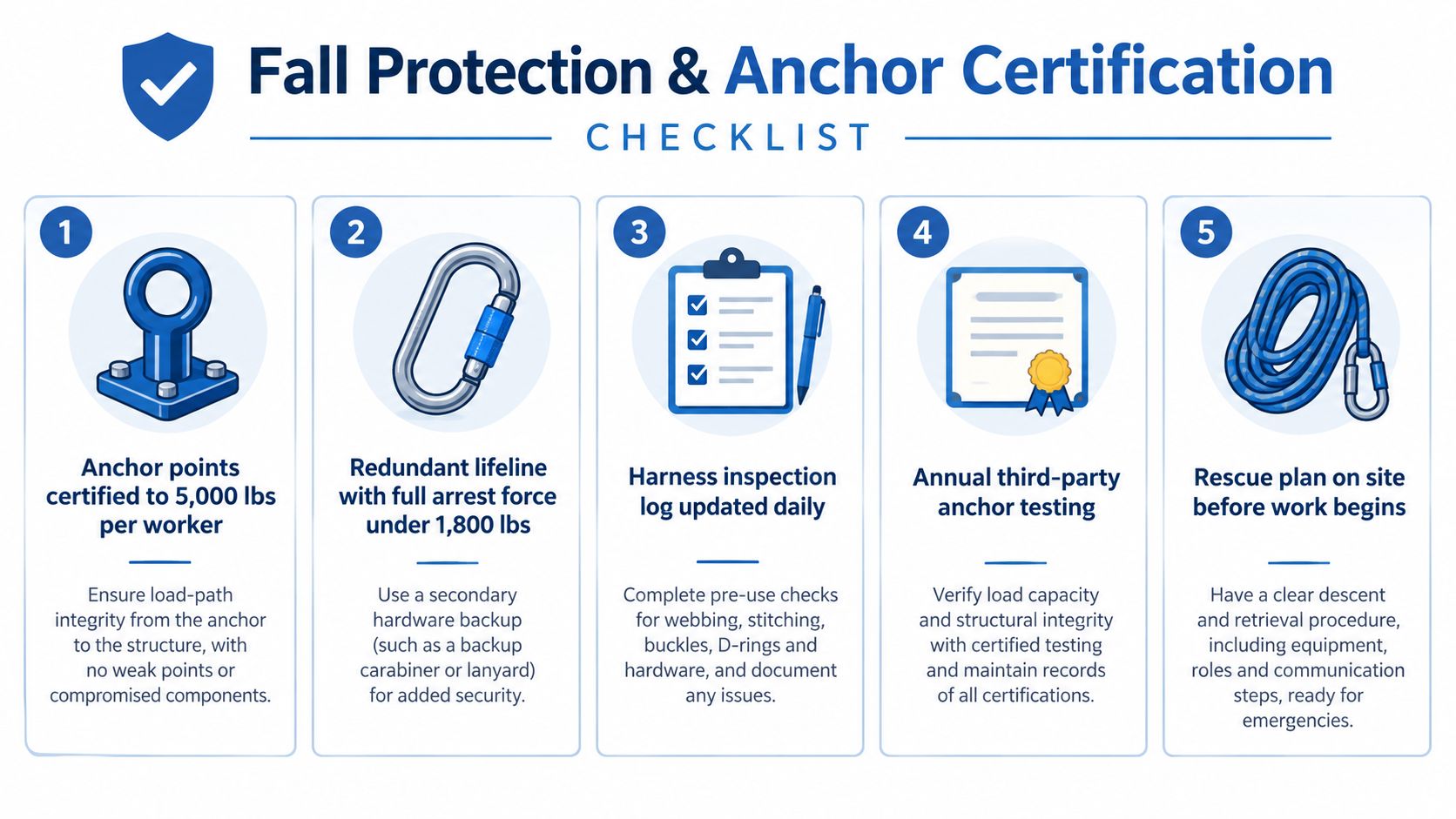
OSHA interpretive guidance requires roof anchorages for window-washing equipment to be permanent, sound, and rigid, with capacity for the maximum intended loading without displacement or deformation. Industry guidance also states that each rope descent anchorage must be tested, identified, and certified to support at least 5,000 pounds in any direction for each attached worker. Each worker must use a separate independent personal fall arrest system. A convenient roof fixture is not automatically an approved anchorage.
Make the record usable on site
The anchor file should answer practical questions before the crew reaches the roof. Each anchorage needs a clear identifier matching the site plan and inspection record. The certification should state its rated capacity and approval conditions. Inspection records should cover the anchor, surrounding structure, connections, corrosion, and visible damage, with the inspection completed by a competent person or qualified professional.
The contractor must then confirm that the planned ropes, connectors, edge protection, and suspension arrangement fit the approved anchor. The suspension line and fall-arrest line should use independent anchors or engineered points, so one failure does not disable both systems.
Paperwork gaps often reveal the underlying control failure. A vendor may arrive with suitable harnesses and descenders while the property file contains outdated roof-anchor information. A building may also have certified anchors, yet the contractor's plan may ignore façade geometry, rope routing, or edge hazards. Managers should require the current certification before approving work and record who owns inspections, where documents are stored, and what happens when a certificate is missing, expired, damaged, or inconsistent with the roof layout.
South Mountain Window Cleaning provides high-rise window cleaning equipment information. The useful test is direct: can the contractor show that every connection was selected, inspected, and documented for the actual job? If a near miss exposes a rigging or anchor problem, preserve the record, suspend the affected setup, and require a documented review before the next service.
Training Certifications and Emergency Rescue Planning
Equipment protects people only when trained workers use it correctly. Rope-access work requires judgment at every stage, including anchor selection, rope routing, descent control, positioning, communication, and the decision to stop.
The University of Toronto's standard for work at height requires rope-access window cleaning to be performed under IRATA or SPRAT certification, with Level 3 supervision present and in direct control whenever workers are on rope. Those requirements recognize that rope work isn't learned safely through informal observation alone. The supervisor must understand the system, control the operation, and intervene when conditions depart from the plan.
Credentials need context
A credential review should confirm more than a name on a roster. Ask to see:
- The worker's current IRATA or SPRAT qualification.
- The supervisor's level and role on the specific site.
- Training records relevant to the equipment and access method.
- Evidence that workers understand the building's rigging arrangement.
- Documentation of rescue practice and emergency responsibilities.
A crew can be technically qualified and still be poorly prepared for a particular building. New façade geometry, unfamiliar anchors, restricted roof access, active pedestrian areas, or unusual glass features can change the risk profile. The pre-job briefing should address those conditions directly.
Rescue is part of the access system
A rescue plan must exist before work begins. It should name the rescue lead, identify the equipment staged on site, establish communication methods, explain how an incapacitated worker will be reached, and define how the worker will be recovered without exposing the rescuer to an uncontrolled hazard.
Calling emergency services may be necessary, but it isn't a complete rope-access rescue plan. The crew must know what it can do immediately while coordinating with building security, emergency responders, and facility staff. The plan should also cover a jammed descender, damaged line, medical emergency, unexpected wind, and a worker who can't assist with their own movement.
A rescue plan is credible only when the crew can explain it clearly and locate the equipment without improvising.
Property managers should request a site-specific rescue plan and ask workers who would take each role. If the answers are vague, the plan hasn't become an operational control yet.
Moving Beyond Fatality Stats to Risk Assessment
A crew arrives for a scheduled wash, then a change in wind moves the rope toward a façade edge. The work stops, the near miss is recorded, and the property manager needs to know whether the contractor corrected the underlying control. Fatality figures cannot answer that question. Managers need evidence from routine operations, including rope movement, dropped equipment, communication failures, anchor concerns, access delays, and near misses that cause no injury.
A neutral legal analysis notes that there is no reliable published California statistic for annual commercial window-cleaner falls. Federal data may combine window washers with broader janitorial or building-cleaner categories, while fatality databases record deaths rather than every fall event. The limitation is discussed in this discussion of window-washer accident data. For a facility owner, the practical response is to track building-specific events instead of relying only on severe outcomes.
Review the contractor's risk record
Ask for anonymized examples of how the company records and closes operational problems. The review should cover:
- Near-miss reports: rope movement, equipment defects, access conflicts, dropped objects, and failed communication.
- Corrective actions: a named owner, completion deadline, and documented resolution for each report.
- Site assessments: updates when façade, weather, tenant, or roof conditions change.
- Inspection logs: pre-use checks for harnesses, ropes, connectors, descenders, platforms, and anchors.
- Stop-work decisions: proof that workers can pause the job when conditions fall outside the plan.
The paperwork matters only if it changes work. A report that sits in a file is administrative theater. A useful process identifies recurring patterns, updates equipment or training, and records who approved the change. Property managers should also compare near-miss records with the building's access plan and anchor documentation, so repeated concerns are not treated as isolated incidents.
Watch this video only for supplementary context. It cannot replace the contractor's records, site plan, or rescue briefing.
The working question is direct: how does the contractor identify and reduce this building's specific risks before they produce an injury?
Hiring Insured and Compliant Window Cleaning Professionals
Vendor selection should compare documented controls, not just price or the promise of a fast completion. A low bid can become expensive if it leaves the owner managing access problems, incomplete records, property damage, tenant disruption, or questions about worker coverage.
South Mountain Window Cleaning, LLC is licensed, bonded, and insured, and its business information describes a $2 million insurance policy for commercial customers. That figure should be verified in the contractor's current insurance documentation rather than accepted from a website or proposal alone. Managers should request a certificate of insurance, confirm the relevant policy dates, and ask whether the coverage matches the work being proposed.
Compare the operating package
| Review area | Stronger evidence | Warning sign |
|---|---|---|
| Insurance | Current certificates and clear coverage details | A verbal assurance without documentation |
| Worker status | Clear workers' compensation arrangements and records | Unclear responsibility for injuries |
| Equipment | Maintained, inspected systems suited to the façade | Generic equipment list with no site fit |
| Scheduling | Coordinated visits that limit disruption | Last-minute arrival without building coordination |
| Cleaning method | Pure-water systems or suitable tools where appropriate | A method chosen only for convenience |
| Personnel | Clean-cut, safety-trained professionals with defined roles | Unidentified subcontractors or unclear supervision |
Workers' compensation deserves separate attention because liability isn't limited to the glass or the roof. A useful background resource is workers compensation insurance information from ABS Insurance Brokers Pty Ltd, which can help managers frame questions about employee injury coverage and employer obligations. The vendor still needs to provide documentation applicable to the contract and jurisdiction.
Technology can support safety, but it doesn't replace competent planning. Pure-water systems and professional squeegees may help crews clean efficiently, while computerized scheduling can reduce missed appointments and improve coordination with occupants. Neither system certifies an anchor, substitutes for a rescue plan, or proves that workers are qualified.
A practical insurance and risk review is available through the company's window cleaning insurance information. Use it as a starting point, then verify all current records directly before signing.
Final Safety Verification Checklist for Property Managers
A high-rise cleaning contract should not be approved because the vendor sounds confident. Approve it when the building owner, facility team, and contractor can show that the access method, anchor system, workers, equipment, and emergency response fit the site.
Use this checklist during procurement and again before the first scheduled descent:
- Confirm the access method: Record whether the job uses rope descent, a suspended platform, a powered platform, a bosun's chair, or another system, and document why it suits the façade.
- Review height controls: Confirm whether the proposed system falls within applicable height limits. OSHA limits rope descent systems to 300 feet above grade unless the employer establishes that no other safe, feasible method exists or another method creates a greater hazard. OSHA's rope descent guidance should be part of the compliance review.
- Verify anchor records: Match each roof anchor to its identification, certification, inspection record, and site plan. Confirm the documented capacity of at least 5,000 pounds in any direction for each attached worker where that requirement applies.
- Check independent protection: Confirm that each worker has separate suspension and fall-arrest systems connected to independent anchors or engineered points.
- Validate credentials: Review IRATA or SPRAT qualifications, including the supervisor's role and level for the job.
- Demand the rescue plan: Keep the site-specific procedure on site before work begins, with equipment locations, communication steps, responsibilities, and recovery methods.
- Inspect documentation: Review pre-use equipment checks, anchor inspections, training records, and near-miss reports.
- Set ground controls: Establish exclusion zones, pedestrian routing, tenant notifications, dropped-object controls, and a contact for building security.
- Agree on stop-work authority: Put weather, damaged equipment, unsafe anchors, and unexpected façade conditions into the written plan.
- Close the record: After the work, retain completion notes, incidents, near misses, equipment concerns, and corrective actions for future visits.
This process protects more than a maintenance schedule. It gives the property manager evidence that the vendor was evaluated on the controls that matter, while giving the crew a clear operating boundary on the roof and at the glass.
South Mountain Window Cleaning, LLC offers residential, commercial, and high rise window washing across Phoenix, Scottsdale, Paradise Valley, Chandler, Tempe, and Gilbert, with safety-trained technicians, pure-water systems, scheduled service, and documented insurance. Visit South Mountain Window Cleaning, LLC to request a fast, free quote and discuss a cleaning plan that fits your building's access and safety requirements.