
A Phoenix high-rise window cleaning typically costs roughly $4,000 to $20,000 or more per cleaning when the tower requires a custom bid, compared with $2 to $8 per pane for standard commercial buildings up to five stories. The final price depends less on the window count than on access, facade design, safety planning, site restrictions, and how often the glass is maintained.
You may be looking at two quotes for the same tower and wondering why they seem unrelated. One contractor prices by the pane, another gives a project total, and a third separates equipment and mobilization from the cleaning itself. In Phoenix, intense sun, desert dust, pollen, and monsoon residue can make the first clean substantially different from a routine maintenance visit.
High-rise work is a specialized access project, not ordinary window washing performed higher up. The useful question isn't “What does each window cost?” It's “How will the crew safely reach every elevation, and what does that access plan include?”
Why Two Phoenix High-Rise Quotes Can Differ By Thousands
A property manager overseeing a 30-story office tower in downtown Phoenix could receive one proposal for $5,000 and another for $18,000. The glass may look identical from the street, yet the contractors may be pricing completely different methods, crew requirements, work windows, and safety responsibilities.
One bid might assume the building has usable roof anchors and a straightforward facade. The other might include suspended equipment, additional rigging, traffic controls, restricted loading access, and more time around setbacks or recessed sections. Neither number can be judged fairly until the scope explains how workers will reach the glass.

Why pane count gives an incomplete picture
A per-window figure works reasonably well when a crew can use a consistent method across a low-rise building. It becomes unreliable when every facade requires different positioning or when the crew must repeatedly move equipment between elevations.
A high-rise estimator may need to account for:
- Access equipment, such as rope systems, suspended platforms, or lifts.
- Facade geometry, including overhangs, balconies, setbacks, curves, and mixed materials.
- Site coordination, including courtyards, landscaping, parking areas, loading zones, and pedestrian routes.
- Occupancy restrictions, such as tenant schedules, office hours, hotel activity, or weekend-only work windows.
- Safety preparation, including anchor checks, rescue planning, inspections, training, and fall-protection equipment.
A commercial pricing guide from South Mountain Window Cleaning places high-rise window cleaning in a custom-bid range of about $5,000 to $20,000 or more, depending on height, accessibility, and architectural complexity. The same source identifies $2 to $8 per pane as typical for ordinary commercial work up to five stories. That distinction is more useful than a universal tower-wide rate.
Practical rule: A low bid is only low if it includes the same access method, safety scope, glass condition, work area, and cleanup responsibilities as the higher bid.
A quote that leaves rigging, equipment rental, or traffic control outside the base price may look attractive at first. Once those items are added, the apparent savings can disappear. The most dependable proposal describes the access plan before it presents the total.
What Actually Drives High Rise Window Cleaning Cost
High-rise window cleaning cost is driven more by access logistics than by glass area alone. Height, facade geometry, and site constraints can increase labor time because crews may need rope access, lifts, or specialized interior-access methods while coordinating activity around landscaping, courtyards, parking, and pedestrians. Pine Country Windows explains how access conditions shape high-rise pricing.
Phoenix adds a demanding environmental layer. Dust settles on exposed glass, pollen collects around frames and ledges, and monsoon weather can leave residue that requires more than a quick maintenance pass. A building with the same glass area as a cleaner, less exposed property may need more preparation and detailing.
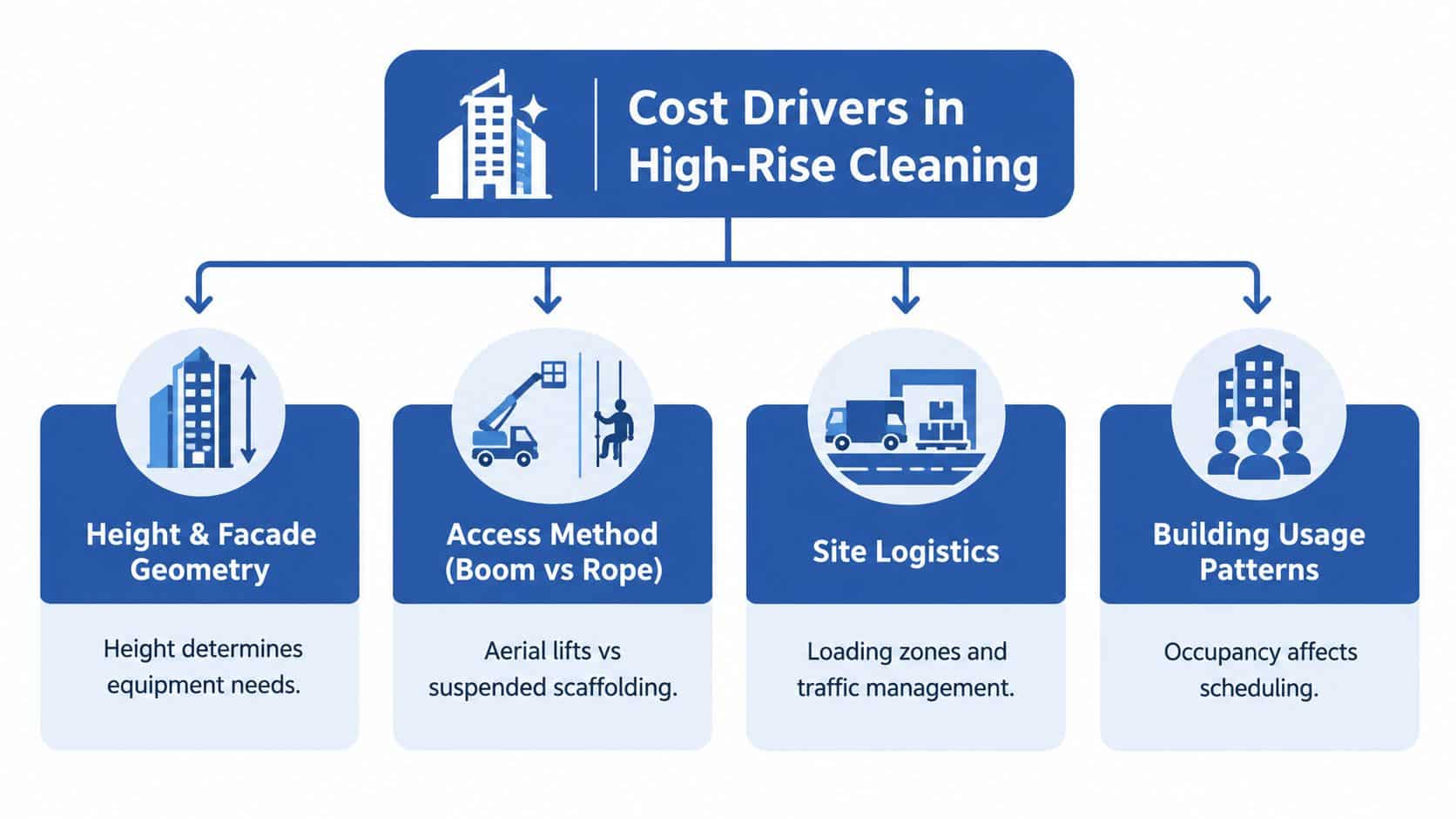
Four variables estimators examine
Height affects productivity. A crew loses time when workers must reposition descent lines, platforms, or lifts. Wind exposure and the distance between staging points can also change the work sequence.
Facade geometry controls equipment choice. A flat, repetitive wall may support an efficient suspended platform. A tower with balconies, recessed windows, sloped sections, or projecting bands may require several access solutions.
Ground conditions determine staging. A lift may be practical only when there's a stable setup area with sufficient clearance. Landscaping, underground structures, parked vehicles, and public walkways can prevent equipment from reaching the facade.
Building use limits the schedule. An occupied office tower may restrict work near entrances during business hours. A hotel, condominium, or medical property may need tenant notices, escorts, barricades, and carefully timed interior access.
These factors interact rather than operate independently. A shorter tower with difficult setbacks can take more planning than a taller building with certified anchors and a repetitive exterior. Likewise, a clean facade with predictable access may cost less to service than neglected glass that needs mineral-deposit treatment or detailed frame work.
For a useful comparison, ask the estimator to separate the price into cleaning labor, access equipment, mobilization, safety planning, site coordination, and exclusions. That breakdown reveals whether the contractor has evaluated the property or merely multiplied a window count by a generic rate.
How Access Method Changes Your Price
A tower can have identical window counts to a neighboring building and still receive a very different quote. The access method affects labor, setup time, equipment, and safety planning before the crew reaches the first pane. Ground-based poles, suspended platforms, and rope access each solve a different reach problem.
For a 20- to 50-story tower with relatively straightforward access, one published guide gives a planning range of roughly $1.50 to $3.00 per window. For towers above 50 stories that require suspended scaffolding or more complex access, it cites about $2.50 to $5.00 or more per window. These are starting ranges, not inspection-based proposals. The high-rise pricing comparison outlines how access method changes per-window cost
Three common ways crews reach the glass
A water-fed pole suits lower elevations and accessible sections. Workers remain on the ground, which can reduce rigging and setup, but height, facade obstacles, and glass angles limit where the system works.
A suspended platform, often called a swing stage, can cover broad, repetitive elevations efficiently. The quote must account for roof equipment, rigging, inspections, staging, and coordination with the area below the platform. Public access, parking, or loading activity can make the setup slower even when the facade itself is simple.
Rope access can fit facades with compatible anchors and clear descent paths. It may provide better access around selected projections and architectural features, but the scope still requires trained technicians, rescue planning, anchor evaluation, and controlled movement around obstructions. Property managers can review South Mountain Window Cleaning's rope-access service information to see why rope-based work should be described separately from ordinary commercial pane pricing.
| Access Method | Story Range | Typical Price Per Window | Best For |
|---|---|---|---|
| Ground-based water-fed pole | Lower elevations and accessible sections | Qualitative estimate only | Low-risk glass reachable from the ground |
| Suspended platform | Mid-rise and high-rise elevations | About $1.50 to $3.00 in a 20- to 50-story example | Broad, repetitive facades with suitable rigging |
| Complex rope access or suspended systems | Taller or obstructed elevations | About $2.50 to $5.00 or more in a 50-plus-story example | Towers with difficult access and limited staging |
Phoenix site conditions can change the preferred method. A Biltmore-area property may have narrow staging areas, decorative projections, or active pedestrian routes. A tower along the I-10 corridor may offer more open perimeter space but still need traffic control around parking and loading areas. The location changes setup requirements, not just travel time.
Ask each contractor to identify the access method, included equipment, expected crew size, mobilization assumptions, and conditions that could create a change order. Emergency scheduling also deserves its own line item. One industry guide reports that rush premiums can run 50% to 100% higher than ordinary scheduling, making planned maintenance easier to control than post-event work.
One-Time Cleanings Versus Recurring Contracts
A one-time cleaning is appropriate when a building has construction residue, a change in ownership, a major tenant event, or years of accumulated contamination. It can also be the right starting point when no contractor has yet documented the facade and access conditions. The first visit often takes more planning because the crew must establish a safe workflow and address heavier buildup.
A recurring contract changes the economics by making the access plan repeatable. Equipment, staging procedures, tenant communication, and crew familiarity can carry from one visit to the next. Routine cleaning also prevents the glass from reaching a condition that demands slower restoration work.
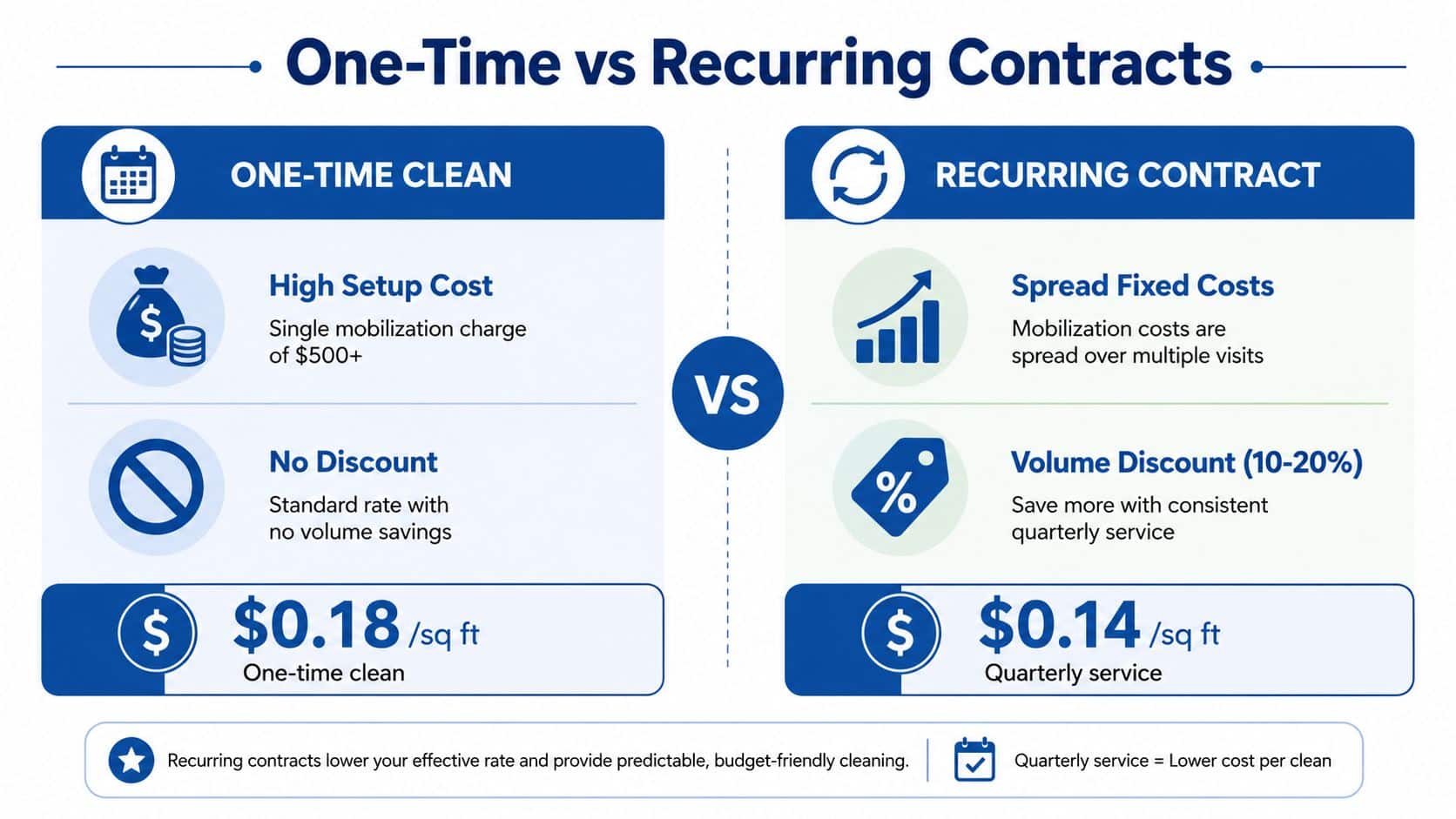
How the pricing model shifts
High-rise contractors may use hourly pricing for irregular work, but larger projects commonly become per-project quotes because mobilization, access equipment, and safety planning dominate the job. One industry pricing guide places high-rise labor around $170 per hour, compared with approximately $40 to $60 per hour for standard commercial window cleaning. The commercial pricing guide explains this labor distinction.
The same guide reports that mid-rise projects may fall around $5,000 to $20,000, while complex high-rise work can exceed $50,000. Those figures don't describe every Phoenix tower, but they show why a building manager should compare complete project scopes rather than hourly rates alone.
| One-time cleaning | Recurring maintenance |
|---|---|
| Larger initial setup burden | Setup can be reused across planned visits |
| Useful for neglected or newly completed glass | Keeps contamination from becoming severe |
| More vulnerable to rush scheduling | Easier to reserve suitable work windows |
| Scope may include restoration or corrective work | Routine cleaning can follow a predictable sequence |
Phoenix properties face an especially practical choice. Desert dust, pollen, and storm residue can make glass visibly dirty before a building's annual budget cycle catches up. A planned schedule, whether quarterly, biannual, or another interval suited to the facade, helps managers avoid waiting until tenants or customers complain.
The cheapest annual plan isn't necessarily the one with the lowest visit price. It's the plan that avoids avoidable mobilization, buildup, and rushed scheduling.
A contract should state the number of visits, included elevations, interior and exterior scope, frames and sills, access equipment, weather delays, and conditions requiring restoration. The contractor should also explain whether the first service is priced differently from later maintenance visits.
Safety Requirements That Add to the Quote
Safety equipment isn't optional overhead in high-rise cleaning. It determines who can perform the work, how the building must be prepared, how many people need to be present, and how quickly the crew can move across the facade.
OSHA fall-protection rules require protection for work above 6 feet. A personal fall-arrest system needs a full-body harness, a lanyard or self-retracting lifeline, and an anchor point capable of supporting 5,000 pounds per worker. The high-rise safety guidance explains these fall-protection requirements.
What compliance adds to a proposal
For rope access and suspended-platform work, the contractor may need to document:
- Anchor suitability, including inspection and compatibility with the planned system.
- Worker training, beyond ordinary general-industry instruction.
- Equipment inspections, before and during the work.
- Rescue procedures, so the crew can respond if a worker becomes suspended or equipment fails.
- Ground controls, including barricades, spotters, pedestrian routing, and protection for vehicles and landscaping.
- Supervision and communication, particularly when several elevations or access methods are involved.
These requirements translate into real project costs. A crew may need additional workers for ground safety and rescue readiness even when only a smaller number are actively washing glass. Equipment must be transported, assembled, inspected, and removed. Work may also be limited to conditions that protect workers, occupants, and people below.
That's why a proposal that lists only “high-rise window cleaning” is incomplete. Ask whether safety planning, equipment inspection, anchor review, barricades, and cleanup are included or billed separately.
South Mountain Window Cleaning's high-rise cleaning process gives building managers a useful framework for asking about access and work-at-height procedures. The same questions apply when evaluating any qualified contractor.
Insurance matters for the property owner as well. A properly insured provider protects the building from exposure created by falls, equipment, water, or damage below the work area. Professional insurance and trained crews increase operating costs, but they also distinguish a documented commercial service from a low quote with unclear responsibility.
Phoenix-Specific Factors That Influence Pricing
Phoenix estimates often use pane pricing for ordinary residential and low-rise commercial work. One local pricing guide places residential service around $6.20 to $8.20 per pane and commercial service around $8.20 to $10 per pane, with the commercial range applying to exterior-only cleaning for buildings no higher than five stories. Properties above that limit require a different estimating process. The Phoenix pane-pricing guide defines the scope of these local ranges.
A low-rise full interior-and-exterior cleaning in Phoenix commonly falls within a broad $175 to $500 range, depending on property size, glass quantity, and whether interior work is included. A Phoenix cost guide provides that local low-rise range. It shouldn't be used as a shortcut for pricing a tower.
A practical Phoenix bid checklist
Before comparing proposals, confirm:
- Building profile: Stories, elevations, glass types, balconies, setbacks, atriums, and unusual facade materials.
- Access plan: Rope access, suspended platform, lift, water-fed pole, or a combination.
- Site conditions: Loading zones, parking restrictions, courtyards, landscaping, pedestrian paths, and tenant entrances.
- Scope: Exterior glass, interior glass, frames, sills, tracks, screens, water spots, and post-work cleanup.
- Schedule: Regular maintenance windows, tenant coordination, weather delays, and any rush requirement.
- Price structure: Per-pane, hourly, per-story, or fixed project pricing, with every equipment and mobilization charge identified.
Phoenix's heat and airborne dust make maintenance planning more important. A property manager who waits for heavily spotted glass may pay for slower detailing rather than routine cleaning. Seasonal weather can also create sudden demand, so scheduling before a major tenant event or after a dusty weather period is often more predictable than requesting immediate service.
For timing decisions, this Phoenix guide to the best time of year for window cleaning offers local planning context.
This short visual provides another way to think about how building type and access affect the work:
South Mountain Window Cleaning serves Phoenix, Scottsdale, Paradise Valley, Chandler, Tempe, and Gilbert with computerized scheduling and fast, free quotes matched to the building's access profile. A customized estimate is more useful than a generic online calculator because it can identify the conditions that control the work.
How To Get An Accurate High-Rise Quote In Phoenix
Start with building information, not a requested per-window rate. Give the estimator the approximate height, facade drawings or photographs, glass types, known anchor locations, access restrictions, and the frequency you want to maintain. Include loading-zone rules, parking limitations, tenant schedules, and any areas where a lift or suspended platform can't be placed.
Prepare the scope before requesting bids
A useful request for proposal should identify:
- The elevations and glass areas included in the service.
- The proposed access method for each difficult section.
- Interior and exterior responsibilities, including frames, sills, tracks, and screens.
- Crew and safety requirements, including training, inspections, rescue planning, and ground controls.
- Insurance and exclusions, including equipment rental, mobilization, permits, weather delays, and restoration work.
- The maintenance schedule, so a one-time clean and recurring service can be compared fairly.
Ask contractors to explain what would cause the price to change after work begins. A vague per-window rate is a warning sign when the proposal doesn't identify access equipment or safety preparation. Missing insurance details, unclear responsibility for barricades, and no description of anchor or rigging checks should also prompt further questions.
A reliable comparison looks at the delivered project cost, not the smallest number beside a pane. Check whether one contractor includes access setup while another bills it separately. Confirm whether the quote covers only exterior glass, and ask whether mineral deposits, construction residue, or neglected frames are treated as routine cleaning or a separate restoration service.
For a broader way to evaluate service rates and scope, review South Mountain Window Cleaning's commercial pricing information. The same evaluation principles apply to other licensed, bonded, and insured providers.
South Mountain Window Cleaning, LLC offers high-rise window washing, pure-water cleaning systems, computerized scheduling, free estimates, and a $2 million insurance policy, along with service coverage across the Valley. Building owners can compare a documented access plan and maintenance scope before committing to recurring work.
South Mountain Window Cleaning, LLC can assess your Phoenix-area building, explain the access method, and provide a fast, free quote for one-time or recurring high-rise service. Visit South Mountain Window Cleaning, LLC to request an estimate suited to your facade, schedule, and site conditions.