

You're standing in a Mesa driveway with a ladder halfway up the wall, looking at a roofline that seemed simple from the street. The estimate was based on linear feet. Then the tile breaks your ladder setup, the second-story peaks slow every move, and the citrus trees turn a quick outline into a rigging job. By the time removal arrives in January, the quote that looked profitable has become unpaid labor.
That's the trap in how to price Christmas light installation. Per-foot pricing gives you a useful starting point, but it isn't a complete quote. In the Phoenix metro, roof access, stucco, tile, palms, travel, liability, service calls, and takedown work can matter more than the raw length of the roofline.
What Actually Goes Into a Christmas Light Quote
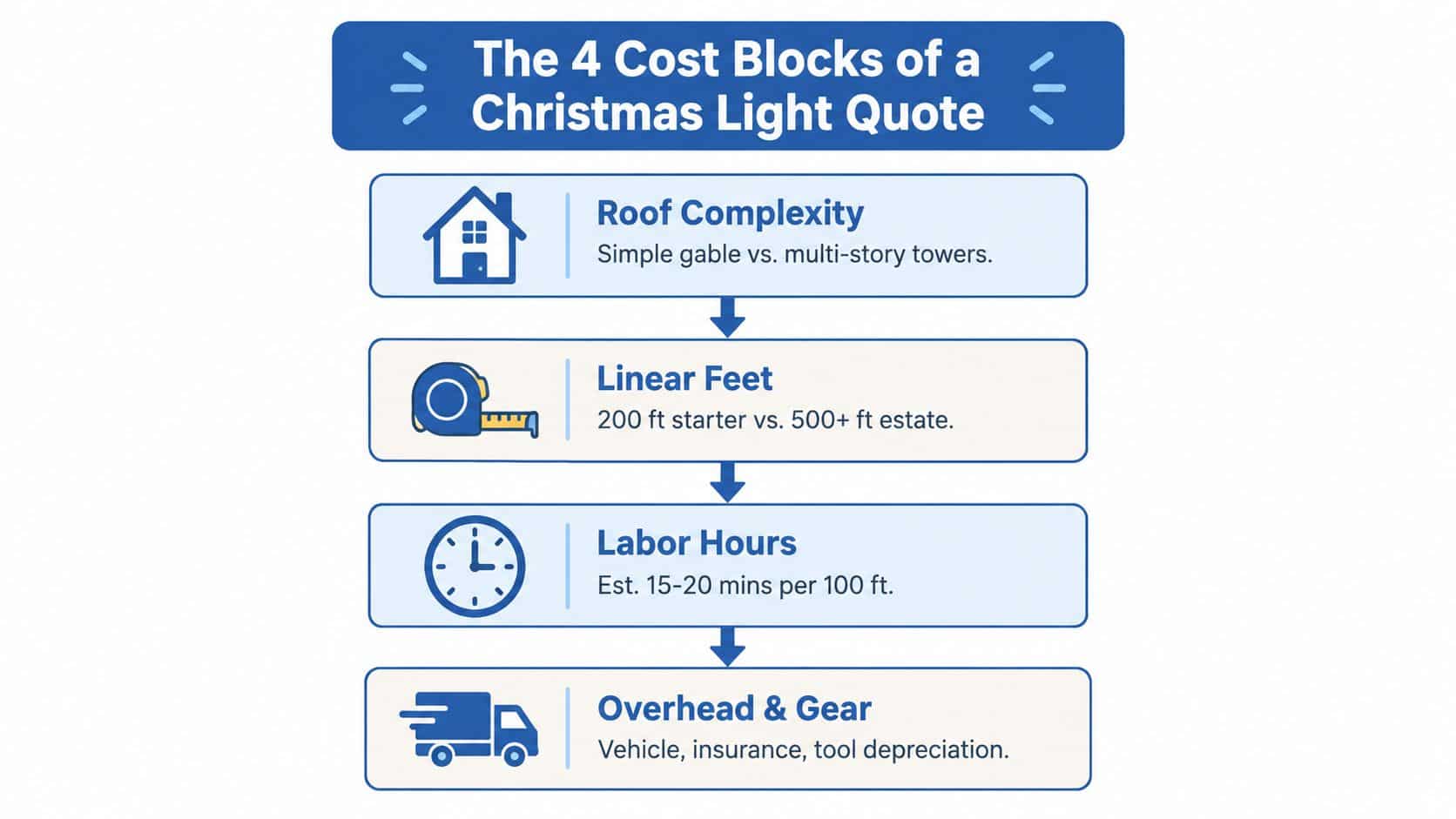
A quote should show four cost blocks: materials, labor, overhead, and risk. Leave one out, and a polished customer price can still turn into an unprofitable job.
Materials include the small items
A Phoenix installation may need C9 bulbs on a front gable, C7 strands under a covered patio, commercial-grade LED sets, clips, timers, zip ties, extension cords, and replacement lamps. If the customer does not own the lights, they can add $0.50 to $2 per linear foot beyond installation pricing, according to HomeAdvisor's holiday lighting cost guide.
Allow for broken bulbs and extra supplies. A few clips or cords seem minor on one address, but repeated purchases reduce seasonal profit. State who owns the lights, who supplies replacements, and whether replacement inventory is included.
Labor covers more than hanging
Billable labor includes measuring, design, loading, driving, ladder movement, climbing, circuit testing, dead-section repairs, customer communication, and takedown. A two-story stucco home with tile roofing, several peaks, or palm rigging can consume far more crew time than a similar-length single-story roofline.
Overhead covers the truck, fuel between Glendale and Queen Creek, commercial insurance, Arizona workers' compensation, equipment depreciation, ladder inspections, software, storage, and scheduling. Risk includes broken tile, gutter damage, stucco cracks, HOA complaints, wind exposure, and falls from high peaks. These factors explain why a flat per-foot price can fail on desert installs.
Practical rule: A quote that omits removal, service calls, or damaged materials is incomplete.
The customer-facing scope should identify whether design, materials, installation, maintenance, removal, and storage are included. This holiday lighting company selection guide can help frame those service questions before prices are compared.
Professional seasonal installation commonly falls between $2.50 and $7 per linear foot, while basic jobs may sit closer to $2 to $5 per foot. Treat those figures as a market baseline, then adjust for access, labor time, exposure, and service obligations. The footage alone does not price the risk.
The Four Pricing Models Installers Actually Use
Each model solves a different estimating problem. The mistake is treating one method as universal.
Per-linear-foot pricing
This is the cleanest model for a simple, single-story roofline. A 180-foot Gilbert home at $4 per foot produces a straightforward installation price of $720. It's easy to explain, easy to compare, and fast to calculate.
It breaks when the footage hides access difficulty. A two-story stucco home with tile roofing, narrow ladder placement, and multiple peaks may take much longer than a single-story home with the same length. Add a separate access or complexity charge instead of pretending the footage tells the whole story.
Per-bulb pricing
Per-bulb pricing works well for canopy lighting in Arcadia, where the customer wants a defined number of trees or branches covered. It can also suit symmetrical displays with a clear bulb count.
The problem is estimating outline lighting. Counting every C9 bulb before the design is approved eats estimator time, and a small design change forces you to recount. Use this model when the visual scope is bulb-driven, not when the roofline is the primary measurement.
Hourly pricing
Hourly billing is practical for repairs, removals, troubleshooting, custom tree wraps, and jobs where the scope remains uncertain. It protects you when a customer asks for several small changes during the visit.
It can leave money on the table for efficient crews. If your team works quickly, an hourly quote may make the customer feel they're being charged for speed. Use a clear minimum, define travel and setup, and reserve hourly pricing for variable work.
Flat-package pricing
Packages work in predictable subdivisions. A defined front roofline, entry wreath, timer, installation, and removal can be sold as a simple seasonal option.
Packages become dangerous when every property is forced into the same box. A Scottsdale custom home and a tight Phoenix tract home shouldn't share a package merely because both have similar frontage. Flat pricing also pushes you toward price competition instead of value, especially when another installer leaves out removal or uses customer-supplied materials.
| Pricing Model | Best Use Case | Typical Range | Failure Mode |
|---|---|---|---|
| Per-linear-foot | Simple rooflines | $2.50 to $7 per foot | Undercharges complex access |
| Per-bulb | Canopies and defined tree work | Varies by design | Estimating takes too long |
| Per-hour | Repairs, removals, custom work | $60 to $100 per hour in one major home-service benchmark | Efficient crews may earn less |
| Flat package | Predictable subdivisions | Varies by scope | Encourages price competition |
The broader Christmas light installation pricing guidance also supports using minimum job fees, geography, and complexity rather than relying on one number. For other exterior services, the same discipline appears in how to price pressure washing. Price the work you'll perform, not the label attached to it.
Building a Quote With a Risk-Adjusted Formula
A 200-foot Phoenix roofline can look simple on paper and still become an expensive install. A two-story stucco outline with 14-foot peaks, tile roofing, two citrus trees, and a patio column wrap creates more ladder work, tile exposure, component handling, and testing than a single-story roofline with clear access.
Use a risk-adjusted formula:
Job Price = (Materials + Labor) × Overhead Multiplier × Profit Multiplier
Jobber's holiday lighting bidding guidance supports starting with the site assessment, materials, labor, and overhead, then checking the result against local pricing.
Build the raw cost first
Start with your loaded labor rate, not the technician's wage alone. A burdened Arizona labor assumption of $45 to $65 per hour can include payroll costs, workers' compensation, insurance, and benefits. Estimate installation, loading, travel, design, testing, and takedown as separate tasks.
Add a risk allowance for ladder requirements, tile-break exposure, wind, and work around citrus trees. In this sample worksheet, a 5% overhead allocation covers workers' compensation and commercial liability. Adjust that percentage to match your actual books and insurance costs.
| Cost Component | Example Value | Calculation Notes | Subtotal |
|---|---|---|---|
| Materials | Variable | Bulbs, wire, clips, timer, cords, replacement allowance | Materials total |
| Installation labor | Variable | Hours × $45 to $65 per hour loaded rate | Labor total |
| Takedown labor | Variable | Separate January removal estimate | Removal total |
| Risk allowance | Variable | Ladder setup, tile exposure, wind, tree access | Risk total |
| Overhead allocation | 5% | Workers' compensation and commercial liability allocation | Overhead total |
| Profit margin | 25% to 35% | Applied after direct cost and overhead review | Final price |
Enter the actual bulbs, clips, crew hours, shop-to-site travel, takedown time, and overhead percentage. Two installers can quote the same Ahwatukee property differently and both remain defensible if their labor burden, equipment, service policy, and risk assumptions differ.
For larger estimating workflows, Exayard electrical estimating software gives you a structured place to organize material quantities, labor assumptions, and quote revisions. It cannot determine whether a tile roof warrants a surcharge. The site assessment still makes that call.
Compare the finished price with the professional seasonal benchmark of $2.50 to $7 per linear foot discussed earlier. If your risk-adjusted figure exceeds that range, explain the access and scope in the quote. If it falls below the range, review the worksheet for missing labor, removal, travel, or risk costs before sending it.
Sample Price Tables for the Phoenix Metro
The same footage can produce very different prices across the Valley. A 150-foot roofline on a simple Phoenix tract home doesn't create the same labor exposure as a Scottsdale two-story custom property or a Gilbert corner lot with citrus trees.
The sample comparison below uses the risk-adjusted approach above. The totals are illustrative quote scenarios, not market statistics. Each profile changes the scope, access, and included work rather than pretending every job is interchangeable.
| Job Profile | Roofline Feet | Stories / Pitch | Trees / Shrubs | Per-Foot Price | Per-Bulb Price | Flat Package | Final Quoted Price |
|---|---|---|---|---|---|---|---|
| Phoenix tract home | 150 | One story, moderate pitch | None | $585 | $610 | $600 | $585 |
| Scottsdale custom home | 150 | Two story, steeper access | Entry features | $1,140 | $1,175 | $1,150 | $1,140 |
| Gilbert corner lot | 150 | Mixed height, corner exposure | Citrus trees | $1,025 | $1,060 | $1,050 | $1,025 |
The Phoenix profile can support a clean per-foot quote because access is predictable. The Scottsdale profile needs more than footage because height, pitch, ladder movement, and finish expectations increase the labor and risk. The Gilbert profile adds tree work and corner-lot visibility, which changes setup and testing even though the roofline remains the same.
Keep the model visible to the customer
Per-bulb pricing may include more design detail, while a flat package may simplify approval. Neither should hide exclusions. State whether lights are supplied, whether maintenance is included, how removal is scheduled, and whether storage is part of the agreement.
A guide to Christmas light installation in Phoenix can help customers understand why a local quote reflects more than a national average. Foot pricing alone can underprice complex Scottsdale jobs by 30% to 40% in this example, while a rigid package can overprice a compact Phoenix tract home. The right model follows the property.
Margins, Markup, and Upsells That Protect Profit
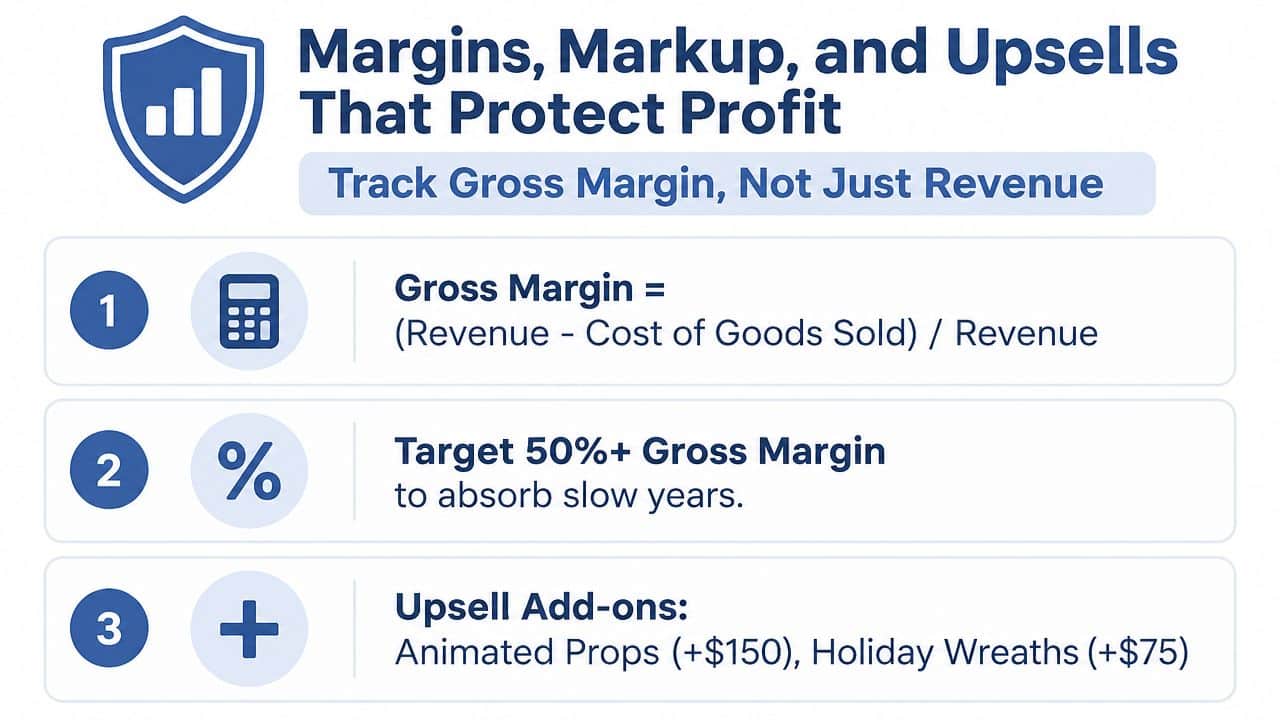
Revenue can make a season look healthy while the owner loses money unnoticed. Track gross margin per job, not only the amount collected.
Gross margin is:
(Revenue − Cost of Goods Sold) ÷ Revenue
A $1,200 job with $420 in direct cost produces a 65% gross margin, not a 35% markup. The distinction matters because markup describes how much you add to cost, while margin describes how much of the selling price remains after direct cost.
Service Autopilot's bidding guidance notes that operators may target 50% to 60% gross margin to absorb seasonal overhead and downtime. Your loaded labor rate must include taxes, insurance, and benefits rather than raw wages.
Sell useful scope, not pressure
Good add-ons solve a problem the homeowner already has:
- Timer upgrades: Replace unreliable plug-in timers with a dependable control option.
- Warm-white C9 retrofits: Improve consistency when the existing bulbs don't match.
- Commercial-grade clip replacement: Prevent repeat failures from brittle or missing clips.
- Mid-season service calls: Define response terms before a section goes dark.
- Takedown protection: Charge for the labor and scheduling commitment instead of giving January work away.
- Off-season storage: Keep labeled lights organized and reduce the customer's future setup burden.
The assigned profitability graphic references animated props at $150 and holiday wreaths at $75, but those figures should only be used when they match your actual product and labor cost. Don't promise that a particular add-on will move a job from one margin band to another without calculating the materials and crew time.
Your break-even labor rate is the lowest loaded rate that covers insurance, fuel, vehicle wear, equipment, and off-season obligations. Calculate it from your own books. A crew that earns revenue but fails to recover those costs is subsidizing every installation.
Contracts, Insurance, and Safety You Cannot Skip
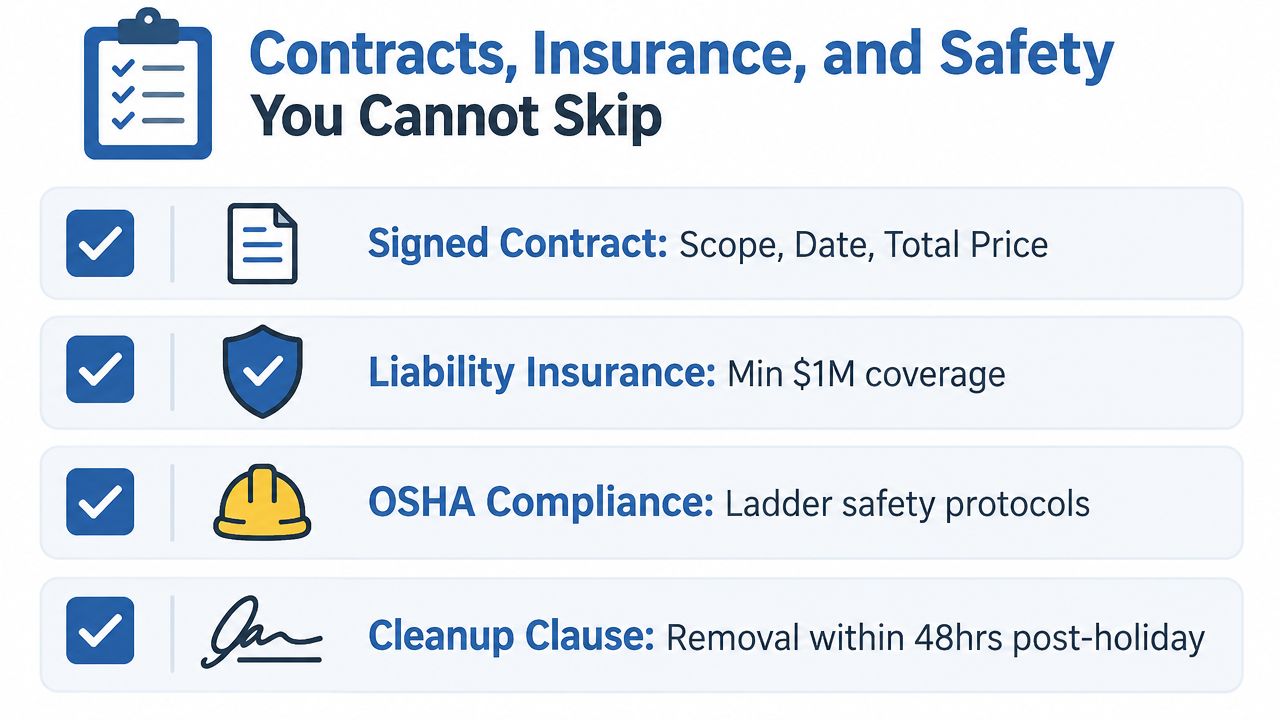
A handshake quote doesn't define who owns the lights, who pays for a broken tile, or what happens when wind damages a display. Put the scope in writing before the ladder leaves the truck.
The contract should identify the property, roofline and tree areas, materials, installation date, service terms, removal date, storage terms, payment schedule, exclusions, and customer responsibilities. It should also describe what happens if the property has unsafe access, damaged tile, failed exterior outlets, or HOA restrictions.
Insurance must match the work
Commercial buyers often require substantial liability coverage. Insuranceopedia's window-cleaning insurance guidance notes that building owners may require $2 million or more for high-rise work, while general liability commonly addresses third-party bodily injury and property damage such as broken glass or surface damage.
Don't copy a coverage number into a lighting quote without confirming your own policy. Ask your broker whether seasonal lighting, roof access, tree work, employees, subcontractors, stored customer property, and commercial sites are covered.
Treat access as a safety decision
Two-story rooflines require deliberate ladder placement, inspection, stabilization, and communication between crew members. Exterior circuits should be evaluated for suitable protection, including GFCI protection where required by the equipment and site conditions. Never promise access to a peak that the crew can't reach safely.
For high-rise or rope-access work, OSHA's framework requires fall protection, a personal fall arrest system, and anchorage capable of supporting 5,000 pounds per attached worker. OSHA also says building owners must certify anchorages in writing before rope descent systems are used, as summarized in high-rise window-washing safety standards. OSHA limits rope descent systems to 300 feet above grade unless the employer can show another method isn't feasible or creates a greater hazard, according to OSHA's rope descent guidance.
Before the quote leaves the truck, confirm these clauses:
- Scope clause: Exact roofline, trees, columns, displays, and materials.
- Access clause: Customer disclosure of fragile tile, damaged surfaces, and unsafe areas.
- Electrical clause: Outlet condition, circuit responsibility, and GFCI expectations.
- Weather clause: Wind, dust, rain, and rescheduling terms.
- Damage clause: Existing-condition documentation and responsibility boundaries.
- Removal clause: Date window, labor price, and customer access requirements.
- Storage clause: Ownership, labeling, storage fee, and replacement policy.
- Service clause: What counts as a callback and what triggers a charge.
For a broader explanation of coverage language, see bonded versus insured service. The contract should protect both sides by making the work understandable before installation begins.
Seasonal Pricing Strategy for the Valley
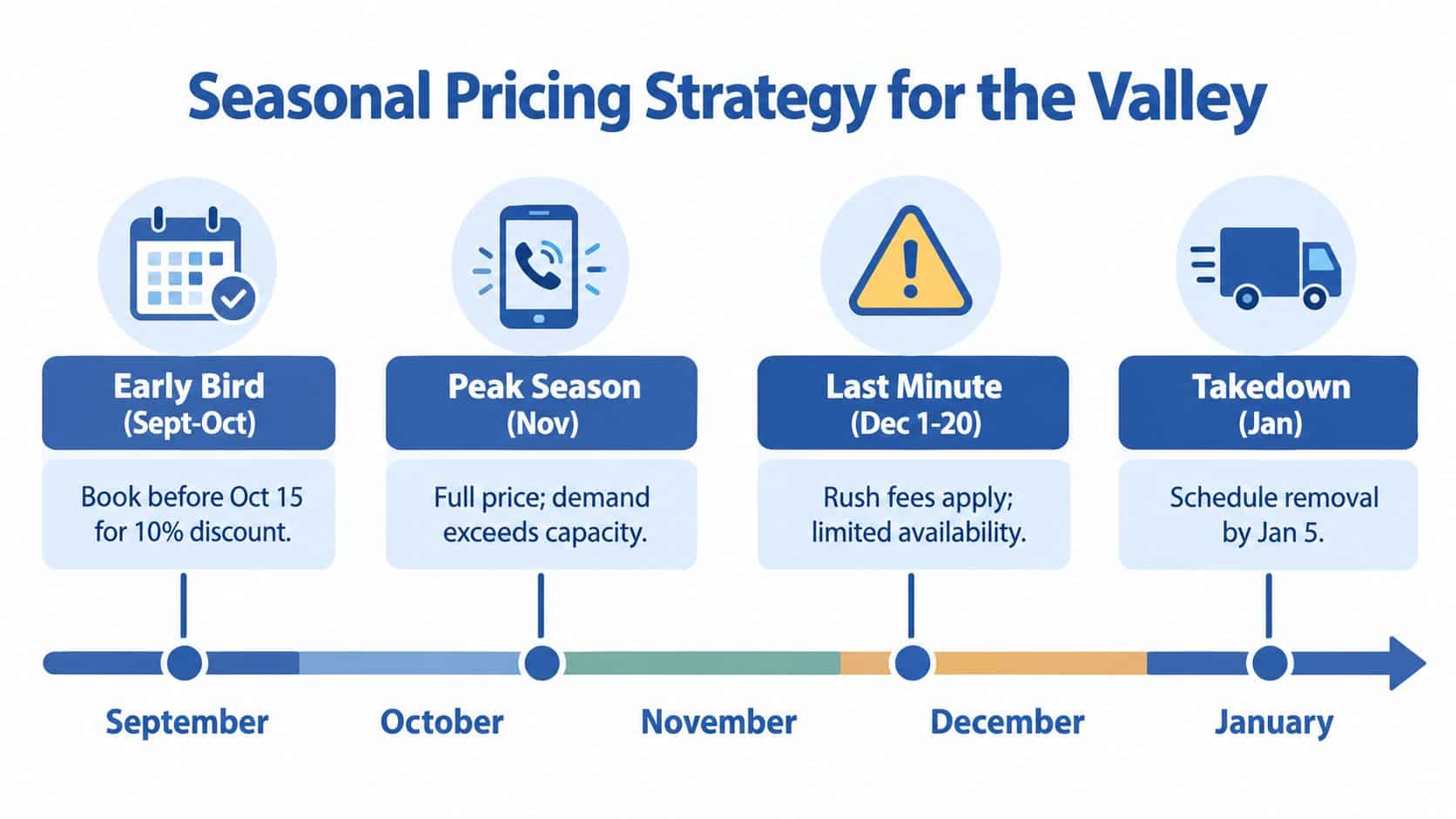
Valley demand has a rhythm. Many homeowners book between October 1 and Thanksgiving, while premium rooflines may close by December 5. January takedowns need their own price because removal uses labor after the installation revenue has already been recognized.
Use a rate card that reflects capacity
Offer an early-booking rate for October installations if the schedule allows it, then move to full pricing during the November and December rush. Late requests should carry a rush premium when they require schedule disruption, extra material sourcing, or night work. Removal should be quoted and deposited separately, with January dates reserved before the crew is fully committed.
Keep the rate card simple:
- Early season: Fill predictable rooflines and collect deposits before demand tightens.
- Peak season: Protect crew capacity and stop discounting complex access.
- Late season: Price urgency, sourcing, and schedule changes explicitly.
- Removal season: Charge for January labor, travel, sorting, and storage handling.
Review the numbers after every season
Track fuel changes when Phoenix diesel costs rise, recalibrate two-story stucco labor after each season, and record which Scottsdale HOA deadlines created rush work. Review Gilbert and Chandler pricing against the customer mix and local operating costs you observe, rather than guessing from a neighboring zip code.
The expensive lessons are consistent: underpricing a 30-foot palm wrap, skipping a takedown deposit, and quoting flat per-foot pricing on tile roofs. A seasonal playbook should include the approved rate card, minimum job fee, access surcharges, tree-work rules, material ownership policy, service-call terms, removal deposit, and storage price.
Keep that page in the truck. If a quote requires an exception, write down why. Next season's pricing should come from completed job records, not memory.
South Mountain Window Cleaning, LLC offers seasonal Christmas light installation alongside residential, commercial, and high-rise window washing in Phoenix, Scottsdale, Paradise Valley, Chandler, Tempe, and Gilbert. For a site-specific scope, safety review, and quote that accounts for roofline complexity, materials, installation, removal, and storage, visit South Mountain Window Cleaning, LLC to request a quote.