
A property manager can have a spotless lobby, polished elevators, and a demanding tenant schedule, yet still face complaints because the upper glass looks dusty after the latest wind event. At the same time, approving a cleaning crew for suspended work means accepting responsibility for roof access, anchor documentation, public protection, weather delays, and emergency planning. High rise building cleaning is an access-engineering and risk-management decision before it becomes a glass-cleaning task.
For properties in Phoenix, Scottsdale, Paradise Valley, Chandler, Tempe, and Gilbert, the desert environment adds another layer. Dust, intense sun, hard-water spotting, and monsoon winds affect appearance, scheduling, equipment selection, and the useful life of exterior assets. A defensible program connects the building's facade design with qualified personnel, documented safety controls, and a maintenance calendar that reflects Arizona conditions.
The Scope of Modern Exterior Maintenance
The pressure usually starts with a tenant complaint. A tower's lower windows look presentable, but upper floors show dust lines and mineral spotting. An ownership representative wants the building refreshed before an important inspection, while the facility manager is looking at roof anchors, public barricades, suspended access, and a budget that was built around “window washing,” not a complete exterior program.
That gap creates avoidable problems. High-rise maintenance includes glass cleaning, facade pressure washing, screen and track care, solar panel cleaning, and structural track cleaning where the building's access equipment requires it. Each surface needs a different method. Aggressive pressure can damage seals or delicate finishes, while a light glass-cleaning approach won't remove embedded grime from concrete, walkways, or loading areas.
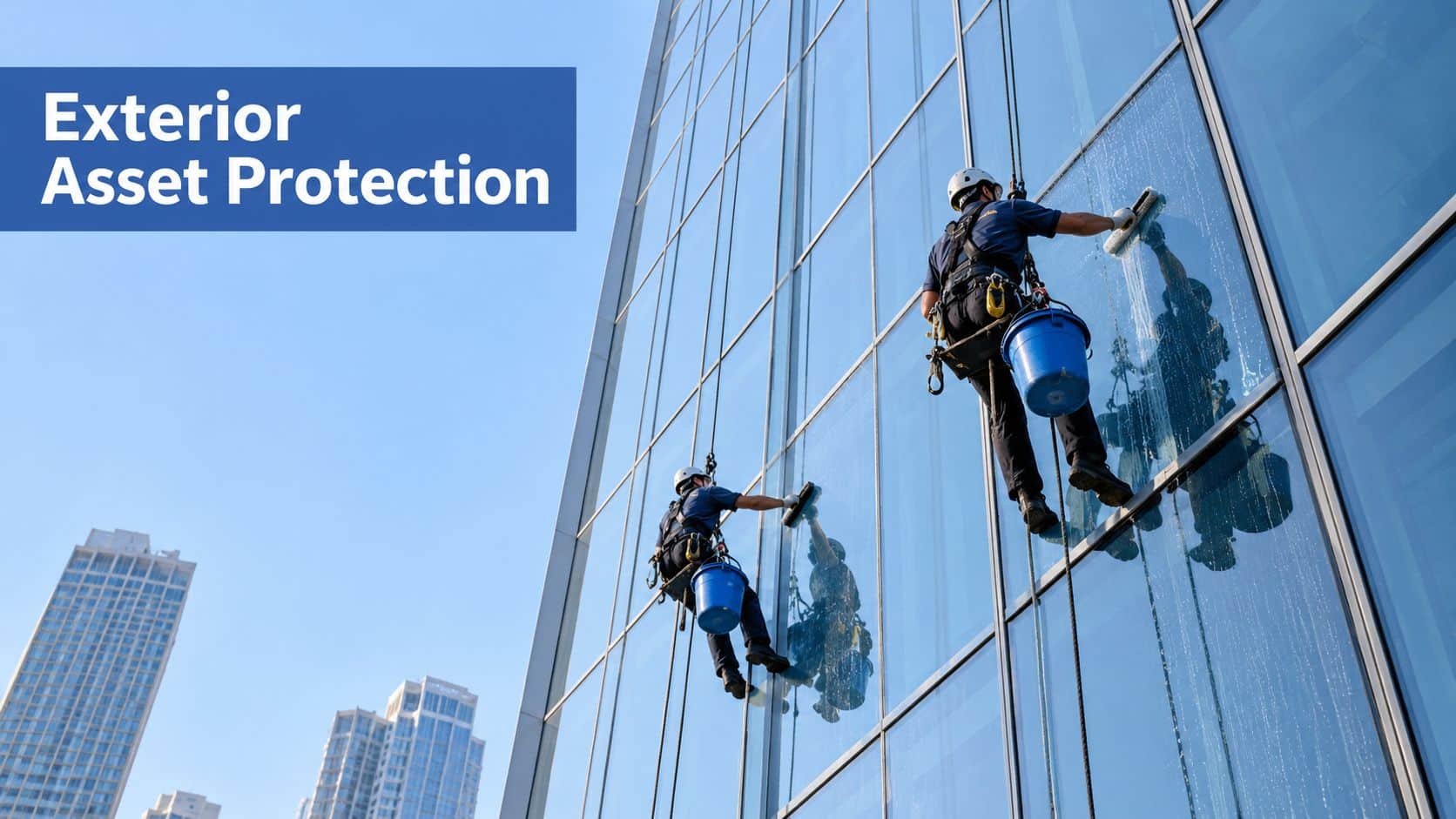
A well-scoped commercial building exterior cleaning program treats the facade as an operating asset, not a decorative backdrop. Dust and airborne pollutants can accumulate on glass, frames, ledges, panels, and tracks. Hard-water deposits can become more difficult to remove when they remain on a surface through repeated drying cycles, especially where irrigation overspray or wash water reaches the facade.
What managers should include
The exterior schedule should distinguish between tasks that protect appearance and tasks that protect function:
- Glass and frame care: Remove dust, residue, and mineral spotting without using methods that harm seals, coatings, or surrounding finishes.
- Facade washing: Clean masonry, stucco, concrete, metal, and other cladding with pressure and chemical choices suited to the material.
- Track and ledge cleaning: Clear accumulated debris from structural tracks, sills, and drainage-sensitive areas so access equipment and facade components remain serviceable.
- Solar panel maintenance: Remove dust from photovoltaic surfaces using a method appropriate for the panel manufacturer and the roof environment.
- Ground-level protection: Coordinate walkways, drive-thrus, entrances, landscaping, vehicles, and occupants before work begins.
High-rise cleaning also operates on a longer cycle than a one-time janitorial visit. A standard 50-floor skyscraper may take 30 to 40 days to clean fully, while the Empire State Building's 102 floors reportedly take six workers about four months, according to the history of industrial rope access and high-rise cleaning published by Anchor Safe Rope Access. Those examples illustrate why owners need a repeatable system for access, labor, inspections, tenant communication, and weather recovery.
Evaluating Access Methods and Engineering Limits
The facade and site conditions should determine the access method, not a contractor's preferred equipment. A straight elevation with permanent roof tracks may suit a building maintenance unit, while recessed corners or irregular architectural features may require rope access. A boom lift can reach a moderate-height section above a clear plaza, whereas a water-fed pole may handle lower areas from the ground.
Rope descent is generally restricted to locations no higher than 300 feet above grade, unless another method is infeasible or would create a greater hazard. Roof anchorages for suspended access must be identified, inspected, and tested to support at least 5,000 pounds per employee attached. Treat those limits as design constraints during planning, before equipment arrives or a crew is scheduled.
| Access Method | Ideal Building Profile | Key Limitations |
|---|---|---|
| Suspended scaffolding | Towers without a suitable permanent BMU, especially where temporary davits or swing stages can be engineered | Requires rigging, roof coordination, public exclusion zones, and inspection of the suspended platform |
| Industrial rope access | Irregular facades, recessed areas, and locations where compact equipment reduces ground disruption | Depends on suitable anchors, trained technicians, rescue planning, weather conditions, and applicable height limits |
| Boom lifts and other MEWPs | Low-to-medium sections with adequate staging space and a clear travel path | Reach, ground bearing, overhead obstructions, traffic, landscaping, and site access can make the method impractical |
| Water-fed pole systems | Lower facade areas where technicians can work from the ground | Height, facade geometry, stubborn deposits, and obstructions limit reach and cleaning control |
| BMUs | Tall buildings designed with permanent roof-mounted access equipment and tracks | Requires proper operation, inspection, maintenance, and building-specific engineering controls |
Match the method to the facade
Rope access reduces ground congestion and reaches irregular surfaces, but it still depends on suitable anchors, rescue capability, weather, and worker training. Suspended scaffolding gives crews a stable position across extended facade runs. A BMU can provide repeatable access when its tracks and controls are maintained. A boom lift works well only when the ground can carry it, the machine can be staged safely, and traffic and landscaping do not block the work zone.
Before approving temporary suspended equipment, property teams should review this scaffolding safety guide for worksites. They should also compare the proposed system with available window-washing equipment for high-rise buildings, including ropes, harnesses, descent devices, platforms, anchors, and rescue equipment. These components must work together as one planned access system.
Practical rule: Select the method only after reviewing facade geometry, roof edges, anchor locations, ground conditions, public exposure, and rescue requirements. Price follows those decisions.
Boatswain's chairs should be used only when windows cannot be cleaned safely and practically by other means, consistent with OSHA's guidance on boatswain's chair use. On taller or more complex structures, the assessment may support a cradle, temporary platform, or BMU instead of a single-point descent. The facility manager's job is to document why the chosen system fits the facade and how the crew will be recovered if conditions change.
Navigating OSHA Regulations and Anchor Liability
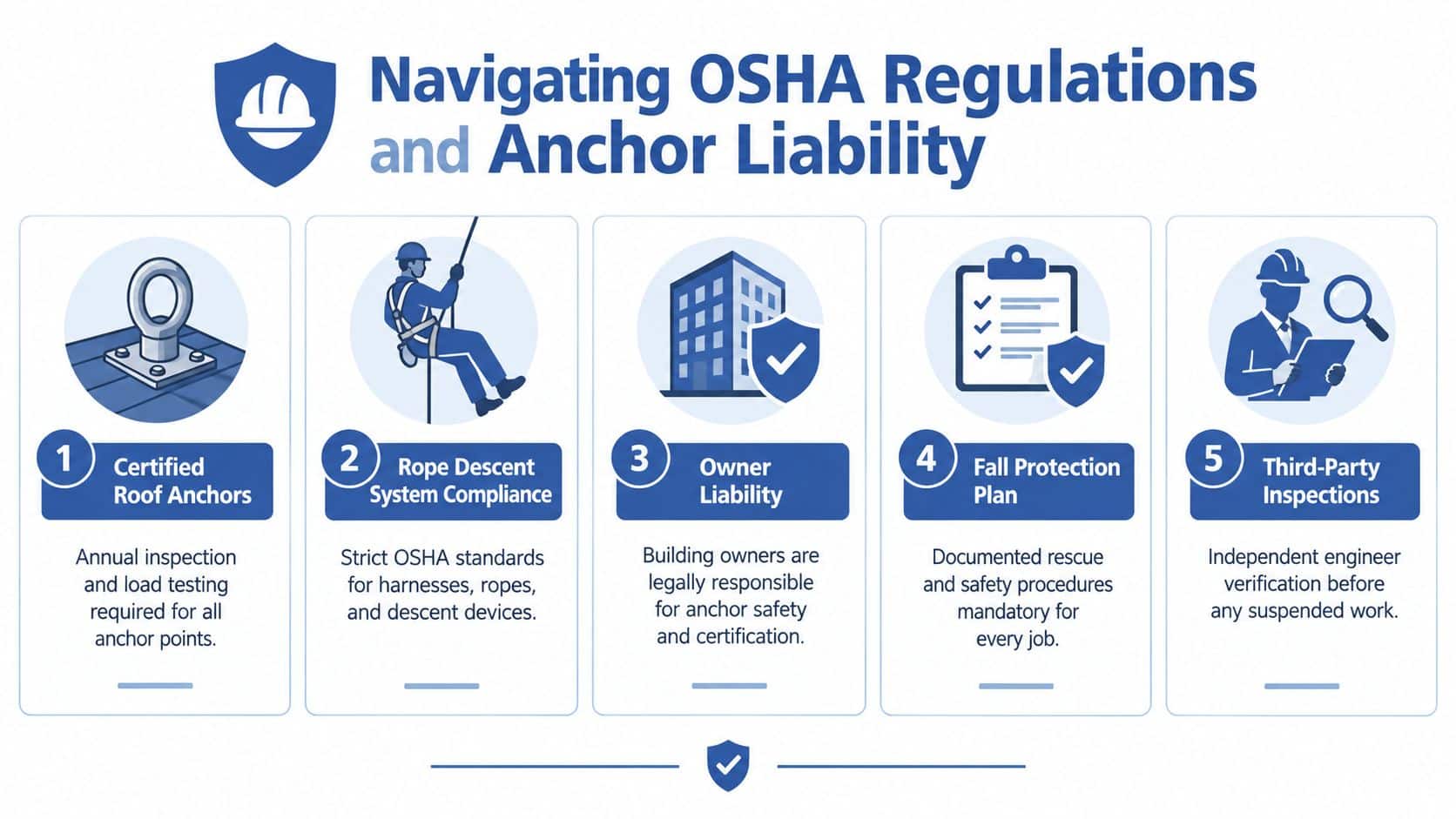
A contractor can arrive with sound ropes and trained technicians, yet the building owner still carries key documentation and access liabilities. In the United States, owners must provide written notice that each rope-descent anchorage has been identified, tested, certified, and maintained to support at least 5,000 pounds in any direction for each attached worker. OSHA also generally restricts rope descent above 300 feet unless another access method is not feasible or would create a greater hazard, as stated in the agency's rope descent system rule.
Keep the paperwork available before mobilization. A former contractor's verbal assurance does not establish that a current anchorage is suitable, maintained, or correctly identified. Verify building-specific records, match proposed rigging points to those records, and retain the written notice in the project file.
The owner's pre-start file
Before suspended work begins, the facility file should address:
- Anchorage identification: Clearly identify each intended roof anchorage and match it to the building's records.
- Testing and certification: Retain documentation showing that each anchorage was tested, certified, and maintained for the required loading.
- Separate safety lines: OSHA guidance calls for separate anchorages for worker safety lines. Window-washing device anchorages must be permanent, sound, rigid, and able to support the intended load without displacement or deformation, according to OSHA window-washing equipment guidance.
- Method approval: Confirm that the selected descent, platform, or BMU method fits the building height and facade conditions.
- Emergency response: Require a written rescue process covering a suspended worker, equipment failure, building access, communications, and people below.
Industrial rope access became more formalized as high-rise construction expanded in the early 1980s, and the Industrial Rope Access Trade Association, or IRATA, formed in 1987. Its two-line system introduced redundancy if a main line failed. Modern practice therefore depends on independent lines, equipment checks, competent crews, and controlled procedures rather than improvised roof rigging.
Weak controls can produce fatal consequences. Falls from height killed workers across all industries in Great Britain in 2024/25, and falls have led workplace deaths in almost every year since 2001/02, according to the reported window-cleaning accident data. OSHA accident records also include fatal window-washing incidents in 2022 and 2023. CDC/NIOSH investigations documented deaths involving an unsecured line and failed rigging, including one fall of 180 feet, detailed in the same reference.
Watch the embedded safety material, but do not treat it as a substitute for a site-specific assessment.
Insurance does not replace anchor certification or rescue planning. Review the contractor's coverage and exclusions as part of the project's window cleaning insurance considerations. That review helps clarify which liabilities remain with the owner, contractor, or other parties when equipment fails, work stops, or a claim arises.
Vetting Contractors and Verifying Safety Programs
A low bid can conceal missing inspections, weak rescue planning, unsuitable equipment, or an inability to recover from weather interruptions. For high-rise work, the vendor review should test the contractor's operating system, not just the appearance of its proposal.
Start with a site meeting. Ask the bidder to identify proposed rigging points, access transitions, public protection zones, staging areas, and the conditions that would stop work. A competent contractor should be able to explain what changes if the roof edge is obstructed, an anchor record is incomplete, a facade section can't be reached, or wind conditions deteriorate.
Review the safety file
Request the written fall-protection program before award. Federal guidance and safety summaries consistently identify hazard assessment, equipment inspection, worker training, and rescue planning as core parts of a high-rise safety program, as outlined in this high-rise window-cleaning safety plan guidance.
Look for evidence rather than broad promises:
- Hazard identification: The program should address roof edges, fragile surfaces, dropped objects, public areas, electrical exposure, facade projections, and changing site conditions.
- Equipment records: Ask for inspection logs covering ropes, harnesses, descenders, platforms, lifelines, connectors, and other suspended-access equipment.
- Training documentation: Verify that the personnel assigned to the building are trained for the specific system they'll operate, not merely experienced with ground-level glass.
- Rescue planning: Require a written process that explains how the crew will recover a suspended worker, who calls for assistance, and how building staff support the response.
- Supervision: Confirm who has authority to stop work and how that decision reaches the property team.
Ask insurance questions directly
The publisher's information identifies a $2 million insurance policy for business services, but coverage must still be checked against the actual project, height, equipment, and contract terms. Ask for current certificates, workers' compensation confirmation, additional-insured language where required, and exclusions that could affect suspended work or facade damage.
Price comparisons become more useful after each bidder answers the same technical questions. A clear scope, inspection record, rescue plan, and defined responsibility matrix make proposals comparable. For a broader contractor-management perspective, quality work for maintenance contractors offers useful context on controlling workmanship and accountability.
A vendor that can't provide records before mobilization isn't offering a complete high-rise service, regardless of how polished its sales presentation looks.
Managing Arizona Climate Realities and Downtime
Phoenix-area high-rise work doesn't follow a simple calendar. A facade may be ready for cleaning, tenants may have been notified, and equipment may already be staged, yet the crew still has to stop because wind, heat, glare, or surface conditions make suspended work unsafe.
Dust is a constant operational factor across the Valley. It settles on glass, frames, ledges, tracks, rooftop equipment, and solar panels, while intense sun accelerates drying and makes residue more visible. Hard-water spotting also deserves its own schedule, particularly where irrigation spray, cooling-related water, or cleaning runoff reaches exterior glass.
Plan around stoppage conditions
Wind matters most when workers, ropes, platforms, or BMUs are exposed along a tall facade. One Australian reference identifies a 40 km/h gust threshold for suspending rope-access and BMU operations, as described in its high-rise safety standards guidance. That threshold shouldn't be copied blindly into an Arizona contract, but it demonstrates why every project needs a documented stop-work rule tied to the equipment and the site.
Monsoon conditions can change a workable morning into an unusable afternoon. Managers should build contingency windows into tenant notices, access reservations, and vendor schedules rather than promising an exact completion date that leaves no room for safe recovery.
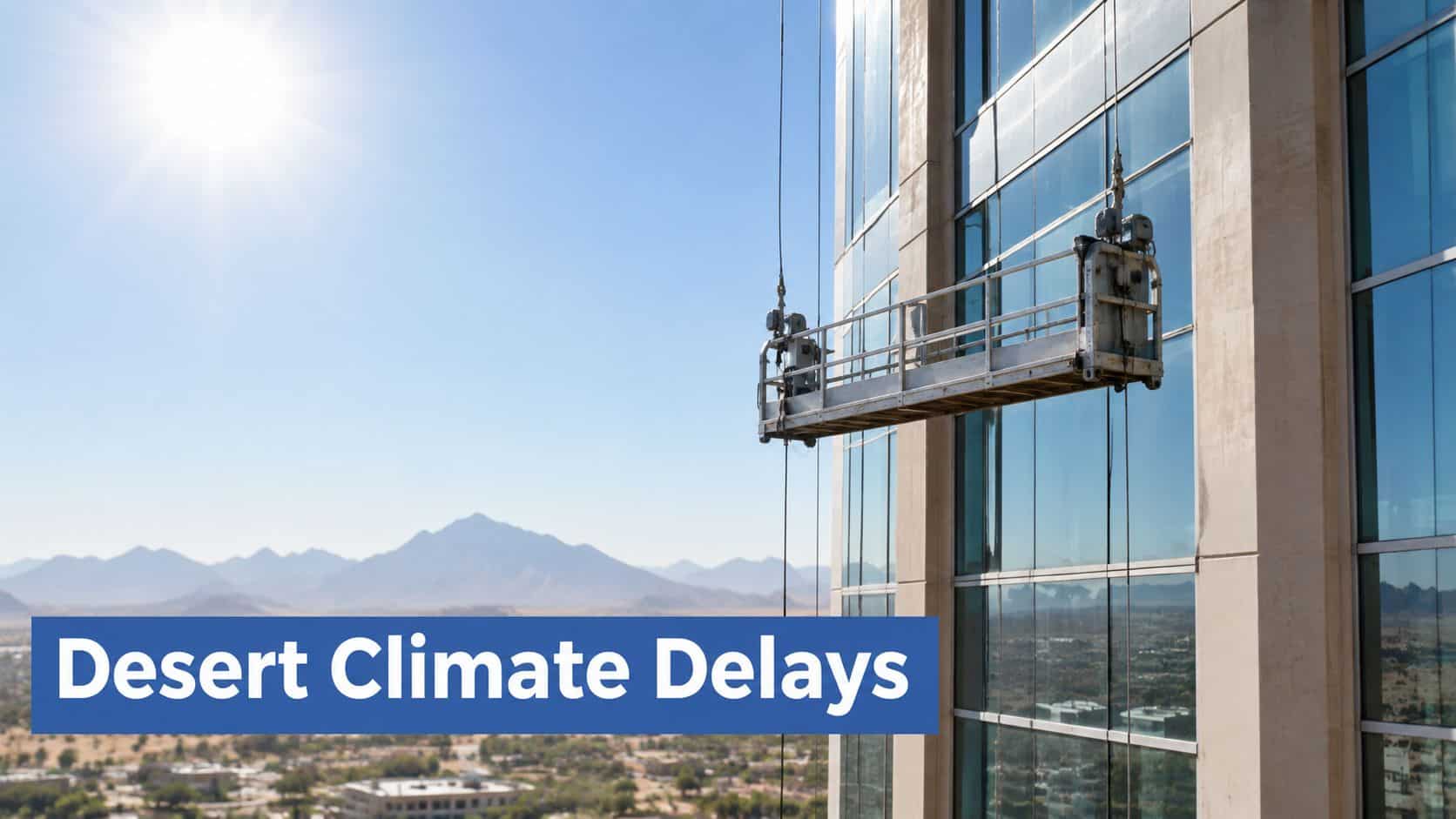
A practical Arizona schedule separates predictable work from weather-sensitive work. Ground-based cleaning, interior glass, pressure washing in protected areas, and track preparation may continue while rope access or a suspended platform waits for acceptable conditions. That flexibility helps preserve labor productivity without pressuring crews to work through unsafe gusts.
Protect the tenant experience
Communicate three things clearly: the planned work window, the conditions that can delay it, and the process for rescheduling. This prevents tenants from interpreting a safety stoppage as poor coordination. It also gives building staff time to protect entrances, move vehicles, adjust loading operations, and keep occupants away from drop zones.
Solar panels need the same climate-aware planning. Dust accumulation can reduce the cleanliness and appearance of panels, but cleaning must account for hot surfaces, water quality, roof access, and manufacturer requirements. The right schedule balances panel condition with safe access, rather than treating every dusty day as an emergency.
Structuring Contracts and Service Expectations
A high-rise cleaning agreement should define a recurring maintenance system, not a one-time visit judged only by the number of windows washed. Before crews arrive, document the access method, surfaces, safety records, scheduling rules, weather recovery, tenant coordination, and acceptance standards.
Build the scope around the property. Separate glass, frames, sills, screens, tracks, facade cladding, solar panels, walkways, drive-thrus, and other exterior surfaces. State which deposits are included and which require restoration or specialty treatment. Require the contractor to report failed seals, cracked panes, damaged frames, stains that need further work, and areas the selected access system cannot reach.
Price the work drivers honestly
Suspended cleaning depends on height, facade coverage, repetition, crew size, and the available access system. Documented examples include a 50-floor tower requiring 30 to 40 days and the Empire State Building requiring about four months with six workers, as detailed by Anchor Safe Rope Access. These examples show why a fixed completion promise can create surprise change orders or pressure crews to rush.
Include clear requirements for:
- Anchor and equipment requirements: State who supplies certifications, inspections, testing, rigging, platforms, and access equipment.
- Weather delays: Define unsafe conditions, identify who records a stoppage, set the rescheduling process, and specify any standby or remobilization charges.
- Tenant coordination: Establish notice periods, access hours, loading-area restrictions, parking controls, and communication duties.
- Quality review: Explain how the owner inspects completed sections, records missed areas, and requests corrections.
- Reporting: Require closeout records listing completed elevations, inaccessible areas, observed damage, safety incidents, and recommended follow-up.
Computerized scheduling earns its place when it connects service history with building operations. It should display completed elevations, upcoming inspections, weather postponements, tenant restrictions, and unresolved facade observations. Appointment reminders alone do not give a facility manager enough control.
Performance metrics should measure safe completion and asset condition rather than speed alone. Track compliance with the approved method, delivery of records, documentation of stoppages, resolution of tenant complaints, and whether recurring deposits are becoming harder to remove. This information gives ownership a defensible basis for renewals, corrective work, and future access planning.
Building a Proactive Facade Asset Strategy
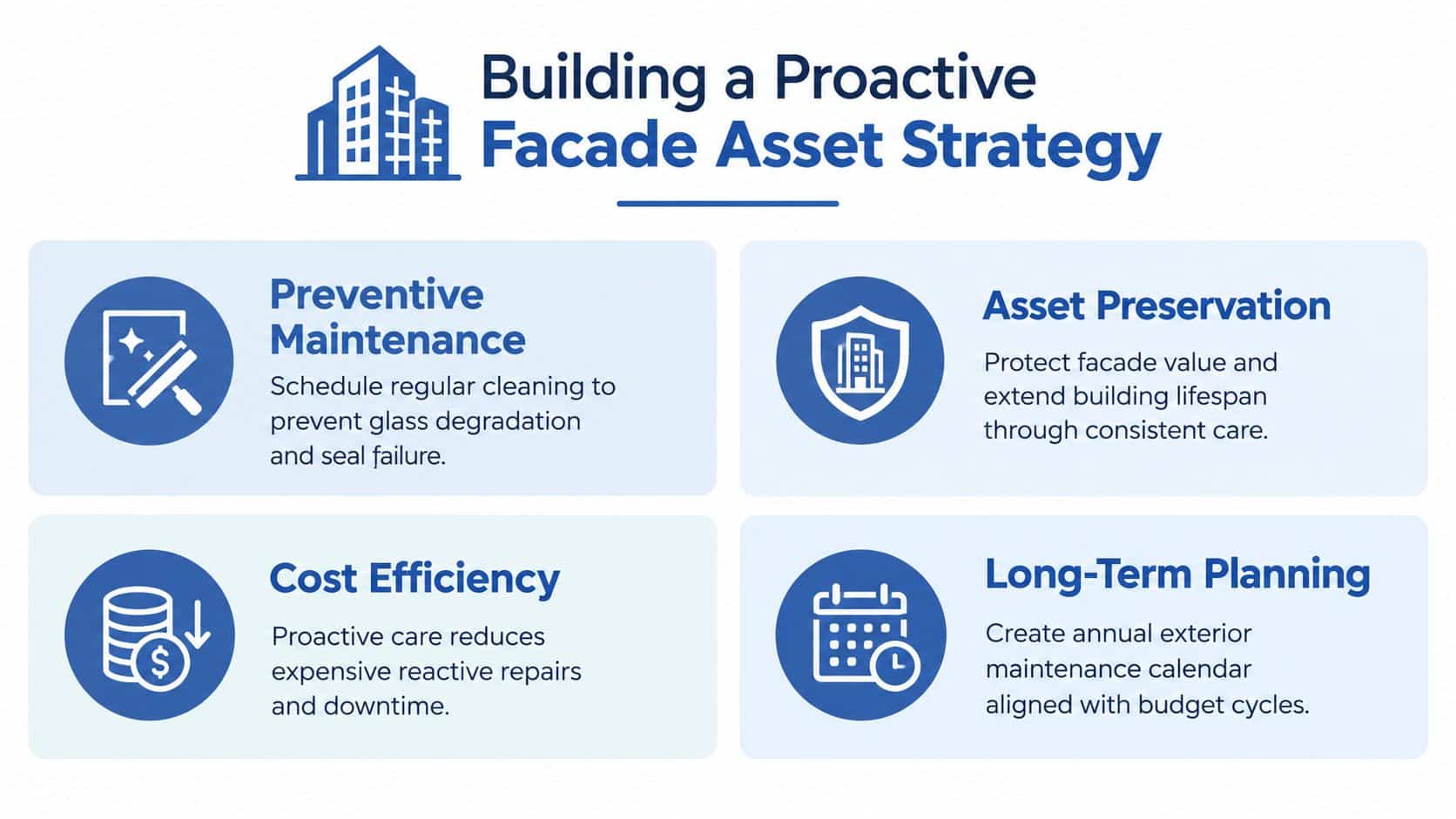
A reactive program waits for complaints, then searches for a crew, a clear weather window, and acceptable roof documentation at the same time. A proactive program keeps those elements organized before the facade becomes a visible problem. That shift protects appearance, reduces scheduling friction, and gives ownership a clearer basis for budgeting.
The manager's role is to connect three disciplines. Access engineering determines how workers reach the surface. Safety compliance determines whether the work can proceed. Climate planning determines when the chosen method can operate reliably in the Phoenix area. Ignoring any one of them can undermine the other two.
Use a practical audit checklist
Before the next vendor review, confirm that the property team can answer these questions:
- Access: Which elevations require a BMU, suspended platform, rope descent, boom lift, or ground-based system?
- Anchors: Are intended anchorages identified, inspected, tested, certified, and documented for the proposed workers and equipment?
- Safety: Does the contractor provide hazard controls, equipment logs, training records, and a written rescue procedure?
- Climate: Does the schedule include wind-related stoppages, monsoon disruption, dust accumulation, glare, and hard-water spotting?
- Scope: Does the agreement distinguish glass care from facade washing, track cleaning, solar panel maintenance, and restoration work?
- Reporting: Will ownership receive completion records, inaccessible-area notes, damage observations, and rescheduling documentation?
- Continuity: Is the work placed on an annual exterior maintenance calendar that aligns with budget planning and tenant operations?
South Mountain Window Cleaning, LLC serves residential, commercial, and high rise properties in Phoenix, Scottsdale, Paradise Valley, Chandler, Tempe, Gilbert, and surrounding Arizona communities. Its commercial services include scheduled window cleaning, building exterior pressure washing, solar panel cleaning, and related exterior care, with computerized scheduling and documented insurance information available for business clients.
A useful commercial building maintenance checklist can help facility teams organize recurring tasks, vendor documentation, and follow-up observations. The goal isn't to clean glass more often by default. It's to maintain the facade with a method that is safe, legally supportable, climate-aware, and consistent with the building's long-term operating needs.
South Mountain Window Cleaning, LLC provides residential, commercial, and high rise window washing, exterior pressure washing, solar panel cleaning, and related facade care across the Phoenix metropolitan area. Review your access records, weather contingencies, and service scope with the team, then visit South Mountain Window Cleaning, LLC to request a fast, free quote.