
In 2020, ladders were linked to 161 workplace fatalities and 22,710 workplace injuries in the United States, according to NIOSH ladder-safety data. That's a serious warning for any crew that treats a ladder as ordinary equipment, especially window cleaners who use access tools around landscaping, traffic, uneven pavement, glass, weather, and occupied buildings.
The right question isn't just, “Which ladder safety equipment should we buy?” It's, “What access method makes this task safest?” Sometimes a stabilizer or leveler solves the problem. Sometimes it only makes an unsuitable ladder job look more acceptable. This guide applies that distinction to residential, commercial, and high-rise window cleaning in Phoenix, Scottsdale, Paradise Valley, Chandler, Tempe, Gilbert, and throughout Arizona.
Why Ladder Safety Equipment Demands Your Attention
In 2020, ladder incidents caused 161 workplace fatalities and more than 22,000 nonfatal injuries in the United States, according to NIOSH. For window cleaning crews, the exposure is practical and repeated: technicians carry equipment, reposition access systems, work beside edges, and reach across glass from changing surfaces.

The equipment choice is only half the decision. The task and access method must match.
A stabilizer can reduce side movement. A leveler can address a modest difference in footing. A tie-off can help prevent the ladder from shifting. These accessories do not make excessive reach, a poor landing, high wind, or a long-duration job acceptable. They also do not solve a work area that requires constant repositioning.
That distinction matters on commercial properties. A storefront may have clean, level concrete early in the morning, then become a different job once customer traffic, wet surfaces, landscaping borders, or parked vehicles enter the work zone. A lower-level setup may suit a ladder, while upper glass on a multi-story building may call for a platform, scaffold, lift, or dedicated building-access system.
Practical rule: Use ladder safety equipment to control a specific hazard, not to justify using a ladder that was never appropriate for the task.
The history of American ladder standards shows why equipment should be treated as part of a safety system. The first American National Standard Safety Code for ladder construction, care, and use was approved in 1923. The standards family was revised in 1935, 1948, 1952, 1984, 1992, and 2002, according to the ANSI ladder standards history. Metal and fixed ladders received separate treatment in 1948 as metal ladder technology developed.
For a window cleaning manager, the working lesson is clear. A ladder is a system that includes the ladder, ground, accessories, worker, tools, weather, building geometry, and task duration. If one part does not fit, adding another accessory can increase setup complexity while leaving the main risk unchanged. Choose the safer task method first, then use ladder accessories when they address a defined hazard without forcing the job beyond the ladder's practical limits.
Assessing Ladder Hazards Before You Climb
A reliable assessment starts before the ladder leaves the truck. The technician should identify the work surface, required reach, surrounding hazards, weather exposure, and expected duration. This prevents the common mistake of selecting a ladder first and trying to force the task to fit it.
Use a repeatable site assessment
NIOSH materials emphasize selecting the right ladder, inspecting it, positioning it correctly, and using accessories or aids that improve stability. The NIOSH app includes an angle indicator and guidance for selection, inspection, positioning, accessorizing, and safe use. Its technical guidance helps crews set extension ladders at about 75.5 degrees, rather than relying on visual judgment, as described in OSHA's fall-prevention educational resources.
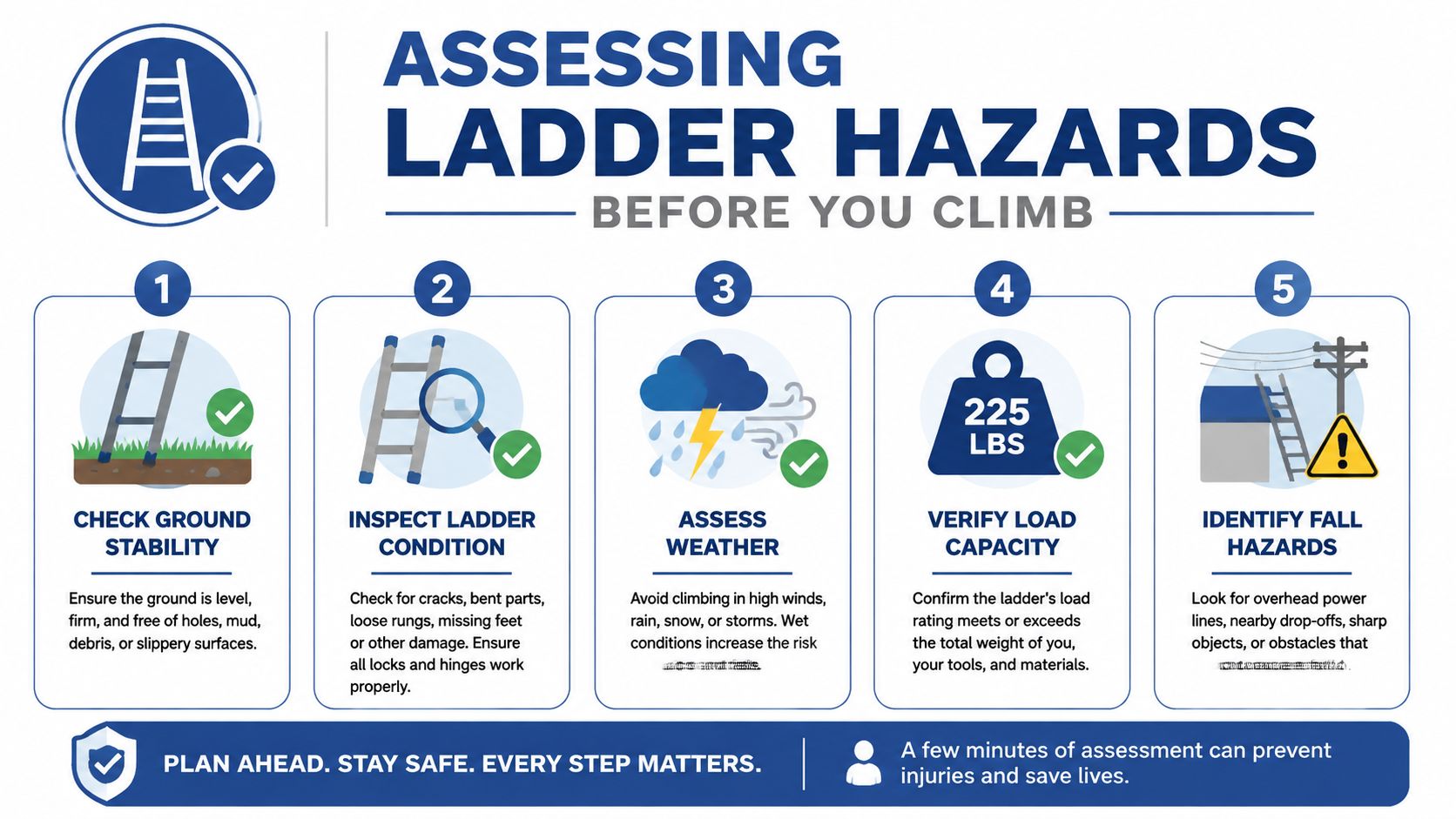
Use this sequence at every site:
-
Check the ground. Look for loose soil, gravel, wet pavement, irrigation runoff, sloped landscaping, cracked concrete, and transitions between surfaces. Arizona properties often combine hardscape with decorative rock or planted areas, so a ladder foot can sit differently from one side to the other.
-
Inspect the ladder. Check rails, rungs, feet, spreaders, locks, ropes, pulleys, labels, and accessory attachment points. A clean appearance isn't proof of structural condition.
-
Assess weather. Wind can affect extension ladders, screens, tools, and long poles. Direct sun can also change surface temperature and worker fatigue. A setup that seems stable in sheltered morning conditions may be unsuitable later.
-
Verify the required reach. Measure the actual glass area, not just the building height. If the technician must lean, twist, stand near the top, or repeatedly stretch sideways, the access method is already questionable.
-
Identify fall and contact hazards. Look for roof edges, balconies, open doors, overhead lines, tree branches, moving vehicles, pedestrians, and fragile surfaces.
Match the access method to the property
At a Scottsdale storefront, a short ladder might work for isolated upper panes if the ground is level, the area can be controlled, and the technician can keep a balanced position. At a Paradise Valley residence, landscaping may create a slope that calls for a leveler, stabilizer, or a different method entirely. At a commercial building in Phoenix, a long run of windows may make a water-fed pole or mobile platform safer because the worker can stay on the ground or maintain a more stable working position.
For gutter-adjacent work, the same assessment applies. Crews can review how to clean gutters safely before deciding whether a ladder is suitable.
Stop and redesign the task when the ladder requires improvised footing, repeated lateral reaching, uncontrolled public access, or exposure that the equipment can't reasonably control. A careful assessment takes less time than recovering from a preventable fall.
Choosing the Right Ladder Safety Equipment
A safer ladder does not always create a safer task. Select each accessory for the hazard it controls, then compare that setup with a platform, scaffold, lift, or ground-based method. If the crew cannot explain what the equipment changes, it may add complexity without reducing risk.
Stabilizers, levelers, and outriggers
A ladder stabilizer widens contact at the upper end and can reduce side-to-side movement when the ladder rests against a suitable surface. It works well around broad window frames or building surfaces where the rails need controlled contact. It does not correct unstable ground, excessive reaching, or a fragile surface.
A ladder leveler raises one side to address modest slope differences on commercial walkways, driveways, or sloped approaches. Because levelers add moving parts, verify that the locks engage fully and both feet remain firmly planted.
Outriggers increase the footprint of some extension ladder systems. They can improve stability when the site has enough room for full deployment. They also occupy more space, may obstruct pedestrians, and can become trip hazards unless the area is barricaded.
Choose the accessory when it solves a defined site problem. Choose a platform, scaffold, lift, or water-fed pole when the task involves extended work, repeated lateral reaching, public exposure, or a setup the crew cannot control consistently. For second-story residential work, this guide to how to clean second-story windows can help crews compare a ladder with pole systems and other access methods.
Tie-offs and personal protection
A tie-off secures the ladder to a sound anchor and helps prevent sliding or shifting. The anchor must suit the load and ladder configuration. A railing, pipe, decorative feature, or window frame is not automatically an acceptable tie-off point.
Harnesses and personal fall-arrest equipment need a compatible system, adequate clearance, and a rescue plan. A harness by itself does not stop a fall. For fixed-ladder climbing systems, ANSI/ASSE Z359.16 covers performance, design, marking, testing, instructions, inspection, maintenance, storage, and removal from service for users in the 130 to 310 lb range, as detailed by ANSI.
Before assigning a worker, confirm:
- User capacity: The worker fits the system's rated range.
- Compatibility: The ladder, carrier, attachment device, and climbing system work together.
- Fall path: The area below is clear of obstructions.
- Inspection status: Components meeting inspection or maintenance requirements remain in service; others are removed.
Exterior fixture work may also require coordination with a qualified lighting installation electrician so ladder placement does not create electrical exposure.
Equipment choice: Use the accessory that controls the actual hazard without creating setup demands the crew cannot use correctly.
A short demonstration helps technicians recognize correct equipment use and poor setup habits:
Inspection and Deployment Checklists That Work
A ladder can pass a quick visual check and still fail in service. Heat inside a vehicle, dust, chemical residue, and repeated contact with rough surfaces can weaken components or make them unreliable. Inspection must happen before deployment, not after the ladder reaches the work area.
Portable ladder inspection
Before assigning the ladder, the technician should check:
- Rails and rungs: Reject ladders with bends, cracks, deep corrosion, missing parts, sharp edges, or contaminated rungs.
- Feet and shoes: Confirm that non-slip feet are present, secure, and contacting the surface evenly.
- Locks and spreaders: Test extension locks and stepladder spreaders. A spreader must lock fully before climbing.
- Rope and pulley: Look for fraying, stiffness, cuts, or poor operation.
- Labels and rating: Confirm that the duty rating remains legible and suitable for the worker, tools, and materials.
- Accessories: Verify that stabilizers, levelers, outriggers, and tie-offs are firmly attached and functioning as designed.
A failed item is not a “use it carefully” item. Tag it, remove it from service, and record the reason. That record prevents another technician from returning the ladder to circulation.
Deployment in the work area
Set the ladder on firm, level footing. Boxes, buckets, rocks, scraps, and other improvised bases are not acceptable substitutes for proper leveling equipment. Keep the body between the rails, face the ladder while climbing, and maintain three-point contact during ascent and descent.
Move tools with a tool belt, hand line, or another method that keeps both hands available. A technician should not climb while carrying a squeegee bucket, pole, chemical container, or loose equipment in both hands. If the task requires repeated handling or heavy materials, select a platform, scaffold, or lift rather than forcing a “safer ladder” to handle a task it does not suit.
For extension ladders, use a standardized angle routine instead of an eyeballed position. NIOSH materials identify about 75.5 degrees as a useful positioning benchmark. Secure the ladder when possible, control traffic, and keep the landing area clear. Accessories improve a ladder only when technicians can install and use them correctly.
Fixed systems and crew behavior
Fall-protection components need their own inspection record. Check the carrier, rail, cable, connectors, attachment points, harness, energy absorber, and labels. A worker who finds damage must be able to stop the job without pressure to “make it work.”
For roof-drainage work, redesigning the task may remove the ladder hazard altogether. Compare the planned method with how to clean gutters without a ladder when ground-based access is practical.
Training should include hands-on setup, not only policy review. Have new technicians identify a failed component, correct a poor angle, secure a ladder, establish a barricade, and explain when a platform or lift provides the safer task solution.
Navigating OSHA Compliance and Fixed Ladder Rules
Property managers should classify access equipment before approving work. Portable ladder practices, fixed-ladder protection, and high-rise access requirements involve different rules, inspection points, and rescue considerations. Combining them under one ladder policy leaves gaps.
OSHA incorporated several ANSI ladder standards into construction regulations, covering portable wood, portable metal, fixed, job-made, and reinforced plastic ladders. The applicable requirements are summarized in the ANSI and OSHA regulatory material. Selection, installation, inspection, and use must also follow the relevant rule and the equipment manufacturer's instructions.
Fixed ladders over 24 feet
Fixed-ladder requirements vary by installation age and specify different protection options. A cage does not automatically replace a ladder safety system. Before approving an upgrade, building teams should document the ladder's installation history, height, condition, access points, and existing protection.
OSHA described a proposed 2026 rule change that would remove the hard deadline for installing fall-arrest or ladder-safety systems on fixed ladders over 24 feet, according to OSHA's April 2026 QuickTakes notice. The proposal does not replace the standard currently applicable to the site. Property managers should verify the rule in force for the jurisdiction, installation, and work activity before changing equipment or procedures.
A useful compliance review should answer these questions:
- Is the ladder portable or fixed?
- Does its height exceed the applicable threshold?
- When was it installed?
- Does it have a cage, a ladder safety system, or personal fall protection?
- Are the ladder, carrier, anchor points, and user equipment compatible?
- Has the complete system been inspected and maintained?
High-rise window cleaning requirements
Roof anchorages intended for window-washing devices and suspension systems must be a permanent part of the structure and be sound, rigid, and capable of supporting the maximum intended loading without displacement or deformation, according to OSHA's roof-anchorage interpretation. A visible anchor is not enough evidence for approving descent work. The building and employer must verify that the anchorage suits its intended use.
California adds a specific restriction. Ladders may be used for window cleaning only when the windows cannot otherwise be cleaned safely and practically with approved anchors and window-cleaning belts. A ladder also cannot be used for a window requiring a fully extended extension ladder over 40 feet, under California's ladder rule.
For crews working across state lines, apply the jurisdiction-specific rule rather than copying one company policy. The equipment decision should also match the task. A compliant ladder may still be the wrong tool if a platform, scaffold, or lift gives workers a stable surface and better control.
When a Ladder Isn't the Safest Choice
A safer ladder isn't always a safer task. Data summarized by the National Association of Home Builders describe ladder incidents as involving about 500,000 treated people and roughly 300 deaths each year, while also highlighting that many ladder falls involve step and extension ladders rather than specialty systems.
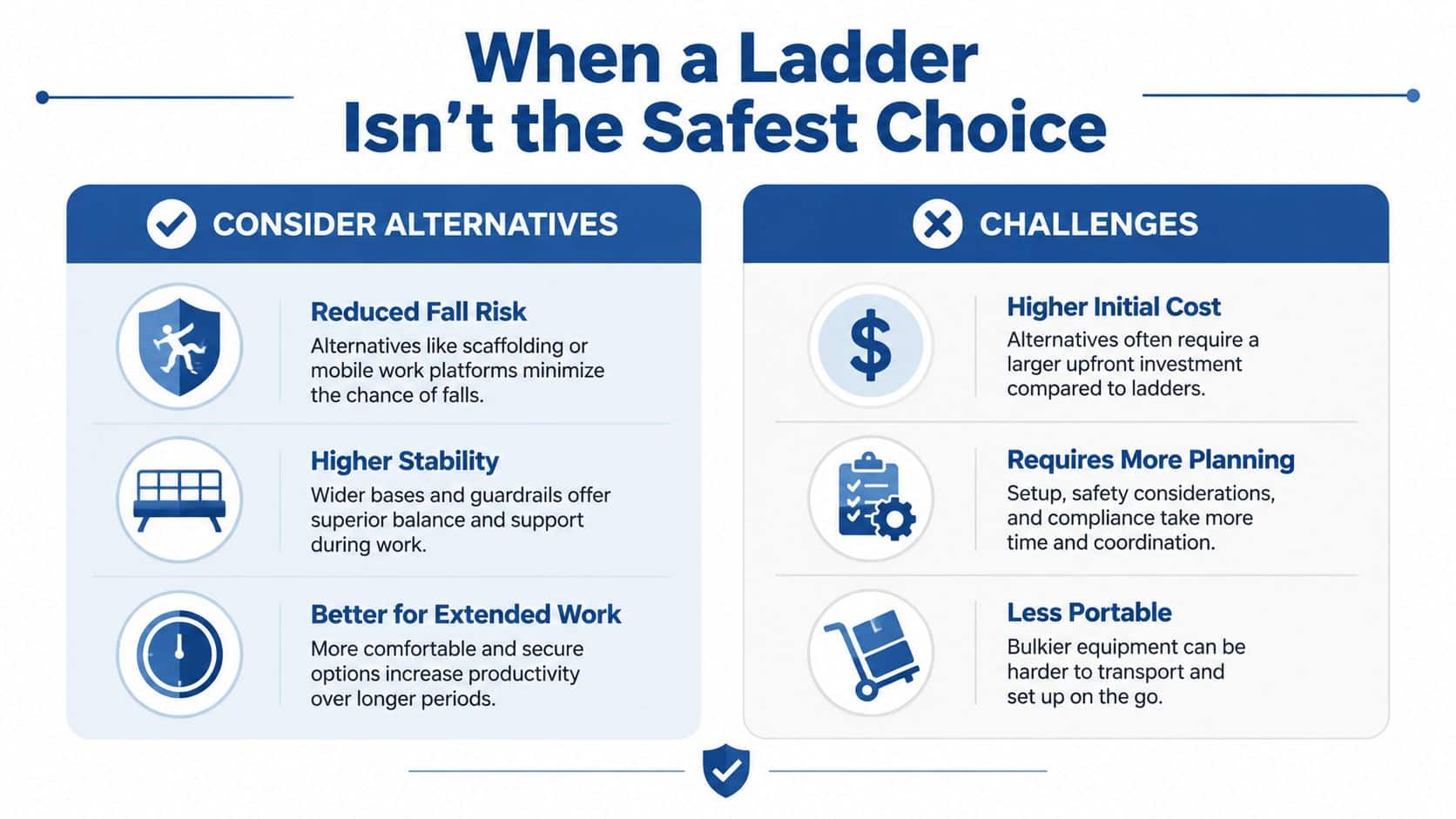
That should change the purchasing conversation. If a technician will work for an extended period, move repeatedly along a façade, reach across a broad window bank, or operate where the ground is irregular, a platform, scaffold, scissor lift, boom lift, or telescoping water-fed pole may reduce risk more effectively than adding another ladder accessory.
A practical access decision
Choose a ladder when the task is short, the surface is stable, the work area can be controlled, the required reach is reasonable, and the technician can maintain a balanced position. Choose a platform or scaffold when workers need a stable work surface and repeated access. Choose a lift when height, reach, or site layout makes ground-based equipment unsuitable. Choose a water-fed pole when the glass can be cleaned effectively from the ground without forcing the worker into a compromised position.
For residential and commercial jobs, reach window cleaning may provide a useful alternative to repeated ladder repositioning. High-rise teams must also account for rope descent limits. OSHA limits routine rope descent systems to 300 feet above grade because wind effects on longer ropes can create danger. Above that height, employers must show that no other access method is feasible or that another method would create a greater hazard, as explained by OSHA's rope-descent guidance.
The strongest crews don't ask how to make every job fit a ladder. They ask which method gives the technician the most stable, controlled, and maintainable work position.
South Mountain Window Cleaning, LLC provides residential, commercial, and high-rise window cleaning across Phoenix, Scottsdale, Paradise Valley, Chandler, Tempe, Gilbert, and nearby Arizona communities, using safety-trained technicians and access methods matched to the property. Visit South Mountain Window Cleaning, LLC to request a fast, free quote for window washing, exterior cleaning, or a safer plan for difficult-to-reach glass.