
If you manage a Phoenix-area building, you already know how the day starts. A tenant wants to know why the lobby glass looks streaked again, the window crew is asking for access instructions, the owner wants a clean answer on CAM charges, and a roofer shows up without notice while your desk is full of invoice questions. That's the world of a commercial property manager, where curb appeal, vendor control, tenant trust, and financial discipline all collide before lunch.
The job is bigger than chasing work orders. In the U.S., commercial specialization is still only a minority slice of the property-management economy, yet it carries real weight, with one industry compilation estimating 66,000 businesses focused only on commercial properties and 155,000 workers dealing exclusively with commercial property management, alongside a broader market study that put U.S. commercial property management sales at $41.9 billion in 2024 across 15,809 companies property-management industry statistics. That scale explains why the role touches everything from building systems to lease language to exterior service contracts.
For Phoenix and the Valley, the pressure is even more practical. Dust, monsoons, hard-water staining, and sun exposure turn window care and exterior maintenance into a repeating operational problem, not a cosmetic nice-to-have. A manager who ignores that cycle ends up paying for it in tenant complaints, renewed scope disputes, and avoidable callbacks.
A Monday Morning in the Life of a Commercial Property Manager
The first call lands before coffee is finished. A tenant says the lobby glass looks dirty again, and the complaint isn't really about glass, it's about whether the building feels cared for. A few minutes later, the window cleaning vendor is on the line asking for the correct Certificate of Insurance, because the file in your inbox isn't current and the owner won't sign off without it.
Then the owner asks about CAM reconciliation, because a line item feels off and nobody wants a surprise at month-end. At the same time, a roofer appears on-site unannounced, which means someone now has to verify access, safety, and whether the work was even scheduled through the right channel.
That's a normal Monday for a commercial property manager in Phoenix. The work is less about isolated tasks and more about absorbing friction between tenants, vendors, ownership, and building systems. As one restoration resource notes, when weather or water issues hit a commercial asset, the manager's response has to be coordinated, documented, and fast enough to keep the problem from spreading into downtime and tenant disruption, which is why restoration planning belongs in the same operational universe as cleaning and maintenance NW Claims Management on restoration.
What the day really looks like
A good manager doesn't just answer the phone. They decide whether the streaked glass is a one-off or a sign that the exterior service schedule is too loose for the building's dust load. They check whether the vendor's insurance files match the lease requirements and the site's risk profile. They also know that if the owner is already asking about recoveries, sloppy contractor records can become a financial problem, not just an aesthetic one.
Practical rule: If a vendor can't prove insurance, show up on schedule, and document its work, the building owner is the one carrying the risk.
That's why the most effective managers treat vendor coordination as part of the asset strategy. In a market like Phoenix, exterior cleaning is tied to tenant perception, water staining, safety around access points, and the simple reality that dust returns fast. The building doesn't care how busy the calendar is, and neither do tenants waiting on a clean entrance.
The Four Core Responsibility Areas
A Phoenix manager can walk a site in the morning and see four different problems at once. A dusty glass line, a delayed vendor, a budget question, and a tenant issue all land on the same desk. The cleanest way to understand the role is through four buckets. An IREM framework describes commercial property management as a blend of physical site, personnel, funds and accounts, and leasing and tenant services IREM responsibilities excerpt. That structure fits the day-to-day better than any buzzword-heavy definition.
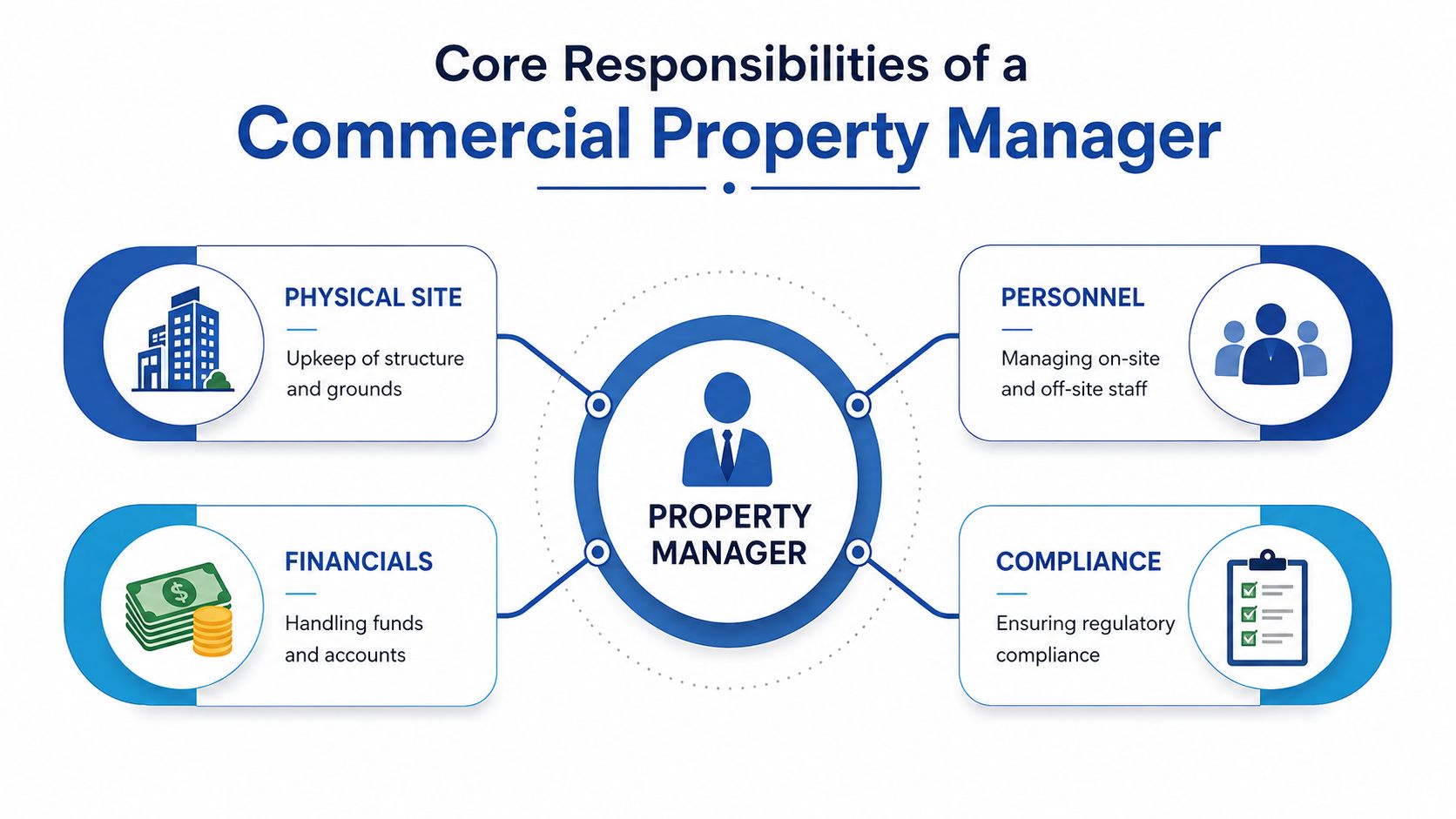
Physical site management
This side of the job starts with the building, the grounds, the systems, and the exterior work that keeps the asset presentable and functional. In Phoenix, that means planning around monsoon season, dust accumulation, and hard-water spotting before tenants start pointing it out. It also means coordinating recurring services like routine inspections and preventive maintenance, and a practical service page such as commercial property maintenance belongs in that planning process.
For exterior cleaning, this bucket includes window washing, pressure washing, rust removal, and keeping entryways and walkways from looking neglected. If a service is not scheduled with the climate in mind, the building starts slipping faster than the budget anticipates.
Personnel management
A manager often coordinates on-site and off-site people who never meet the same way twice. That may mean a daytime porter, an after-hours glass crew, a roofing contractor, and a leasing team all working around the same property without stepping on each other. The job is to align access, timing, and expectations.
For a commercial building, bad handoffs create chaos. One vendor shows up during tenant peak hours, another misses a badge check, and suddenly the manager is the one smoothing over the friction.
Funds and accounts
The financial side includes budgets, operating expenses, rent collection, service-charge reconciliations, and owner reporting. A detailed job description for property managers includes monthly reports, annual budgets, vendor COI files, and collections follow-up, which shows how operational decisions and reporting sit in the same workflow property manager job description.
Exterior service contracts belong in that same review. If invoices are vague, scopes are loose, or frequency changes are not documented, the owner ends up paying for ambiguity. That kind of drift shows up later in recoveries, complaints, and hard conversations about whether the vendor is holding up its side of the deal.
Leasing and tenant services
This bucket covers tenant communication, onboarding, service requests, and the practical details that keep occupants satisfied enough to renew. Clean windows, orderly entrances, and a visible response to exterior issues all shape how a tenant judges the property. The tenant may never say, “The window program is working,” but they notice when it isn't.
A commercial building's exterior is part of the tenant experience, not separate from it. If the common areas look ignored, the lease conversation gets harder.
Key KPIs a Commercial Property Manager Should Track
A manager can't improve what isn't being measured. For owners and asset managers, the right KPIs translate the four responsibility areas into something operational, visible, and comparable across properties. The point isn't to drown the team in dashboards. It's to track the few numbers that tell you whether the building is stable or drifting.
The metrics that matter most
Occupancy and retention tell you whether the property is holding its tenant base. In commercial real estate, this matters because the role is tied directly to income-producing space, and tenant turnover creates friction in leasing, service, and cash flow. Rent collection and aged receivables show whether the financial engine is healthy or lagging.
CAM recovery variance should be watched closely because the owner and tenant often see the same charge very differently. If the reconciliation keeps creating disputes, the issue may not be accounting, it may be a breakdown in communication or documentation. A simple internal checklist can help here, and a commercial property inspection checklist from South Mountain Window Cleaning's site is a useful operational reference point for building-related review work commercial property inspection checklist.
Benchmarks to aim for
For preventive maintenance completion, a strong manager should expect the scheduled work to happen consistently and on time. The exact target depends on the asset, but the core benchmark is reliability, not improvisation. If recurring exterior services keep slipping, the building starts paying in cleanup costs, callbacks, and tenant complaints.
For vendor SLA compliance, the standard should be whether the vendor hits the agreed window, performs the scope, and leaves clean documentation. That matters because the service record becomes part of the asset's operating discipline.
For insurance certificate renewal rate, managers should want current files on every vendor that touches the property. A missing COI is not a paperwork nuisance, it's a risk gap. For curb appeal or tenant satisfaction, the practical benchmark is simple, if complaints about the exterior keep showing up, the schedule or contractor performance probably isn't aligned with the site.
| KPI | What It Tells You | What Good Looks Like |
|---|---|---|
| Occupancy and retention | Whether the asset is holding tenants | Stable occupancy and renewals that don't rely on constant concessions |
| Rent collection and receivables | Cash flow discipline | Fast follow-up and few lingering balances |
| CAM recovery variance | Whether charges are understood and defensible | Small variances, clear backup, fewer disputes |
| Preventive maintenance completion | How well the schedule is being executed | Recurring work gets done as planned |
| Vendor SLA compliance | Whether contractors are reliable | On-time arrival, scope completion, and clean closeout |
| COI renewal rate | Whether vendor risk files are current | No expired certificates on active vendors |
| Curb appeal / tenant satisfaction | How the building feels to occupants | Few complaints, clean entrances, fewer appearance-related escalations |
The point isn't perfection. It's control. A manager who can show a clean service calendar, current COIs, and fewer surprises is already ahead of the portfolio problem that eats time and margin.
Where Vendor Management Quietly Drains Net Operating Income
A lot of owners still think the fastest path to better NOI is a cheaper vendor. That sounds tidy until the low bid shows up late, documents the work poorly, or leaves the property manager to absorb the complaint when a tenant calls. The invoice looks better, the hidden drag does not.
That drag shows up in callbacks, access disputes, and weak records. Independent guidance on CRE challenges points to formal contractor management, proof of insurance and licensure, access-control tracking, and invoice review against scope as the difference between actual control and just hoping the software keeps up commercial property management challenges. Managers looking for a more hands-on benchmark can also use a commercial property maintenance companies near me resource to compare how outside help handles scope, documentation, and scheduling in practice. More automation will not fix a weak process if nobody defines what done looks like.
The hidden cost of loose vendor control
If a window cleaning vendor cannot explain when it last serviced a façade, the manager has to decide whether to accept the risk or start over. If the invoice does not match the scope, the CAM conversation gets harder. If the crew does not coordinate with tenant schedules, the building pays in annoyance even when the labor cost looked attractive on paper.
Documentation matters more than the lowest bid. A sound vendor program protects NOI by reducing disputes, preventing duplicated work, and making service quality predictable. In Phoenix, where dust and hard-water staining return quickly, inconsistency is expensive because the building never really catches up.
Exterior work also exposes the practical trade-offs that sales pitches tend to skip. A crew that saves a little on paper but lacks access discipline can create tenant friction, missed work windows, or extra rework after monsoon weather interrupts the route. A manager who has served enough buildings learns that the cheapest vendor often costs more once the file, the tenant, and the calendar all need repair at once.
The contrarian part most teams miss
Software alone does not create accountability. It can track the same blind spots faster if the vendor scorecard is weak. The manager still needs scopes, benchmarks, signoff rules, and a simple way to compare what was promised against what was delivered.
That is especially true for exterior cleaning contractors, where insurance, access, and timing all matter at once. A vendor can look fine in a proposal and still be hard to manage on-site if the crew changes often, the certificates expire, or the scheduling window does not match tenant activity. Practical guidance from a seasoned CRE vendor manager is usually more useful here than a polished pitch deck, because the day-to-day questions are concrete, not theoretical.
Practical rule: Price is only one variable. A vendor that protects access, documents work, and shows up on time often costs less in the long run than a cheaper crew that creates friction.
That is why the right standard for exterior cleaning is not “Who is cheapest?” It is “Who helps the property manager reduce complaints, protect the file, and keep the building looking intentional?”
A Practical Checklist for Vetting Exterior Cleaning Vendors
The best vendor conversations are unglamorous. You're not buying slogans, you're buying proof. For a commercial property manager, the screening process should make it hard for weak operators to hide and easy for reliable crews to stand out.
Start with the nonnegotiables
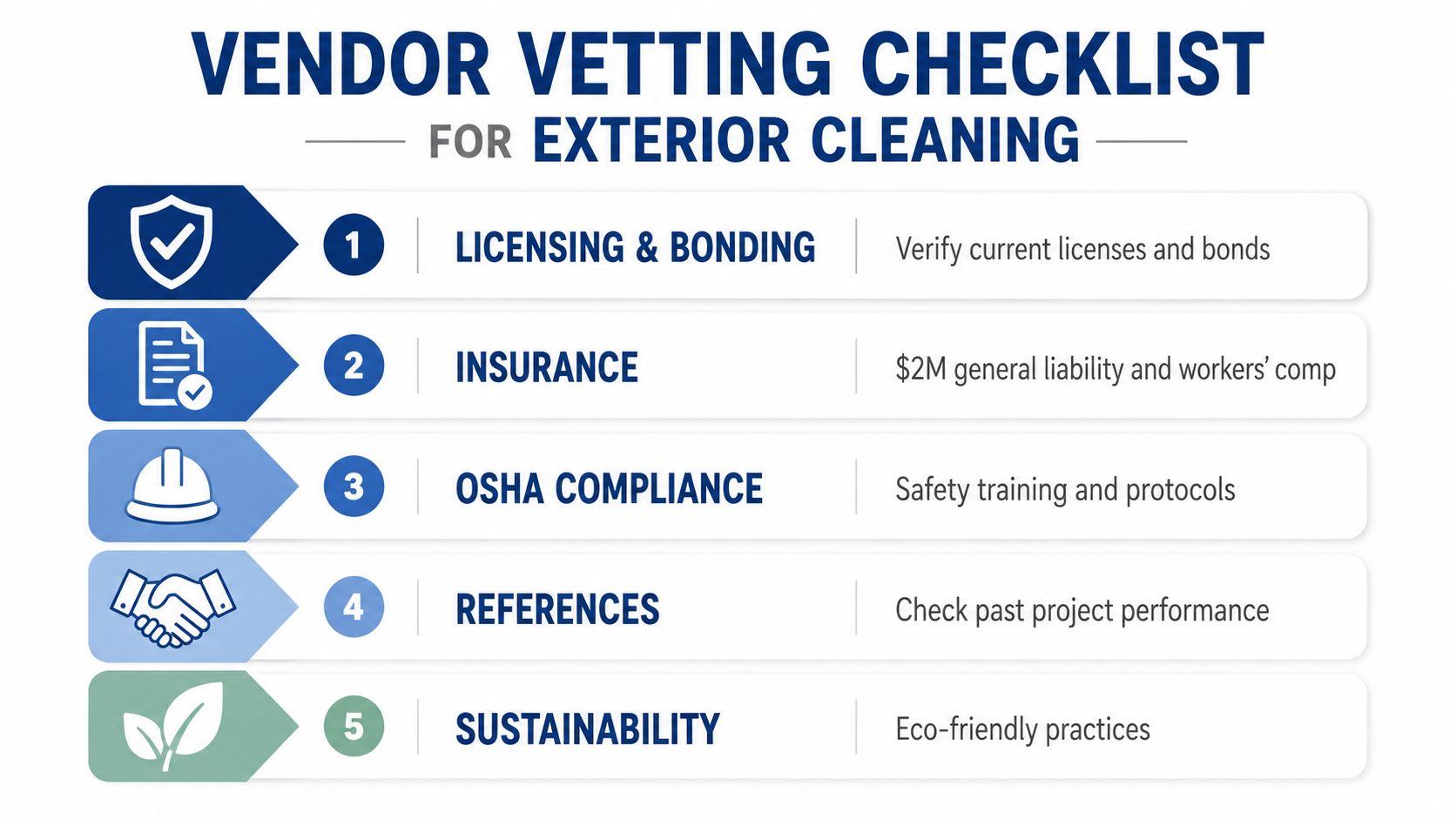
Ask for current licensing and bonding status first. Then verify workers' compensation and a $2 million general liability policy, because the cleaner's risk exposure can become your risk exposure if a ladder accident or property damage claim lands on the building. OSHA-compliant safety training matters just as much, especially for high-rise access, fall protection, and crew supervision.
The next filter is the scope itself. A written scope of work should spell out frequency, exclusions, access assumptions, and what happens when weather interrupts the schedule. In Phoenix, monsoon-season rescheduling needs to be written down ahead of time, not argued about after the fact. Hard-water stain treatment, pure-water cleaning, traditional squeegee work, and solar panel-safe chemistry should all be identified clearly so nobody is guessing what the crew is using on-site.
Require operational discipline, not just a price
A vendor with computerized scheduling and access-control tracking is easier to manage across multiple buildings, but software isn't the win by itself. The win is that the manager can see who's coming, when they're arriving, and whether the work is documented. Transparent pricing helps too, especially when the quote is broken into a per-pane, per-square-foot, or per-visit structure that matches the asset.
South Mountain Window Cleaning, LLC is one option that fits this kind of operational standard, because it offers commercial and high-rise window cleaning, power washing, computerized scheduling, and a $2 million insurance policy for Valley properties that need recurring exterior service. For managers comparing proposals, that combination is the kind of file-ready structure worth asking for in any RFP.
Use references and scorecards
Ask for references from comparable Class A or high-rise properties, not just any building with glass. Then keep a scorecard that tracks on-time arrival, quality audits, and complaint response. If a vendor gets praised on sales calls but struggles in the field, the scorecard will show it.
| Exterior Cleaning Vendor Vetting Criteria | Minimum Standard | What to Ask the Vendor |
|---|---|---|
| Licensing and bonding | Current and verifiable | Can you provide active license and bond documentation? |
| Insurance | General liability and workers' comp in force | Can you send a current COI and additional-insured endorsement? |
| Safety training | OSHA-aligned, fall-protection ready | How do you train crews for ladders, anchors, and high-rise access? |
| Scope and schedule | Written, specific, and weather-aware | What's included, what's excluded, and how do you handle monsoons? |
| References and reporting | Comparable buildings and consistent communication | Who can speak to your reliability, and how do you document each visit? |
The goal is simple. A manager should be able to hand the checklist to procurement, the owner, or a regional director and know the conversation will be about risk, service, and reliability, not just the lowest number on the page.
Use a site-specific service model
A commercial office tower may need pure-water exterior work on one schedule and post-storm touch-ups on another. A building with solar panels, hard-water staining, or mixed tenant access should have those details in the scope before the first service call. If the vendor can't match the site reality, the relationship will keep creating exceptions.
Two Building Types, Two Cleaning Programs
A good cleaning program changes with the asset. The wrong schedule for a high-rise can irritate tenants and create safety headaches, while the wrong schedule for retail leaves storefronts and pads looking neglected. The manager's job is to fit the service to the building, not the other way around.
A Class A high-rise office tower
In midtown Phoenix, a high-rise needs tighter access control, after-hours scheduling, and a crew that knows how to work around tenants who are billing by the hour. Suspended access, anchor points, and building-specific safety paperwork matter more here than price alone. The common failure mode is access friction, the crew arrives prepared to clean but unprepared to fit the building's security, tenant, and timing rules.
The pricing model that usually makes sense is one built around building specifics rather than one-size-fits-all assumptions. A manager should expect detailed quoting, a predictable service calendar, and documentation that fits the property's compliance file. The cleaning cycle often needs to account for dust buildup and post-storm spotting instead of a rigid, never-changing calendar.
A Valley strip retail center
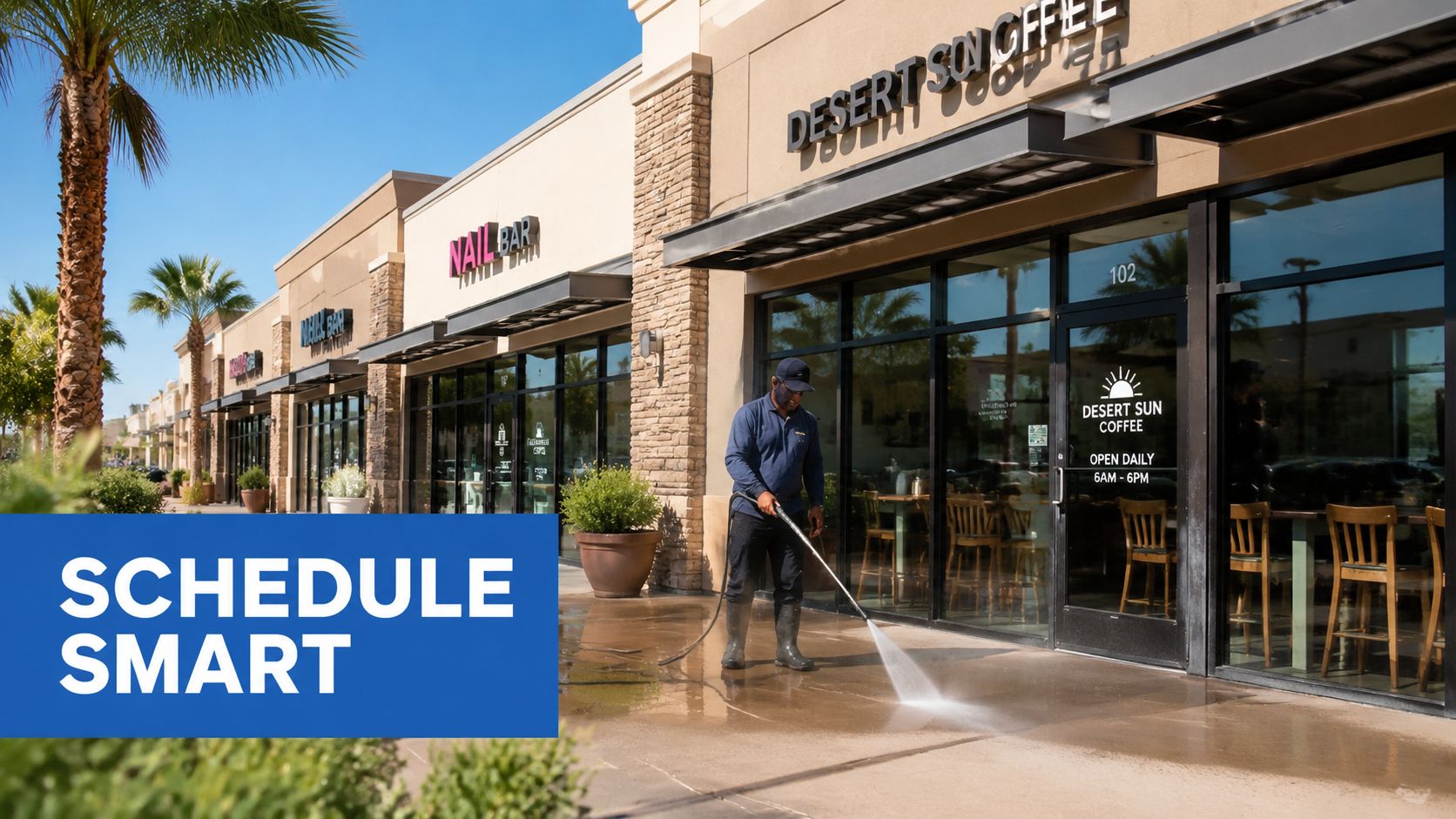
At a Chandler retail center, the priorities look different. Storefront glass, dumpster pads, sidewalks, and drive-thru surfaces drive the appearance problem, not suspended access equipment. The risk here is less about high-rise exposure and more about traffic, customer flow, grease, and visible grime.
A retail center often benefits from recurring exterior cleaning tied to foot traffic, tenant mix, and high-use areas. The common failure mode is under-cleaning the parts customers see first, which creates the impression that the owner doesn't care. A power-washing program that handles sidewalks, entries, and service areas well can protect tenant perception without overcomplicating the schedule.
A manager who understands the difference between these two programs avoids the classic mistake of copying a high-rise service model onto retail, or a retail price expectation onto a tower. The asset decides the workflow.
Bringing It All Together for the Phoenix Valley
A commercial property manager's best move in the Valley is simple, keep exterior maintenance documented, scheduled, and tied to the actual building. Dust, UV exposure, monsoons, and mineral staining don't wait for a convenient budget cycle, which means the exterior program has to be part of the operating plan, not an emergency response.
The managers who stay ahead of complaints usually do four things well. They audit COIs before the next service call, verify that vendor insurance matches lease requirements, set a cleaning frequency based on occupancy and dust load, and use a basic scorecard to track on-time arrival and quality. That's enough to turn exterior care from a recurring scramble into a controlled process.
Predictability matters because it protects tenant confidence and reduces avoidable churn. It also gives owners cleaner answers when they ask why a building looks the way it does. In Phoenix, where the environment works against the glass every week, proactive maintenance isn't a luxury, it's a defensive move.
If you need a vendor that can handle commercial window cleaning, high-rise work, power washing, and recurring exterior service across Phoenix, Scottsdale, Paradise Valley, Chandler, Tempe, and Gilbert, South Mountain Window Cleaning, LLC can support that kind of maintenance plan. Visit South Mountain Window Cleaning, LLC to request a quote and compare services against your current exterior maintenance schedule.