
Soft washing is low-pressure exterior cleaning with specialized solutions, not high-pressure force, and it has become the dominant residential service mix for professional operators, accounting for 40 to 50% of residential revenue in 2026 while traditional pressure washing represents 25 to 35% and roof cleaning 15 to 25% (The Dab Marketing on the soft-wash shift). If you're looking at dusty stucco, monsoon runoff marks, roof stains, or buildup around solar panels, soft washing is usually the safer answer for Arizona surfaces that can be damaged by too much pressure.
In Phoenix, dirt isn't the only problem. Fine dust settles into textured finishes, algae and mildew show up where water lingers, and the sun bakes contaminants onto siding, trim, and roof lines. A lot of homeowners assume the fix is more force. On delicate materials, that's often the wrong move.
Soft washing works because it treats the cause of the staining, not just the visible layer on top. For homeowners and property managers in Phoenix, Scottsdale, Paradise Valley, Chandler, Tempe, Gilbert, Arizona, that matters. Surface damage is expensive, and in our climate, a cleaning method should protect the building while it cleans it.
The Professional Answer to Arizona Dust and Grime
A common Phoenix call goes like this. The front stucco looks dusty, the north wall has dark streaks under a scupper, the patio cover has drip lines from hard water, and the owner wants it cleaned before guests arrive or a listing goes live. The surface looks like it needs more force. In many cases, it needs the right chemistry, controlled application, and a technician who knows what to protect before the pump ever turns on.
That matters in Arizona because exterior cleaning here is not just about dirt. Fine desert dust packs into textured stucco. Monsoon runoff leaves vertical staining. Sprinkler mist loads lower walls with mineral deposits. Around pool areas and shaded entries, organic growth can still show up even in extreme heat.
Soft washing is the professional answer because it cleans vulnerable finishes with low pressure while reducing the chance of etching, lifted paint, broken mortar, or water pushed behind trim. On Phoenix homes, that risk control is a big part of the service.
The other part is site management. A good soft wash job in the Valley includes pre-wetting and covering sensitive desert plants, controlling runoff near decorative gravel, and choosing mixes carefully around oleander, citrus, agave, and other landscaping that does not tolerate sloppy chemical use. That is one reason experienced crews get better results than a rinse-and-go approach.
Solar panels are another Arizona-specific concern that generic articles usually skip. Dust, pollen, and bird residue cut performance, but blasting panels with high pressure or the wrong angle can damage seals, frames, or surrounding roof components. Soft washing methods, used correctly and paired with the right rinse process, help clean buildup more safely on and around panel arrays. If you want a clearer breakdown of where each method fits, this guide on pressure washing vs soft washing for Phoenix-area homes lays it out well.
Practical rule: If the finish costs more to repair than the dirt costs to remove, use the least aggressive method that will do the job.
Arizona owners already know the climate is hard on buildings. Heat, dust, UV exposure, irrigation, and sudden storms all show up on exterior surfaces faster than many people expect. For a broader snapshot of the conditions that shape upkeep in this state, 50 essential facts about Arizona is a useful read.
What soft washing solves on a Phoenix property
A proper soft wash is often the right fit for problems like these:
- Dust-loaded stucco: Textured walls trap fine soil that a light rinse will not remove evenly.
- Painted trim and siding: These surfaces need cleaning without forcing water into edges or joints.
- Roof edge staining: Fascia, underlayment edges, and tile lines often respond better to treatment than force.
- Patio covers and entry areas: Overspray, cobwebs, and runoff marks build up fast in high-use zones.
- Solar panel surroundings: Frames, nearby roofing, and accumulated grime need a careful approach.
- Storefronts and HOA common areas: Properties need to look clean without unnecessary wear on coatings and finishes.
For Phoenix homeowners and property managers, the value is straightforward. Soft washing helps keep surfaces cleaner with less risk, protects finishes that are expensive to repair, and fits the realities of Arizona properties where dust, sun, irrigation, and desert landscaping all affect how a cleaning job should be done.
Soft Washing vs Pressure Washing Explained
The easiest way to understand the difference is this. Soft washing is like using a targeted treatment with a gentle rinse. Pressure washing is like using water force as the main tool. Both methods have a place. They just aren't interchangeable.
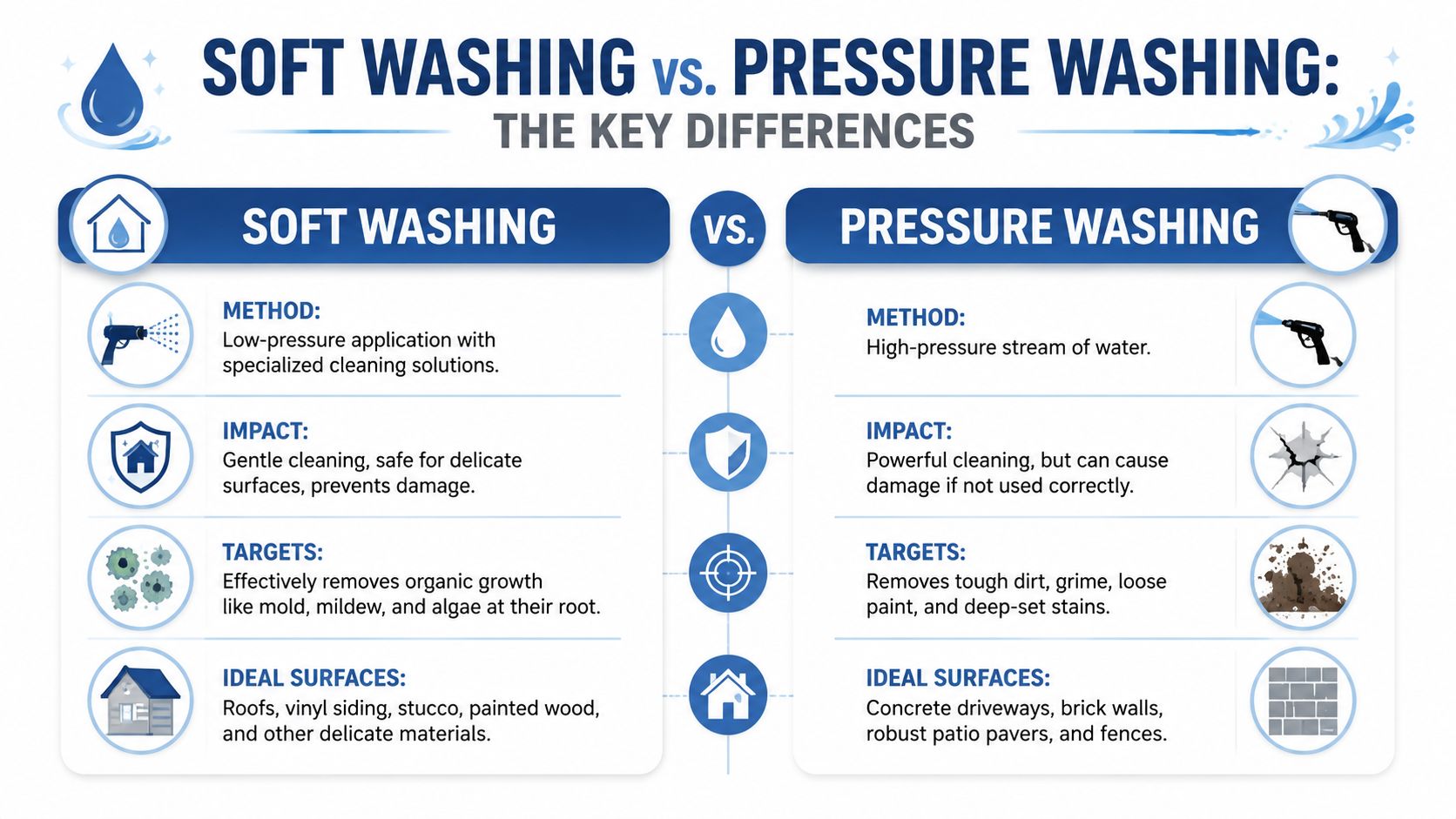
Soft Washing vs. Pressure Washing at a Glance
| Feature | Soft Washing | Pressure Washing |
|---|---|---|
| Cleaning approach | Low-pressure application with cleaning solutions | High-pressure water removes buildup by force |
| Main action | Treats and loosens organic staining and grime | Blasts away surface dirt and debris |
| Best surfaces | Stucco, siding, painted wood, roof areas, other delicate finishes | Concrete, some pavers, sturdy masonry, hard flatwork |
| Risk profile | Lower risk on delicate finishes when applied correctly | Higher risk of etching, chipping, water intrusion, or surface damage if misused |
| Typical result | Better for surfaces that need cleaning without aggression | Better for hard materials that can take force |
Where homeowners get tripped up
People often use "pressure washing" as a catch-all term for any exterior cleaning. In practice, a pro should choose the method based on the material, the stain, and the risk. If someone wants to compare the two methods in more detail, this breakdown of pressure washing vs soft washing is a helpful reference.
Here's the trade-off. Pressure washing can be effective on the right surface, especially hard concrete. On stucco, painted siding, fascia, roof areas, and other finish-sensitive materials, too much force can cause the very problem the cleaning was supposed to prevent.
What works, and what doesn't
What works:
- Using soft washing for organic staining: Mold, mildew, algae, and similar growth respond better to treatment than brute force.
- Using pressure washing on durable flatwork: Concrete and other hard surfaces can often handle more force.
- Matching the process to the substrate: The cleaner should change the method when the surface changes.
What doesn't:
- One-tool-fits-all cleaning: That usually leads to either poor results or damage.
- Blasting stucco to chase discoloration: It can rough up the finish and force water into cracks.
- Assuming more PSI means better cleaning: On many Arizona homes, it means more risk.
A clean wall isn't enough if the process shortens the life of the finish.
The Science Behind Soft Washing Chemicals and Methods
The word "chemical" makes some homeowners uneasy, and that's fair. The important question isn't whether a solution is used. What matters is whether it's mixed, applied, and neutralized correctly.
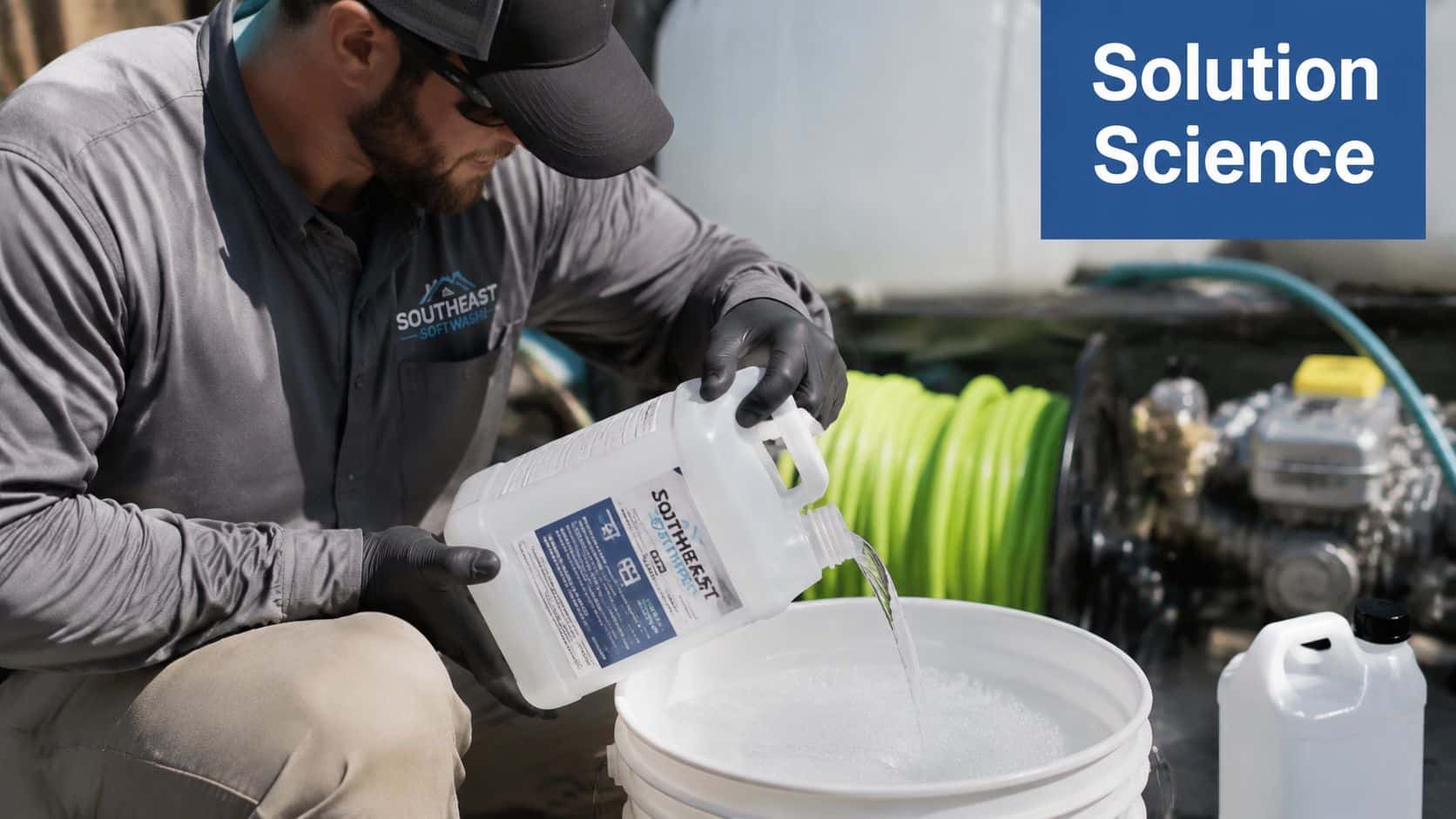
A typical soft washing mix uses water, a cleaning agent that targets organic growth, and a surfactant that helps the solution stay where it's needed long enough to work. The chemistry does most of the cleaning. The rinse removes the dead growth and residue.
Why plant protection matters so much in Arizona
Desert landscaping is expensive, and it's less forgiving than people think. Decorative shrubs, irrigated beds, succulents near walls, and heat-stressed plants can all react badly when an exterior cleaner handles runoff carelessly.
That risk isn't theoretical. A 2024 industry analysis found that 38% of homeowner complaints against exterior cleaners in the Sun Belt involve vegetation damage due to improper sodium hypochlorite application, while only 12% of educational articles provide specific neutralization ratios or post-treatment pH testing protocols (industry analysis on vegetation damage and education gaps).
What a careful operator actually does
A professional soft wash should include more than spraying and rinsing. The process usually involves:
- Pre-wetting landscaping: Wet plants and soil before treatment so roots and leaves are less likely to absorb concentrated runoff.
- Controlling dwell time: Solutions can't be left sitting too long in direct Arizona sun.
- Managing runoff paths: Technicians should pay attention to where gutters, beds, and slope lines move solution.
- Post-rinse and neutralization: Plants, soil, and nearby surfaces should be rinsed and treated as needed.
For homeowners who want a clearer explanation of the solution side of the process, this guide to the best house washing solution lays out how professionals think about the mix itself.
Low pressure doesn't automatically mean low risk. The safety comes from the technician's process.
What doesn't work
Two mistakes cause most problems. The first is assuming every surface can take the same mix. The second is treating landscaping as an afterthought.
In Phoenix, heat speeds things up. A solution that behaves one way in mild weather can act differently on a hot wall, a dark roof edge, or a planting bed in full sun. That's why soft washing isn't just about equipment. It's about judgment.
Key Benefits for Your Arizona Property
The biggest benefit of soft washing is simple. It cleans exterior surfaces while reducing the chance of avoidable damage. In Arizona, that matters because many homes rely on finishes that look tough but don't respond well to aggressive cleaning.
Better for appearance and maintenance
Soft washing helps restore a more even, cared-for look on surfaces that collect dust, runoff staining, and organic buildup. That matters for curb appeal, but it also matters for routine maintenance. When buildup stays on the surface, it can mask developing cracks, failed caulking, and paint issues you should catch early.
For commercial properties, cleaner exteriors also signal that the building is being managed properly. That matters to tenants, guests, and customers.
Better for delicate materials
Arizona homes commonly use stucco, painted trim, coated fascia, tile roofing, and other finish-sensitive materials. Those surfaces often need cleaning, but not abrasion.
Soft washing helps protect:
- Stucco finishes: Less risk of surface scarring and water being driven into weak areas.
- Painted surfaces: Lower chance of stripping or lifting compared with aggressive washing.
- Roof components: Less chance of disturbing edges, coatings, or vulnerable sections.
- Exterior details: Trim, vents, and fixtures benefit from a gentler process.
Clean isn't the only goal. Preserving the material underneath is part of the job.
A longer-lasting kind of clean
When staining has an organic component, knocking off the visible layer doesn't solve much. Soft washing addresses that problem at the source, which is why the result often looks better for longer than a force-only approach on the same material.
On Arizona properties, that's especially useful on shaded walls, north-facing sections, courtyard areas, and rooflines where dust and moisture combine. The method is less about making a surface look freshly blasted and more about returning it to a healthy maintenance condition.
Ideal Surfaces for Soft Washing Services
Some parts of a property practically announce that they need soft washing. Others are less obvious until damage starts. On Phoenix homes and commercial buildings, the right method usually depends on the finish, not the size of the stain.
Stucco, siding, and painted exteriors
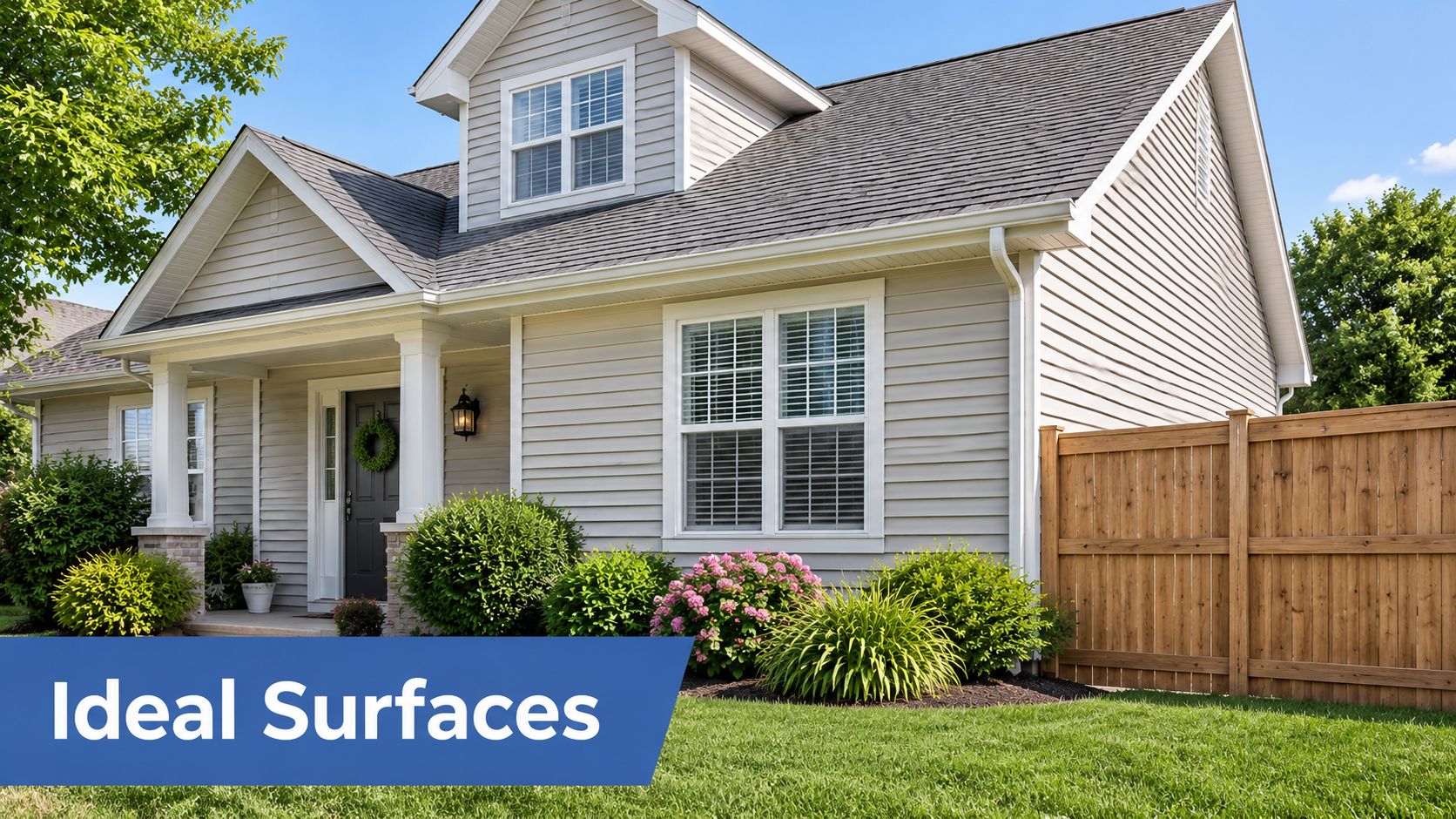
Stucco is one of the easiest surfaces to damage with the wrong approach. A wall can look solid and still have hairline cracks, weak paint, or a finish coat that shouldn't be hit with aggressive water pressure. That's one reason many homeowners ask whether they can clean it themselves. The short answer is to be careful, and this explanation of whether you can pressure wash stucco covers why.
Vinyl siding and painted exteriors also respond well to soft washing because the method focuses on removing grime and organic contamination without trying to shear everything off by force. On multi-material homes, that matters. One wall can include painted trim, vents, sealants, and decorative elements that all need a gentler touch.
Roof areas and hard-to-reach sections
Roof staining often isn't a pressure problem. It's a treatment problem. Soft washing is commonly used on roof areas because it can clean vulnerable sections without the same physical stress that comes from high-force washing.
The same logic applies to fascia, soffits, eaves, and upper elevations that collect grime but don't tolerate aggressive cleaning well. These are the areas where technique matters more than brute strength.
Solar panels in the Arizona sun
Solar panels deserve separate attention because Phoenix homeowners count on them. Dust is part of the story, but it isn't the whole story. Panels can also develop a bio-film layer that reduces performance, and pushing water across the surface alone doesn't always solve that.
Recent 2024 to 2025 field studies show that soft washing with 1 to 2% SH concentrations removes the bio-film that blocks 15 to 20% of solar energy absorption, which corrects the common myth that any bleach contact automatically damages panel coatings (field-study summary on soft washing and solar panel bio-film).
That point gets missed in a lot of generic cleaning advice. The issue isn't "chemicals are always bad" or "pressure is always better." The issue is whether the panel has organic film that needs to be killed and removed safely.
A practical video example helps show why runoff control and application technique matter so much on real properties.
Common places soft washing makes sense
- Residential house washing: Exterior walls, trim, soffits, and entry areas.
- Commercial building exteriors: Storefront facades, low-rise exteriors, and customer-facing surfaces.
- Solar panel cleaning: Especially where dust and organic film reduce output.
- Fence and painted wood surfaces: Areas that need cleaning without fiber or coating damage.
- High or awkward elevations: Spots that need controlled application rather than force.
South Mountain Window Cleaning provides residential, commercial, and high rise window washing services in Phoenix, Scottsdale, Paradise Valley, Chandler, Tempe, Gilbert, Arizona, and exterior soft washing is one of the methods used where low-pressure cleaning is the better fit for the surface.
Hiring a Professional Soft Washing Company in Phoenix
Once you know what soft washing is, the next question is who should do it. In Phoenix, the difference between a careful operator and a careless one often shows up in the landscaping, the finish quality, and whether the property still looks good after the crew leaves.

What to check before you book
Start with the basics. A company should be licensed, bonded, and insured. If the work involves larger homes, commercial properties, ladders, roof access, or multi-story service, that protection matters even more.
Then ask practical questions:
- How do you protect plants and irrigation areas?
- How do you decide between soft washing and pressure washing?
- What surfaces on my property would you avoid treating aggressively?
- How do you handle runoff near beds, drains, and decorative landscaping?
Those questions tell you more than a generic sales pitch ever will.
Signs the company has real systems
Professional exterior cleaning companies should have organized communication, clear scheduling, and a documented process. For property managers with recurring service needs, modern systems matter. If you're curious how service businesses streamline customer communication and follow-up, this look at how teams automate cleaning business client interactions gives useful context.
You should also look for a company that can explain the scope clearly. House washing, roof treatment, window cleaning, solar cleaning, and flat surface work aren't all the same service. If the estimate treats everything as the same job, that's a red flag.
A useful benchmark for comparing providers
Review the company's actual service page, not just the homepage. A page dedicated to house washing services usually tells you more about how the company thinks about materials, method selection, and property protection.
Ask the company what they won't clean with pressure. A serious pro always has an answer.
The best hiring decision usually comes down to this. Choose the crew that understands surfaces, chemistry, and risk control, not just the one that shows up with the loudest machine.
The Smart Choice for a Lasting Clean
Soft washing is the professional answer when a property needs more than a surface rinse and less than a blast of high pressure. It works by combining low-pressure application with targeted cleaning solutions so delicate materials can be cleaned without unnecessary wear.
For Arizona homes and buildings, that matters in very practical ways. Stucco, painted trim, roof lines, and solar panels all benefit from a method that respects the surface. The goal isn't just to remove grime today. It's to clean in a way that helps the property hold up in heat, dust, and monsoon conditions.
If you came here asking what is soft washing, the short answer is that it's a safer, more controlled cleaning method for many exterior surfaces. The better answer is that it's part of smart property maintenance. Done correctly, it protects curb appeal, reduces risk to finishes, and addresses the underlying cause of many stains instead of just stripping off the visible layer.
If you need exterior cleaning for a home, storefront, commercial building, or high-rise property in the Phoenix area, contact South Mountain Window Cleaning, LLC for a free quote and a professional assessment of which surfaces should be soft washed, which should be pressure washed, and how to protect your landscaping and exterior finishes in Arizona's harsh climate.