
If you own solar in Phoenix, Scottsdale, Paradise Valley, Chandler, Tempe, or Gilbert, you already know the pattern. Dust settles after a dry week. Pollen sticks in spring. Monsoon season throws grime onto every horizontal surface. Then your panels sit up there looking fine from the ground while output slips little by little.
That's the frustrating part. Solar panels don't need to look filthy to underperform. A light film can be enough to cut light transmission, and in Arizona that turns into lost production fast. A lot of property owners start looking at a solar panel cleaning drone because it sounds faster, safer, and more modern than sending people onto roofs.
Sometimes that's exactly the right move. Sometimes it isn't. The right answer depends on your roof, your array size, site access, electrical risk, and whether you're solving a recurring maintenance problem or chasing a gadget.
The Hidden Cost of Arizona Dust on Your Solar Panels
Arizona dust is fine, dry, and relentless. It doesn't just blow through once and disappear. It settles, bakes on, mixes with hard water spotting if the wrong cleaning method is used, and slowly blocks the sunlight your system is supposed to convert into power.
For homeowners, that means paying for a solar system that isn't performing the way it should. For commercial properties, it means a larger maintenance problem because underperforming panels affect a broader energy budget and can go unnoticed longer.
Why clean panels matter more in Arizona
Properly cleaned solar panels can experience efficiency boosts of 10% to 30%, which directly increases energy output and ROI, especially in dust-intense climates like Arizona, according to this solar cleaning performance reference.
If you want a fuller breakdown of the issue, this guide on solar panel efficiency loss is a useful place to start.
Dust doesn't have to look dramatic to cost you money. On solar, “slightly dirty” is often dirty enough to matter.
Why owners start looking at drone cleaning
The appeal is obvious. A drone can reach areas that are awkward, steep, high up, or spread across a large commercial roof. It also reduces foot traffic near fragile roof materials and avoids some of the access problems that make manual cleaning slow and expensive.
But drone cleaning isn't a magic shortcut. It's a specialized system with real operating requirements, real safety concerns, and real limits. Before you hire anyone promising futuristic results, it helps to understand what the equipment does and what separates a professional setup from a marketing pitch.
How Solar Panel Cleaning Drones Actually Work
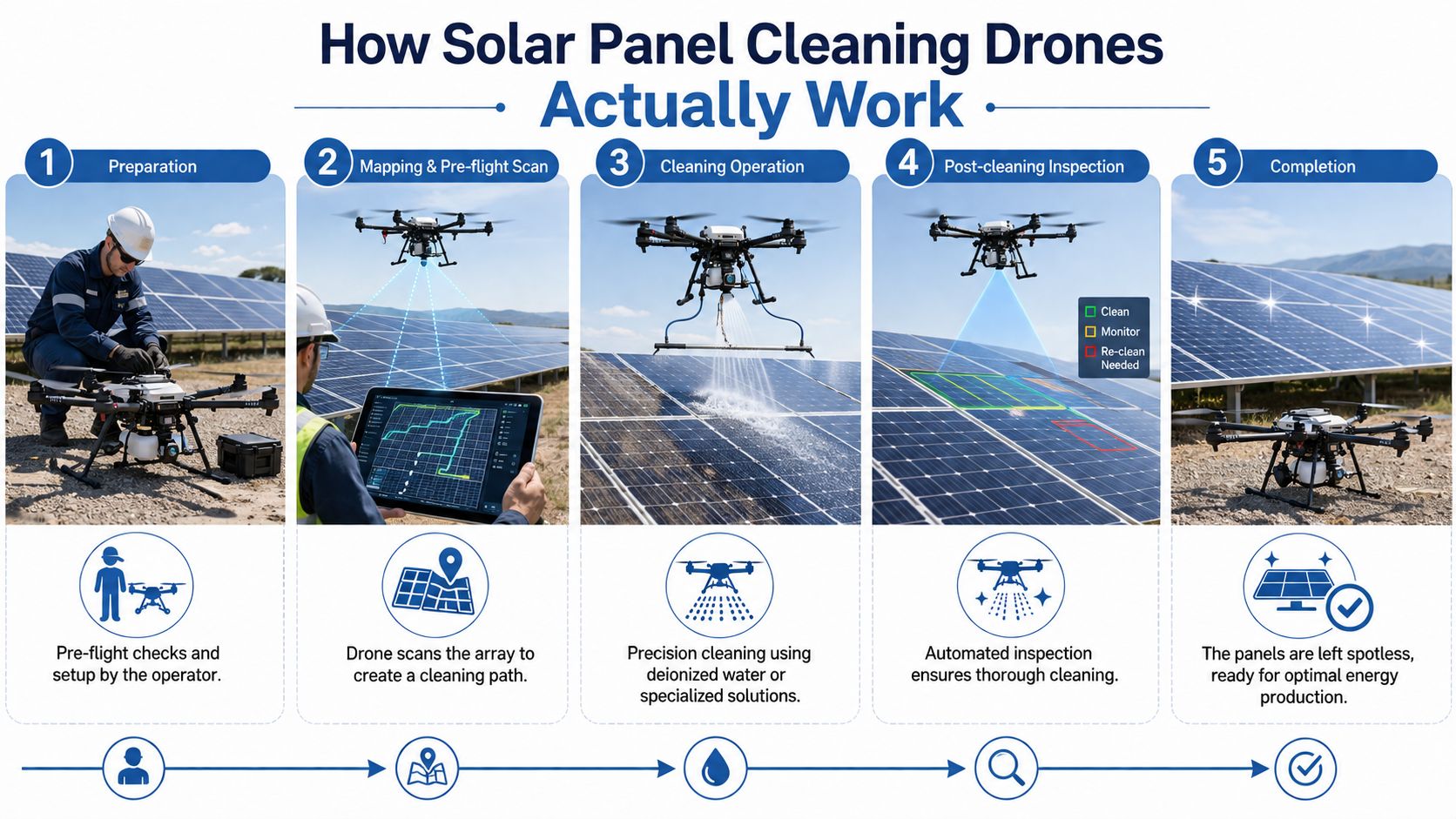
A real solar panel cleaning drone setup is closer to a flying wash system than a hobby drone with a spray bottle. The aircraft is usually a heavy-lift unit designed to carry a cleaning head while staying stable over the array. On the ground, the crew runs a support skid with water storage, pumps, filtration, hose management, and flight controls.
Here's the process visually.
The system is more than the drone
The drone usually works in tandem with a hose-fed water supply from the ground. That matters because cleaning at scale requires more water than an onboard tank can reasonably carry. The operator performs pre-flight checks, maps the array, and runs controlled passes over the panels so the cleaning head stays consistent across each row.
A good primer on the equipment side is this overview of solar panel cleaning tools.
The water quality is not optional. To prevent mineral residue and spotting that degrades solar panel light transmission, drone cleaning systems must use pure RODI water, with ground-based skids supplying at least 200 gallons of pure water per operational cycle, as explained in this RODI water and skid requirements guide. If that purity isn't there, the panels can be left with residue that causes permanent efficiency loss.
The cleaning head does the real work
The best setups don't rely on brute force. They combine controlled water application with soft brush contact so dirt lifts off the glass without scratching the panel surface. On delicate surfaces, the goal is uniform cleaning, not aggressive blasting.
That's why the “just pressure wash it” approach is usually the wrong mindset for solar. A professional system controls flow, keeps the spray pattern consistent, and follows a route distributing cleaning evenly across the array instead of leaving random clean streaks and missed sections.
For a quick look at the process in action, this video helps make the workflow easier to picture.
What operators watch during the job
A competent operator is watching more than flight stability.
- Panel spacing: Tight rows and edge clearances affect how safely the cleaning head can pass.
- Wind behavior: Even mild gusts can change how precisely the drone tracks over the glass.
- Hose management: A hose-fed drone needs disciplined ground coordination to avoid snags and drag.
- Water purity: If the filtration isn't right, the panels may look clean at first and still end up spotted.
Field reality: If a company can't clearly explain its water system, cleaning head, and flight path control, it probably isn't running a serious solar cleaning operation.
The Three Pillars of Drone Cleaning Benefits
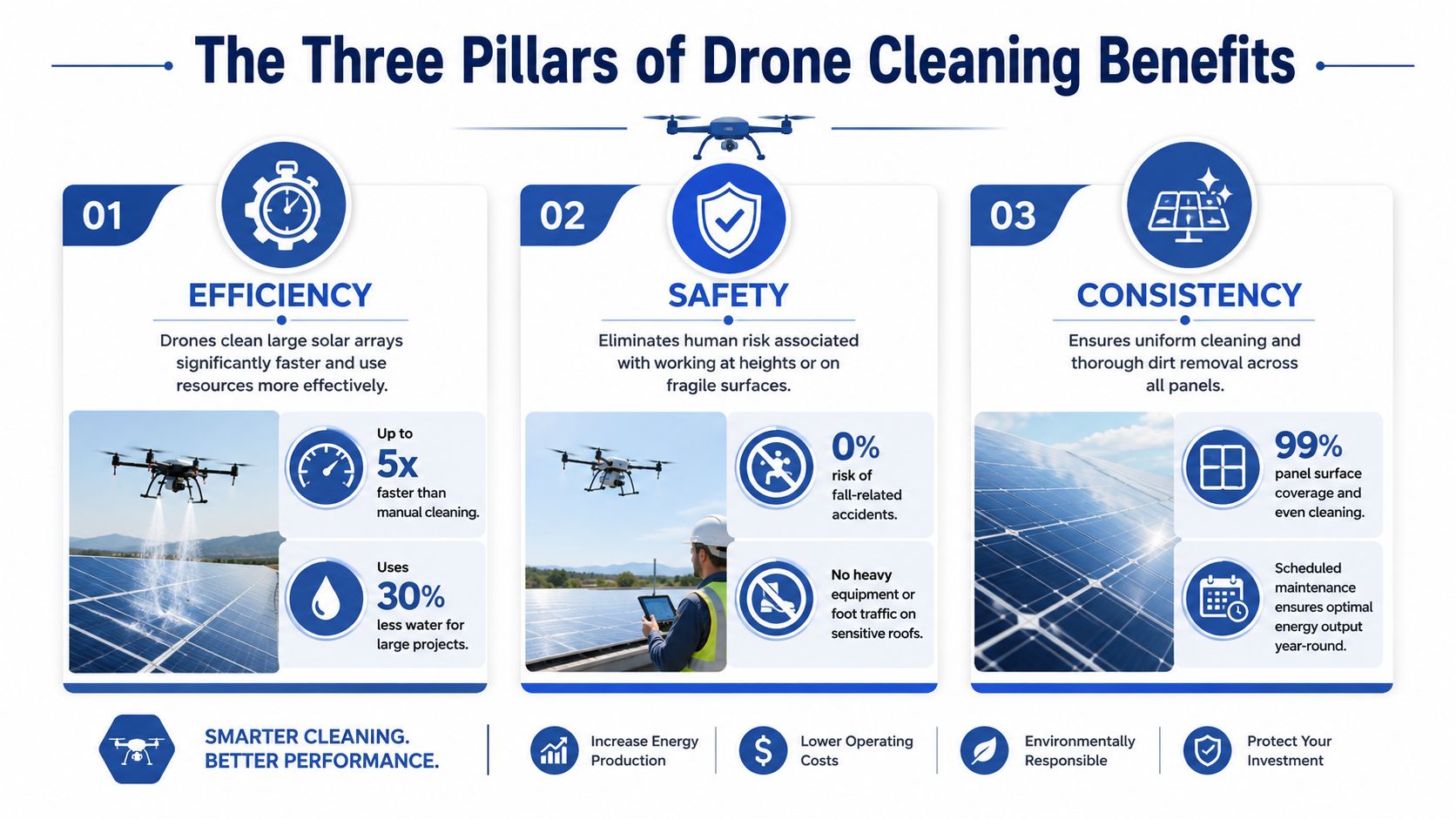
Drone cleaning earns attention for three reasons that matter in the field. It can move faster on the right sites, reduce fall exposure, and deliver more uniform passes across large arrays than a manual crew usually can.
Efficiency on large accessible arrays
On bigger installations, speed is the headline advantage. Solar panel cleaning drones can clean 200 to 400 panels per day, compared with 20 to 50 for manual cleaners. That's a 4- to 8-fold increase and can reduce cleaning time by about 75% on large solar farms, based on this drone versus manual cleaning comparison.
That kind of throughput matters most when the array is large, the layout is repetitive, and access is straightforward. On those jobs, a drone can turn a drawn-out maintenance task into a shorter, more predictable operation.
If you're still weighing the economics of regular cleaning, this article on whether solar panel cleaning is worth it helps frame the decision.
Safety where roof access creates exposure
The second benefit is simpler. Fewer people climbing, stepping, leaning, and carrying equipment around high surfaces usually means a safer operation.
That doesn't mean drone work is risk-free. It means the risk shifts. Instead of repeated foot traffic on roofs and around panel edges, you're relying on controlled remote operation from the ground. For many commercial roofs, especially large ones with long panel runs, that's a meaningful improvement.
Consistency across the full array
Manual cleaning quality often depends on the technician, the weather, fatigue, roof pitch, and how easy it is to physically reach every section. Drone systems do better when the job rewards repetition.
A mapped route helps the operator maintain even coverage across rows instead of over-cleaning easy areas and under-cleaning awkward ones. That consistency matters because uneven cleaning can leave sections of the array performing differently.
Where the benefit shows up most clearly
| Site type | Drone advantage |
|---|---|
| Large flat commercial roofs | Strong fit because access and row spacing are usually more uniform |
| Utility-style arrays | Strong fit when repeated passes matter more than close hand-detailing |
| Steep or fragile roof zones | Helpful when reducing foot traffic is a priority |
Uniform cleaning is one of the least flashy advantages. It's also one of the most useful on large arrays.
When Drones Are Not the Right Answer
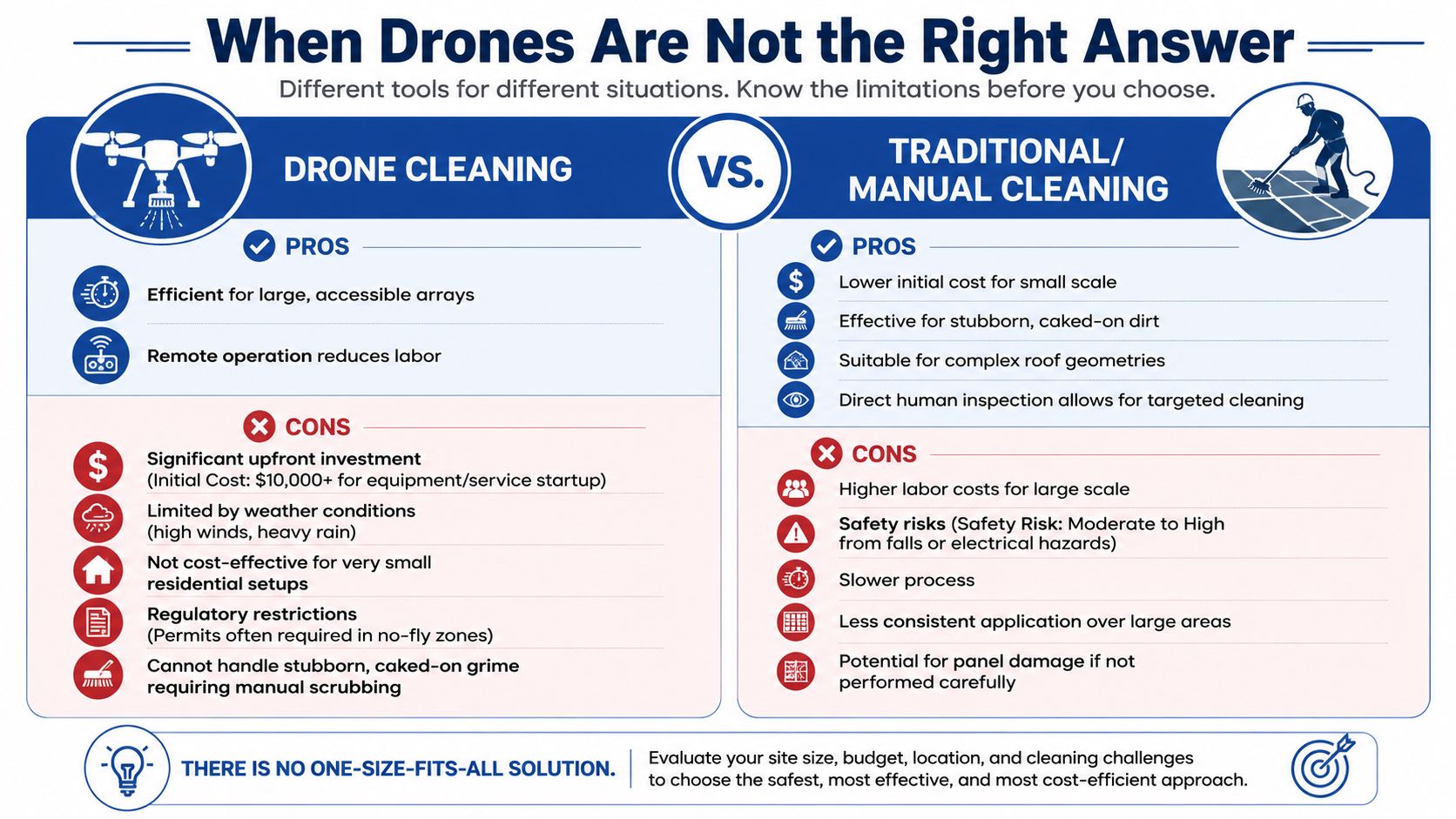
Drone cleaning has real advantages, but it's not the default answer for every roof in Arizona. Some properties are too small to justify it. Some are too cluttered. Some have debris that still calls for hands-on work. And some owners hear “drone” and assume it means cheaper, when the opposite can be true.
The cost barrier is real
Commercial viability demands a “business in a box for $75,000” including the aircraft, training, and insurance, according to this industry overview of drone cleaning economics. That high entry cost is one reason drone ROI may not pencil out for smaller installations where manual methods still work well.
That matters to the customer because serious equipment, trained pilots, insurance, and support gear all have to be paid for somehow. If you have a modest residential array on an easy-to-access roof, the advanced setup may be more than the job needs.
For many owners, a grounded explanation of how to clean solar panels is more useful than a blanket statement that drones are always best.
Some dirt still needs direct attention
Drone systems are excellent for regular maintenance cleaning on the right surfaces. They're not automatically the best tool for every contamination type.
A few examples where manual cleaning often makes more sense:
- Stubborn buildup: Thick caked-on grime, bird droppings, or residue in isolated areas may need targeted hand work.
- Complex roof geometry: Multi-level roofs, obstructions, overhangs, and tight corners can limit safe drone movement.
- Small residential systems: If the array is compact and easily reached, the setup time and equipment cost can outweigh the benefit.
Side-by-side view of the trade-offs
| Method | Best fit | Main drawback |
|---|---|---|
| Drone cleaning | Large, open, repetitive panel layouts | Higher cost and more operational complexity |
| Manual cleaning | Smaller systems, spot cleaning, complex roof details | More labor, slower pace, and more roof exposure |
| Ground-based robotics | Certain large-scale installations with predictable layouts | Site-specific limitations and specialized deployment needs |
What gets oversold
The biggest problem in this market isn't the technology. It's the messaging. Some providers talk as if a drone is automatically safer, faster, and cheaper in every case. That's not how field work works.
A balanced recommendation depends on the site. If a property has a clean layout, enough scale, and a recurring maintenance need, drone cleaning can be a smart operational tool. If the roof is intricate or the array is small, a skilled manual crew can be the better answer.
The best cleaning method is the one that fits the roof, the soil condition, and the maintenance budget. Not the one with the flashiest equipment list.
Navigating Safety Regulations and Insurance
The legal side of drone cleaning matters. So does the part that gets talked about far less, which is what happens when water, electricity, roofs, and aviation equipment all meet on one job.
For commercial drone work in the United States, operators need FAA Part 107 certification. That's the baseline. It tells you the pilot is legally qualified to operate commercially. It does not tell you the company has a complete safety protocol for solar panel cleaning.
The electrical risk is not theoretical
Experts warn that “drone solar panel cleaning and electrocution is a very real risk” unless an electrician tests equipment for insulation beforehand, according to this electrocution risk discussion for drone solar cleaning. The same source notes that FAA Part 107 licensing does not explicitly codify electrical safety standards.
That gap matters. A provider can be legal to fly and still be unprepared for the specific hazards of washing around energized solar infrastructure.
What property owners should ask for
Before any work starts, the provider should be able to explain:
- Electrical precautions: How equipment is evaluated before water is introduced near live components
- Insurance documentation: Proof of active coverage for drone operations and property damage
- Site-specific planning: How the crew handles hose routing, takeoff areas, setbacks, and emergency procedures
A broader overview of essential insurance for cleaning companies is worth reading if you want to understand why liability coverage matters so much on specialized exterior cleaning jobs.
Hiring a hobbyist because they own a drone is a liability decision, not a savings strategy.
Insurance is especially important for commercial properties, HOAs, retail centers, and multi-story buildings. If an operator can't produce clear documentation or gets vague about safety, move on.
Your Guide to Hiring a Drone Service in Arizona
Most owners don't need to become drone experts. They do need to ask better questions. In Arizona, that means focusing on dust conditions, water quality, roof access, and whether the provider understands the difference between a flashy demo and a dependable maintenance program.
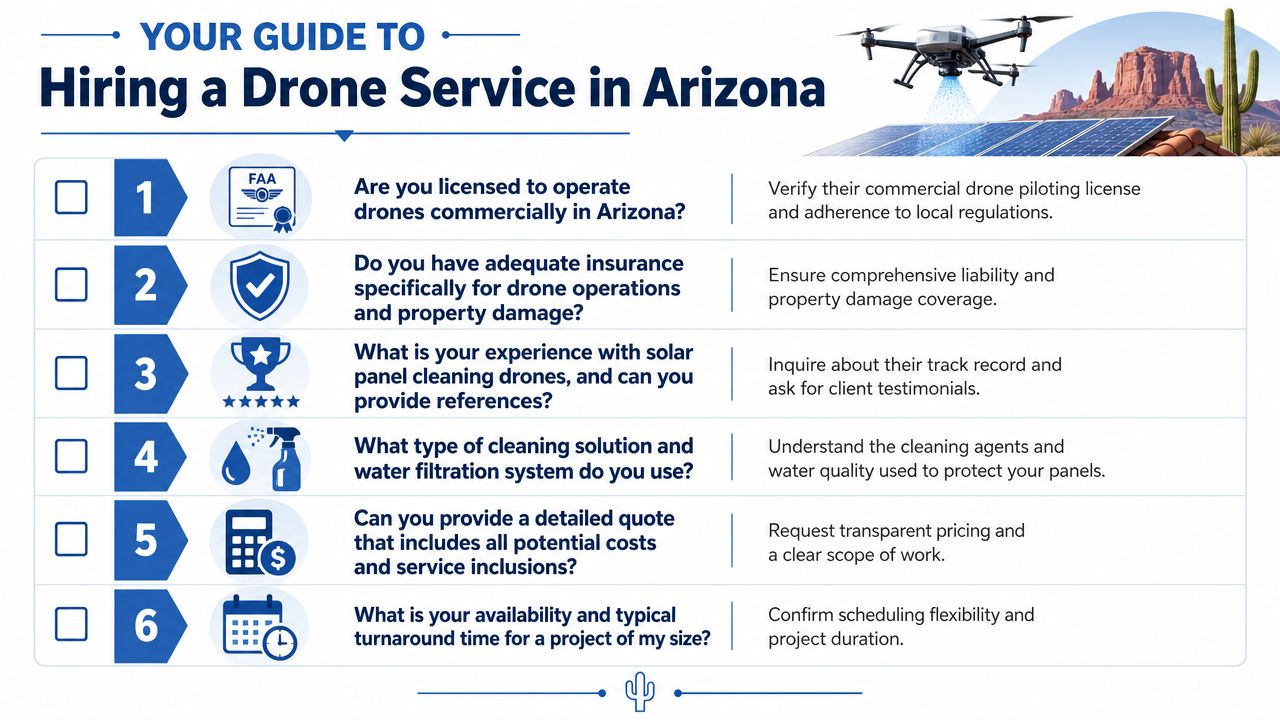
Questions that separate professionals from marketers
Start with the basics, then get specific.
- Ask about certification: Are your drone operators FAA Part 107 certified for commercial flight?
- Ask about insurance: Can you provide a certificate of insurance that specifically covers drone operations and property damage?
- Ask about water quality: Are you using purified water suitable for solar panels, and how is that water supplied on site?
- Ask about electrical safety: What is your process for addressing insulation and electrocution risk around live solar equipment?
- Ask about method selection: When would you recommend manual cleaning instead of a drone for a property like mine?
Those questions tell you a lot very quickly. A serious provider answers directly. A weak provider pivots back to buzzwords.
What Arizona owners should think about before requesting quotes
Phoenix-area properties vary widely. A flat commercial roof in Tempe is a different job from a tile-roof home in Scottsdale or a large estate in Paradise Valley with tight access and surrounding landscaping.
Use this quick decision framework:
| Property condition | Better first option |
|---|---|
| Large array with open access | Ask for a drone evaluation |
| Small residential system with easy reach | Compare manual cleaning first |
| Roof with obstacles, trees, or awkward geometry | Ask whether hybrid service is possible |
| Heavy isolated grime on select panels | Consider targeted manual treatment |
Don't shop by headline claims alone
AI-integrated autonomous robotic systems have demonstrated an average cleaning efficiency of 91.3%, restoring up to 31.2% of energy output on heavily soiled panels, according to this overview of AI-integrated solar cleaning systems. That's promising. It also doesn't mean every provider with a drone is delivering that level of performance on every Arizona roof.
The gap between demo-quality marketing and field-quality service is real. Ask what system they use, how they document the job, and how they determine whether your site is even a good fit for aerial cleaning.
A practical hiring checklist
Before you sign anything, make sure you've covered these points:
- Scope of work: Which panels are being cleaned, what method will be used, and what happens if some areas require hand work
- Access planning: Where the crew will stage equipment, how long the site will be occupied, and whether your roof or lot has restrictions
- Seasonal timing: Ask how the company handles scheduling around dust events, pollen periods, and monsoon-related buildup
- Post-job review: Will they document completion and flag any visible issues that need a separate solar technician's attention
A good quote doesn't just give a price. It explains the method, the limits, and why that method fits your property.
Maximizing Your Solar Investment
Clean panels produce better than dirty ones. In Arizona, that isn't a cosmetic issue. It's routine asset maintenance. Dust, pollen, and residue lower performance, and waiting too long between cleanings usually costs more in lost output than owners expect.
A solar panel cleaning drone can be an excellent solution when the site is large, accessible, and repetitive enough to benefit from aerial cleaning. It's less compelling on smaller or more complex properties where manual work remains the practical choice. The method matters, but the bigger decision is choosing a provider who understands water purity, roof conditions, electrical safety, and insurance.
If you run a solar business and want to understand how companies get found in competitive markets, these local search strategies for solar businesses offer useful context on how professional operators position their services online.
The right approach is simple. Evaluate the site accurately, choose the cleaning method that fits it, and treat solar maintenance like the investment protection work it is.
If you want an expert opinion on the most effective way to clean your panels, South Mountain Window Cleaning, LLC can help. The team provides residential, commercial, and high rise window washing services across Phoenix, Scottsdale, Paradise Valley, Chandler, Tempe, Gilbert, Arizona, and also handles exterior cleaning services that support solar performance in Arizona's dusty climate. Reach out for a straightforward assessment and a recommendation based on your property, whether that means drone cleaning, manual cleaning, or a more economical hybrid approach.