
By the time a commercial property starts looking neglected in Arizona, it usually isn't because anyone ignored it. It's because dust settles fast, sprinkler overspray leaves mineral staining, drive-thrus collect oil and gum, and the sun bakes every bit of grime into concrete, stucco, and painted surfaces. A building can be professionally managed and still look tired within weeks.
That's why commercial power washing supplies matter more than most managers expect. The difference between a clean-looking property and a property that stays presentable often comes down to equipment fit, detergent choice, operator habits, and maintenance discipline. If you're managing retail, office, multifamily, restaurant, or mixed-use sites in Phoenix, Scottsdale, Paradise Valley, Chandler, Tempe, or Gilbert, you're not just cleaning for appearance. You're protecting surfaces, reducing complaints, and avoiding the slow decline that makes a property feel older than it is.
Beyond the Bucket A Manager's Introduction to Power Washing
Most managers first think about power washing when tenants complain, ownership is touring, or a storefront starts losing that sharp edge. The visible issues are obvious. Sidewalk darkening, dumpster pad buildup, stained entryways, and dusty facades pull down curb appeal fast. What's less obvious is that delay usually makes cleaning harder and more expensive.
Professional exterior cleaning has grown because operators and property managers keep running into the same reality. A hose, a bucket, and occasional spot cleaning won't keep up with modern commercial sites. The global commercial pressure washer market was valued at USD 3.19 billion in 2025 and is projected to reach USD 4.03 billion by 2030, growing at a CAGR of 4.8%, which reflects how widely professional power washing is used for building exteriors, walkways, and drive-thrus according to commercial pressure washer market projections from MarketsandMarkets.
That matters on the ground. A shopping center manager isn't buying a machine or hiring a vendor just to remove dirt. They're preserving first impressions, limiting slip hazards, and keeping high-traffic surfaces from looking permanently worn.
Why Arizona changes the equation
Arizona properties get punished differently than properties in wetter climates. Fine dust builds quickly. Heat dries detergent before it can dwell properly if crews don't manage timing. Hard water and irrigation overspray leave stubborn staining. Painted curbs, decorative concrete, EIFS, stucco, and coated metal all react differently under pressure.
Clean surfaces don't stay clean in the desert by accident. They stay clean because someone matched the method to the material and the climate.
A useful way to look at commercial power washing supplies is as a system, not a shopping list. The washer, pump, hose, nozzle, surface cleaner, detergent, PPE, and storage habits all affect outcome.
For a broader look at why these services matter on commercial properties, the article on benefits of power washing for curb appeal and maintenance is worth reviewing.
What property managers should care about first
Before talking brands or accessories, focus on three questions:
- What surfaces are you maintaining. Concrete, stucco, painted masonry, storefront aprons, dumpster pads, and breezeways don't clean the same way.
- How often will you clean them. Recurring maintenance needs a different setup than occasional restoration work.
- Who's responsible for uptime. If equipment sits broken or chemicals are stored poorly, the whole plan fails.
Managers who start with those questions usually avoid the common mistake of buying around price alone.
The Core Equipment Power Washers and Pumps
The power washer is the engine of the whole operation. If it's undersized, crews work too slowly and overcompensate with bad technique. If it's oversized for the surface, you increase the chance of etching concrete, damaging sealants, or stripping coatings where you didn't intend to.
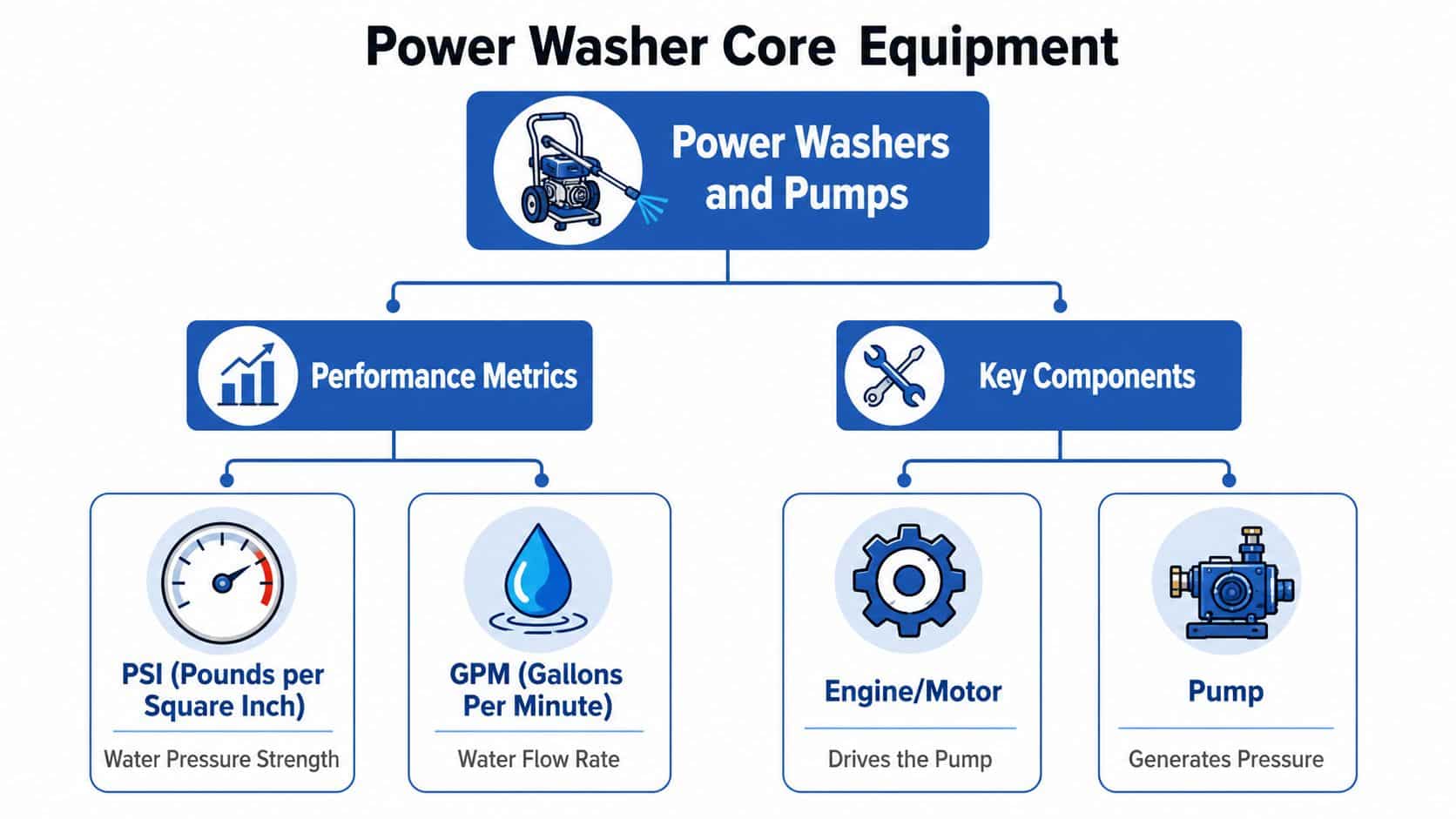
PSI and GPM do different jobs
Managers hear PSI and GPM constantly, but they shouldn't treat them as interchangeable. PSI is pressure. It's the force hitting the surface. GPM is flow. It's how much water moves through the system. In practical terms, PSI helps break soils loose, while GPM helps carry contamination away and speed up production.
A useful analogy is this. PSI is the bite. GPM is the pace. A machine can hit hard and still clean slowly if flow is weak. On large commercial flatwork, low flow usually costs more time than managers expect.
Hot water versus cold water
Cold water units handle a lot of routine building and walkway cleaning when paired with the right chemical and technique. But greasy work changes the decision. Dumpster pads, restaurant back entries, loading areas, and drive-thrus often respond better to hot water because heat helps break down oily residue and food-related buildup.
That doesn't mean hot water is automatically better for every property. Hot water systems are heavier, more complex, and require tighter maintenance discipline. For managers overseeing mostly dust, general grime, and non-grease flatwork, a cold water setup can be more practical.
Practical rule: Use heat when the soil is the problem. Use restraint when the surface is the risk.
Gas, electric, direct drive, and belt drive
The power source matters less than most marketing suggests and more than many buyers realize.
- Gas-powered units usually make sense where mobility and field use matter most. They work well on larger properties and areas without convenient power access.
- Electric units fit sites that need lower noise, easier starts, and cleaner operation. They're often easier for indoor-adjacent or noise-sensitive environments. The industry is also shifting toward electric-powered growth, as reflected in the same earlier market outlook.
- Direct-drive systems are simpler and compact. They're common, serviceable, and fine for many applications.
- Belt-drive systems are often chosen when crews expect longer run times and want reduced pump wear from lower pump RPM.
A manager evaluating a contractor should listen for how they discuss these trade-offs. If the answer is always “more pressure,” that's usually a warning sign.
For a practical residential comparison that also helps frame commercial conversations, what goes into pressure washing a house correctly gives useful context on machine choice and surface risk.
The Application Arsenal Hoses Nozzles and Surface Cleaners
A strong machine with the wrong attachments still produces weak work. On commercial sites, the delivery tools matter because they control speed, consistency, and surface safety more than the raw machine spec does.
Hoses and lances that hold up on real properties
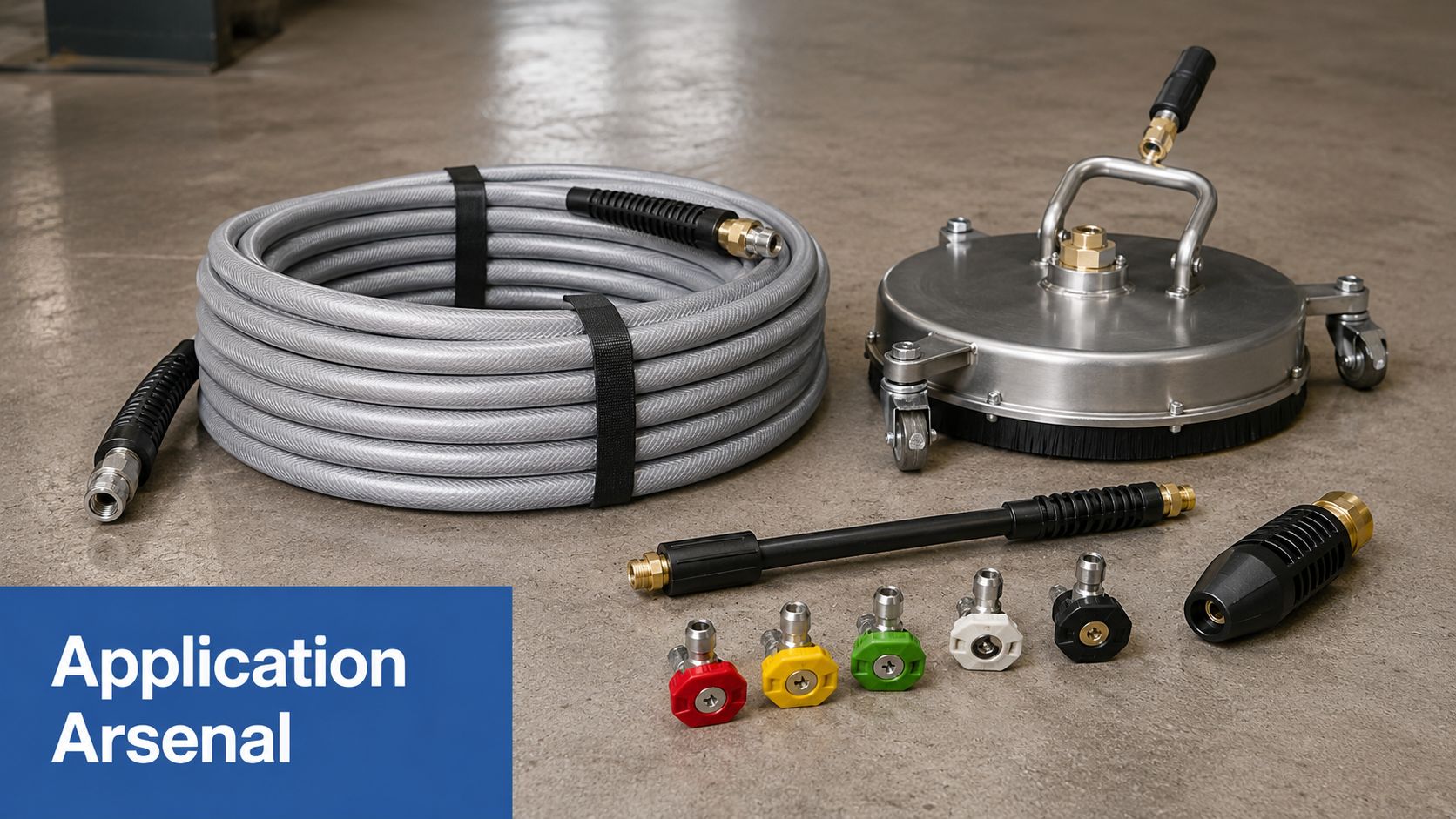
Commercial crews don't need bargain hoses. They need hoses that won't mark walls, kink constantly, or fail halfway through a service window. Non-marking hose jackets matter on light-colored surfaces and finished entries. Reinforced construction matters when crews are dragging lines over curbs, corners, and rough flatwork.
The same goes for spray guns and lances. Poorly balanced lances make operators compensate with awkward angles, and that usually shows up in uneven cleaning. If you want a solid technical overview of lance options and why the right reach and control matter, the MA Hydraulics experts on jet lances break down the basics well.
Nozzles are where bad decisions become visible
Most crews rely on the standard color-coded nozzle system because it works. The mistake is thinking each nozzle is just a stronger or weaker version of the others.
- 0-degree nozzle concentrates force tightly. It has niche use and a high damage risk.
- 15-degree nozzle is aggressive and useful for stubborn buildup on durable surfaces.
- 25-degree nozzle is the everyday workhorse for many general cleaning tasks.
- 40-degree nozzle is better for rinsing and for more delicate areas such as some stucco or painted surfaces.
- Soap nozzle is for applying downstream chemical at lower pressure.
A nozzle that's technically “effective” can still be the wrong choice if it leaves lap marks, stripes, or wand scars. On visible commercial frontage, uniformity matters as much as removal.
Why surface cleaners change production
Flatwork is where professional setups separate themselves from improvised ones. Surface cleaners are the right tool for sidewalks, breezeways, entry plazas, parking decks, and similar areas because they clean evenly and faster than a wand alone.
A wand can clean concrete. It just won't do it uniformly across large areas unless the operator is unusually disciplined and patient. Surface cleaners reduce streaking, contain overspray better, and make production more predictable.
This walkthrough helps visualize how tool choice affects workflow on large areas:
For managers responsible for aprons and flatwork specifically, professional driveway pressure washing methods offer a close parallel to what works on commercial concrete.
Essential Consumables Detergents and Safety Gear
Commercial power washing supplies aren't just machines and metal. Chemistry and PPE are what turn a rinse into a controlled cleaning process. Managers who cut corners here usually pay for it later in slower production, rework, damaged surfaces, or avoidable incidents.
Detergents do the heavy lifting
Pressure alone doesn't solve most commercial cleaning problems. It removes loose soil. It doesn't reliably break down grease, irrigation staining, oxidation film, organic residue, or the traffic grime that builds up around entries and dumpster enclosures.
Use the detergent that matches the contamination:
- Degreasers are for oily areas such as service corridors, dumpster pads, and restaurant back doors.
- Neutral building washes are the safer starting point for general grime on many exterior surfaces.
- Rust and mineral stain removers are useful where irrigation leaves orange or white deposits on masonry, concrete, and curbing.
- Specialty soaps may be needed for painted surfaces, delicate finishes, or maintenance cleaning where residue control matters.
What doesn't work is using one harsh cleaner for every job. That approach might remove a stain today and create a surface problem tomorrow.
The best detergent is the one that lets the operator clean with less aggression, not the one with the toughest label.
Another common miss is dwell management in Arizona. When heat and sun flash-dry product, the chemistry can stop working or leave residue. Crews need to work smaller sections, watch surface temperature, and rinse before the product dries.
For a good example of how solution choice affects wash quality, choosing the best house washing solution highlights the difference between generic soap use and surface-specific chemistry.
PPE is part of production, not a separate issue
Some managers still see PPE as a compliance box. On active commercial sites, it's more basic than that. PPE keeps crews working safely enough to stay efficient.
A proper setup usually includes:
- Eye protection for rebound spray, grit, and chemical splash.
- Chemical-resistant gloves when handling detergents, especially concentrates.
- Slip-resistant or steel-toed footwear for wet pavement, hose handling, and jobsite movement.
- Hearing protection when operators spend long hours around gas units or loud equipment.
- Appropriate clothing to limit skin exposure from spray and chemical contact.
Cheap supplies create expensive risk
The hidden cost of bad consumables is inconsistency. Weak detergents force operators to overuse pressure. Inadequate gloves lead to rushed handling. Poor footwear changes footing and body position, which affects nozzle control and fatigue.
If you manage multiple properties, ask vendors what detergents they use, how they control dwell time in heat, and what PPE standards crews follow. Those answers tell you a lot about whether they run a professional operation.
Specifying for Success Matching GPM to Your Needs
One of the most common equipment mistakes is buying a surface cleaner by guesswork. Bigger isn't automatically better. On commercial flatwork, an oversized cleaner attached to an underpowered machine usually leads to weak rotation, poor recovery, slower cleaning, and visible striping.
The useful sizing rule is simple. A surface cleaner's width in inches should be roughly four times the machine's GPM, and a 4 GPM machine is optimally paired with a 16-inch surface cleaner, as explained in this surface cleaner sizing guidance. That same guidance also points out that mismatching these components is a common cause of poor results and unnecessary strain.
The sizing rule that actually helps on site
Managers don't need to memorize pump curves to make better decisions. They just need to understand that flow has to support the cleaning head. If the deck is too wide for available water volume, the cleaning bar won't do the job it was designed to do.
That matters for vendor oversight too. If a contractor is cleaning broad concrete areas with a machine and surface cleaner that obviously don't belong together, you'll often see missed lanes and repeat passes.
Don't judge a setup by how large the attachment looks. Judge it by whether the machine can feed it properly.
Optimal Surface Cleaner Sizing Guide
| Machine GPM | Recommended Surface Cleaner Diameter (Inches) | Common Application |
|---|---|---|
| 2.5 | 10 | Small walkways and tight entry pads |
| 3 | 12 | Side paths and smaller storefront concrete |
| 4 | 16 | General commercial sidewalks and aprons |
| 5 | 20 | Larger flatwork areas with open access |
The exact site still matters. Tight corners, bollards, outdoor seating, and decorative edges can make a slightly smaller cleaner more practical even when the machine could support a larger one.
Don't forget the rest of the system
A balanced setup doesn't stop at the surface cleaner.
- Hose length affects work feel and pressure delivery. Too short and crews drag machines constantly. Too long and handling gets clumsy.
- Nozzle selection has to match surface sensitivity. The wrong spray angle can turn a simple maintenance wash into etching, furrowing, or paint damage.
- Flow expectations should match the site. Large parking decks and long breezeways need a production-minded setup. Small, intricate storefronts need maneuverability and control.
A smart property manager doesn't need to own this equipment to benefit from knowing these basics. It gives you better purchasing judgment if you manage in-house work, and it gives you better questions if you hire it out.
Procurement Storage and Proactive Maintenance
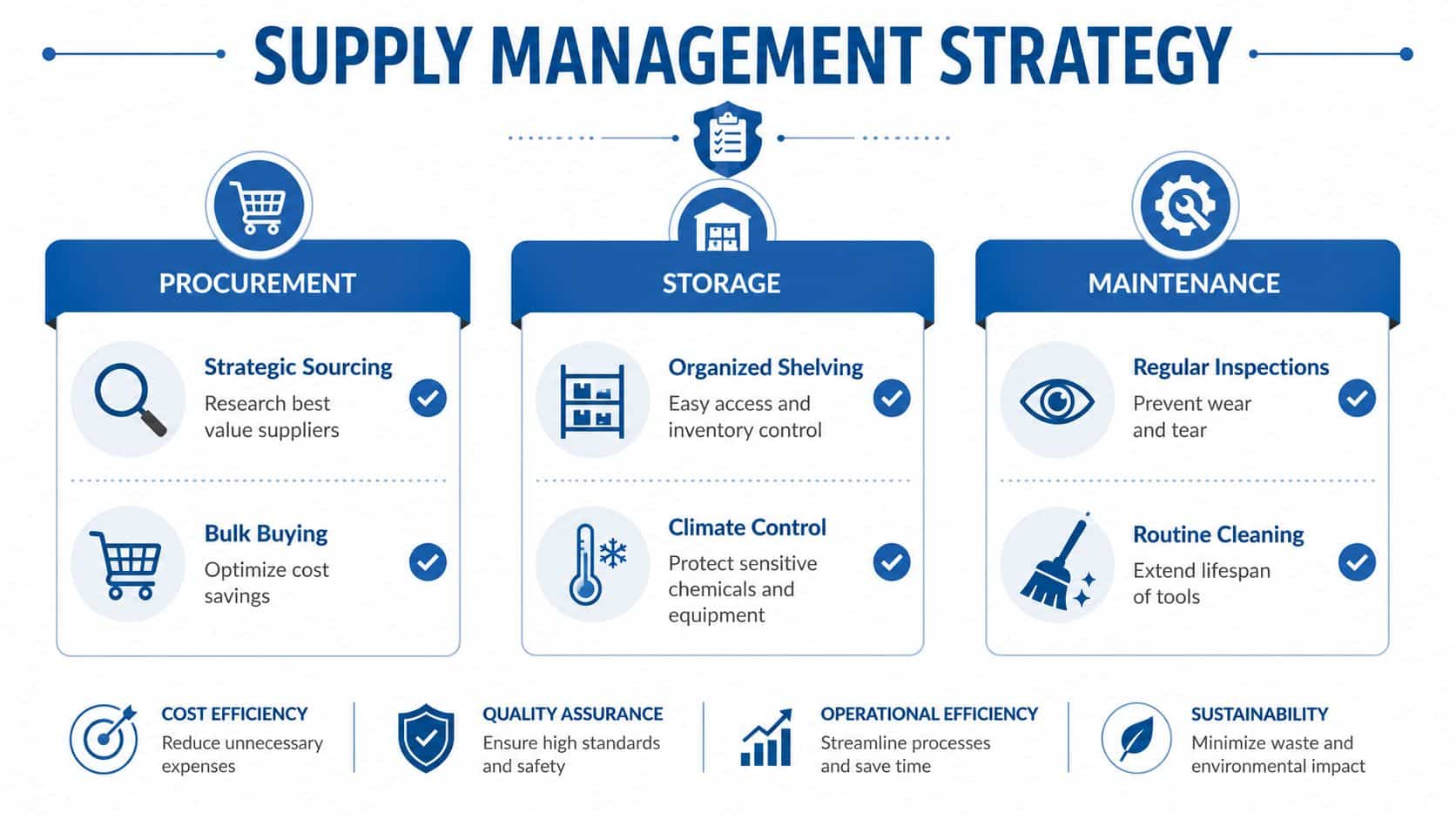
Buying the right equipment is only half the job. Keeping it usable in Arizona is where many otherwise solid setups fall apart. Heat dries seals, UV shortens hose life, hard water leaves deposits, and long idle periods degrade machines that looked fine when they were parked.
Buy versus rent depends on frequency and control
Ownership makes sense when your portfolio has recurring exterior cleaning demand and someone is accountable for upkeep. Renting fits occasional specialty work, overflow periods, or one-off restoration tasks where long-term storage and maintenance don't pencil out.
The trap is buying equipment because the machine itself seems affordable, then neglecting the essential support needs. Hoses, filters, nozzles, chemical storage, maintenance parts, and operator habits determine whether ownership saves money or creates downtime.
Storage mistakes are more expensive than they look
Improper storage is one of the easiest ways to shorten equipment life. According to pressure washer maintenance guidance from WET, failing to disconnect hoses and briefly run the machine to expel residual water can lead to internal freeze damage in colder climates or bacterial growth and seal degradation in warmer ones.
That warning applies in Arizona too. People think only about heat, but colder desert nights and higher-elevation conditions can still create freeze risk. Even when freezing isn't the problem, trapped water, stagnant lines, sun exposure, and poor ventilation create their own damage.
A storage routine that prevents headaches
Use a repeatable shutdown process:
- Disconnect hoses fully so the machine and line aren't holding trapped water under tension.
- Run the machine briefly to help expel residual water where the manufacturer's procedure allows.
- Store in a dry, ventilated area away from direct sunlight.
- Keep chemicals separated and labeled so concentrates don't leak onto equipment or contaminate other supplies.
- Inspect reels, seals, and quick connects before the next use instead of discovering problems on site.
Storage discipline saves more equipment than emergency repairs do.
Maintenance should follow a rhythm
Daily checks should be short and visual. Look for leaks, damaged hoses, worn nozzles, and loose fittings. Confirm that filters and inlet screens are clean.
Weekly attention should go deeper. Check oil where applicable, inspect hose jackets for abrasion, and clean out any buildup around moving parts or spray components.
Monthly review is where managers or crew leads catch repeat issues. If the same coupling leaks, the same gun binds, or the same hose section kinks, the system is telling you what needs replacement or a different workflow.
Arizona adds one more variable. Hard water leaves mineral deposits that gradually reduce performance if crews skip flushing and cleaning habits. The equipment may still run. It just won't run well.
Operational Excellence Calculating ROI and Scheduling Service
A clean property doesn't just look better. It runs better. Complaints drop, site walks go smoother, and tenants stop treating stained entries and dirty walks as signs that management is slipping. That's the true return from commercial power washing supplies and the services built around them.
The business case is easy to miss if you only look at a single invoice. In practice, regular exterior cleaning supports leasing, customer experience, and risk reduction. In the U.S. pressure washing industry, commercial contracts represent 33 to 38 percent of total revenue, and for larger operators that can rise to 50 to 65 percent, according to this industry overview on commercial pressure washing demand. Businesses keep buying these services because clean, safe, presentable properties have operational value.
How to think about ROI without forcing fake precision
You don't need an invented spreadsheet metric to decide whether routine washing is worth it. Use a simple management lens:
- Appearance value. Does the property present well to tenants, shoppers, guests, or ownership?
- Surface preservation. Are you removing buildup before it becomes difficult or damaging to clean?
- Labor efficiency. Are recurring visits preventing larger, slower, more disruptive cleanups?
- Site safety. Are greasy pads, slippery entries, and neglected walk areas being addressed before they become a problem?
If those answers improve, the program is doing its job.
A practical service rhythm for Arizona properties
Scheduling should follow use patterns, not just the calendar.
High-traffic storefronts, restaurant pads, and customer-facing entries often need the most frequent attention. Building exteriors usually work on a broader maintenance cycle. Parking structures, loading areas, and less visible service zones can be scheduled around accumulation and inspection findings.
A workable checklist looks like this:
- Walk the site monthly and photograph problem areas from the same angles.
- Group surfaces by exposure such as public-facing, grease-prone, shaded, or irrigation-affected.
- Schedule early-morning work when Arizona heat would otherwise shorten detergent dwell time.
- Bundle related services so glass, flatwork, and facade cleaning support each other instead of being handled in isolation.
The best cleaning schedule is the one that prevents embarrassment, not the one that reacts to it.
If you manage properties across Phoenix, Scottsdale, Paradise Valley, Chandler, Tempe, or Gilbert, consistency usually matters more than intensity. A steady program keeps properties looking managed. Sporadic cleanup makes them look rescued.
South Mountain Window Cleaning, LLC serves commercial and residential clients across Phoenix, Scottsdale, Paradise Valley, Chandler, Tempe, and Gilbert, Arizona, with window cleaning, power washing, house washing, high-rise service, and other exterior cleaning support suited for the Valley's harsh conditions. If you need a reliable partner for storefront glass, walkways, drive-thrus, building exteriors, or recurring maintenance planning, contact South Mountain Window Cleaning, LLC for a quote and service schedule that fits your property.