
If you're standing in a Phoenix driveway or looking up from a courtyard and the glass looks fine in the shade but awful in full sun, you're not imagining it. High windows in the Valley collect a mix of dust, pollen, hard-water residue, and baked-on grime that only becomes obvious when that Arizona light hits at the right angle. On second-story homes, office entries, atrium glass, and high-rise façades, the problem isn't just cleaning. It's reaching the glass safely and finishing it without leaving new marks behind.
The Challenge of High Windows in the Phoenix Sun
Phoenix is unforgiving on glass. Dust settles fast, sprinkler overspray leaves mineral residue, and intense sun can make every streak look sharper by mid-morning. That changes the way high windows cleaning has to be approached. What works on a shaded first-floor pane with a towel and spray bottle often fails badly once the glass is higher, sun-exposed, and difficult to access.
On taller homes and commercial buildings, the challenge isn't only height. It's the combination of heat, visibility, and surface buildup. Arizona architecture adds to that. Stucco walls throw dust back onto glass, flat roofs can drop debris near parapets, and modern homes in Scottsdale and Paradise Valley often use large fixed panes that show every imperfection.
The window cleaning trade exists at a large scale because property owners keep running into this exact problem. One industry estimate places the global window cleaning market at $45.2 billion in 2022, with projected growth to $68.7 billion by 2030, and it estimates the U.S. window cleaning services industry at $2.8 billion in 2023. The same source notes that commercial contracts account for 55% of global window cleaning revenue, which says a lot about how important recurring building maintenance is for appearance and property upkeep in practice, not just in marketing language, according to window cleaning industry market data.
Why high glass looks worse in Arizona
A clean window in Phoenix has to survive more than fingerprints.
- Sun exposure: Direct light magnifies residue that might go unnoticed elsewhere.
- Dust load: Fine desert dust clings to frames, tracks, screens, and upper ledges.
- Hard water: Irrigation overspray and hose rinsing often leave visible mineral spotting.
- Height: The higher the window, the less forgiving your technique and equipment become.
Practical rule: If you need to lean, stretch, or guess whether a tool will reach, the job has already moved out of routine cleaning and into access work.
For property owners, that usually means the primary question isn't "How do I wash this?" It's "What's the right access method for this building, this glass, and this site?"
Methods and Equipment for Reaching New Heights
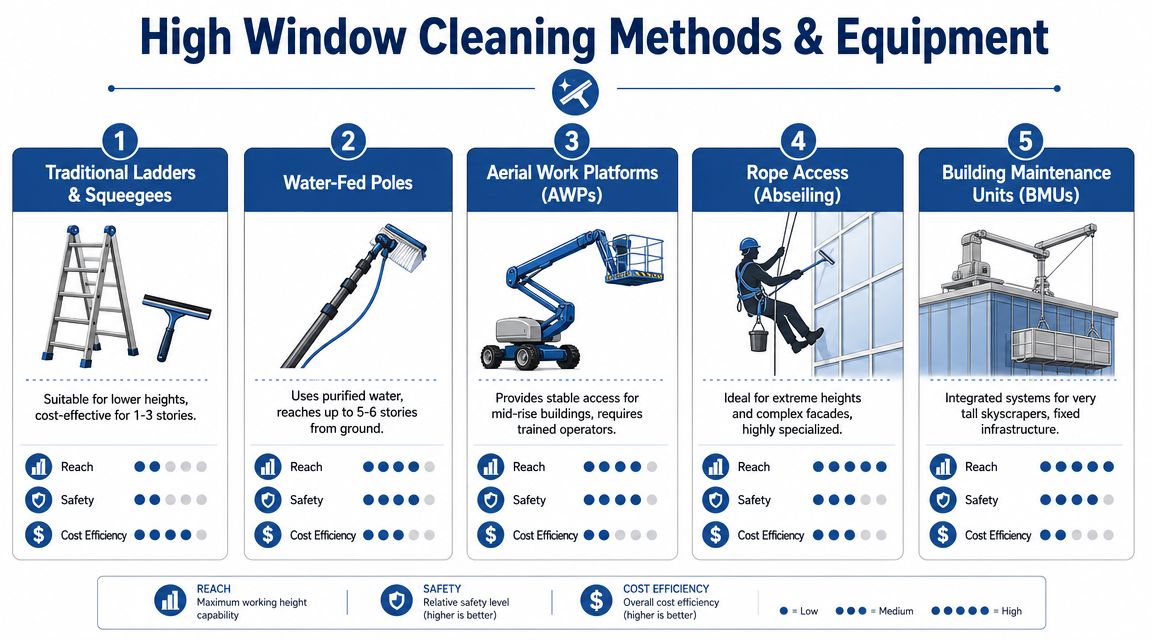
There isn't one universal method for high windows cleaning. The right choice depends on height, ground access, façade design, landscaping, roof conditions, and how much soil is built up on the glass. In practice, the method should fit the building, not the other way around.
Water-fed poles from the ground
For many Phoenix homes, medical offices, schools, and mid-rise commercial properties, a water-fed pole system is the cleanest first option. Professional guidance says water-fed poles are typically suitable up to about 6 to 8 storeys, while some consumer-facing guidance describes professional systems reaching around six stories or roughly 90 feet from the ground. The broader point is consistent. Ground-based purified-water systems work well on many high windows, but they have a limit, as explained in high-rise access method guidance.
This method uses long poles with a brush head and purified water delivery. The brush agitates dirt. The purified water rinses the glass so it can dry clear without needing a technician to hand-detail every pane from a ladder.
It works especially well on:
- Multi-story homes: Tall entry windows, stacked second-story glass, and rear elevation windows over patios
- Commercial storefront clusters: Buildings with awkward landscaping where ladders would be clumsy
- Low-to-mid-rise offices: Properties with good ground access and repetitive window layouts
A useful reference if you're comparing tools is this overview of equipment used for high-rise window cleaners.
Rope access for tall and complex façades
When one thinks of true high-rise window cleaning, rope access often comes to mind. It's used on medium to very high buildings where ground systems can't reach and where suspended access is more practical than lifts. In Phoenix and Scottsdale, that often means condo towers, downtown office buildings, hotels, and properties with setbacks or architectural projections.
Rope access isn't just "someone rappelling down the side." Done correctly, it's a controlled system built around anchors, descent gear, backup fall protection, communication, and planned movement across the façade.
This method makes sense when:
- The building is too tall for ground methods
- The façade has obstacles or recessed glass
- Ground access is limited by traffic, canopies, or landscaping
- A repeatable route can be set from the roof
Rope access is efficient on the right building. It's the wrong answer on the wrong roof.
Lifts and elevated work platforms
MEWPs, including boom lifts and other aerial platforms, are generally best for low-to-medium height access where the ground can support the machine and the operator can position it safely. They're often a strong fit for retail centers, churches, schools, and mid-rise commercial buildings with open perimeter space.
They don't solve every problem. In dense urban settings, tight courtyards, soft landscaping, parked cars, and overhead obstructions can eliminate lift access fast. But where site conditions cooperate, they give technicians a stable working position and strong control over detail work.
When permanent systems are built into the property
Very tall landmark structures may use BMUs, or Building Maintenance Units. These are purpose-built systems integrated into the building for façade access. They bring repeatability and engineered control, but they also come with capital cost and ongoing maintenance complexity. For most residential and standard commercial properties in the Valley, BMUs aren't relevant. For iconic towers, they often are.
The Critical Role of Safety Protocols and Insurance
High windows cleaning is a trade where the quality of the safety system matters more than the sales pitch. A clean pane isn't hard to promise. What matters is whether the contractor can reach that glass with a written plan, appropriate access, trained technicians, and verifiable protection for the client if something goes wrong.
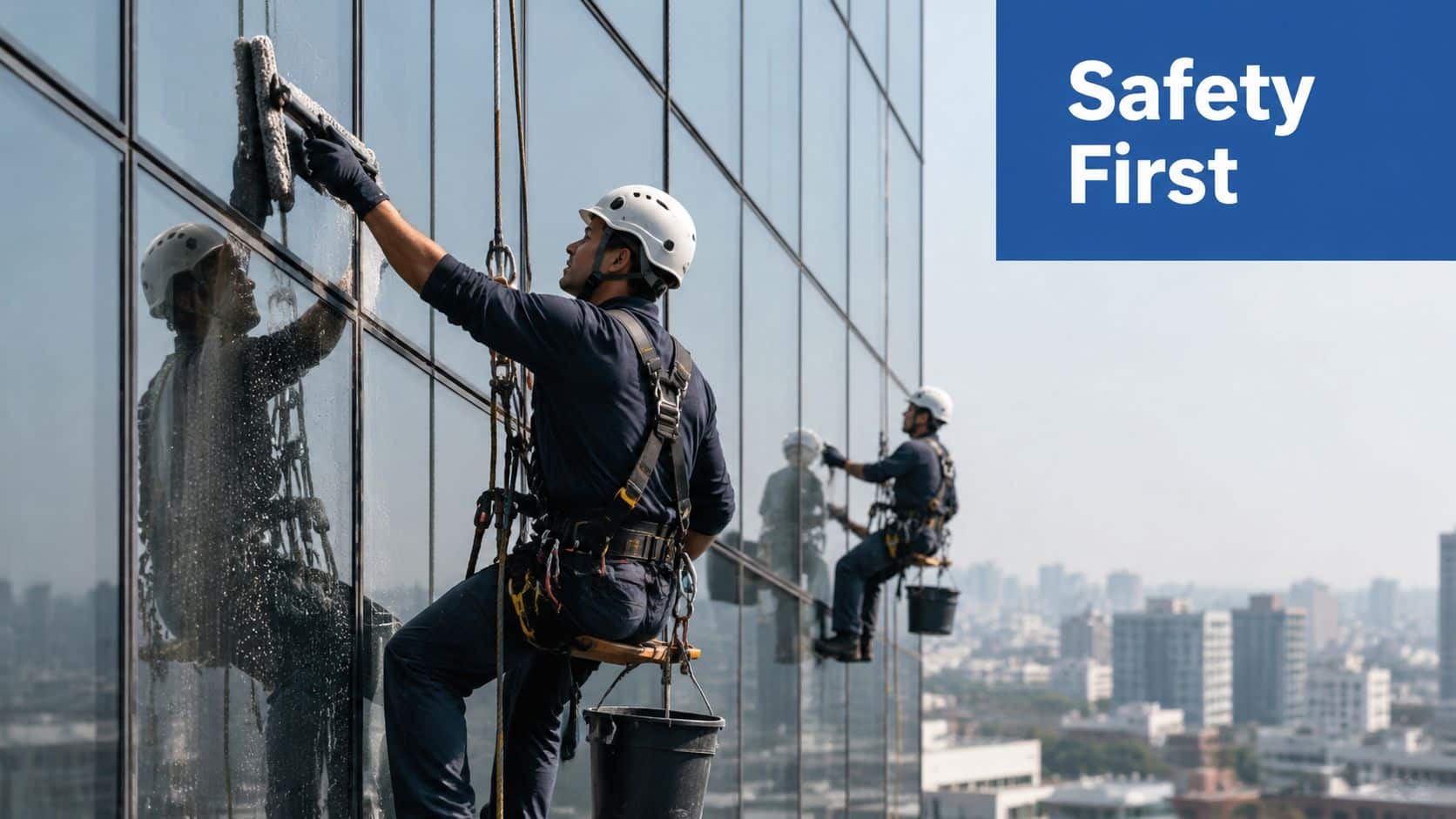
One safety review notes that in the UK, around 30 workers suffer serious injuries each year from high window cleaning, while modern safety practices now emphasize written work plans, formal risk assessments, and safer alternatives such as telescopic water-fed poles where appropriate. The same review also cites an industry summary saying that on average one high-rise window cleaner per year was killed between 2010 and 2014, showing that improved training and equipment changed outcomes materially, according to a safety-focused review of high window cleaning.
What a real risk assessment looks like
A legitimate assessment isn't a checkbox. It should account for the actual property.
That includes:
- Access selection: Ground system, lift, rope access, or a combination
- Site hazards: Power lines, unstable ground, pedestrian traffic, roof-edge conditions, and irrigation overspray
- Glass condition: Heavy mineral buildup, oxidized frames, or debris that changes cleaning technique
- Weather and timing: Wind, heat exposure, and whether direct sun will affect worker safety or finish quality
In Phoenix, timing matters more than many owners expect. Crews may need to work elevations in a sequence that follows shade, not convenience. That's not being picky. It's how you reduce heat stress and avoid forcing poor cleaning conditions.
Insurance is part of the safety system
Property owners often treat insurance as paperwork. It isn't. It's financial protection tied directly to access risk, worker exposure, and the possibility of property damage or liability claims.
If you're reviewing vendors, it helps to understand the basics of essential insurance for contractors before you ask for certificates. You don't need to become an insurance expert. You do need to verify that coverage is current and appropriate for height work.
A contractor handling suspended or high-level access work should be ready to provide documentation and explain what kind of jobs their policy covers. That conversation is part of due diligence, especially for property managers.
For an example of a provider that offers this category of service locally, high-rise window cleaning in Phoenix and surrounding areas is one option to review alongside any other properly credentialed contractor.
A short look at the work helps explain why the paperwork matters:
The signs of a contractor to avoid
Some red flags show up before the job starts.
- No written scope: If the contractor can't describe how they'll access the glass, stop there.
- Ladder-first thinking: If every problem gets solved with a ladder, they may not have the right equipment or judgment.
- Vague insurance answers: "We're covered" isn't proof.
- No discussion of exclusion zones: On commercial sites, pedestrian control matters.
Safe high-access work is built on planning, not confidence.
DIY Ambition vs Professional Reality
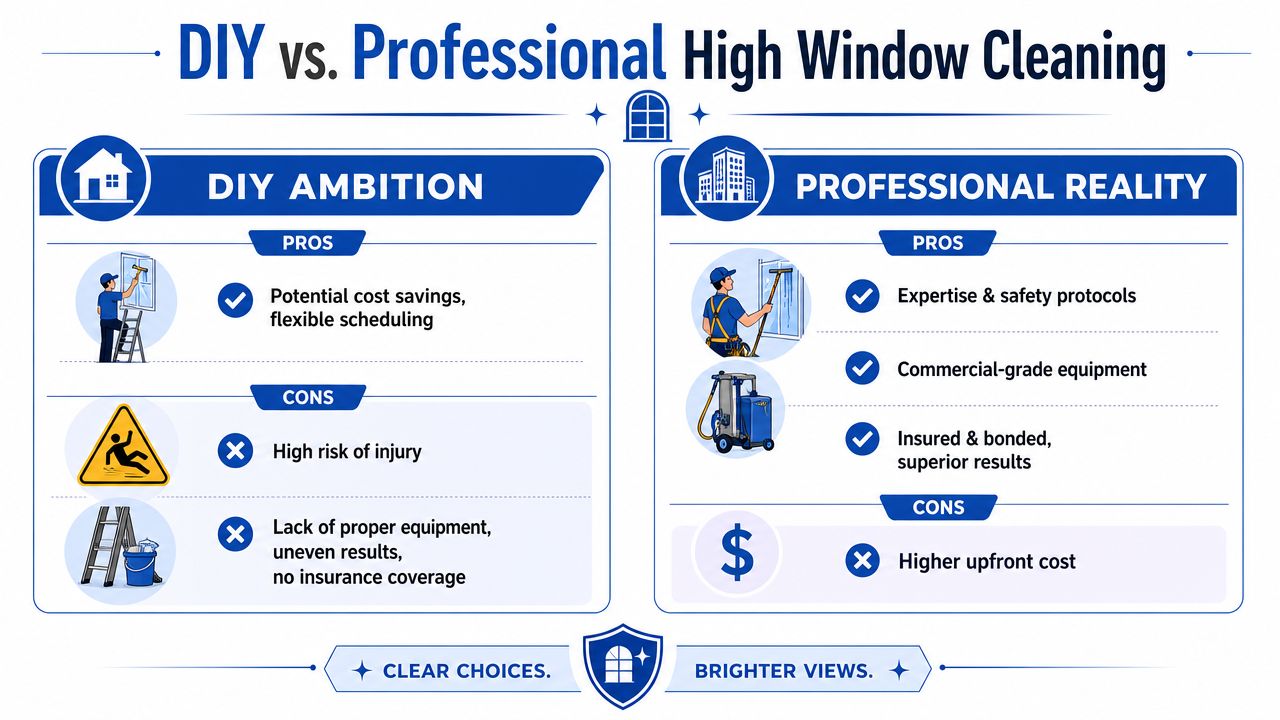
Most property owners think about doing high windows themselves for one reason. They want to save money. That's understandable, especially on a house with a few second-story panes or a small storefront with awkward glass above an entry canopy.
The problem is that DIY tools and professional systems live in different worlds. Consumer guidance says a telescoping pole is one of the safer DIY options, warns users to avoid unstable ground and electrical wiring, and advises calling a professional if the pole becomes too unwieldy. Professional guidance, by contrast, describes water-fed poles that can clean up to about six stories or roughly 90 feet from the ground, which marks a practical gap between homeowner tools and trained commercial use, according to consumer guidance on cleaning high windows.
Where DIY still makes sense
There are cases where a homeowner can handle the job.
If the glass is reachable from stable ground, the tool stays manageable, and there are no power lines, steep grades, or awkward architectural features, a telescoping pole can be a reasonable maintenance option. That's usually limited to simpler situations with light soil and easy access.
DIY becomes a bad bet when the job requires leaning from a ladder, pushing a long pole at full extension, working around fragile landscaping, or trying to remove baked-on buildup from upper windows in direct sun.
What professionals bring that DIY doesn't
The difference isn't only height. It's control.
Professionals typically have:
- Specialized access options: Ground systems, lifts, or rope access depending on the site
- Better rinse quality: Purified water systems reduce spotting compared with standard hose water
- A repeatable process: Crews know how to scrub, rinse, inspect, and detail without improvising
- Risk management: Training, planning, and insurance protection that DIY work doesn't provide
If you're comparing whether to handle it yourself or outsource it, this guide on how to wash high windows lays out the practical limits clearly.
| Factor | DIY Approach | Professional Service |
|---|---|---|
| Safety | Works only when the window is truly reachable from stable ground and the tool remains manageable | Uses the access method that fits the building and site |
| Equipment | Consumer poles, ladders, hose tools, and basic hand tools | Purified-water systems, lifts, rope systems, and commercial tools |
| Time | Often slower because setup, repositioning, and rework take longer | Faster workflow because crews use planned access and established methods |
| Results | Can be uneven, especially on high glass with dust and mineral residue | More consistent finish on difficult elevations |
| Liability | Falls and property damage are on you | Insurance and formal job procedures reduce owner exposure |
If a pole feels awkward on the ground, it won't get safer once it's extended.
How to Choose Your Phoenix High Window Cleaning Contractor
Hiring the right contractor starts with questions that force clear answers. In Phoenix, local experience matters because high glass here doesn't behave like it does in milder climates. Dust loads are heavier, hard-water spotting is common, and many buildings combine decorative architecture with access challenges that aren't obvious from the parking lot.

Questions worth asking before you approve the job
Start with the basics, then move straight into access and safety.
- Insurance verification: Ask for current general liability and workers' compensation documentation.
- Access plan: Ask how they intend to reach your specific glass. A real contractor should be able to explain the method without hedging.
- Building experience: Ask whether they've worked on similar homes, offices, towers, or mixed-use properties in the Valley.
- Water and finish approach: Ask how they handle dust, mineral spotting, and post-rinse quality in Arizona conditions.
Then ask one question many clients skip. What happens at the roof or anchor point if rope descent is involved?
What to verify for rope-descent work
OSHA-aligned guidance says rope descent components must support at least 5,000 pounds, the seat board must support 300 pounds, each worker needs a separate fall-arrest system attached to a separate anchor, and anchorages must be certified at least every 10 years. That makes anchor integrity one of the most important verification points on any suspended-access job, according to OSHA-oriented rope descent and anchorage guidance.
Those details matter because façade work usually doesn't fail at the squeegee. It fails, when it fails, at the system level.
Ask these directly:
- Who verifies the anchors?
- When were they last certified?
- Does each technician use an independent fall-arrest line?
- How do you inspect gear before use?
What local familiarity changes
A contractor who works regularly in the Valley will usually make better decisions on scheduling, water use, and finish expectations. They know that dusty wind can undo rushed work, that mineral residue may need more than a quick rinse, and that certain home designs in Paradise Valley, Chandler, Tempe, and Gilbert create awkward access points around courtyards, tile roofs, and recessed windows.
If you want one place to start comparing local credentials and service scope, review a Phoenix window cleaning company and hold every other bidder to the same standard of clarity.
South Mountain Window Cleaning Your Partner in Phoenix
For property owners in Phoenix, Scottsdale, Paradise Valley, Chandler, Tempe, and Gilbert, the right contractor isn't just someone who can reach the glass. It's someone who can match the method to the building, work safely in Arizona conditions, and show up with the systems needed for repeat service.
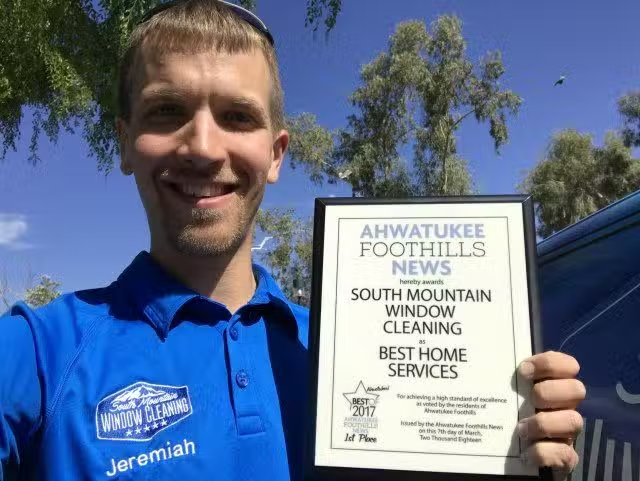
South Mountain Window Cleaning, LLC fits the practical checklist that matters on high-access work. The company is licensed, bonded, and insured, provides residential, commercial, and high-rise window washing, and operates with a $2 million insurance policy. Its technicians are described as clean-cut, safety-trained professionals who use pure-water systems and professional squeegee methods for lasting results. The company also notes 400+ five-star reviews and a 100% satisfaction guarantee, which gives property owners more than a generic promise.
Why local execution matters
On Valley properties, technique has to account for the environment. Crews need to work around hard-water spotting, airborne dust, roofline access constraints, and the way full sun exposes every missed detail. A contractor that's used to Phoenix architecture will be more comfortable with tall entry glass, multi-story stucco homes, office façades, retail centers, and the mix of modern and traditional building styles across the metro.
That local familiarity also matters for scheduling. Some elevations are better handled early. Others need a different sequence because of heat, glare, or foot traffic. Those aren't minor adjustments. They're part of delivering a clean result safely and consistently.
A sensible choice for homes and commercial properties
If you're managing a high-rise, maintaining a mixed-use property, or trying to keep a custom home's upper windows clear without taking unnecessary risks, you want a contractor that can handle both access and finish quality. That means more than showing up with a ladder. It means arriving with the right plan for your site.
For owners who want recurring service, the administrative side matters too. Reliable scheduling, responsive communication, and clear scope are what turn a one-time cleaning into dependable maintenance.
If you need high windows cleaning for a home, storefront, office building, or high-rise in the Valley, South Mountain Window Cleaning, LLC offers fast, free, no-obligation quotes and service across Phoenix, Scottsdale, Paradise Valley, Chandler, Tempe, and Gilbert.