
Glass looks great in Miami for about five minutes after a storm, a humid week, or a stretch of ocean wind. Then the haze comes back. If you manage a condo tower in Brickell, own a storefront near the beach, or live in a house with big impact-glass panels, you already know the problem isn't just dirt. It's salt, humidity, traffic film, and the kind of buildup that turns clear glass dull fast.
That's why window cleaning miami isn't a basic wipe-down job. In this market, clean glass is part appearance, part maintenance, and part risk control. High-rise work adds another layer. Access, wind, glass type, and safety standards all matter before a crew ever touches a squeegee or rigging line.
Miami also has a mature service market. There are over 10 prominent local firms, many with 10 to 30+ years of experience, serving high-rises, homes, and commercial sites across neighborhoods like Brickell and Miami Beach, according to this overview of Miami window cleaning companies. That's good news for buyers, but it also means you need to know how to separate a real professional from someone with a ladder, a bucket, and too much confidence.
Keeping Miami's Views Crystal Clear
In Miami, glass takes a beating. The skyline is full of reflective towers, balcony glass, storefront systems, and oversized residential windows that sit under hard sun and constant moisture. The ocean gives the city its appeal, but it also puts a steady layer of salt into the air. That residue settles on glass, frames, seals, and tracks.
Good window cleaning here protects more than the view. It helps prevent buildup from sitting too long on the surface, especially on coastal properties where grime doesn't stay cosmetic for long. On homes, that means preserving curb appeal and keeping natural light clean. On commercial sites, it means tenants, customers, and guests aren't staring through a film-covered facade.
What Miami changes
A dry inland market lets you get away with average work longer. Miami doesn't. Crews need to account for coastal exposure, impact glass, and building access from the start. The method that works on a one-story house won't carry over to a condo tower or a storefront facing heavy foot traffic and road grime.
Practical rule: If the glass is in Miami, the cleaning plan has to match the environment, not just the window count.
That's also why routine service usually beats waiting until the glass looks bad. Once mineral spotting, salt haze, and stuck-on debris sit too long, the job gets slower and more delicate. The cost can go up, and the risk of scratching glass with bad technique goes up with it.
If you're weighing whether regular service is worth it, this guide on the benefits of window cleaning is a useful companion. The short version is simple. Clean windows look better, last longer, and are easier to maintain when you don't let buildup bake on.
What separates pros from amateurs
The difference usually comes down to three things:
- Correct access planning: A real crew chooses the right method before arrival.
- Glass-safe technique: Impact glass and coated surfaces need non-abrasive handling.
- Safety discipline: On high-altitude work, shortcuts aren't savings. They're liability.
In Miami, that isn't extra professionalism. It's the baseline.
Understanding Your Window Cleaning Needs in Miami
Not every property needs the same crew, tools, or schedule. A house in Coral Gables, a restaurant with street-facing glass, and a waterfront high-rise all have different problems to solve.
Residential homes and condos
Residential work sounds simple until you factor in oversized panes, second-story glass, sliders, screens, and hurricane-impact windows. Homes often need detail work as much as glass cleaning. Tracks hold grit. Screens trap debris. Salt and hard water marks build up around edges first.
For many homeowners, the best fit is a crew that handles both exterior and interior glass and understands how to clean around seals and coatings without causing damage. If you're comparing service options for houses and condos, this page on residential window cleaning gives a solid benchmark for what full-service work should include.
Storefronts and low-rise commercial buildings
Storefront and low-rise commercial jobs are about consistency. Restaurants, retail shops, offices, and hospitality properties need glass that stays presentable between visits, especially in areas with heavy pedestrian traffic and street dust. A crew may use traditional squeegee work for close-detail visibility, especially where customers are walking right past the glass every day.
This category also has more scheduling pressure. Entry glass can't be blocked during peak hours. Parking and access matter. So does speed. A good low-rise crew works around business operations without turning a routine service call into a disruption.
High-rise buildings
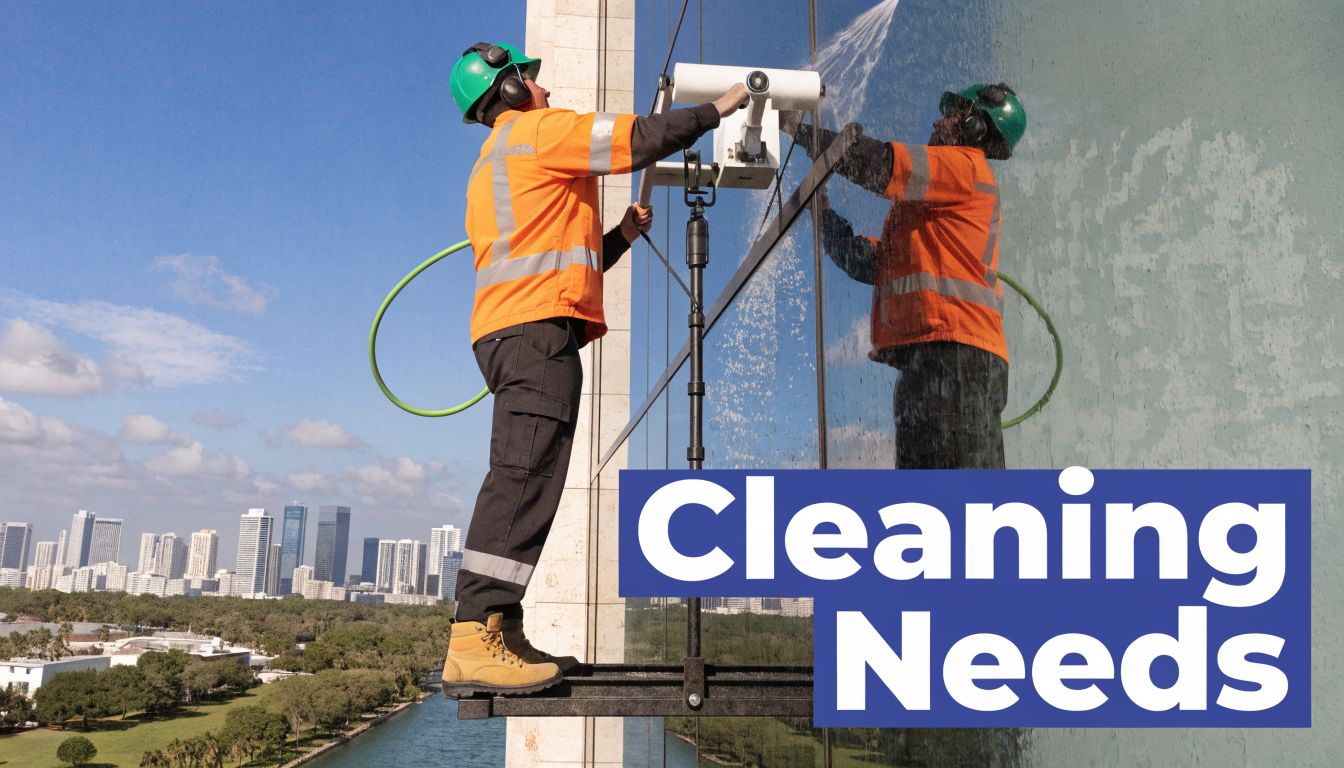
High-rise cleaning is a different trade. The jump from low-rise to tower work isn't about bigger ladders. It's about rigging, suspended access, wind management, staging, and glass-safe procedures at height. In Miami, that often means working around coastal exposure and impact-glass systems.
Pricing reflects that complexity. According to this Miami commercial and high-rise pricing breakdown, window cleaning for high-rise and commercial properties ranges from $5 to $15 per standard window or $20 to $53 hourly, with costs escalating 20% to 50% for upper floors. The same source notes that full-house exterior and interior residential projects with 20 to 40 panes average $185 to $570.
The biggest mistake buyers make is treating high-rise cleaning like a scaled-up house wash. It isn't. It's specialized access work with cleaning attached.
Quick way to identify your service type
- You own or manage a home: Focus on glass condition, screens, tracks, and safe handling of impact windows.
- You run a business at street level: Focus on appearance, route frequency, and minimal disruption.
- You manage a tower or large mixed-use property: Focus on access method, insurance, safety training, and building-specific planning.
The clearer you are about the property type, the easier it is to get an accurate quote and the right crew.
What Does Professional Window Cleaning in Miami Cost
Price questions are fair. In Miami, costs move with access, building type, glass condition, and the amount of detail work included. If someone gives you a fast number without asking about height, window type, or add-ons, that quote is probably too rough to trust.
Core Miami pricing ranges
For high-rise properties, Miami window cleaning cost data shows $13.00 to $15.00 per window as a typical range. The same source notes that paint removal adds $3.30 to $6.00 per window, sliding glass door cleaning costs $2.50 to $8.00 per door, and sills and tracks add $0.50 to $5.00 each.
Those numbers tell you something important. The glass itself is only part of the invoice. A basic exterior cleaning costs less than a detailed service that includes doors, tracks, stain removal, and post-construction cleanup.
Estimated Window Cleaning Costs in Miami (2026)
| Service Type | Average Price Range |
|---|---|
| High-rise window cleaning | $13.00 to $15.00 per window |
| Standard high-rise or commercial window cleaning | $5 to $15 per standard window |
| Hourly high-rise or commercial work | $20 to $53 hourly |
| Sliding glass door cleaning | $2.50 to $8.00 per door |
| Paint removal | $3.30 to $6.00 per window |
| Sills or tracks | $0.50 to $5.00 each |
If you want a broader pricing comparison beyond Miami-specific high-rise figures, this guide on the average cost of window cleaning helps frame how service scope affects the quote.
What pushes the number up
Three things move pricing faster than anything else:
Access difficulty
If a crew needs rope access, suspended equipment, or specialized staging, labor and setup time increase. Upper floors cost more for a reason.Glass condition
Salt film is one thing. Paint specks, adhesive, heavy mineral staining, and neglected tracks are another. Detail work is slower and more labor-intensive.Extra services
Doors, screens, tracks, sills, and stain removal all add labor. They also improve the result. Clean glass next to dirty tracks never looks fully finished.
Cheap bids often leave out the slow parts of the job. Then the crew rushes, skips detail work, or adds charges after arrival.
What a buyer should ask before approving a quote
A useful estimate should tell you:
- What surfaces are included: Exterior only, interior and exterior, or glass plus detailing.
- How access is handled: Ground, lift, rope descent, or suspended setup.
- Which extras are separate: Tracks, sills, screens, stain treatment, and debris removal.
- Whether the price reflects current condition: Routine maintenance and first-time restoration aren't the same job.
A good quote doesn't have to be complicated. It does need to be specific enough that both sides know what “clean” means before work starts.
Protecting Windows from Miami's Coastal Climate
Many residents notice the haze first. The bigger issue is what sits behind it. In Miami, salt air and humidity don't just make glass look dirty. They keep contaminants on the surface longer, and over time that can affect the glass, frames, and surrounding materials.

What coastal exposure does to glass
According to this Miami window cleaning analysis citing 2025 coastal glass data, untreated coastal windows degrade 30% faster due to 80%+ humidity and NaCl etching. The same source says deionized pure-water system use is up 40% in Florida, because it eliminates mineral spotting and provides a longer-lasting clean.
That matches what experienced crews see in the field. Salt sticks. Humidity helps grime hang on. When residue sits through repeated wet-dry cycles, it gets harder to remove cleanly. You can't fix that with stronger soap. Stronger chemicals often create their own problems.
Why pure water matters
A proper deionized pure-water system removes minerals from the rinse water. That matters because ordinary tap water can leave behind spotting as it dries. Pure water dries clean, so crews can scrub and rinse exterior glass without leaving residue that attracts more dirt.
For many Miami properties, especially larger homes and low-rise commercial sites, pure water is the best maintenance tool for routine exterior service. It works well on broad glass surfaces and helps crews clean efficiently without flooding frames with detergents.
If you're dealing with stubborn spotting or mineral staining, this guide on how to remove hard water stains from windows gives a practical look at what comes off with normal cleaning and what needs restoration work.
Cleaning versus preserving
Not every dirty window needs aggressive treatment. That's where bad crews get into trouble. They over-scrub, use abrasive pads where they shouldn't, or apply harsh chemicals without thinking about coatings, seals, or impact-glass surfaces.
A better approach is to match the method to the contamination:
- Routine salt film: Pure water and soft agitation usually handle it well.
- Traffic grime and oily residue: Traditional applicator-and-squeegee work may be the better choice.
- Mineral spotting or bonded contamination: Spot treatment or restoration is often needed, not a harder wash.
Cleaners should remove contamination without creating new damage. On Miami glass, that distinction matters every time.
For property owners, the takeaway is straightforward. Window cleaning in Miami isn't just appearance work. Done correctly, it's preventive maintenance for a coastal asset.
How Professionals Safely Clean Miami's High-Rises
High-rise cleaning only works when safety planning happens before production. The public usually sees a technician on the glass and a bucket on a line. Essential work starts earlier, with access review, anchor planning, weather checks, equipment inspection, and a clear decision on what method fits the building.
The main access methods
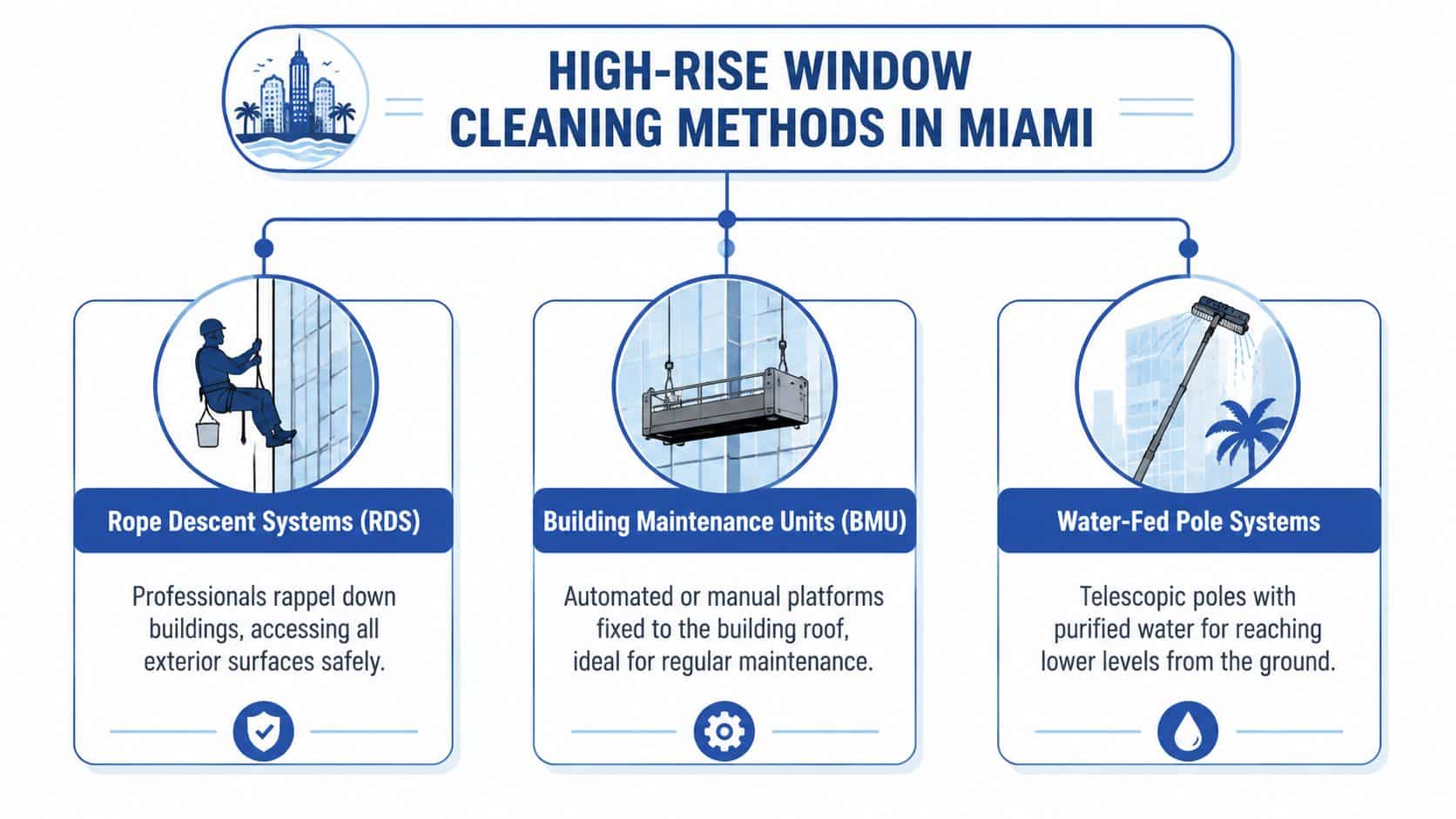
High-rise crews in Miami use a few core systems, and each one has a place.
Rope descent systems
Rope descent, often described as a bosun's chair setup, gives technicians direct access to vertical glass where the building supports that method. It's efficient on many towers because the worker can descend the line and clean in sequence with controlled movement.
This method demands trained technicians, sound anchor points, and strict weather judgment. It's not the cheapest-looking option because the setup is serious. That's exactly why it works.
Suspended scaffolding and building-mounted access
Some properties use suspended platforms or building-maintenance systems. These are a good fit when the facade design favors a platform approach or when routine maintenance is built into the structure. Platforms can provide a stable work area for large sections of curtain wall or facade cleaning.
Water-fed pole systems
For lower elevations and sections reachable from grade or podium levels, water-fed poles can be the safest and fastest option. In Miami high-rise work, these poles can reach up to 72 feet, according to this overview of high-rise window cleaning methods in Miami.
Here's a field view of high-rise window cleaning in action:
What weather changes on the job
Miami crews don't just watch for rain. They watch for wind. The same source notes that high-rise operations in Miami halt at wind speeds over 25 mph. That isn't overcaution. On suspended work, wind changes rope behavior, body position, swing control, and tool handling. On the wrong facade, a gusty day turns a routine drop into a bad decision.
If the wind says stop, the job stops. Schedules matter less than sending everyone home safely.
Why glass type matters too
High-rise buildings in Miami often use hurricane-impact glass and coated surfaces that require careful cleaning. The same Miami high-rise source states that crews use purified deionized water to prevent streaks and avoid damage to Low-E coatings. That's one reason experienced teams don't default to harsh chemicals or abrasive tools.
What building managers should expect from a serious contractor
Ask for a clear explanation of the work plan. A professional high-rise company should be able to explain:
- Which access method fits the building
- How weather shutdown decisions are made
- What protection is in place for glass coatings and frames
- How the crew handles staging, pedestrian areas, and restricted access zones
Good high-rise cleaning looks smooth from the ground because the hard parts were handled before the first descent.
A Checklist for Vetting Miami Window Cleaning Companies
A bad hire shows up fast in Miami. Missed safety paperwork can delay a condo job for days. The wrong method can leave mineral spotting on impact glass or push dirty runoff onto balconies, entry canopies, and pedestrian areas.
Plenty of companies can clean first-floor storefront glass. Fewer can handle a salt-heavy high-rise facade, building management rules, and weather shutdown decisions without creating problems for the property.
What to check before you hire
Start with documents. Ask for current insurance and make sure it fits the work being quoted. A contractor cleaning a single-story home is not carrying the same risk profile as a crew working swing stage, rope descent, or multi-level commercial access.
Then check building-specific experience. In Miami, that means more than "we do high-rises." Ask what kind of properties they service: oceanfront condos, inland office towers, hotels, retail centers, or residential homes. Salt exposure, humidity, access restrictions, and glass type change the cleaning plan.
Ask how they clean the glass, not just what they charge. A serious company should be able to explain when it uses pure-water systems, when it switches to traditional squeegee work, and how it avoids damaging coated or impact-rated glass. If the answer is vague, keep looking.
Get the scope in writing:
- Exterior and interior glass: Confirm exactly what surfaces are included
- Frames, tracks, and screens: These are often quoted separately
- Hard water, paint, and adhesive removal: Ask whether this is maintenance cleaning or restoration work
- Access and staging: Clarify who handles lift access, roof access, keys, escorts, and restricted areas
- Weather delays: Confirm how the company handles wind, lightning, and storm-season rescheduling
Red flags that should slow you down
Cheap pricing can hide real problems. On Miami properties, the usual ones are thin insurance, rushed production, incomplete scope, or a crew that lacks experience with coastal glass and building procedures.
Watch for these signs:
- No site visit on a property with access limits, upper-level glass, or tenant coordination issues
- No clear answer on how the crew will reach and clean upper elevations
- No proof of insurance or license status
- No mention of water type, runoff control, or glass coating protection
- No plan for HOA rules, valet zones, loading restrictions, or pedestrian control
One sentence in a quote can tell you a lot. If a contractor lists "full window cleaning" but cannot define what that includes, expect change orders or skipped details.
What good vendors do differently
Good companies ask sharp questions early. They want to know which elevations take the most salt, whether the building has Low-E or impact glass, what hours the property allows for staging, and who signs off on access. That is job planning, not sales filler.
They also explain trade-offs. Pure-water cleaning is efficient on many exterior surfaces and helps reduce spotting in Miami's mineral-heavy environment when the system is maintained correctly. It is not the answer for every pane or every detail pass. Interior glass, lobby glass, and close-finish work often still need hand detailing.
Choose the company that can explain the method, the risk controls, and the limits of the quote in plain language. That is usually the crew that will show up prepared and leave the building manager with fewer problems.
Frequently Asked Questions About Miami Window Cleaning
How often should windows be cleaned in Miami
It depends on the property and exposure. Oceanfront buildings, busy commercial corridors, and homes with large exterior glass usually need more frequent service than sheltered inland properties. The right schedule is the one that removes salt and grime before it bonds to the surface and turns maintenance cleaning into restoration work.
Is it safe to clean windows during rainy season or storm season
Yes, but only when conditions allow it. Professional crews adjust around weather, especially on high-altitude work. Rain by itself isn't always the issue. Wind, slick surfaces, and unstable conditions are the primary concerns. On high-rise jobs, weather decisions should be conservative and made before the crew commits to the drop.
What's the difference between water-fed pole cleaning and squeegee cleaning
Water-fed pole cleaning uses purified water and soft brushes to scrub and rinse exterior glass from the ground or a safe working level. It's efficient for many exterior surfaces and leaves no mineral residue when done correctly. Traditional squeegee cleaning offers more detailed control and is often preferred for interior glass, storefronts, and jobs where close visual finish matters most.
Can every stain come off with standard window cleaning
No. Routine cleaning removes loose dirt, salt film, and normal buildup. Mineral spotting, paint, adhesive, and etched contamination may need separate treatment. A good contractor will tell you the difference before starting instead of promising that every mark will disappear.
What should I ask for in a quote
Ask what glass is included, whether interior work is part of the service, how access will be handled, and which extras are priced separately. If the property is complex, ask who supervises the work and how the crew handles weather, safety barriers, and building access.
If you need a contractor that understands tough exterior conditions, safe production, and clean glass that lasts, South Mountain Window Cleaning, LLC is worth a close look. The team handles residential, commercial, and high-rise window cleaning with pure-water systems, professional squeegee work, and a strong focus on reliability, communication, and safety-trained service.