
Your panels looked great when they were installed. Then a Phoenix summer happened.
A few windy days, a little pollen, a streak of monsoon dust, and suddenly your system isn't working on a clean glass surface anymore. Many homeowners first notice it indirectly. The electric bill feels higher than it should. The inverter app looks flatter than expected. The roof still has solar, but the savings don't feel as strong.
That's why solar panel cleaning phoenix az matters more than many people realize. In the Valley, cleaning isn't cosmetic. It's part of protecting the return on a major home investment.
The Phoenix Sun vs The Phoenix Dust
A common Phoenix scenario goes like this. A homeowner installs solar to take advantage of the desert sun, expects strong summer production, then heads into July and August wondering why the system doesn't seem to be carrying as much of the load as expected. The problem often isn't the panels. It's the layer sitting on top of them.
Phoenix gives you intense sun, but it also gives you airborne dust, pollen, bird mess, and the kind of grime that settles in stages. A light coating becomes a film. That film grabs more dust. Then monsoon season adds moisture, and the surface starts holding onto buildup instead of shedding it.
That's where homeowners usually split into two groups. One group assumes rain will handle it. The other group realizes solar works best when the glass is clean.
What local owners run into
The Valley creates a specific maintenance problem:
- Dust is constant: Even when your roof doesn't look filthy from the ground, panels can still have a fine layer that cuts performance.
- Summer is unforgiving: The months when homeowners want maximum solar production are also the months when buildup matters most.
- Hard water complicates cleaning: A quick rinse with a hose often trades dust for mineral residue.
Clean panels don't just look better. They give sunlight a clear path to the cells underneath.
For contractors trying to better understand how local demand forms around solar service, resources like find solar leads for your business can be useful for seeing how homeowners search when performance becomes a concern. For the homeowner, the takeaway is simpler. In Phoenix, sunshine alone doesn't guarantee strong output. Clean surface conditions matter.
Why Dirty Solar Panels Cost You Money in Arizona
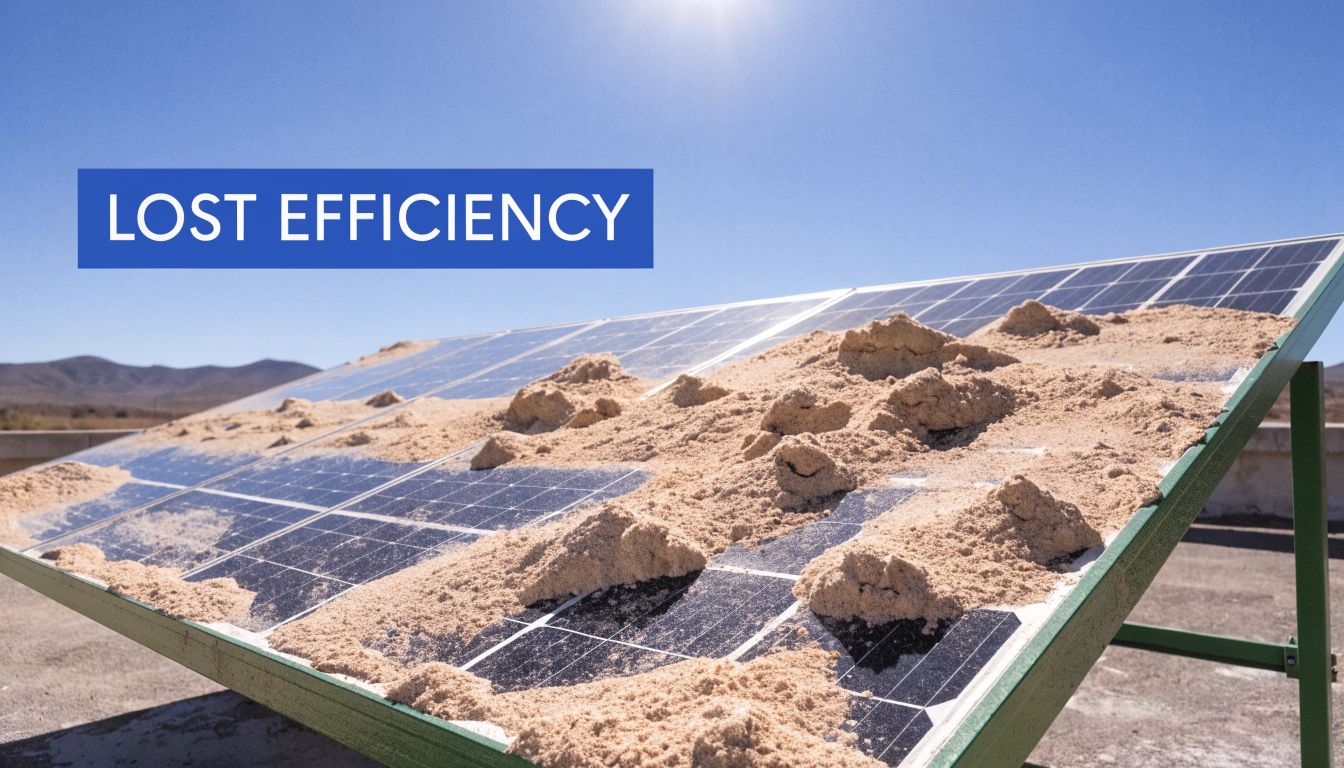
Dirty solar panels act like dirty sunglasses. Light still gets through, but not as much of it, and not as cleanly. Solar glass works the same way. When dust, pollen, and bird droppings cover the surface, the panel can't absorb sunlight as effectively.
In Phoenix, that loss isn't minor. Solar panel efficiency can decline by up to 33% due to accumulated dust, bird droppings, and pollen, and NREL findings cited here note annual output losses of 20-40% in desert environments without regular cleaning according to this Phoenix solar cleaning reference.
What's actually sitting on your panels
Phoenix roofs collect more than just loose dirt. The usual culprits include:
- Windblown desert dust: Fine particles spread evenly across the glass and reduce light transmission.
- Pollen and organic film: These can create a sticky layer that holds additional debris.
- Bird droppings: Unlike light dust, droppings create concentrated blockage in specific areas.
- Urban grime: Airborne residue from roads and daily city activity adds another layer over time.
Some buildup looks harmless from the yard. Up close, it often has texture and adhesion. Once that happens, casual rinsing doesn't fully solve it.
Why rain usually isn't enough
Phoenix rain doesn't behave like a full wash cycle. It often mixes airborne dust into mud, then leaves residue behind as it dries. If the panel already has grime on it, the water can spread that contamination instead of removing it.
Practical rule: If you can see dust from the ground, your panels have already been underperforming for a while.
Homeowners who want a deeper breakdown of what buildup does to production can review this guide on solar panel efficiency loss. It's useful if you're trying to connect what you see on the roof with what you see on your utility bill.
There's also a broader maintenance point here. Arizona weather isn't just about dust. Storm exposure matters too, which is why some homeowners also research hail-resistant solar solutions from Hail King Professionals when comparing long-term panel protection strategies. Different climate, same idea. Your system performs best when the surface stays both protected and clean.
How Often to Clean Solar Panels in the Valley
There isn't one universal schedule that fits every roof in Phoenix. A home near open desert, active construction, heavy traffic, or frequent bird activity may need more attention than a home in a more sheltered setting. Still, most homeowners do best with a simple rhythm tied to the Valley's weather.
The practical approach is to clean once after monsoon season and once before peak summer demand. That timing matches what lands on the panels and when you most want production.
Best times on the calendar
Fall cleaning makes sense after monsoon season. Summer storms leave behind dust, residue, and the kind of baked-on film that doesn't blow away on its own.
Spring cleaning helps before the hottest months arrive. If your panels are already carrying winter dust and early pollen, you don't want that buildup sitting there when summer electric demand climbs.
A helpful local reference on timing is how often to clean solar panels, especially if you're comparing seasonal service rather than waiting until the panels look obviously dirty.
Signs your home may need a tighter schedule
Some homes should be watched more closely than others:
- You live near active dust exposure: Open lots, desert edges, or new development tend to increase roof soiling.
- Birds use your roofline regularly: Droppings create concentrated mess that's more damaging than a uniform dust layer.
- Your system sits at a shallow angle: Panels that don't shed debris well usually hold onto grime longer.
- You notice output dips in your monitoring app: A visible issue isn't always the first clue.
In Phoenix, the best cleaning schedule is seasonal first, then adjusted for your roof's actual conditions.
Homeowners often wait until the glass looks bad from street level. That's usually late. A calendar-based plan works better because it keeps production from slipping for months before anyone responds.
DIY vs Professional Solar Panel Cleaning in Phoenix
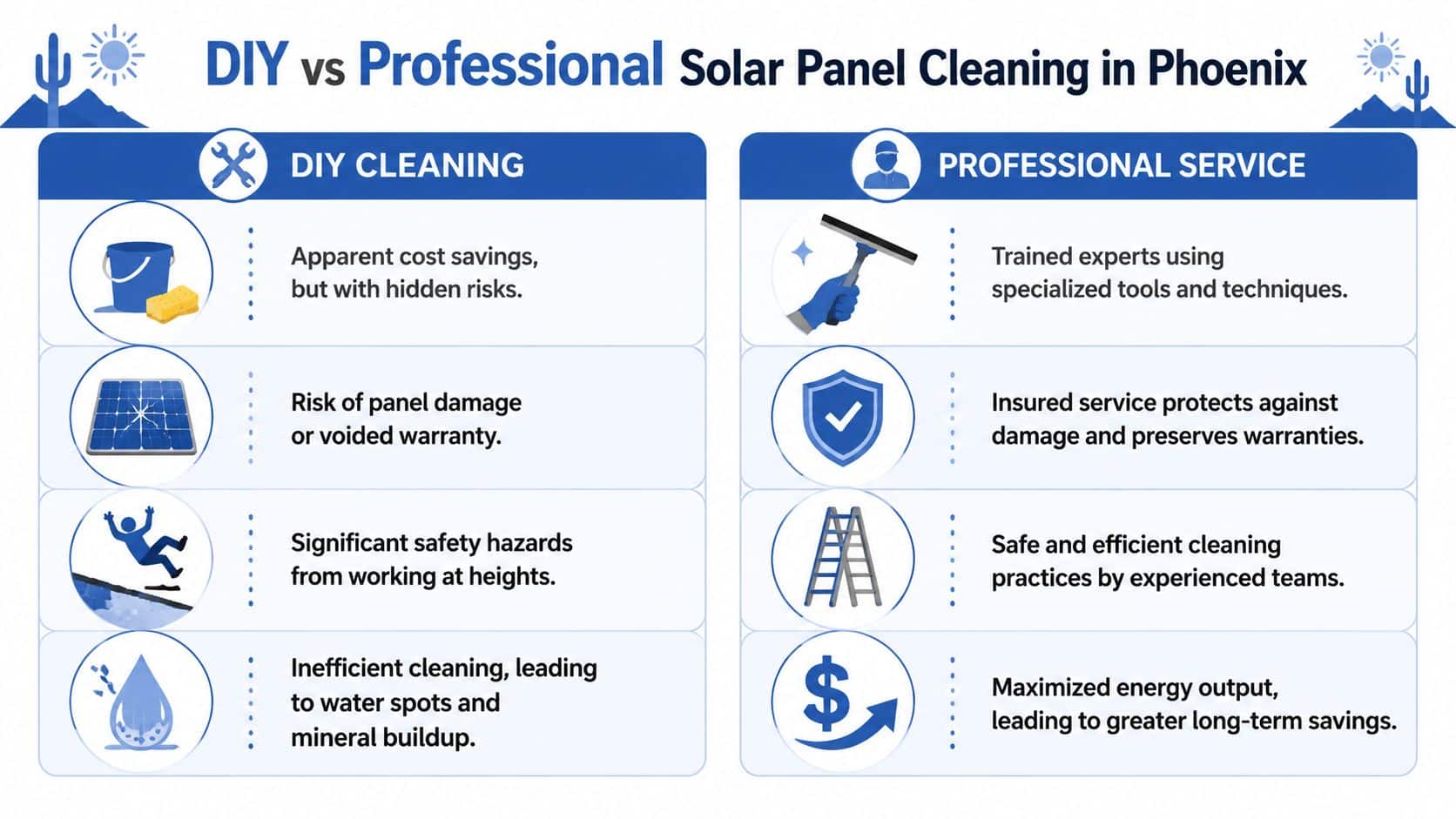
DIY sounds cheaper. On the surface, it makes sense. Grab a hose, climb up, rinse things off, and move on. In Phoenix, that simple plan runs into three problems fast: safety, hard water, and tool choice.
The math also matters. In Phoenix, professional solar panel cleaning often pays for itself in 2-4 months. Dirty panels can lose 15-30% of efficiency, and professional cleaning can produce $300-500 in additional electricity value annually compared with a typical $150-250 service cost, based on this local ROI calculator reference.
Where DIY goes wrong
The first issue is roof access. Many Phoenix homes have tile roofs, steep sections, awkward access points, or surfaces that get slick and unstable fast. Cleaning the panels is only half the job. Reaching them safely is the main barrier.
The second issue is water. Tap water in Phoenix leaves residue. A rinse may remove loose dust, but it can also leave minerals on the glass after drying. That means you can spend time cleaning and still not end up with a properly clear surface.
The third issue is technique. Pressure washers, abrasive brushes, and household chemicals are all bad bets around panel glass, seals, and finishes. The goal is to remove contamination without creating new problems.
DIY vs. Professional Solar Panel Cleaning Comparison
| Factor | DIY Cleaning | Professional Service (South Mountain Window Cleaning) |
|---|---|---|
| Safety | Homeowner takes on roof access risk | Crews use professional access methods and cleaning tools |
| Water quality | Tap water may leave residue on the panels | Pure-water systems are designed for spot-free rinsing |
| Tools | Homeowners often use whatever is on hand | Soft-bristle tools and purpose-built equipment are used |
| Cleaning result | Often removes only loose surface dirt | Better for removing bonded dust, film, and residue |
| Cost view | Lower upfront out-of-pocket feel | Better framed as maintenance tied to production and protection |
A lot of homeowners start with the question, “Can I do this myself?” The better question is, “What am I risking to save one service call?”
Here's a practical visual if you want to see general cleaning methods in action:
What professional service changes
Professionals don't just bring labor. They bring a process. That includes safer access, panel-appropriate agitation, purified rinse water, and a finish that doesn't leave behind the same problem in a different form.
For homeowners comparing methods, this guide on how to clean solar panels is useful because it shows why “clean enough” and “properly cleaned” are not the same thing.
If your cleaning method leaves minerals on the glass, you didn't finish the job. You changed the kind of obstruction sitting on the panel.
DIY can work in limited situations, especially on easy-access systems and with careful technique. But in Phoenix, where hard water and roof access are real issues, professional service is often the lower-risk decision.
Finding the Best Solar Panel Cleaners in Phoenix
Once you decide to hire out the work, the next challenge is choosing the right company, as not every exterior cleaner uses the right water, the right brush, or the right approach for solar.
A good provider should be able to explain the method plainly. If the answer sounds vague, that's a warning sign.
Ask about water first
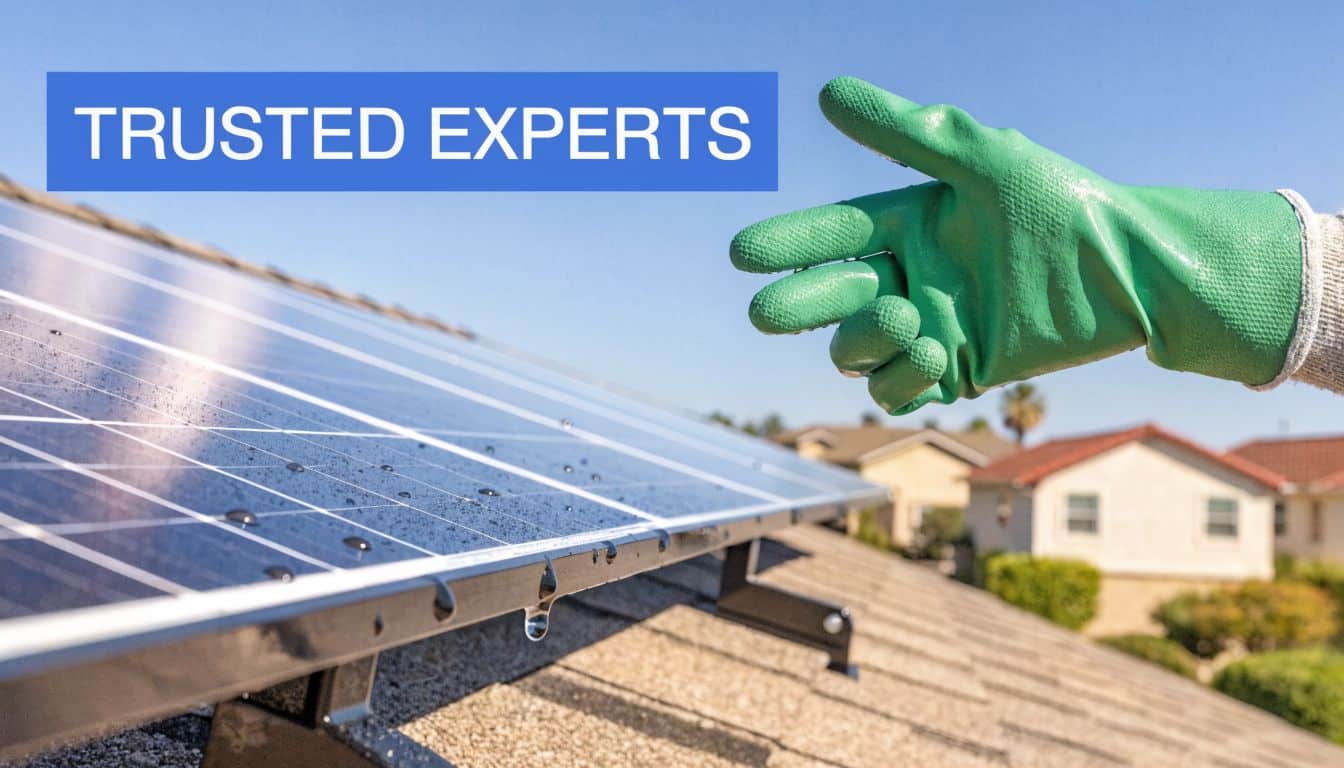
In Phoenix, water quality isn't a side detail. It's central to the result. Phoenix hard water runs above 300-600 ppm TDS, and professional DI filtration removes more than 99.9% of ions, which prevents spotting and can restore panel transmittance to over 98%, boosting output by an average of 20% according to this Phoenix solar cleaning overview.
That's why the first question should be simple: do you clean with deionized or other purified water, or are you just spraying panels with tap water?
If the answer is tap water, keep looking.
What good equipment looks like
The right setup usually includes:
- Pure-water filtration: This prevents mineral spotting after rinse.
- Soft-bristle brushes: The tool should remove grime without being abrasive.
- Water-fed poles: These allow controlled cleaning while reducing unnecessary roof walking.
- A method built for glass surfaces: Solar isn't the place for aggressive pressure and improvised chemicals.
One local option that fits this approach is South Mountain Window Cleaning, LLC, which uses pure-water cleaning systems as part of its solar service. That's the kind of method you want to hear from any provider you're vetting, whether you hire that company or another one.
Questions worth asking before you book
Use this checklist when you call:
- What water do you use: You want purified water, not a standard hose rinse.
- What brushes or pads touch the panels: The answer should be soft, non-abrasive tools.
- How do you access the roof: The company should have a clear safety process.
- Are you insured: For residential and especially commercial properties, this is not optional.
- Do you also clean around the system if needed: Debris, bird mess, and nearby roof grime often affect the overall result.
The best company to hire isn't the one with the shortest pitch. It's the one that can explain its method clearly and without hand-waving.
A provider should also understand that panel cleaning is part of exterior maintenance, not an isolated task. Homes with dusty roofs, dirty skylights, clogged gutters, or bird activity often benefit from coordinated service instead of treating every surface separately.
What to Expect from a Professional Service
For most Phoenix homeowners, the process is straightforward. You request a quote, confirm the number of panels and roof access, then schedule a visit based on weather and availability.
On the cost side, residential solar panel cleaning in Phoenix typically runs about $150-250 per visit based on the local ROI data cited earlier in this article. Final pricing usually depends on panel count, roof layout, and how easy the array is to access.
A normal service visit
A professional visit usually includes:
- A quick assessment: The crew checks access, buildup level, and any obvious trouble spots.
- Safe cleaning methods: The work is done with panel-appropriate tools and purified water.
- A controlled rinse: The goal is a clean surface without leftover spotting.
- Minimal disruption: Homeowners usually don't need to do much beyond providing access.
The experience shouldn't feel complicated. It should feel like routine maintenance handled by people who know what they're doing.
What matters most is the result. The glass should be clean, the rinse should dry without residue, and you should feel confident that the service improved the condition of the system rather than just making it look better from the driveway.
Frequently Asked Questions About Phoenix Solar Cleaning
Doesn't rain clean solar panels
Not reliably. In Phoenix, rain often mixes with dust and leaves residue behind. It may knock off some loose dirt, but it usually doesn't produce the kind of clean surface solar glass needs.
Can I spray panels with a hose from the ground
You can, but that doesn't mean you should. Phoenix tap water is mineral-heavy, so a hose rinse can leave spotting and deposits after the water dries.
How do I know my panels need cleaning
Check for visible dust film, bird droppings, or dull-looking glass. Also watch your monitoring app. If production seems softer than expected and weather hasn't changed much, dirty panels are worth considering.
Is professional cleaning really worth it
For many Phoenix homeowners, yes. The local conditions are tough on solar surfaces, and professional cleaning is often less about appearance and more about protecting output, avoiding poor cleaning methods, and keeping maintenance simple.
If your solar system is producing less than it should, South Mountain Window Cleaning, LLC offers solar panel cleaning for Phoenix-area homes and commercial properties using pure-water methods suited to Arizona dust and hard water conditions.