
You notice the glass before your customers do. That second-story bedroom window has a dusty film on it. The office frontage looks dull by mid-morning. The panes above an entry tower are streaked, but they’re too high to handle with a step ladder and too visible to ignore.
That’s a normal problem in the Phoenix area. Dust settles fast, irrigation overspray leaves mineral residue, and strong sun makes every smear stand out. On many properties, the hardest windows to reach are also the ones that affect curb appeal the most.
That’s where reach window cleaning makes sense. Instead of sending a technician up a ladder for every upper pane, this method uses ground-based equipment designed to clean exterior glass safely and leave a cleaner finish on many Arizona homes and commercial buildings.
The Challenge of Hard-to-Reach Windows in Arizona
A common Phoenix scenario goes like this. The lower windows still look acceptable after a quick wipe, but the upper glass tells a different story. You can see dust buildup along the edges, spots from hard water, and a hazy layer that seems to come back almost as soon as the windows are cleaned.
Arizona conditions are rough on exterior glass. Wind moves dust across stucco walls, screens, and ledges. Sprinklers often leave residue where they hit the building. Then the sun dries everything quickly, which makes mineral spotting and baked-on grime harder to remove with basic tools.
Why ladders stop being practical
For many property owners, the first instinct is still a ladder and a hose. That works for a very limited set of windows. It stops working when the glass sits over landscaping, behind architectural features, above awnings, or on a second or third story.
The problem isn’t only reach. It’s control. A ladder setup often turns a simple cleaning job into a balance problem, especially around uneven ground, decorative rock, planting beds, pool decks, or tight walkways.
Upper windows usually aren’t the dirtiest because people ignore them. They’re the dirtiest because they’re the most inconvenient and risky to clean well.
What property owners actually need
A more creative ladder setup isn't the primary requirement. Instead, a method is needed that's built for height, awkward access, and spot-free drying in a climate where tap water can leave visible residue.
That’s what reach window cleaning is for. It gives technicians a way to scrub and rinse upper glass from the ground, which is a better fit for many homes, storefronts, office buildings, and multi-unit properties in Phoenix, Scottsdale, Paradise Valley, Chandler, Tempe, and Gilbert.
What Exactly Is Reach Window Cleaning
Reach window cleaning usually refers to a water-fed pole system. The tool itself is a lightweight telescopic pole with a brush on the end. Water travels through the pole and out through jets near the brush, so the technician can scrub the glass and rinse it at the same time.
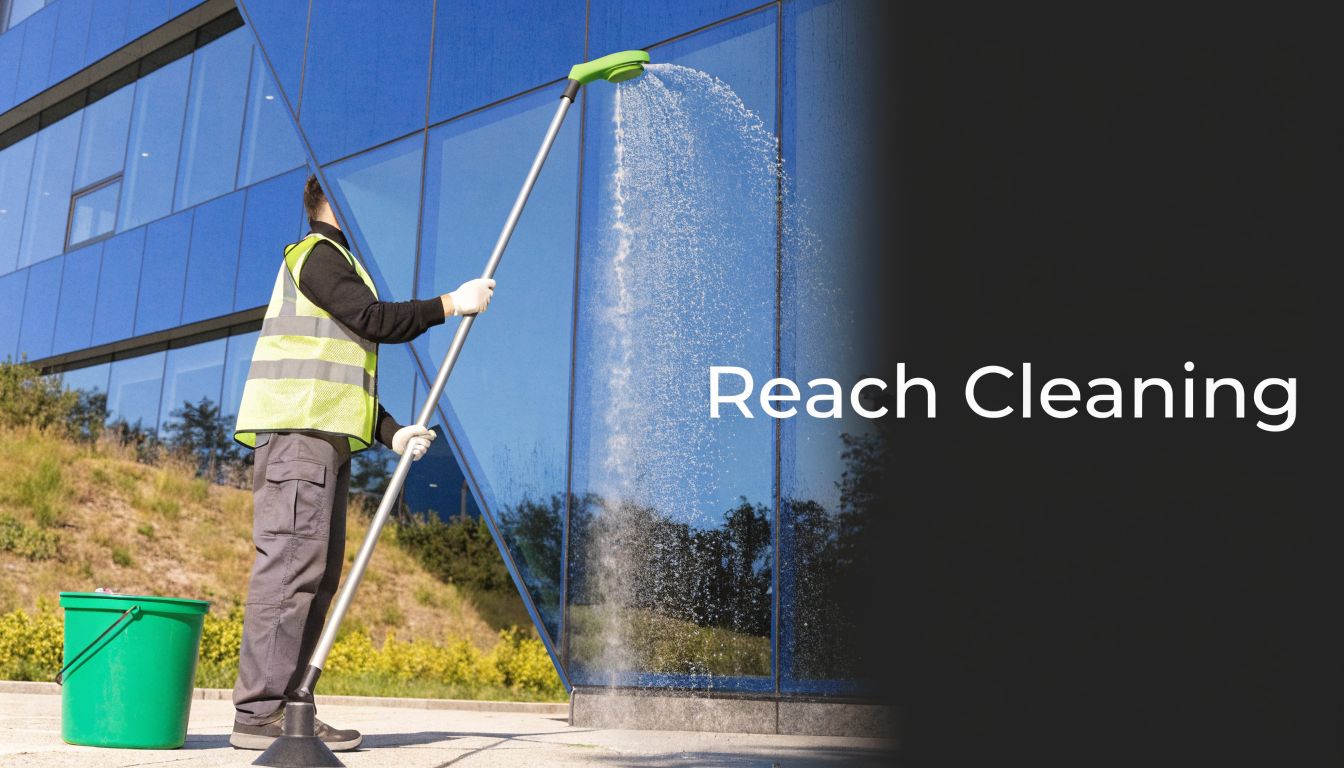
It is a powered exterior cleaning tool for glass. It doesn’t just extend your arm. It combines reach, water delivery, agitation, and rinsing into one system.
More than a brush on a stick
A lot of people assume reach window cleaning means somebody attached a brush to a long pole and started spraying. That’s not it. A real system includes:
- Telescopic poles that extend to upper-story windows while staying manageable from the ground
- Specialized brush heads made to loosen dirt on glass and around frames
- A purified water supply that supports spot-free drying
- A pump and hose setup that keeps water flowing consistently during the job
If you want a closer look at how these systems are set up in the field, pure water window cleaning systems explain the core equipment and why the water matters as much as the pole.
Where this method fits best
Reach systems are a strong fit for many residential and commercial properties where technicians can work from the ground and still clean upper exterior glass thoroughly. They’re especially useful on homes with tall elevations, storefronts with broad panes, offices with repeated window lines, and buildings where landscaping or obstacles make ladder work clumsy.
That shift toward efficient professional methods isn’t a niche trend. The global window cleaning market is projected to reach $128.7 billion by 2030, according to Grand View Research's window cleaning market outlook.
How Water-Fed Poles Achieve a Spot-Free Finish
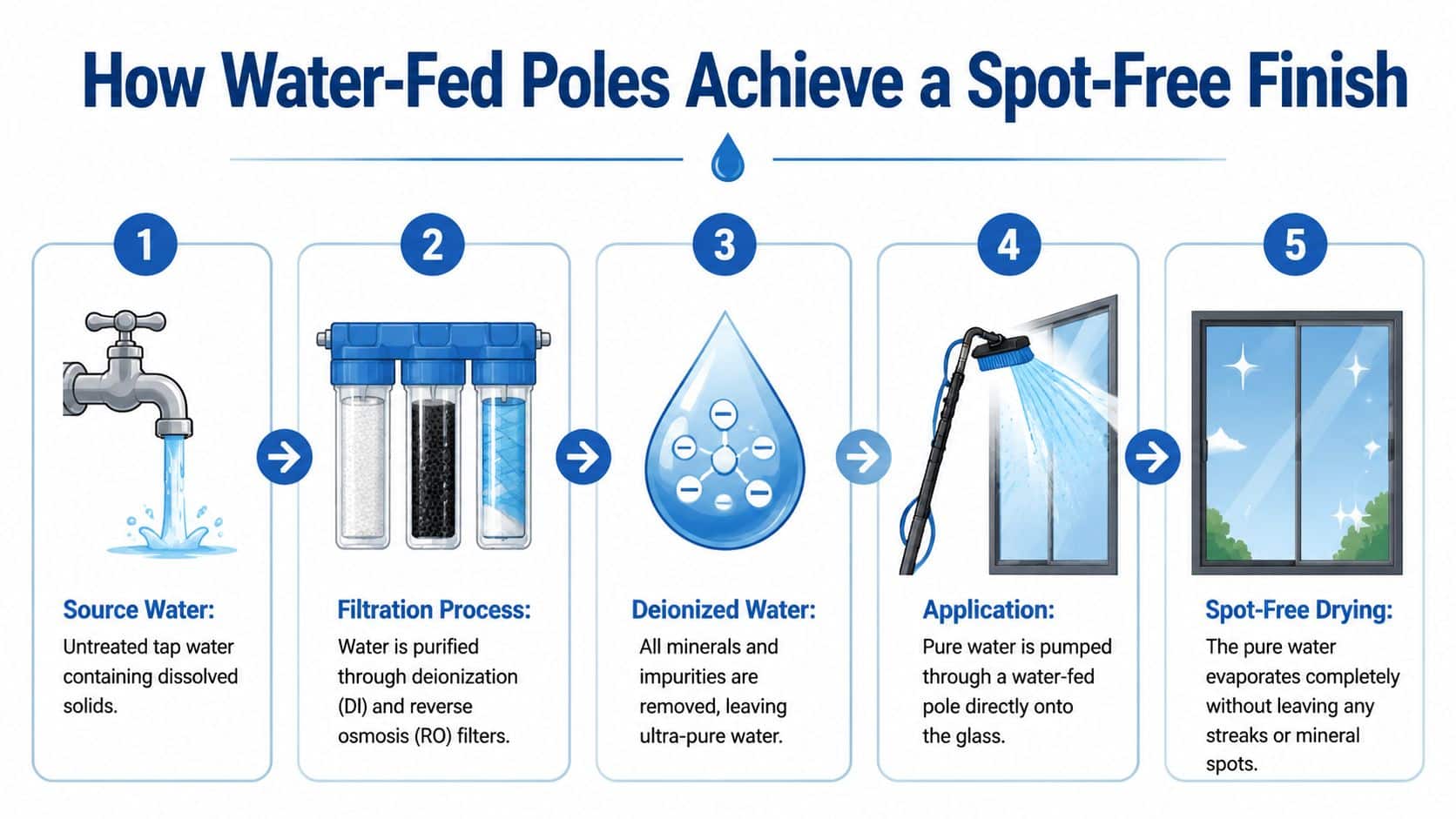
A key advantage in reach window cleaning isn’t only the pole. It’s the water purification process behind it. Without that, upper windows would still dry with spots and streaks, especially in Arizona.
Why tap water creates residue
Tap water contains dissolved minerals and impurities. When that water evaporates on glass, those solids stay behind. That’s what creates the white spotting, haze, and streaking people often mistake for “still dirty” windows.
With a water-fed pole system, the water goes through reverse osmosis and de-ionization filtration before it reaches the brush. That process removes the dissolved material that would normally dry on the glass.
Here’s the short version:
| Step | What happens | Why it matters |
|---|---|---|
| Source water enters the system | Regular water contains minerals | Untreated water can leave marks |
| RO and DI filtration remove impurities | The system strips out dissolved solids | Cleaner rinse water reaches the glass |
| Brush agitates the surface | Dirt, dust, and residue are loosened | Cleaning improves around edges and frames |
| Pure water rinses the glass | Contaminants are carried off the surface | No dirty film is left behind |
| Glass air-dries | No minerals remain to form spots | The finish dries clear |
Why pure water works so well
As explained in this guide to professional window cleaning tools, the system works because the water itself is part of the cleaning action. According to Pivotal Window Cleaning's explanation of reach and wash systems, pure water, by its nature, is an aggressive cleaning agent. Because it has no dissolved solids, it pulls dirt and minerals from the glass surface, then rinses them away so the window can dry clear without cloths or squeegees.
Field note: If you rinse glass with mineral-heavy water in direct sun, you’re often leaving the next problem on the window before you finish the current one.
Why this matters more in Arizona
Phoenix-area properties deal with three issues at once. Dust settles fast. Hard water leaves visible deposits. Sun exposure speeds up drying, which can lock residue onto the glass.
That’s why purified water changes the result. Instead of wiping around minerals and hoping the finish holds, the system removes contamination and rinses with water that doesn’t leave its own deposits behind. On many exterior jobs, that’s the difference between windows that look clean for a day and windows that dry clean.
Comparing Reach Systems to Traditional Window Cleaning
Traditional window cleaning still has a place. A skilled technician with a mop and squeegee can do excellent work, especially on interior glass or exterior panes that are easy to access by hand. But for many upper exterior windows, reach systems solve problems that older methods don’t solve well.
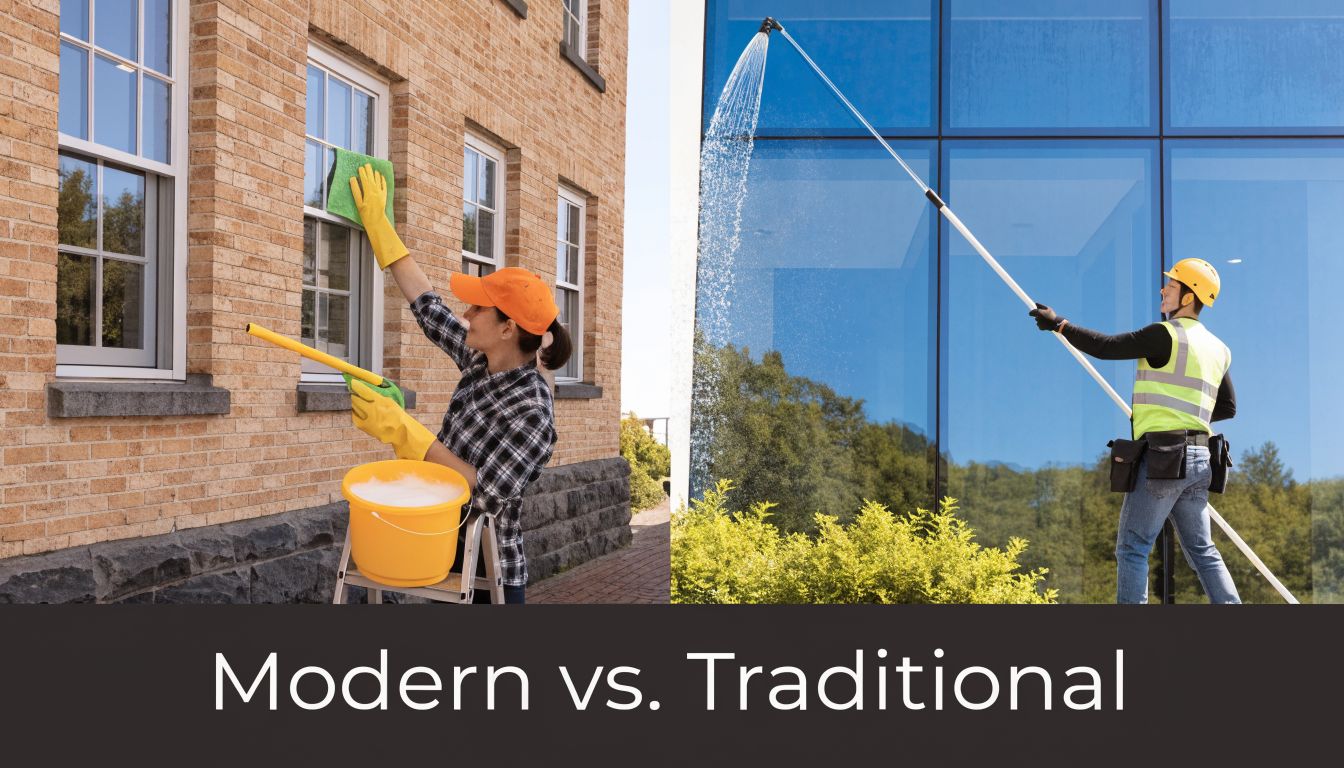
Side-by-side differences that matter
| Decision factor | Reach window cleaning | Traditional ladder and squeegee |
|---|---|---|
| Safety | Ground-based for many upper windows | Requires repeated climbing and repositioning |
| Access | Works well over landscaping, awnings, and obstacles | Can be limited by terrain and obstructions |
| Exterior frame rinse | Easier to flush dust from frames and edges | More detail by hand, but slower on repeated upper windows |
| Finish on exterior glass | Spot-free when purified water is used correctly | Strong results by hand, but tap water can leave residue |
| Speed on routine maintenance | Efficient on repeated upper-window layouts | Slower when each ladder move takes time |
The biggest win is usually safer access with less setup. If a technician can stand on the ground and still clean the upper exterior glass correctly, that removes a lot of friction from the job.
Where traditional methods still make sense
A balanced answer matters here. Reach systems aren’t the right tool for every pane on every property.
Traditional hand cleaning is still useful when:
- Interior windows need detailing because a pole system is meant for exterior work
- Small panes or divided lights require close hand work and edge control
- Glass has stubborn debris such as paint, adhesive, or construction residue that needs specialty removal
- Final touch work is needed in tight spots where a pole head can’t maneuver cleanly
That’s why experienced crews don’t treat this as an either-or decision. They choose the tool that fits the surface, access, and condition of the glass.
The best window cleaning method isn’t the newest one. It’s the one that gives a clean result without creating unnecessary risk.
What works well on Phoenix properties
For routine exterior maintenance on homes and commercial buildings, reach systems often outperform ladder-heavy workflows because they match the layout of local properties. Many Valley buildings have broad elevations, repeated upper windows, desert landscaping, decorative stone, signage, or walkways that make ladder repositioning inefficient.
On those properties, the practical trade-off is simple. Water-fed poles are usually better for repeated exterior glass at height. Hand cleaning remains important for specialty work, interiors, and detail-sensitive panes.
Why Professional Insurance and Safety Protocols Matter
Window cleaning isn’t only about clear glass. For commercial properties and high-rise work, it’s also about liability control. If a contractor gets hurt on site or damages part of the property, the paperwork behind the service matters just as much as the tools on the truck.

The risk is not theoretical. Gitnux window cleaning industry statistics report that falls from height account for 65% of fatalities in the window cleaning industry, and U.S. window cleaners experience 12.5 incidents per 100 workers annually. That’s why ground-based systems, trained crews, and documented safety procedures matter so much.
What property owners should verify
Before hiring any company for upper-story or commercial window cleaning, ask for proof of:
- General liability insurance so property damage claims don’t become your problem
- Workers' compensation coverage so employee injuries are handled properly
- Safety procedures for ladder work, restricted access areas, and public-facing job sites
- Clear scope of work so you know which windows, frames, screens, and access challenges are included
For larger properties, it also makes sense to review the difference between bonded and insured service providers, because those terms aren’t interchangeable.
Why this matters even more on commercial and high-rise jobs
Commercial managers have more to protect. There are tenants, visitors, storefront customers, parked vehicles, access restrictions, and schedule demands. High-rise work raises the stakes further because the equipment, training, and site coordination become more specialized.
South Mountain Window Cleaning, LLC operates with a $2 million insurance policy for business clients, which is one example of the kind of documentation commercial buyers should look for when comparing vendors.
If a bid looks unusually cheap for work at height, check what’s missing before you check the calendar.
Scheduling and Pricing for Your Phoenix Property
Most window cleaning quotes in the Phoenix area come down to access, condition, and scope. Height matters, but it isn’t the only factor. A single-story home with severe hard-water buildup can take more effort than a taller property with lightly soiled glass and easy access.
What affects the quote
A contractor usually looks at a mix of conditions, including:
- Window count and size because larger panes and higher volume change labor time
- Access issues such as landscaping, narrow side yards, screens, ledges, awnings, or locked areas
- Soil level including dust, residue from sprinklers, oxidation around frames, or construction debris
- Service mix if you also want tracks, screens, mirrors, solar panels, or pressure washing handled on the same visit
If you want a better sense of how companies build estimates, window cleaning cost per window outlines the variables that usually shape pricing.
How often should Phoenix windows be cleaned
There isn’t one perfect schedule for every property. The right frequency depends on visibility, exposure, and how much appearance matters day to day.
A practical rule of thumb looks like this:
- Storefronts and customer-facing businesses often benefit from more frequent service because fingerprints, dust, and traffic show quickly
- Office properties and multi-unit buildings usually do best with a recurring maintenance plan that prevents buildup instead of waiting for the glass to look neglected
- Homes often work well on a seasonal or semi-annual schedule, though houses near busy roads, active construction, or heavy irrigation may need more attention
What tends to work best
Routine maintenance is almost always easier than restoration. Once hard-water spots, dust film, and baked-on residue build up, the job gets slower and more specialized.
For Phoenix, Scottsdale, Paradise Valley, Chandler, Tempe, and Gilbert, the smartest move is usually to set a schedule based on how your property performs in local conditions. That keeps the glass presentable, helps avoid heavy buildup, and makes budgeting more predictable.
If you want a clear estimate for residential, commercial, or high-rise service in the Phoenix metro, contact South Mountain Window Cleaning, LLC. The company serves homes and businesses across the Valley and can quote the work based on your building’s height, access, and cleaning needs.