

In Phoenix, professional Christmas light installation for a typical two-story home usually runs $152 to $412 when you supply the lights, with an average around $278. If you want a full-service setup with lights, installation, maintenance, takedown, and storage, packages start at $999 and average homes typically fall between $1,899 and $2,799.
That’s the number most homeowners and property managers want first. The harder part is figuring out why one quote looks lean, another looks expensive, and a third includes things you didn’t realize mattered until you’re standing on a ladder over a tile roof with a bundle of clips in one hand and a dead string in the other.
In the Phoenix area, christmas light installation cost has its own local logic. Stucco walls, tile roofs, tall entry facades, gated estate lots, dust buildup, strong sun, and awkward second-story rooflines all affect labor. The company matters too. A crew that already works on ladders, roofs, storefronts, and high-access exteriors usually prices risk and access more realistically than a seasonal side hustle.
Planning Your Holiday Glow The Real Cost of Christmas Lights
A lot of people start in the same place. They want a clean roofline, maybe some wrapped columns or lit shrubs, and they want the house to feel finished for the holidays. Then the bins come down, clips are missing, a few strings don’t work, and the high spots suddenly look a lot higher than they did from the driveway.
That’s when the decision starts. In Phoenix, a labor-only install on a typical two-story house, with homeowner-provided lights, ranges from $152 to $412 with an average around $278, based on Phoenix christmas light installation pricing data. If you’d rather hand the whole job over, that same local pricing data shows average full-service homes typically land between $1,899 and $2,799.
What those first numbers actually tell you
The low end usually means a simpler job. Think straightforward access, limited roofline, and fewer design elements.
The higher end usually means more labor. Multiple levels, tighter access, delicate roof details, and a house that needs more than a quick outline all push the work up.
Practical rule: The best quote isn’t the one with the lowest number. It’s the one that makes clear what’s included, what isn’t, and how the crew plans to work safely on your specific property.
Why Phoenix homes need a different conversation
Holiday lighting in the Valley isn’t the same as hanging lights on a basic shingle roof in another market. Stucco can be unforgiving. Tile roofs demand careful foot placement. Dust and sun wear on clips, cords, and bulbs faster than many homeowners expect.
That’s also why many people stop looking at christmas light installation cost as just a holiday splurge and start treating it as a seasonal exterior service. A clean install, proper attachment method, planned takedown, and off-season handling usually matter more than squeezing every dollar out of the bid.
If you’re planning your display now, a good starting point is a practical guide to a flawless Christmas light setup in Phoenix, especially if you’re trying to match the lighting plan to the shape and finish of your home.
Typical Christmas Light Installation Costs in the Phoenix Area
Most professional quotes come in one of two forms. You’ll either see a per-foot model or a project price based on the design, access, and service package. Both are normal. What matters is whether the quote clearly matches the work.
Nationally, professional christmas light installation averages $432, while the Southwest, including Phoenix, averages around $400, according to 2024 Christmas light installation market pricing. That same source notes that pricing is commonly built around $2.50 to $7 per foot, with materials at $0.50 to $2 and labor at $2 to $5.
The per-foot model in plain English
Per-foot pricing works because rooflines and facades scale. A compact single-story home in Gilbert is a different job than a broad custom home in Chandler or a retail frontage in Tempe.
The model also helps for commercial properties. Storefronts, office entries, and hospitality buildings often have longer runs, cleaner geometric lines, and more repeatable installation patterns, so a per-foot quote gives both sides a practical framework.
What per-foot pricing usually covers
- Basic materials allowance: Commercial-grade lighting materials may be included, depending on the package.
- Labor for installation: The physical hang, placement, fastening, and routing.
- Standard design layout: A simple roofline or defined display pattern.
- Sometimes service items: Maintenance, takedown, and storage may be bundled or listed separately.
How project pricing differs
A project price is common when the home or building doesn’t fit neatly into a simple linear measurement. Tile roof transitions, entry towers, wrapped trees, courtyard walls, and layered landscaping can make a flat project quote easier to understand.
That approach also helps when the customer wants a finished result rather than an itemized line of roof edge, shrubs, garland, and entry accents. It’s often cleaner on luxury homes and mixed-use properties.
If a quote feels hard to compare, ask the contractor to explain the design scope in plain language. A good estimator should be able to tell you exactly what part of the home or building is being lit.
What Valley properties tend to look like on the ground
Here’s the practical way to think about local tiers:
| Property type | Typical pricing approach | What usually drives the number |
|---|---|---|
| Single-story home | Small project or lower-footage quote | Roofline length, shrubs, entry accents |
| Two-story home | Mid-range project or per-foot quote | Height, access, ladder movement, upper peaks |
| Commercial storefront | Per-foot or custom commercial bid | Frontage length, access windows, timing, maintenance |
A simple single-story house usually benefits from keeping the design disciplined. A clean outline can look better than trying to light every surface.
A two-story home changes the labor profile fast. Access takes longer. Setup and movement take longer. Crews also need to think through where they can work safely without damaging roof materials or rushing corners.
Commercial work adds a different kind of complexity. The challenge often isn’t decorative ambition. It’s scheduling, consistency, power access, and keeping the display neat around signage, pedestrian areas, and glass.
Why Phoenix can price differently than other regions
That same national cost source puts the Southwest at about $400, which is below some other major regions. But that doesn’t mean every local quote should feel cheap. It means Phoenix has an active market and a cost structure that can still swing based on property type and service level.
For homeowners, the main takeaway is simple. A quote should reflect the specific shape of your home. For property managers, the better question is whether the bid accounts for access, service follow-up, and removal without creating headaches in January.
Key Factors That Determine Your Final Installation Price
Your final number isn’t random. It’s usually the result of four things working together: how much area you want lit, what type of lighting you want, how difficult the property is to access, and what services are bundled into the job.
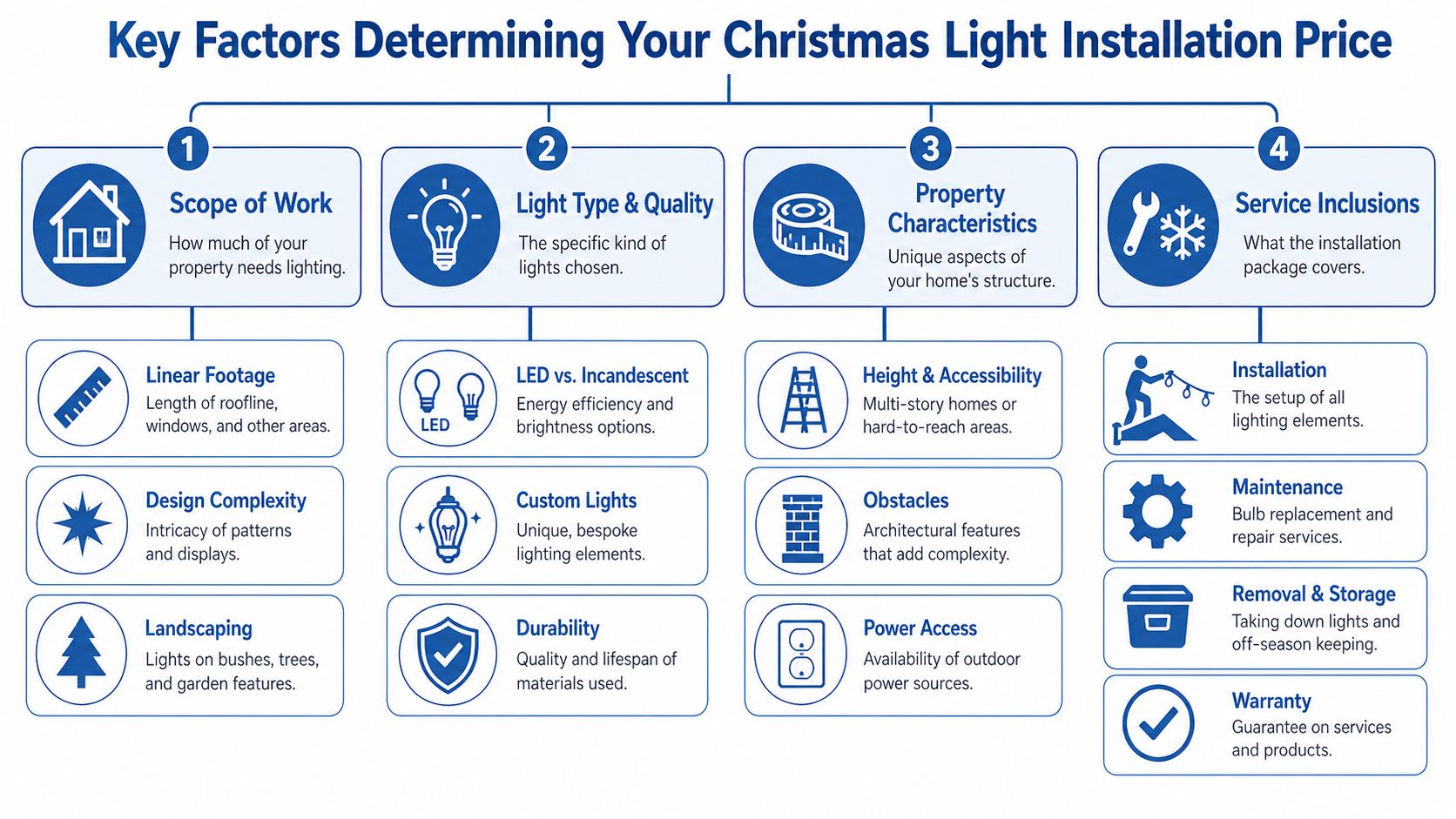
Scope changes everything
The fastest way to raise or lower christmas light installation cost is to change the scope. A simple front roofline is one job. Front and rear elevations, trees, walkway accents, entry columns, and courtyard walls are another.
That matters in Phoenix because a lot of homes don’t have one clean, uninterrupted roof edge. They have pop-outs, parapets, varied facades, and separate architectural planes that force the installer to stop, reposition, and detail the work more carefully.
Scope items that increase labor
- Longer rooflines: More footage means more setup and fastening time.
- Layered landscaping: Bushes, palms, and feature trees create more individual work zones.
- Detailed patterns: Clean symmetry takes longer than a casual hang.
- Multiple focal points: Entry, garage, courtyard, and upper peaks all add handling time.
Property height and access can move a quote fast
Many homeowners underestimate the job. Two-story work isn’t just “a little more ladder time.” It changes safety planning, crew movement, and in some cases the equipment needed to complete the install without damaging finishes.
For high-end estate homes in Scottsdale and Paradise Valley, full-service installations can range from $6,500 to $15,000+, driven by scale and complexity, according to Scottsdale and Paradise Valley holiday lighting cost data. That same source notes that these larger displays often involve 3,000+ bulbs and may require scaffold-rated boom lifts for multi-story access on stucco surfaces, which can add 15% to 25% to labor costs.
Phoenix architecture adds its own friction
Tile roofs change how crews move. Stucco and EIFS surfaces require care with attachment methods. Tall front entries and recessed windows can turn a nice-looking design into a much slower install than the home’s square footage suggests.
That’s one reason quotes on estate homes can jump sharply even when the display itself looks clean and restrained. The visual simplicity can hide difficult access.
The house that looks easiest from the curb is not always the fastest to decorate. Tall facades, fragile roof materials, and broken rooflines usually matter more than the basic footprint.
Light type and package design matter
Some customers provide their own lights. Others want a complete package with supplied lighting, seasonal service, takedown, and storage. Both can make sense.
Owner-provided lights can reduce upfront spending, but they also introduce uncertainty. Older strands, mismatched bulb color, worn plugs, and inconsistent clip compatibility can slow an install and lead to more maintenance calls.
Full-service packages cost more because the contractor is controlling the result. That usually means a more consistent look, fewer surprises during install, and a cleaner takedown.
Service inclusions affect value more than people expect
Quotes that look similar can be very different. One may cover install only. Another may include in-season maintenance, post-install adjustments, removal, and organized storage.
Ask what happens if a section goes dark. Ask whether takedown is scheduled automatically. Ask who owns the materials and how they’re handled after the season. These aren’t small details. They’re often the difference between a smooth holiday season and a chain of avoidable service calls.
DIY vs Professional Installation A Cost and Safety Comparison
A DIY setup can make sense for some homes. If the roofline is low, the design is simple, and you already have working lights and the right equipment, doing it yourself may be reasonable.
But people often compare DIY against the labor line only, not against the full reality of the job. Such a comparison includes time, testing, ladder work, attachment method, troubleshooting, takedown, and storage.
DIY vs Professional Christmas Light Installation
| Factor | DIY Installation | Professional Installation |
|---|---|---|
| Upfront cash outlay | Can seem lower if you already own lights | Higher because labor and service are included |
| Time required | You handle setup, testing, hanging, fixes, removal | Crew handles the work start to finish |
| Safety exposure | You take the ladder and roof risk | Contractor assumes the access work |
| Design consistency | Depends on your materials and patience | Usually cleaner and more uniform |
| Maintenance during season | You troubleshoot outages yourself | Often handled if included in package |
| Takedown and storage | You do it after the holidays | May be bundled into service |
Where DIY usually works
DIY is most realistic on a modest, easy-access house where you’re keeping the display simple. A clean front edge, low shrubs, and one entry feature is a different project than lighting a tall two-story facade with multiple roof transitions.
It also helps if your lights are already sorted and tested. If you’ve ever spent a night chasing one failed section through three extension cords and a half-working strand, you know the hidden labor starts before the first clip goes on the house.
Where DIY usually breaks down
The trouble starts when access and troubleshooting stack up. Tile roofs are not forgiving. Upper-story peaks take longer than expected. A design that looked manageable on paper turns into repeated ladder moves and a lot of trial and error.
Before you commit to a DIY route, it helps to review a practical bulb tester guide for Christmas tree lights, especially if your existing sets are part of the plan.
Field note: Most DIY frustration doesn’t come from hanging the first section. It comes from fixing the last 10 percent when the lights don’t match, the clips don’t fit right, or one dead run forces you to undo finished work.
Safety is the real dividing line
For homeowners, the biggest professional advantage is often not speed. It’s controlled access work. Exterior crews that already handle windows, storefront glass, upper elevations, and difficult approach points are used to moving safely around the same areas where holiday lighting gets tricky.
Property managers usually see this faster than homeowners do. The issue isn’t whether a staff member can technically hang lights. It’s whether that’s a smart use of time and risk when the building still has tenants, customers, deliveries, and routine maintenance to manage.
Professional installation also tends to produce a neater final result because the crew is focused on layout, attachment, and repeatable spacing. DIY can absolutely work. It just works best when the property is forgiving and the homeowner is realistic about the labor.
How to Get an Accurate Quote and Hire the Right Pro
The fastest way to get a bad quote is to ask for “lights on the house” and leave it at that. Good estimates come from good detail. Contractors need to know what areas you want lit, how high the access points are, whether you’re supplying lights, and what level of service you expect after installation.

What to have ready before you ask for pricing
Photos help a lot. So does a short written list of what you want illuminated.
Bring these to the conversation:
- Front and side photos: Clear pictures of the roofline, entry, and landscaping.
- A scope list: Roofline only, roofline plus shrubs, columns, trees, wreaths, or garland.
- Material preference: Your own lights or contractor-supplied package.
- Service expectations: Install only, or maintenance, removal, and storage too.
What a fair quote should explain
A lot of companies quote one bundled number. That’s normal. But you should still understand what sits inside that bundle.
Industry pricing data shows materials often account for $0.40 to $2 per foot, while labor and operational overhead make up $2 to $5 per foot, according to this breakdown of Christmas light installation pricing. That’s useful because it helps you judge whether a bid is thin, realistic, or missing important service components.
Ask these questions before hiring anyone
What exactly is included?
Ask whether the quote covers lights, clips, timers, maintenance, takedown, and storage.How do you handle service calls?
If a section goes out, you want to know whether a return visit is included.Are you insured for this type of work?
For exterior access work, insurance matters. For commercial and high-access jobs, many property managers use a substantial policy as a baseline review point.How will you attach lights to my home?
This matters on stucco, tile, painted trim, and delicate exterior finishes.What happens after the season?
Takedown logistics can be as important as installation.
A low quote that skips maintenance or removal can end up costing more in time, hassle, and patchwork fixes than a fuller bid that looked expensive at first glance.
How to vet a contractor without overcomplicating it
A simple hiring checklist goes a long way. If you want a useful outside reference, Richmond Tree Experts' hiring guide is a solid framework for evaluating contractors online, even though it’s written for a different service category.
You should also review how the company talks about process, protection, and scope. A practical example is this holiday lighting company checklist, which helps narrow down what to ask before approving a job.
One Phoenix option to compare is South Mountain Window Cleaning, LLC, which offers seasonal lighting as part of its exterior service lineup and notes a $2 million insurance policy for business clients in its company information. That kind of detail matters more than glossy photos because it tells you the company is thinking in operational terms, not just decorative terms.
Tips to Manage Costs and Maximize Curb Appeal
The easiest way to overspend is to light everything. The easiest way to underspend is to cut so much that the display looks accidental. The sweet spot is a focused plan that highlights the home’s strongest lines and keeps labor concentrated where it creates the most visual payoff.
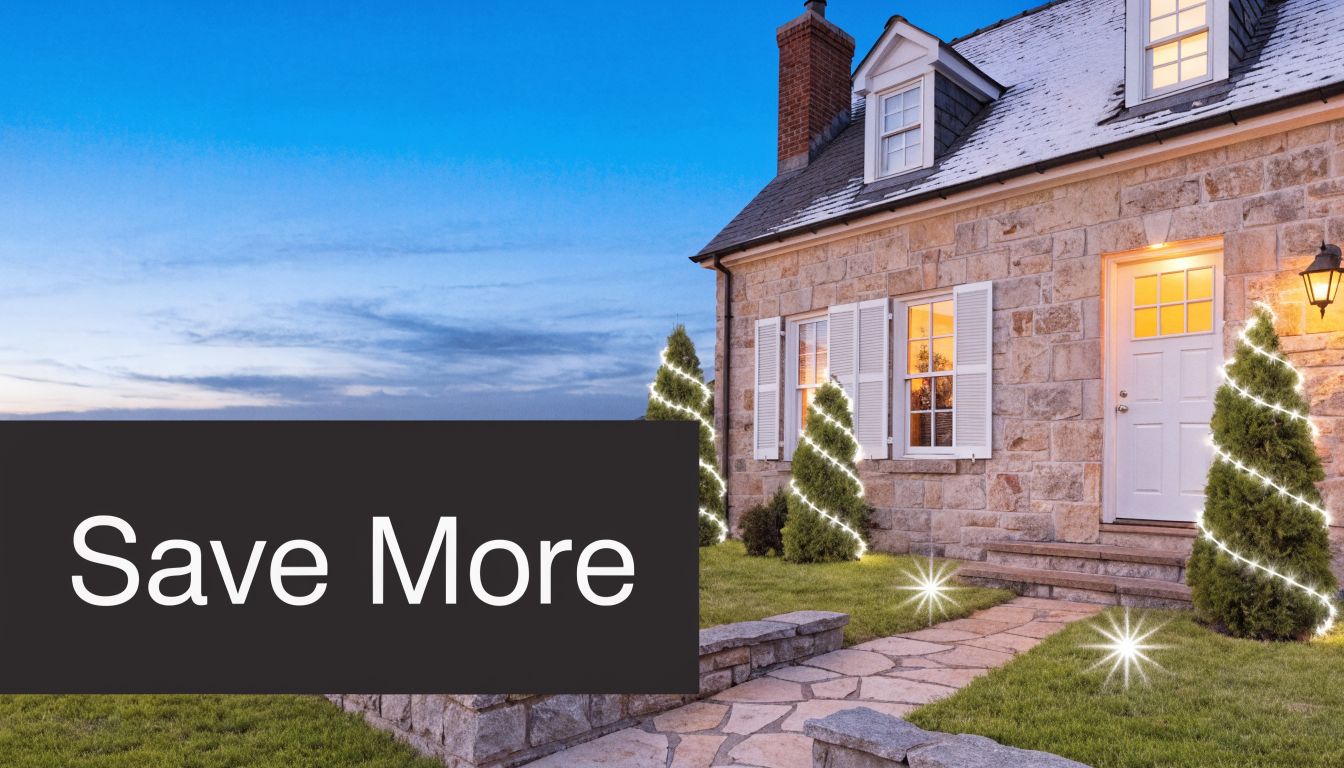
Keep the design disciplined
For many Phoenix homes, the best-looking display is not the busiest one. A crisp roofline, a defined entry, and a few exterior accents usually read cleaner than trying to cover every peak, pillar, and shrub.
That’s especially true on stucco homes with strong architectural lines. The house already has shape. The lighting should trace it, not fight it.
A few curb appeal fundamentals also carry over from the rest of your exterior maintenance. If you’re trying to coordinate windows, entry presentation, and lighting together, this curb appeal guide for Arizona homes is a useful planning reference.
Use package choices strategically
If your own lights are in good condition and the scope is simple, using them may be enough. If the display is larger or you want a more polished result, a full-service package often reduces headaches because one company controls the look, service, and takedown.
You can also manage cost by deciding where not to decorate. Rear elevations that no one sees from the street don’t always deserve the same budget as the front facade. A property manager might make the same call on secondary building sides and focus spending on the customer-facing frontage.
Practical ways to keep the budget under control
- Prioritize the front view: Spend money where guests, customers, and neighbors see it.
- Choose a cleaner layout: Fewer, better-placed lines usually look more expensive than a cluttered design.
- Bundle seasonal exterior work: Scheduling lighting alongside window cleaning or related exterior services can simplify timing and reduce friction.
- Think about upkeep early: A design that’s easier to service is usually a smarter design.
This short video gives a useful visual sense of how layout choices can affect the final look.
Match the plan to the property
A Paradise Valley estate can absorb a broader design. A narrower Chandler lot may look better with restraint. A retail storefront usually benefits from symmetry and consistency more than decorative complexity.
That’s the best cost-control principle in holiday lighting. Don’t buy or install by habit. Design for the actual building.
Light Up Your Phoenix Holiday with Confidence and Cheer
A good holiday lighting plan starts with honest numbers and realistic expectations. In the Phoenix area, the spread between labor-only installation and full-service packages makes sense once you account for access, architecture, materials, maintenance, and removal.
The core question isn’t just what christmas light installation cost on paper. It’s what kind of experience you want through the season. Some homeowners are happy to sort bins, test strands, and handle the ladder work. Others want a clean result, safer access, and one clear point of responsibility if something needs attention.
For Phoenix, Scottsdale, Paradise Valley, Chandler, Tempe, and Gilbert properties, local conditions matter. Tile roofs, stucco, sun exposure, dust, and tall front elevations all reward careful planning and experienced exterior crews. That’s why hiring a properly insured pro often makes more sense than comparing bids as if every house were a simple one-story rectangle.
If you’re reviewing quotes now, focus on scope clarity, service inclusions, attachment method, and who’s taking responsibility for the job from install through takedown. That’s where value shows up.
If you want a clear, no-pressure estimate for holiday lighting from a company that already works on Phoenix-area exteriors every day, South Mountain Window Cleaning, LLC offers fast quotes for residential and commercial properties across the Valley.