
By 8:30 a.m., the sun is already exposing every streak on the west elevation. Tenants are walking in, ownership is asking why the glass looks dull again, and you’re trying to decide whether this is a simple touch-up or the start of a larger facade problem. That’s a familiar position for Phoenix property managers who oversee mid rise buildings.
These properties sit in a demanding middle ground. They’re tall enough to require planning, specialized access, and tighter safety controls, but they often don’t have the built-in maintenance systems or straightforward geometry that make some tower work more predictable. In Phoenix, dust, hard water, heat, and UV exposure turn that challenge into an ongoing operational issue, not a once-a-year cosmetic task.
A good cleaning plan for a mid rise isn’t just about making glass look better. It affects tenant perception, lease tours, maintenance budgets, vendor risk, and how well the building holds up over time. The right approach comes down to three things: access, safety, and scheduling discipline.
The Growing Challenge of Mid Rise Building Maintenance
Phoenix managers are handling more properties that fall into this category for a reason. Mid-rise buildings, typically defined as structures with 4 to 12 stories, have grown from 6% of new U.S. apartment construction in the 1990s to 41% of current projects under construction, according to RentCafe’s market snapshot on high-rise and mid-rise residential trends.
That shift matters on the maintenance side. A two-story retail pad can often be cleaned with simpler ground-based methods. A true high-rise usually gets designed with more formal facade access planning. Mid rise buildings often land in between. They’re big enough to need real logistics and small enough that owners sometimes underestimate what proper upkeep requires.
Why these properties create more operational pressure
Mid rise buildings usually combine several priorities in one envelope:
- Street-level appearance matters: Leasing traffic, retail visitors, and residents all see the lower facade up close.
- Upper floors still need advanced access: Once height and setbacks change, routine work gets more technical.
- Mixed materials age differently: Glass, stucco, metal, EIFS, painted concrete, and stone don’t collect soil the same way.
- Budgets get squeezed: Managers are expected to preserve curb appeal without treating the property like a downtown tower.
That combination creates a common problem. Teams delay exterior cleaning because it feels discretionary, then call for service only when stains, dust buildup, or tenant complaints become impossible to ignore.
Practical rule: If your facade only gets attention when someone complains, you’re already paying more than you need to.
In Phoenix, deferred cleaning rarely stays cosmetic. Dust bonds to frames and ledges. Irrigation overspray leaves mineral staining on lower glass. Pollutants and runoff collect in corners, reveals, and expansion joints. Once that buildup sets, crews need more labor, more detailed methods, and more access coordination to restore the surface.
That’s why mid rise maintenance needs a building-specific plan instead of a generic “window washing” line item.
What Exactly Defines a Mid Rise Building in Phoenix
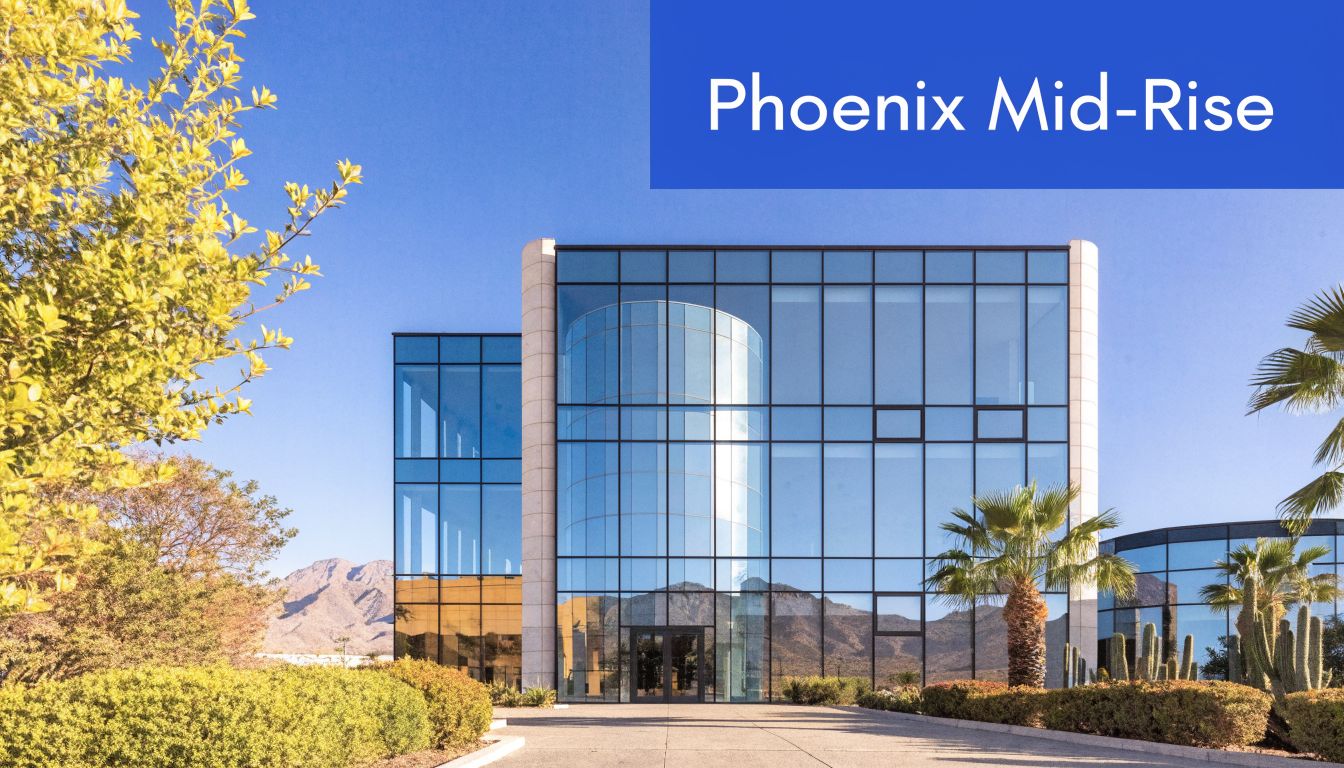
A practical definition matters because the cleaning plan starts with the building type. In day-to-day property operations, mid rise buildings are the ones that have outgrown simple ladder work but don’t function like full towers. They often sit along busy corridors, in mixed-use developments, or as multifamily and office properties with prominent street frontage.
The standard range is generally 5 to 12 stories, and the International Building Code treats them as buildings that avoid high-rise status, which begins over 75 feet to the highest occupied floor. That distinction is part of why they’re often built with more cost-effective wood-frame approaches, as outlined in Swiftlane’s overview of low-rise, mid-rise, and high-rise buildings.
What a manager should look for on site
You can usually identify a mid rise by operational characteristics, not just floor count.
| Building trait | What it means for maintenance |
|---|---|
| Multiple occupied floors above street level | Ground crews can’t reach all work areas safely |
| Large glass areas mixed with solid facade materials | Different cleaning chemistry and tools may be needed |
| Podium or courtyard layouts | Access may be restricted even when the building isn’t extremely tall |
| Retail, lobby, or amenity frontage | Lower-level presentation affects perception every day |
In Phoenix, many of these buildings also feature modern design choices that look sharp on lease-up but demand more upkeep later. Think recessed window bands, decorative metal screens, balcony rails, parapet transitions, and horizontal ledges that catch fine desert dust.
Why the Phoenix environment changes the definition in practice
The code definition tells you what the building is. The climate tells you how it behaves.
A four- to twelve-story building in Phoenix isn’t just a mid rise on paper. It’s a structure with exposed glass under intense sun, facade materials that expand and contract in heat, and surfaces that collect airborne dust faster than many managers expect. Dark metal frames show residue quickly. Reflective glass reveals spotting. Light stucco can look faded or dirty even when the issue is concentrated runoff.
These buildings are the missing middle in urban form, but they’re often the awkward middle in maintenance.
That’s why the same building class can feel manageable in one market and demanding in another. In the Valley, the exterior is always on display, and small lapses become visible fast.
The Unique Cleaning Challenges of Mid Rise Facades
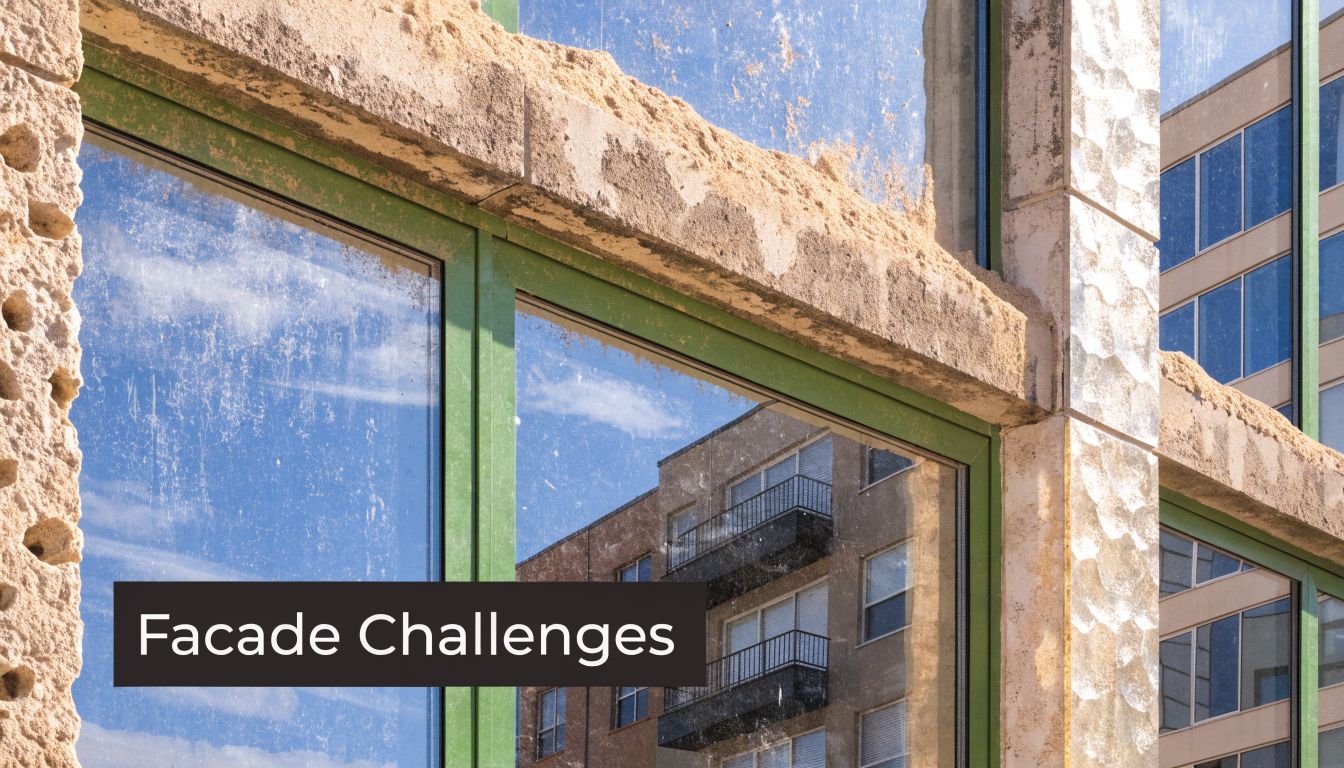
The problem isn’t just that Phoenix is dusty. It’s that mid rise facades give dust, minerals, and baked-on residue places to stay. Modern buildings have more texture than owners sometimes realize. Every reveal, panel joint, projecting sill, sunshade, and corner transition becomes a collection point.
Where Phoenix grime actually builds up
On most mid rise properties, crews see the same trouble areas repeatedly:
- Horizontal ledges and frame tops: Fine dust settles first, then moisture locks it in.
- Glass near irrigation zones: Hard water staining starts low and becomes permanent-looking if ignored.
- Shaded recesses: Dirt doesn’t rinse away evenly, so these areas often look patchy.
- Metal and textured cladding: Heat bakes grime onto the surface and can make aggressive cleaning risky.
A simple rinse doesn’t solve those issues. It can make the appearance worse if minerals in the water dry on hot glass or if runoff pulls dirt across adjacent materials.
Design decisions often make access harder
Some of the biggest maintenance problems start in design, not in operations. A key issue in mid-rise design is the tendency to create deep units and limit balconies in order to maximize floor space. That restricts exterior access and increases reliance on specialized rigging for cleaning and repairs, as noted in Smart Density’s discussion of mid-rise buildings that work and the problems they face.
For a property manager, that translates into a few practical headaches:
- Fewer natural staging points for technicians.
- Less forgiving access to inset glass and facade transitions.
- More dependence on roof-based or suspended methods when a lift can’t get close enough.
That’s why a “wash-down” mindset usually fails on mid rise buildings. The facade may include storefront glass at grade, sealed upper windows, stucco returns, metal coping, breezeway glazing, and courtyard elevations with restricted ground access. Those aren’t one cleaning problem. They’re several.
What works and what doesn’t
What works is matching the method to the soil and the surface. Pure-water poles can be effective on reachable exterior glass. Professional squeegee work is often the better finish option on detail-sensitive panes. Soft washing can help on some exterior surfaces. Pressure washing has a place, but not on every finish and not at every pressure level.
What doesn’t work is sending one crew with one method and expecting consistent results across the whole envelope.
The facade tells you how it needs to be cleaned. If the proposal looks identical for every building, the vendor probably hasn’t read the building correctly.
Choosing the Right Access Method for Your Building
Most mid rise cleaning problems are really access problems. If the crew can’t reach the work area safely and efficiently, the final result suffers and the labor cost climbs. On many Phoenix properties, the right method changes by elevation. What works on the front entry may be completely wrong for a rear courtyard or upper glass band.
Building specifications directly affect access. Heights reaching 85 feet, common in 6-8 story mid-rises, often require specialized access such as insured bosun’s chair teams because ground-based equipment can no longer reach the full facade, according to WBDG’s guidance on strategies and trends in mid-rise wood construction.
Comparing the three main options
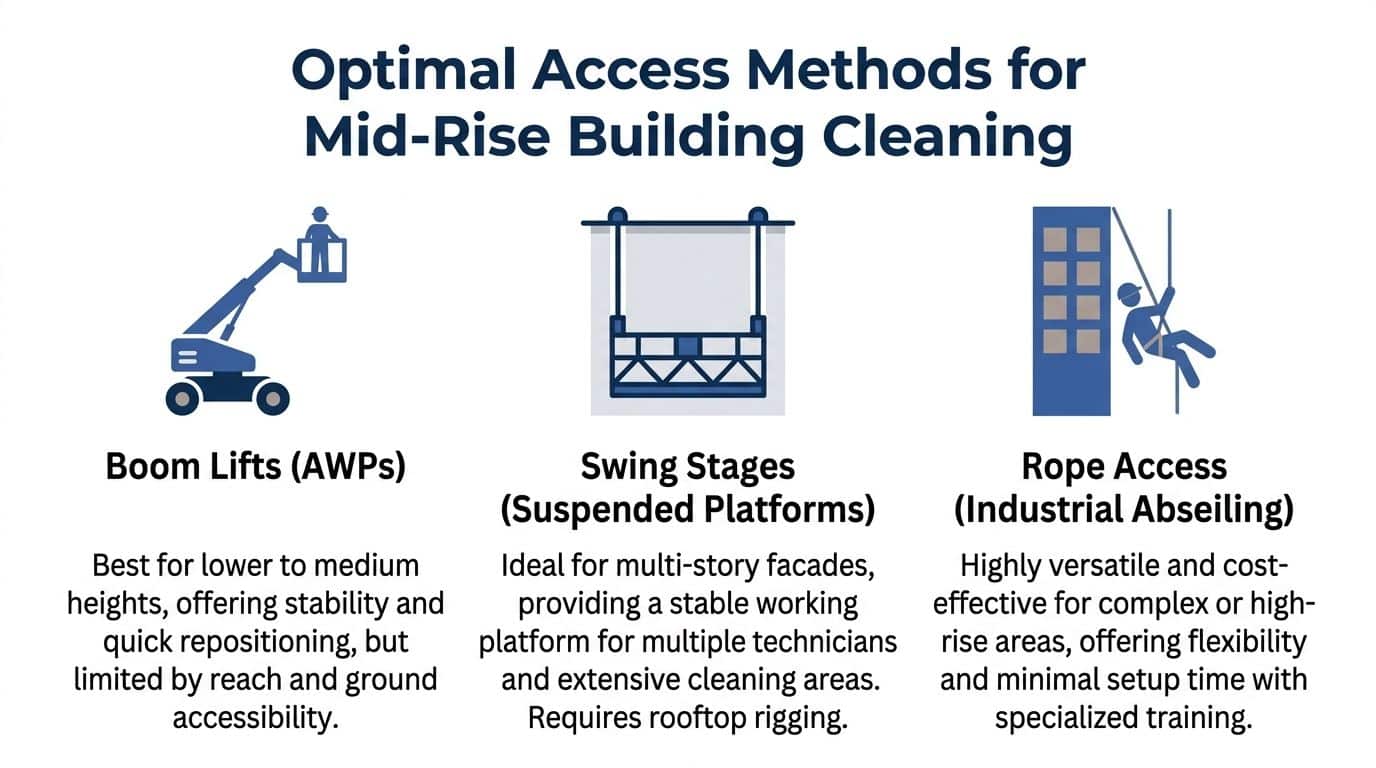
| Access method | Best fit | Main advantage | Main limitation |
|---|---|---|---|
| Boom lifts | Lower to medium heights with open ground access | Fast repositioning and stable platform | Limited by reach, landscaping, parked cars, and tight setbacks |
| Swing stages | Broad vertical facades with roof rigging options | Good working platform for larger facade sections | More setup, more rooftop coordination |
| Rope access or bosun’s chairs | Complex elevations, inset windows, restricted access areas | Flexible and less intrusive at many sites | Requires specialized training, planning, and rescue readiness |
When a boom lift makes sense
Boom lifts are often the most straightforward choice for storefronts, lobby glass, and sections where the building has clear perimeter access. They’re useful when crews need to move laterally and handle detail work without constant rigging changes.
They become a poor fit when the site has:
- Tight landscaping beds
- Podium garages
- Restricted rear alleys
- Canopies and architectural projections
- Courtyards with limited equipment entry
Managers often like lifts because they’re easy to visualize. But if the machine can’t get square to the work, production slows down fast.
Where suspended or rope-based access wins
Swing stages work well when the facade is fairly continuous and the roof can support proper rigging. They’re a strong option for long vertical drops where crews need a stable platform for repeated passes.
Rope access and bosun’s chair work become the better answer when the facade is broken up, setbacks interrupt the line, or there are multiple inset sections. For more specialized upper-elevation service on taller properties, many managers also review high-rise window cleaning methods and requirements to understand how suspended access differs from standard low-rise service.
The least expensive access method on paper often becomes the most expensive one on site if it forces slow work, repeated mobilization, or tenant disruption.
The right question to ask vendors
Don’t ask only, “What’s your price?” Ask, “Why is this access method the right one for this facade?”
A qualified contractor should be able to explain the choice in relation to roof conditions, reach limitations, pedestrian control, glass layout, and how much setup will affect tenants and daily operations.
Navigating Safety Insurance and Regulatory Compliance
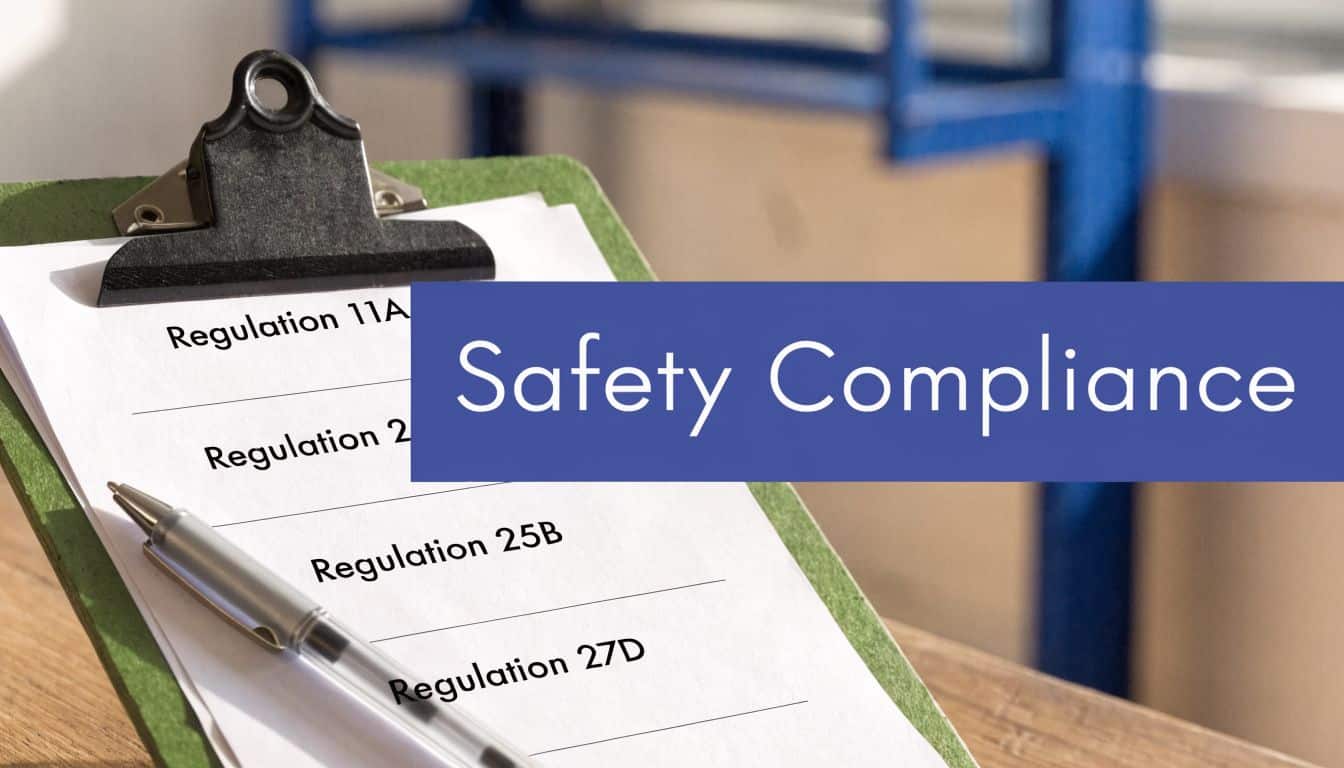
Exterior cleaning on mid rise buildings is a risk management issue before it’s a janitorial issue. If a vendor is working above entries, walkways, loading areas, or tenant spaces, your exposure as a manager goes well beyond streaks on glass. You need a contractor who can control the work zone, protect the public, and document that the job is being done correctly.
What proper compliance looks like in practice
On a real job, safety isn’t a generic promise. It shows up in paperwork and site behavior.
Look for vendors who can provide:
- A site-specific work plan: Not a recycled template, but a plan tied to your roof, elevations, and pedestrian flow.
- Fall protection procedures: The contractor should explain anchor use, tie-off practices, and rescue planning in plain language.
- Traffic and pedestrian control: Entry cones, ground spotters, cordoned-off zones, and communication with building staff matter.
- Current insurance documentation: Ask for certificates sent directly from the insurer, not screenshots forwarded by a salesperson.
If you want a useful outside reference on how professionals evaluate jobsite risk and legal obligations, Health and Safety Compliance Surveyors offers a good overview of how compliance review supports safer operations.
Insurance is not all the same
Many managers hear “insured” and stop asking questions. That’s a mistake. General liability alone doesn’t tell you enough. You need to understand whether the policy matches the type of work being performed and whether height-related operations are contemplated.
South Mountain Window Cleaning, for example, states that it carries a $2 million insurance policy in its company information. More important than the number itself is whether the contractor can clearly explain coverage, bonding, and the difference between the two. This bonded vs insured guide for property owners and managers is a useful starting point for those distinctions.
Risk check: If a vendor avoids detailed insurance questions, assume they’ll be just as vague when something goes wrong on site.
What managers should insist on before work starts
A clean proposal isn’t enough. Require a pre-job review that confirms access points, restricted hours, tenant notification needs, and emergency contacts. If rope or suspended methods are involved, ask who supervises the drop and how communication works between roof and ground.
That conversation should feel operational, not promotional. If it doesn’t, keep looking.
Budgeting and Scheduling for Year-Round Curb Appeal
Reactive cleaning costs more because the building gets dirtier, the stains get harder, and access usually has to be rushed around complaints. Mid rise buildings perform better when the budget reflects how the exterior soils in Phoenix.
The first step is to separate visibility from full-building scope. Entry glass, retail frontage, and leasing-facing elevations usually need more frequent attention than upper facade washing. That doesn’t mean everything should be cleaned at the same interval. It means your schedule should follow exposure, tenant expectations, and how difficult it is to remove buildup once it sets.
Build the budget around service categories
A practical annual plan usually includes a few distinct buckets:
- Street-level glass and entry work: This is the first impression area. Keep it on a tighter cycle.
- Upper exterior glass: Schedule by exposure and complaint history, not by guesswork.
- Full facade rinsing or washing: Use this to address broader dust accumulation and appearance drift.
- Spot treatment work: Hard water, runoff lines, bird issues, or isolated staining need separate planning.
This approach gives owners a cleaner budget conversation. Instead of arguing over one big annual number, you can show what protects image, what protects materials, and what can be scheduled seasonally.
Design affects cost more than managers expect
The facade area isn’t determined only by the visible height of the building. Code-driven design decisions can enlarge the cleaning scope. When sprinklers allow floor plates to expand from a 12,000 square foot base to 45,000 square feet, the exterior facade area also scales up, which increases the scope and cost of window and building washing, as discussed in Structure Magazine’s article on mid-rise wood-frame buildings.
That matters because two buildings with the same story count can have very different service requirements. One may have a simple rectangle with straightforward drops. Another may have long wings, deeper courtyards, and more glass line per floor.
A workable scheduling framework
Use this as a planning model, then adjust based on exposure and tenant standards:
- Audit the building by elevation. Don’t budget the whole property as one surface.
- Group work by access method. If one side needs a lift and another needs rope access, budget those separately.
- Schedule visible glass more often than hidden facade areas. That keeps complaints down and image up.
- Reserve contingency funds for stain removal and post-storm cleanup. Phoenix weather and irrigation issues don’t always follow the calendar.
A clean budget is one that ownership can defend. It ties frequency to visibility, complexity, and preservation instead of treating exterior care like an emergency expense.
A Procurement Checklist for Your Next Cleaning Vendor
Most vendor selection problems start with vague bids. If the proposal doesn’t tell you how the company will access the building, protect pedestrians, and handle Phoenix-specific soil conditions, you’re not comparing equal contractors. You’re comparing incomplete assumptions.
A stronger procurement process uses a checklist that forces detail before a crew ever shows up.
Questions that reveal whether a vendor is prepared
Ask these in writing:
- How will you access each elevation? A serious contractor should identify lifts, suspended access, rope work, or water-fed pole zones by area.
- What cleaning methods will you use on glass versus facade materials? You want to hear specific tools and surface-appropriate methods.
- Can you provide a site-specific safety plan? Generic corporate paperwork isn’t enough.
- Will insurance certificates come directly from your carrier? That reduces surprises.
- How do you control spotting on glass in the Phoenix heat? Pure-water systems, technique, and timing matter.
- Who supervises the work on site? You need one accountable contact.
For broader facility teams that also evaluate vendor diversity as part of procurement policy, this piece on partnering with diverse suppliers offers useful context for building a more intentional sourcing process.
What good documentation should include
A credible bid should spell out scope clearly. It should note whether tracks, frames, ledges, lower canopies, signage glass, or courtyard elevations are included. If those details are missing, change orders and misunderstandings usually follow.
It also helps to compare each proposal against a formal internal list. Property teams that want a stronger template can use a commercial building maintenance checklist to keep exterior cleaning aligned with the rest of the site maintenance program.
A vendor who answers clearly before the job usually communicates clearly during the job.
One last screen that saves trouble
Ask the company what doesn’t work on your building type. That question tends to separate experienced contractors from generalists. The experienced ones will tell you where lift access fails, where direct sun complicates glass work, and where certain surfaces need gentler methods.
That kind of candor is usually a good sign.
Protect Your Phoenix Property as a Premier Asset
Mid rise buildings ask more from a maintenance program than most owners expect. The height, facade mix, access limits, and Phoenix climate all push routine cleaning into the category of planned asset protection. Done right, it supports appearance, tenant confidence, and material longevity.
If you manage a property that needs a clearer strategy for access, scheduling, and facade care, treat exterior cleaning like part of your preservation plan, not a cosmetic add-on. A structured commercial building exterior cleaning program makes the budget easier to defend and the building easier to keep sharp.
If you manage a mid rise property in Phoenix, Scottsdale, Paradise Valley, Chandler, Tempe, or Gilbert, South Mountain Window Cleaning, LLC can help you evaluate facade access, safety requirements, and a realistic service schedule for your building. Reach out for a quote and a practical review of what your exterior needs.