
By midweek, a Phoenix property manager usually knows which buildings need attention first. The east-facing glass is dusty again. A tenant has mentioned streaks near the lobby entrance. A retail client wants the storefront to look sharper before a busy weekend. Someone from accounting is also asking whether exterior cleaning can wait another quarter.
In Arizona, that decision has consequences beyond appearance. Glass takes a beating from dust, heat, irrigation overspray, and hard water. If windows stay dirty too long, the problem shifts from cosmetic to operational. The building looks less cared for, tenants notice, and mineral residue starts turning a routine service issue into a restoration issue.
That’s why smart property managers don’t treat window cleaning services commercial work as an occasional touch-up. They treat it like asset protection. The right plan protects curb appeal, lowers risk, supports tenant retention, and prevents avoidable damage to glass and surrounding finishes.
Your Guide to Commercial Window Cleaning in Phoenix
A lot of managers inherit a property with no clear exterior maintenance standard. One building gets cleaned only when ownership is visiting. Another gets a rushed service after monsoon dust settles. A third uses a low bid vendor that leaves drips on mullions and can’t explain its safety process.
That approach usually creates the same cycle. Complaints come in late, the work becomes reactive, and every cleaning feels like a special project instead of routine operations.
Phoenix makes that worse. Fine dust settles fast. Intense sun highlights every spot and streak. Hard water from sprinklers and runoff bakes onto glass, especially at storefronts, office entries, and lower elevations near landscaping. In this climate, clean windows aren’t just about presentation. They’re part of how a property signals that management is paying attention.
What a property manager actually needs
Most owners and managers aren’t looking for a lecture on shiny glass. They need answers to practical questions:
- How often should the building be serviced so the glass stays presentable without overspending?
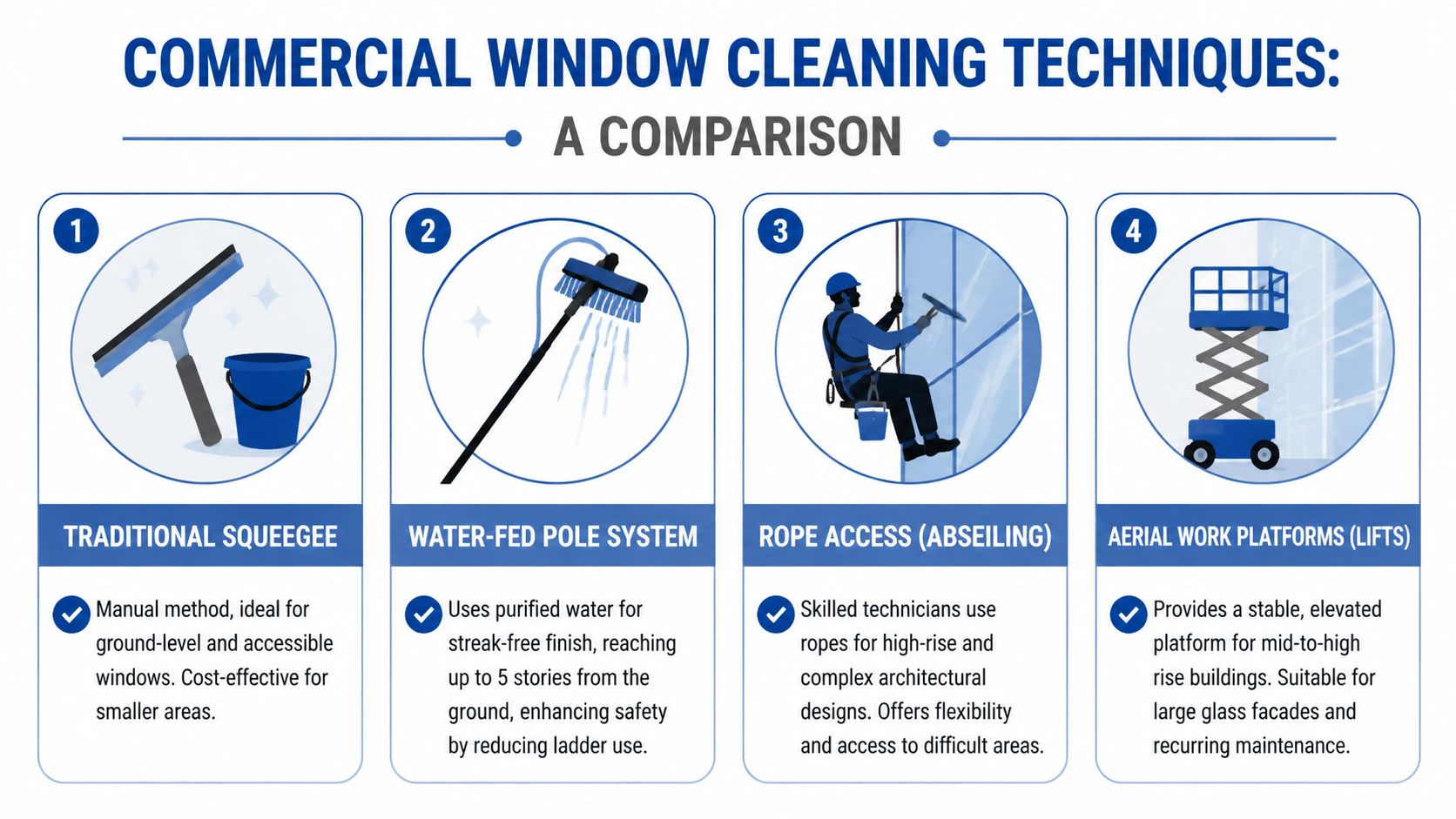
- Which cleaning method fits the property: traditional squeegee work, pure-water pole systems, rope access, or lifts?
- What safety standards matter most when technicians are working above occupied areas?
- How do you compare quotes without rewarding the vendor who leaves out insurance, training, or scope?
Clean windows don’t fix bad operations, but dirty windows advertise them.
The strongest commercial programs are simple. Match the method to the building, schedule service before the glass deteriorates, and use a vendor that can document training, insurance, and scope clearly. In Phoenix, that’s the difference between stable maintenance and recurring cleanup.
The Business Case for Impeccable Windows in Arizona
Property managers in Arizona often get pushed to justify exterior cleaning as if it were optional. It isn’t, especially on buildings where glass is a visible part of the tenant and customer experience. Routine exterior cleaning supports occupancy, presentation, and the long-term condition of the property.
Industry data from BOMA indicates that properties with routine exterior cleaning see 5-15% higher tenant retention rates, which supports NOI by reducing vacancy loss, and in Phoenix’s sun-intense conditions, hard water spots and mineral buildup can reduce glass lifespan by 20-30% without professional intervention, as noted by Pro Form Window Cleaning’s discussion of exterior cleaning and property value. That’s the budget conversation many managers need. A regular cleaning line item can protect a much larger revenue stream.
Why Arizona changes the math
In milder climates, you can sometimes stretch service intervals without obvious damage. In Phoenix, the environment is less forgiving. Dust settles, sprinklers leave mineral residue, and heat bakes contamination onto the surface. Once that residue sits long enough, a simple maintenance clean can turn into more involved restoration work.
That’s why a planned commercial building exterior cleaning program makes financial sense. It keeps the asset in maintenance mode instead of repair mode.
A practical consideration:
- Tenant perception matters: Clean glass at entries, lobbies, and common areas reinforces that the property is actively managed.
- Glass replacement is expensive: Preventing mineral etching is usually cheaper than addressing damaged panes later.
- Brand image affects use: Retail, hospitality, and office properties all depend on visual trust.
Here’s a useful visual on how commercial window cleaning fits into property presentation and maintenance planning.
Revenue protection, not vanity spending
Managers who treat window cleaning as a cost center often end up approving more expensive corrective work later. Managers who treat it as preventive maintenance usually get steadier results. The building presents better. Tenants complain less. Ownership gets fewer surprise issues tied to neglected exterior surfaces.
A clean facade helps a building lease and renew on confidence. A neglected one forces you to explain why standards slipped.
That’s the business case in Arizona. You’re not buying shine. You’re protecting rent, reputation, and the useful life of visible building components.
Understanding Commercial Window Cleaning Techniques
Not every building should be cleaned the same way. A single-story storefront with easy sidewalk access needs a different approach than a mid-rise office with landscaping obstacles or a tower with recessed glass. If a vendor uses one method for everything, that’s usually a warning sign.
Traditional squeegee work
This is still the right tool for many commercial properties. Ground-level storefronts, entry glass, interior partitions, and accessible low-rise windows often clean best with a mop, detailing cloth, and professional squeegee. A skilled technician can remove handprints, dust film, and fresh spotting with tight edge control.
Where it doesn’t work well is on larger multi-story buildings where ladder dependence increases time and exposure. It’s also a poor fit when hard water residue has built up across broad elevations and you need a more efficient rinse process.
Pure-water pole systems
In Arizona, this is one of the most important technologies to understand. Pure-water systems use deionization to remove minerals from tap water. In this region, tap water is often above 300 ppm TDS, and purified water can be brought to below 10 ppm TDS, which allows it to dry clear instead of leaving mineral residue, according to this overview of pure-water window cleaning systems. The same source notes that using purified water from the ground can cut labor time by 40-50% on multi-story buildings because technicians can work without constant ladder repositioning.
If you want a technical breakdown of how this equipment is used in practice, this page on pure-water window cleaning systems is a helpful reference.
Think of TDS like what’s left behind after the water disappears. If regular tap water carries dissolved minerals, the window becomes the drying rack for those minerals. Pure water removes that leftover problem before it starts.
Field rule: In hard-water areas, the rinse water matters as much as the scrubbing.
Rope access and lift work
For high-rise and architecturally complex buildings, vendors may need rope descent systems, bosun’s chairs, or aerial lifts. These methods aren’t just about reach. They’re about reaching the glass safely and consistently without damaging landscaping, blocking entrances longer than necessary, or improvising around building features.
A good vendor chooses the method based on access, risk, and finish quality. They don’t force every property into the same equipment plan.
Here’s a practical comparison:
- Storefront and interior glass: Traditional squeegee work is usually the cleanest and most efficient choice.
- Mid-rise exteriors: Pure-water poles often provide the best mix of safety, speed, and finish.
- High-rise towers or complex facades: Rope access or lift-based work is often necessary.
- Mixed-use properties: Many sites need more than one method on the same service day.
When you understand the method, you can evaluate the quote more intelligently. You’re no longer buying “window cleaning.” You’re buying the right access strategy for your building.
Prioritizing Safety and Mitigating Your Risk
If a vendor can’t speak clearly about safety, insurance, and high-rise procedures, the conversation should stop there. Window cleaning looks simple from the ground. It isn’t simple when technicians are working above entries, sidewalks, parking areas, and occupied tenant space.
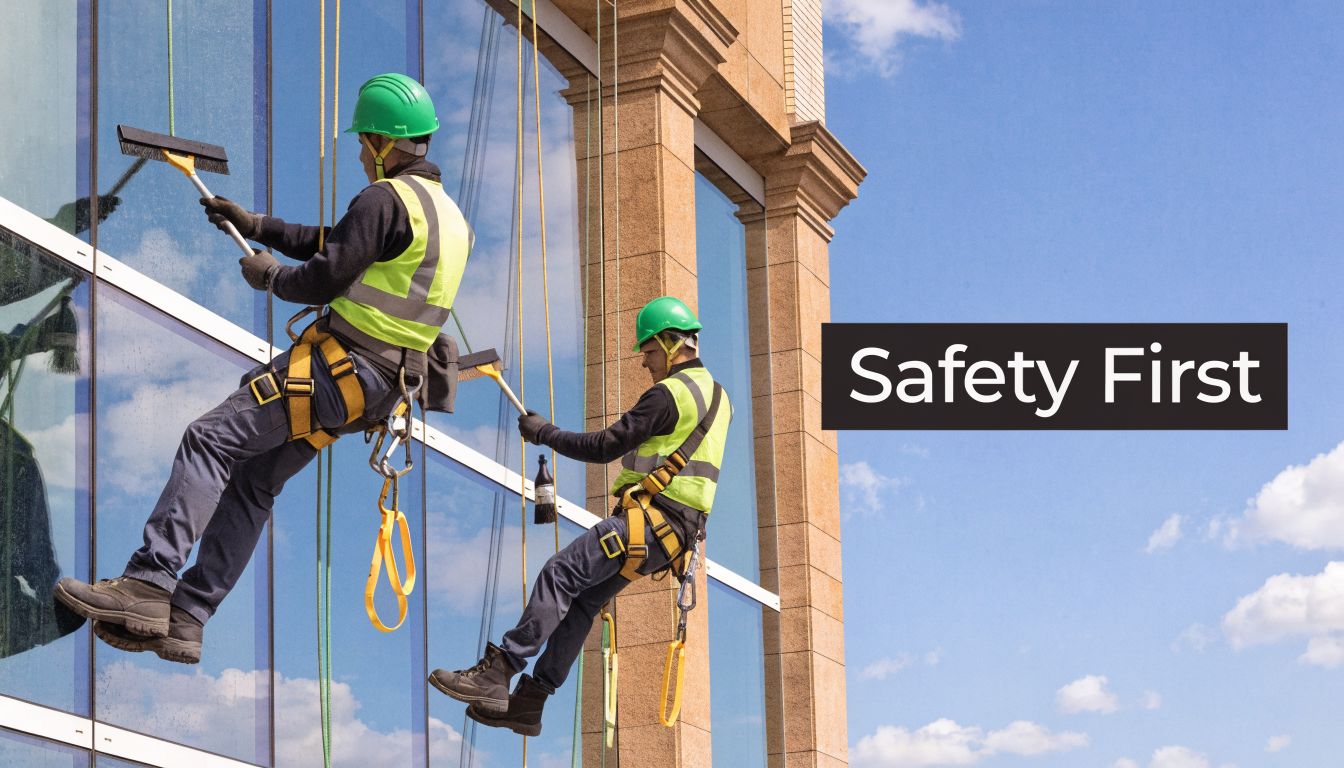
For high-rise work, OSHA 1926.502 requires fall protection, and using proper rope descent systems and personal fall arrest systems can reduce accident rates by 70%. The same source notes that high winds contribute to 30% of incidents, which is why weather judgment and site controls matter as much as gear. It also advises property owners to verify that the vendor carries a $2M+ insurance policy as a key liability protection step, as outlined in this high-rise cleaning safety discussion.
What a manager should verify before work starts
A certificate of insurance by itself isn’t enough. Ask how the crew will access the glass, what fall protection system they’ll use, and who is supervising the work. If the building is active during service, ask how they’ll control pedestrian areas below and coordinate with your team.
For managers who want a broader refresher on safe work practices for heights, that guide is a useful companion to vendor interviews. It helps you ask sharper questions without pretending to be the contractor.
Use this checklist in every bid review:
- Insurance limits: Confirm the vendor carries at least $2M+ in liability coverage.
- Access method: Get a clear explanation of whether the crew will use poles, lifts, rope descent, or a combination.
- Training record: Ask who trains the technicians and how competency is documented.
- Weather policy: Wind decisions matter in Arizona, especially around taller structures.
- Site protection: Look for cones, barricades, communication with tenants, and controlled drop zones.
Cheap bids often hide the biggest exposure
Low pricing sometimes comes from efficiency. More often, it comes from missing scope, weak insurance, poor equipment, or unsafe labor assumptions. If the quote doesn’t mention fall protection, public protection, or method of access, it’s incomplete.
A specialized high-rise window cleaning service should be able to explain all of that before the first technician arrives. That level of clarity protects the contractor, the property, and the manager approving the work.
If a crew is working over people, parked cars, and occupied entries, “we’ve done this before” is not a safety plan.
Risk management in commercial window cleaning isn’t paperwork for its own sake. It’s how you avoid turning a maintenance task into a liability event.
Decoding Commercial Window Cleaning Prices
The fastest way to compare bids badly is to focus on one number at the bottom of the proposal. Commercial pricing only makes sense when you understand what drives the scope. Two quotes can look similar on paper and cover very different levels of access, labor, risk, and finish quality.
A useful baseline comes from national industry data. In the United States, cleaning a typical 1,500-square-foot property costs around USD 260, with a range of USD 150-370, and services commonly equate to USD 40-75 hourly or USD 4-8 per window, according to Jobber’s summary of window cleaning industry statistics. Those figures are only a starting point. Commercial properties in Phoenix vary too much for a simple per-window formula to tell the whole story.
What actually changes the price
The main cost drivers are operational, not arbitrary.
- Height and access: A low-rise storefront is one thing. A building that needs lift access, rope work, or controlled pedestrian zones is another.
- Window condition: First-time cleanup after long neglect takes more labor than maintenance cleaning on a regular route.
- Obstructions: Awnings, signage, dense landscaping, narrow walkways, and architectural recesses all slow the job.
- Service frequency: Recurring work is usually more predictable than one-off recovery cleaning.
- Scope beyond the glass: Frames, tracks, screens, mirrors, entry doors, and surrounding exterior surfaces may or may not be included.
How to read a quote like an operator
When you review pricing, ask what the proposal assumes. Does it include water-fed pole work? Does it exclude hard water stain removal? Are after-hours logistics part of the number? Will the vendor need building engineering access or roof coordination?
Property managers who already track broader repair budgets often find it useful to think of glass service the same way they think about other recurring building costs. This guide to calculating maintenance expenses for landlords is residential in framing, but the budgeting logic applies. Regular maintenance is easier to forecast than deferred correction.
If you want a local benchmark for how scope affects bids, this page on commercial window cleaning prices gives a practical starting point.
Bid-reading tip: If one proposal is much lower, don’t ask “How did they get so cheap?” Ask “What did they leave out?”
The right price is the one tied to a clear scope, safe access, and a repeatable service standard. That’s what keeps costs predictable over time.
Your Checklist for Hiring the Right Vendor in Phoenix
A Phoenix property manager usually starts looking for a window cleaning vendor after a complaint, a failed inspection walk, or a streaked front elevation before a tenant tour. That is late. Vendor selection affects liability, tenant perception, and long-term glass condition, especially in a market where dust, intense sun, and hard water exposure can turn minor neglect into visible damage fast.
The market for window cleaning services is growing. According to Fortune Business Insights’ window cleaning services market outlook, the global market, valued at USD 162.35 billion in 2026, is projected to reach USD 316.85 billion by 2034. More companies will compete for your account. That makes screening more important, not less.
Commercial Window Cleaning Vendor Checklist
| Qualification | What to Look For | Why It Matters |
|---|---|---|
| Insurance | Proof of liability coverage that meets your property requirements | Reduces owner and manager exposure if equipment, glass, or pedestrians are involved in an incident |
| Safety compliance | Written fall-protection procedures, documented training, and a site-specific access plan | High-access work fails when crews improvise |
| Arizona-specific method | Experience with dust, irrigation overspray, oxidized frames, and hard water staining | Phoenix conditions affect labor time, finish quality, and whether the glass is being maintained or slowly damaged |
| Appropriate equipment | Pure-water systems, squeegee tools, lifts, or rope access matched to the building | Good vendors choose the method around the property, not around what happens to be in the truck |
| Clear scope | Written detail on interior, exterior, frames, tracks, screens, doors, and exclusions | Prevents change-order disputes and missed expectations |
| Scheduling reliability | Confirmed service windows, communication process, and repeatable route planning | Unreliable vendors create access issues, tenant complaints, and wasted staff time |
| References and reviews | Verifiable commercial clients with similar building types | Comparable work says more than a polished sales pitch |
| Responsiveness | Clear answers during quoting and fast follow-through on paperwork | Slow admin at the start usually becomes slower once service begins |
How to separate capable vendors from risky ones
During a site walk, a capable vendor should spot operational issues without being coached through them. That includes roof access limits, foot traffic at entries, irrigation overspray patterns, mineral buildup on lower panes, and elevations that take the hardest sun. In Phoenix, those details matter because they affect both frequency and method. A vendor who treats every building the same usually prices the job wrong or delivers inconsistent results.
Listen to how they discuss outcomes. Good operators talk in terms of scope, access, risk controls, and condition. Weak operators jump straight to price or promise perfect glass without mentioning stain removal limits, tenant coordination, or the difference between maintenance cleaning and restoration work.
Ask direct questions.
How do they protect pedestrian areas during service? What is excluded from the quote? Who coordinates access with engineering or security? What happens when they find mineral staining that standard cleaning will not remove? A professional vendor should answer those questions plainly and in writing.
A few requirements should stay on your list every time:
- Documentation: Insurance certificates, scope details, and scheduling terms should be easy to review before work starts.
- Method fit: The crew should explain why the property needs pure water, hand detailing, lift access, or another approach.
- Commercial discipline: Teams need to work around active tenants, retail traffic, deliveries, and parking flow without creating avoidable disruption.
- Service consistency: A key test is whether the second, third, and sixth visit match the first.
One practical example of the standard to look for
In the Phoenix market, South Mountain Window Cleaning, LLC is one example of the kind of operator to benchmark against. The company profile provided for this article notes commercial and high-rise capability, pure-water systems, computerized scheduling, and a $2 million insurance policy. Those are useful operating signals for evaluating any vendor, whether you hire that company or another one.
The goal is not to find the cheapest crew that can reach the glass. The goal is to hire a contractor that protects the asset, shows up reliably, and does not create new risk for your team to manage.
A good vendor interview should feel like pre-job planning. If it feels like a generic sales call, keep looking.
Frequently Asked Questions About Commercial Services
How often should a Phoenix property schedule service
Set the schedule by exposure, tenant standards, and how expensive it will be to recover neglected glass later.
In Phoenix, dust loads, sprinkler overspray, and hard water change the math. Ground-level retail glass at a busy frontage may need monthly or even more frequent service to stay presentable. Upper office glass on a sheltered elevation can often run on a longer cycle. The mistake is waiting for visible buildup. Once mineral spotting bakes in under Arizona sun, routine maintenance can turn into stain removal, added labor, and uneven results.
A good service interval protects appearance and keeps each visit efficient.
Should window cleaning and solar panel cleaning be bundled
Often, yes, if the property has both and the vendor is qualified for each scope.
The main benefit is operational control. One visit can cover roof access, site coordination, and tenant communication instead of repeating those steps with separate crews. That can reduce disruptions and make scheduling easier for engineering staff and on-site management. In Arizona, where dust settles fast on both glass and panels, pairing the work also helps keep exterior maintenance from slipping behind.
Bundling still needs judgment. If the window contractor is not properly set up for roof work, fall protection, or panel-safe cleaning methods, separate vendors are the better choice. One invoice is not worth taking on avoidable liability.
What should happen on the service day
Expect a crew that arrives within the agreed window, checks access points, confirms any restricted areas, and starts work without creating confusion for tenants or staff.
On larger sites, crews should control pedestrian exposure, work around entrances and loading areas, and communicate quickly if they find issues that affect scope or results. In Phoenix, that often means hard water staining, oxidation around frames, or glass that has been damaged by past scraping. Those conditions should be documented on the day of service, not discovered later in a billing dispute.
The site should be left clean and orderly. That includes cones or barricades removed, equipment cleared promptly, and no residue left around entries.
What’s the biggest hiring mistake managers make
Assuming every bid covers the same level of service.
Commercial window cleaning proposals can look similar while hiding major differences in access method, stain treatment, crew supervision, insurance limits, and how the vendor handles active properties. That affects cost, risk, and tenant complaints. In Phoenix, it also affects asset preservation because desert dust and hard water punish neglected glass faster than many out-of-state vendors expect.
As noted earlier, South Mountain Window Cleaning, LLC is one example of a Phoenix operator with commercial capability that property managers may use as a comparison point during vendor review. The point is not the brand name. The point is to compare vendors on scope clarity, safety discipline, and whether they understand local conditions that affect long-term glass maintenance.