
The glass looks dull from the driveway again. You wiped the inside last month, and the outside still shows dust, sprinkler spots, and a couple of storm marks a paper towel didn't touch. That's the usual moment when window cleaning for homes stops feeling like a weekend chore and turns into a decision about height, tools, and timing.
If you can stand on the patio and reach the pane, you can do a careful job yourself. If you need a ladder, a roof, or a balcony rail, the safer call is a trained crew. In Phoenix, Scottsdale, Paradise Valley, Chandler, Tempe, and Gilbert, fine dust doesn't wait on a calendar. It settles, mixes with water, and bonds. What follows is the height test, the service scope, the interval that fits your lot, and the details that keep a quote honest.
Which Window Jobs You Can DIY and Which to Hire
Height and access decide the job, not how dirty the glass looks. Sort the work before you buy a taller ladder.
| Job | Safe to DIY? | Why |
|---|---|---|
| Interior glass reachable from the floor | Yes | No height or fall risk; squeegee and soft cloth |
| Ground-floor exterior glass with a pole | Yes | Low drop risk; avoid pressure washers near seals |
| Second-story exterior glass | Hire | Ladder fall risk |
| Skylights, roof edges and balconies | Hire | Fall protection needed at height |
| Ground-floor screens and tracks | Yes, light cleaning | Risk of tears; test cleaner first |
| Storm-marked or etched glass | Hire | Mineral marks need professional treatment |
| Windows near power lines or sloped ground | Hire | Ladder placement and electrical clearance |
Interior glass you can reach while standing on the floor is ordinary housework. A squeegee and a soft cloth are enough. Ground-floor exterior panes reached with a telescoping pole stay in the same category, as long as you stay off a pressure washer near the seals. Ground-floor screens and tracks are light DIY work. Pop the screen, rinse it gently, and test any cleaner on a corner first so you don't cloud the mesh or the frame finish.
Everything above that line is a hire. Second-story exterior glass needs a ladder, and a ladder on a patio is where most home attempts go wrong. Skylights, roof edges, and balconies need fall protection, not a good sense of balance. Storm-marked or etched glass needs mineral treatment, not more scrubbing. Windows near power lines or on sloped ground need someone who can set ladder feet, keep electrical clearance, and leave a clear drop zone.
Why height decides the call
Window cleaning is a fall-risk job even at a house. OSHA accident records include window-washing falls from ladders, roofs, suspended scaffolds, window ledges, and high-rise platforms. Those records include a fatal fall from a 60-foot elevation in 1985, a fatal fall from a fourth-floor window ledge in 1996, and a worker who fell ten stories while washing windows in 2004. The same search records fatal window-cleaning incidents in 2022 and 2023, including deaths after falls of approximately four, six, and eight stories.
Those aren't only downtown stories. The hazards show up on second-story windows, uneven ground, roofs, skylights, balconies, and spots near electrical lines. A clean pane doesn't justify a shaky ladder or a chair on a slope.
If the only way to reach the glass is a ladder or the roof, call a pro.
For upper glass, how to clean second story windows is worth reading, then hand the ladder job to a crew that already has the access method, the gear, and a plan for people below.
What a Full Home Window Service Covers
A full visit follows the order a crew can reach the glass, not a random room-by-room wipe. Crews who do this every day start with the panes, then the parts that hold the dirt.

Inside and outside glass is the core job and comes first. Interior film is mostly fingerprints and cooking residue. Exterior film is dust and minerals. Doing both in one pass keeps you from chasing a streak that was on the other side.
Screens come off next. They're rinsed, checked for tears, and put back only after the glass is dry. A torn screen can be repaired rather than left flapping. Tracks on sliders are cleared after the screens are off, because that's when a brush can reach the channel. Desert grit sits there and grinds on the rollers every time the door moves.
Mirrors and ceiling fans are common add-ons, not part of every glass-only quote. Exterior light fixtures hold the same dust and spotting as the panes beside them, and they can be wiped while the crew is already at that wall.
Time on a typical house
Say a house has 20 to 25 windows, counting sliding glass doors. Some homes run 40 or more. An average-sized home takes about five hours, and it runs longer when fingerprints and mineral marks have stacked up. Floor-to-ceiling sliders take more passes than a small bath window, so count openings, not rooms.
Confirm this list in writing before the crew arrives:
- Inside and outside glass: Every pane in the quote, both sides, including sliders.
- Screens: Removed, cleaned, inspected, and reinstalled, with tears called out.
- Tracks: Grit cleared from window and door channels after screens are off.
- Mirrors: Listed as included or as an add-on, not assumed.
- Light fixtures: Exterior coach lights included only if the quote says so.
Ask whether screens are removed and reinstalled, and get that sentence on the estimate. A low number that skips tracks and screens isn't the same job.
How Often Arizona Homes Need Window Cleaning
Match the interval to the dust on your lot, not to a national twice-a-year habit.
| Home situation | Suggested interval | Why |
|---|---|---|
| Standard home in a low-dust area | Every 6 months | Routine film and pollen |
| Typical Phoenix-area home | Every 3 months | Fine dust builds up and bonds to glass |
| Home near unpaved lots or construction | Every 2 to 3 months | Settled dust and grit |
| Home with sprinkler overspray or hard water | Every 3 to 4 months | Mineral deposits |
| After a dust storm or monsoon storm | Within 1 to 2 weeks | Dust and mineral marks bond quickly |
| Before hosting or listing | One visit in the month before | Presentation of glass and screens |
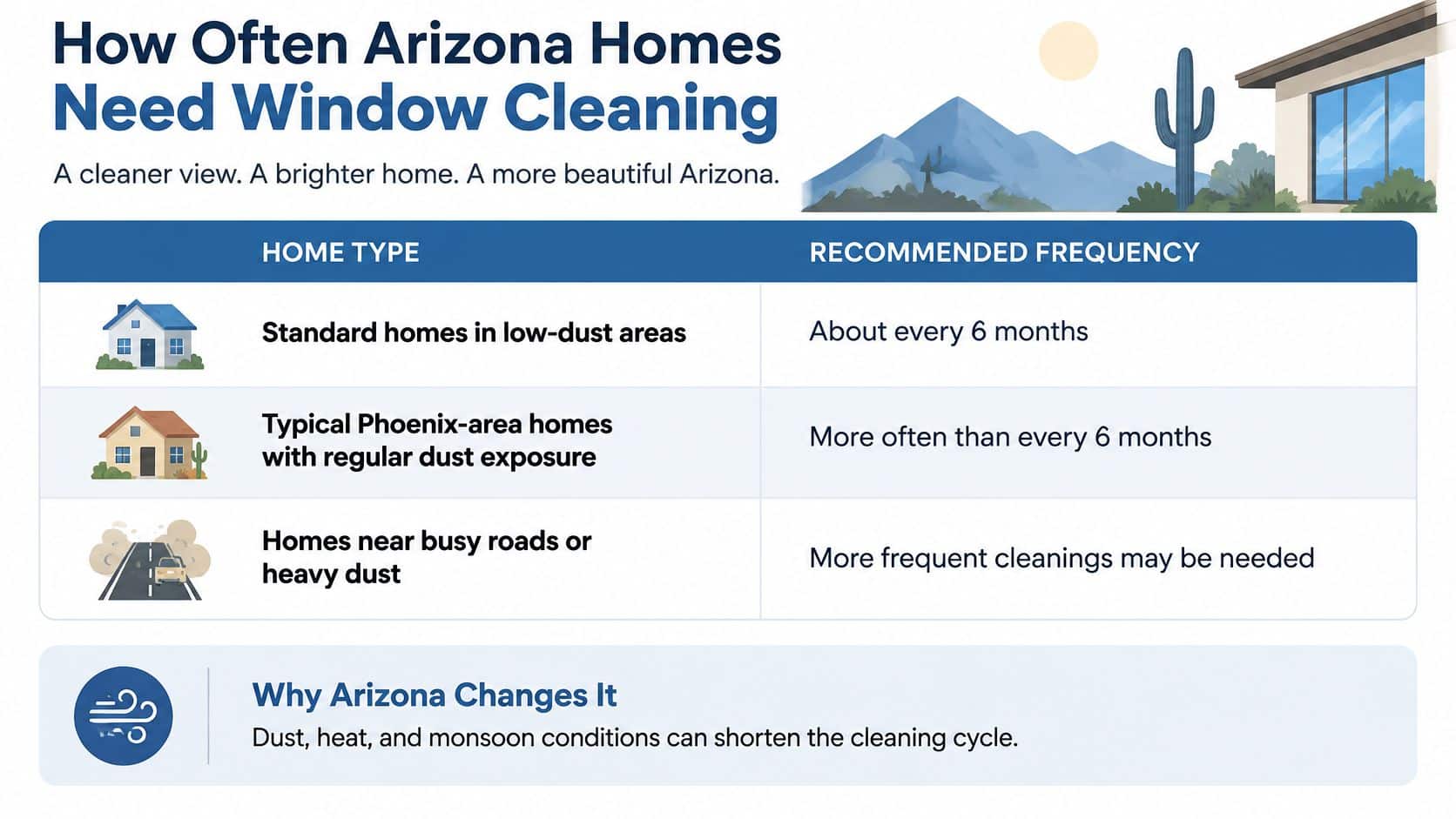
A standard home in a low-dust area can sit on a six-month cycle and still look presentable. A typical Phoenix-area home shouldn't. Fine dust builds between those visits and bonds once sprinklers or a light rain wet the pane, so three months is the working interval.
What shortens the cycle
Homes beside unpaved lots or construction pick up settled grit, so plan on every two to three months. Sprinkler overspray and hard water leave minerals even when the air looks clear, which points to every three to four months before the film etches. After a dust storm or monsoon, book within one to two weeks, while the film is still a deposit and not a stain. Before you host or list, schedule one visit in the month before so glass and screens read clean from the curb.
The City of Phoenix defines PM10 as particulate matter measuring 10 micrometers or less and states that it is most commonly dust. One Arizona Department of Environmental Quality listing reported PM10 at 57 µg/m³ at the Central Phoenix View Monitor. That fine fraction is what you see on glass, screens, and tracks in Phoenix, Scottsdale, Paradise Valley, Chandler, Tempe, and Gilbert. Exposure beats the season. A quiet winter week next to a graded lot dirties glass faster than a mild spring on a paved cul-de-sac.
Move up one interval when grit shows on the cloth, film returns within weeks, or the haze is obvious from the street. More on timing sits in how often to clean windows.
What Drives the Price of Window Cleaning
Access moves the quote more than the brand of soap. Count the hard reaches before you compare two numbers.
| Factor | How it changes the quote | Example |
|---|---|---|
| Number of stories | Higher stories need more setup and safety gear | Second-story vs single-story |
| Window count and size | Larger panes and more windows take more time | Floor-to-ceiling glass |
| Roof or skylight access | Needs specialized equipment and trained crew | Skylights above a garage |
| Screens and tracks | Adds labor and time | Full track cleaning |
| Glass condition | Mineral or storm marks need added treatment | Hard-water film |
| Service frequency | Recurring plans lower the cost per visit | Quarterly plan vs one-time job |
Single-story glass at ground level needs little setup. Poles, a bucket, and a clear path around the shrubs cover most of it. Second-story and skylight work needs specialized equipment and crews trained for fall protection, so time and risk rise together. A skylight over a garage isn't a longer version of a patio door. It's a different access plan.
Recurring visits versus a one-time rescue
Glass on a quarterly plan stays ahead of the film, so each visit is mostly removal of loose soil. A one-time job after a year of sprinklers often needs mineral treatment on top of the wash, and that added step is what lifts the price per visit. You're paying for buildup, not for the same wipe done four times.
DIY supplies are inexpensive. The trade-off shows up when the wrong tool hits a seal, a screen, or a coating. A pressure washer that drives water past a gasket, or a scraper that marks low-e glass, can cost more than one professional visit. I would price the repair risk before I price the squeegee.
Quotes are usually built per window, per story, or as a flat rate per visit on a recurring plan. This guide doesn't publish a dollar figure, because pane size, access, and condition change the job. Exact figures come from a provider's free quote. Give three facts so the number is real: number of stories, number of windows, and whether roof or skylight access is needed. The breakdown behind those inputs is spelled out in the cost of residential window cleaning.
How to Clean Ground-Level Windows Yourself
Stay on the ground. This sequence is for panes you can reach with your feet on a stable surface and a pole or a short step, not a ladder against the eave.

- Remove loose grit first. Brush the pane or rinse it with low pressure. Dry dust dragged across glass is what leaves fine scratches, especially after a windy week on a dirt lot.
- Work in shade or early morning. Sun heats the glass, the solution flashes off, and you're left with streaks and mineral spots. If the wall is already hot to the touch, wait.
- Soak, then wash. Wet the pane with clean water. Apply a mild, non-abrasive cleaner, or a simple vinegar-and-water mix, with a soft microfiber washer. Don't flood the weep holes.
- Keep sections small. About one square yard at a time is the right patch. If the film turns tacky before you squeegee, the section was too big or the glass was too warm.
- Squeegee top to bottom right away. Pull straight passes and wipe the blade on a cloth after each one. A dirty blade reprints the line you just removed.
- Rinse the frame and sill, then dry. Clear water, then a soft lint-free cloth. Leaving suds in the track just glues the next round of dust in place.
- Test an unfamiliar cleaner on a hidden corner. Wait for it to dry. If the finish dulls or the coating looks patchy, stop and switch products.
What to leave in the garage
The Fenestration and Glazing Industry Alliance says high-pressure rinsing can dislodge seals and gaskets and damage frame components. Concentrated spray can force moisture past the interfaces and carry grit into the glass and the finish. Use low-pressure wetting, a mild soap or vinegar cleaner, a clear rinse, and a soft cloth or squeegee. Skip razor blades, putty knives, steel wool, abrasive pads, petroleum products, and caustic chemicals. Those limits matter most on insulated units, coated glass, and painted or clad frames, where a scratch or a swollen seal shows up later as fog or a leak.
A finished pane looks streak-free in low-angle daylight, and the cloth comes away without a gray smear. If you still see grit, rinse again before the next pass. Don't "finish" a sandy pane by rubbing harder.
Fixing Streaks, Water Spots and Storm Marks
Read the pane before you change products. The mark tells you whether you need a cleaner pass or a different job entirely.
| Symptom | Likely cause | Fix |
|---|---|---|
| Streaks after squeegeeing | Solution dried or dirty blade | Squeegee sooner and wipe the blade each pass |
| Gritty scratches when wiping | Dry dust rubbed across glass | Pre-rinse and soak before wiping |
| White, chalky spots | Hard-water mineral film | Soft applicator with mild cleaner and a second soak |
| Cloudy haze on sun-facing glass | Solution dried in direct heat | Clean in shade or cooler hours |
| Brown or etched marks after storms | Storm-deposited minerals or tannins | Professional mineral removal |
| Loose seals or leaks after pressure washing | High-pressure spray forced water past seals | Stop pressure cleaning and have a pro inspect |
Streaks are usually timing. The solution dried, or the blade carried soil back onto the glass. Gritty scratches mean dry dust was wiped, not rinsed. White, chalky spots are hard-water film. A second soak with a mild cleaner and a soft applicator lifts fresh mineral better than scrubbing. Cloudy haze on a sun-facing wall is evaporated cleaner. Move that wall to shade or a cooler hour.
Coatings and marks that won't wipe off
The Glass Association of North America recommends soaking architectural glass with clean water and a mild, non-abrasive solution, agitating lightly with a soft applicator, and removing the liquid at once with a squeegee. That order cuts abrasive drag, because dry dust and construction particles act like grinding media. Routine cleaners should exclude acids, especially hydrochloric and hydrofluoric acid. Razor blades and metal scrapers can scratch glass or damage coatings.
Low-emissivity, tinted, and decorative panes follow the manufacturer's instructions, not a generic acid from the hardware aisle. If the label doesn't name your coating, don't experiment on the whole elevation.
Brown or etched marks after storms are minerals or tannins. Fresh film may release with a mild second soak. Etched glass will not, and it needs professional mineral removal. Loose seals or leaks after pressure washing are a stop-work problem. Have the seal inspected rather than washing that opening again.
A one-visit fix covers a dirty blade, a dried solution, or a light mineral film. Marks that return within weeks, or etched storm stains, belong on a shorter recurring schedule aimed at that exposure, not on another Saturday of the same wash.
Booking a Window Cleaner for Your Home
You can set this up in one week if the scope is written down before anyone drives to the house.

- Confirm credentials for the height you have. We are licensed, bonded, and insured, and our cleaners go through extensive window cleaning safety training. Ask for that proof on any elevated work, not only on a ground-floor quote.
- Lock the scope in writing. Use the glass, screen, track, mirror, and light-fixture list so a "window wash" doesn't leave the tracks out.
- Request the quote with three facts. We provide a fast and free quote. Give the number of stories, the number of windows, and whether roof or skylight access is needed.
- Book and set the next date. South Mountain Window Cleaning, LLC offers full service commercial and residential window cleaning valley-wide, including Phoenix, Scottsdale, Paradise Valley, Gilbert, Chandler, and Tempe. We offer a 100% satisfaction guarantee on residential window cleaning. Ask how that guarantee applies to your job, then book by phone or online and pick the interval that matches your dust exposure. Keep the visit date so the next one isn't a guess.
Schedule the first visit before the next dust season, not after the film has already bonded. A straightforward place to start is our window cleaning company page.
South Mountain Window Cleaning, LLC cleans residential glass across the Valley, including inside-and-out panes, screens, and tracks, for homes where a ladder isn't the right tool. If desert dust, hard water, or a second story is already on your glass, a fast, free quote gets the first visit on the calendar before the next storm bonds the film. Visit South Mountain Window Cleaning, LLC to schedule.