
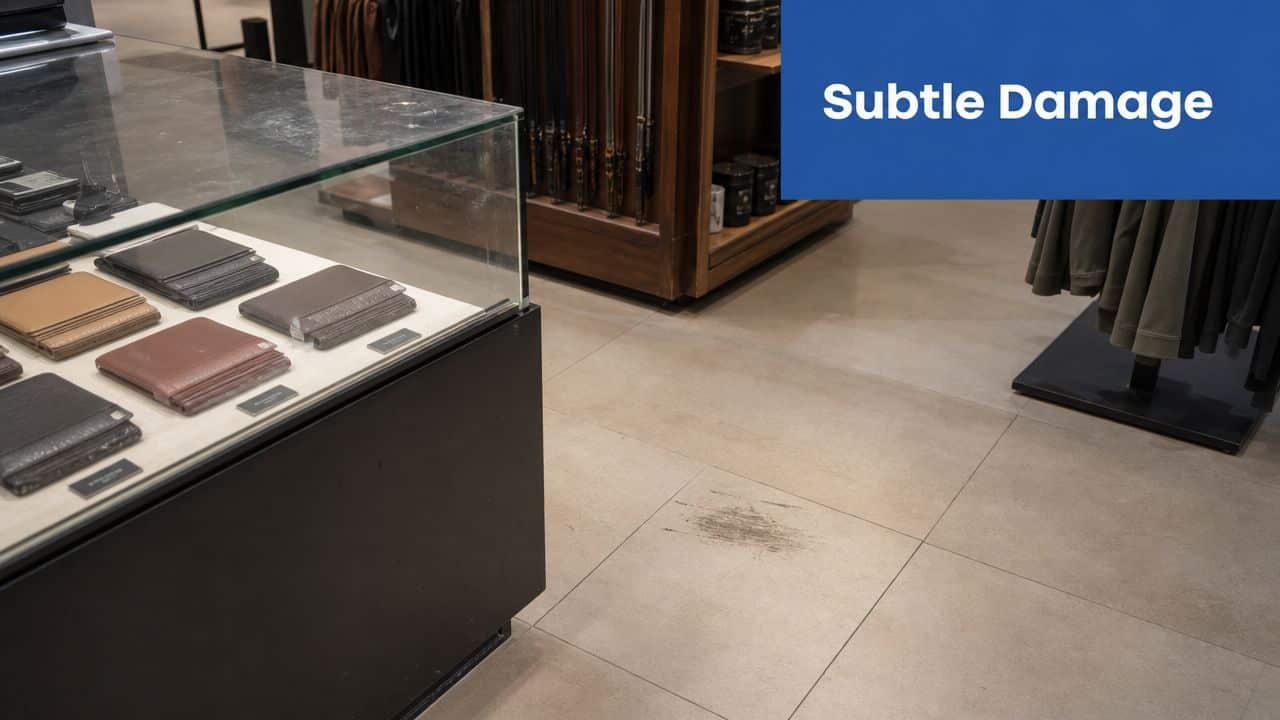
You usually notice the problem gradually. The front glass picks up fingerprints. Dust starts collecting on lower shelving where nobody looks until the afternoon sun hits it. The entry tile keeps a dark scuff mark that never seems to come all the way out. Restrooms are technically being cleaned, but they don't feel fresh by mid-day. Then one morning you stand at the entrance, look inward, and realize the store doesn't match the brand you're trying to present.
That's when hiring a retail store cleaning service stops being a side task and becomes an operating decision. In a retail environment, cleanliness affects how shoppers read your store before they touch a single product. It also affects how your team works, how often managers get pulled into avoidable issues, and how much wear your surfaces show over time.
Beyond the Broom Closet Why Professional Cleaning Matters
A store manager can mop a spill. Staff can wipe a counter. That's not the same as running a store that looks consistently cared for from opening through close.
The difference shows up in small moments. A customer grabs the handle on a cloudy glass door. They step over tracked-in dirt at the threshold. They glance at a mirror in the fitting room and see streaks instead of themselves. None of those details creates a dramatic complaint. They just lower confidence a little at a time.
Retail cleaning changed after 2020
This isn't just a cosmetic issue. Retailers have shifted hard toward professional cleaning. Since 2020, professional cleaning demand rose 84% for luxury retailers and 35% for big-box retailers, according to an Aspire report compiling ServiceChannel data in its janitorial business growth trends report.
That matters because it shows where the market moved. Cleanliness is now tied more directly to customer expectations and store operations, not just end-of-day housekeeping.
Clean stores don't win points because customers notice every task. They win because customers don't notice distractions.
Retail owners often focus on visible selling work. Endcaps, pricing, staff coverage, displays, promotions. All important. But if the physical environment feels neglected, those efforts lose force. A premium display behind dusty glass doesn't feel premium. A polished checkout script doesn't land the same at a stained counter.
It's part of brand control, not just janitorial work
A good retail store cleaning service protects more than hygiene. It protects presentation. That includes floor appearance, storefront glass, restroom condition, fitting room turnover, and the exterior cues customers see before they enter.
For food-adjacent concepts or mixed-use retail, it also helps to look at adjacent operational standards. If your store includes prepared food, beverage service, or shared customer-touch areas, this guide on implementing restaurant sanitation protocols is useful because it shows how structured sanitation standards support consistency under traffic.
Exterior appearance deserves the same discipline. Entry glass, sidewalks, building face, and grime around doors shape first impression before the shopper even reaches the threshold. For that side of the scope, some owners fold cleaning into broader commercial building exterior cleaning services so the inside and outside don't operate on different standards.
Defining Your Store's Unique Cleaning Blueprint
Most bad cleaning programs start with a vague request. “We need someone to clean the store.”
That's not a scope. It's an invitation for mismatched quotes, skipped details, and constant back-and-forth after service starts. The stores that get good results usually define their environment before they talk to vendors.
Walk the store by zone, not by room count
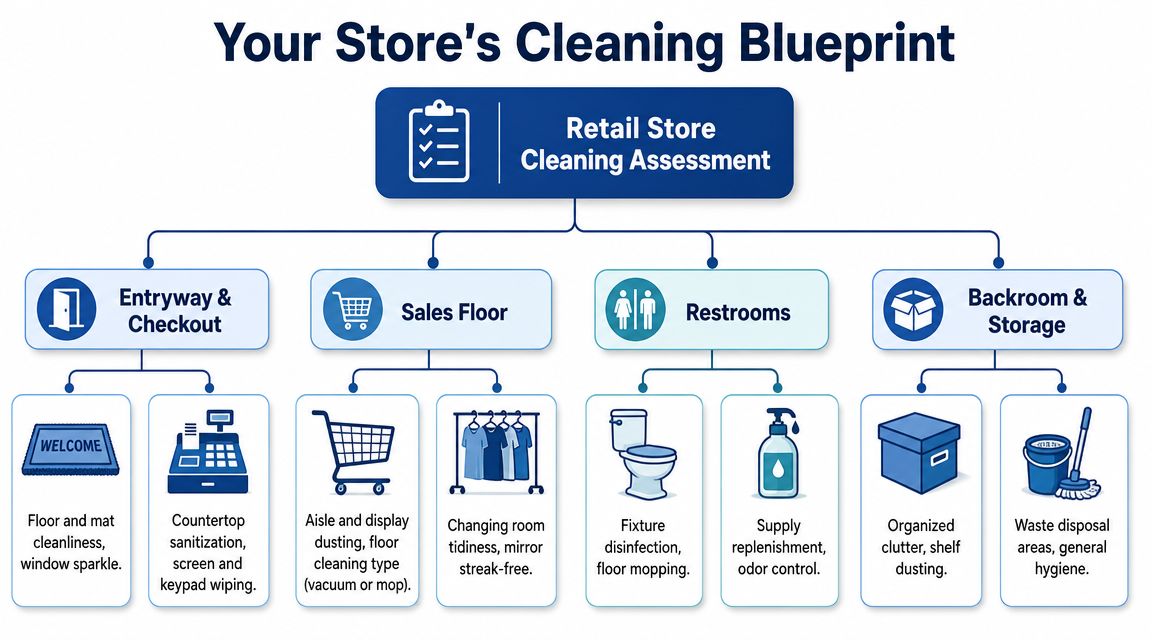
The most effective retail cleaning programs use a zone-based approach, setting specific standards and frequencies for different areas so high-contact zones don't get missed and low-priority spaces don't get over-cleaned, as outlined in this retail cleaning strategy guide.
That means you should stop looking at the store as one box and break it into working zones.
Start with these:
Entry and storefront
Glass, door frames, handles, threshold tracks, entrance mats, and the first stretch of flooring inside the door.Sales floor
Aisles, product shelving, fixture bases, display tables, mirrors, hard floors or carpet, and any customer demo area.Checkout and service counters
Countertops, payment terminals, queue rails, bagging areas, and trash touchpoints.Fitting rooms or customer-use spaces
Benches, mirrors, floors, hooks, handles, and wall smudges.Restrooms
Fixtures, partitions, dispensers, floors, odor control, and refill checks.Backroom and employee areas
Break spots, sinks, receiving paths, storage shelves, mop areas, and waste staging.
Set standards before you set frequency
Once the zones are clear, define what “clean” means in each one. Retailers get into trouble when they ask for “daily cleaning” without deciding what result they need.
A useful blueprint looks more like this:
| Zone | What matters most | Common service need |
|---|---|---|
| Entry | First impression and soil control | Glass touch-up, mat care, spot mopping |
| Sales floor | Dust control and floor appearance | Dusting, vacuuming, mopping, edge detail |
| Checkout | High-touch presentation | Surface wipe-down, screen cleaning, trash control |
| Restrooms | Hygiene and odor control | Disinfection, refill checks, floor care |
| Backroom | Safety and organization support | Sweep, mop, wipe shared surfaces, waste handling |
Practical rule: If a vendor can't repeat your zone priorities back to you clearly, they're not ready to quote your store accurately.
Match service types to what your store actually needs
Not every retail store needs the same mix. A boutique with polished floors and front glass needs a different program than a discount store with heavy traffic and receiving dust. A strip-center tenant with exposed walkways may also need periodic exterior work bundled into the plan.
Common service categories include:
- Daily or routine janitorial work for floors, trash, restrooms, touchpoints, and dusting.
- Glass and mirror detailing for storefront visibility and fitting room presentation.
- Floor maintenance for scrubbing, buffing, or more restorative work when daily mopping stops being enough.
- Pressure washing for sidewalks, entry approaches, and dumpster pad areas.
- High dusting and detail cleaning for signage, vents, ledges, and display tops.
If you want a practical way to compare these items against your building needs, a commercial building maintenance checklist can help you turn a rough idea into a usable scope.
By the time you talk to vendors, you should be able to hand them a blueprint that says what gets cleaned, how often, when it can be cleaned, and what “done right” looks like in each zone.
Decoding Quotes and Budgeting for Quality
Retail owners often ask the wrong pricing question first. They ask, “What's your price per square foot?”
That number can be useful, but it's not enough to judge the quote. Two stores with the same size can price very differently if one has heavy restroom usage, constant entry soil, fitting rooms, fingerprint-prone glass, or frequent spot response needs.
How solid quotes are actually built
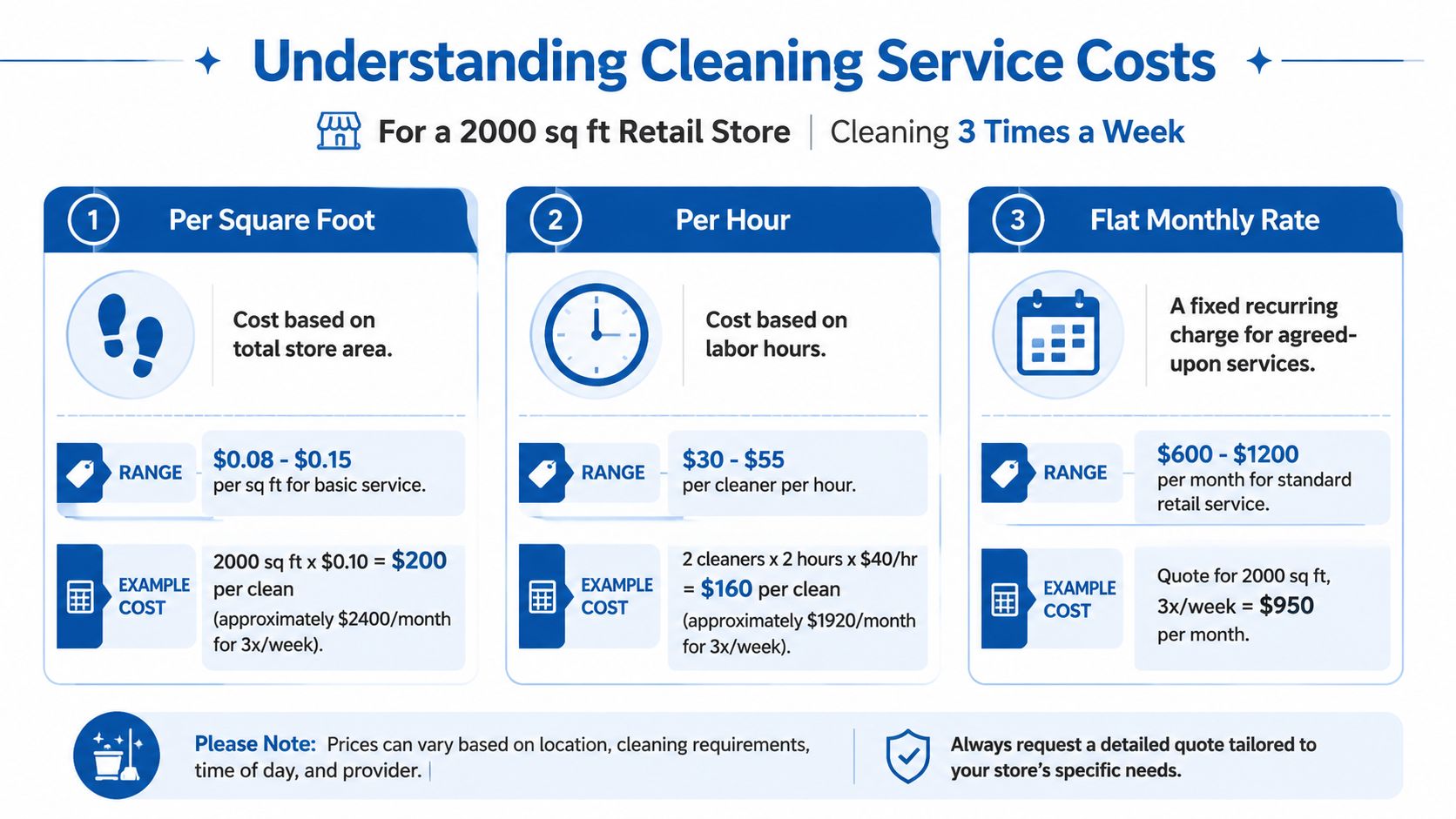
In commercial cleaning, benchmark-style rate modeling is often built from task times, not guesswork. ISSA notes a general U.S. range of $0.05 to $0.25 per square foot, with example task standards of about 10 minutes per 200 sq. ft. for restrooms and 1 minute per 300 sq. ft. for standard office space. ISSA also shows a worked pricing example totaling $103.50 per visit on $75 labor, 15% overhead, and a 20% profit margin in its guide to calculating commercial cleaning rates.
That's why a real quote usually starts with labor planning. The estimator looks at task duration, labor burden, travel, overhead, and profit. Square footage may be part of it, but it isn't the whole story.
Three common pricing models
You'll usually see one of these structures:
Per square foot
Easy to compare on paper. Easy to misuse when traffic and fixtures vary.Hourly pricing
Useful for irregular work, resets, and specialty cleaning. Less useful if nobody defines what should be accomplished in those hours.Flat monthly pricing
Often the easiest for budgeting, as long as the scope is detailed and there's a clear list of what counts as extra work.
A cheap flat rate can hide a lot. Fewer labor hours. Less detailed floor work. No touch-up visits. No allowance for restroom load. Minimal supervision.
If the quote feels low, ask which tasks were shortened, how often supervisor checks happen, and what the vendor excluded.
What to question before you sign
Use this short filter when comparing bids:
- Ask about restroom load because restrooms can swing labor significantly.
- Ask about day porter or touchpoint support if your store stays busy during open hours.
- Ask what happens after weather events because tracked-in dirt can change the workload fast.
- Ask about periodic work such as glass detailing, walkway pressure washing, and restorative floor service.
- Ask what “included” means so you don't discover later that spot cleaning, interior glass, or fitting room detail was assumed to be extra.
For stores with exterior concrete, grease, gum, or dusty walkways, cleaning costs also overlap with outside maintenance. Reviewing typical commercial pressure washing cost factors helps separate routine janitorial pricing from periodic exterior work.
The common pitfall is accepting a flat square-foot price that doesn't reflect actual use. In retail, that shortcut usually shows up later as missed detail and declining service quality.
How to Vet and Hire the Right Cleaning Partner
A retail store cleaning service can make your life easier, or create a steady stream of callbacks, access problems, and finger-pointing. The difference usually gets decided before the first mop hits the floor.
Most owners spend too much time comparing prices and too little time verifying how the company operates. Price matters. Reliability matters more.
Start with risk control
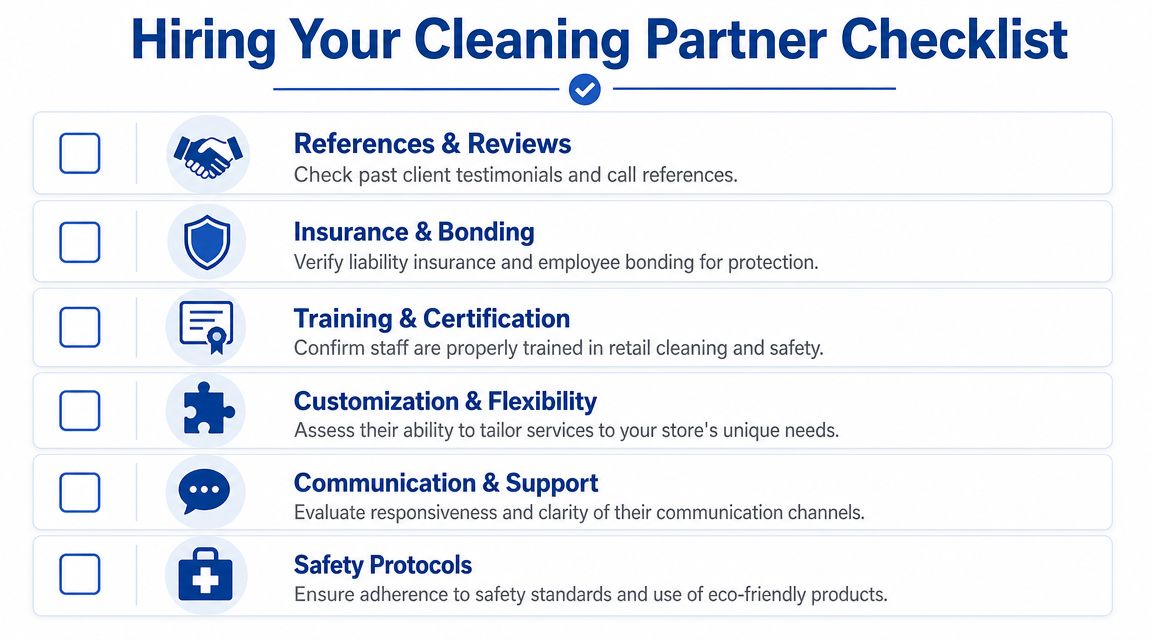
If a cleaner is working in your store after hours, around glass, hard floors, electrical equipment, and customer areas, your first concern should be exposure. You want a provider that can document insurance, explain access procedures, and show how they train staff for retail settings.
Look for clear answers on:
- General liability coverage that they can document through a current certificate.
- Workers' compensation so employment-related injuries don't become your problem.
- Bonding or security controls for after-hours access, keys, alarm procedures, and lock-up.
- Site-specific training for floor hazards, glass care, chemical handling, and incident reporting.
A company that hesitates on paperwork will usually hesitate on accountability too.
Interview the operation, not just the salesperson
Good vetting happens in conversation. Ask how they staff call-outs. Ask who inspects work. Ask how missed tasks are documented and corrected. Ask what your manager does if a restroom issue shows up at noon on a Saturday.
Here's a practical set of questions:
- Who is my direct contact if there's a problem tonight?
- How do you verify task completion?
- What's your process for replacing absent crew members?
- How do you train cleaners on retail surfaces and customer-facing spaces?
- What tasks are commonly requested but not included in base service?
- Can you provide commercial references from stores with similar traffic and layout?
A polished proposal doesn't answer those questions. The operator does.
For store owners comparing broader vendors, lists of commercial property maintenance companies near me can be a starting point, but the shortlist should come from documented process, not directory presence.
Here's a quick video that helps frame what to look for in a service relationship:
References tell you what proposals won't
Call references. Don't just read testimonials.
When you talk to another commercial client, ask what happened after the sale. Did quality stay consistent after the first month? Did the company respond when a key employee left? Did they solve access issues cleanly? Did they need repeated reminders for the same problem?
A cleaning partner earns trust by being boring in the right ways. They show up, follow scope, communicate clearly, and don't create surprises.
This is also the right place to mention service fit. If your store needs routine storefront glass, walkway washing, and exterior presentation support in addition to janitorial coordination, one option in the Phoenix market is South Mountain Window Cleaning, which handles commercial window cleaning and exterior cleaning scopes for businesses. That's useful when your biggest visibility issues start at the glass and entry.
Your Onboarding Checklist for a Seamless Start
The contract is signed. That doesn't mean the service is ready.
Most retail cleaning problems in the first month aren't caused by bad intent. They come from a weak handoff. Nobody clarified alarm timing. The cleaner didn't know which storage area was off-limits. The manager assumed the crew would handle fitting room mirrors daily. The crew assumed that was weekly detail work.
Set one point of contact and one reporting path
Pick one person on your side who owns the relationship. That might be the store manager, facilities lead, or district contact. What matters is consistency.
That person should control:
- Access instructions including keys, codes, lock-up sequence, and who to call if the alarm trips.
- Scope clarifications when gray-area tasks come up.
- Issue reporting so problems don't get relayed through three employees and come out distorted.
- Approval for extras such as emergency cleanup, post-event work, or periodic deep cleaning.
If multiple people direct the crew, quality drifts fast.
Do a pre-start walkthrough on the floor
Walk the space with the supervisor before the first service. Not just the salesperson. The working supervisor.
During that walkthrough, identify:
- Sensitive fixtures such as acrylic displays, specialty flooring, electronics, and treated surfaces.
- Off-limits areas including cash handling zones, locked storage, manager desks, or inventory rooms.
- Restroom expectations around supplies, odor control, and mid-day checks if applicable.
- Damage documentation so old scuffs, floor wear, or scratched fixtures aren't blamed on the new crew.
A written site sheet helps. So does a simple marked floor plan.
The cleaner shouldn't have to guess what matters most in your store. Show them the surfaces, the standards, and the failure points before day one.
Choose the right schedule for your traffic
Scheduling is an operations decision, not an afterthought. A key strategic issue is minimizing shopper disruption. Most providers offer overnight service, but a hybrid approach that combines after-hours cleaning with targeted daytime touchpoint cleaning and rapid spill response often preserves customer flow more effectively, as noted in Coverall's discussion of retail cleaning scheduling options.
That usually means thinking in layers:
- After-hours work for floors, restrooms, trash removal, detailed dusting, and larger reset tasks.
- Opening touch-ups for glass, entry floors, and checkout presentation.
- Operating-hour response for spills, restroom checks, fingerprints, and visible touchpoints.
Stores make mistakes at both extremes. Some push everything to overnight and wonder why the entrance looks tired by lunch. Others schedule too much open-hour cleaning and create noise, blocked aisles, and visible labor that interrupts shopping.
Review the first month closely
The first few weeks should be managed tightly. Check work early. Walk the store at the same times each day. Photograph repeat misses. Don't wait until frustration builds.
Good early review points include:
| Review item | What to check |
|---|---|
| Entry condition | Glass clarity, threshold dirt, mat appearance |
| Sales floor | Dust on low fixtures, corners, under displays |
| Restrooms | Odor, refills, floor condition, touchpoint cleanliness |
| Communication | Speed of responses, correction of misses |
| Consistency | Whether quality holds across different days |
If problems show up, fix them in writing with clear examples. Early correction is easier than re-training expectations months later.
A Clean Store Is Your Silent Salesperson
Retail owners usually feel cleaning as an expense because it sits in operations. Customers experience it as part of the product.
That's the shift that matters. Clean glass makes displays easier to trust. Dust-free shelving keeps merchandise from looking old before it is old. Floors with a maintained finish make the whole store feel managed. Restrooms that stay under control tell customers the back-end of the business is under control too.
Professional cleaning also does more than support customer comfort. It serves a merchandising-control function by protecting inventory from dust and grime, reducing the visible “aged” effect on products and helping preserve premium brand perception in high-traffic environments, as discussed in this article on how retail store cleaning affects brand image.
That's why the right retail store cleaning service isn't just a crew with supplies. It's a partner that understands timing, storefront visibility, floor care, touchpoint discipline, and how your store operates day to day.
When cleaning is scoped correctly, priced correctly, vetted carefully, and onboarded with discipline, it stops being a recurring headache. It becomes one of the quiet systems that helps the store sell.
If your store in Phoenix, Scottsdale, Paradise Valley, Chandler, Tempe, or Gilbert needs a partner for storefront glass, exterior retail cleaning, walkways, or broader commercial upkeep, South Mountain Window Cleaning, LLC is worth contacting for a quote. They handle commercial window cleaning and exterior cleaning work for retail properties, which can be a practical fit when curb appeal and first impression start at the glass and entry.