
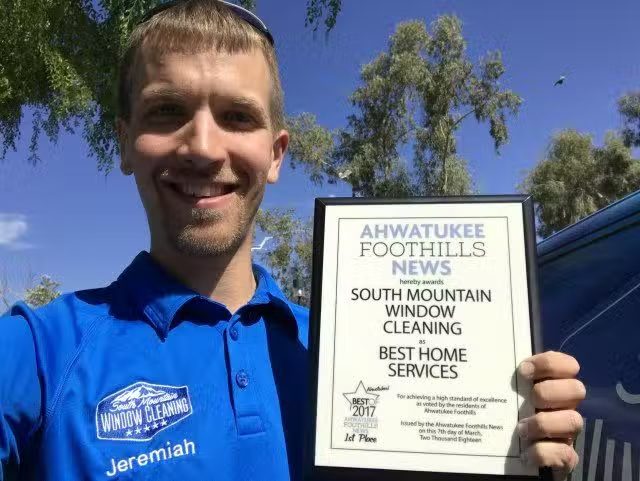
Most advice about pressure washer window cleaning starts with “never use a pressure washer on glass.” That warning is safer than telling everyone to blast windows at full force, but it's too broad to guide real property maintenance. The better question is: what kind of glass, frame, film, seal, and access condition are you dealing with?
A low-pressure rinse may help remove loose dust from some exterior surfaces. Direct high-pressure cleaning can also drive water behind frames, weaken seals, damage putty, or break fragile panes. In Arizona, where dust and mineral-heavy water can dry quickly in intense sun, the wrong method can leave both visible spotting and hidden building-envelope damage.
The practical rule is simple: treat pressure as a controlled rinsing tool, not as the primary way to scrub glass. For many homes, storefronts, solar installations, and high-rise properties, purified water and professional hand-finishing provide a safer result.
Rethinking Pressure Washer Window Cleaning Safety
The assumption that “glass can handle pressure” ignores everything around the glass. A pane may appear sound while its edge seal, glazing compound, tint, frame, or surrounding wall assembly is already vulnerable. Pressure applied at the wrong angle can turn a routine rinse into a repair problem.
Independent guidance notes that tinted or filmed glass should not exceed 800 PSI, and it recommends testing a lower corner first. The same guidance warns that repeated cleaning above 2,000 PSI can damage double-pane seals and allow moisture between panes (guidance on surfaces unsuitable for pressure washing). Those thresholds aren't universal permission to spray. They're risk boundaries that show why window material matters.
Glass type changes the decision
Tinted and filmed glass deserves the most conservative approach because the film or coating can be affected by heat, pressure, or water forced beneath an edge. Older single glazing, aged putty, cracked panes, and deteriorated seals also call for manual cleaning or a gentle hose rinse rather than direct pressure.
Double-pane windows present a different concern. The glass may survive the first wash, yet repeated force around the perimeter can weaken the seal. Once moisture enters the insulated space, fogging and longer-term deterioration can follow. The visible pane isn't the only component being cleaned. You're interacting with the whole opening.
Practical rule: If you can't identify the glazing and seal condition, don't choose a pressure setting based only on the machine's dial.
Arizona buildings need envelope awareness
Dust on the surface is easy to see. Water intrusion behind a frame is not. Before choosing a method, inspect corners, glazing beads, weep areas, caulking, screens, and any existing fogging. For a broader comparison of cleaning methods, review pressure washing versus soft washing.
Pressure washing is often useful on nearby masonry, walkways, and siding, but that doesn't make the same force appropriate for the window assembly. A material-specific inspection is more reliable than an absolute rule or a generic promise of streak-free results.
Configuring Your Equipment for Safe Glass Rinsing
If the window type and condition support a low-pressure rinse, equipment configuration matters as much as the pressure setting. The objective is to loosen surface dust and rinse frames or surrounding areas without forcing water beneath seals or glazing compound.
Independent how-to guidance converges on a setup under 2,000 PSI, with a wide fan nozzle in the 40- to 65-degree range. The spray should hit the glass obliquely, not perpendicular to it, to reduce the chance of seal damage and putty blowout (low-pressure window rinsing guidance).
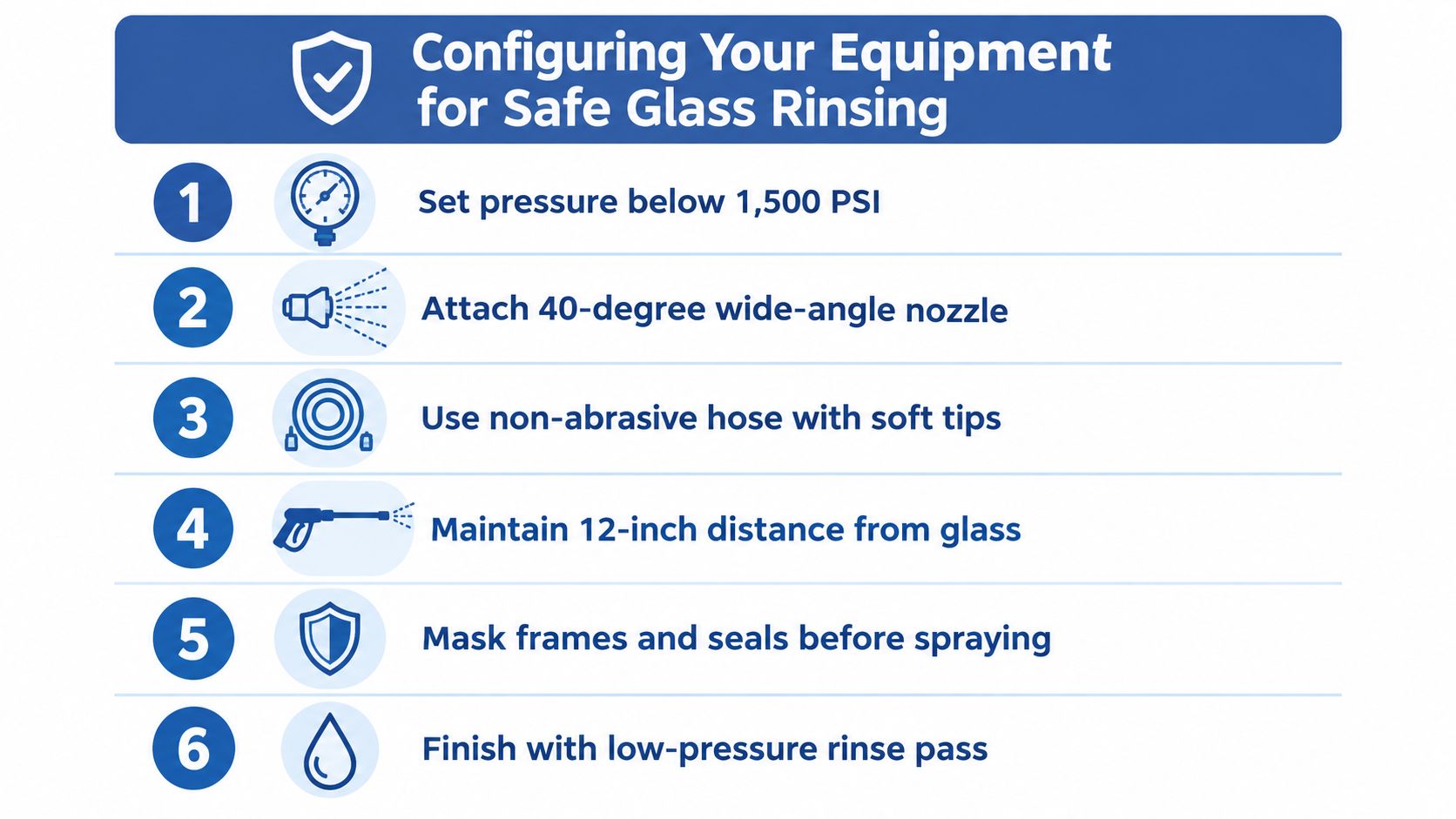
A controlled rinse sequence
- Inspect first. Look for cracks, loose glazing, failed caulk, damaged screens, and fogging between panes. Don't use pressure to discover a defect.
- Select the widest practical fan pattern. A wide spray distributes force more evenly than a narrow jet.
- Keep the wand moving. Stationary spray concentrates energy in one spot and increases the risk of damage.
- Start at the top and work downward. This lets loosened dust and rinse water move in one direction instead of settling on already-cleaned areas.
- Spray from the edge toward the center. This reduces the chance of driving water beneath putty or weather seals.
- Rinse immediately after applying detergent. Never allow soap to dry on the pane, especially in direct Arizona sunlight.
A three-foot distance is recommended by one expert source, while other guidance emphasizes an oblique angle and a wide nozzle. Because equipment output varies, distance and spray behavior still need adjustment for the individual window. If the surface shows movement, seal failure, film lifting, or water entering the frame, stop immediately.
The spray should remove loose contamination, not replace agitation and precision finishing.
For surrounding exterior surfaces, a separate house pressure washing service can use the appropriate method for siding, walkways, and other materials. Glass itself usually benefits from a gentler rinse followed by a professional window-cleaning process.
Hidden Building Envelope and Safety Risks
Broken glass gets attention because the damage is immediate. Water intrusion is often more serious precisely because it can remain hidden. A forceful spray directed at window edges may push water behind frames, into wall cavities, or through weakened seals. The result can appear later as staining, soft wood, mold, rot, or deteriorated insulation.
Repeated high-pressure cleaning around window edges can weaken seals over time and drive water into wall cavities, causing leaks, mold, and rot. The same coverage notes that pressure washers can cause serious wounds and throw debris when misused (window-seal and pressure-washing risks).
The envelope is larger than the pane
A window opening includes several connected components:
- Glazing and seals, which keep the insulated space dry.
- Frames and weep paths, which need to drain rather than receive forced water.
- Flashing and surrounding cladding, which can conceal moisture movement.
- Interior finishes, including plaster, drywall, trim, and paint, which may show damage only after intrusion has continued.
Wood-frame homes deserve particular caution because moisture can travel beyond the visible perimeter. Commercial buildings can have similar vulnerabilities around storefront systems, curtain-wall joints, and older caulking. A clean-looking pane isn't proof that the assembly tolerated the wash.
Worker safety changes the decision
Pressure equipment creates hazards even at ground level. A narrow jet can cut skin. Loose grit can become airborne debris. Wet surfaces can create slips, while electrical equipment and unsuitable indoor or enclosed operation introduce additional risks. Height adds a separate layer of exposure because the worker must manage water, hoses, equipment, and fall protection at the same time.
The sensible control is to separate tasks. Use suitable pressure methods on compatible exterior materials, and use low-pressure rinsing, pure water, or hand tools for glass when those methods match the window assembly. Property owners should also consider whether the operator has training, documented procedures, and insurance before allowing work near occupied areas or high windows.
The Pure Water Soft Wash Alternative
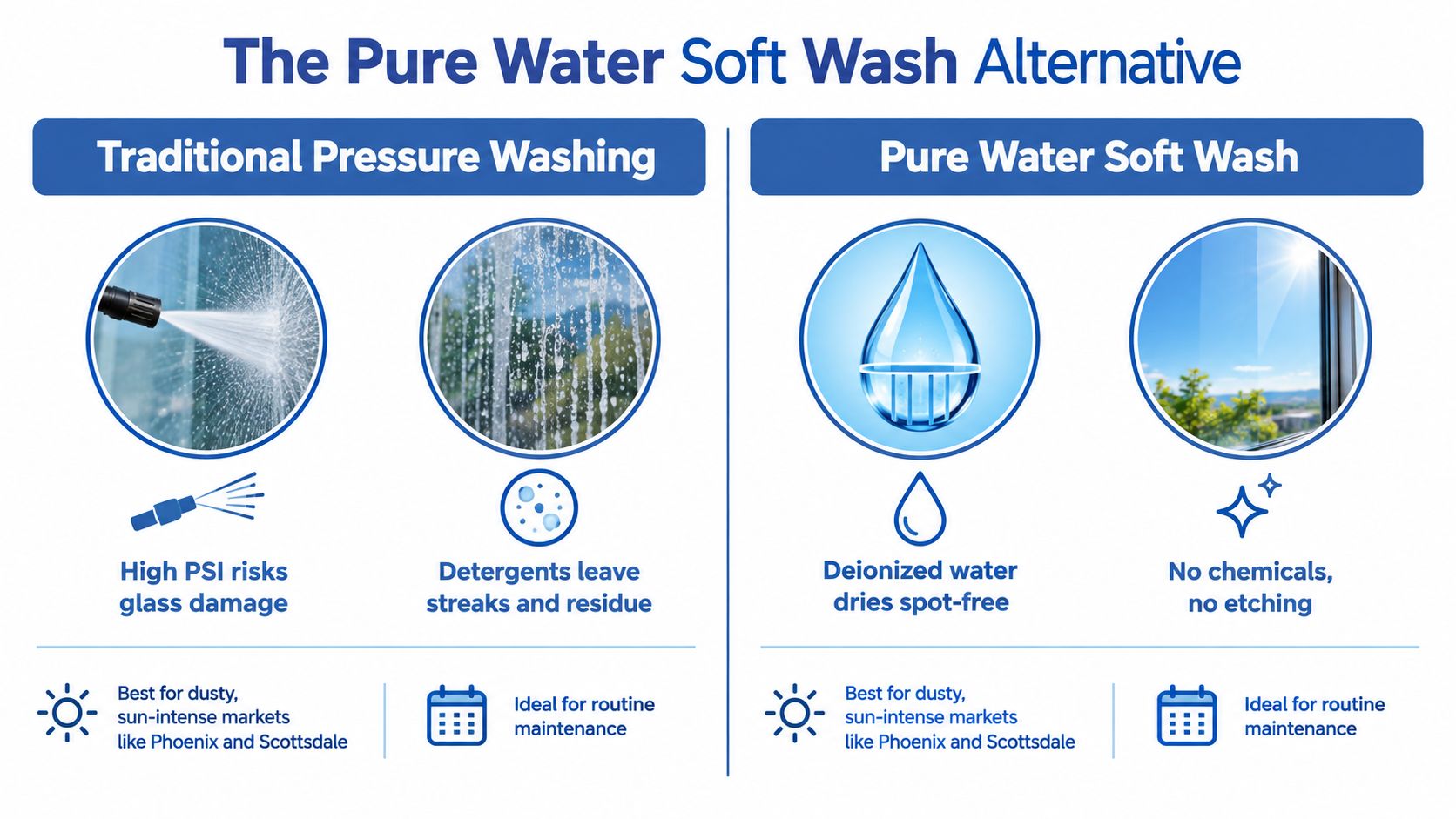
Phoenix, Scottsdale, Paradise Valley, Chandler, Tempe, and Gilbert properties deal with a combination of airborne dust, strong sunlight, and water that can leave mineral residue. Pressure can remove loose dirt, but it doesn't solve dissolved-solids spotting. Detergent can loosen soil, yet it may leave residue if the rinse water dries before the pane is finished.
Pure-water cleaning addresses the water-quality problem instead of trying to overpower it. A purification system removes dissolved minerals so the water can loosen dirt from glass and frames, then evaporate without leaving the same mineral film. The cleaner still needs proper technique, but the process reduces dependence on aggressive pressure and heavy detergent.
The measurable water target
Industry guidance citing the National Glass Association identifies 20 ppm TDS or lower as the threshold for a pure-water rinse on architectural glass when the water is allowed to evaporate spot-free (pure-water rinse guidance and TDS explanation). A TDS meter gives the technician a practical quality check instead of relying on appearance alone.
For routine exterior glass, a water-fed pole can agitate frames and panes with a soft brush while purified water carries away dust. Ground-level and reachable interior glass may still receive traditional squeegee finishing. The method should match the surface, access, and contamination.
This approach also suits solar panels and storefronts where repeated mineral spotting can affect appearance and maintenance effort. It isn't a universal substitute for every exterior-cleaning task, but it offers a controlled alternative when the priority is clean glass without forcing water into the building envelope.
The process is easier to understand visually:
A professional pure-water window cleaning system should include purification, TDS verification, suitable brushes, controlled water flow, and technicians who know when not to use pressure.
High Rise Access and Commercial Compliance
High-rise window cleaning is an access and life-safety operation, not ordinary residential work performed higher up. The plan must account for structural documentation, rope systems, rescue procedures, weather, worker positioning, occupants, and coordination with the building. A pressure washer adds hose weight, snag points, and spray reaction, so the selected cleaning method must fit the access system.
OSHA limits rope descent systems to 300 feet above grade, except where other access methods are not feasible or would create a greater hazard (OSHA rope descent system requirements). That limit shapes the work plan before equipment arrives. A pressure washer does not make an unsuitable descent setup acceptable.
Anchorages require documentation
The building owner must inform the employer in writing that each rope descent anchorage has been identified, tested, certified, and maintained. Each anchorage must support 5,000 pounds in any direction for each worker attached. The documentation must reflect an annual inspection, with recertification when necessary at least every ten years (OSHA anchorage certification interpretation).
A rooftop attachment point is not automatically a usable anchorage. Property managers should request current records, access procedures, and a clear rescue plan before approving work. They should also review our high-rise window cleaning safety guide before authorizing rope descent work.
Interior access still needs fall protection
For exterior windows cleaned from inside, OSHA guidance requires workers to keep their feet firmly on the floor, with sill height preventing a fall through the opening. If floor-level cleaning is impractical, the employer must protect the worker with a personal restraint system connected to a secure anchorage (OSHA guidance on interior window cleaning).
HOA boards, office managers, retail operators, and facility teams should treat insurance, training records, access documentation, and rescue planning as part of vendor qualification. A low-pressure rinse can still create an incident if hoses cross an edge, spray reaches occupants, or the worker's position is improvised. Commercial work requires a method that protects the glass, the building envelope, and everyone below.
Choosing Professional Exterior Cleaning Services
DIY cleaning can make sense for reachable, uncomplicated glass when the owner can use hand tools safely and identify the window condition. A pressure washer becomes a poor choice when the pane is filmed, tinted, aged, cracked, fogged, or surrounded by questionable seals. Height, occupied spaces, fragile surfaces, and large recurring schedules all move the decision toward professional service.
The right contractor should explain the method before starting. Ask what equipment will touch the glass, whether the crew will use pure water, how they verify water quality, how they protect frames and landscaping, and what happens if a seal or pane appears compromised.
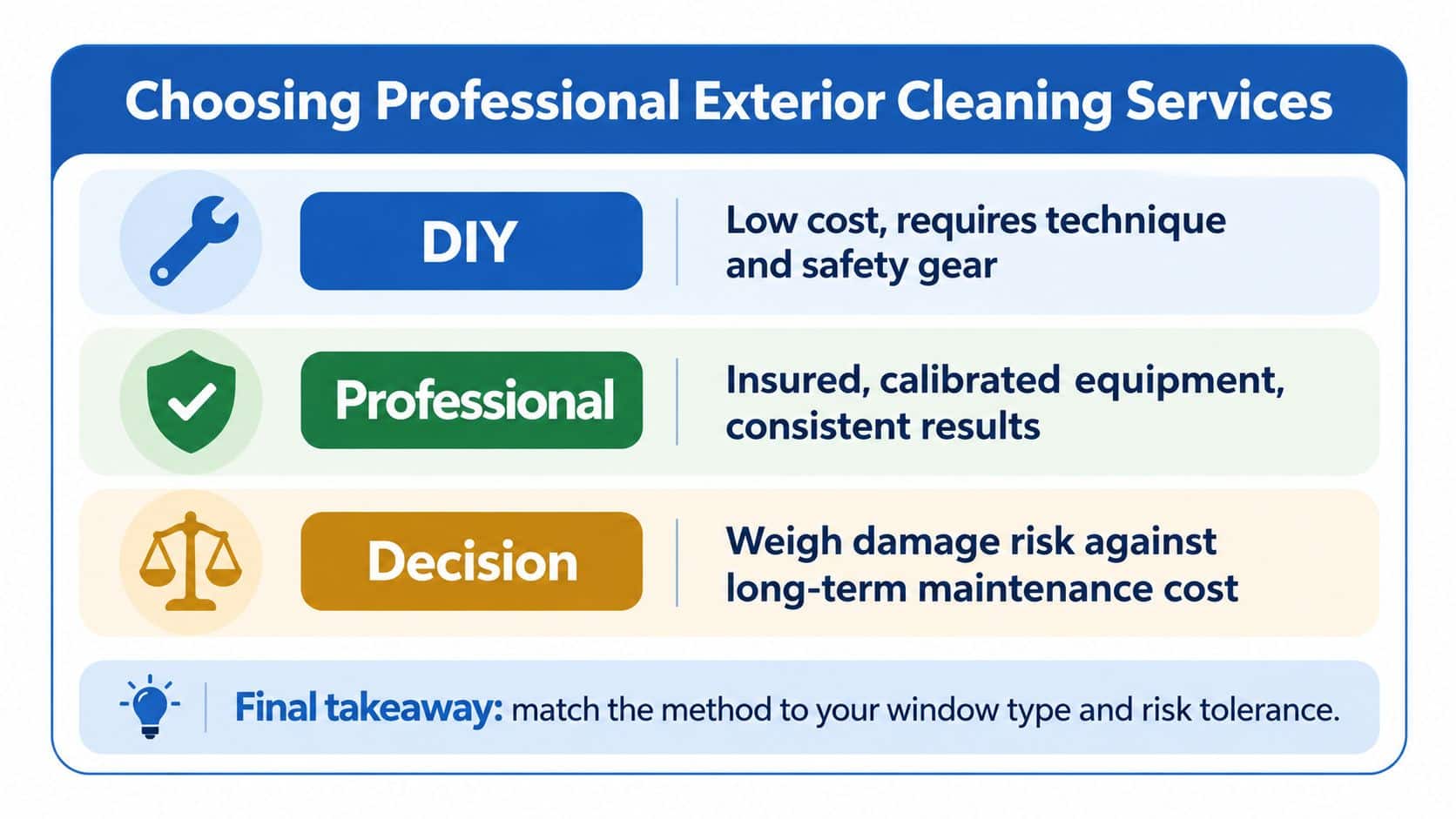
A practical screening checklist
- Window assessment: The technician identifies glazing, film, frame condition, seal issues, and access limitations.
- Method selection: The company distinguishes pressure rinsing from glass cleaning and uses pure water, squeegees, or soft washing where appropriate.
- Safety credentials: The vendor provides evidence of training, documented procedures, and suitable liability coverage.
- Property protection: The crew plans for runoff, screens, tracks, landscaping, nearby occupants, and fragile exterior finishes.
- Service scope: The proposal states whether it includes screens, tracks, frames, solar panels, gutters, walkways, or other exterior surfaces.
South Mountain Window Cleaning, LLC serves residential, commercial, and high-rise properties in Phoenix, Scottsdale, Paradise Valley, Chandler, Tempe, Gilbert, and nearby Valley communities. Its service model combines pure-water systems, professional squeegee work, exterior power washing, screen and track care, solar panel cleaning, and high-rise window washing.
The safety history supports a cautious approach. An OSHA analysis cited by HealthDay recorded 88 window-cleaning accidents over a 15-year period, with 62 fatalities (HealthDay reporting on window-cleaning accidents). Those figures reinforce why access planning and insured professionals matter, particularly when work extends beyond ground-level glass.
South Mountain Window Cleaning, LLC provides residential, commercial, and high-rise window washing, pure-water cleaning, solar panel cleaning, and compatible power-washing services across the Valley. Visit South Mountain Window Cleaning, LLC to request a quote and choose a window-cleaning method that protects both your glass and the building envelope.