

A 2023 homeowner guide from Angi recommends 1,500–2,000 PSI for stucco, with the nozzle 7–10 feet back. That number sits far above what finish manufacturers and preservation guidance allow, which makes it a poor spec to shop by. A pressure washer for stucco is judged at the gun, not the pump badge: a wide fan tip, real standoff, and a regulator you can set decide whether the texture survives.
The PSI badge on the machine is only the pump's ceiling. What reaches the wall is lower after the fan spreads the jet, and lower again as you step back. A high-PSI machine with a wide tip and long standoff can be gentler than a low-PSI machine with a narrow tip held close. I would not buy a stucco machine on PSI alone. Set the regulator, test a hidden patch, and adjust the tip before the main wall.
Valley dust and hard sun make exteriors look tired. Blasting them is how a hairline crack becomes a repair.
Safe Pressure Limits for Stucco at a Glance
One ceiling governs every stucco wash: 500 psi. Sto Corp.'s stucco repair and maintenance guide caps pressure washing at roughly 200–500 psi, calls for several feet of standoff, and warns that past 500 psi the finish loses surface integrity. Work inside that band, let the cleaner lift the soil, rinse with clean water, and let the wall dry. Local rules on chemical and wastewater disposal still apply.
What the wall feels is pressure at the nozzle, after the fan has spread the stream and the standoff has bled off the rest. A 3,000 psi pump running a wide tip two feet back is gentler on texture than a 1,200 psi unit with a pencil jet held at the surface.
The chart below summarizes the limits to check before a machine comes off the truck. Preservation guidance starts lower than the manufacturer cap. Commercial EIFS bulletins match Sto's ceiling and add a fan angle plus a hard standoff. Detergent makers specify tip and distance instead of a PSI number. Homeowner retail guidance stays in the same low-pressure family. The 2023 figure in the top row is the outlier, and it conflicts with every other source listed.
| Source | Pressure limit | Nozzle and standoff | Context |
|---|---|---|---|
| National Park Service masonry guidance | Start at 100 psi, generally stay within 300–400 psi | Lowest effective pressure | Historic masonry and stucco |
| U.S. General Services Administration | Not above 300 psi | Lowest effective pressure after a test mockup | Historic masonry applications |
| Sto Corp. stucco and EIFS guide | 200–500 psi, never above 500 psi | Several feet from the surface | Stucco and EIFS finishes |
| Sika/Parex EIFS bulletin | 500 psi cap, regulator in the 200–500 psi range | At least 2 ft, 30–45 degree fan | Commercial EIFS and textured coatings |
| Simple Green stucco directions | Low pressure | 65-degree nozzle for detergent at 18 in minimum; 25–40 degree for rinse | Residential stucco |
| Lowe's stucco guidance | Low-pressure setting | About 2 ft; at least 10 in | Homeowner stucco washing |
| Angi (2023) | 1,500–2,000 psi | 7–10 ft | Outlier; conflicts with the limits above |
Simple Green's stucco directions specify a 65-degree nozzle for low-pressure detergent, a downward spray, and at least 18 inches of distance so water is not driven behind the siding. Rinse top to bottom with a 25–40 degree nozzle.
Do not let the cleaner dry on the wall. Dried product needs more pressure to break loose, and more pressure is the one thing this finish cannot absorb.
Practical rule: If the machine cannot hold a steady setting under 500 psi, it is the wrong tool for this wall, no matter how far you stand.
A long standoff does not rescue a jet that is too strong. Impact drops with distance, but a tight stream still etches texture, and no one holds a steady pattern seven to ten feet back along a second-story elevation. Check any rental or purchase against the 500 psi ceiling and the nozzle distances above, then set the regulator before the wand goes near the wall.
Why Stucco Needs Far Less Pressure Than Consumer Machines
PSI is force at the nozzle. GPM is how much water that force carries. Shoppers treat the first number as cleaning power. On stucco it is mostly damage potential.
National Park Service preservation guidance says to begin masonry cleaning at 100 psi or below and, even when more pressure is justified, generally stay within about 300–400 psi. The U.S. General Services Administration keeps certain historic masonry washes at no more than 300 psi, chosen on a test mockup and held as low as possible. Common consumer gas machines produce roughly 2,500–4,000 psi. That gap is why a machine's capability is not a safe operating setting.
Stucco is porous and comparatively delicate. Too much pressure etches the finish, knocks texture or aggregate loose, widens cracks that were already there, and drives water through gaps into the wall. Chemistry should lift the soil. The rinse only carries it off. If you raise pressure because the detergent didn't dwell, you're using the jet as a scraper.
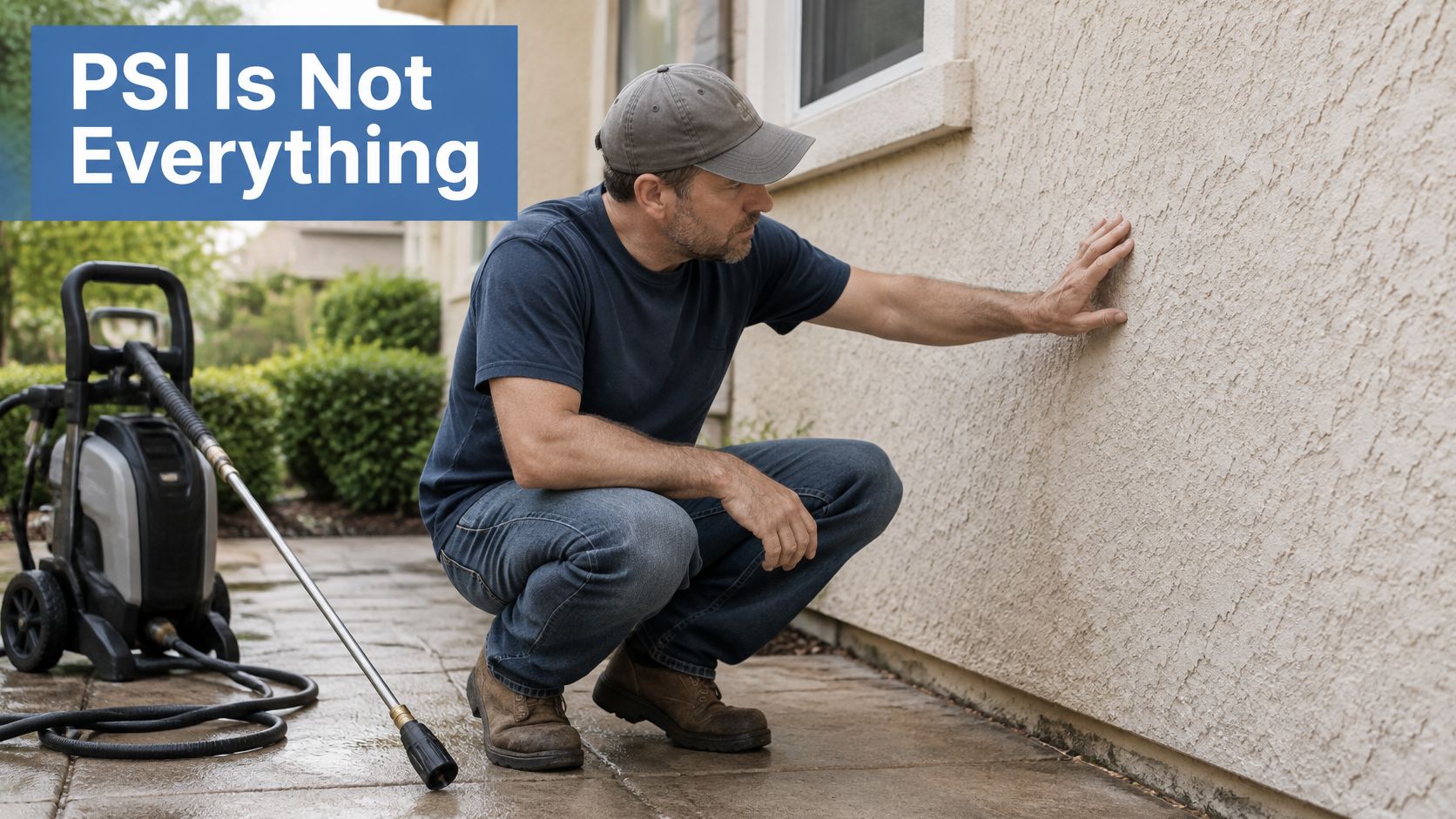
Say a homeowner rents a 3,000 psi gas unit for a cracked stucco garage in Gilbert. The unloader is stuck near full output, and the only tip in the box is a narrow fan. One afternoon of "just knocking the dust off" leaves the wall looking brighter. Within a week a fine crack network shows again, darker where water sat in the scratch coat. The jet didn't invent those cracks. It opened them and pushed moisture behind the finish, where Arizona sun then pulls the stain back to the surface.
The same mistake shows up when someone compares a soft wash to a blast and picks the blast because it looks faster. A soft wash versus a high-pressure wash is really a choice about where the cleaning work happens: in the solution, or in the impact.
Start low, and only step up if a test patch still holds soil. Never step up to the number printed on the shroud.
Before any production pass, identify the system (cement stucco or EIFS), walk cracks and old repairs, test a discreet patch, and use the lowest pressure that removes soil without changing the finish. Dust and sun in the Valley increase how often walls need cleaning. They do not raise the pressure the finish can take.
Matching the Machine to the Job
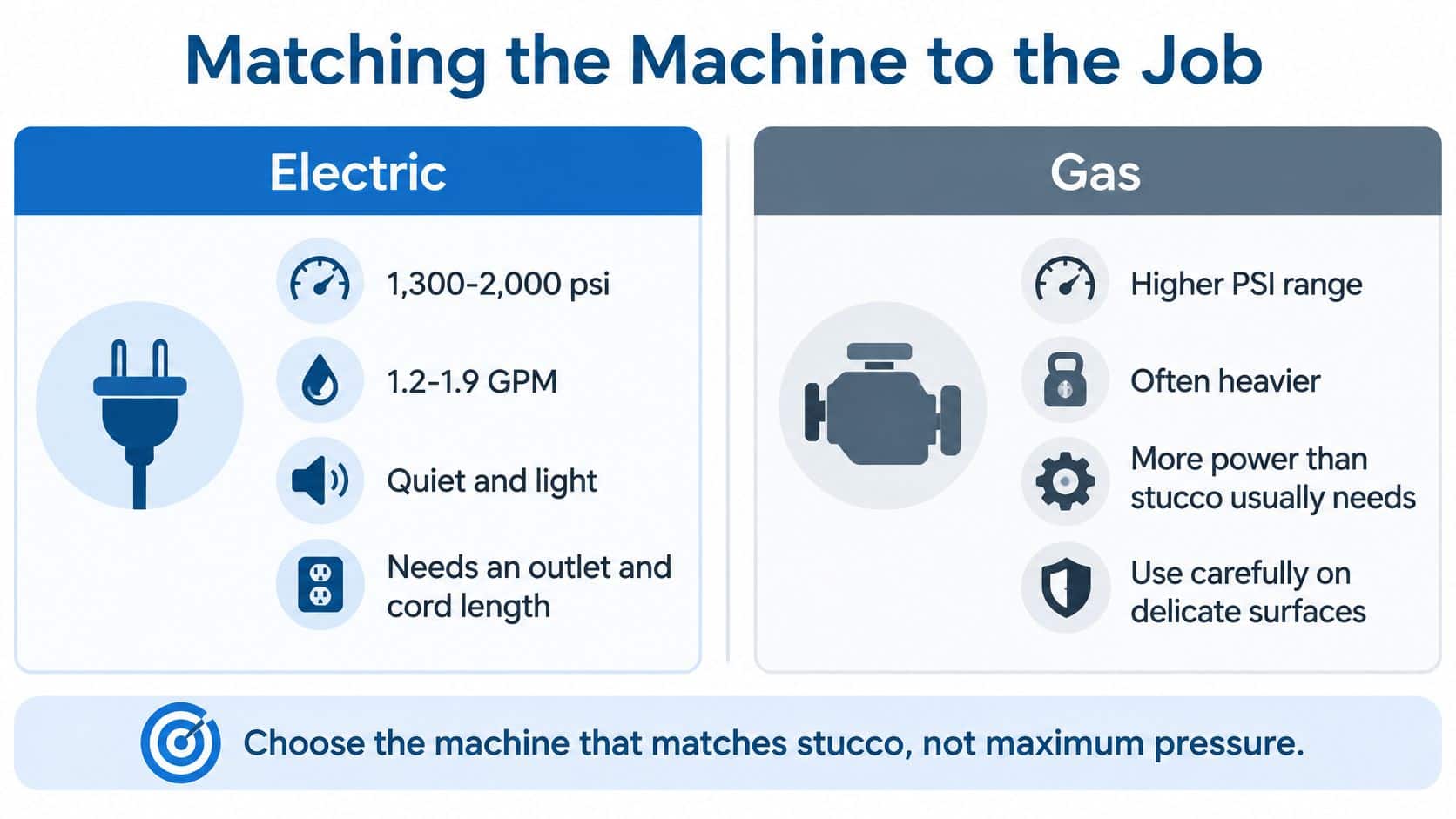
Buy or rent for regulator control first, then for flow. Electric and gas both clean stucco only when an adjustable regulator or unloader can hold the 200–500 psi band. A fixed high-output setting is the risk, not the fuel type.
Electric machines in the homeowner class typically land around 1,300–2,000 psi at 1.2–1.9 GPM. They're quiet, light, and they need an outlet plus enough cord to reach the far wall without a daisy chain of cheap extensions. Gas machines typically land around 2,500–4,000 psi at 2.0–4.0 GPM. They move around a lot with no cord, and the extra flow helps on a large dirty elevation, but they're loud, they exhaust, and most of them want to run far above what a textured finish should see. Holding one at a true low-pressure rinse takes a working unloader, not a hope that "low" on the grip means low.
| Criterion | Electric | Gas |
|---|---|---|
| Typical pressure | 1,300–2,000 psi | 2,500–4,000 psi |
| Typical flow | 1.2–1.9 GPM | 2.0–4.0 GPM |
| Low-pressure control for stucco | Good with an adjustable regulator | Good only with a regulator; harder to hold at low output |
| Noise and exhaust | Quiet, no exhaust | Loud, produces exhaust |
| Portability and power | Needs an outlet and cord length | Portable, runs on fuel |
| Best fit | Single-story walls, patios, condos | Two-story exteriors, long runs, no nearby outlet |
Which property gets which machine
A patio wall or a single-story stucco entry is an electric job. You can see the tip, you can keep two feet of standoff, and a neighbor on the other side of a block wall won't hear a gas engine for three hours.
A two-story home with long runs and no outlet on the back elevation is where gas earns its keep, but only with the regulator verified at the gun and a wide fan on the lance. If you can't read pressure at the nozzle, don't guess from the idle sound.
A condo with shared walls flips the choice back. Noise, fuel storage, and overspray onto a neighbor's patio matter more than gallons per minute. An electric unit with a regulator, a 40-degree tip, and a short work window is the fit. More GPM does not add cleaning power on this surface. Extra flow only means more water driven behind the cladding if you crowd the wall.
I would rather run a modest electric unit I can throttle than a commercial gas washer locked near 3,000 psi. Confirm the regulator moves through the low band on a test patch before you commit the elevation. If it snaps from a dribble to full blast, take the machine back.
Nozzle Tips and a Safe Step-by-Step Wash
The red 0-degree tip never touches stucco. Neither does the yellow 15-degree. Both throw a concentrated jet that cuts texture and can scar acrylic finishes or an EIFS lamina. If those two are the only tips in the rental bag, stop and get a wider fan before you wet the wall.
Sika/Parex's technical bulletin caps water pressure at 500 psi, requires the nozzle at least 2 feet off the wall, and calls for a fan of 30–45 degrees or wider. Excessive pressure damages textured finishes and the EIFS lamina. A commercial setup needs a regulator that operates in the 200–500 psi range, not a fixed 2,000–4,000 psi output. The 24-inch standoff is the repeatable margin around texture, cracks, penetrations, and window interfaces. Verify pressure at the gun, test an inconspicuous area, and look for texture loss, color change, or water intrusion before you expand the work.
| Tip | Spray angle | Stucco use | Minimum standoff |
|---|---|---|---|
| Red | 0 degrees | Never use on stucco | Not applicable |
| Yellow | 15 degrees | Avoid; too concentrated | Not applicable |
| Green | 25 degrees | Rinsing at a distance | About 24 in |
| White | 40 degrees | Wide top-down rinse | About 24 in |
| Black | 65 degrees | Low-pressure detergent application | 18 in or more |
Lowe's stucco guidance says wash top-down with plain water on a low-pressure setting, stand at least 10 inches away, and aim the stream at about a 45-degree angle, because high-pressure water damages the porous surface and can create cracks. A separate Lowe's washer guide puts the nozzle about 2 feet off stucco, applies cleaner from the bottom up, rinses from the top down, and tells you to avoid gaps, undersides, and windows. I treat two feet as the working distance and 10 inches as a floor you should not crowd.
Detroit's masonry cleaning guidelines say stucco and stone are best cleaned with mild detergent and a low-pressure rinse, or with plain water at low pressure. Any higher-pressure proposal has to be shown first on a test patch so the pressure doesn't abrade the surface. Don't pressure-wash when freezing temperatures are prevalent, and schedule the work at least two calendar weeks before freezing so the masonry can dry. Phoenix rarely freezes on a wash day, but the drying rule still applies before paint or sealant, and it matters on any trip to higher country.
The wash, in order
Name the system and walk it. Cement stucco and EIFS are not the same wall. Mark cracks, loose patches, and failed sealant. Hollow spots and open joints get repaired before water shows up. Washing over a failed patch pushes water into the assembly.
Mask what shouldn't get wet. Cover outlets, lights, and door hardware. Wet plants first if you'll use detergent. Keep the fan off glass edges and sealant joints. A house wash that soaks window perimeters creates the leak you're trying to avoid.
Test a discreet patch at the lowest pressure that cleans. Watch for texture loss and color shift while the patch is still wet. If the finish changes, drop pressure or widen the tip. Do not "finish this section and fix it later."
Pre-wet lightly, then apply mild detergent with the black 65-degree tip, at least 18 inches off the wall, working bottom up so runoff doesn't stripe dry soil. The solution does the cleaning. A weak mix is not a reason to swap in a yellow tip.
Dwell, but never let the cleaner dry. Rinse top-down with a green 25-degree or white 40-degree tip at about 24 inches, stream near 45 degrees, aimed downward. Do not shoot into laps, joints, frames, or up under soffits. Overlap passes and keep the wand moving.
Read the wall before you expand. Texture should still read as texture. Color should be even, not blasted bright in a stripe. Dark weep lines at the base mean water found a path. Stop and fix the path.
Let the elevation dry fully. Don't coat or caulk a damp wall. If freezing weather is in the forecast where you're working, finish early enough that the cladding has those two calendar weeks to dry.
A sound wash looks even, with the original texture intact and no fan marks. If streaks remain, they usually mean the detergent dried or the rinse started in the middle of the wall. Re-wet, give the cleaner a real dwell on the streak, and rinse top-down again. Do not chase the streak with more pressure.
Spotting Damage Early and Keeping Stucco Maintained
The symptom I see most after a bad wash is fine cracks that look wider than they did that morning. The jet finds an existing crack, packs it with water, and the edges chip. That is a stop, not a "finish the side and look tomorrow" problem.
Read the rows this way: the symptom shows up after washing, the cause is almost always pressure, angle, or distance, and the fix is a change on the next pass or a repair before any more water.
| Symptom | Likely cause | Fix |
|---|---|---|
| Fine cracks widen after washing | Pressure too high or jet aimed at an existing crack | Stop, repair with a compatible patch, then wash at lower pressure |
| Texture or aggregate washed away | Concentrated jet at close range | Lower pressure, use a wider tip, increase standoff, then repair texture |
| Dark water lines or stains behind the wall | Water driven behind the siding | Keep 18–24 in standoff and spray downward |
| Blisters or soft patches | Water intrusion | Stop washing, let the wall dry, and have it assessed by a professional |
| Dirt returns quickly | Too little dwell time, not too little pressure | Let detergent dwell longer and do not raise pressure |
Lost sand or a polished spot means the tip was too tight or too close. You can lower pressure, move to a white 40-degree tip, and add standoff on the next wall, but the bald patch still needs a compatible texture repair. It will not "blend in" after it dries.
Dark lines that seem to sit behind the finish, plus blisters or soft spots, mean water got past the cladding. Stop. Let the wall dry. Have someone assess it before another gallon goes on that elevation. More rinsing will not push the water back out.
What to do between washes
In this dry, sun-intense climate, dust and irrigation salts are the usual film, not thick algae. Rinse or wash on a schedule matched to soiling, not to a fixed month on the calendar. A practical look at how often a house needs washing starts with what you see on the wall, not with a yearly blast.
- Check sealant once a year around windows, doors, and penetrations, and repair hairline cracks before any wash.
- Knock dust off with a low-pressure rinse when the film is light. Save detergent for bonded soil.
- If dirt returns in days, extend dwell time. Raising pressure only strips finish and leaves a rougher surface that holds the next layer of dust.
After a patch cures, retest one small section before you wash the full elevation. A repair that softens under the fan is not ready, and the original pressure setting may still be too high for the new material.
Deciding Between DIY Washing and a Professional Crew
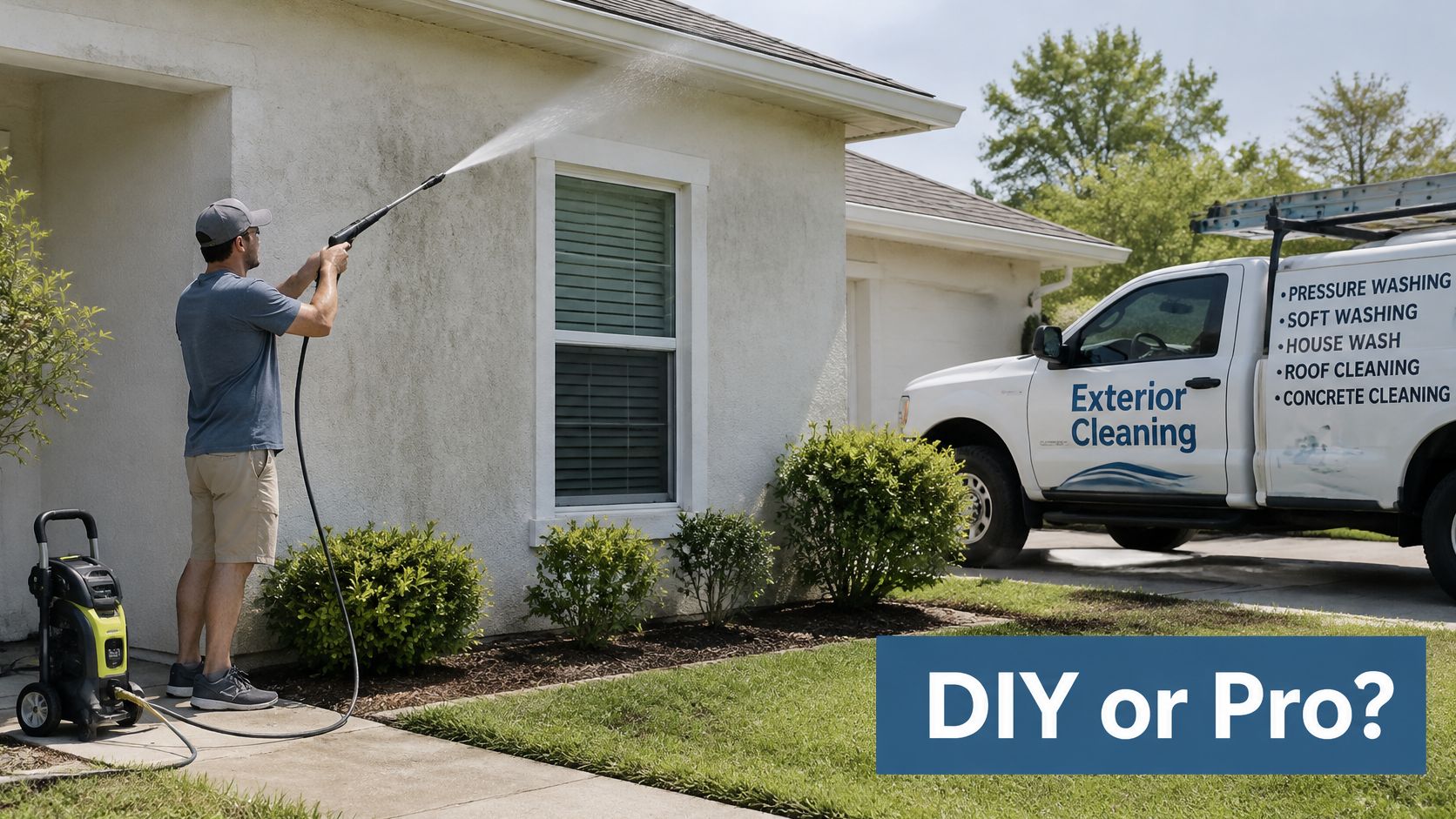
DIY is reasonable on a single-story, intact cement stucco wall, with nothing wider than a hairline crack, when you can hold standoff and you will leave the red and yellow tips in the case. Use a regulated electric unit and a 40-degree tip. Test a patch. If the texture changes, stop.
Hire the job out when the cladding is EIFS, when cracking is widespread, or when you already see blisters, soft spots, or stains that suggest water has been inside the wall. Multi-story and high work belong with a crew that can reach the elevation without improvising from a ladder and a rental gun. Commercial façades, acrylic finishes, and thin lamina scar fast, and a scar on a storefront is not a weekend patch.
QuoteIQ listed a 2026 typical rate of $0.18–$0.40 per square foot for soft-washing stucco house siding. At that rate, a 2,000 square foot elevation lands around $360–$800. A botched texture repair on the same wall often costs more than the wash.
South Mountain Window Cleaning, LLC serves Phoenix, Scottsdale, Paradise Valley, Chandler, Tempe, and Gilbert. We include house washing with our exterior work, our technicians go through extensive window cleaning safety training, and we give a fast, free quote before you commit. If you're unsure whether the wall is cement stucco or EIFS, that quote is cheaper than finding out with a rental. You can also read how we approach hiring a crew to pressure wash a property when the elevation, the access, or the cladding type is past a careful DIY pass.
For an intact single-story cement wall, wash it yourself with control. For EIFS, cracked walls, or high work, don't.
South Mountain Window Cleaning, LLC washes stucco and other exteriors with low pressure and the right chemistry, alongside residential, commercial, and high-rise window cleaning across Phoenix, Scottsdale, Paradise Valley, Chandler, Tempe, and Gilbert. If your wall is EIFS, cracked, or above the first story, a free quote is the safer next step than a 3,000 psi rental. Visit South Mountain Window Cleaning, LLC to schedule house washing or window care.