
You're usually not deciding between two spreaders in a vacuum. You're standing in the aisle, looking at a broadcast model and a drop model, and trying to figure out which one will help your lawn without creating extra work around the rest of the property.
That's the part many comparisons miss.
A spreader choice affects more than turf color. It affects how much product lands on your driveway, how much cleanup you have after an application, whether your lawn ends up with visible stripes, and how well you protect flower beds, patios, walkways, and other finished surfaces. On a well-kept property, those details matter.
The short version is simple. Broadcast spreaders are built for speed. Drop spreaders are built for control. The better choice depends on your yard layout, the amount of hardscape around the lawn, and whether you want to optimize for fast coverage or tighter placement.
Choosing the Right Spreader for a Flawless Lawn
If you've ever bought fertilizer or grass seed and then hesitated in front of the spreaders, that hesitation makes sense. Both tools can work well. Both can also create problems if they're mismatched to the property.
A clean, even application helps your lawn look intentional instead of patchy. It also helps protect the surrounding surfaces that shape curb appeal. Product scattered across a walkway or stuck in paver joints doesn't just look sloppy. It can mean waste, staining, extra sweeping, and avoidable runoff.
That's why the better question isn't “Which spreader is best?” It's “Which spreader fits the way your property is built?”
If your lawn is broad and open, a broadcast spreader usually makes more sense. If your turf is cut up by edging, beds, sidewalks, drainage areas, or decorative hardscape, a drop spreader often earns its keep because placement matters more than speed.
For homeowners trying to simplify ongoing yard care, broad maintenance habits matter too. Practical guidance like these tips for a low-maintenance Austin lawn can help you think beyond one tool and look at the whole upkeep routine.
What the decision really affects
- Lawn appearance: Uneven passes can leave visible bands or missed sections.
- Product waste: Material that lands off target still costs you money.
- Cleanup time: More throw usually means more sweeping and rinsing afterward.
- Property protection: Precision matters around driveways, walkways, planting beds, and drainage paths.
A good spreader choice supports the same goal as any smart exterior upkeep plan. You want the whole property to present well, not just the grass. If curb appeal is part of your bigger home maintenance checklist, this guide on how to improve curb appeal is worth pairing with your lawn decisions.
Choose the spreader based on the property you actually have, not the one shown on the box.
How Broadcast and Drop Spreaders Work
The difference starts with how each machine releases material. Once you understand that, the trade-offs become easier to judge.
How a broadcast spreader moves product
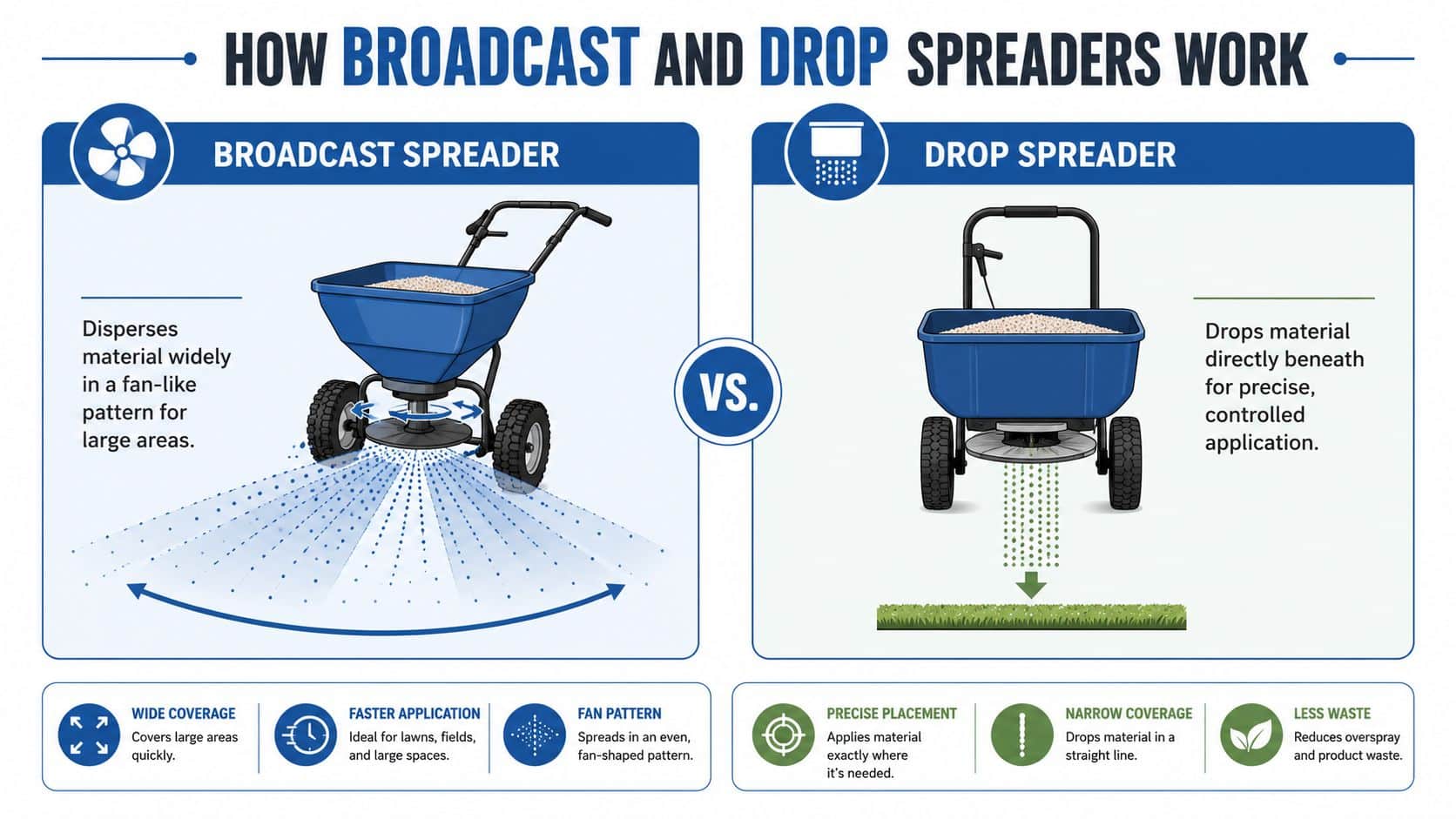
A broadcast spreader uses a rotating mechanism to fling material outward in a wide, sprinkler-like pattern. Instead of putting everything in one narrow line, it sends granules out in a fan-shaped spread over a larger area.
That wide pattern is why it covers ground quickly. It also explains why it's less exact at the edges. If you're moving alongside a bed, driveway, or walkway, some material can land where you don't want it.
This design also puts more responsibility on the operator. Scotts guidance, cited by Richmond Tree, notes that users should walk at about 3 mph when calibrating, and that a higher dial number opens the gate wider. The same guidance also notes that drop spreaders often require a higher setting than broadcast spreaders for the same product.
How a drop spreader places material
A drop spreader works more like a soaker hose. Instead of throwing product outward, it releases material directly between the wheels in a narrow band.
That means what gets treated is the strip directly under the hopper. You get tighter control, cleaner lines, and less chance of scattering product into nearby areas.
This mechanism changes how the spreader behaves in practice. With a drop spreader, your wheel path matters because the machine lays product exactly where you push it. It's more deliberate work, but that's also why many people prefer it near sidewalks, planted borders, and other boundaries.
Why the mechanics matter in the real world
Two spreaders can both say they apply fertilizer, but they don't manage risk the same way.
- Broadcast models favor coverage and throughput.
- Drop models favor boundary control and placement.
- Dial settings aren't interchangeable: A setting that works on one style won't necessarily match the other.
- Operator pace matters: Especially with broadcast units, how you walk affects the result.
A broadcast spreader behaves like a wide spray. A drop spreader behaves like a measured line.
Core Comparison Broadcast vs Drop Spreaders
A spreader choice affects more than how fast you finish the lawn. It also affects how much product ends up on the grass instead of the driveway, how long cleanup takes, and whether you leave fertilizer granules sitting against concrete, pavers, or stone edging.
That is the true comparison.
Broadcast vs. Drop Spreader At-a-Glance
| Feature | Broadcast Spreader | Drop Spreader |
|---|---|---|
| Coverage style | Wide fan pattern | Narrow band between wheels |
| Best use | Open lawns and larger areas | Tight layouts, edges, and segmented lawns |
| Speed | Faster across broad turf | Slower, more deliberate |
| Precision | Lower near borders | Higher near borders and hardscape |
| Risk of off-target spread | Higher | Lower |
| Pace sensitivity | More sensitive to walking speed | Less affected in the same way |
| Typical cost position | Lower entry cost | Higher purchase cost |
| Good fit for | Simpler lawn geometry | Complex lawn geometry |
Coverage speed versus total job time
A broadcast spreader usually gets material over turf faster. On a wide front lawn or a large back yard with long, open passes, that matters. You cover ground quickly and spend less time walking.
Speed alone can fool you, though.
If the spread pattern throws fertilizer into the driveway, street, mulched beds, or against a foundation wall, the job is not done when the hopper is empty. You still have to sweep, blow, or vacuum up stray product. On some properties, that cleanup erases the time you saved during application.
A drop spreader is slower on the lawn, but it often shortens the full job on properties with tight boundaries because there is less mess to correct afterward.
Precision and protection of hardscape
The difference becomes evident in real property care.
A drop spreader gives you tighter placement along sidewalks, pool decks, decorative borders, and narrow strips between beds and concrete. That control helps protect surfaces you paid good money to install. It also reduces the chance of granules lodging in paver joints, staining damp concrete, or washing into areas where they do not belong.
Broadcast spreaders still have a place. They work well where you have enough buffer around the turf to let the spread pattern do its job without catching hard surfaces.
If your lawn sits close to windows, entry walks, stone veneer, or freshly sealed hardscape, tighter placement is often the better financial choice, even if the application takes longer. The same logic applies to routine exterior care. A property that stays on schedule with an annual home maintenance checklist usually has fewer cleanup and repair issues across the board.
Where each spreader creates mistakes
Both spreaders can produce a clean result. They just fail in different ways.
Broadcast spreaders tend to create off-target spread and uneven feeding when the operator changes pace, turns too sharply, or misjudges overlap. The lawn may still look mostly covered, but you can end up with light areas, heavy bands, and wasted material around the perimeter.
Drop spreaders reduce lateral scatter, but they demand straighter tracking. Drift off your line and you can leave a missed strip or create a darker band from overlap. On small lawns, that trade-off is usually worth it because correcting a visible miss is easier than cleaning fertilizer out of rock beds or off a front walk.
Upfront price versus long-term cost
Broadcast spreaders usually cost less to buy, especially at the entry level. That makes them appealing for simple lawns and occasional use.
Long-term cost depends more on the property than on the sticker price. If you are treating a wide, open yard, a broadcast spreader often gives you the best return because it saves labor and handles the area efficiently. If you are treating a chopped-up yard with edging, patios, and narrow side runs, a drop spreader can save money by reducing waste, avoiding hardscape cleanup, and lowering the risk of overapplication near borders.
That is the part many homeowners miss. The cheaper tool is not always the lower-cost tool.
Which spreader is the better fit
Choose a broadcast spreader if your priority is efficient coverage over open turf and you have enough room to keep product off nearby surfaces.
Choose a drop spreader if your priority is placement control, cleaner edges, and protecting the rest of the property while you feed the lawn.
If your yard includes both open lawn and tight detail areas, the best answer is sometimes using each where it makes sense. That approach costs more upfront, but on the right property it produces a better lawn with less waste and fewer avoidable cleanup problems.
Choosing Your Spreader by Yard Type and Terrain
A spreader should fit the property, not the other way around. Yard shape, slope, and the amount of non-lawn surface around the turf change the right answer fast.
The large open suburban lawn
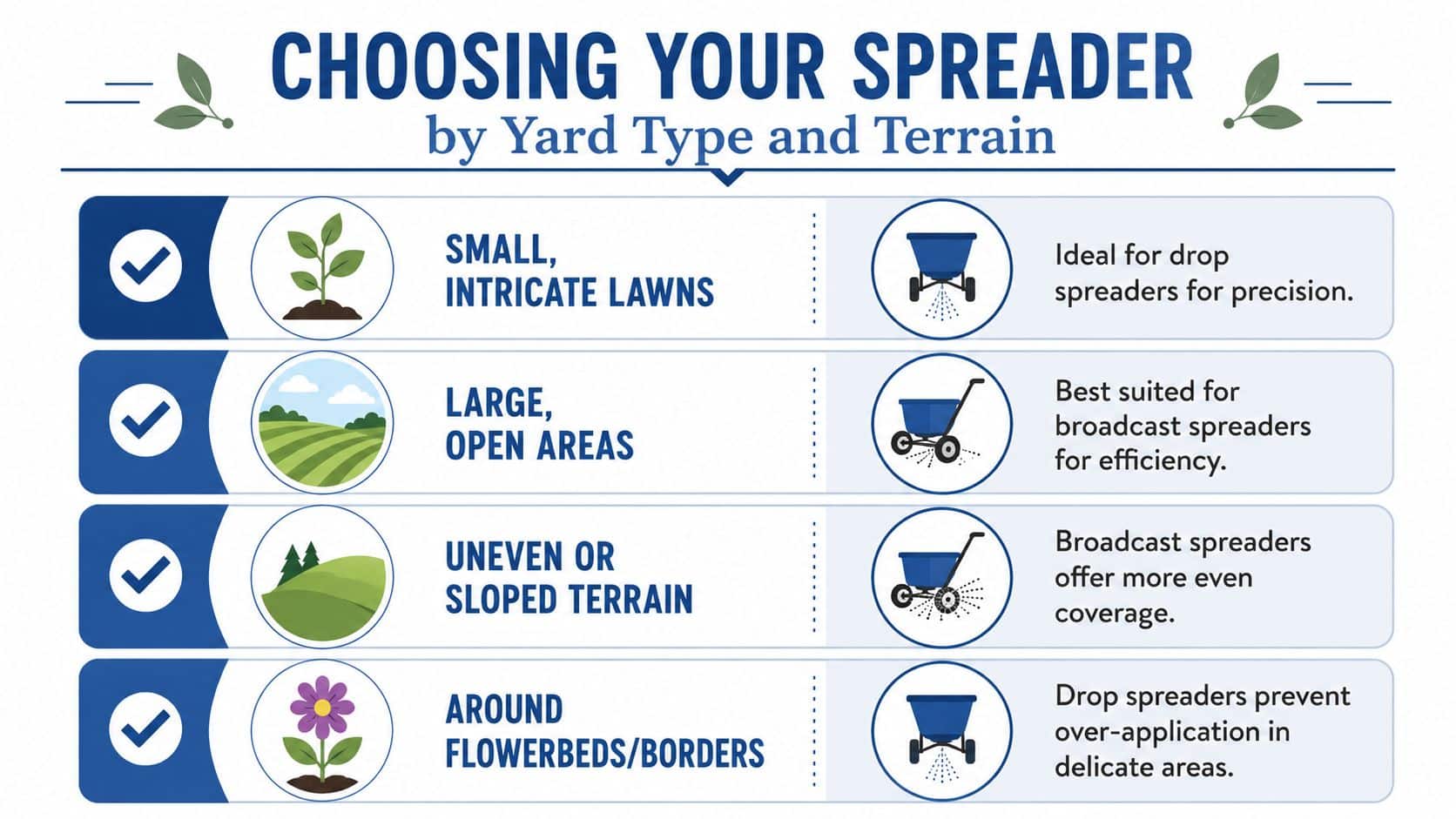
If your lawn is mostly open turf with long straight runs and few obstacles, a broadcast spreader is usually the practical choice. You'll cover the area faster, and the wide spread pattern works well when you have room to maintain a consistent rhythm.
This is the classic “cover ground efficiently” property. The fewer interruptions you have, the more a broadcast spreader's speed helps.
The smaller yard with beds and borders
Now take a yard with narrow side strips, curved planting beds, edging, a front walk, and a patio close to the grass line. That property asks for control.
A drop spreader is usually better in that setting because every pass runs close to something you don't want to coat. The tighter placement helps you avoid product ending up on hardscape, decorative gravel, mulch, or drainage routes.
Uneven ground and pace consistency
Terrain changes the conversation.
According to Sod Solutions, the amount applied with a broadcast spreader changes with walking speed, while a drop spreader's output is not affected the same way. The same source notes that a 10% change in walking speed can cause a 5% to 7% change in application rate.
On uneven or sloped ground, that matters because your pace naturally changes. You slow down uphill, shorten steps on rough sections, and adjust around dips or roots. If you can't keep a steady pace, the broadcast pattern becomes harder to manage evenly.
On rough terrain, the best spreader isn't just the one with the wider pattern. It's the one you can control consistently.
Properties with a lot of hardscape
Think about homes with long driveways, courtyards, pool decks, paver walkways, or commercial sites with visible pedestrian paths. These properties often benefit from a drop spreader because cleanup matters.
A little extra application time can be worth it if it prevents product from reaching areas where it will need to be swept, rinsed, or corrected later. That broader property mindset is the same reason many owners keep a seasonal checklist. If you maintain multiple exterior systems at once, this annual home maintenance checklist helps keep those tasks coordinated.
Calibration and Pro Application Techniques
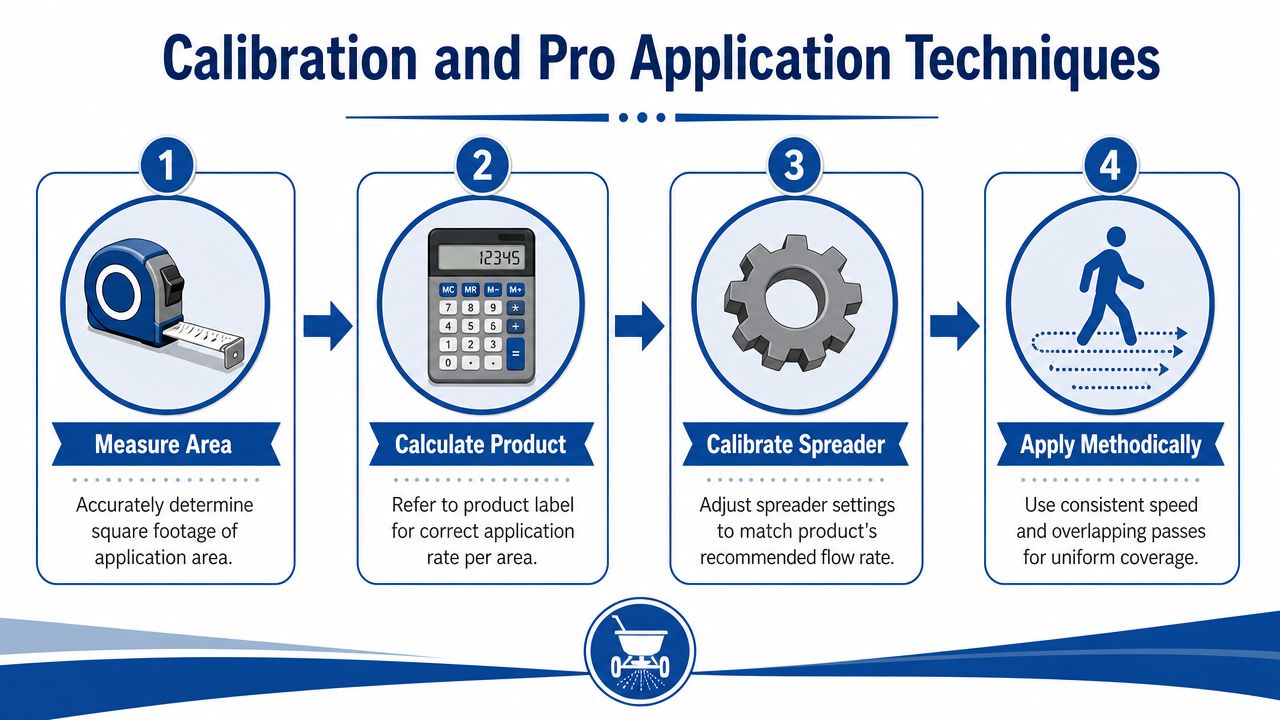
The right spreader won't save a careless application. Calibration and walking technique decide whether you get a clean result or a lawn with visible mistakes.
Start with the label and the area
Before you fill the hopper, confirm two things:
- Measure the lawn area you're treating.
- Read the product label for spreader-specific guidance.
- Test on a small area first if the directions allow it.
- Adjust conservatively rather than opening the gate too far at the start.
This matters with any product, but especially with materials where timing and coverage are important. If you're applying a barrier treatment, these Key facts about pre-emergent applications are useful background before you start.
Broadcast spreader technique
A broadcast spreader performs best when your pattern is repeatable.
- Keep your pace steady: Sudden speed changes affect the pattern.
- Make planned passes: Don't wander or improvise halfway through the lawn.
- Watch the edges: The fan pattern can reach farther than people expect.
- Clean up immediately: If product lands on pavement or other finished surfaces, remove it before irrigation or rain moves it elsewhere.
For homes where overspray or residue on siding, trim, and hard surfaces is already an issue, exterior cleaning becomes part of the same maintenance mindset. That's why property owners often pair lawn care planning with guidance on when to pressure wash a house.
Drop spreader technique
A drop spreader rewards discipline.
- Track straight wheel lines: The machine only treats the strip under the hopper.
- Use a perimeter-first approach: Establish the boundaries before filling in the interior.
- Avoid careless turns: Sharp turns while the gate is open can leave heavy spots.
- Check for clogs and buildup: Precision only helps if material flows evenly.
Cleaning and storage habits
A spreader is only accurate if it stays in good condition.
- Empty the hopper after use
- Brush off leftover granules
- Rinse according to manufacturer guidance
- Dry it fully before storing
- Inspect moving parts before the next application
Practical rule: Most spreader problems blamed on “bad settings” come from poor calibration, inconsistent walking, or a machine that wasn't cleaned after the last job.
Considering Cost Waste and When to Hire a Pro
A spreader can look cheap at checkout and still cost you more over the season.
Purchase price is only one part of the decision. You also pay for wasted material, time spent sweeping granules off pavement, and the risk of staining or roughening hard surfaces that should have stayed clean. On properties with decorative concrete, stone walkways, curbs, edging, or mulch beds, those extra passes and cleanup steps add up fast.
Drop spreaders usually cost more upfront than basic broadcast models. That higher price can make sense if your yard has tight borders, narrow turf strips, or a lot of surfaces you do not want to hit. You are not just paying for precision. You are paying to keep fertilizer, seed, or treatment products off driveways, patios, windows, and planting beds where they create more work and no benefit.
Costs that show up after the application
- Material waste: Product on concrete, gravel, or beds is money lost.
- Cleanup time: Broadcast scatter often means sweeping, blowing, or vacuuming hard surfaces after the job.
- Surface risk: Stray granules can leave residue on finished walkways and contribute to avoidable exterior cleanup.
- Rework: Thin stripes, heavy spots, or missed areas can lead to a second application.
- Appearance issues: On highly visible properties, uneven results stand out long after the spreader is put away.
That matters more than many homeowners expect. A fast application is not a bargain if it creates an hour of cleanup or leaves product where rain can carry it across hardscape and into areas you never intended to treat.
When hiring a pro makes more sense
Hire a professional if the property is hard to treat cleanly and evenly.
That usually includes lawns with curves, island beds, retaining walls, steep sections, narrow side yards, premium hardscape, or commercial frontage where appearance matters every day. It also makes sense when the cost of a mistake is higher than the savings of doing it yourself. One bad pass near a front walk, entry, or pool deck can create more cleanup than the application itself.
The same judgment applies across exterior maintenance. Jobs that look simple from the driveway often depend on technique, equipment, and protecting surrounding surfaces. If you are weighing whether to handle visible exterior work yourself or bring in help, this guide on hiring an experienced window washing company covers that decision from a property care standpoint.
Your Spreader Decision Checklist
If you're still deciding between a broadcast vs drop spreader, run through this list once and the answer usually gets clearer.
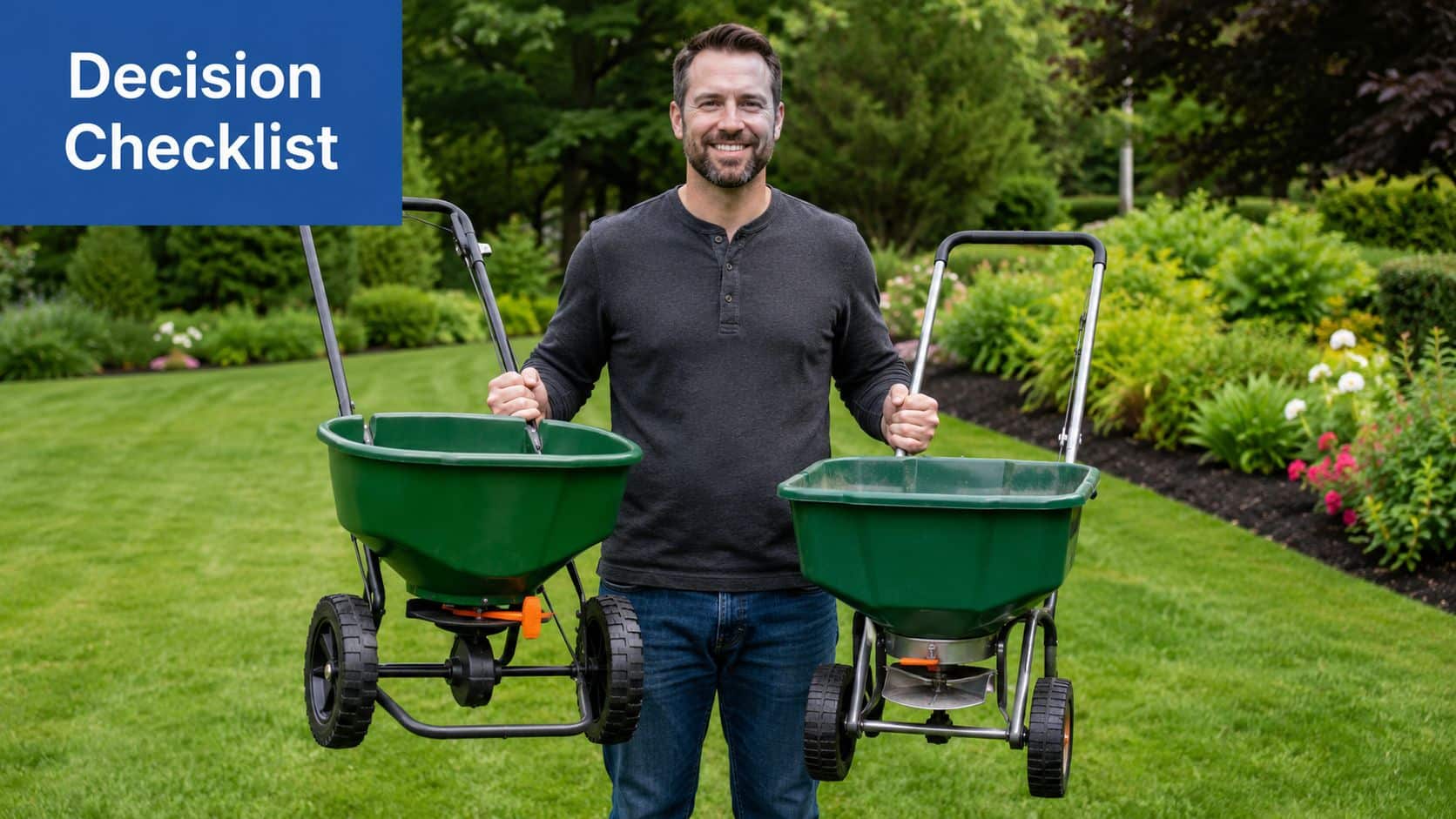
Ask yourself these questions
- Is your lawn mostly open turf? If yes, a broadcast spreader is usually the better fit.
- Do you have lots of edges, curves, beds, or hardscape? If yes, a drop spreader usually gives you better control.
- Can you maintain a steady walking pace? If not, broadcast application gets harder to keep even.
- Are cleanup and surface protection a priority? If yes, the drop spreader becomes more appealing.
- Is purchase price your main concern? Broadcast often has the lower entry cost.
- Are long-term waste and rework your bigger concern? Drop spreaders can make more sense where precision prevents product loss.
One of the most useful ways to frame the decision is this: the main advantage of a drop spreader isn't just a cleaner border. It's a lower risk of putting material where it shouldn't go, especially near hardscape and drainage paths, as explained by Sod Solutions. On many properties, that reduction in waste and rework offsets the speed advantage of a broadcast model.
If your lawn is simple, go for speed. If your property is detailed, choose control. If your property care plan values the lawn and the surfaces around it, don't choose by spreader price alone.
If you're improving curb appeal beyond the lawn, South Mountain Window Cleaning, LLC helps homeowners, businesses, and property managers keep exterior glass, walkways, and building surfaces looking their best across Phoenix, Scottsdale, Paradise Valley, Chandler, Tempe, and Gilbert. For streak-free windows and professional exterior cleaning that supports the same polished look you want from the rest of your property, reach out for a quote.