
A lot of Phoenix-area homeowners arrive at the same moment the same way. They step back from an older house, notice siding that looks chalky, dusty, or stained, and think the fix is simple. Rent a pressure washer, blast off the grime, and get the curb appeal back.
That instinct makes sense. It's also where people can make a very dangerous mistake.
On older homes, especially ones with mid-century exterior materials, what looks like tired cement board may be asbestos cement siding. If that's what you have, cleaning it aggressively is not just a bad maintenance choice. It can turn a manageable exterior into a health hazard. If you're trying to decide whether to wash, paint, cover, repair, or remove it, the first step is understanding what you're looking at and what must never be disturbed.
That Old Siding Might Be Hiding a Serious Risk
A common scenario looks like this. A homeowner in Scottsdale or Phoenix has older siding with faded paint, hard-water staining, or windblown dirt. They search for ways to freshen the exterior, maybe read a general guide on how to clean a house exterior safely, and assume siding is siding.
It isn't.
Some older exteriors can handle routine cleaning methods. Asbestos cement siding cannot be approached that casually. Before any washing, scraping, sanding, drilling, or repainting starts, the material itself has to be considered. If the house dates to the era when asbestos siding was common, the right question isn't “How do I clean this?” It's “What is this, and what happens if I disturb it?”
That distinction matters because intact asbestos cement siding is often managed very differently from damaged siding. Property owners who want a practical overview can protect your home from asbestos siding by learning the basic warning signs before they touch the exterior at all.
Practical rule: If you suspect asbestos cement siding, assume the wrong cleaning method can make the situation worse.
Arizona homes create a special kind of temptation. Dry dust builds up. Monsoon residue sticks. Sun exposure makes old finishes look tired fast. Owners naturally want the exterior to look cleaner. But on suspected asbestos siding, “cleaner” has to come second to “undisturbed.”
That's the frame to keep in mind through every decision that follows. The safest path usually starts with distance, observation, and restraint.
What Is Asbestos Cement Siding
Asbestos cement siding is a cement-based exterior cladding made from Portland cement mixed with asbestos fibers. It was manufactured as a practical building product, not as a specialty material. Builders used it as the weather-exposed outer wall surface, and the product category was formally standardized under ASTM C223 for exterior sidewall use.
That technical detail matters. This material was designed around weather resistance and dimensional stability. It was not designed to flex or absorb impact the way many modern siding materials do.
Why builders liked it
Asbestos cement siding first appeared in the United States in 1907, and it was praised for fire resistance and durability. By the 1920s, the National Board of Fire Underwriters endorsed it, and its use remained widespread until the EPA banned asbestos in most building materials in 1973, as summarized by Asbestos.com's siding history overview.
That long run explains why it still shows up on houses, apartment buildings, garages, and small commercial properties. For decades, it checked the boxes builders cared about:
- Fire resistance helped it stand out in an era that valued noncombustible materials.
- Durability made it appealing for long-term exterior exposure.
- Uniform manufactured panels gave installers a repeatable product for walls and gables.
It also came in multiple profiles. Some pieces were shingles. Others were larger sheets or lap-style panels. Some were smooth. Some were textured to resemble wood grain or slate.
The flaw that matters now
Its strength was always paired with a weakness. Asbestos cement siding is brittle.
That brittleness is a big part of the risk profile today. The material can crack, chip, or break when struck, fastened improperly, or handled roughly during repairs. That's why old siding often shows snapped corners, broken edges, or clean cement-like fractures instead of dents.
For owners comparing materials, it helps to understand that modern fiber-cement products can look similar at a glance. That's one reason visual inspection has limits. A home with old, rigid cement shingles may have asbestos-containing siding, but age and appearance alone can't confirm it. If you're familiar with how other fragile claddings behave, some of the same caution mindset from cedar siding maintenance guidance applies here, except the consequences of abrasive cleaning are far more serious.
How to Visually Identify Asbestos Siding
You can't confirm asbestos cement siding just by looking at it. You can only raise or lower your level of suspicion.
That said, visual clues are useful because they help property owners decide when to stop treating a wall like ordinary siding and start treating it like a potential hazardous material.
What to look for from the ground
Older asbestos cement siding often appears as rigid shingles or panels with a dense, cement-like look. The most common clues include:
- Age of the structure. Homes built before the early 1980s deserve closer attention, especially if the siding appears original.
- Shape and layout. Many installations use rectangular shingles or lap-style pieces with straight bottom edges.
- Texture. Some surfaces are smooth. Others imitate wood grain or slate.
- Breakage pattern. Corners may chip sharply rather than bend.
- Thickness and rigidity. Pieces usually look heavier and more solid than vinyl or aluminum.
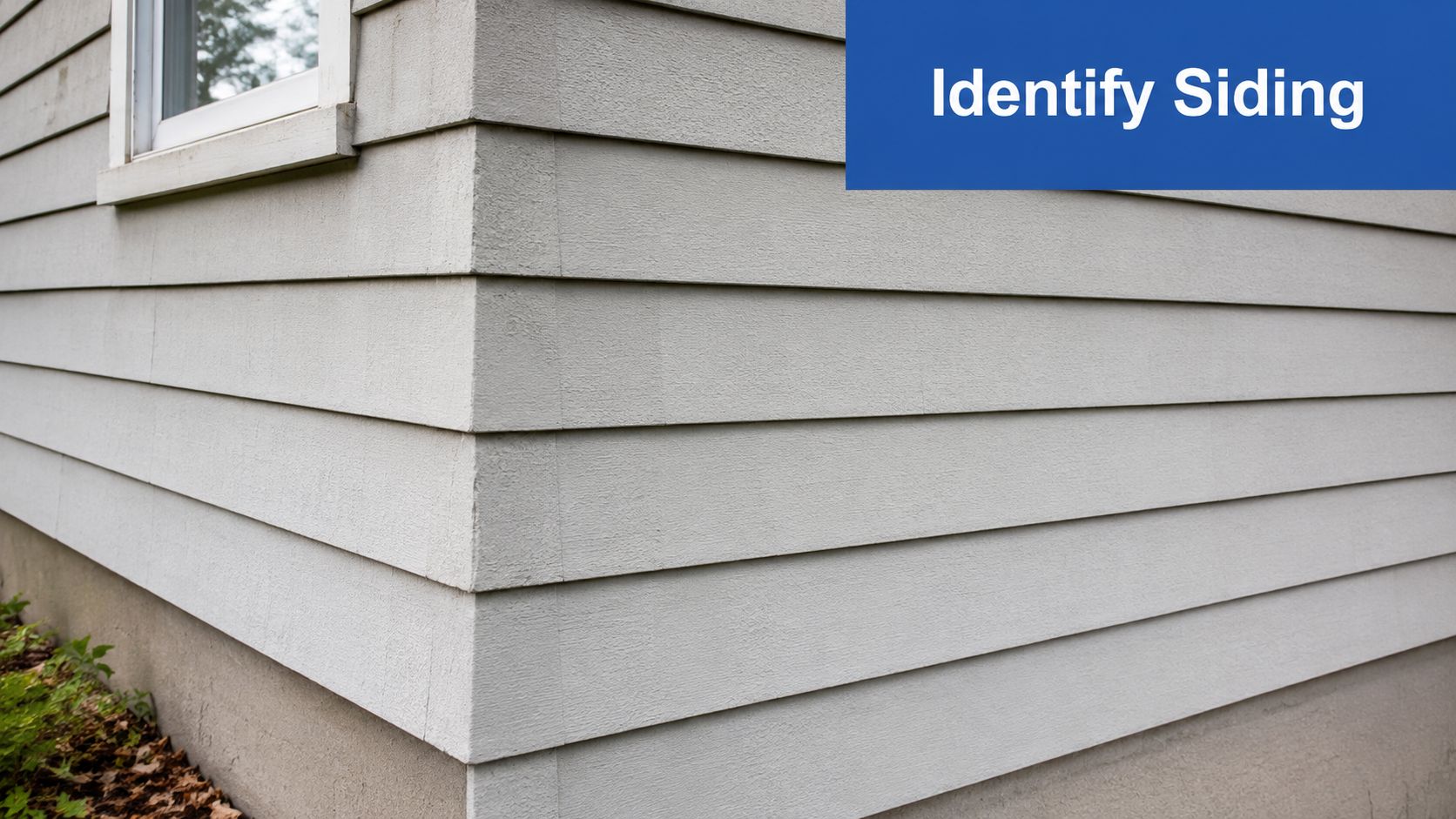
A practical field check is to stand back and inspect the wall with binoculars or a zoomed phone camera. You're looking for brittle fractures, patched sections, exposed edges, and whether any repairs appear to mix old cement shingles with newer replacement materials.
What not to do during identification
Owners get into trouble when visual inspection turns into hands-on investigation. Don't pry at a loose edge. Don't remove a broken fragment to “see what's inside.” Don't drill a test hole. Don't scrape the surface to get a cleaner sample.
Visual identification is a screening step, not proof.
Modern non-asbestos fiber-cement siding can resemble older asbestos products closely enough to fool experienced owners. Paint layers can hide texture. Replacement sections can create a mixed exterior. A house may even have asbestos siding on one elevation and a newer material on another.
When to move from suspicion to testing
If several clues line up, especially home age, brittle cement-like pieces, and original-looking siding, the safe assumption is that it may contain asbestos until proven otherwise.
Lab testing is the only reliable way to confirm the material. Sample collection should be handled by someone who knows how to minimize disturbance and control debris. That usually means an asbestos professional, not a handyman and not a curious homeowner with a pry bar.
Health Risks Why You Cannot Pressure Wash Asbestos Siding
A homeowner sees dirt, oxidation, or mildew on old cement shingles and assumes a stronger wash will solve it in an afternoon. On suspected asbestos siding, that decision can turn a maintenance job into a contamination problem.
Pressure washing suspected asbestos cement siding is unsafe because it can damage the material and release fibers. That is the line I do not cross on site.
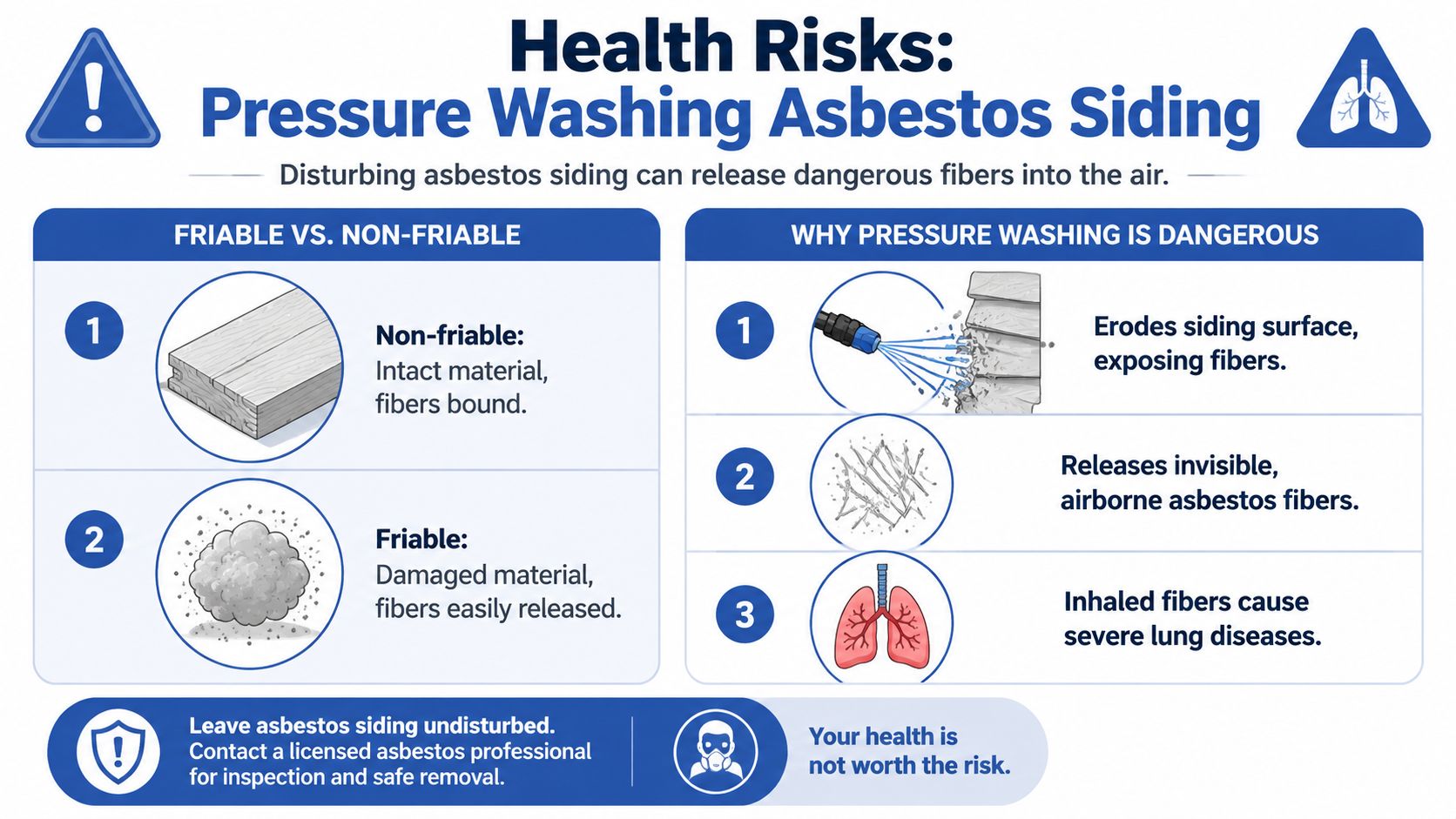
In normal service, asbestos cement siding is generally classified as nonfriable. The fibers are bound into a hardened cement matrix. That matters, but only as long as the siding stays intact. The Minnesota Department of Health advises owners to leave intact siding alone and use licensed asbestos contractors when the material may be disturbed, as explained in its guidance for asbestos roof and siding materials.
Why pressure washing changes the risk
High pressure does more than remove dirt. It attacks the surface itself.
A concentrated spray can wear away the cement binder, especially on aged, chalking, or weathered shingles. It can drive water into cracks, strike weak edges, and break brittle pieces around fasteners and corners. Once that happens, the job is no longer about cleaning. It is about controlling dust, fragments, and runoff that may now contain asbestos.
- Surface erosion can strip away the outer cement layer that keeps fibers bound.
- Impact damage can crack brittle panels or break corners loose.
- Stress at nail holes and edges can turn a stable shingle into a damaged one.
- Runoff and debris spread can move contaminated material into soil, landscaping, walkways, and work areas.
This is why competent exterior cleaners sometimes decline the work. The right call is not always to clean the surface. Sometimes the right call is to stop, assess condition, and keep an intact wall intact. If you want to understand why aggressive rinsing and lower-impact methods are treated so differently, this comparison of pressure washing vs soft washing helps clarify the difference.
Fiber release is the real hazard
The health concern is not the siding sitting undisturbed on the wall. The hazard is airborne asbestos created when the material is cut, broken, abraded, or otherwise disturbed.
Exposure is associated with serious disease, including mesothelioma, asbestosis, and other lung and pleural conditions. That is why condition matters so much in the decision process. Intact siding and damaged siding do not present the same level of immediate risk, and they should not be handled the same way.
Here is a brief visual explanation of the problem and why disturbed siding should never be treated like ordinary cladding.
If you suspect asbestos cement siding, base your next step on condition first. Leave intact material undisturbed. Treat cracking, breakage, and surface failure as a prompt for professional evaluation, not a cleaning experiment.
That approach protects the people living in the home, the crew working outside, and anyone nearby.
Safe Cleaning and Maintenance for Intact Siding
If siding is intact and undisturbed, the safest approach is usually conservative maintenance, not aggressive restoration.
That doesn't mean the wall has to be ignored forever. It means every maintenance step has to protect the cement surface from abrasion, impact, and dust creation. The right goal is to reduce surface soil while keeping the material stable.
What safer maintenance actually looks like
For intact siding, low-impact care generally means:
- Use minimal pressure. A garden hose or very gentle water application is a different category from pressure washing.
- Choose soft tools. Soft-bristle brushes are less likely to scar the surface than stiff deck brushes or abrasive pads.
- Use mild cleaning solutions. Gentle cleaners are preferable to anything caustic or gritty.
- Work slowly. The fastest method is often the riskiest one.

A practical maintenance plan usually focuses on removing loose dust, light biological growth, and grime without creating surface damage. If paint is sound and the siding isn't cracked, owners sometimes choose an encapsulation-oriented approach later, but only after the condition is assessed carefully.
What to avoid every time
Some methods are off the table even when the siding seems solid.
- No pressure washer
- No sanding or grinding
- No wire brushes
- No aggressive scraping of peeling paint
- No drilling for convenience items, signs, lights, or trim without expert review
That last point gets missed often. Owners may avoid cleaning mistakes, then accidentally create risk during a simple exterior project.
Where soft washing fits and where it doesn't
People hear “soft washing” and assume it means every surface is automatically safe. It doesn't. Soft washing is a lower-pressure cleaning method, and on many exteriors it's the right answer. But with suspected asbestos cement siding, even low-pressure work needs judgment about condition, runoff, brush contact, and whether the surface is intact.
A general explanation of what soft wash house cleaning is helps clarify the method, but asbestos siding still belongs in a separate risk category. The decision isn't just about PSI. It's about whether any cleaning action could disturb a brittle, legacy material.
Field advice: If the siding has active cracking, loose fragments, or flaking that exposes raw cement, skip cleaning and move straight to a condition assessment.
Owners often want a yes or no answer. Can it be cleaned or not? The answer is more nuanced. Intact siding may allow gentle maintenance. Damaged siding changes the decision entirely.
Your Options When Siding Is Damaged Repair Encapsulate or Remove
Once asbestos cement siding is damaged, you're no longer making a cleaning decision. You're making a risk-management decision.
Many resources reduce the choice to two extremes. Leave it alone or tear it all off. That misses the reality owners face, especially with mid-century housing stock and aging small commercial properties. As noted in Key Property Inspection Group's discussion of asbestos siding decisions, the important question is when weathered siding crosses the line into a material that needs repair, encapsulation, or full abatement.
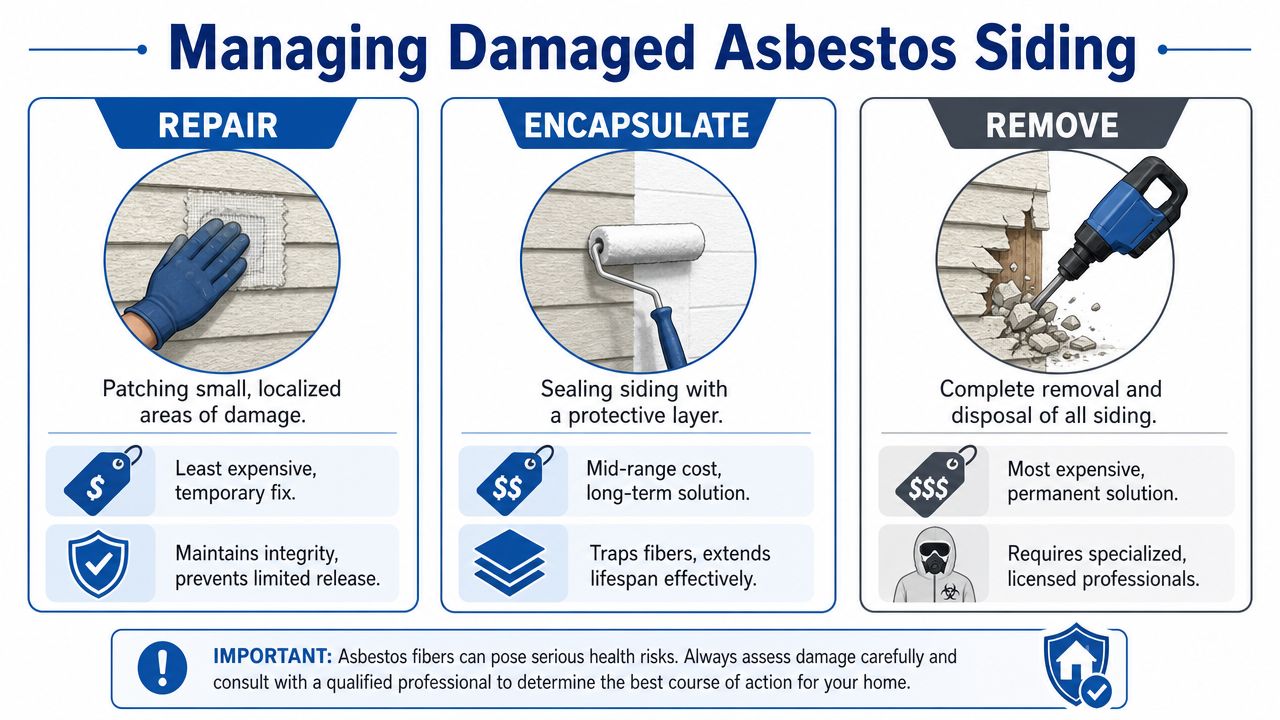
Option one is targeted repair
Repair makes sense when damage is limited and localized. Think a few broken shingles, a chipped corner near an entry, or a small area affected by impact.
This path aims to keep disturbance narrow. The goal is not cosmetic perfection. The goal is to stabilize the wall and prevent further breakage. In some cases, broken pieces can be replaced with compatible non-asbestos materials such as fiber-cement, provided the work is done carefully and with proper protective measures.
Best fit for repair
| Condition | Repair fit |
|---|---|
| Isolated cracks or chips | Good candidate |
| Large areas of breakage | Poor candidate |
| Renovation planned soon | Usually not ideal |
Repair is often the least disruptive path, but it doesn't erase the presence of asbestos elsewhere on the wall.
Option two is encapsulation
Encapsulation means sealing the material rather than removing it. That can involve specialized coatings or, in some projects, covering the siding with a new exterior layer if the installation details can avoid damaging the existing material.
This option is often chosen when the siding is weathered but still largely stable. Owners who want better appearance without opening a full abatement project may prefer it.
A few practical trade-offs matter:
- It can extend service life if the existing siding is still sound.
- It doesn't remove the asbestos. It manages it in place.
- Surface prep must stay gentle. Bad prep can defeat the purpose.
- Future renovations become more complicated because the legacy material is still there.
For owners comparing approaches on other asbestos-clad structures, Commercial Roofers' asbestos guide is useful because it reinforces the same principle. Encapsulation can be a valid management strategy when the material is stable and the work plan controls disturbance.
Option three is full removal
Removal is the most complete option. It's also the most disruptive and specialized.
This path makes sense when siding is broadly deteriorated, when a remodel will disturb multiple elevations, when repeated repairs no longer make sense, or when an owner wants the material gone rather than managed. Removal involves regulated handling, containment, disposal, and replacement planning.
Removal solves the asbestos problem permanently, but it creates the highest disturbance potential during the project. That's why the contractor matters so much.
A simple way to choose
Use condition and future plans together.
- Monitor if the siding is intact and stable.
- Repair if damage is limited and isolated.
- Encapsulate if the material is aging but still broadly sound and you want a managed long-term approach.
- Remove if deterioration is widespread or upcoming work will disturb too much of the wall.
What doesn't work is using cleaning as a substitute for decision-making. Dirt is one issue. Broken asbestos siding is another.
Hiring Professionals and Understanding Abatement Costs
A lot of costly asbestos problems start with one bad call. An owner hires a painter, a handyman, or a pressure washing crew to "clean things up," and the job turns a manageable siding issue into a regulated contamination problem.
Once asbestos siding may be disturbed, the standard changes. This work belongs with licensed asbestos professionals who know how to test, contain, repair, remove, and dispose of the material legally. As noted earlier, asbestos exposure remains a serious public health issue worldwide, with around 209,481 deaths in 2019 attributed to occupational exposure. That is reason enough to be selective about who touches the siding.
Who to hire and who not to hire
Hire for the task in front of you.
If the siding is only suspected to contain asbestos, start with a qualified testing company or inspector. If lab results confirm asbestos and the material is damaged, bring in an abatement contractor. If the siding is intact and only dirty, use an exterior cleaning company that understands asbestos risk and will refuse methods that disturb the surface.
Ask direct questions:
- Are you licensed for asbestos-related work in this jurisdiction?
- Does your insurance cover hazardous-material operations?
- How do you prevent fiber release during siding work?
- Who handles transport and disposal, and where does the waste go?
- Have you worked on asbestos cement siding specifically?
That last question matters. Exterior cement siding is different from pipe wrap, popcorn ceilings, or floor tile. The crew should understand brittle edges, breakage risk, and how weathered panels behave during handling.
If you are still sorting out whether the material is asbestos at all, this overview of property asbestos identification is a useful starting point before you approve any invasive work.
What a competent contractor should explain
A qualified contractor should be able to walk you through the job in plain language. That includes how they will protect the site, control debris, keep workers protected, and prevent unnecessary disturbance to panels that can stay in place.
They should also tell you what they are not going to do. No casual break-off removal. No grinding. No aggressive washing. No vague promises that the material will be "fine once it's wet."
If a contractor cannot explain the process clearly, keep looking.
About costs
Abatement costs vary because the siding condition drives the scope. A house with a few isolated cracked panels is a different project from a two-story home with widespread failure, tight side-yard access, and disposal loads from full tear-off.
Price usually moves with five factors: how much siding is affected, how damaged it is, how hard the walls are to access, what local disposal rules require, and whether replacement siding is part of the same job. That is why phone-quote pricing is often unreliable.
A practical way to think about cost is by decision path:
| Service type | Relative cost |
|---|---|
| Testing | Lower |
| Limited regulated repair | Lower to moderate |
| Encapsulation | Moderate |
| Full removal and disposal | Highest |
The cheapest option on paper can become the most expensive outcome if the wrong crew breaks stable siding and expands the cleanup. Good decision-making starts with condition. Intact panels often call for monitoring or controlled maintenance. Damaged panels may justify repair, encapsulation, or full abatement, depending on how widespread the deterioration is and what work you plan to do next.
Your Next Steps for a Safer Arizona Home
If you suspect asbestos cement siding, the safest response is simple. Assess, don't disturb, and call the right professional.
Start with a visual check from the ground. Look at the age of the property, the shape of the siding, and whether the material appears rigid, brittle, and cement-like. Use those clues to gauge risk, not to make a final diagnosis.
Then stop any DIY plans that involve force or abrasion. No pressure washing. No scraping. No drilling. No test cuts. If the siding may contain asbestos, treat it that way until a qualified professional says otherwise.
A practical action plan looks like this:
- Inspect carefully from a distance and document areas with cracks, chips, loose edges, or weathering.
- Pause any exterior cleaning or repair work if the siding could be asbestos-containing.
- Call the appropriate specialist. That may be a testing company for confirmation, an asbestos abatement contractor for repair or removal planning, or an exterior cleaning professional who knows when a surface should not be washed.
Arizona property owners deal with intense sun, dust, and aging exteriors. That often creates pressure to act quickly. On suspected asbestos cement siding, patience is the safer move. A conservative decision today can prevent a much bigger health and liability problem later.
If you need an exterior cleaning company that knows when not to pressure wash, contact South Mountain Window Cleaning, LLC. Their team serves Phoenix, Scottsdale, Paradise Valley, Chandler, Tempe, and Gilbert with a safety-first approach to exterior cleaning, window washing, and property care.