

An OSHA-compiled analysis recorded 88 window-cleaning accidents over a 15-year period, including 62 fatalities, according to HealthDay's window-washer safety report. That history changes the pricing question. A useful window cleaning cost calculator shouldn't just count glass. It should account for how a crew will reach it safely, what condition it's in, and exactly which surfaces need cleaning.
For homeowners and property managers, the benefit is transparency. When you can separate cleaning time, access, equipment, and extras, you can rebuild an estimate instead of accepting an unexplained total.
Typical Window Cleaning Prices at a Glance
The national average window-cleaning cost is $283, with most customers paying $266–$300 for a standard job, according to a 2026 FieldCamp pricing guide citing Thumbtack data. Those figures provide a useful budgeting reference, but they aren't a Phoenix-area quote or a promise about your property.
Residential pricing also appears as a whole-home charge or a per-pane rate. These approaches describe different units, so don't compare them until you know what the contractor counted.
Window cleaning price benchmarks
| Pricing basis | Typical range | What it covers |
|---|---|---|
| Standard residential job, national average | $283 | Most customers pay $266–$300 |
| Residential home, professional cleaning | $150–$350 | Whole-home price per visit |
| Residential per pane | $4–$11 | Price per pane before access and add-ons |
The residential home and pane figures are consumer benchmarks, not standardized service packages. A whole-home total doesn't establish whether screens, tracks, stain removal, or both glass surfaces are included.
Three inputs explain much of the difference between estimates:
- Quantity: More panes mean more cleaning, detailing, and inspection.
- Reach: Height, landscaping, rooflines, and restricted staging areas change the work method.
- Scope: Screens, tracks, restoration, and interior service add tasks beyond wiping exterior glass.
Comparison rule: Match the pricing unit before comparing the price.
A similar distinction appears in commercial grounds care. Prestonwood Commercial Grounds Services' explanation of per-acre pricing for DFW properties offers a useful parallel: a unit price needs a defined maintenance scope to become meaningful.
For a single-storey home, a per-pane price well below the benchmark's lower end should prompt a check for exclusions, not an automatic rejection. A price far above its upper end should have an understandable explanation, such as difficult access or corrective cleaning. Neither number proves value by itself.
The strongest estimate combines a measurable quantity with a written description of the work. That gives you something more useful than a low headline price: a total you can check.
Building Height, Access and Property Type Costs
A condominium, a detached home, a retail storefront, and a large commercial building don't require the same work plan. Interior access, staging space, pedestrian traffic, and equipment placement can matter as much as the amount of glass.
Our work ranges from a 1-bedroom condo to a 100,000 square foot commercial property. That range makes property type a starting point for estimating, not a substitute for assessing access. For multifamily properties, an apartment window-cleaning assessment also needs to distinguish common-area glass from windows requiring resident coordination.
Pole access can simplify some exterior work, provided the operator has suitable reach and clear working space.
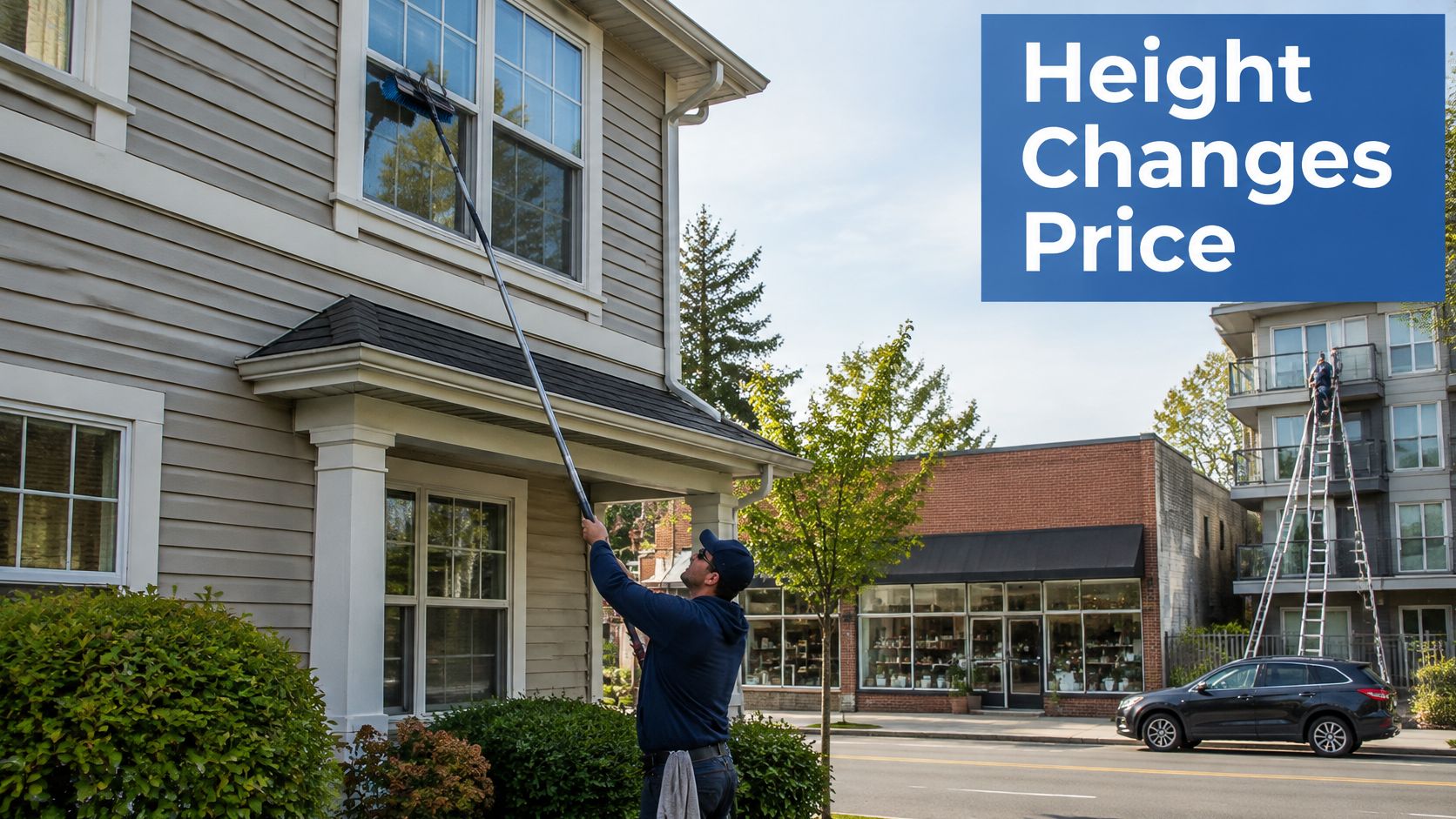
Access methods and their cost effects
| Access method | Setup effect | Main cost driver |
|---|---|---|
| Ground level with water-fed pole | Lowest setup | Pane count and reach length |
| Short ladder | Moderate setup, slower per pane | Ladder time and fall-protection planning |
| Aerial lift | Higher mobilization | Equipment rental and crew size |
| Suspended platform or rope descent | Highest setup | Documented roof anchorage, 5,000 lb per attached worker, insurance |
For rope descent, Neat N Clean's commercial pricing guidance identifies documented roof anchorage as a requirement and states that each anchorage must support at least 5,000 pounds in any direction for every attached worker under the cited OSHA rule. That isn't just an equipment preference. It affects whether the proposed access method is feasible.
Translate the work method into a line item
Ground-based water-fed poles generally minimize staging, but parked vehicles, overhead obstructions, and limited hose routes can slow the crew. Ladder work adds repeated positioning and secure footing checks. A lift introduces delivery, placement, rental, and movement around the property.
Suspended systems require a different level of planning. Roof access, rigging, documentation, exclusion zones, and crew coordination belong in the estimate before anyone assigns a cleaning rate.
Published commercial window-cleaning cost guidance notes that OSHA fall-protection rules generally apply to walking-working surfaces with an unprotected edge 4 feet or more above a lower level. That threshold isn't a universal description of every window-cleaning situation, but it illustrates why height must inform the safety plan.
A higher building shouldn't receive a ground-level price with an unexplained premium attached. Its estimate should identify the access method, setup labor, equipment, and safety-related work so the customer understands what changes the total.
Add-Ons and Quote Checks That Change the Total
Clean glass doesn't automatically mean clean screens, clear tracks, or restored mineral-spotted surfaces. A base glass-cleaning price should describe routine cleaning of the listed accessible panes. Everything beyond that needs an explicit inclusion or separate line.
The Home Service Cost calculator distinguishes scope items such as screens and tracks from additional work involving hard-water staining and construction residue. That distinction matters because these tasks don't take the same tools or time.
Separate maintenance from corrective work
Screen cleaning involves removal, washing, drying, and replacement. Screen repair is different again. Track cleaning requires removing loose grit and detailing channels, rather than cleaning adjacent glass.
Our residential services include inside and out window cleaning, screen cleaning, screen repair, track cleaning, window tinting, ceiling fan cleaning, coach light cleaning, and mirror cleaning. The window track cleaning service should be identified separately when comparing a glass-only estimate with a more complete service.
Arizona dust can collect around frames, while irrigation water can leave mineral spots on glass. We can also remove water marks left by powerful storms. Paint, construction film, and sticker residue require assessment before removal, particularly on coated or otherwise sensitive glass.
Skylights, mirrors, ceiling fans, and coach lights need their own item counts. Solar panel cleaning and power washing of walkways or building exteriors belong on separate service lines, rather than being folded into a window count.
Questions to ask in order
- Define the unit. Does a window mean a pane, an opening, or both surfaces of the glass?
- Confirm the surfaces. Are interior glass, exterior glass, screens, tracks, and sills included?
- Identify access charges. Does the total include setup, ladders, lifts, or suspended systems?
- List corrective work. Are mineral deposits, paint, film, and skylights included or inspection-dependent?
- Check the complete total. Confirm how insurance, cleanup, travel, and equipment are accounted for.
- Read the schedule assumption. Is a recurring discount shown, and what frequency qualifies?
A lump sum can be a valid final price. It isn't a useful comparison unless the scope behind it is visible.
Warning signs include missing exclusions, an unusually low pane rate without a scope description, or a mixed property priced without distinguishing accessible glass from specialty work. The problem isn't necessarily the amount. It's the inability to tell what you're buying.
How the Calculator Turns Windows into a Price
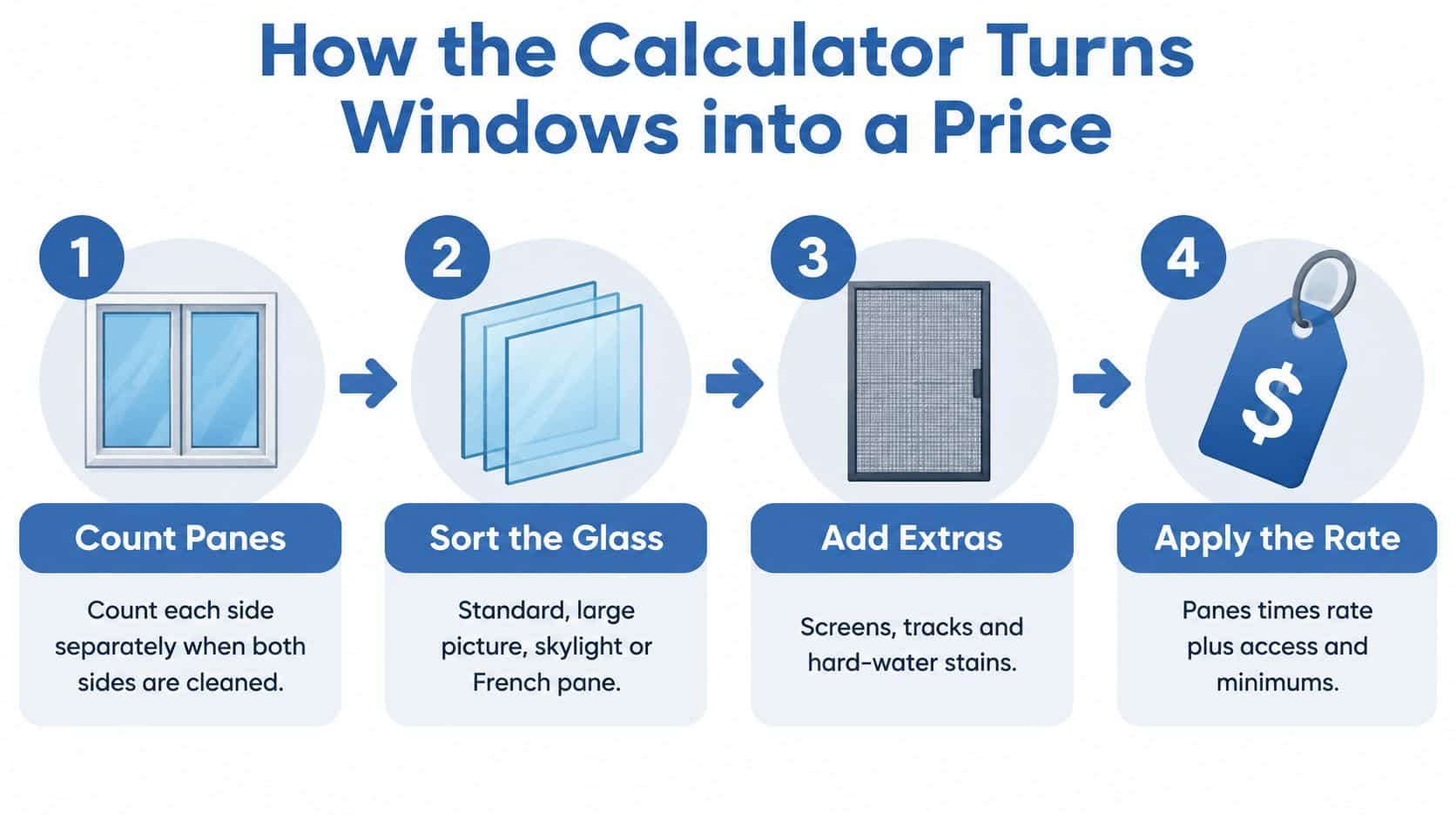
A transparent calculator converts the work into labor and operating costs before producing a customer-facing estimate. Employee wages aren't the retail service price. The business must also cover expenses that continue while technicians travel, load equipment, prepare the site, and complete administrative work.
The process graphic summarizes the main inputs.
Build a residential example
The following 24-window, single-storey home is a hypothetical calculation. Its time allowance, multiplier, extras, and access charge are assumptions for illustration, not South Mountain rates.
Count the panes and surfaces. Record each piece of glass, then count each side separately when both sides will be cleaned. Keep physical panes and billable cleaning surfaces in separate fields so you don't accidentally double an inclusive rate.
Sort the glass. Identify standard panes, large picture windows, skylights, and specialty or divided glass. Equal glass area doesn't necessarily mean equal detailing time.
Record the access method. For this example, assume most glass is reachable from ground level, with selected high windows requiring a ladder. A single-storey building can still have awkward clerestory or entry glass.
Estimate labor hours. Allow 5 labor hours for this hypothetical home. This is an estimating assumption, not a universal production benchmark; divided panes, furniture, and buildup could change it.
Calculate direct wages. FlarePlan's window-cleaning business report gives a May 2025 U.S. median wage of $17.71 per hour for janitors and cleaners, making the illustrative wage floor 5 × $17.71 = $88.55. This occupational benchmark isn't a specialized window-cleaning retail rate.
Apply the operating burden. An illustrative 2.0 multiplier brings that amount to $177.10. Here, the multiplier represents payroll taxes, insurance, equipment, travel, and supervision; a real business must establish its own costs and provide for profit.
Add separately scoped work. Assume $40 for screens and tracks and $60 for ladder-height access, bringing the illustrative total to $277.10. These are hypothetical allowances, not published market prices.
Present a budgeting range. Round this example to $265–$290, subject to confirming the property's condition and access. A range acknowledges uncertainty without hiding the calculation.
Check the assumptions, not just the arithmetic
The wage floor is much lower than the finished service price because wages cover only part of delivering the visit. Don't add an access charge twice if the labor allowance already includes the same setup time.
This separation of base work and allowances is also useful in renovation budgeting, as illustrated by the Trademaster Construction bathroom cost breakdown. The transferable lesson is to identify each component before accepting the total.
For a visual companion to the work-planning discussion, the following video is available.
An estimate within a common residential range is plausible only if its inputs fit the home. A total outside that range isn't automatically wrong for a multi-storey or commercial property. Check the access line first.
Commercial and High-Rise Estimate Walkthrough
Consider a hypothetical three-storey retail property with 40 panes, cleaned from an aerial lift by a two-person crew spending 6 hours on site. All prices, time allowances, and discounts in this scenario are illustrative assumptions, not our rates.
The important distinction is between elapsed time and labor hours. The crew's combined time is 12 labor hours, even though the property is occupied by the crew for only the assumed on-site duration.
Rebuild the visit total
| Component | Illustrative calculation | Amount |
|---|---|---|
| Direct wage floor | 12 labor hours × the $17.71 benchmark | $212.52 |
| Burdened labor | $212.52 × an assumed 2.0 multiplier | $425.04 |
| Lift rental and mobilization | Assumed separate allowance | $150.00 |
| Calculated visit total | $425.04 + $150.00 | $575.04 |
| Budgeting range | Rounded illustrative estimate | $550–$600 |
Using a rounded $575 per visit, the hypothetical annual cost of 12 monthly visits is $6,900. Applying an assumed 15% recurring discount to each visit produces $5,865 per year. Neither the equipment allowance nor the discount should be treated as an available offer.
Change the access plan before changing the rate
If the same building required rope descent, the estimate would need a rope-access setup and roof-anchorage assessment instead of retaining the lift allowance. The estimator would also need to reconsider crew responsibilities, staging, and the production schedule.
Our high-rise window-cleaning cost guidance provides context for reviewing that type of project. For a commercial comparison, keep equipment, setup, cleaning labor, and tenant coordination visible rather than reducing everything to a pane rate.
Budget check: A larger crew can shorten the site visit without reducing total labor hours.
Before approving the estimate, verify whether rental duration includes delivery and collection, whether the crew can reach every listed pane, and whether interior work has its own access arrangements. A mathematically correct total can still be incomplete if the work plan leaves part of the building unaddressed.
Schedules and Recurring Plans That Lower Each Visit
One-time, quarterly, monthly, and weekly service solve different maintenance needs. A home preparing for an event may need a single visit. A restaurant entrance or busy storefront may need a recurring schedule that fits customer traffic and appearance standards.
Our commercial window cleaning is available as weekly, monthly, or quarterly maintenance, as well as one-time service. We use computerized scheduling so the crew arrives at the scheduled time.
The schedule options are summarized below.
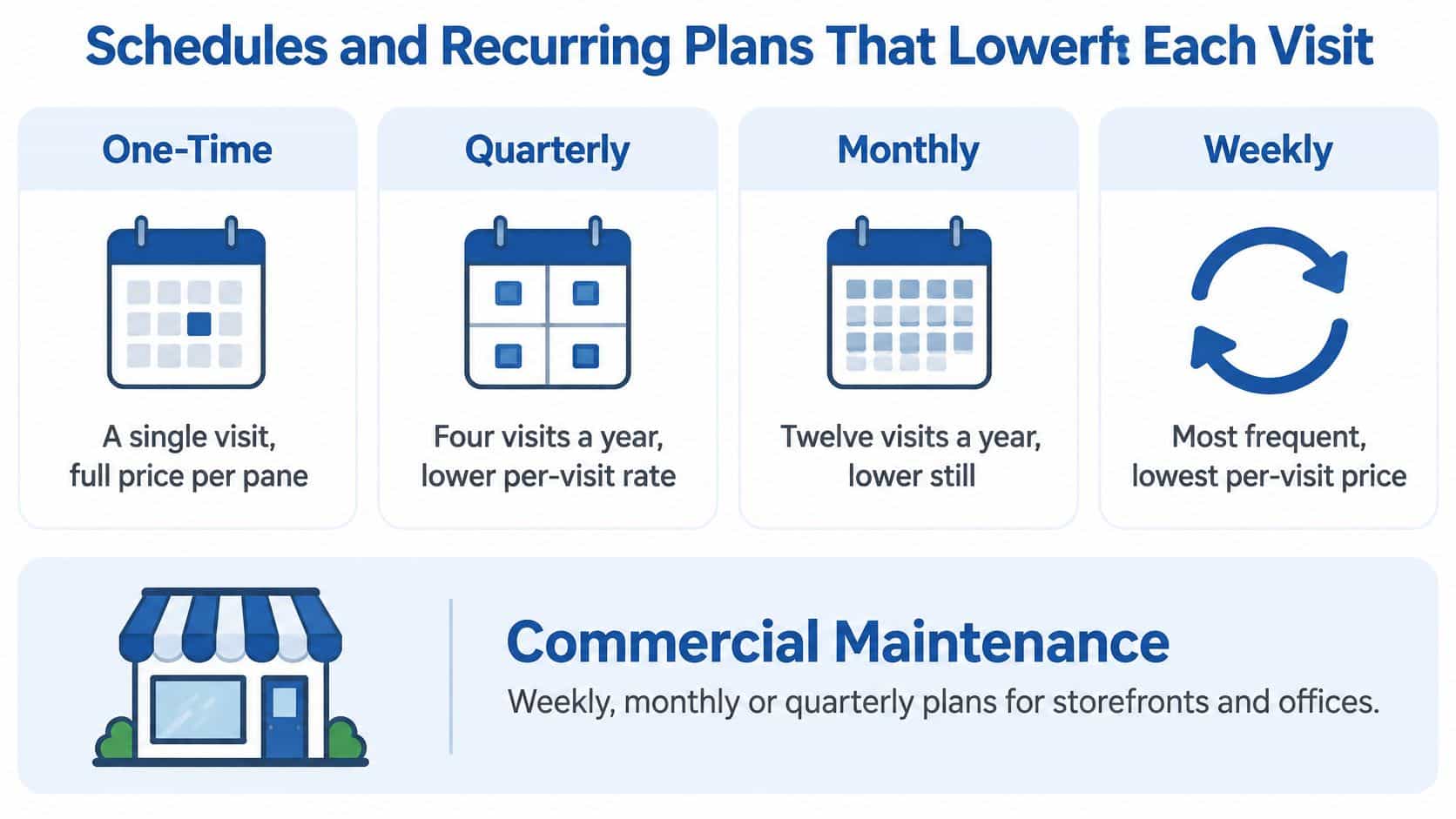
Visit frequency and annual effect
The following comparison uses the earlier residential benchmark as a hypothetical $283 visit price, with an assumed 15% recurring discount. It isn't a quotation or a guarantee that discounts increase with frequency.
| Schedule | Visits per year | Annual effect |
|---|---|---|
| One-time | 1 | Full single-visit price, $283 per year at the example rate |
| Quarterly | 4 | $1,132 without a discount; $962.20 with the assumed discount |
| Monthly | 12 | $2,886.60 with the assumed discount and predictable scheduling |
| Weekly | 52 | $12,508.60 with the assumed discount and fewer access surprises for storefronts |
CalcPro's window-cleaning calculator guidance suggests recurring plans may reduce individual visits by roughly 10–20%. Actual terms require a property-specific quote, and more frequent service doesn't automatically produce a lower annual bill.
Compare the year, including disruption
In the hypothetical quarterly comparison, four independently booked visits cost more than the same number under the assumed maintenance discount. The scope must remain identical for that comparison to be fair.
Predictable access windows can simplify tenant notices, opening procedures, and storefront coordination. Where the property allows it, combining compatible tasks can also reduce separate access events. More frequent visits themselves don't mean fewer interruptions, so include the operational consequences in the decision.
Long gaps can allow mineral deposits and grime to develop into corrective work rather than routine cleaning. Maintenance planning uses the same logic in other trades; Aastro Roofing Company's explanation of roof tune-ups for South Florida homes provides another example of evaluating planned care rather than isolated service calls.
For local scheduling considerations, our guide to how often windows should be cleaned helps frame the discussion. Multiply the proposed visit price by the annual frequency, then add expected interruption and restoration costs. The cheapest single visit isn't necessarily the least expensive year.
Compare Your Quote and Book a Free Estimate
A window-cleaning quote is easier to compare when you can trace its total to the work included. Check the glass, access method, add-ons, and visit schedule. Then compare proposals that cover the same scope.
A national average is only a rough reference. A property with difficult access or extra services may cost more than one with straightforward access and glass cleaning alone. Ask what accounts for any difference.
Four actions before approval
- Confirm scope: Check which glass surfaces are included, along with screens and tracks, and ask how the crew will reach the windows.
- Check the range: Consumer estimates vary with pane count, property size, and service scope. Use any benchmark as a starting point, then ask the provider to explain how the property's details affect the quote.
- Check the schedule: Compare one-time and recurring terms. Confirm whether a discount applies and which tasks are repeated at each visit.
- Request itemization: Ask for a written breakdown of included work, optional services, and exclusions.
These checks help separate a price difference from a service difference. If one proposal includes interior glass and another does not, they are not quotes for the same job.
A local option across the Valley
South Mountain Window Cleaning, LLC provides residential, commercial, and high-rise window cleaning across the Valley, including Phoenix, Scottsdale, Paradise Valley, Chandler, Tempe, and Gilbert. The company offers fast, free quotes and a 100% satisfaction guarantee on residential window cleaning.
Phoenix and Scottsdale customers can call (480) 519-9327. Property details can also be sent to office@southmountainwindowcleaning.com.
The website offers an online way to arrange service.
Prepare information that improves the estimate
Gather a pane count, photos of hard-to-reach exterior areas, and a description of visible staining. Mention locked gates, limited parking, tenant access requirements, or restrictions on interior work during business hours.
For a commercial property, state the preferred maintenance schedule and identify areas that must remain clear while the business is open. For a home, distinguish routine glass cleaning from screen repair, track cleaning, or removal of storm water marks.
Describe the height or obstruction, but leave equipment choices to the estimator. Clear details help the provider assess access rather than assume every window is easy to reach.
Compare itemized proposals for the same scope. Choose the one that explains access, add-ons, and scheduling clearly, so the total reflects the work being delivered.