
The usual advice to buy the strongest, fastest-drying glass cleaner misses what commercial properties need. A powerful formula can remove fingerprints and still leave haze, affect window film, or create avoidable exposure in an occupied lobby. The best commercial glass cleaner is the least aggressive product that passes a repeatable cleaning trial, suits the entire window assembly, and gives the crew enough working time to remove it cleanly.
For property managers, that means buying verified performance plus low practical exposure, not fragrance, ammonia smell, or an impressive front label.
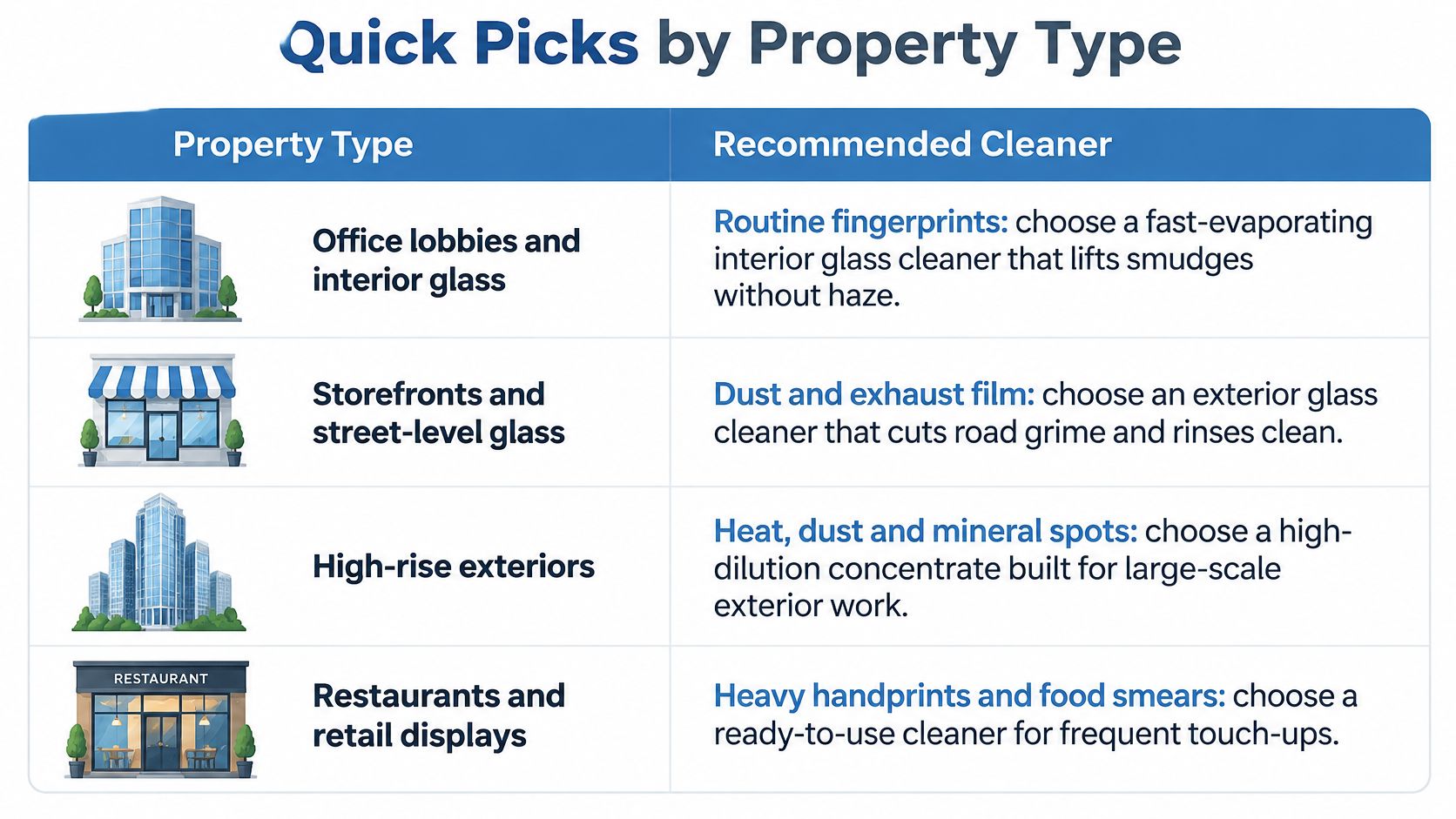
Quick Picks by Property Type
Start with a cleaner matched to the property's soil, occupants, and access conditions, rather than choosing a universal brand.
Starting cleaner profile by property type
| Property type | Cleaner profile to start with | Why it fits |
|---|---|---|
| Office lobbies and interior glass | Neutral-pH, low-VOC, documented streak testing | Routine fingerprints clean without heavy chemistry |
| Restaurant and food-service storefronts | Alkaline ammonia-based cleaner, used with ventilation | Cuts grease and hand film; keep away from chlorine disinfectants |
| Retail frontage facing sun and dust | Residue-free neutral cleaner, applied in cooler hours | Heat and dust leave streaks quickly |
| Schools and occupied public buildings | Lowest verified VOC, fragrance-free | Limits indoor air complaints during occupied hours |
| High-rise exterior glass | Crew-selected, approved product | Access equipment and fall protection drive the job |
This table is a starting point, not a brand ranking. A restaurant entrance and an office partition may look similar, but they don't carry the same soil or require the same chemistry.
An office lobby usually needs reliable removal of handprints without haze. Start with a neutral formula and clean microfiber cloths, reserving stronger chemistry for a clearly identified problem rather than applying it throughout the building.
Match the product to the workday
At a restaurant, greasy hand film can justify an alkaline ammonia-based product. Keep its application separate from food preparation and disinfecting routines, provide ventilation, and never mix it with chlorine disinfectants.
Sun-facing retail frontage needs enough working time for the technician to finish each pane. The fastest evaporation isn't an advantage if the cleaner dries before the squeegee reaches it. For schools and occupied public buildings, prioritize fragrance-free products with verified VOC disclosure instead of masking cleaning odors with perfume.
High-rise exteriors require a different purchasing process. The access crew should select a compatible product within its approved working method, rather than accept whatever bottle the building already stocks.
Use this visual as a quick orientation, then confirm the actual formulation and equipment requirements.
Before purchasing, ask:
- Chemistry: What pH and VOC content does the current safety data sheet list?
- Evidence: Does the supplier have streak-test results, rather than only a streak-free claim?
- Compatibility: Do the instructions cover your glass, applied film, frames, and surrounding finishes?
How Formulas Differ on pH and VOC
A higher pH or stronger solvent profile is not automatically better. Compare the cleaner's pH and VOC content with the soil, the exposure conditions, and documented performance.
Formula references by pH, VOC and typical use
| Formula type | pH reference | VOC reference | Best fit |
|---|---|---|---|
| Ammonia-based alkaline, published SDS example | 10.7 | 0.2% | Greasy film and food-service soils |
| Neutral-pH biodegradable, technical-sheet example | Neutral | Not stated | Routine maintenance where a neutral-pH product is preferred |
| Verified low-VOC institutional cleaner, Green Seal standard | Not specified by the standard | Maximum 1% by weight, or the applicable CARB limit if lower | Occupied buildings and shared spaces |
| Hazard-classified glass cleaner, government-posted SDS example | Not stated | 5.42% by weight | Follow the product label's handling requirements |
The published SDS for Windex Powerized Glass and Surface Cleaner with Ammonia-D reports pH 10.7 and 0.2% VOC. The Project Clean technical sheet describes a separate biodegradable cleaner made with pH-neutral wetting agents and detergents. It does not provide a numeric pH or VOC figure, so those values should not be inferred. These are product-specific references, not figures for every ammonia-based or neutral cleaner.
Alkaline ammonia chemistry can help remove greasy fingerprints and food-service film. Use it for a demonstrated cleaning need, especially where runoff could contact paint, decorative finishes, or applied film.
Neutral pH, biodegradability, and low VOC are separate properties. A neutral-pH claim does not establish VOC content, and biodegradability does not confirm compatibility with every surface.
Separate certification from marketing
For qualifying glass cleaners, the Green Seal institutional-cleaner standard sets a ready-to-use VOC limit of 1% by weight or the applicable California Air Resources Board limit, whichever is lower. It also requires minimum soil-removal, smearing, and streaking performance under HCPA DCC 09. The standard combines exposure-related criteria with cleaning requirements; low VOC alone does not establish cleaning performance.
A government-posted SDS for one glass cleaner reports 5.42% VOC by weight and classifies the product as hazardous under OSHA's Hazard Communication Standard. That figure applies to the specific formulation, not to glass cleaners as a category. Follow its stated handling requirements rather than relying on front-label wording.
Specialty slick or anti-fog products make additional performance claims. Ask what test supports each claim, and whether the product is intended for the glass and use conditions at your property.
Buying rule: Compare the ready-to-use solution workers apply, not only a concentrate's headline claim.
Read product documents in this order:
- Confirm the current SDS: Match the product name and formulation.
- Check the VOC basis: Establish whether the figure applies to the concentrate or working solution.
- Match pH to the soil: Choose stronger alkalinity only when the cleaning need warrants it.
- Review application controls: Follow the stated ventilation, protective-equipment, dilution, and incompatibility instructions.
pH and VOC figures do not predict visible streaking. Evaluate that separately with documented performance evidence and a controlled field trial.
Streak Control You Can Verify Before Buying
Streak resistance depends on residue control and wetting behavior, not cleaning strength alone. A cleaner must spread evenly, loosen soil, and leave the surface without a patchy film.
A published formulation benchmark in Happi used the DCC-09 guideline with 1 gram of product on a 2-by-4-inch glass panel, spread using Grade-40 cheesecloth for 10 back-and-forth strokes without downward pressure; the control scored 7, a competing fluorosurfactant formula scored 5, and a branched C2 fluorosurfactant formula scored 2, with lower ratings indicating cleaner optical results under those test conditions.
The reported mechanism was reduced static and dynamic surface tension. In practical terms, better wetting and leveling helped the liquid spread and evaporate more uniformly. The evaluation also warned that excessive foam can require more wiping and leave residue when incompletely removed.
That's evidence about a formulation mechanism, not a recommendation to purchase fluorinated chemistry. A strong optical result still needs to pass your ingredient, exposure, and compatibility requirements.
Run a trial the crew can repeat
Use a simple comparison that isolates the cleaner from changes in technique:
- Request evidence. Ask for DCC-09 or equivalent streak-test results, including the method and meaning of the scoring scale.
- Choose three storefronts with different sun exposure as a practical trial layout. Include a shaded entrance and glass that receives direct afternoon light.
- Keep tools consistent. Use your actual towels, squeegees, dilution equipment, and water. Start with clean applicators and sound rubber blades.
- Inspect panels at the same elapsed time after drying. View them straight on and at an angle, recording lighting conditions.
- Record the outcome. Note streaks, foam, drying time, soil removal, and whether the technician needed another pass.
Keep the product identity concealed from the person judging the finish when practical. Familiar packaging shouldn't influence the inspection.
A cleaner that needs repeated correction across the whole frontage isn't a bargain, even if the container costs less.
Also decide whether chemical cleaning is the right method for the exterior zone. Pure-water window-cleaning systems offer a different workflow from spraying and wiping, so evaluate that method as its own option rather than mixing its results into a bottle-to-bottle trial.
Choose the product that wins on your glass with your tools. Fragrance strength and ammonia smell aren't performance scores.
Surface Compatibility for Coated, Tinted and Framed Glass
A commercial portfolio rarely contains bare glass alone. You may have single-pane storefronts, insulated units with low-emissivity coatings, laminated glazing, applied tint, and aluminum, vinyl, or painted-steel frames on the same site.
Identify which surface the cleaner touches. A coating protected inside an insulated unit is different from an exposed coating or an aftermarket film facing the room. Don't assume a product approved for uncoated glass is approved for those exposed surfaces.
Applied films deserve their own care instructions. Quote My Wall's window film advice for UK homeowners offers useful context on privacy-film choices, but the installed film manufacturer's cleaning requirements should govern your maintenance specification.
Approve the whole window assembly
Read the technical data sheet alongside the glazing and film care documents. Look for explicit approvals and exclusions, not just the word glass.
Neutral-pH chemistry is generally a gentler starting point for surrounding finishes, but it isn't automatic approval. Incorrect dilution can leave residue, while unsuitable chemistry or prolonged contact can affect paint, seals, and decorative surfaces.
Control overspray by applying the solution to an applicator or cloth where appropriate. Catch runoff before it sits on frame ledges, and protect adjacent landscaping during exterior treatment.
Use this approval procedure:
- Inventory the site. List each glass, coating, film, frame, gasket, and sealant type you can identify.
- Collect the candidate cleaner's technical sheet and the relevant surface-care instructions. Resolve missing approvals before testing.
- Spot test discreetly. Use the intended dilution and application method on an inconspicuous area of each material, then allow at least a full day for observation.
- Record haze, tackiness, film lifting, loss of gloss, or frame discoloration. Stop if anything changes.
- Approve by zone. Use a product across the site only when every relevant material passes; otherwise, maintain separate product specifications.
Mineral deposits need a separate assessment. Consult the guidance on cleaners for hard-water stains before treating persistent spotting as a reason to increase ordinary glass-cleaner strength.
Compatibility is a property-by-property decision, not a single purchasing decision for the entire portfolio.
Safety and Supplier Questions That Matter Most
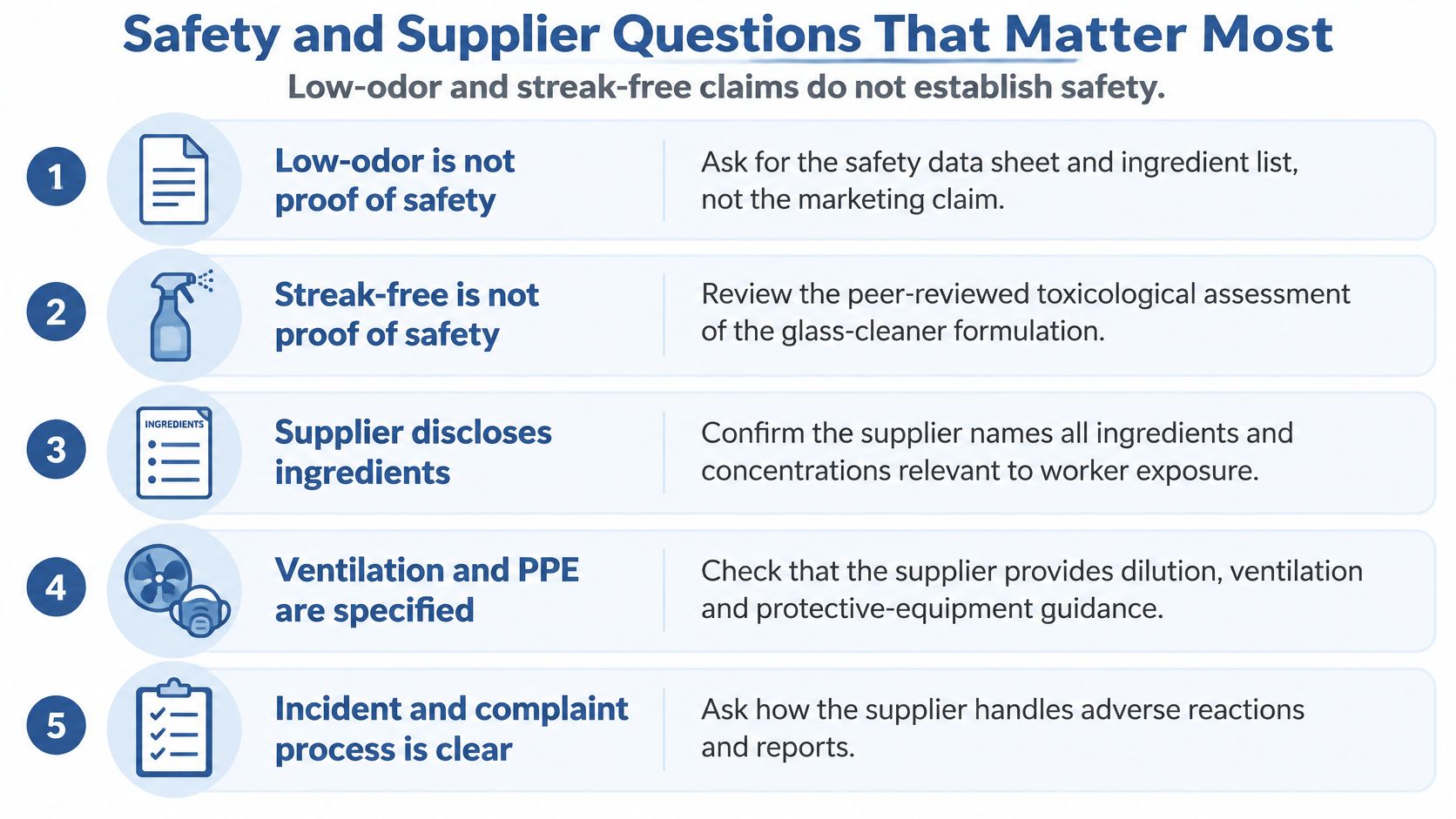
A strong scent and a quick-drying finish are poor safety proxies. Buyers need to know how the product is diluted and applied, what ingredients it contains, and what controls limit worker and occupant exposure.
A peer-reviewed toxicological assessment of a glass-cleaner formulation found conservative consumer and environmental exposure estimates were not of concern under the intended-use conditions it examined. The paper also describes production controls, protective clothing, quality management, and inspections. Those findings apply to the studied formulation and conditions, not to every glass cleaner.
For recurring maintenance, ask how the supplier keeps batches consistent and reports formulation changes. A successful sample test cannot establish that future batches will perform the same way.
Use this checklist to request evidence, not just marketing assurances.
Ask about specialty ingredients
A literature review on PFAS in cleaning applications discusses fluorinated surfactants used to improve wetting and reduce streaking, as well as challenges in assessing occupational exposure and environmental release. That does not establish that every slick, anti-fog, or anti-static cleaner contains PFAS. Ask suppliers to identify relevant ingredients rather than relying on performance claims as a substitute for disclosure.
Some jurisdictions have proposed tighter VOC limits for ready-to-use glass cleaners. Procurement teams should track formulation and regulatory changes instead of assuming a product's current specification will remain suitable.
Send suppliers a written checklist:
- Documents and date: Request the current SDS and technical sheet, their revision dates, and the exact product identifier.
- Ingredients: Ask for full disclosure where available, including fluorinated ingredients and fragrance components.
- Production controls: Ask how batches are tested and managed, and how the supplier reports formulation changes.
- Exposure controls: Confirm dilution, ventilation, eye and skin protection, spill response, and application restrictions.
- Packaging and disposal: Request guidance on refills, container handling, and post-use discharge.
- Complaint handling: Get the contact process for occupant reactions, surface damage, or inconsistent batches.
An SDS may not disclose the complete formulation. Record unanswered questions as unknowns, not as confirmation that a concern does not apply.
Low VOC does not remove the need for precautions. Workers still need appropriate ventilation, controlled application, and protection from overspray and contact.
How Phoenix Heat, Dust and High Rises Change the Plan
Consider a Phoenix property with a shaded lobby entrance, west-facing retail glass, and upper-floor office windows. The morning schedule should separate those zones instead of sending a crew around the building in a fixed order regardless of sunlight.
Work at height adds access planning to that daily sequence.

Arizona's 2025 State Climate Summary identifies Phoenix as having the hottest climate of any major U.S. city and reports 70 days at or above 110°F in 2024, alongside 113 consecutive days at or above 100°F. On heated glass, a workable solution can dry before the technician finishes removing it.
Schedule exterior cleaning in cooler morning or evening periods where practical. Follow the shaded elevations, reduce the working area per application, and don't compensate for rapid drying by adding extra concentrate.
Adjust the route after dust and wind
The NOAA annual Phoenix climatological report for 2023 notes that desert duststorms can travel substantial distances across the region. A property doesn't need an adjacent construction site to collect airborne material on storefronts, office glazing, or solar panels.
Set inspection and cleaning intervals around frontage, road traffic, landscaping, construction activity, and seasonal wind events. After a dust event, assess loose contamination before dragging a towel across the pane.
The working sequence matters as much as the cleaner.
For upper elevations, don't treat a successful ground-level product trial as approval for the entire job. OSHA's window-cleaning interpretation identifies applicable requirements for two-point suspension scaffolds and powered platforms, including the referenced standards 29 CFR 1910.28 and 1910.66. Equipment, fall protection, training, and emergency arrangements require a building-specific review.
Our cleaning team members undergo extensive window-cleaning safety training. For high-rise window cleaning, keep the product specification within the access and safety planning process, and verify insurance documentation before authorizing work.
Use this daily planning sequence:
- Schedule cooler hours and assign elevations according to shade.
- Set maintenance frequency by actual exposure and post-wind inspections.
- Confirm training and access arrangements, including protection for people below.
- Review the emergency plan for the building and equipment being used.
A cleaner chosen for Phoenix must remain workable within this schedule. That's a different buying decision from choosing a formula solely for mild indoor conditions.
Confirm the Cleaner and Provider Before Your Next Order
The final purchase should produce a usable maintenance specification, not just a preferred product name. Record who mixes the cleaner, where it's approved, how the finish is checked, and which conditions require a different method.
Use this decision sequence before placing the order:
- Assign a cleaner profile to each zone. Separate interior touch-ups, greasy entrances, dusty frontage, and upper exteriors instead of forcing every area into one specification.
- Collect the current SDS, technical sheet, and available streak-test results for each candidate. Resolve unanswered supplier questions before accepting a bulk order.
- Confirm material coverage. Match the documents to the site inventory and retain the spot-test record with the property's maintenance files.
- Run the controlled storefront trial and retain the score sheet. Approve the cleaner on demonstrated finish quality and workable application, not familiarity.
- Choose the service interval. Our commercial window-cleaning service offers weekly, monthly, or quarterly maintenance, plus one-time services. Adjust the selection to the property's dust exposure and wind-related needs.
- For high-rise work, require the proposed cleaner's identity and SDS alongside insurance, crew-training documentation, and the emergency plan. Don't authorize access-dependent work on a product specification alone.
South Mountain Window Cleaning, LLC provides residential, commercial, and high-rise window washing in Phoenix, Scottsdale, Paradise Valley, Chandler, Tempe, and Gilbert, Arizona. We use computerized scheduling so the commercial crew arrives at the scheduled time, and we provide fast, free quotes.
Your next step is concrete: gather the documents for your current cleaner, trial the candidate on a sun-exposed zone, and identify any areas that need specialized access. That gives you a useful scope for comparing products and service proposals.
South Mountain Window Cleaning, LLC offers residential, commercial, and high-rise window washing, with recurring maintenance and one-time service options for properties across the Valley. Visit South Mountain Window Cleaning, LLC to request a fast, free quote and discuss your glass types, dust exposure, and access needs before choosing your next cleaning plan.