
Your solar monitoring app shows less production than you expected, but the panels look reasonably clean from the driveway. Phoenix hasn't had meaningful rain lately, nearby construction has stirred up dust, and you're wondering whether to book a cleaning or call your installer. Start with evidence, not a ladder. Solar panel cleaning and maintenance should address lost production and asset condition, not just how the glass looks.
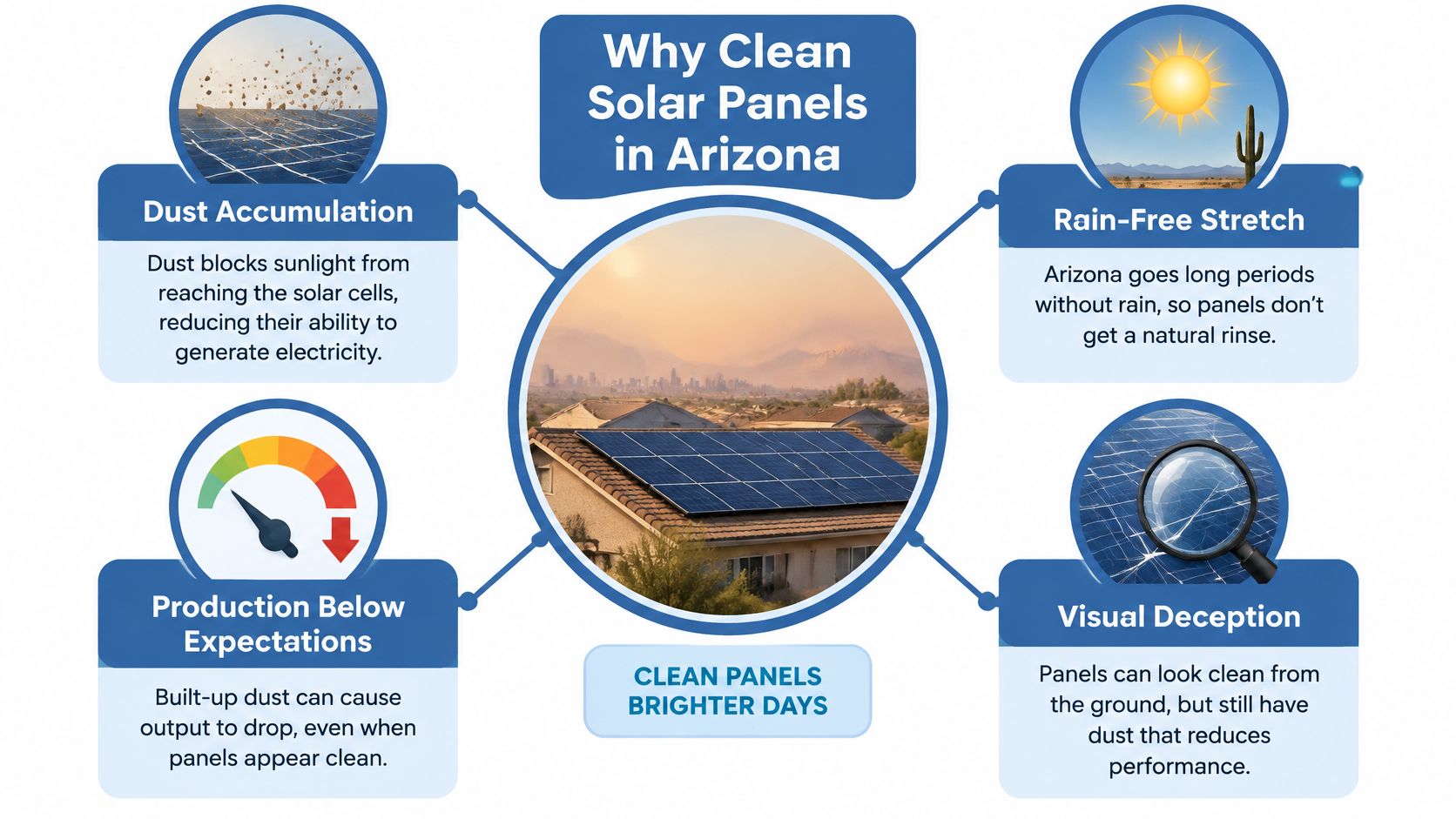
Why Clean Solar Panels in Arizona
A Valley homeowner checks the monitoring app after a dusty stretch and notices disappointing production. A facility manager sees a similar pattern across a commercial rooftop. Neither should assume dirty panels are the only explanation, but neither should dismiss a thin film because the installation still looks presentable.
Think about sunlight passing through a lightly obscured window. You can still see through it, yet less light reaches the room. Dust, pollen, bird droppings, and other deposits on solar modules can interfere with incoming sunlight before the contamination looks dramatic.
This infographic connects familiar Arizona conditions with the decision to investigate.
Treat soiling as an operating issue
The International Energy Agency Photovoltaic Power Systems Programme reported at least 3%–4% of global annual photovoltaic production losses in 2018 from soiling, estimated typical annual losses of approximately 3%–5%, and noted that losses may approach 1% per day in some deserts, according to its assessment of photovoltaic soiling losses. Those are global and environment-specific findings, not a prediction for your Phoenix roof.
For an owner, the practical concern is electricity value. For a property manager, it also includes coordinating access, identifying maintenance concerns, and avoiding service that doesn't deliver a useful result.
Practical rule: Clean because the evidence supports cleaning, not because the panels fail a driveway appearance test.
Arizona's dry, dusty exposure deserves local attention. My recommendation is to connect the production record with the site's recent conditions before approving work. A fixed calendar can remind you to review the system, but it shouldn't make the decision for you.
How Soiling Reduces Solar Panel Output
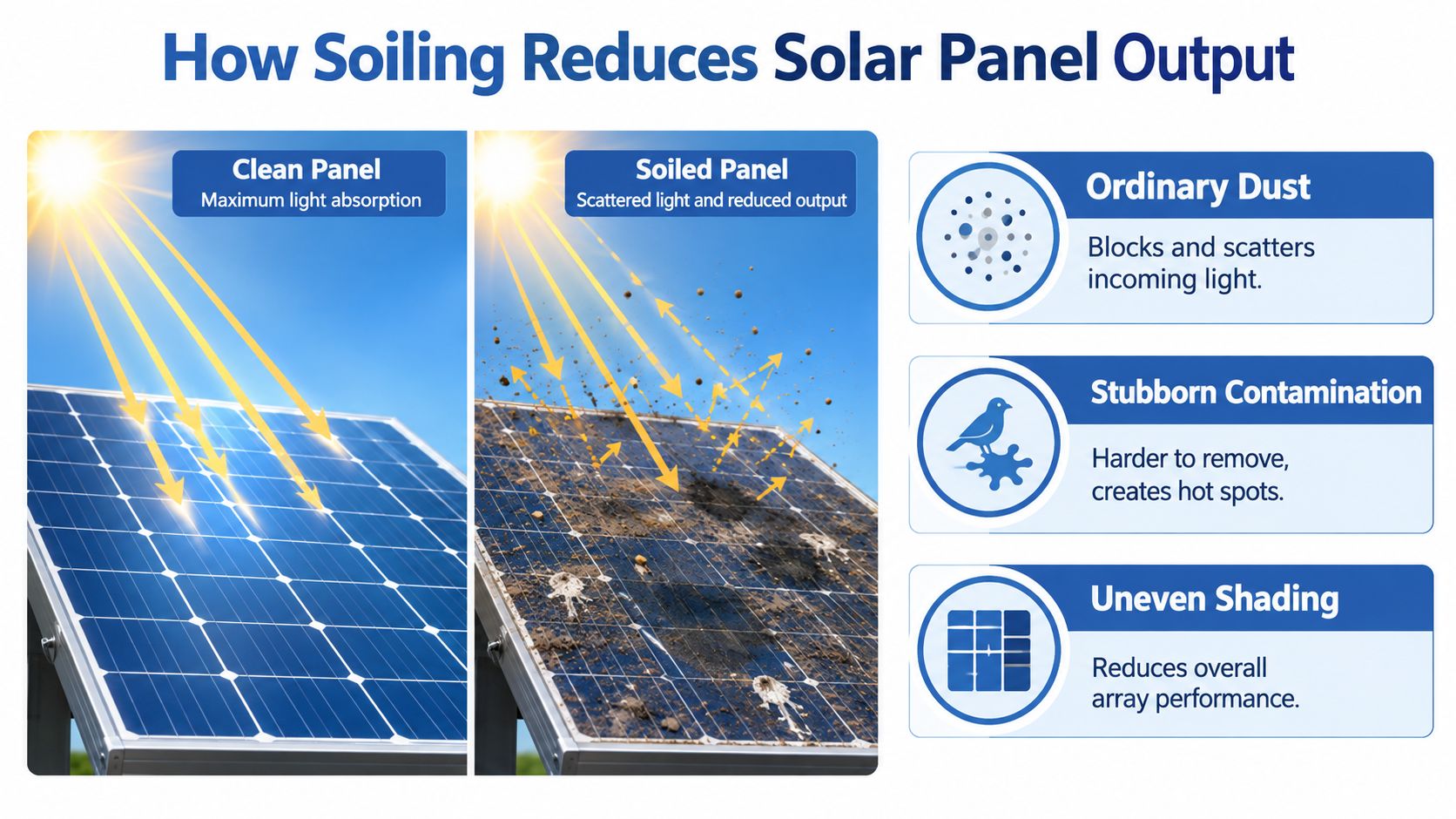
Soiling reduces usable light, not merely surface attractiveness. Deposits can block or scatter incoming irradiance, while uneven contamination can shade some cells more than others. A uniform dust film and a concentrated bird dropping therefore deserve different attention, even when both occupy the same array.
Loose particles may be removable with an appropriate rinse. Cemented dust, adhered sediment, and bird droppings can require more controlled treatment, particularly where repeated wetting has helped deposits bond to the surface.
The distinction between light transmission and localized contamination is shown below.
What controlled cleaning can reveal
A University of Kentucky field case found temperature-corrected performance 6.3% below expectations from aging alone because of soiling; after professional washing, DC output increased more than 12% under some conditions, and the five-day moving-average performance ratio rose from approximately 75% to 81%. The result demonstrates recoverable loss at that installation, not a guaranteed cleaning benefit elsewhere.
Temperature correction matters. A hotter or cloudier comparison period can complicate the result, so a photograph and an isolated inverter reading aren't enough to establish the cause.
- Broad dust coverage: Assess the production trend and exposure history rather than judging the glass color.
- Concentrated deposits: Record their location and extent so the cleaner can plan controlled removal.
- Persistent underperformance: Investigate other causes instead of repeatedly washing an already clean array.
Rain can remove loose material, but its effectiveness depends on the deposits and local conditions. Don't assume a passing shower has resolved contamination, especially when adhered residue remains.
For a closer explanation of the performance issue, review how soiling contributes to solar panel efficiency loss. The strongest evidence is a sustained, weather-aware production gap that improves after an appropriate intervention.
Choose the Right Cleaning Frequency
Reject a universal cleaning interval. A home beside active earthwork and a commercial property with recurring bird activity don't necessarily need the same service schedule as a less exposed installation.
Research illustrates that variation: weekly cleaning was favored in 37% of reviewed cases, intervals of 7–30 days in another 44%, and a separate optimization study produced intervals of roughly 16 to 60 days, depending on methods and assumptions, as summarized in this review of photovoltaic cleaning optimization. Those findings aren't instructions to wash an Arizona rooftop weekly.
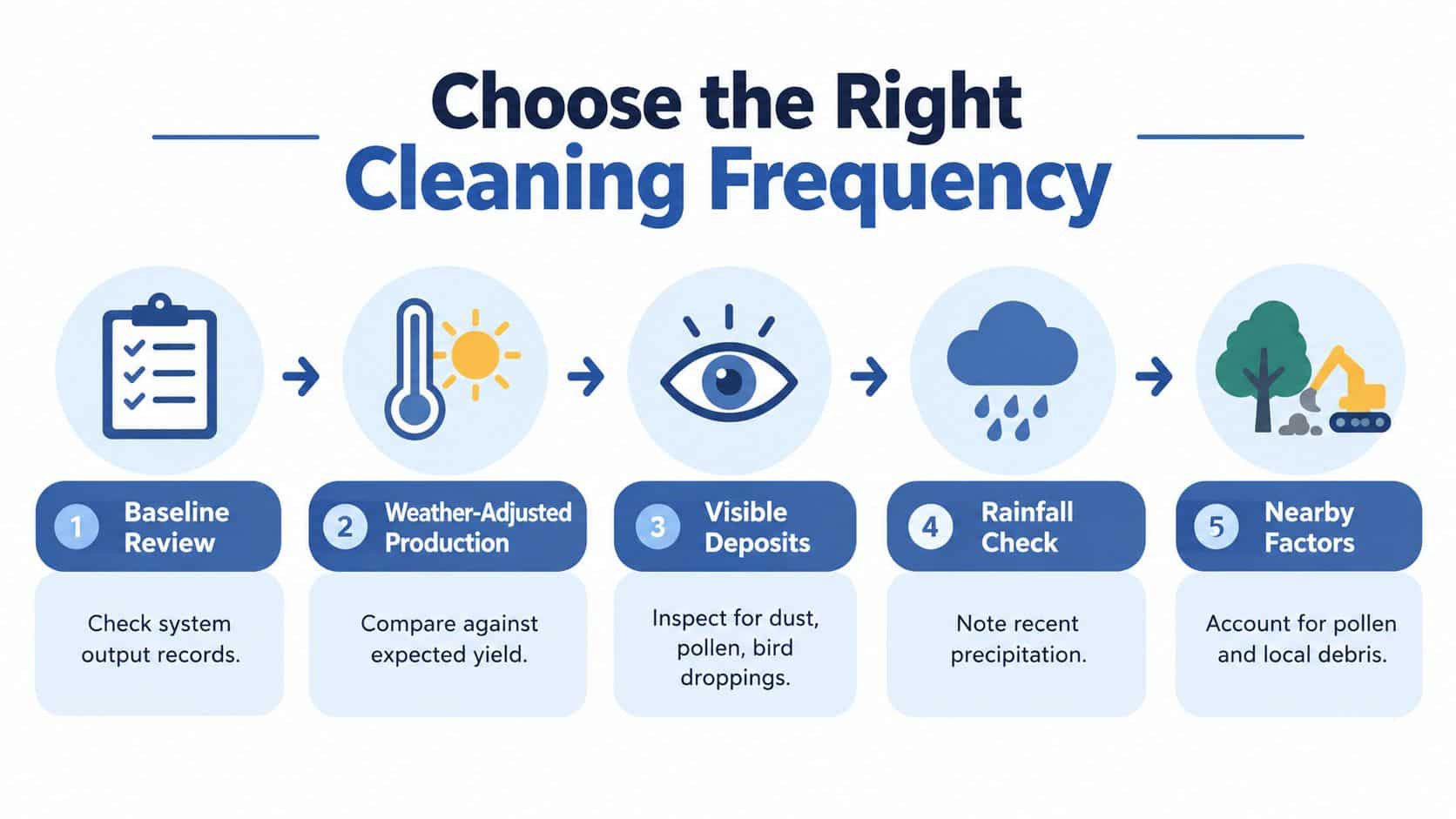
Use the following process to decide when closer inspection is warranted.
Establish a useful baseline
Start with the system's monitoring history. Record energy yield alongside available irradiance and module-temperature data, rainfall, and previous cleaning dates. Where detailed sensors aren't available, ask your installer or monitoring provider how to make a reasonable weather-adjusted comparison.
Then assess the site:
- Exposure changes: Note windblown dust, nearby construction, agricultural activity, traffic-related contamination, and prolonged dry weather.
- Localized contamination: Check accessible views for bird droppings, pollen buildup, and irrigation overspray.
- Production changes: Investigate a persistent departure from expected output, not an isolated disappointing afternoon.
- Service constraints: Include roof access, water availability, labor, and the value of recoverable electricity before authorizing cleaning.
Separate review frequency from washing frequency
More frequent inspections don't have to mean more frequent washing. After nearby construction or a major dust event, review the monitoring data and arrange a safe visual assessment. If the evidence doesn't support meaningful recoverable loss, keep monitoring rather than automatically ordering service.
This distinction prevents two expensive habits: letting contamination persist because the annual appointment hasn't arrived, and paying for unnecessary visits because a recurring booking exists.
Use this guide to deciding how often to clean solar panels as a planning aid, then adapt the decision to your property. Set the next inspection from exposure and observed trends; authorize washing from condition, economics, and safe access.
Compare DIY Cleaning and Professional Service
A readily accessible ground-mounted array is a different job from panels above a steep residential roof or across a large commercial building. Responsible DIY work can make sense when the owner can follow system documentation without climbing, overreaching, or improvising equipment. Difficult access changes the recommendation.
For complex or complicated installations, I favor professional service with a documented access plan. The question isn't whether an owner can hold a hose. It's whether the entire job can be completed safely, with suitable water control and no avoidable exposure to roof edges or electrical components.
DIY and Professional Solar Panel Cleaning Compared
| Consideration | Safe DIY Approach | Professional Service |
|---|---|---|
| Access | Work only where stable ground-level access is practical | Require a site-specific plan for elevated or restricted areas |
| Safety | Stop when the task requires unfamiliar procedures | Ask how technicians manage falls, hot surfaces, and electrical concerns |
| Equipment | Use only equipment compatible with module guidance | Confirm tool suitability rather than accepting “specialist equipment” as an explanation |
| Water control | Account for water quality, runoff, and nearby property | Request an explanation of treatment, rinsing, and runoff management |
| Roof risk | Avoid roof travel and improvised ladder positioning | Clarify access routes and protection of surrounding surfaces |
| Documentation | Keep photographs and monitoring records | Request a written service record and follow-up findings |
Know where cleaning ends
Neither a homeowner nor a washing crew should treat damaged cables, questionable connectors, or system alarms as ordinary dirt-removal problems. Refer electrical concerns to a qualified solar service provider. Don't let a cleaning appointment become an improvised repair visit.
Commercial managers should also coordinate tenant activity, pedestrian routes, water access, and the work window before the crew arrives. These practical details belong in the scope, not in a hurried conversation after equipment is unloaded.
A low quote isn't good value if the contractor can't explain how the panels will be reached, cleaned, and checked.
Ask prospective contractors about insurance, manufacturer compatibility, documentation, and exclusions. A professional service should make responsibilities clearer. It shouldn't replace your questions with a blanket promise that every panel will produce more power afterward.
Use Safe Methods and Cleaning Agents
Start with the module and system documentation. Confirm approved cleaning materials, access requirements, and any operating procedure that requires a qualified person. Don't assume switching off an inverter makes every component safe to touch.
Before work begins, establish a suitable access and equipment plan.

Follow the module instructions, not the photograph
The U.S. Department of Energy's operations and maintenance guidance specifies plain water or mild dishwashing detergent and advises against brushes, solvents, abrasives, and harsh detergents that could damage module surfaces. A pictured brush isn't permission to use one on your installation.
Select any contact tool according to the module manufacturer's requirements. Review solar panel cleaning tools and their applications before buying equipment, but give the system's own documentation priority.
Use a controlled workflow
- Inspect first: Look for cracked glass, loose cables, obstructed drainage, vegetation, or visible damage. Stop and refer concerns before wetting the array.
- Prepare the site: Choose cool, low-irradiance conditions, organize runoff control, and confirm stable access. Avoid working around hot module surfaces.
- Wet deposits gently: Use controlled water application rather than dry scraping. Give adhered contamination an opportunity to soften.
- Clean without force: Use only approved, nonabrasive contact methods. Stubborn material is a reason to reassess technique, not increase pressure.
- Rinse carefully: Use demineralized or appropriately treated water where mineral spotting is a concern. Keep uncontrolled spray away from electrical components.
- Clear and verify: Remove accessible surrounding debris, check drainage, and record the completed work before reviewing performance.
Avoid abrasive pads, harsh chemicals, and uncontrolled high-pressure spraying. These methods can scratch glass, affect seals, or impose unnecessary mechanical stress.
Use this video as supplementary visual context, not a substitute for your system's instructions.
Don't confuse exterior power washing with solar-module washing. A contractor may offer both services, but the equipment settings, surface requirements, and work procedures shouldn't be treated as interchangeable.
Verify Results and Record Maintenance
A clean-looking array confirms appearance, not recovered generation. Post-service verification should test whether the suspected loss was recoverable, while accounting for changing operating conditions.
A study of natural and manual cleaning on monocrystalline panels found that 0.85 grams of particulate matter per square meter accumulated during a 17-day rain-free period, reducing output by approximately 4%; a rainfall event then restored output to within 1% of the manually cleaned panel. The same study detected no temperature difference between the soiled and clean panels, supporting an optical explanation rather than overheating at that site.
Compare like with like
Compare pre-service and post-service performance under similar irradiance, module temperature, and time-of-day conditions. Review the trend rather than celebrating the first higher reading after the crew leaves. A brighter afternoon can otherwise look like a cleaning success.
For properties with comparable array sections, an appropriately designed comparison can help separate cleaning effects from changing weather. Ask the system operator whether the monitoring arrangement supports that analysis.
- Service details: Record the date, contractor, module areas serviced, cleaning method, and water treatment used.
- Observed conditions: Retain photographs of deposits, visible defects, nearby obstructions, and relevant weather.
- Performance evidence: Save baseline and follow-up production information with the comparison conditions.
- Unresolved findings: Document alerts, shading changes, damaged components, or concerns referred to the installer.
Respond correctly when output stays low
If production remains below expectations, don't automatically schedule another wash. Review inverter alerts, vegetation, new shading, possible permanent degradation, and component concerns with the appropriate service provider.
Electrical connections deserve qualified assessment, not casual washing or handling. Keep those findings separate from the cleaning scope.
Useful evidence: A service record should show what changed, what didn't, and what action remains.
For a homeowner, this creates a coherent system history. For a facility manager, it provides a basis for contractor evaluation, budget planning, and deciding whether the next visit should involve a cleaner or a solar technician.
Evaluate Solar Panel Cleaning ROI
Cleaning earns its place in the budget when the expected benefit justifies the full delivered cost. That means comparing recovered electricity value with service charges, access arrangements, water use, operational disruption, and follow-up review.
An NREL review of photovoltaic soiling and cleaning economics described a large-array case in which automated washing was considered justified when electricity was worth more than $0.065 per kilowatt-hour and soiling frequently caused at least an 8% production loss. That historical, installation-specific threshold isn't a current residential pricing rule.
Compare the actual alternatives
| Option | When it deserves consideration | What to evaluate |
|---|---|---|
| Continue monitoring | Evidence of recoverable loss remains weak | Whether delayed action could allow a meaningful loss to persist |
| Targeted cleaning | Contamination affects a defined area | Whether limited service can address the issue safely |
| Full-array cleaning | Measured conditions support broader intervention | Expected recovery against the complete service cost |
| Technical investigation | Faults or unexplained underperformance remain | Whether cleaning would leave the underlying problem unresolved |
For a homeowner, use the electricity's actual value under the applicable tariff. Electricity consumed on-site and electricity exported may need different treatment in the calculation. For commercial properties, ask the energy manager to evaluate the relevant billing arrangement rather than applying an assumed rate.
Require site-specific arithmetic
The basic comparison is straightforward: expected recoverable electricity multiplied by its applicable value, weighed against the complete cost of intervention. The difficult part is establishing a credible recovery estimate and how long the benefit is likely to last.
A gentle, low-angle rinse may address removable dust, but the benefit depends on how much recoverable loss existed beforehand. Lightly soiled panels shouldn't be sold the same recovery expectation as heavily contaminated ones.
Use the factors that affect solar panel cleaning cost to assess quotes. Keep cleaning within a broader preventive program covering inspections, vegetation, asset management, security, insurance, and component-failure response. Don't accept automatic-payback claims without property-specific evidence.
Build a Condition-Based Maintenance Routine
A useful routine assigns responsibility and defines what happens when conditions change. The homeowner should know where monitoring records are stored. A facility team should know who reviews alerts, who authorizes access, and which contractor handles cleaning versus electrical maintenance.
NREL estimated utility-scale photovoltaic operations and maintenance costs across $0–$40 per kilowatt of direct-current capacity per year, reflecting differences in conditions, system design, labor, and scope, as reported in utility-scale operating-cost benchmarking. That broad range reinforces the need to budget for the actual asset rather than borrow a generic maintenance allowance.
Keep the routine repeatable
- Review monitoring: Check expected production and unresolved alerts.
- Assess exposure: Note dust events, construction, rainfall, bird activity, and visible deposits.
- Confirm access: Decide whether the work is safely reachable or requires a professional plan.
- Approve the scope: Specify compatible tools, water quality, exclusions, and documentation.
- Close the record: Review results and assign any outstanding technical work.
Coordinate cleaning without confusing scopes
South Mountain Window Cleaning provides solar panel cleaning alongside residential, commercial, and high-rise window washing in Phoenix, Scottsdale, Paradise Valley, Chandler, Tempe, and Gilbert, Arizona, and surrounding Valley communities. Screen and track care, exterior cleaning, and power washing can also be coordinated, while keeping solar-module methods separate from other surface treatments.
The company offers licensed, bonded, and insured service with safety-trained technicians, computerized scheduling, and online or phone booking. Its $2 million insurance policy and 100% satisfaction guarantee concern service protection and satisfaction, not guaranteed energy gains.
Whether you use an exterior-cleaning provider, your solar installer, or separate specialists, keep responsibilities explicit. Ask who will report defects and who will verify production afterward.
The durable approach is simple: inspect intelligently, clean safely, measure performance, and schedule the next action from evidence.
South Mountain Window Cleaning, LLC offers residential and commercial solar panel cleaning alongside window washing and exterior-cleaning services across the Valley. Visit South Mountain Window Cleaning, LLC to request a quote and discuss your array's access, water-quality needs, and service scope before scheduling.