
A Phoenix property manager can start the morning with dust-coated walkways, stained drive-thru concrete, and a cleaning invoice that doesn't resemble the number approved last month. The surprise usually isn't the washing itself. It's the unlisted travel time, surface preparation, runoff control, access equipment, or extra labor that appeared after the crew arrived.
Understanding how power washing quotes are built gives you a better way to protect the budget. You can compare the actual scope, identify the factors driving the price, recognize reasonable market benchmarks, and ask questions that prevent hidden fees. You'll also see why a responsible quote for a drought-sensitive commercial property may cost more than a basic rinse.
For practical background on exterior cleaning benefits, review the benefits of power washing. South Mountain Window Cleaning provides free, transparent quotes and serves residential, commercial, and high-rise properties across Phoenix, Scottsdale, Paradise Valley, Chandler, Tempe, and Gilbert.
Introduction to Power Washing Quotes
A useful quote should work like a site map. It should show what gets cleaned, how the crew will reach it, what equipment and chemicals they'll use, how long the work should take, and how wastewater will be controlled.
A vague line such as “power wash exterior, price to follow” leaves too much room for disagreement. A detailed proposal separates the visible cleaning from the work that makes the result safe and repeatable. That distinction matters in Phoenix, where windblown dust returns to storefronts, glass, concrete, frames, and walkways, and where water-use practices deserve careful attention.
The National Oceanic and Atmospheric Administration's Phoenix dust-climatology dataset recorded 803 dust-storm events between 1948 and 2012, including 167 events from 2000 through 2012 (NOAA dust-climatology data). That history supports treating exterior cleaning as a maintenance decision, not just an emergency expense.
A strong quote helps you compare one-time restoration with recurring service, understand labor and equipment assumptions, and spot exclusions before work begins. It also gives you a record to use when reviewing future visits.
Understanding What Goes into Power Washing Quotes
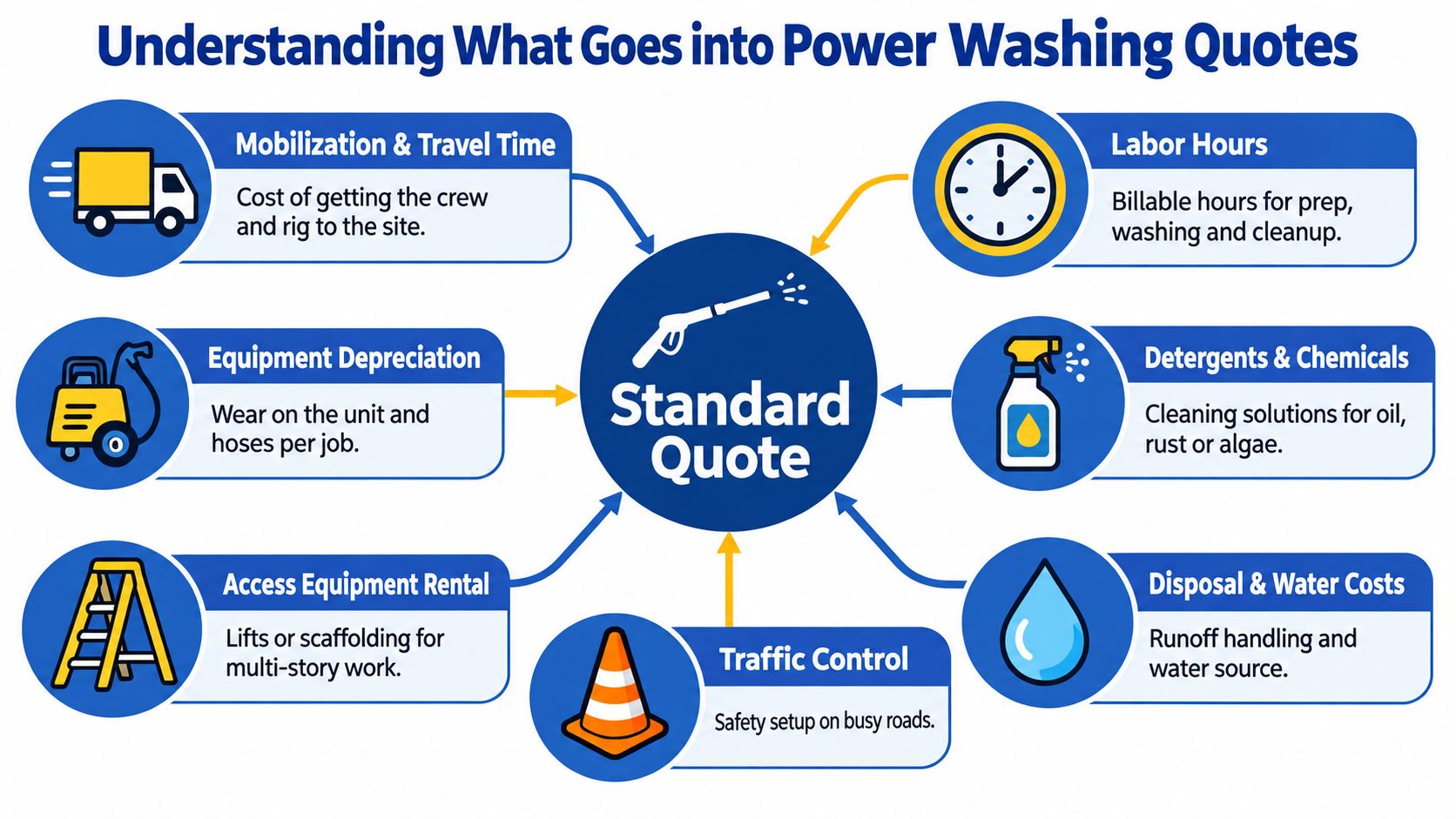
A standard quote makes more sense once you break it into the cost categories behind the work. On a Phoenix property, that matters because the visible cleaning is only part of the job. Dust, runoff control, pedestrian safety, and water use can all change the estimate, even when two areas look similar at first glance.
A practical estimating formula is:
Quoted price = mobilization + labor time + equipment and chemical costs + access and protection measures + wastewater handling + margin
The visible and less-visible line items
- Mobilization and travel: Every job starts before the trigger is pulled. The crew has to arrive with a vehicle, hoses, reels, surface cleaners, ladders, recovery tools, and materials to protect nearby finishes. On many sites, setup and breakdown take real time even if the washing itself is relatively short.
- Labor hours: Labor covers site inspection, moving obstacles, pre-rinsing, applying chemistry, allowing dwell time, washing, rinsing, cleanup, and reloading equipment. The U.S. Bureau of Labor Statistics reported a May 2023 mean hourly wage of $17.43 and a median hourly wage of $16.84 for building-cleaning workers (BLS occupational data). Those figures represent wages, not customer pricing, yet they explain why labor deserves a dedicated line in any estimate.
- Equipment and chemicals: Pumps, hoses, nozzles, surface cleaners, detergents, rust treatments, and protective materials either wear down or get used up. Even when a machine is not rented for one specific project, maintenance, depreciation, and replacement still belong in the quote.
- Access and protection: A ground-level sidewalk and a two-story entry canopy do not clean at the same pace. Ladders, lifts, scaffolding, exclusion zones, plant protection, and traffic control can all add time and planning.
- Wastewater handling: This is one of the cost drivers many property managers do not see until it appears on a proposal. A quote may include drain covers, berms, vacuum recovery, filtration, transport, or disposal, especially where wash water could carry sediment, soap, grease, or other residues into the storm system.
Surface area is only the starting point. Water flow, trigger time, porosity, pretreatment, and rinsing method affect both production and water use. EPA WaterSense guidance notes that pressure washers typically operate at 3 gallons per minute or less, and at that rate a 1,000-gallon allowance represents roughly 333 minutes of continuous spraying, excluding preparation and rinsing (EPA WaterSense guidance). In Phoenix, where drought awareness and dust conditions both shape exterior maintenance, those assumptions deserve a clear explanation.
Practical rule: Ask for production assumptions, not only square footage. A useful quote explains how condition, flow rate, access, safety setup, and environmental controls affect the work.
Key Factors That Affect Your Power Washing Quote
A Phoenix property can show the same square footage on paper as another site and still come back with a very different quote. Estimators are pricing the cleaning path, not just the footprint. Dust load, baked-on stains, delicate finishes, pedestrian exposure, and wastewater controls all change how the crew has to work.
Surface and contamination
Surface type sets the rules for the job. Concrete usually allows stronger methods than painted wood, older masonry, stucco, or coated siding. Soil type matters just as much. Light desert dust rinses differently from grease, algae, rust marks, or embedded runoff lines, and each one changes pretreatment, dwell time, rinse time, and sometimes water temperature.
Decking is a good example. A shaded timber deck with moisture and organic growth needs a gentler approach than a driveway that only has loose dust. Property managers dealing with that kind of buildup can review practical guidance on how to clean moss off timber decking. Matching pressure, chemistry, and dwell time to each material is the whole discipline. A single-pressure approach signals a contractor who has not assessed material risk.
South Mountain Window Cleaning's explanation of what soft washing is is useful when a quote includes low-pressure cleaning for painted or otherwise delicate exterior surfaces. That line item often protects the surface and reduces the chance of etching, splintering, or forcing water where it should not go.
Area, access, and site controls
Measured area still matters, but production rarely follows a simple square-foot formula. Curbs, breezeways, storefront frontage, and long sidewalks may be estimated by linear footage because setup and hose movement drive labor. A one-story walk-up with open water access cleans faster than a site with tight corners, glass, parked cars, irrigation, and constant foot traffic.
Safety and environmental controls are often the hidden cost drivers. On a busy commercial property, crews may need cones, barricades, hose management, slip-risk controls, plant protection, and staged work times. In Phoenix, that planning also has to fit drought-conscious operations and heavy dust conditions that can turn a quick rinse into a containment job once soil and detergent start moving.
Wastewater handling belongs in the quote before work starts. Municipal best-practices guidance from Eugene describes controls such as sump collection, grit trapping, and positive-control diversion to keep wash water out of the storm system (Eugene pressure-washing guidance).
The following walkthrough shows how a professional estimator itemizes these conditions on a real bid.
Comparing Typical Price Ranges for Common Jobs
A reliable comparison table needs actual local rates. The available verified information doesn't provide Phoenix-area dollar ranges for driveways, sidewalks, decks, building exteriors, or dumpster pads, so a responsible guide shouldn't manufacture them.
Instead, use the table below as a scope-comparison framework. Ask each contractor to complete the same fields. The result is more useful than comparing unsupported headline prices.
| Job Type | One-Time Rate | Recurring Service Rate |
|---|---|---|
| Driveway | Request a written site-specific price | Request a scheduled-maintenance price |
| Sidewalk | Request a written site-specific price | Request a scheduled-maintenance price |
| Deck | Request a written site-specific price based on material and condition | Request a scheduled-maintenance price based on approved method |
| Building exterior | Request a written price by frontage, area, access, and controls | Request a route-based service price with stated frequency |
| Dumpster pad | Request a written price including degreasing and wastewater handling | Request a recurring sanitation price with disposal terms |
The distinction between one-time and recurring service still matters. One-time cleaning may involve heavier restoration, difficult access, extensive pretreatment, or more preparation. Recurring work may benefit from predictable scheduling, known access routes, familiar water sources, and a more stable soil load. Those advantages can reduce production uncertainty, but they don't automatically guarantee a lower price.
Commercial maintenance often follows building size and floorspace rather than isolated tasks. The Energy Information Administration reported that regular HVAC maintenance was used in 60% of commercial buildings, representing 81% of commercial-building floorspace (EIA commercial buildings data). Although that finding concerns HVAC, it illustrates a broader property-management pattern. Managers commonly schedule maintenance around the building and its operating calendar.
For a more methodical way to organize labor, materials, and overhead, review this step by step estimator for contractors from XTREME EDEALS INC. You can then compare those assumptions with the cost of pressure washing and request a written quote that matches your property's actual scope.
Building a Thorough Bid with Essentials and Contractor Questions
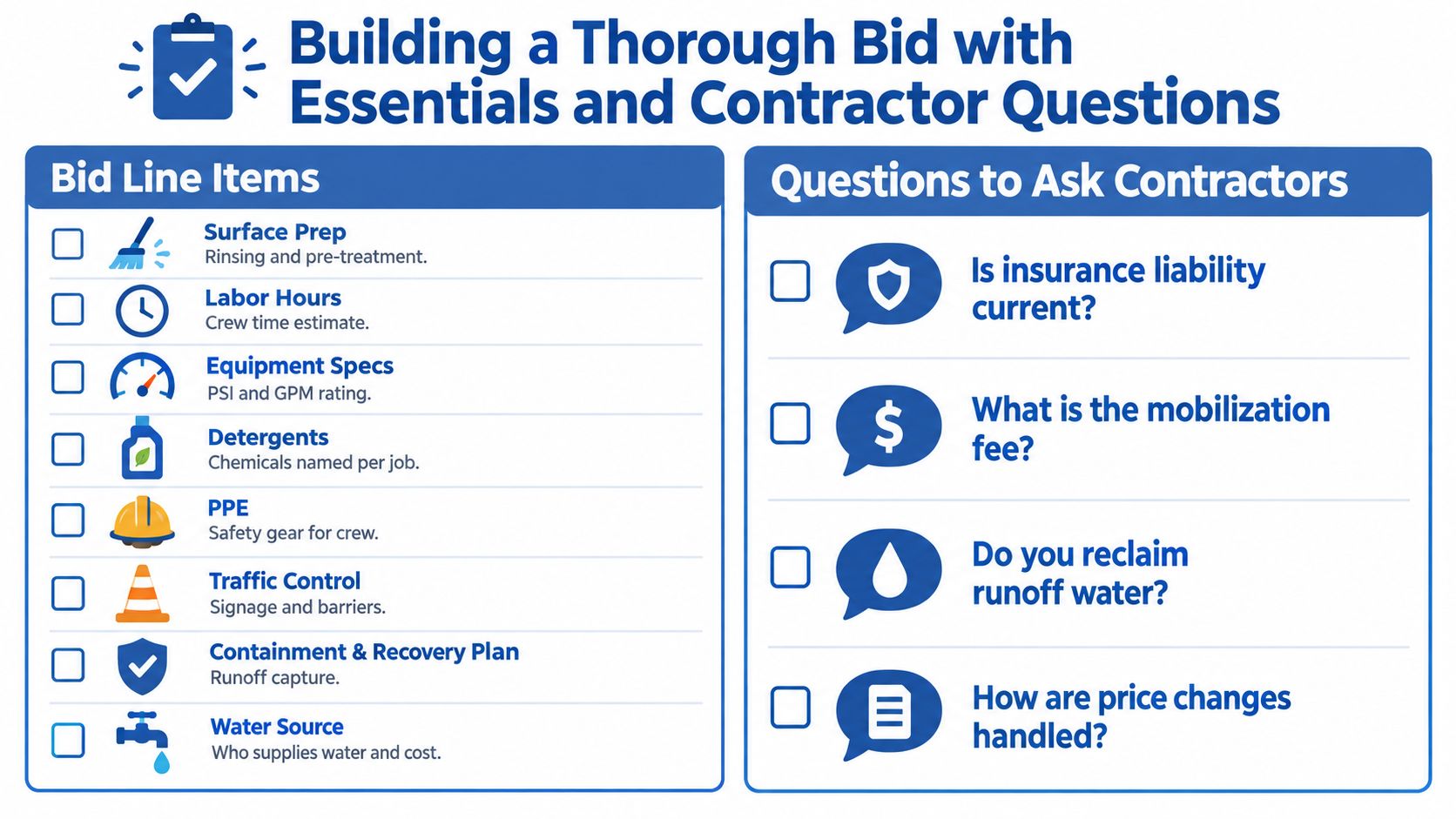
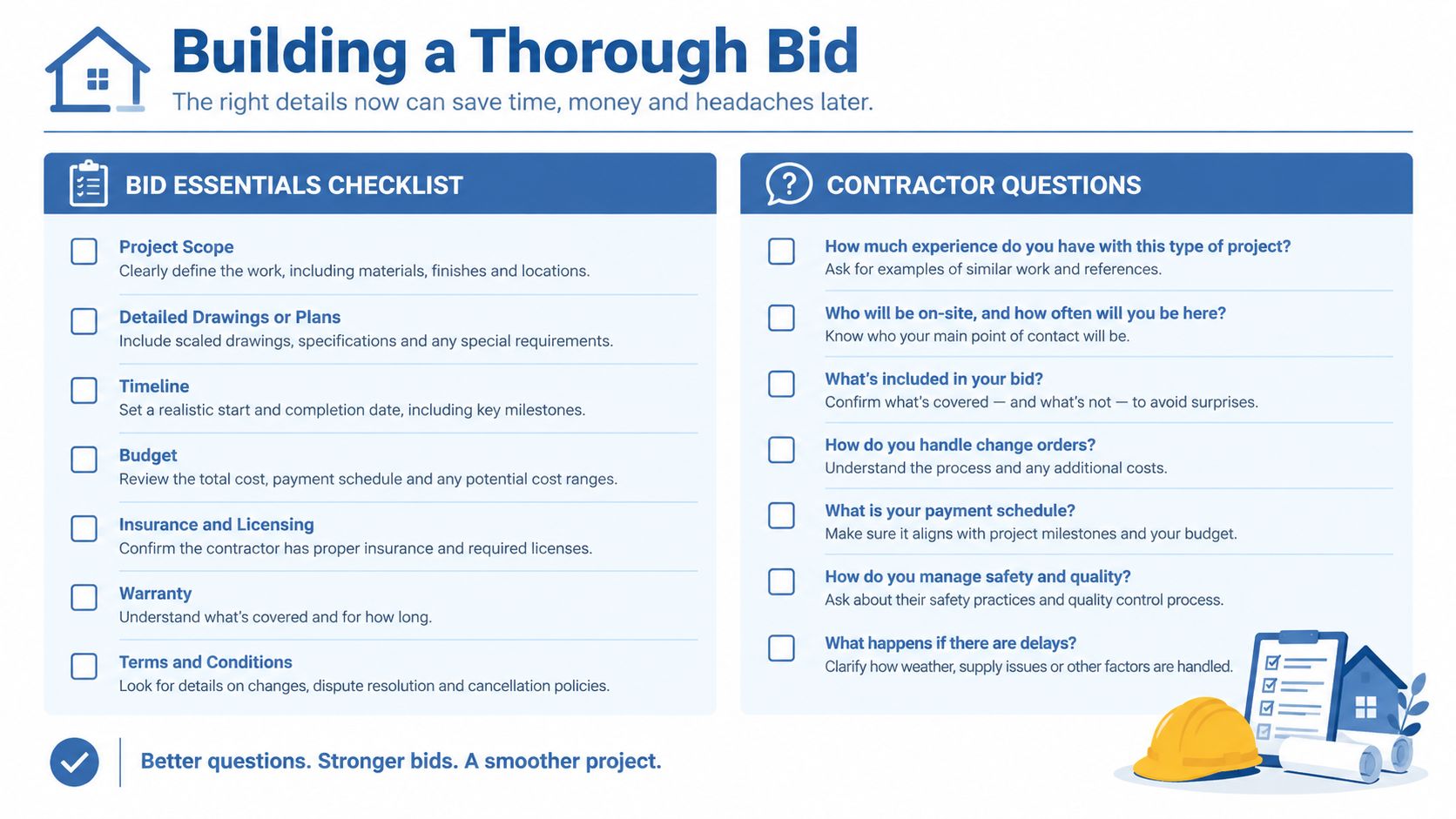
A thorough bid should let another manager understand the job without calling the estimator for translation. Start with the physical scope, then document the method, safety controls, water plan, and commercial terms.
Record the work itself
The proposal should identify each surface, its approximate area or frontage, condition, access route, and expected result. “Exterior cleaning” isn't enough. Write “front walkway,” “drive-thru lanes,” “dumpster pad,” “stucco façade,” or “parking-garage entrance,” then list exclusions such as gum removal, rust treatment, paint removal, or high-access work if they aren't included.
Include the following line items:
- Surface preparation: Sweeping, pre-rinsing, degreasing, spot treatment, and dwell time.
- Labor assumptions: Crew size, estimated hours, arrival window, setup, breakdown, and cleanup.
- Equipment specifications: Pressure level, flow rate, surface-cleaner use, hot or cold water, ladders, lifts, or recovery tools.
- Detergents and chemicals: Product purpose, application method, dosage assumptions, and whether neutralization or rinsing is included.
- PPE and safety: Protective clothing, eye and hearing protection, exclusion zones, occupied-site safeguards, and chemical safety procedures.
- Traffic control: Cones, barriers, signage, pedestrian rerouting, and coordination with deliveries or business hours.
- Containment and recovery: Drain covers, berms, vacuum recovery, filtration, storage, transport, treatment, or disposal.
- Water source: Whether the customer supplies water, whether the crew brings water, and how access limitations affect production.
- Insurance and liability: Current general liability coverage, workers' compensation where applicable, bonding terms, and responsibility for property damage.
- Final cleanup: Residual water, displaced debris, plant rinsing, furniture replacement, and customer inspection.
- Margin and change orders: The price basis, included contingencies, overtime rules, and written approval requirements.
Safety isn't decoration on a commercial proposal. The Cleaning Equipment Trade Association identifies pressurized water, chemicals, high noise, and environmental exposure as hazards, while CDC guidance warns that pressure-washer sprays can cause serious wounds (CETA safety guidance). A credible quote should show how the contractor controls those risks.
Ask questions that expose assumptions
Before approving a bid, ask:
- What water-use permits or runoff controls are included?
- Which chemicals and dosage rates will you apply?
- How many crew members and hours are assumed?
- What equipment type, pressure, and flow rate will you use?
- What insurance and bonding limits do you carry?
- Who supplies water, and what happens if the source is unavailable?
- How will you protect entrances, landscaping, vehicles, tenants, and pedestrians?
- What conditions trigger a price change, and will you obtain written approval first?
- Where will recovered wastewater go?
- What cleanup and final inspection are included?
High-rise work requires even more documentation. OSHA's powered-platform standard, 29 CFR 1910.66, covers permanently installed platforms used for exterior building maintenance, including window cleaning. Workers on those platforms must use compliant fall-arrest systems, and employers must provide competent-person training covering hazard recognition, safe operating procedures, maintenance, and inspections (OSHA powered-platform requirements).
For a deeper look at the pricing side of this process, use how to price pressure washing as a reference point. The strongest bid is the one that makes responsibilities visible before work starts.
Tips for Comparing Quotes and Avoiding Hidden Fees
The lowest number on the first page isn't necessarily the lowest project cost. Compare what each contractor has promised to do, what each price excludes, and what could cause the invoice to change.
Create a side-by-side scope sheet with these columns:
- Cleaning area: Record surfaces, measurements, frontage, and access zones.
- Method: Note pressure washing, soft washing, hot water, detergents, pretreatment, and rinsing.
- Water plan: Identify the source, expected allowance, efficiency method, and customer responsibility.
- Wastewater plan: Record containment, recovery, filtration, discharge, transport, or disposal.
- Site protection: Check traffic control, pedestrian protection, landscaping safeguards, and occupied-building procedures.
- Commercial terms: Confirm mobilization, fuel or travel charges, overtime, cancellation, weather delays, change orders, and payment timing.
- Closeout: Verify debris removal, final rinsing, inspection, photos, and correction procedures.
Phoenix makes water and runoff especially important. The city's drought-preparation materials describe different potential restrictions for commercial and industrial water use depending on how water is used, along with possible restrictions on outdoor water use and enforcement against water waste (Phoenix drought-preparation guidance). The city's 2025 drought statement reported Tier 1 Colorado River shortage conditions through 2026, so water-efficiency measures and runoff controls are meaningful bid differentiators, not decorative environmental language.
A slightly higher quote can be the safer purchase when it includes low-flow equipment, controlled chemical application, containment, recovery, and documented disposal.
Ask whether the price changes for heavier soil, unavailable water, blocked drains, night work, tenant delays, or additional access equipment. Also ask whether the contractor handles local approvals or expects the property manager to know the rules.
A useful quote doesn't hide complexity behind a flat number. It converts complexity into clear assumptions, which makes the invoice easier to approve and the service easier to manage.
Conclusion and Next Steps with South Mountain Window Cleaning
Power washing quotes become easier to judge when you separate labor, equipment, access, surface condition, water use, safety, and wastewater handling. Compare matching scopes, ask direct questions, and require written change-order terms before approving work.
South Mountain Window Cleaning serves Phoenix-area homes, businesses, and high-rise properties with exterior cleaning services and free, transparent quotes. The licensed, bonded, and insured team accounts for Arizona dust, drought concerns, occupied sites, and safety requirements while providing services across Phoenix, Scottsdale, Paradise Valley, Chandler, Tempe, and Gilbert.
South Mountain Window Cleaning, LLC offers residential and commercial power washing for drive-thrus, walkways, dumpster pads, building exteriors, and related exterior surfaces, along with window cleaning and high-rise service. Visit South Mountain Window Cleaning, LLC to request a free quote and discuss a clear scope for your Phoenix property.