
Most Phoenix house washes land between roughly $150 and $600 for a typical single-family home, with two-story properties often costing $400–$1,000. Square-foot averages alone are misleading because height, stucco condition, dust loading, access, water controls, and the cleaning method can change the labor far more than the home's footprint suggests.
You may be looking at a dusty stucco exterior after a windy week, dark streaks beneath the eaves, or a patio that has picked up a film of desert grit. The first quote sounds reasonable, the second seems expensive, and the third leaves you wondering whether every contractor is measuring a different house.
For Phoenix homeowners, house washing prices make sense only when you compare the work behind the number. A professional quote should tell you what surfaces will be cleaned, which method will be used, how the crew will protect landscaping, and whether water-use or access limitations affect the scope.
What a Phoenix House Wash Actually Costs in 2026
A homeowner in Ahwatukee might request three estimates for the same single-story stucco home and receive three very different totals. One company may price a quick rinse, another may include detergent and detailed plant protection, and a third may add difficult roofline access, heavy staining treatment, or extra preparation. Those bids aren't necessarily measuring the same service.
A useful national reference places the average professional pressure-washing project at approximately $311, with most jobs between $213 and $448. House-specific estimates vary considerably by height, from approximately $150–$750 for a one-story home, $400–$1,400 for a two-story home, and $700–$1,800 for a three-story home. A typical minimum service charge is about $100, which reflects travel, setup, equipment mobilization, preparation, and teardown. National pressure-washing cost benchmarks show why a single per-house price rarely tells the complete story.
Why square footage isn't enough
A 1,200-square-foot bungalow and a 4,000-square-foot two-story home can have very different cleanable surfaces. Stucco walls, soffits, fascia, trim, parapet walls, courtyard recesses, tile-roof edges, and narrow side yards all affect production time. A calculator that considers only living area misses the places where technicians spend time setting ladders, managing hoses, applying solution, rinsing, and protecting finishes.
Phoenix also has a fragmented service market. Industry data summarized by IBISWorld's pressure-washing services overview reports approximately $1.2 billion in U.S. industry revenue in 2024, 32,193 businesses, and no single company holding more than 5% of the market. That decentralization helps explain why homeowners can receive widely different quotes for similar properties.
Practical rule: Compare the written scope before comparing the total. A lower number may simply exclude detergent, difficult access, plant protection, or a second treatment.
The price bands in this guide are planning references, not promises. Local labor, water access, restrictions, soil buildup, surface material, and technician skill can move a quote above or below a broad benchmark. For a more detailed look at scope and estimating, review this pressure-washing cost guide.
The Five Inputs That Drive Every Quote
A useful estimate starts with production variables. Think of the quote as a recipe. The home's size provides the base ingredients, while the surface, access, buildup, and requested extras determine how much time and solution the job needs.
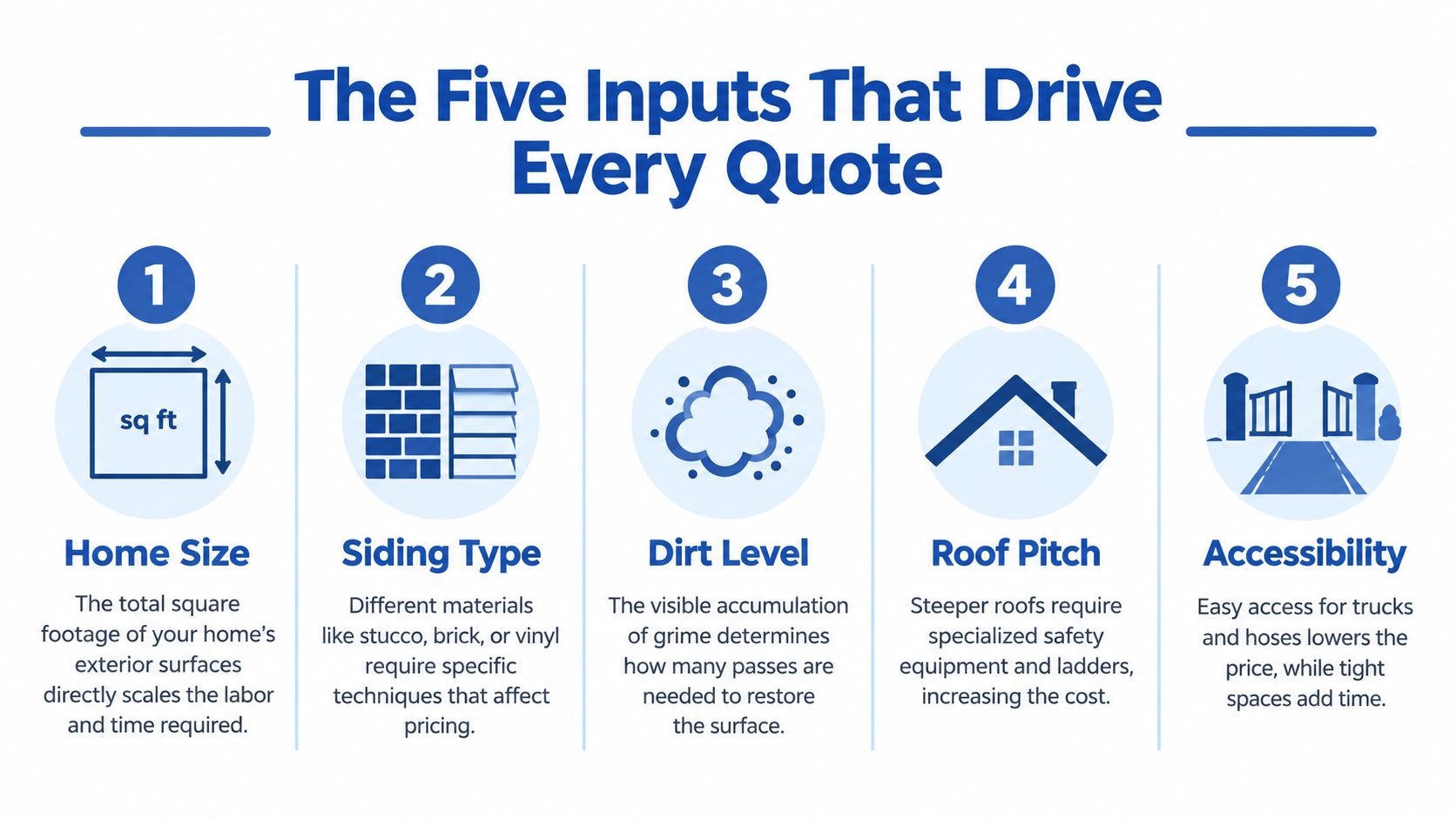
1. Exterior surface area
Living-area square footage is only a starting point. A technician looks at the cleanable exterior, including stucco walls, soffits, fascia, trim, porch columns, entry areas, and other exposed surfaces. A home with a compact footprint can still require substantial work if it has multiple wall planes, enclosed courtyards, or detailed trim.
Published U.S. exterior-cleaning benchmarks commonly place professional work around $0.10–$0.50 per square foot, with common project totals of $213–$449. HomeAdvisor's exterior-surface pricing information also reports a Phoenix-area benchmark of approximately $120–$270, although that figure changes with surface area, access, stories, staining, and the selected method.
2. Siding and substrate
Stucco, painted wood, EIFS, brick, vinyl, and fiber-cement siding don't respond to water pressure in the same way. Painted stucco can show damage if a technician uses excessive pressure, while brick may hold moisture and organic buildup in its texture. Hardie board and painted wood require controlled application around seams, coatings, and vulnerable edges.
3. Height and access
A single-story wall with an open driveway is straightforward. A two- or three-story wall behind landscaping, a gate, or a narrow side yard takes more hose management and setup. Ladders, extension poles, independent access equipment, or a lift can change the labor plan.
4. Soil and staining
Light dust is different from black algae streaks, rust bleed caused by irrigation, or mud lines left after a monsoon storm. Chemical dwell time, spot treatment, rinsing, and sometimes more than one pass may be necessary.
5. Add-on services
Gutters, screen enclosures, solar-panel rinses, driveway flatwork, patios, and flat-surface cleaning should appear as separate line items. Bundling can be practical because the crew is already mobilized, but the homeowner should still know what each addition costs.
For contractors, direct labor, chemicals, fuel, equipment reserve, insurance, travel, and administrative overhead all belong in the production model. One industry cost analysis places entry-level technician wages around $16–$22 per hour, experienced soft-wash technicians around $20–$28 per hour, per-job chemical costs around $11–$16, commercial equipment around $5,000–$15,000, and replacement reserves around $3–$8 per operating hour. This pressure-washing industry cost analysis shows why a professional quote can't be built from square footage alone.
A homeowner can use the same five inputs to test whether two proposals are genuinely comparable. A practical pressure-washing pricing resource can help clarify the estimating logic, but the property itself remains the final source of truth.
Typical Price Bands by Home Size and Stories
Phoenix price bands are most useful when you treat them as planning ranges rather than guaranteed totals. A small, lightly soiled home with clear access can fall near the lower end, while a taller property with staining, landscaping constraints, and several exterior surfaces can move quickly toward the upper end.
The table below combines practical Phoenix planning bands with national benchmarks. The national reference reports one-story work around $150–$750, two-story work around $400–$1,400, and three-story work around $700–$1,800. The national cost compilation provides the broader context, while HomeAdvisor's Phoenix benchmark places a typical Phoenix range around $120–$270 for certain exterior-washing projects.
| Home Profile | Typical Sq Ft | Low-End Price | High-End Price |
|---|---|---|---|
| One-story stucco home with easy access | Under 1,800 | $150 | $300 |
| Larger one-story home | 1,800–2,500 | $200 | $400 |
| Two-story home with standard access | Under 3,000 | $300 | $600 |
| Large two-story or three-story home | Over 3,000 | $450 | $1,000 |
These bands assume a standard house-washing scope and appropriate low-pressure methods. They don't automatically include extensive tile-roof cleaning, large driveways, solar-panel work, rust removal, screen care, or unusually difficult access.
Why outliers happen
A total can reach approximately $1,200–$2,000 when the job includes extensive tile-roof washing, heavy post-construction grime, complicated access, or several substantial add-ons. That isn't a normal price for a straightforward single-story maintenance wash. It signals that the scope needs to be read carefully.
A quote should separate the house wash from other work. Ask whether the price includes soffits, fascia, porch areas, exterior gutters, screens, and the rinse-down of nearby landscaping. If the answer is unclear, the total isn't ready for a fair comparison.
A low price can work when the surface is accessible, the buildup is light, and the scope is narrow. It stops being a bargain when the operator has to rush dwell time, skip protection, or use an unsuitable pressure setting to finish within an unrealistic allowance.
Soft Wash vs Pressure Wash and Why the Method Matters
Soft washing and pressure washing solve different cleaning problems. Soft washing uses low pressure and detergents to treat biological growth and bonded dust, then rinses the surface. Pressure washing uses higher force and is generally better suited to harder surfaces such as concrete and some masonry.
For Phoenix stucco, a low-pressure approach is often the safer starting point because excessive force can etch the finish, drive water behind vulnerable areas, or disturb paint and sealants. Painted wood, EIFS, vinyl, and tile roofs also require surface-specific control. Concrete driveways and flat hardscape can usually tolerate more pressure than a painted wall.
| Surface | Recommended Method | Typical PSI | Price Impact |
|---|---|---|---|
| Stucco siding | Low-pressure soft washing | Not fixed, surface-dependent | Detergent and dwell time can add cost |
| Painted wood | Low-pressure application and controlled rinse | Not fixed, surface-dependent | More protection and care may increase labor |
| Vinyl siding | Soft washing or gentle low-pressure cleaning | Not fixed, surface-dependent | Usually depends on buildup and access |
| Brick | Controlled soft wash or moderate pressure | Not fixed, surface-dependent | Mortar condition and moisture affect scope |
| Tile roof | Low-pressure roof-safe cleaning | Not fixed, surface-dependent | Roof access and safety add labor |
| Concrete driveway | Pressure washing | Not fixed, surface-dependent | Surface area and stains drive the total |
The exact pressure setting should be selected by the technician after inspecting the substrate. A quote that advertises one pressure level for every exterior surface isn't showing much technical judgment.
Soft washing can cost more because the crew must apply solution, allow dwell time, protect plants, rinse thoroughly, and sometimes neutralize or treat problem areas. A pressure-only quote may look cheaper, but it can create repair risk on stucco or painted finishes. Published service comparisons commonly place the difference between methods around $50–$200 per job, depending on siding area and treatment requirements. The HomeAdvisor exterior-washing benchmark offers broader pricing context for these variables.
Fence surfaces create a similar decision. Homeowners comparing pressure and low-pressure methods can use this practical resource on when to call a pro for fence before assuming the strongest spray is the best option.
A detailed explanation of the surface decision is available in this guide to pressure washing versus soft washing. The central rule is simple. Choose the method for the material, age, coating, and buildup, not for the lowest advertised number.
How Phoenix Dust and Sun Change the Equation
Phoenix exteriors collect more than ordinary household dirt. The City of Phoenix identifies PM10, particulate matter with diameters of 10 micrometers or less, as an air-quality concern. Those particles settle on glass, screens, sills, stucco, and trim, where irrigation minerals, humidity, shade, and organic residue can help the film cling. Phoenix's dust and air-quality information explains why exterior maintenance must account for local particulate conditions.
North-facing walls and shaded eaves often hold visible buildup longer than sun-exposed surfaces. After a storm, dust can collect in corners and around window frames, while moisture can leave mud lines or encourage biological staining. Strong sun then bakes that residue onto paint and stucco, making a chemistry-led treatment more useful than a fast blast.
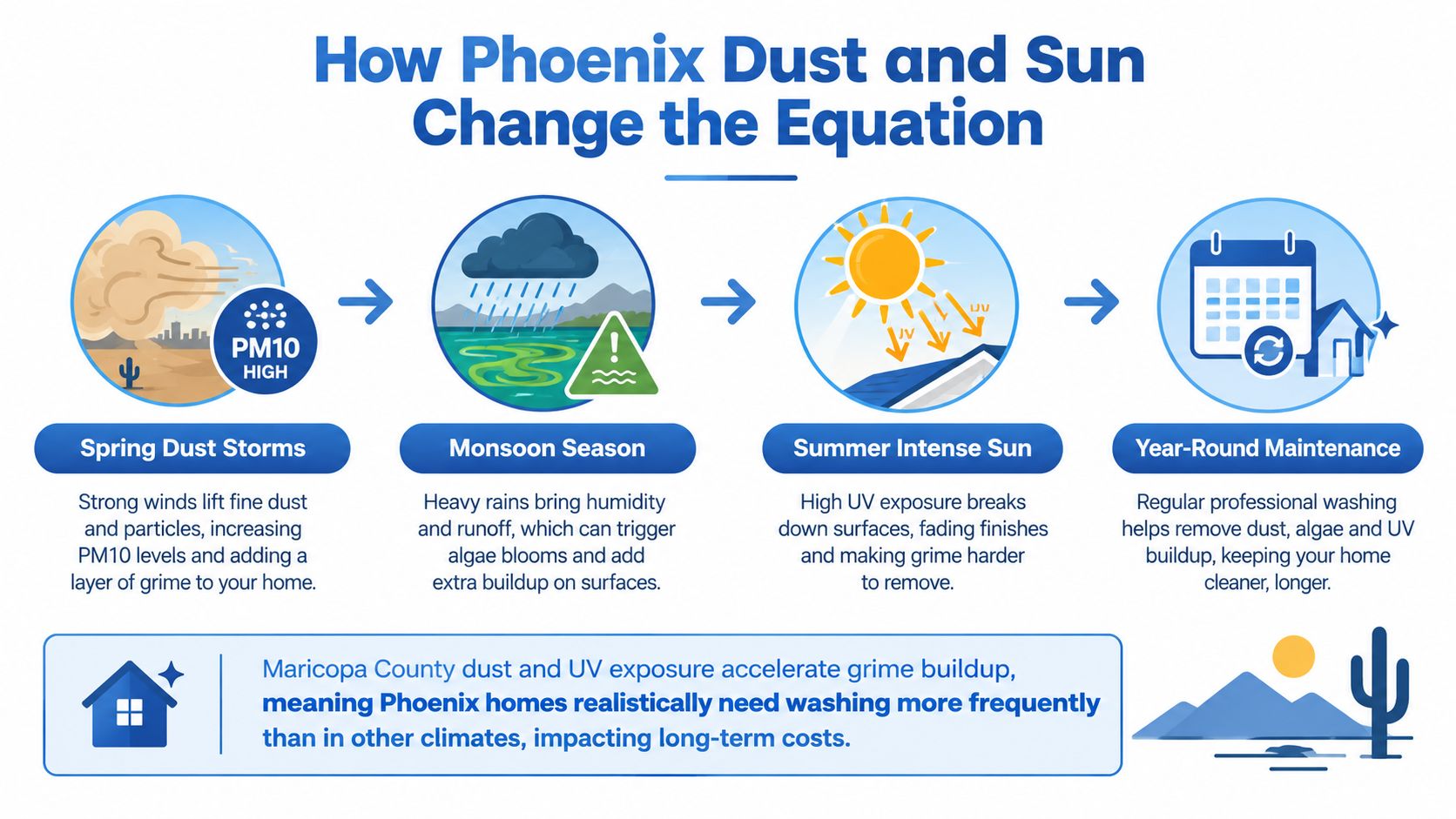
A practical maintenance schedule should respond to the property rather than follow a rigid calendar. Homes near construction, washes, busy roads, or heavy tree canopy may need more frequent attention than homes in open, low-dust settings. Look for the condition of north-facing stucco, eaves, entry columns, window frames, and lower walls when deciding whether the home needs service.
The cost question is also about compliance. Phoenix maintains year-round water-conservation rules, including restrictions concerning water waste and outdoor use during daytime hours. Guidance also indicates that routine pressure washing of driveways, sidewalks, and exterior walls may be restricted during heightened drought conditions, while dry cleaning, spot treatment, and low-pressure methods can reduce water demand. The Phoenix water-use and house-washing guidance explains why a quote should identify the method, water source, runoff controls, and any contingency for changing rules.
Watch this short visual explanation before booking a service:
A property-specific discussion of detergents and exterior treatments is available in this guide to the best house-washing solution. The lowest water-use or lowest-price method isn't automatically the best choice if it leaves staining behind or creates a runoff problem.
Reading a Quote Without Getting Burned
A written estimate should let you understand what will happen before a hose reaches the wall. If the proposal contains only a total and a vague phrase such as “exterior cleaning,” you can't tell whether two contractors are offering equivalent work.
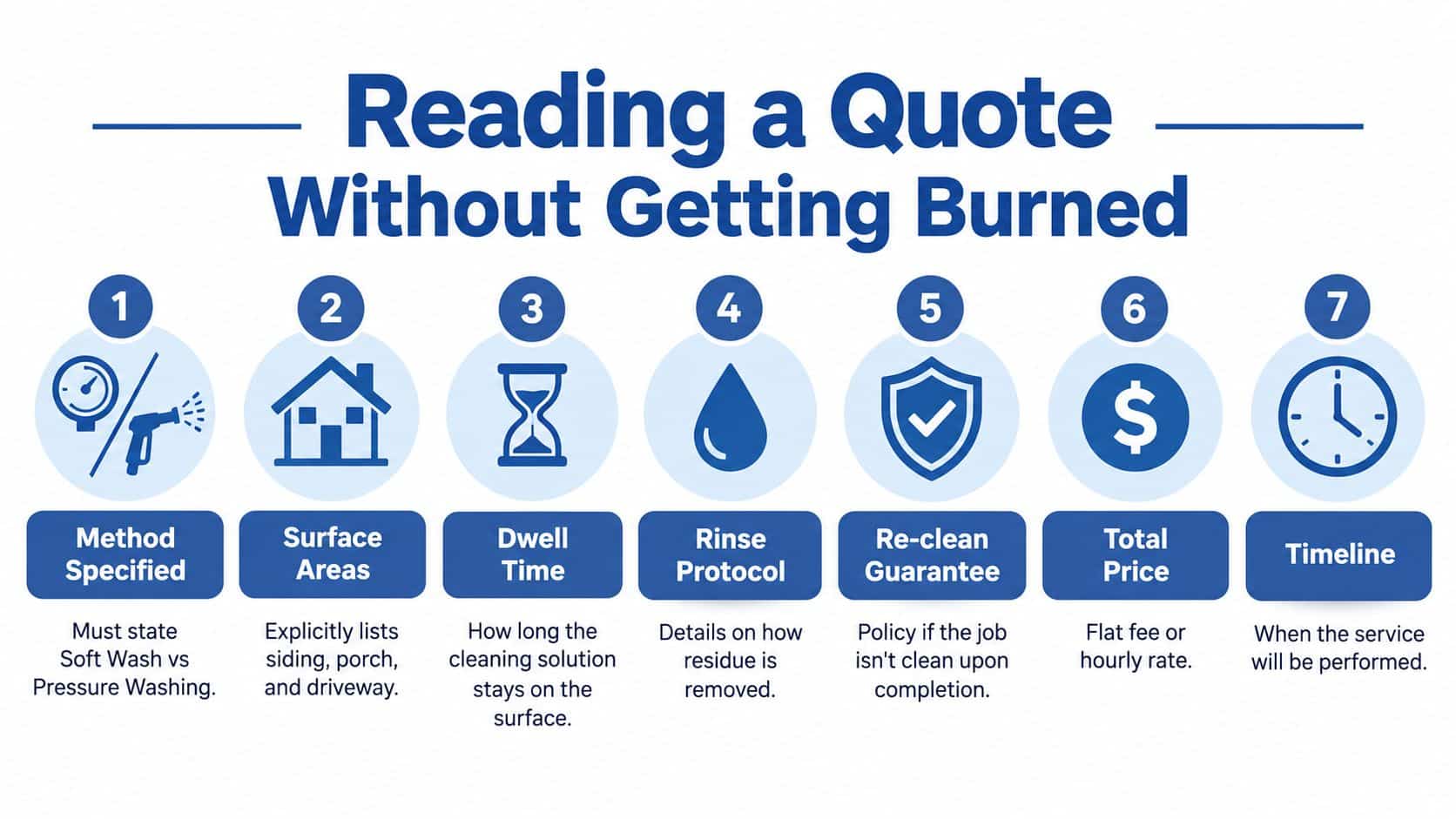
Use this checklist during the estimate call:
- Method: The quote should identify soft washing, pressure washing, or a surface-by-surface combination.
- Measured surfaces: Look for siding, soffits, fascia, porch areas, screens, gutters, and any driveway or flatwork included.
- Height and access: The proposal should note stories, parapets, roofline difficulty, gates, narrow side yards, and equipment needs.
- Material notes: Stucco, painted wood, EIFS, brick, vinyl, and tile shouldn't be treated as interchangeable.
- Treatment scope: Ask whether the price includes detergent, dwell time, rust treatment, algae treatment, spot work, and a final rinse.
- Water and protection: Verify the water source, runoff controls, plant protection, and whether the method is compatible with local conservation rules.
- Completion terms: Request before-and-after documentation and a written satisfaction or re-clean policy.
Red flags that deserve a second call
A verbal-only quote leaves too much room for disagreement. So does an unusually low square-foot price that doesn't identify the surfaces being measured. Be cautious if the estimate says “pressure wash” for a stucco home without discussing pressure control, or if it excludes the rinse-down of landscaping.
Insurance should be documented rather than assumed. You should also ask whether water-spotted windows, screens, solar panels, gutters, and pet-sensitive or drought-conscious cleaning requirements are included or priced separately.
Compare scope, not slogans: Put two bids side by side and normalize the method, measured areas, treatments, access assumptions, protection steps, and completion policy. The lowest number often removes a line item rather than reducing the real cost of equivalent work.
If one contractor includes a full soft wash and another includes only a pressure rinse, the totals aren't competing on equal terms. Ask each provider to revise the estimate using the same list of surfaces and add-ons. That small step often reveals why the numbers diverge.
Why Licensed and Insured Providers Are Worth the Price
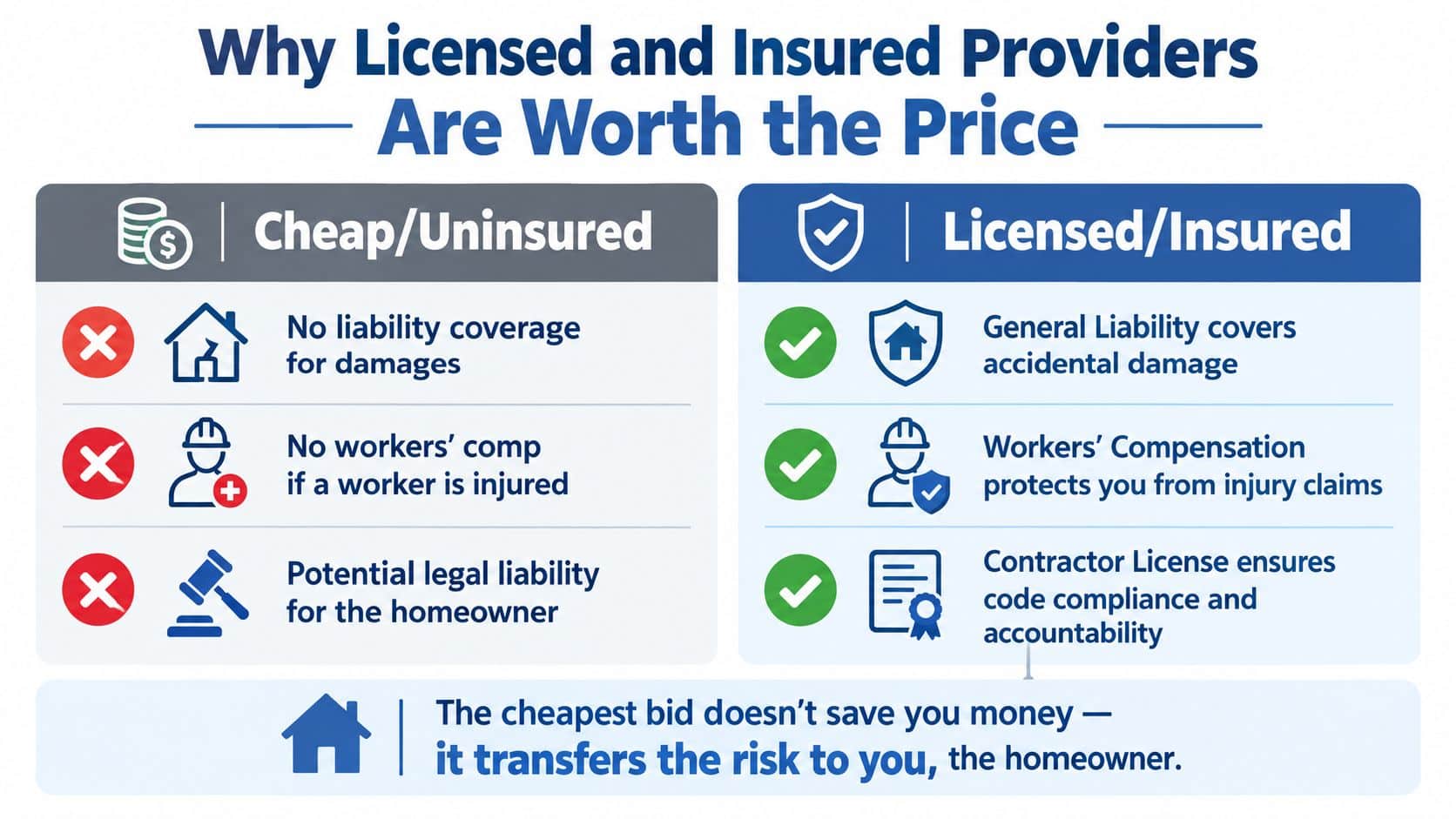
Insurance is part of the service, not an invisible administrative detail. Exterior cleaning takes place around glass, painted surfaces, landscaping, electrical fixtures, ladders, hoses, and sometimes access. A mistake can involve property damage, worker injury, or both.
General liability insurance is designed to address accidental damage claims, such as damage to a window, fixture, finish, or customer property, subject to the policy terms. Workers' compensation addresses covered workplace injuries involving employees. A contractor's license, where required, supports accountability and compliance with applicable rules, but homeowners should still verify the actual license and insurance documentation rather than relying on a logo or verbal assurance.
What the risk looks like at home
A ladder can slip against a window. A hose can damage a plant bed or create a trip hazard. A technician can become injured while working on the property. If the operator has no appropriate coverage, the homeowner may face a dispute over repair costs or injury responsibility.
Payment and contract problems can create another layer of exposure. Homeowners should ask who is performing the work, whether subcontractors are involved, and whether the company carries the coverage it claims to carry. A professional estimate should make those answers easy to obtain.
Training and safety controls also show up in the price. A crew that understands stucco, chemical handling, roof access, ladder placement, runoff management, and window protection is carrying a different operating cost than someone who arrives with a consumer machine and chooses maximum pressure.
For commercial and condominium properties, the documentation standard becomes even more important. High-rise window work requires building-owner confirmation, anchor inspections, worker training, equipment checks, independent rigging, and a rescue plan. OSHA's rope-descent framework requires rooftop anchorages to be identified, inspected, tested, certified, and maintained, with each anchorage supporting at least 5,000 pounds in any direction for every attached worker. Rope-descent systems are generally limited to buildings no more than 300 feet above grade, unless the employer demonstrates that another access method isn't feasible or would create a greater hazard. This high-rise window-cleaning safety explanation summarizes the controls property managers should confirm.
A small price difference is easy to see. The risk transferred by missing insurance, training, and documentation is much harder to see until something goes wrong.
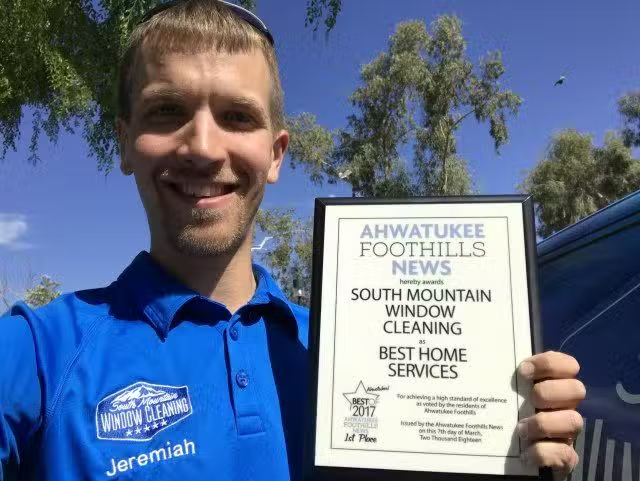
South Mountain Window Cleaning, LLC is one local example of a provider whose published service information describes licensed, bonded, and insured operations, safety-trained technicians, commercial scheduling, and a $2 million insurance policy. EPA high-performance-building guidance also connects scheduled cleaning and maintenance with building comfort, daylighting, and ongoing energy performance, which matters to property managers beyond curb appeal.
Smart Next Steps and Common Questions
Start with a short property inventory before requesting estimates. Note the number of stories, siding material, visible algae or rust, narrow access points, nearby landscaping, and any extras such as screens, gutters, solar panels, patios, or driveways.
Then request two or three written estimates. Ask each provider to itemize the cleaning method, surfaces, water source, runoff approach, add-ons, access assumptions, and completion policy. A quote that answers those questions gives you a stronger basis for comparison than a fast total over the phone.
How long does a house wash take?
The duration depends on surface area, stories, access, buildup, preparation, dwell time, and rinsing. A small maintenance wash with open access can move efficiently, while a taller home with heavy staining, landscaping, and multiple treatments requires more onsite work. Ask the contractor what could extend the appointment before scheduling.
How often should a Phoenix home be washed?
Use the exterior condition as the guide. Dust exposure, PM10 accumulation, shaded walls, nearby construction, tree canopy, irrigation overspray, and monsoon residue can all shorten the useful interval between cleanings. A recurring maintenance plan may also make sense when consistent appearance matters, because setup and travel are repeated costs on one-off visits.
Can I stay home during the work?
Usually, homeowners can remain at home if windows and doors are closed, pets are kept safely inside, and the crew can access the required water and exterior areas. Confirm where hoses will run, which gates must be opened, whether alarms or outdoor electrical equipment need attention, and how the crew will communicate when the work is complete.
The most useful number is the one attached to a clear scope. Before approving a quote, confirm the surface area, substrate, stories, soiling, access, method, water controls, protection steps, add-ons, insurance, and re-clean policy. That process won't guarantee the lowest total, but it gives you a much better chance of buying the service you actually need.
South Mountain Window Cleaning, LLC offers residential and commercial house washing, window cleaning, screen and track care, solar-panel cleaning, gutter cleaning, and exterior surface cleaning across Phoenix, Scottsdale, Paradise Valley, Chandler, Tempe, and Gilbert. Request a detailed, no-obligation estimate by visiting South Mountain Window Cleaning, LLC, and compare the written scope before you book.