
You're standing in a Phoenix driveway with a customer asking why one pressure-washing quote is a couple hundred dollars and another is much higher. The concrete looks straightforward, but the dust is packed into the pores, irrigation has left hard-water marks, and the afternoon heat is drying chemicals before they can work. If you price by instinct, you can win the job and still lose money.
The practical answer to how to price pressure washing is to price the production required, not just the surface area or the pressure rating on your machine. A defensible quote accounts for square footage, material, condition, access, water and chemical use, travel, overhead, and the time needed to deliver a safe result. That approach works for a Chandler driveway, a Scottsdale home wash, and a recurring commercial route.
Why Pressure Washing Pricing Feels So Inconsistent
A Phoenix homeowner may see one driveway advertised at a low price, then receive a much higher quote after a site visit. Both figures can be reasonable. Pressure washing has no universal flat rate because a clean concrete walkway, oxidized siding, stained pavers, and a delicate roof require different methods, safety controls, and production time.
An industry pricing guide places typical pressure-washing jobs at $150 to $500, with many residential cleanings around $250 to $400. It also reports residential flatwork at about $0.15 to $0.75 per square foot and commercial flatwork at approximately $0.08 to $0.40 per square foot. The range reflects surface type, total area, condition, access, and the amount of preparation required. Customers often combine exterior services for broader property-maintenance results, including the services described in the benefits of power washing.
Why Phoenix jobs take longer than they look
Arizona conditions create production problems that measurements alone cannot show. Fine desert dust settles on sills, stucco, concrete, and storefront glass. Irrigation can leave hard-water minerals that resist a quick rinse. Direct sun also reduces the working time of detergents and pre-treatments, which may require smaller work sections, extra applications, or more controlled rinsing.
Those conditions change the quote even when two surfaces have identical dimensions. A lightly dusty driveway with open hose access takes less labor than a heavily stained driveway surrounded by landscaping and narrow gates. The second property requires more setup, repositioning, chemical control, and cleanup. Heat can also make the crew work in shorter sections to prevent products from drying on the surface.
Published guides show the same pattern across services. Driveway cleaning commonly falls around $100 to $300, house washing around $250 to $800, and full exterior packages around $500 to $1,500 or more, according to Housecall Pro's pressure-washing pricing guide. These ranges support using both hourly and area-based methods, depending on how predictable the production is.
Practical rule: A profitable quote pays for setup, production, cleanup, travel, and business costs. Square footage is only one input.
South Mountain Window Cleaning uses a systematic approach for residential, commercial, and high-rise exterior cleaning across Phoenix, Scottsdale, Paradise Valley, Chandler, Tempe, and Gilbert. Its window work also demonstrates why surface-specific pricing matters. Glass, screens, tracks, stucco, concrete, and roof surfaces should not be forced into one formula.
Choosing the Right Pricing Model for Each Job
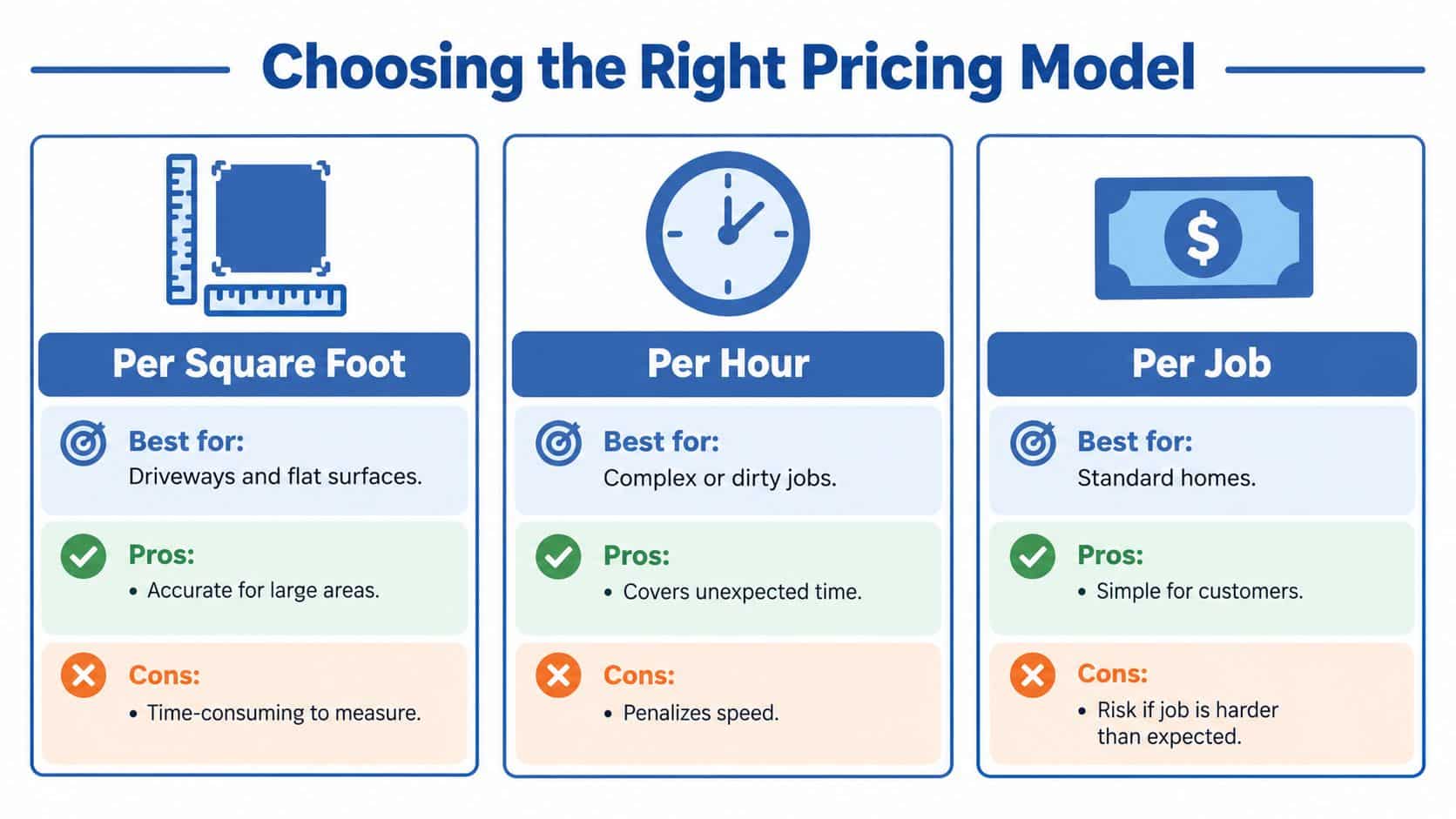
The right pricing model depends on how predictably the crew can measure and produce the work. Per-square-foot pricing is efficient for open flatwork. Hourly pricing protects the contractor when condition and access are uncertain. Flat-rate pricing makes a standard residential package easier for the customer to understand.
Per-square-foot pricing
Square-foot pricing works best when the surface is measurable and production is repeatable. Driveways, sidewalks, patios, parking areas, and commercial flatwork are natural candidates. The customer can see how the quote relates to the scope, while the contractor can adjust the rate for concrete, pavers, oil staining, or difficult access.
For 2026 benchmarks, concrete driveways are often cited around $0.12 to $0.35 per square foot, vinyl siding around $0.20 to $0.40, and roofs around $0.30 to $0.75 or more, according to FieldCamp's pressure-washing pricing guidance. The difference isn't arbitrary. Soft washing a roof or painted siding involves chemical control, dwell time, careful rinsing, and greater risk than cleaning an open concrete pad.
The weakness is measurement. A small property may require almost as much setup as a larger one, and an area rate can undercharge a difficult site. Use a minimum service fee when the square footage is small.
Per-hour pricing
Hourly pricing fits restoration work, heavy staining, cluttered commercial sites, and jobs where the final production time is hard to predict. It can cover unexpected labor, but customers may worry that a faster technician costs more if the quote is presented poorly.
Use hourly pricing with a defined scope. State the anticipated work, the hourly rate, the tasks included, and what conditions could extend the visit. This model is especially defensible when access, condition, or water management creates uncertainty.
Flat-rate pricing
Flat-rate quotes win on standard homes and clearly defined bundles. A house wash with driveway and walkway cleaning can be presented as one package, provided the contractor has inspected the surfaces and included reasonable allowances for height, condition, and access.
A small Chandler driveway may deserve a measured area quote. A full Scottsdale exterior package may be easier to sell as a flat rate because the customer wants one clear number for the whole result.
| Pricing Model | Best For | Watch Out For |
|---|---|---|
| Per square foot | Driveways, sidewalks, patios, and open flat surfaces | Small areas, heavy stains, and access obstacles |
| Per hour | Restoration, unpredictable buildup, and complex commercial work | Customer uncertainty if the scope isn't clearly defined |
| Per job | Standard homes and bundled exterior packages | Underestimating height, condition, or add-on labor |
A fourth option is a hybrid. Price predictable flatwork by area, price difficult restoration by time, and present the final scope as a flat customer-facing quote. That gives the operator control without making the customer manage the calculation.
What Every Profitable Price Must Include
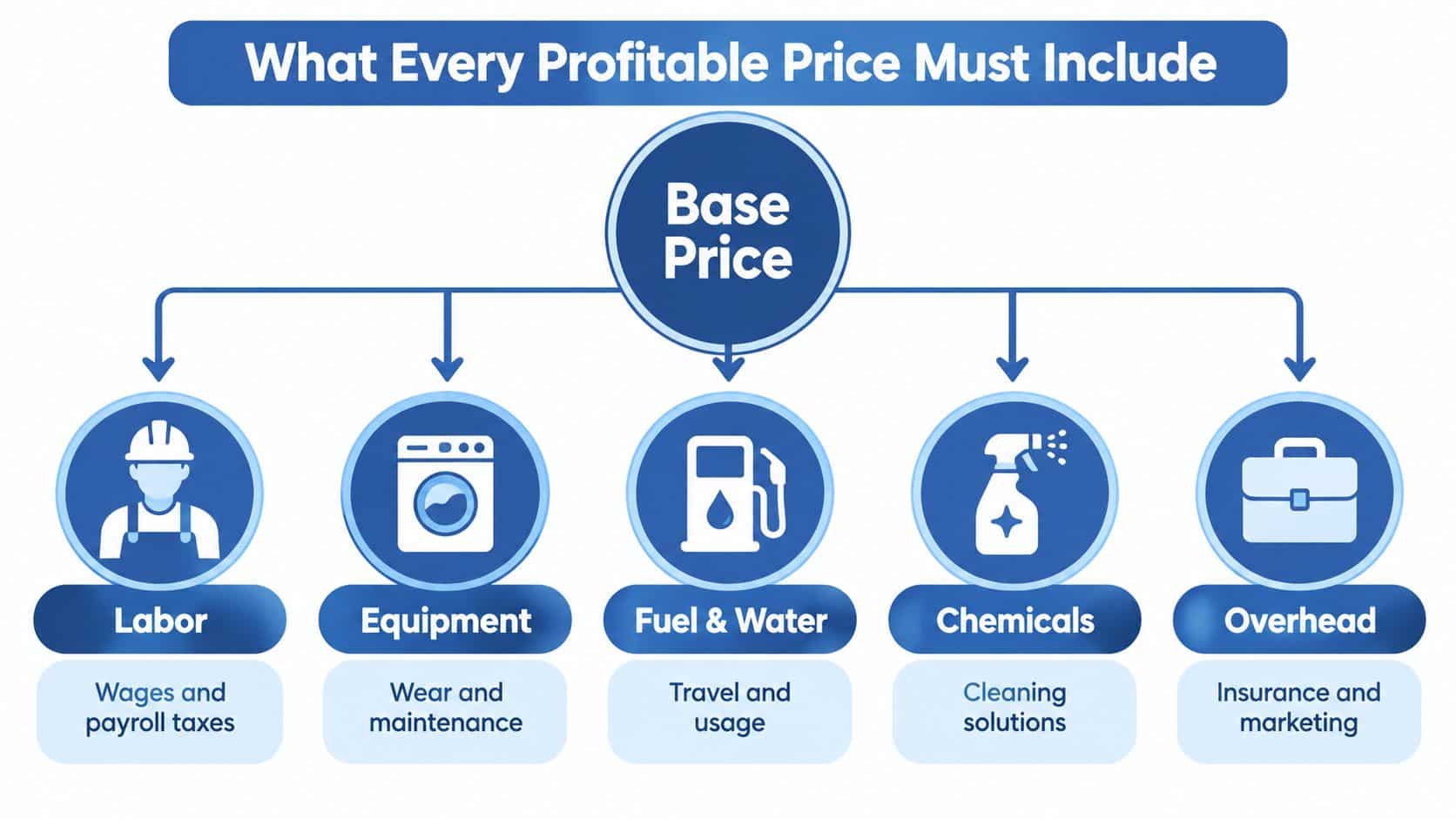
A Phoenix quote that covers only labor and fuel can still lose money. The operator may remain responsible for equipment repairs, insurance, scheduling gaps, marketing, and unpaid travel. Build the base price from actual production costs, then track the time each job required so future quotes reflect field conditions.
Labor includes the whole visit
Count loading, driving, setup, hose moves, plant protection, pretreatment, rinsing, inspection, packing, and job documentation. Waiting for access, controlling runoff, or working around occupied areas also uses paid production time. Phoenix dust and heat can slow setup and rinsing, while hard-water deposits may require extra treatment and inspection.
Owner-operators often overlook their own labor because no payroll check leaves the account. Assign that labor an internal cost. Include payroll taxes when employees perform the work, and review the estimate against actual hours after each visit.
Equipment and chemicals consume margin
Pressure washers, surface cleaners, hoses, reels, pumps, tanks, ladders, water-fed tools, and recovery equipment all wear out. Job costing should include maintenance, repairs, replacement parts, and depreciation. A machine that operates today still uses part of its useful life.
Chemicals and water belong in the same calculation. Degreasers, detergents, surfactants, rust removers, and soft-wash solutions vary by surface and condition. Operators planning equipment and consumables can review these commercial power washing supplies.
Travel and overhead affect small jobs
Phoenix service areas can spread appointments across the Valley. Account for vehicle use, fuel, loading, scheduling gaps, insurance, licensing, software, phones, uniforms, advertising, payment processing, and office administration. A small job far from the next appointment can consume a profitable portion of the day.
Set a minimum service charge for the mobilization, not just the measured cleaning area. Commercial work may also require certificates of insurance, site coordination, after-hours scheduling, and water or runoff controls. Those requirements belong in the quote when they apply.
For a practical explanation of separating direct job costs from operating overhead, use this job costing guide for founders. Record the result by job so recurring estimates improve instead of repeating the same guess.
Price for production time, not just square footage.
Add the desired profit margin after direct costs and overhead are covered. Pricing guidance discusses target margins of 20% to 40% or higher and warns that minimum fees protect routine work from becoming unprofitable, as outlined in MakeWash's 2026 pressure-washing rates guide. The right margin depends on the business model, market, risk, and available capacity. A quote without margin leaves little room for repairs, reinvestment, or slow days.
How to Build a Quote From Walkthrough to Final Number
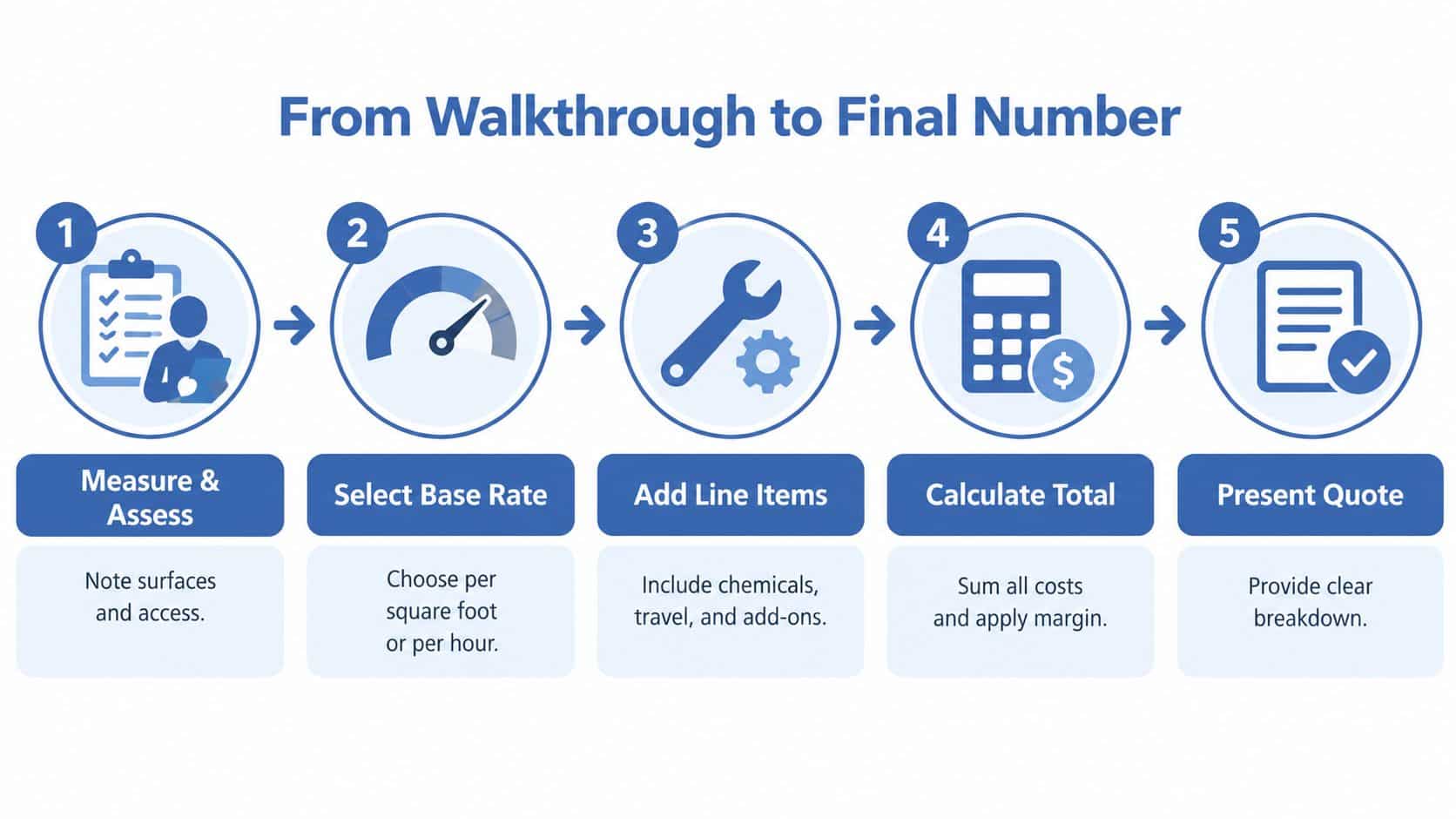
A Chandler driveway can look simple from the street and still lose money if irrigation deposits, oil, long hose runs, or heavy dust slow production. Build the quote from the walkthrough, not from a calculator alone. Identify each surface, choose the cleaning method, estimate crew time, and record conditions that can change the work. Photos help, but access and surface condition often require a site visit or a detailed customer walkthrough.
Step one, measure and assess
Record square footage for concrete, siding, roofs, patios, and walkways. Note the material, staining, oxidation, hard-water deposits, dust load, height, gates, landscaping, hose distance, water access, and drainage. Phoenix heat can dry detergent quickly, while windblown dust and mineral-heavy irrigation water may require extra treatment or rinsing.
Do not promise restoration when discoloration may be permanent. Separate standard cleaning from stain treatment, rust removal, oil treatment, oxidation removal, or other specialized work. The customer should see what the base service includes and what requires a separate line item.
Step two, select the base rate
Use per-square-foot pricing for measurable, repeatable flatwork. Hourly pricing fits uncertain restoration, difficult access, or commercial work where production time is hard to predict. Use a flat rate for a standard home or a bundle after the scope and expected labor are clear.
Published benchmarks can provide a starting point, but your own production records should control the final rate. Residential flatwork is commonly cited around $0.15 to $0.75 per square foot, while commercial flatwork is often around $0.08 to $0.40 per square foot. Use the lower end only when the site is efficient, accessible, and uncomplicated. For a broader explanation of cost drivers, see this cost of pressure washing guide.
Step three, add line items
List conditions that create extra labor, materials, or risk:
- Pre-treatment: Apply detergent or degreaser before surface cleaning.
- Stain treatment: Address oil, rust, oxidation, or mineral deposits separately.
- Access work: Account for gates, ladders, tight side yards, height, and hose movement.
- Protection and cleanup: Include plant protection, rinsing, runoff management, and final inspection.
- Minimum charge: Cover mobilization when the job is too small to support normal production.
Step four, calculate the total
For a Chandler driveway, measure the concrete, multiply it by the selected concrete rate, then add stain treatment if oil or irrigation deposits require it. Add travel and the minimum charge where applicable, then apply the margin required by the business.
For a Scottsdale house wash, separate stucco, trim, roof, windows, and hardscape rather than pricing the entire exterior as one pressure-washing surface. Published residential benchmarks place average home-washing prices around $241 to $418, while 4,000 to 5,000 square-foot homes can average $550 to $834. Those figures show how size affects a quote, but they are not automatic Phoenix prices. Height, dust, hard-water staining, and access still determine production time.
A Tempe commercial walkway can use area pricing when it is open and predictable. Gum, grease, pedestrian controls, after-hours access, or water-management requirements call for a hybrid or hourly structure. Current guidance places commercial flatwork around $0.05 to $0.20 per square foot and specialty surfaces around $0.30 to $0.75, with hourly models around $50 to $160, depending on market and complexity. Treat those figures as reference points, then compare them with your actual crew hours and completed area.
Step five, present the quote clearly
Customers do not need every internal cost, but they do need a precise scope. Identify the surfaces, cleaning method, included treatments, exclusions, access assumptions, scheduling conditions, and final price.
A reusable estimate template can include:
- Property address and service date.
- Surface measurements and materials.
- Base service and rate model.
- Treatment and access line items.
- Minimum charge, if applicable.
- Included cleanup and customer responsibilities.
- Final price and approval terms.
A clear estimate protects both sides. AurenWell's pressure washing service estimates can help organize the customer-facing document without hiding the scope behind one unexplained number. For customers comparing options, a written scope makes it easier to confirm whether competing quotes cover the same work.
Bundling Add Ons and Pricing Recurring Commercial Work
A Phoenix storefront may look like a quick add-on until the crew reaches the shaded side, finds hard-water spotting, and has to manage dusty access paths. Bundle services when they share mobilization, protection, water setup, and cleanup. Keep each service priced internally so a convenient package does not donate labor.
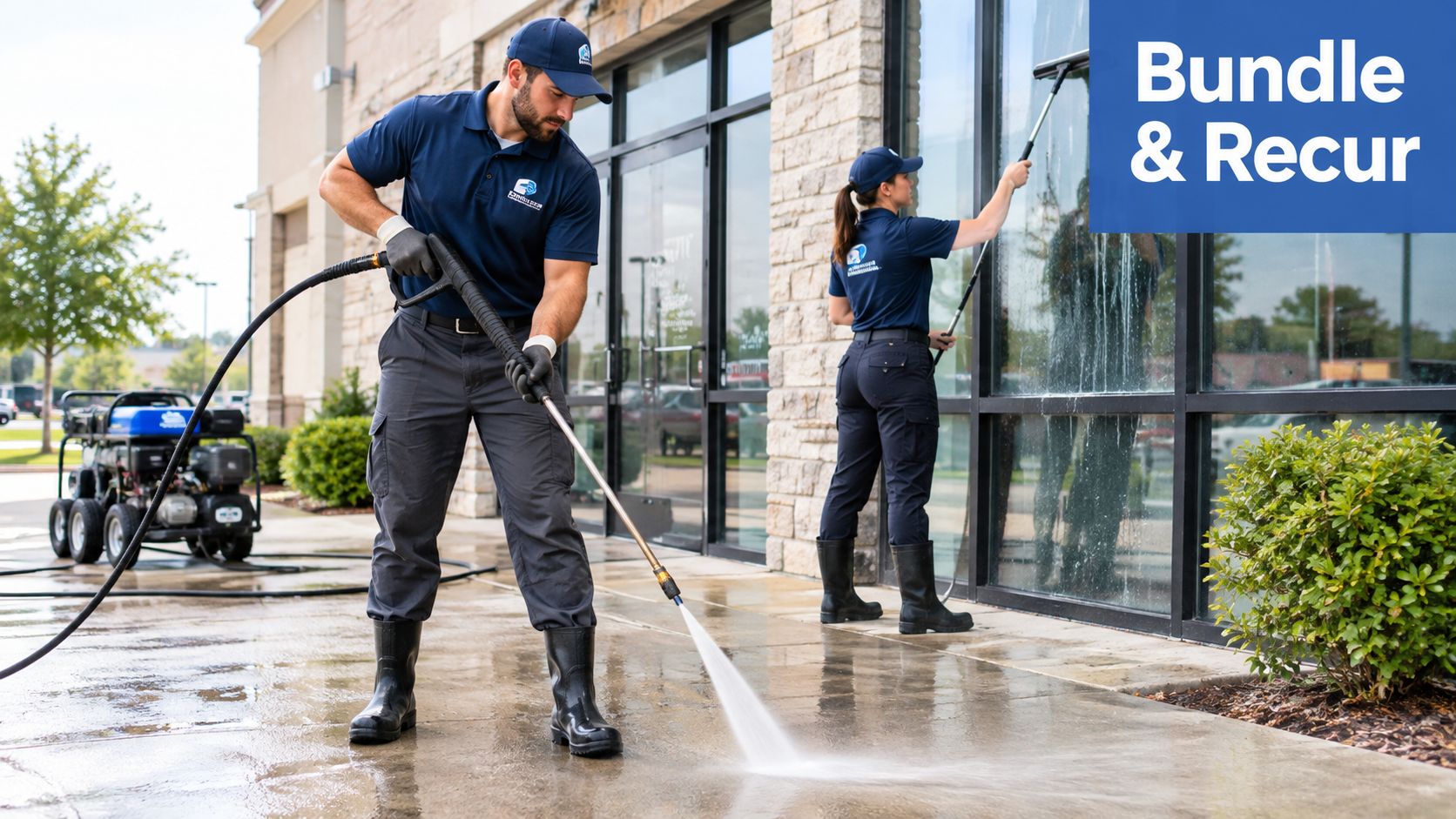
A Phoenix residential package can combine house washing, driveway and walkway cleaning, window cleaning, plus screen or track care. One coordinated visit reduces repeated travel and setup. It does not remove production time. Estimate every component, including chemical use, rinse time, ladder movement, hard-water treatment, and cleanup. Apply a package adjustment only after the combined price still covers labor, materials, overhead, and margin.
Recurring commercial work follows route economics. Storefronts, restaurants, HOAs, and property-management portfolios can provide dependable schedules, but frequency by itself does not support a steep discount. Build the rate around service frequency, route density, volume, access, and condition.
Build the recurring rate from route economics
A cluster of nearby storefronts can support a lower per-visit price than scattered properties across the Valley because travel and setup are shared. Dusty sites may need shorter, more frequent maintenance visits. A neglected property usually needs an initial cleanup or restoration price before it qualifies for maintenance pricing.
Use a structure such as:
- Initial service: Price the first visit for accumulated buildup, detailed setup, hard-water or mineral deposits, and corrective work.
- Maintenance visits: Set the recurring rate from expected production time and the condition you can reasonably maintain.
- Route adjustment: Lower the rate only when nearby appointments reduce drive time, setup, and equipment handling.
- Commercial minimum: Keep a minimum visit charge for small sites, even when the work repeats.
- Review clause: Recheck the scope if access, operating hours, surface condition, water availability, or frequency changes.
For outside benchmarks, review the commercial pressure washing cost guidance before presenting a recurring proposal. Compare any published range with your own route data, crew hours, fuel, insurance, chemical usage, and target margin. A low per-square-foot figure can still lose money if the crew spends half the visit controlling runoff, moving vehicles, or waiting for access.
Bundle related commercial services without hiding them. A property manager may prefer one vendor for glass, walkways, drive-thrus, dumpster pads, and exterior surfaces. The proposal should show each service, its frequency, access conditions, exclusions, and price allocation. That structure makes later scope changes easier to price and prevents a window-cleaning visit from absorbing unpriced pressure-washing work.
Schedule recurring work around the property's actual soil load. Phoenix dust, summer heat, and hard-water spotting can change both the cleaning method and the time required. A maintenance agreement should state what happens when buildup exceeds routine conditions, when water access is unavailable, or when heat delays the crew. The discount belongs to predictable production, not to every condition the site may present.
High-rise work adds a separate access and safety calculation. OSHA limits rope descent systems to 300 feet above grade, with use above that height allowed only when the employer demonstrates that no other access method is feasible or would create a greater hazard, according to OSHA's final rule. Building anchorages for rope-descent window cleaning must be designated separately for worker safety lines and capable of supporting 5,000 pounds per attached worker, as described in OSHA's interpretation on building anchorages. Include those requirements in the scope and risk assessment instead of burying them inside a generic cleaning rate.
Common Pricing Mistakes and How to Avoid Them
A low quote often reflects missing production time, not better efficiency. If travel, setup, chemical use, insurance, water, or cleanup stays off the worksheet, a Phoenix job can consume the day while appearing profitable on paper.
Mistakes that cut into the final margin
- Ignoring surface condition: Oxidation, oil, rust, mineral deposits, and restoration work can change the method and labor. Ask when the property was last cleaned, then inspect the worst area before quoting.
- Using one rate for every surface: Concrete, stucco, siding, roofs, glass, and pavers differ in risk, dwell time, rinsing requirements, and production speed. Price the material and method you will use.
- Skipping travel and setup: A small property may require a long drive, water connection, hose runs, equipment staging, and cleanup. Review the full door-to-door schedule, not only active spraying time.
- Copying the lowest advertised rate: Public ranges rarely show the same scope. Compare access, treatments, insurance, surface condition, and cleanup before changing your number.
- Forgetting minimum fees: Every visit carries mobilization and administrative time. Set a minimum that pays for the service block, even when the cleaned area is small.
- Using high pressure on delicate surfaces: Painted siding, roofing, and fragile substrates may need soft washing, controlled chemical use, and slower rinsing. Confirm the method before promising a price.
- Underestimating commercial liability: Property managers may require certificates, site coordination, restricted access windows, safety procedures, and detailed documentation. Get those requirements before final approval.
A quote should also show what happens when conditions fall outside routine production. Dust, hard-water deposits, heat delays, and restricted water access can add labor or change the cleaning method. State those exceptions instead of absorbing them after the price is accepted.
For high-rise window cleaning, safety costs belong in the scope. OSHA 1910.27 addresses rope-descent systems, while fall-protection rules such as OSHA 1910.28 apply when workers face fall hazards. Industry guidance describes a primary suspension rope and an independent fall-arrest lifeline on a separate certified anchor, as outlined by Sonlight Window. The work plan should also cover written procedures, equipment inspections, training records, and suspended-worker rescue, consistent with J. Racenstein's high-rise safety-plan guidance.
Before sending the quote, verify the scope, production time, access, and conditions that could reduce your margin. For homes and businesses across Phoenix, Scottsdale, Paradise Valley, Chandler, Tempe, and Gilbert, South Mountain Window Cleaning, LLC provides residential, commercial, and high-rise window washing, plus power washing, house washing, gutter cleaning, solar panel cleaning, and related exterior services. Visit South Mountain Window Cleaning, LLC to request a free quote based on the property's surfaces, access, and cleaning requirements.