
The first real clue usually shows up after a storm. Water sits along the foundation, the yard stays muddy longer than it should, and the drain you forgot about all spring is suddenly the thing standing between your house and a bigger repair bill. In Phoenix, Scottsdale, Paradise Valley, Chandler, Tempe, and Gilbert, french drain maintenance matters because dust, monsoon debris, and shifting desert soil all work against a system that's supposed to move water and out of sight.
A lot of homeowners treat a French drain like it's permanent once it's buried. That's the mistake. These systems are passive, but they're not maintenance-free, and the annual upkeep is usually cheap compared with the cost of fixing water intrusion later, especially when a clogged outlet or sediment-packed low point starts pushing water back toward the structure. The good news is that the right routine isn't complicated. It just has to be consistent.
Why French Drains Fail in Arizona Yards
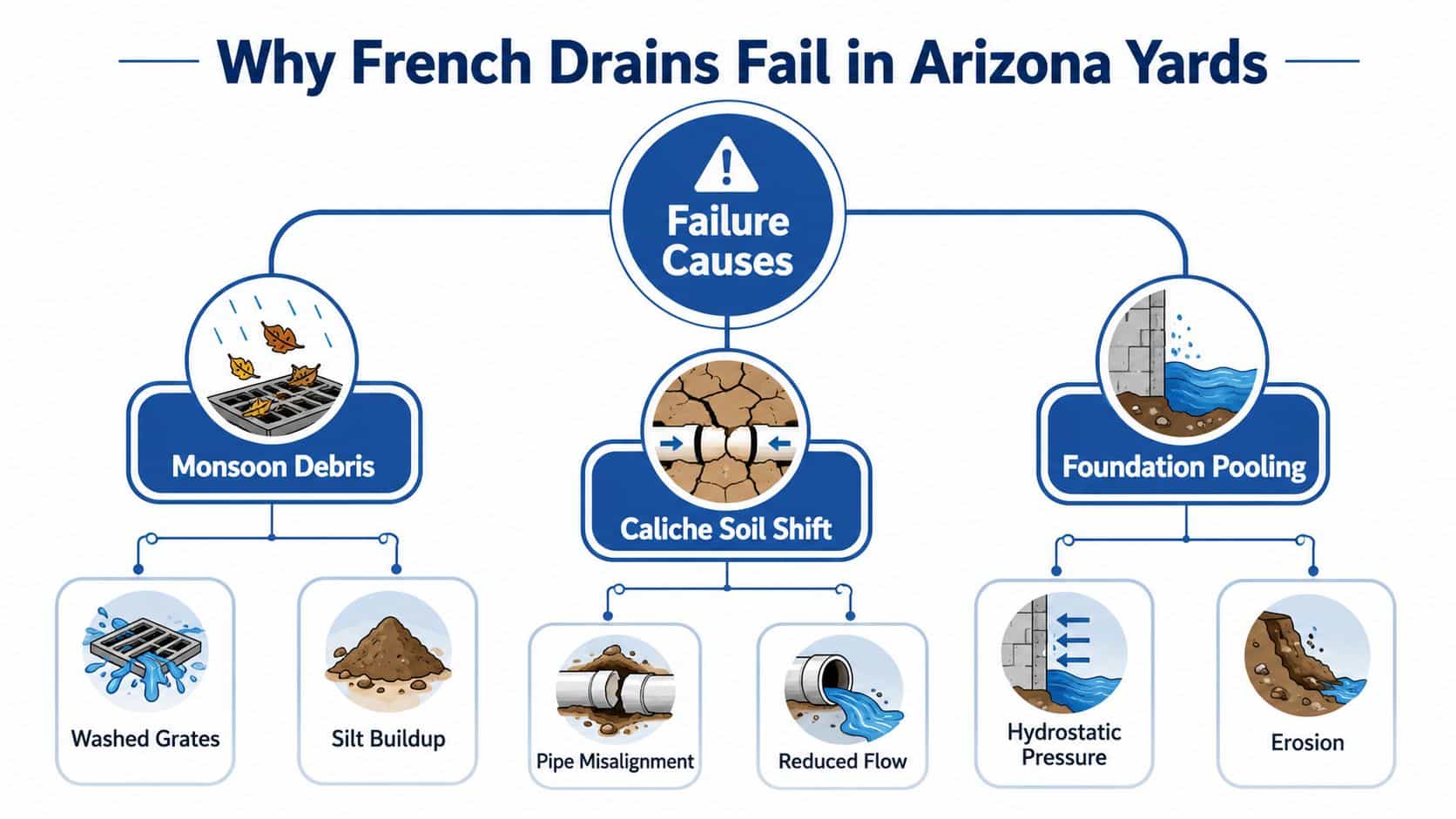
A monsoon rolls through, the sky opens up, and by the next morning the grate by the side yard is packed with leaves, seed pods, and grit. That is the kind of debris load that turns a working drain sluggish, especially in neighborhoods with mature mesquite, palo verde, or yards that collect a lot of windblown material. In Arizona, the problem is not just water. It is what the water carries with it.
The Valley conditions that punish buried drains
In caliche-heavy yards, soil does not act like loose garden dirt. It can hold fines, settle unevenly, and press against pipe runs in ways that slow flow and create clog points. Once the inlet is dirty and the outlet is partly restricted, a passive system starts collecting sediment instead of moving water away from the house.
Practical rule: If a French drain only gets looked at after a storm, it is already behind.
That is why homeowners who install a drain and never revisit it are the ones most likely to deal with ponding near the foundation. The system may still be in place, but the path water needs to follow has narrowed from debris, roots, or a low point full of silt. For a broader look at backyard water management, the backyard drainage guide is useful because it places French drains alongside grading, runoff, and surface flow.
A buried drain can also go unnoticed until water begins pooling near the foundation. If the outlet is hidden behind rock, blocked by mulch, or tucked under hardscape, the homeowner may not notice the problem until the soil around the home starts staying wet. That is why maintenance in the Valley is practical work, not cosmetic work. It catches the failure before the house does.
If you are comparing drainage strategies, the internal resource on alternatives to gutters helps show where a French drain fits in the larger water-control picture.
The Core DIY Cleaning Workflow
Most residential French drain cleanouts start at the top, not the trench. Clear the grate or inlet first, because that's where leaves, gravel dust, and windblown debris collect after storm cycles. If the opening is packed tight, flushing the line before removing that material just pushes the mess deeper.
Follow the water, not the guesswork
Once the inlet is open, find the access point and the outlet. A lot of homeowners skip this part and aim a hose at the most obvious opening, but that's how you waste time and miss a blockage farther down the line. Run a garden hose at full flow for 5 to 10 minutes while watching the discharge point, because the outlet tells you more than the inlet does. That flushing method is the practical workflow described in field guidance on cleaning French drains, including the idea that a weak or delayed outlet flow usually means sediment has settled in a low spot and needs more than a rinse. Cardona Construction's cleaning guide covers that same inlet-to-outlet sequence.
If the outlet trickles instead of flowing steadily, the low point is probably loaded. If it starts strong and then fades, that can also point to a partial restriction that's holding water inside the run.
Watch the discharge, not just the hose pressure. A clean line should show steady movement at the outlet, not a hesitant start and stop.
For most homeowners, this is a Saturday-morning job if the drain has decent access. The key is patience at the outlet and a realistic view of what a hose can and can't do. A hose is great for loosening loose sediment, but it won't solve a packed section, a crushed pipe, or root growth that's already inside the line.
If the drain includes a debris basin, vacuum out the settled material before flushing. If the grate is clogged with fine desert silt, a stiff brush helps more than brute force. The process is simple, but only if you treat the outlet as the final test.
How Often Should You Inspect
The right inspection cadence depends on how your drain is built and what it sits under. In Phoenix, Scottsdale, and the rest of the Valley, a buried line under clean gravel behaves very differently from an open-grate system under mesquite, palo verde, or a roof that sheds a lot of dust and debris. A dry yard can lull people into waiting too long, then one monsoon storm pushes silt straight into the line.
Match the cadence to the system
An open-grate drain, a system with a debris basin, or a line tied into a sump pump deserves closer attention than a buried run with limited access. Yards that catch windblown dust, seed pods, and leaf litter also need more frequent checks, because surface openings collect problems before you ever see backup at the outlet. The more the system exposes itself to debris, the shorter the inspection interval should be.
For Arizona homes, the practical rhythm is to inspect before monsoon season and again after it. A late spring look catches loose material before it gets washed into the line, and a post-monsoon check shows whether the outlet stayed clear once the heavy runoff hit. That lines up with broader maintenance guidance that homeowners inspect and clean French drains at least once per year, with some sources recommending twice-yearly checks, and with the LSU AgCenter's guidance that slow drainage or persistent pooling usually points to a blockage that should be cleared before water backs up into the structure. LSU AgCenter guidance on French drain care is a solid baseline for that logic.
Timing also matters around roof runoff. A useful local reference is the best time for gutter cleaning, since clogged gutters and a loaded French drain often show up together after the same dust storms and leaf drop. If the gutters are shedding debris into the yard, the drain usually needs attention sooner, not later.
A practical rule is simple. Inspect more often when the system has visible openings, sits under heavy debris, or has a history of slow discharge. If it is buried, protected, and still flows cleanly year after year, annual checks may be enough. The cadence should follow the exposure, not a generic calendar.
Tools and Materials With Real Cost Ranges
A good cleanout doesn't require a truck full of gear, but it does require the right few items. Work gloves and eye protection keep the job manageable, a stiff-bristle brush handles grit at the grate, and a garden hose with a jet nozzle gives you the flush pressure you need for routine maintenance. For debris basins, a wet-dry vac is the difference between stirring up muck and removing it.
What belongs in a weekend kit
- Work gloves and eye protection for debris, sharp rock, and dirty splashback.
- Stiff-bristle brush for grates, basin walls, and caked silt.
- Garden hose with jet nozzle for full-flow flushing at the inlet and outlet.
- Wet-dry vac for sediment in basins or low collection points.
- Plumber's snake or auger for tougher restrictions that don't clear with water alone.
- Optional knee pads or headlamp if the access point is low, dark, or awkward.
The budget side matters because homeowners often overbuy before they know what kind of drain they have. A basic weekend kit can stay around a modest spend if the line is accessible and the blockage is light. Once you start adding an auger, extra hose fittings, or a wet-dry vac, the total climbs fast, and that's before any camera work or digging.
| French Drain Maintenance Tools and Materials | Use Case | Typical Cost |
|---|---|---|
| Work gloves | Hand protection during debris removal | Low-cost basic item |
| Eye protection | Keeps grit and splash out of your eyes | Low-cost basic item |
| Stiff-bristle brush | Cleans grates and basin walls | Low-cost basic item |
| Garden hose with jet nozzle | Flushes inlet and outlet | Moderate purchase |
| Wet-dry vac | Removes sediment from basins | Moderate to higher purchase |
| Plumber's snake or auger | Breaks up tougher clogs | Moderate purchase |
| Knee pads or headlamp | Improves comfort and visibility | Low-cost to moderate |
For a sense of how professional service compares to buying tools, the gutter cleaning cost resource is useful because it shows how quickly exterior maintenance adds up when the job needs specialized equipment or access.
If your drain only needs a rinse and a quick basin cleanout, the cheaper kit is enough. If the line is buried deep, repeatedly backing up, or tied into a more complicated drainage layout, a homeowner's tool list can become a false economy.
Diagnosing Root Intrusion, Sediment Collapse, and Outlet Failure
A drain that runs slowly isn't always clogged in the same way. That's where a lot of DIY efforts go wrong, because people flush the line, see temporary improvement, and assume the problem is solved. If the same section keeps acting up, the system is trying to tell you something specific.
Read the symptom before you pick the fix
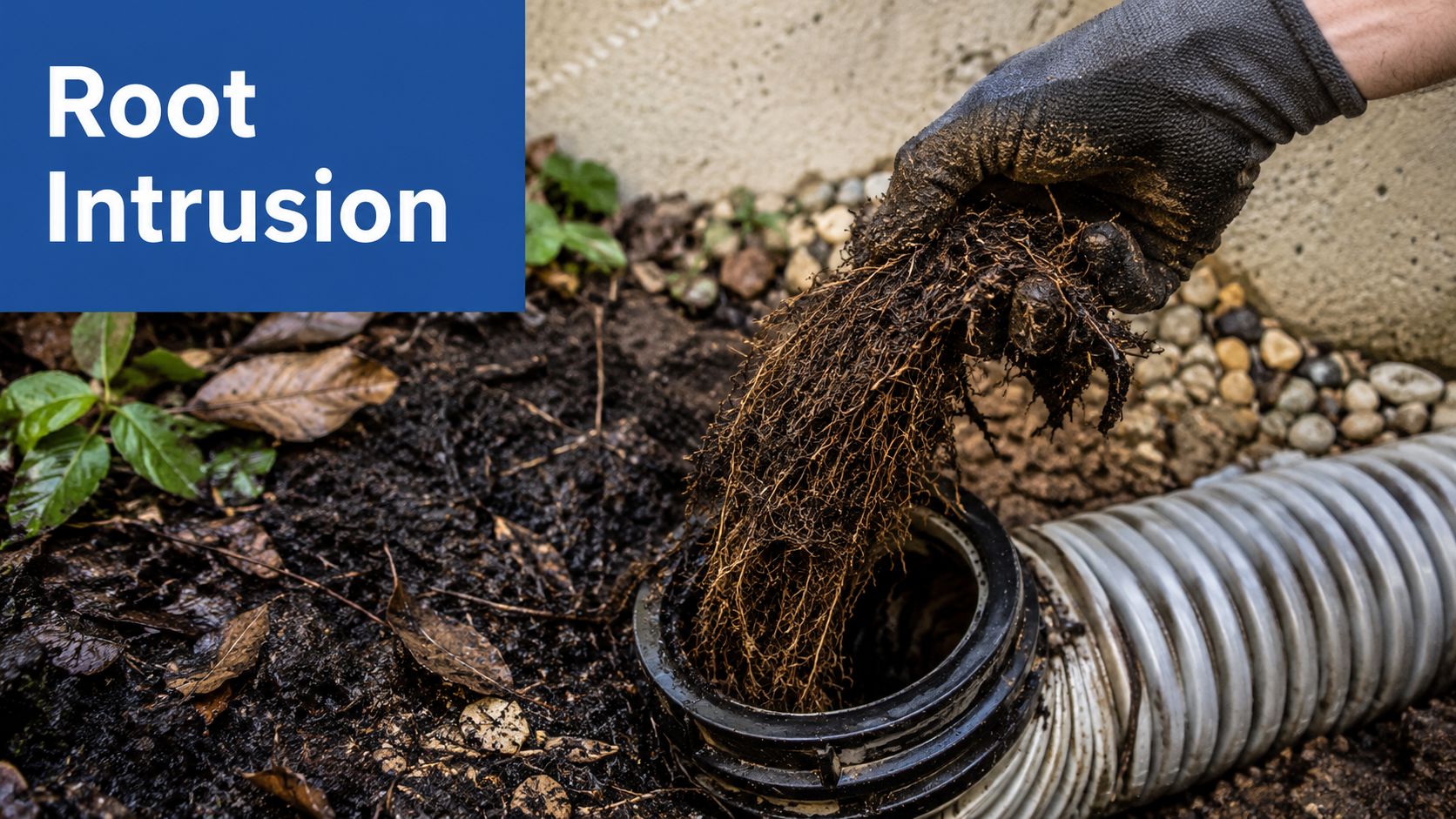
Root intrusion usually shows up as recurring clogs in the same spot, especially near established trees or shrubs. If a drain clears and then slows again in the same zone, roots may be growing through perforations or joints. In that case, a simple flush won't last, and a camera inspection is the smarter next move.
Sediment collapse feels different. Water may disappear into the line but never come back out cleanly, which points to a low point where fines have settled and the pipe bed has changed shape. That's common when soil and gravel spaces have filled in over time.
Hidden outlet failure is the least obvious. You can run water for a long time and still see nothing useful at the discharge point, which means the problem may be at the exit instead of the inlet. When that happens, the line may be full of water somewhere you can't see, and continued flushing just wastes time.
For harder cases, professional camera inspection and hydro-jet cleaning make sense because they show what the pipe is doing instead of guessing from the surface. When you're weighing whether nearby trees are part of the problem, a tree removal cost calculator can help you think through whether it's cheaper to address the root source than keep cleaning the same line forever.
If the same drain section fails twice, stop treating it like a surface cleaning problem.
Excavation is the last resort, but sometimes it's the only honest answer. If the line is crushed, separated, or misaligned, or if a buried outlet can't be restored from the surface, digging is what makes the repair real. The useful question isn't whether digging is inconvenient. It's whether repeated cleanouts are just masking a deeper failure.
DIY Versus Hiring a Pro in the Valley
A homeowner can handle a visible grate, a reachable basin, and a straightforward flush without much risk. The line changes fast once the drain is buried, tied into a sump system, or running under hardscape where digging becomes guesswork. At that point, the decision isn't about pride, it's about access and liability.
Simple jobs versus the ones worth quoting
DIY makes sense when the inlet is visible, the outlet is easy to inspect, and the system responds to a hose flush. Professional help starts to make more sense when you need camera diagnostics, hydro-jetting, or excavation around a foundation, pool deck, or retaining wall. Multi-story buildings, commercial properties, and tie-ins that affect larger drainage networks also raise the stakes because the consequences of a mistake are bigger and the insurance picture matters more.
A licensed, bonded, and insured exterior-service company familiar with Arizona soil can handle those higher-risk jobs more safely than a weekend excavation attempt. That's true for high-rise work, too, where access, fall protection, and property protection are nonnegotiable. South Mountain Window Cleaning's broader exterior-care background fits that same world of access, safety, and clean results, even though French drains themselves are a separate discipline.
If you're comparing service models, the top Sydney French drain services page is a useful reminder that the best drainage providers don't just poke at the visible problem. They diagnose the whole system.
The rule of thumb is simple. If the drain is easy to see and easy to flush, DIY is reasonable. If you're unsure where the line runs, if the same blockage keeps returning, or if the job might require excavation near critical structures, get a quote before you dig.
For related exterior maintenance planning, the internal page on gutter cleaning and maintenance pairs well with drainage work because roof runoff and yard drainage problems often show up together after the same storm.
A Seasonal Checklist and Key Takeaways
A French drain in the Valley does best when it is treated like regular property equipment, not a buried feature that only gets attention after a storm. In Arizona soil, dust, palm litter, gravel movement, and monsoon runoff all work into the system in different ways, so steady upkeep matters more than one big repair later. Well-maintained systems are commonly reported to last 30 to 40 years, and that kind of service life depends on routine inspection, flushing, and keeping both the inlet and the outlet clear. Neglected systems can fail in 5 to 10 years in heavy-rainfall conditions, which is a short window when the drain is supposed to protect the yard and foundation.
A simple Valley rhythm to follow
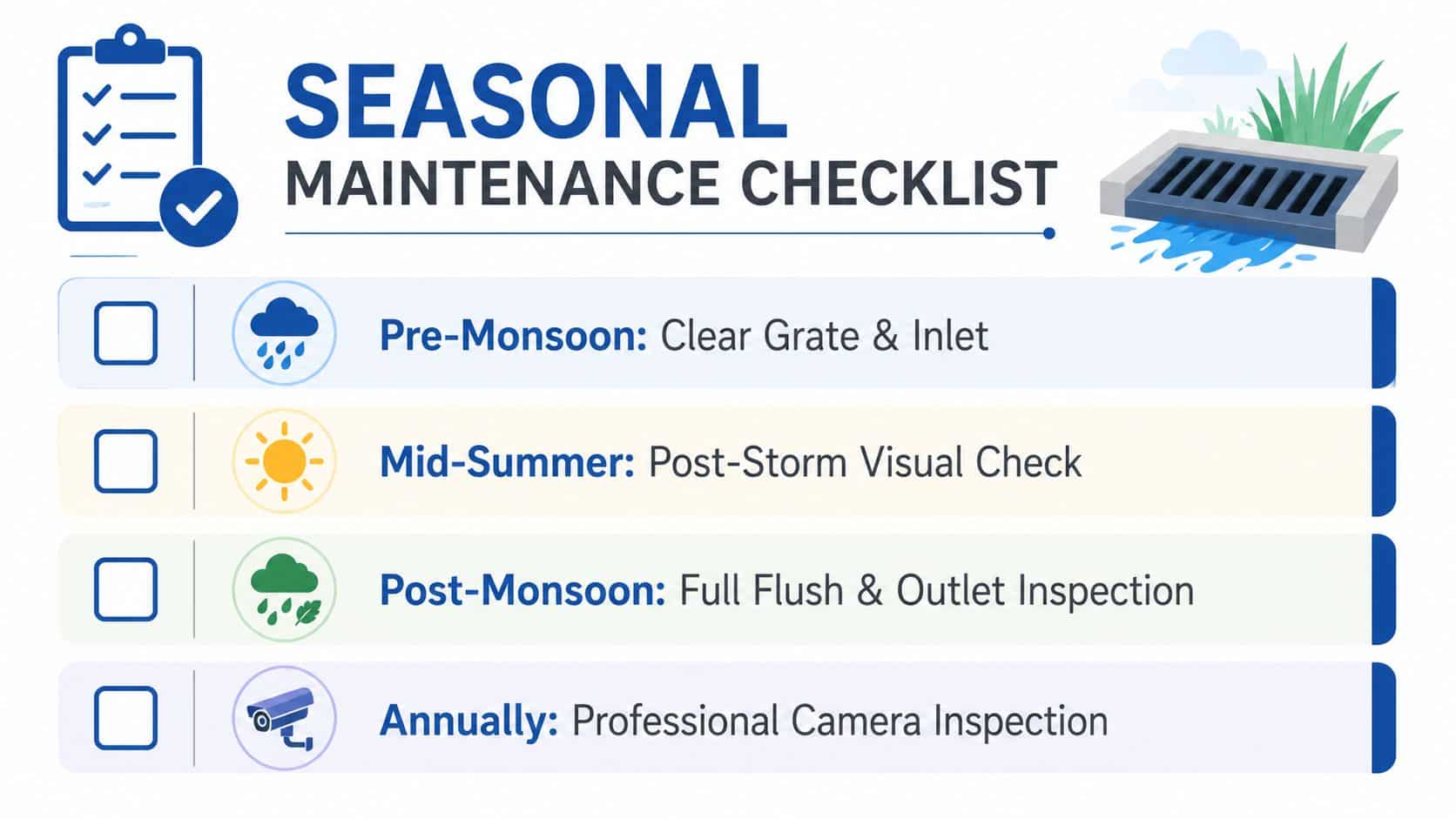
- Pre-Monsoon: Clear the grate and inlet, then look for loose debris around the outlet. In Phoenix and Scottsdale, this is the time to remove dust buildup before the first hard storm pushes it deeper into the line.
- Mid-Summer: Check the system after strong storms or heavy runoff, especially if you see standing water. The heat itself is not the issue, but the sudden water load is.
- Post-Monsoon: Run a full flush and confirm the outlet discharges steadily. If flow slows or sputters, the drain may already be holding sediment.
- Annually: If the system is buried, complicated, or has failed before, a professional camera inspection is worth considering. That is often the fastest way to find a crushed section, a settled trench, or roots pushing into the pipe.
The yearly service benchmark matters because upkeep usually costs far less than the damage that follows a backup. Published maintenance costs generally fall around $150 to $345, rising to about $600 when clogs are severe, which is still a small outlay compared with foundation repair or water intrusion from a failed drain. In Arizona, that trade-off is real because dust and monsoon debris can load a system even when it looks fine from the surface.
The practical read is simple. If the outlet is weak, the low point is likely loaded. If the same section clogs again, roots or collapse are worth checking first. If water keeps pooling near the foundation, do not wait for the next storm to prove the point.